
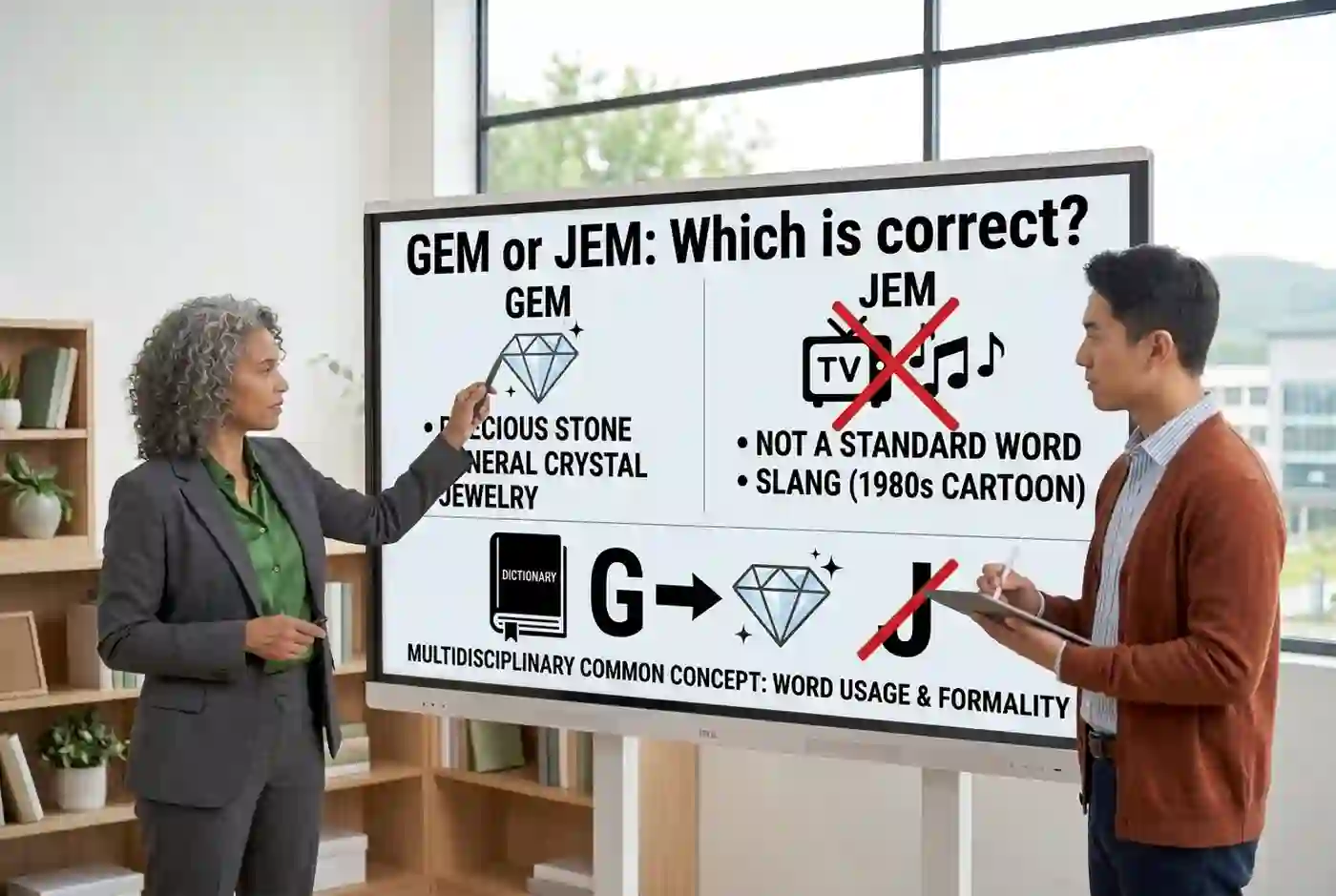
Gem or Jem the correct spelling is gem when you mean a precious stone, a treasured object, or someone or something especially valuable. Jem is not the standard spelling of that word, although it can appear as a person’s name or a fictional character’s name. The confusion makes sense because both spellings sound alike in English.
If you’ve ever typed jem instead of gem, you’re not alone. The letter G can represent a soft sound like the one in giant, while J often represents the same sound in words such as jam and jewel. Since gem and jem sound identical in common English pronunciation, it’s easy to mix them up.
The key is to remember that gem is the standard word for a jewel or something precious. You might call a beautiful diamond a gem, describe a helpful colleague as a gem, or praise a small local restaurant as a hidden gem. In all these examples, the correct spelling is gem.
This guide explains the difference between gem and jem, shows how to use gem naturally, explores the word’s origin, and provides practical examples and memory tricks. You’ll also learn when Jem can be correct as a name and how to avoid this common spelling mistake in everyday messages, schoolwork, and professional writing.
Quick Answer
Gem is the correct spelling for a precious stone or a person or thing you value highly. Jem is generally a misspelling when used with this meaning, but it can be a proper name. Both spellings are pronounced the same way, so remember the standard spelling: gem.
Gem or Jem Comparison Table
The easiest way to understand gem or jem is to compare their spelling, meaning, and use.
| Feature | Gem | Jem |
|---|---|---|
| Standard spelling | Correct | Incorrect for the common word |
| Main meaning | A precious stone or something valuable | Usually a name |
| Part of speech | Noun | Proper noun when used as a name |
| Pronunciation | /dʒɛm/ | Usually /dʒɛm/ |
| Syllables | One | One |
| Formal writing | Standard English word | Correct only in appropriate name or title contexts |
| Example | This ruby is a beautiful gem. | Jem is my friend’s nickname. |
| Common expression | A hidden gem | No standard expression using jem |
| Plural | Gems | Jems when pluralizing a name, if needed |
| American English | Gem | Jem as a name or title |
| British English | Gem | Jem as a name or title |
The main distinction is simple. Gem is the regular English word. Jem may be a valid name, but it cannot replace gem in ordinary writing.
What Does Gem Mean
A gem is a precious or semiprecious stone, especially one that people cut and polish for use in jewelry. The word also describes a person, place, object, or idea that someone considers especially valuable or delightful.
The word has two common meanings.
Gem as a Precious Stone
In its literal sense, a gem is a gemstone valued for its beauty, rarity, durability, or other qualities. Diamonds, rubies, emeralds, and sapphires are familiar examples.
For instance:
- She wore a diamond gem on a silver necklace.
- The jeweler examined the gem under a bright light.
- This emerald is the finest gem in the collection.
- The museum displayed gems from several countries.
In everyday English, people often use gem as a broad term for a beautiful or valuable stone. In specialist jewelry contexts, gemstone may be more precise.
Gem as Something Special
The figurative meaning is just as common. People use gem to describe someone or something they value because it is helpful, enjoyable, rare, or unusually good.
Consider these examples.
- My grandmother is a gem.
- That little bookstore is a real gem.
- Your suggestion was a gem.
- We discovered a hidden gem near the beach.
- She found a gem of a house at a reasonable price.
None of these examples refers to an actual gemstone. Instead, gem expresses appreciation.
Calling a person a gem usually means that person is kind, thoughtful, dependable, or wonderful to have around. Describing a place as a gem suggests that it offers something special that people may overlook.
What Does Jem Mean
Jem is not the standard spelling of the common noun gem. However, it can be correct when it functions as a proper name.
For example, Jem may be:
- A person’s given name or nickname.
- A fictional character’s name.
- Part of a business name or brand.
- A name used in a book, film, television show, or song.
In these cases, the spelling depends on the name chosen by the person or creator.
A sentence such as Jem arrived early for the meeting can be perfectly correct if Jem is someone’s name. The same spelling is incorrect in She bought a beautiful jem for her necklace if the writer means a precious stone.
The difference comes down to meaning and context rather than sound.
Is Jem Ever a Real Word
Jem can appear in legitimate writing, especially as a name. It is also known as the name of a fictional character in Harper Lee’s novel To Kill a Mockingbird. The character Jem Finch is Scout Finch’s older brother.
That literary example shows why you should not label every occurrence of Jem a spelling error. Proper names follow their established spellings.
However, when you want to describe a jewel, a valuable discovery, or a wonderful person, use gem.
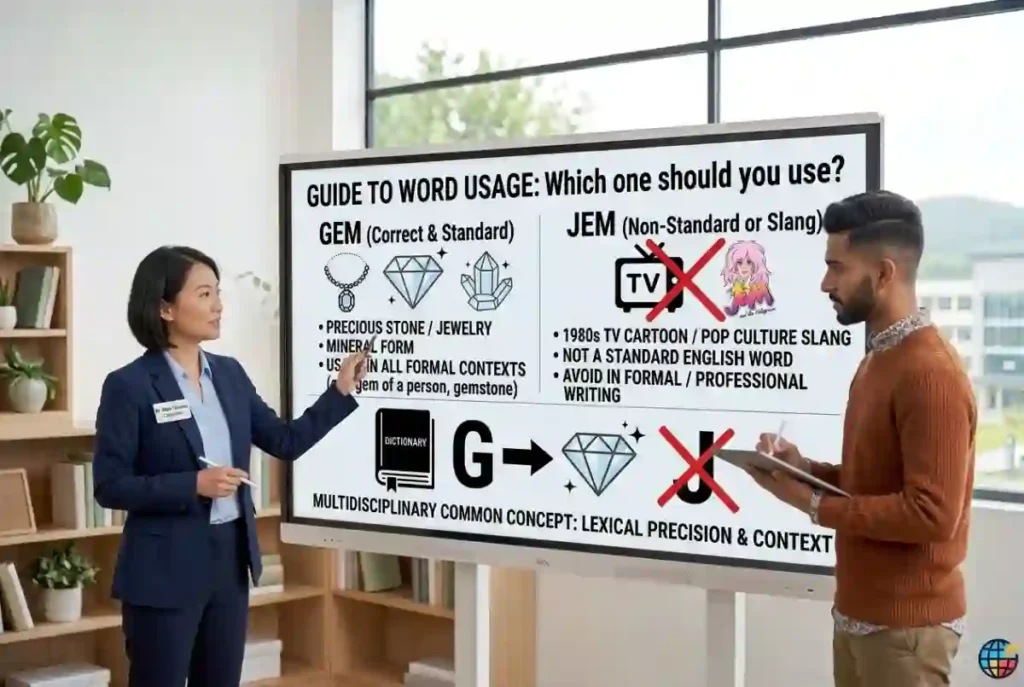
Gem or Jem Which One Should You Use
Use gem in ordinary English whenever you mean a precious stone or something especially valuable.
Here is a practical guide.
| What you want to express | Correct choice | Example |
|---|---|---|
| A precious stone | Gem | The gem sparkled in the sunlight. |
| A wonderful person | Gem | Your sister is a gem. |
| An excellent discovery | Gem | This café is a hidden gem. |
| A valuable idea | Gem | That was a gem of a suggestion. |
| A person’s name | Jem, if that is the established spelling | Jem called me this morning. |
| A fictional character | Jem, if the character uses that spelling | Jem Finch appears in the novel. |
When you are unsure, ask yourself what the word refers to. If it describes something precious or wonderful, gem is the correct spelling. If it identifies a person or a named character, follow the established name.
Why People Confuse Gem or Jem
The mistake usually happens because English spelling does not always match pronunciation in a simple way.
The G and J Sounds Are Identical Here
In gem, the letter G represents the soft sound /dʒ/. That is the same sound heard at the beginning of jam, jelly, and jewel.
As a result, gem and jem sound the same to most English speakers.
When people write quickly, they may choose the letter that seems more natural based on the sound. Since many familiar words begin with J and use /dʒ/, some writers mistakenly spell gem with J.
Pronunciation alone cannot help you choose the right spelling in this case. You need to remember the conventional written form.
English Has Several Ways to Spell Similar Sounds
English spelling developed over many centuries. Words entered the language through different historical paths, and their spelling patterns do not always follow one simple rule.
For example, the soft G in gem has the same sound as the J in jet. Yet the words use different letters.
Other examples include:
- Giant and jacket.
- Gentle and jungle.
- Ginger and jelly.
- General and January.
These examples show why a sound based spelling guess can fail. The spelling of a familiar word is often something you need to learn and remember.
Fast Typing Can Cause the Mistake
People often type messages without stopping to check every word. If you write jem in a text message, your reader may still understand your meaning because the pronunciation and context are clear.
However, readers can notice the spelling in a résumé, product description, school assignment, or business email. A small error can distract from an otherwise strong piece of writing.
Taking a moment to proofread helps prevent this mistake.
Autocorrect May Not Catch It
Spellcheck tools do not always identify a wrong word when the spelling resembles a legitimate name. Because Jem can be a proper noun, some systems may accept it in certain contexts.
A tool might also fail to flag the mistake if its dictionary or language model interprets the word as a name.
For that reason, do not rely entirely on autocorrect. Check the meaning of the sentence and confirm that the spelling fits.
Social Media Makes Informal Spelling Common
On social media, people often type quickly and use playful spellings, usernames, or nicknames. You may see jem in comments, profiles, captions, and messages.
That does not make it the standard spelling of the common noun.
Informal use can spread a mistake, especially when readers see it repeated. If you are writing for a public audience, use the conventional spelling gem unless the word is an actual name.
Gem Spelling Rules
The word gem has a short and simple spelling pattern.
It contains three letters:
- G at the beginning.
- E in the middle.
- M at the end.
There is no silent letter, doubled consonant, or special suffix to remember.
Why Gem Begins With G
In English, G can represent two common sounds.
The hard G appears in words such as go, game, and garden. The soft G appears in words such as gem, giant, and gentle.
The soft G often appears before E, I, or Y, although English has exceptions. This pattern can help you remember the spelling of gem.
The letter J also commonly represents the /dʒ/ sound, but that does not mean you can freely replace G with J. Each word has its established spelling.
Why Jem Is Incorrect for a Gemstone
The spelling jem follows a sound based guess rather than the standard spelling of the English noun.
English does not allow writers to change a word’s first letter simply because another letter represents the same sound. The spelling must match the word itself.
For example, giant does not become jiant, and gentle does not become jentle. In the same way, gem does not become jem when referring to a precious stone.
Is Gem Spelled Differently in British and American English
No. Gem is the standard spelling in American English, British English, Canadian English, and Australian English.
Unlike word pairs such as color and colour, this word does not have a standard regional spelling difference.
You should write gem in formal and informal English across these varieties.
Gem or Jem Pronunciation Guide
Both spellings are usually pronounced the same way when Jem is used as a name.
G
Gem
IPA: /dʒɛm/
One syllable. Rhymes with them and stem.
J
Jem
Usually /dʒɛm/
One syllable when pronounced as the common name.
The first sound is the same sound you hear in jump. The vowel is the short E sound in bed, and the word ends with the M sound.
Because the two spellings sound alike, pronunciation is not a reliable way to spot this spelling error. You must learn the correct written form.
The Origin of Gem
The history of gem helps explain why its spelling is fixed in modern English.
The word came into English through Old French gemme, which came from Latin gemma. The Latin word referred to a bud or precious stone. Over time, the gemstone meaning became established in English.
The word’s history goes back much further than modern jewelry terminology. Latin gemma could refer to a plant bud as well as a valuable stone, linking the idea of a developing bud with something precious or beautiful.
English adopted the spelling gem, which remains standard today. The spelling jem is not a historical alternative that you can use freely in modern English.
How Gem Developed Its Figurative Meaning
The word gradually expanded beyond physical stones.
A gemstone is valuable because of its beauty, rarity, or desirability. English speakers began using gem figuratively for things they considered equally special.
That explains expressions such as:
- A gem of a person.
- A hidden gem.
- A gem of an idea.
- A gem of a book.
The figurative meaning relies on a simple comparison. Something valuable in everyday life can be treated like a precious stone.
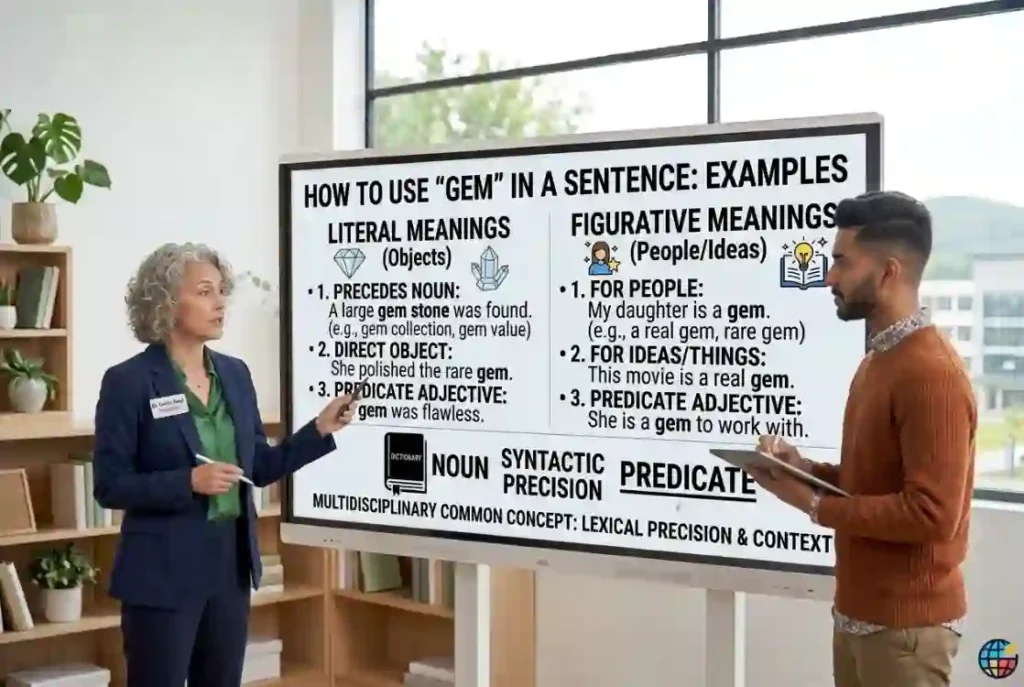
How to Use Gem in a Sentence
The noun gem fits naturally into many kinds of writing. The examples below show how its literal and figurative meanings work in everyday situations.
Gem in Daily Conversation
- My grandmother gave me a beautiful gem for my birthday.
- That little coffee shop is a hidden gem.
- You’re a gem for helping me move.
- We found a gem of a restaurant while exploring the city.
- This old book is a real gem.
The first example refers to a physical object. The others use gem to express appreciation for a person, place, or object.
Gem in Workplace Communication
- Maria is a gem on our team because she always helps new employees.
- Your suggestion was a gem and helped us solve the problem.
- We discovered a gem of an idea during the planning meeting.
- That employee is a real gem when deadlines get tight.
- The presentation contains several gems of practical advice.
In professional settings, gem adds warmth and personality. It works especially well in informal praise, team messages, and friendly conversations.
For highly formal reports, more specific words such as valuable, useful, or effective may fit better.
Gem in Emails
- Thanks for your help with the project. You’re a gem.
- I found a gem of a resource that could help with our research.
- Your feedback was a gem and gave me a fresh perspective.
- We found a hidden gem for the team lunch next week.
- Thank you for sharing such a useful resource. It’s a real gem.
These examples suit friendly professional emails. The word sounds appreciative without feeling overly formal.
Gem in Academic Writing
- The archive contains a gem of historical evidence.
- Researchers discovered a rare gem among the old manuscripts.
- This passage is a gem of literary analysis.
- The collection offers a gem of insight into early trade.
- The historian described the letter as a gem of primary evidence.
In academic writing, gem is usually figurative unless the subject concerns gemstones. For a more neutral tone, consider valuable source, important finding, or significant insight.
Gem in Journalism and Online Content
- The travel writer called the coastal village a hidden gem.
- This small museum is a gem for anyone interested in local history.
- The interview contains a gem of advice for young entrepreneurs.
- Fans described the early recording as a forgotten gem.
- The new documentary is a gem for viewers who enjoy science.
Journalists and bloggers often use gem to attract attention to something unusual or overlooked. The expression hidden gem is especially common in travel writing, restaurant reviews, and entertainment articles.
Common Expressions With Gem
Learning common phrases can help you remember the correct spelling and use the word naturally.
Hidden Gem
A hidden gem is a place, object, or discovery that is especially good but not widely known.
Example: We found a hidden gem of a bookstore on a quiet side street.
The phrase often appears in travel guides, local recommendations, and online reviews.
A Gem of a Person
This expression describes someone who is kind, helpful, thoughtful, or wonderful to know.
Example: Our new neighbor is a gem of a person.
It is a warm, informal way to praise someone’s character.
A Gem of an Idea
This phrase describes an especially useful or clever idea.
Example: Your suggestion about simplifying the process was a gem of an idea.
The expression is conversational. In formal writing, an excellent idea or a valuable suggestion may sound more natural.
A Rough Diamond
A rough diamond is a person or thing with great potential that has not yet been fully developed or recognized.
Example: The young musician is a rough diamond who needs the right mentor.
This expression is related to the imagery of gemstones, but it has a distinct meaning. It emphasizes potential rather than simply describing something valuable.
Gems of Wisdom
Gems of wisdom are short, valuable pieces of advice or insight.
Example: My grandfather shared several gems of wisdom during dinner.
The plural noun is gems, with an S at the end.
Gem Plural and Other Grammar Forms
The word gem is a countable noun. You can refer to one gem or several gems.
| Form | Example |
|---|---|
| Singular | The gem is beautiful. |
| Plural | The gems are beautiful. |
| Indefinite article | She found a gem. |
| Possessive singular | The gem’s surface is smooth. |
| Possessive plural | The gems’ colors vary. |
How to Form the Plural of Gem
Add S to make the plural.
- One gem.
- Two gems.
- Several gems.
- A collection of gems.
You do not need to change the E or double the M.
How to Use Gem With Articles
Use a gem when you introduce one nonspecific gem.
Example: She found a gem at the antique market.
Use the gem when your reader already knows which gem you mean.
Example: The gem was placed inside a glass display case.
The choice between a and the depends on context, not on the spelling confusion between gem and jem.
Is Gem a Verb
In ordinary modern English, gem is primarily a noun. Some specialized or creative uses may treat it as a verb, but those uses are uncommon and usually unnecessary for everyday writing.
For most readers, the important forms are the singular noun gem and the plural noun gems.
Gem or Jem Common Mistakes to Avoid
Several errors appear when writers confuse gem with jem or misunderstand the word’s meaning.
Mistake One Writing Jem for a Precious Stone
Incorrect: She bought a beautiful jem for her necklace.
Correct: She bought a beautiful gem for her necklace.
The common noun always uses G.
Mistake Two Assuming Jem Is Never Correct
Incorrect assumption: Jem is always a spelling mistake.
Better understanding: Jem can be correct as a person’s name, nickname, or fictional character’s name.
The spelling error occurs when someone uses it in place of the common noun gem.
Mistake Three Confusing Pronunciation With Spelling
Some learners assume that a word beginning with the /dʒ/ sound must start with J.
English does not follow that rule. Words such as gem, giant, and gentle begin with G but use the soft G sound.
Mistake Four Using Gem When You Mean Jewelry
A gem is a precious or semiprecious stone. Jewelry refers to decorative items such as rings, necklaces, bracelets, and earrings.
A necklace may contain a gem, but the two words do not mean the same thing.
Incorrect: She wore a gem around her wrist.
This sentence may be understandable, but it is vague if you mean a bracelet.
Clearer: She wore a bracelet decorated with a beautiful gem.
Mistake Five Treating Every Gem as a Diamond
A diamond is one kind of gemstone. The word gem can refer to many other stones, including rubies, emeralds, sapphires, and other valued minerals.
The words are related, but they are not interchangeable in every specialist context.
Memory Tricks for Gem or Jem
The best memory tricks connect the spelling to something you already know.
Remember G for Gemstone
Think of the phrase G for gemstone and G for gem. Both words begin with G, making the correct spelling easier to recall.
Connect Gem With Genuine Value
The word gem describes something precious or special. Remember that the standard word for a precious gem begins with G.
Use the Hidden Gem Test
If you can replace the word with hidden gemstone or valuable treasure, the correct spelling is almost certainly gem.
Try these quick practice sentences.
- This café is a hidden ___.
- My colleague is a real ___.
- The jeweler examined the rare ___.
- ___ is my friend’s nickname.
Answers: gem, gem, gem, Jem if that is the friend’s established name.
The last example reinforces the distinction. Ordinary vocabulary follows standard spelling, while proper names follow the spelling chosen for them.
Gem or Jem Related Words and Confusing Terms
A strong vocabulary includes more than a single definition. Understanding related words helps you select the most precise expression.
| Word | Meaning | Example |
|---|---|---|
| Gem | A precious stone or something special | This shop is a hidden gem. |
| Gemstone | A mineral or stone valued for use in jewelry | The ring contains a blue gemstone. |
| Jewel | A precious stone or valued decorative object | The crown held several jewels. |
| Jewelry | Decorative items worn on the body | She bought new jewelry. |
| Treasure | Something highly valued | The letters were a family treasure. |
| Treasure trove | A valuable collection or source of things | The archive was a treasure trove of records. |
| Jewel like | Resembling a jewel in appearance | The lake looked jewel like in the sunlight. |
Gem vs Jewel
Gem often emphasizes a precious stone or something especially valuable. Jewel can refer to a precious stone and may also refer to a valued decorative object.
For example, a diamond set in a ring is a gem. The ring itself may be described as a jewel.
In figurative language, both words can describe something cherished, although their use depends on the phrase.
Gem vs Gemstone
Gemstone is a more specific term for a stone valued for its beauty or other qualities. Gem is shorter and can have a broader figurative meaning.
A geologist, jeweler, or mineral specialist may prefer gemstone when discussing stones. In everyday speech, gem is common and natural.
Gem vs Treasure
A treasure can be anything highly valued, including money, an object, a memory, or a person. A gem often suggests something precious, unusual, or delightful.
For example, That family photograph is a treasure emphasizes emotional value. That little gallery is a gem praises a special place.
What Professional Editors Recommend About Gem or Jem
An editor should choose the spelling that matches the intended meaning.
When the sentence refers to a gemstone or something special, write gem. When it refers to a person named Jem or a character whose name is spelled Jem, preserve that spelling.
The distinction is straightforward, but proofreading still matters. A spelling checker may recognize a proper name without understanding that the writer intended a common noun.
Professional editing also considers the audience and tone. Gem works naturally in everyday writing, reviews, travel articles, and friendly messages. In technical writing, the more specific term gemstone may be preferable.
When editing a sentence such as This restaurant is a jem, correct the spelling to gem. If the sentence says Jem opened the restaurant, do not change the name without evidence that it is wrong.
The goal is not to replace every unfamiliar spelling. It is to make sure the spelling communicates the intended meaning accurately.
Frequently Asked Questions
Is gem or jem correct
Gem is correct when you mean a precious stone or something valuable and special. Jem is generally incorrect for this meaning, but it can be a legitimate name. If you are describing a beautiful stone, a wonderful person, or a great place, use gem.
Why do people spell gem as jem
People confuse the spellings because both words sound the same. The soft G in gem makes the /dʒ/ sound, which is also represented by J in words such as jam. That sound similarity makes jem look plausible, but gem remains the standard spelling of the common noun.
Is Jem a real name
Yes. Jem can be a given name or nickname, and it also appears as a fictional character’s name. For example, Jem Finch is a character in To Kill a Mockingbird. When you refer to a person or character with that established name, keep the spelling Jem.
What is the plural of gem
The plural of gem is gems. Add S to the singular form without changing any other letters. For example, The museum displayed several rare gems. The spelling jems is not correct when you mean multiple precious stones.
Does gem mean diamond
No. A diamond is one type of gemstone, but gem can refer to many precious or semiprecious stones. It can also describe something figuratively valuable, such as a helpful person, an excellent idea, or a place worth discovering.
What does hidden gem mean
A hidden gem is a place, person, object, or discovery that is especially good but not widely known. The phrase commonly appears in restaurant reviews, travel guides, and recommendations. For example, We found a hidden gem of a bookstore in the old neighborhood.
How do you pronounce gem
In standard American English, gem is pronounced /dʒɛm/. It has one syllable and rhymes with them and stem. The name Jem is usually pronounced the same way. Since pronunciation cannot distinguish the spellings, remembering the written form is essential.
Is gem the same in British and American English
Yes. Gem is the standard spelling in both British and American English. Canadian and Australian English use the same spelling as well. There is no regional spelling variation like the difference between color and colour. Use gem in ordinary writing regardless of your English variety.
Final Verdict on Gem or Jem
The correct spelling is gem when you mean a precious stone, a valuable object, a wonderful person, or an excellent discovery.
Jem is appropriate when it is an established proper name, nickname, or fictional character’s name. It is not a standard alternative spelling of the common noun.
Remember the simple rule: G is for gem and gemstone. If you are describing something precious or special, write gem. That small spelling choice keeps your writing clear, polished, and correct.

Founding Editor
Maya spent six years as a copyeditor at a regional newspaper before starting Grammist, which is where the “answer first” format came from: newsroom style guides don’t have room for a preamble.
She writes and reviews most of the word-pair and spelling entries, and has final say on anything that goes out under the Grammist name.