
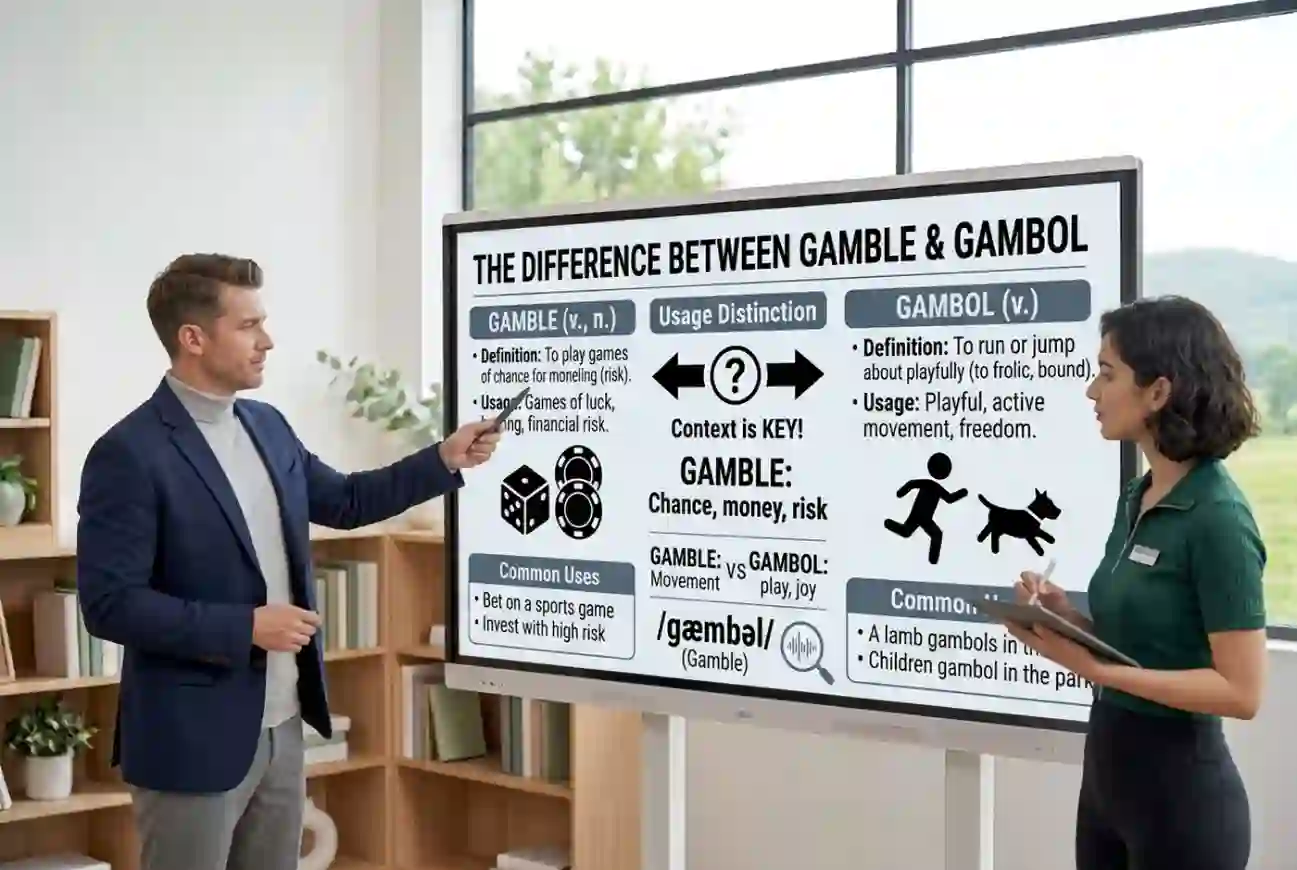
Have you ever wondered if you should write Gamble vs Gambol? These two words look almost identical, but they have very different meanings. Choosing the wrong one can change your sentence completely. If you are writing about taking a risk, playing cards, or watching a puppy bounce across the grass, the difference matters.
The main distinction in gamble vs gambol is simple. Gamble means to take a risk, often involving money or an uncertain outcome. Gambol means to run, jump, or play in a lively, carefree way. You might gamble at a casino, but a young deer might gambol through a meadow.
Why do people mix them up? Both words contain nearly the same letters, share a similar rhythm, and can be unfamiliar to people who rarely encounter gambol. Spellcheck tools may not catch the mistake because both words are correct English words. Their meanings, however, are not interchangeable.
This guide explains the definitions, pronunciation, grammar, word origins, and everyday uses of both words. You will also find natural examples, common mistakes, memory tricks, and answers to frequently asked questions. By the end, you will know exactly when to use each word and how to avoid this confusing word pair in professional and casual writing.
Quick Answer
Gamble means to risk money or something valuable on an uncertain outcome, or to take a chance. Gambol means to leap, skip, or play energetically and happily. Use gamble when discussing risk and chance. Use gambol when describing lively movement, such as children playing or lambs jumping in a field.
Gamble vs Gambol at a Glance
| Feature | Gamble | Gambol |
|---|---|---|
| Main meaning | To take a risk or bet | To leap or play energetically |
| Part of speech | Verb and noun | Verb and noun |
| Pronunciation | GAM buhl | GAM buhl |
| IPA | /ˈɡæm.bəl/ | /ˈɡæm.bəl/ |
| Syllables | Two | Two |
| Stress | First syllable | First syllable |
| Common context | Betting, risk, uncertain outcomes | Playful movement and lively activity |
| Example as a verb | He gambles on sports. | The lambs gambol in the field. |
| Example as a noun | The investment was a gamble. | The puppies’ gambols made us laugh. |
| Related word | Gambling | Gamboling |
| Common mistake | Using it to describe playful movement | Using it to describe betting |
| Formality | Common in everyday and professional English | Less common and often literary |
The key point is that these words are spelled differently but are usually pronounced the same in standard English. That makes them a classic example of homophones: words that sound alike but have different meanings and spellings.
What Does Gamble Mean
Gamble means to risk money, property, or something else of value on an uncertain result. It can also mean taking a chance when success is not guaranteed.
The word often appears in discussions about casinos, betting, lotteries, and games of chance. However, English speakers also use it figuratively to describe risky decisions in business, relationships, careers, and everyday life.
Gamble as a Verb
As a verb, gamble describes the act of taking a risk.
For example:
- He likes to gamble at the casino.
- The company gambled on a new marketing strategy.
- She gambled her savings on a business idea.
- We gambled that the weather would improve before the weekend.
Notice that not every use involves money. In the last three examples, the word describes decisions made despite uncertainty.
Gamble as a Noun
As a noun, gamble means a risky choice or an action that depends on an uncertain outcome.
Consider these examples:
- Buying the old house was a gamble.
- Launching the product without testing it was a risky gamble.
- His career change paid off, but it was still a gamble.
- Investing in an untested idea can be a gamble.
In these sentences, the word refers to the risk itself rather than the act of taking it.
Gamble in Everyday English
People often use gamble figuratively because many decisions involve uncertainty.
A business owner might gamble on a new product. A student might gamble by waiting until the last minute to prepare for an exam. A traveler might gamble on a tight connection between flights.
These situations are not necessarily forms of gambling for money. Instead, the speaker emphasizes that the decision could lead to success or failure.
Common Expressions With Gamble
Several expressions use gamble in natural English.
Gamble on something. This means to take a chance on a particular outcome.
Example: The team gambled on an inexperienced goalkeeper.
Gamble with something. This means to put something valuable at risk.
Example: You should not gamble with your health.
A gamble worth taking. This describes a risk that seems reasonable because the possible reward is attractive.
Example: Moving to another city was a gamble worth taking.
Take a gamble. This means to make a risky choice.
Example: We took a gamble by opening the store in a new neighborhood.
These phrases appear in conversations, news reports, business writing, and fiction. Their central idea is always risk, uncertainty, or the possibility of loss.
What Does Gambol Mean
Gambol means to move about playfully and energetically, often by leaping, skipping, or jumping. The word usually suggests happiness, freedom, and lively movement.
It commonly describes animals or children at play. You might see lambs gambol in a field, puppies gambol around a garden, or children gambol along a beach.
Unlike gamble, the word has no built in connection to money, betting, or risk.
Gambol as a Verb
As a verb, gambol describes playful movement.
Examples include:
- The puppies gambol across the lawn.
- Children gambol along the beach after lunch.
- Young lambs gambol in the spring sunshine.
- The foals gambol around their mother in the pasture.
Each sentence paints a picture of energetic, carefree movement. The word is more expressive than a plain verb such as move or run.
For instance, the puppies ran across the lawn tells you what happened. The puppies gambolled across the lawn suggests playful leaps and joyful energy.
Gambol as a Noun
As a noun, gambol refers to a playful leap or a lively act of movement. The plural form is gambols.
Examples:
- The puppy’s gambol delighted the children.
- We watched the lambs’ playful gambols.
- Her sudden gambol across the garden made everyone smile.
The noun form is less common than the verb in everyday conversation. It appears more often in descriptive or literary writing.
When Writers Use Gambol
Writers choose gambol when they want readers to picture light, lively movement rather than ordinary walking or running.
A nature writer might describe young deer gambolling through a meadow. A children’s story might show a group of rabbits gambolling beside a stream. A poet might use the word to create a sense of freedom or youthful joy.
The word is expressive without being overly dramatic. It adds movement and mood to a sentence in just a few letters.
Gamble vs Gambol Which One Is Correct
Both gamble and gambol are correct English words. Neither is a misspelling of the other. The right choice depends on the meaning you want to express.
Use gamble for risk, betting, or uncertain decisions.
Use gambol for playful leaps and energetic movement.
Compare these sentences:
Correct: The investor gambled on the new company.
The investor took a financial risk.
Correct: The young deer gambolled through the meadow.
The deer moved around in a playful, lively way.
Now imagine switching the words.
The investor gambolled on the new company.
This suggests playful movement rather than a financial risk, so it does not express the intended meaning.
The young deer gambled through the meadow.
This implies risk taking and makes little sense in the intended scene.
The spelling difference is small, but the meaning changes completely. Always choose the word based on the action or idea you want to communicate.
The Main Difference Between Gamble vs Gambol
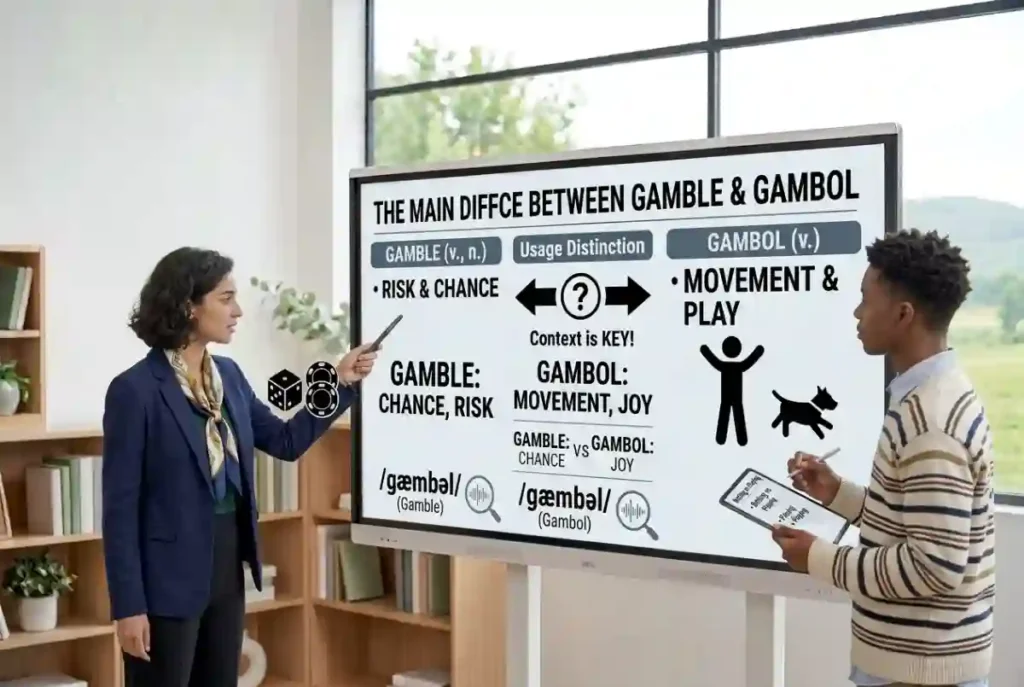
The clearest difference is risk versus playful movement.
Gamble focuses on uncertainty. The person taking the gamble hopes for a favorable outcome but may lose something.
Gambol focuses on movement. The person or animal is leaping, skipping, or playing with energy.
The two words also differ in how often people use them. Gamble is common in everyday speech, business, news, and sports commentary. Gambol is less frequent and often appears in descriptive prose, children’s literature, and nature writing.
Despite those differences, their pronunciation is usually identical. Readers must rely on spelling and context to identify the intended meaning.
Why People Confuse Gamble vs Gambol
The confusion comes from a mix of spelling, sound, and familiarity. These factors make it easy to type one word when you mean the other.
The Words Look Almost Identical
Both words begin with gamb and end with a similar sound. Only the vowel in the final syllable changes from e to o.
Because the difference is so small, a reader may overlook it during proofreading. A writer who knows one word well but rarely uses the other may also select the wrong spelling without noticing.
They Sound the Same
In standard English pronunciation, gamble and gambol are homophones. Both are pronounced /ˈɡæm.bəl/, with stress on the first syllable.
This means listening alone will not help you choose the correct spelling. You need to understand the meaning of the sentence.
Gambol Is Less Familiar
Most English speakers encounter gamble regularly in discussions about money, sports, business, or risk. By comparison, gambol is less common in everyday conversation.
When people hear a sentence about playful movement, they may reach for the more familiar spelling even if it is incorrect for that meaning.
Spellcheck May Miss the Error
Spellcheck tools often identify misspelled words, but they may not flag a correctly spelled word used in the wrong context.
If you type The lambs gamble in the field, a basic spellchecker may accept gamble because it is a valid word. A grammar tool might catch the unusual wording, but you should not rely on software to recognize every meaning error.
Autocorrect Can Make the Wrong Choice
Autocorrect may replace a less familiar word with a more common one. This can happen when you type quickly or when your device predicts the next word based on frequent usage.
If you intend to write gambol in a story or article, review the sentence after typing. Context is the best safeguard against an incorrect automatic substitution.
The Difference Is Not Regional Spelling
This confusion is not a British versus American English issue. Both spellings are standard in the United States, the United Kingdom, Canada, Australia, and other English speaking regions.
The difference comes from meaning, not geography. You cannot use gamble in American English and switch to gambol in British English to express the same idea.
A Simple Memory Trick For Gamble vs Gambol
The easiest way to remember the difference is to connect each word with its main idea.
Gamble has an E for uncertain outcomes. Think of an expense, an estimate, or the chance of losing money. The letter is only a memory aid, but it can remind you that gamble often involves risk.
Gambol has an O for a playful hop. Picture a lamb bouncing through a field or a puppy leaping across a lawn.
You can also remember these short phrases:
- Gamble on a chance.
- Gambol on the grass.
The similar sounds are no longer a problem once you attach each spelling to a clear mental picture. When you proofread, ask yourself if the sentence describes a risk or a playful movement. That quick test will usually give you the answer.
Section 2 of 3
Gamble vs Gambol Grammar
Both gamble and gambol can function as verbs and nouns. Their grammar follows regular English patterns, so once you know the meaning, forming the correct tense or plural is straightforward.
The main challenge is not grammar itself. It is making sure the sentence uses the right word before applying the grammar rules.
Verb Forms of Gamble
Gamble is a regular verb. Its past tense and past participle use the ending ed.
| Verb form | Example |
|---|---|
| Base form | gamble |
| Third person singular | gambles |
| Present participle | gambling |
| Simple past | gambled |
| Past participle | gambled |
Examples in sentences:
- I rarely gamble with money.
- She gambles on the outcome of major elections.
- They are gambling on a last minute change.
- He gambled his savings on the business.
- The company has gambled on a new approach.
The spelling changes slightly when you add certain endings. In gambling, the final silent e disappears before ing. In gambled, the e remains because the verb takes d rather than ed as an additional sound and spelling element.
Verb Forms of Gambol
Gambol is also a regular verb. Its forms follow the same basic pattern.
| Verb form | Example |
|---|---|
| Base form | gambol |
| Third person singular | gambols |
| Present participle | gambolling or gamboling |
| Simple past | gambolled or gamboled |
| Past participle | gambolled or gamboled |
The spelling difference in the longer forms is worth noticing. British English commonly doubles the final l in forms such as gambolled and gambolling. American English generally uses gamboled and gamboling.
Both forms are accepted, but your choice should follow the spelling convention used in the rest of your writing.
Examples:
- The young goats gambol in the field.
- A puppy is gamboling beside the fence.
- The children gambolled along the path.
- The lambs have gambolled around the pasture all morning.
The spelling convention changes the number of l letters, but it does not change the meaning.
Gamble vs Gambol in Different Tenses
You can use both verbs in the present, past, and future.
Present tense
- He gambles on football games.
- The lamb gambols around the garden.
Past tense
- She gambled on a business opportunity.
- The foal gambolled across the grass.
Present continuous
- They are gambling on a favorable result.
- The puppies are gamboling near the gate.
Present perfect
- The company has gambled on several new products.
- The young deer have gambolled through the clearing.
Future tense
- He will gamble on the final match.
- The lambs will gambol in the field once the rain stops.
The tense tells the reader when the action happens. The choice between the two verbs tells the reader what the action means.
Using Gamble and Gambol With Helping Verbs
Helping verbs such as is, are, was, have, and will work with both words.
For example:
- She is gambling on the results.
- The puppies are gamboling outside.
- He has gambled before.
- The lambs have gambolled all afternoon.
- They will gamble again next season.
- The foals will gambol in the pasture.
Pay attention to the form after each helping verb. After is or are, use the present participle when describing an ongoing action. After have or has, use the past participle.
These are ordinary English grammar rules. You do not need a special rule for this word pair.
Gamble vs Gambol as Nouns
Both words can name an action or activity, but their meanings remain distinct.
A gamble is a risk or risky decision.
A gambol is a playful leap or act of lively movement.
Compare these examples:
- The investment was a gamble.
- The puppy’s sudden gambol surprised us.
In the first sentence, gamble names a risky decision. In the second, gambol names a playful movement.
Articles and Singular Forms
Both nouns can take the article a because they begin with consonant sounds.
- It was a gamble.
- The puppy made a gambol across the lawn.
The second example is grammatically possible, although the noun gambol is uncommon in everyday conversation. Most speakers would naturally write The puppy leaped across the lawn or The puppy gambolled across the lawn.
This illustrates an important editorial point. A word can be grammatically correct without being the most natural choice in every sentence.
Plural Forms
The regular plural of gamble is gambles. The regular plural of gambol is gambols.
Examples:
- The company’s gambles did not always succeed.
- The lambs’ gambols delighted the visitors.
In the second example, gambols refers to several playful movements. The possessive form lambs’ shows that the movements belong to the lambs.
In most everyday writing, however, the noun gamble appears more often than the noun gambol. Writers frequently use gambol as a verb instead.
Spelling Rules for Gamble vs Gambol
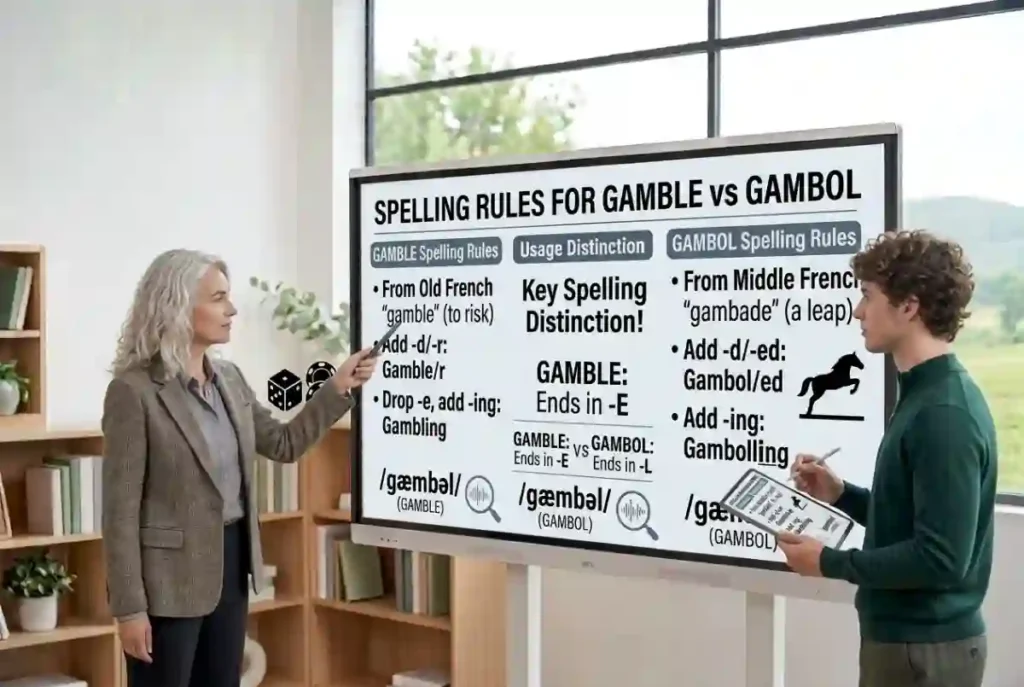
The difference between the base forms is one letter. Still, spelling rules become important when you add endings.
Why Gambling Drops the E
The base verb gamble ends in a silent e. When you add ing, you normally drop that final e.
Therefore:
- gamble becomes gambling
- not gambleing
This pattern appears in many English verbs.
- hope becomes hoping
- dance becomes dancing
- write becomes writing
Remembering this rule helps prevent common spelling errors.
Why Gamboling Can Have One or Two Ls
The spelling of gambol changes slightly between American and British conventions when you add endings beginning with a vowel.
American English usually keeps one l:
- gamboling
- gamboled
British English commonly doubles the l:
- gambolling
- gambolled
The difference follows a wider pattern in English spelling. Compare traveling in American English with travelling in British English.
Not every word follows the same pattern, so a dictionary is useful when you are unsure. The important point is to remain consistent within one article, book, or report.
Why Gamble and Gambol Are Not Spelling Variants
Some English words have regional spelling variants. Color and colour are a familiar example. Both forms describe the same thing, with the preferred spelling depending on the variety of English.
Gamble and gambol do not work that way. They are separate words with separate meanings.
You cannot replace one with the other simply because you are writing for an American or British audience.
Gamble vs Gambol Pronunciation
In standard American English, both words are pronounced GAM buhl, with stress on the first syllable.
Their IPA transcription is generally given as /ˈɡæm.bəl/.
The first syllable sounds like the beginning of gambler. The second contains a reduced vowel, often represented by the symbol /ə/, followed by an l sound.
Because the two words are homophones, pronunciation does not distinguish their meanings.
How to Pronounce Gamble
Break gamble into two syllables:
GAM + buhl
The first syllable carries the stress. Say it naturally rather than giving both syllables equal emphasis.
You can practise with these phrases:
- gamble carefully
- gamble on the result
- a risky gamble
- gambling at a casino
How to Pronounce Gambol
The pronunciation is the same:
GAM + buhl
Try practising these phrases:
- gambol in the meadow
- lambs gambol happily
- watch the puppies gambol
The surrounding words make the intended meaning clear.
Are Gamble and Gambol Homophones
Yes. In standard English, gamble and gambol are homophones because they have the same pronunciation but different spellings and meanings.
They are not homonyms in the narrow sense of words that share both spelling and pronunciation but have unrelated meanings. Instead, their different spellings make the term homophones the more precise label for this pair.
Homophones create a common spelling challenge. Other examples include their and there, brake and break, and flower and flour.
The best way to distinguish them is to learn the meaning and use of each word rather than trying to hear a difference that usually does not exist.
Gamble vs Gambol in American and British English
The basic meanings of both words remain the same in American, British, Canadian, and Australian English.
Gamble means to risk something or make a risky choice. Gambol means to move playfully by leaping or skipping.
The main regional difference appears in the spelling of the longer forms of gambol.
| Variety of English | Past tense | Present participle |
|---|---|---|
| American English | gamboled | gamboling |
| British English | gambolled | gambolling |
| Canadian English | Both patterns appear | Follow the chosen style |
| Australian English | British style is common | British style is common |
Canadian English uses both American and British spelling patterns in different contexts. Australian English generally follows British spelling conventions, although individual publishers may set their own style rules.
For a US audience, gamboling and gamboled are usually the natural choices. If you are writing for a British publication, gambolling and gambolled will generally fit better.
No regional variation changes the core difference between gamble and gambol.
The Origins of Gamble vs Gambol
Although these words look and sound similar, they have different histories. Their origins help explain why English has two distinct spellings for words that sound alike.
The Origin of Gamble
The verb gamble developed from the noun game. Its history is associated with playing games and taking chances, particularly games in which money or something valuable could be won or lost.
Over time, the word expanded beyond games of chance. Today, it can describe almost any decision that exposes someone to risk.
For example, a business can gamble on a new product without playing a game. A politician can gamble on an unpopular decision. A homeowner can gamble on buying a property that needs major repairs.
The modern figurative meaning grew from the central idea of risking something for a possible reward.
The Origin of Gambol
Gambol has a different history. It entered English through French and is associated with playful movement and leaping. Its history connects with words related to legs and lively physical action.
That background fits its modern meaning. When lambs gambol in a field, they leap and move about with playful energy.
The word has retained a more descriptive flavor than gamble. Writers often use it to create a vivid picture rather than simply report that an animal or child is moving.
Why Their Origins Matter
The histories reinforce the difference between the words.
Gamble developed around games, risk, and uncertain outcomes.
Gambol developed around physical movement and play.
Their similar modern pronunciation does not mean they share the same meaning. English contains many words whose sounds overlap even though their histories and uses differ.
Understanding those distinctions can make vocabulary easier to remember and help you choose more precise words when writing.
Section 3 of 3
Real Life Examples of Gamble vs Gambol
The best way to learn the difference is to see how each word works in real sentences. The following examples cover everyday conversation, business, school, journalism, and creative writing.
Gamble vs Gambol in Daily Conversation
- Gamble: I wouldn’t gamble my rent money on a football game.
- Gambol: The puppies gambol around the backyard every morning.
- Gamble: She decided to gamble on a cheaper flight with a short connection.
- Gambol: The children gambolled along the beach while their parents watched.
- Gamble: Buying a used car without an inspection is a gamble.
- Gambol: A young lamb began to gambol across the field.
The first group focuses on risk and uncertainty. The second describes playful movement.
Gamble vs Gambol in the Workplace
- Gamble: The company gambled on a new product before completing its market research.
- Gamble: Accepting the position without discussing the salary would be a gamble.
- Gamble: The manager gambled that the team could finish the project ahead of schedule.
- Gambol: During the company picnic, the children gambolled across the open lawn.
In professional writing, gamble often describes a business decision that could succeed or fail. Gambol is less common in workplace documents, but it works naturally in a description of an outdoor event.
Gamble vs Gambol in Emails
- Gamble: Moving forward without reviewing the contract would be a gamble.
- Gamble: We should not gamble on receiving approval before the deadline.
- Gambol: The attached photos show the lambs gamboling in the field during our spring visit.
The first two examples would fit a business email about planning or risk. The third could appear in a personal message or a newsletter about a farm visit.
Gamble vs Gambol in Academic Writing
- Gamble: The researchers gambled on a narrow sample size and acknowledged the limits of their findings.
- Gamble: Choosing a research method without testing its reliability can be a gamble.
- Gambol: The naturalist observed young animals gambolling near the edge of the woodland.
Academic writing tends to favor precise and direct language. A researcher would usually explain the risk in detail rather than use gamble as a vague substitute for a specific methodological concern. The word gambol may appear in descriptive natural history writing, although a technical report would more likely describe the movement directly.
Gamble vs Gambol in Journalism
- Gamble: The retailer gambled on lower prices to attract customers during the holiday season.
- Gamble: The candidate took a political gamble by announcing the policy before the debate.
- Gambol: Young deer gambolled through the meadow as visitors arrived at the wildlife reserve.
News writing often uses gamble as a metaphor for an uncertain decision. The verb helps explain the risk without requiring a literal game or wager.
By contrast, gambol can make a nature report more vivid. It shows the animals moving playfully rather than simply walking through the landscape.
Gamble vs Gambol in Creative Writing
- Gamble: He knew that leaving his hometown was a gamble, but staying felt even riskier.
- Gambol: Golden sunlight filled the meadow as lambs gambolled beside the stone wall.
- Gamble: She gambled everything on one final attempt to save the family business.
- Gambol: The young foxes gambolled in the grass before disappearing into the trees.
Creative writers use gamble to build tension around risk and possible loss. They use gambol to create movement and a lighthearted mood.
These examples also show that a word’s effect depends on context. A gamble can be frightening, exciting, or foolish. A gambol usually suggests freedom, playfulness, or delight.
Gamble vs Gambol on Social Media
- Gamble: I gambled on the new restaurant, and the food turned out to be amazing.
- Gamble: Buying concert tickets before the lineup is announced is a gamble.
- Gambol: These baby goats gamboling in the sunshine just made my day.
On social media, gamble often appears in casual comments about purchases, plans, and uncertain outcomes. Gambol is less common but can add a playful touch to captions about pets, wildlife, or children.
Common Mistakes With Gamble vs Gambol
Most mistakes involve choosing the wrong word rather than misspelling a word completely. Both spellings are valid, so a basic spellchecker may not catch the problem.
Using Gamble to Describe Playful Movement
Incorrect for the intended meaning: The puppies gamble around the garden.
Correct: The puppies gambol around the garden.
The incorrect sentence suggests risk taking rather than playful movement. If you mean that the puppies are jumping and playing, gambol is the right choice.
Using Gambol to Describe a Risk
Incorrect for the intended meaning: The company gambolled on a new investment.
Correct: The company gambled on a new investment.
The company is taking a chance on the investment. It is not moving about playfully.
Assuming Gambol Is a Misspelling
Some writers assume gambol must be a typo because they rarely encounter it. That assumption is incorrect.
Gambol is a recognized English word. It is simply less common than gamble.
If you are reading a sentence about lambs gambolling through a field, the spelling is intentional.
Assuming Gamble and Gambol Are Regional Variants
These words do not represent American and British versions of the same word.
Both forms exist in both varieties of English. Their meanings remain distinct regardless of the writer’s location.
Confusing the Words Because of Autocorrect
A writing tool may accept the wrong word because it is spelled correctly in isolation.
For example, a sentence about playful lambs may contain gamble even though the writer intended gambol. The error is semantic rather than purely orthographic.
Always read the complete sentence after using autocorrect. Check the meaning instead of trusting the spelling checker alone.
Assuming Gamble Always Involves Money
The verb gamble often refers to betting or financial risk, but its figurative use is much broader.
A person can gamble with a career decision, a business strategy, or an important opportunity. The common element is uncertainty and the possibility of an unwanted result.
Using Gambol When a Simpler Verb Would Work Better
Although gambol is correct, it may sound unusual in plain everyday writing.
For example:
The children gambolled around the room.
This is grammatically correct, but The children jumped and played around the room may sound more natural in a casual conversation.
The choice depends on the purpose. Use gambol when its lively and descriptive quality adds something to the sentence.
Related Words and Expressions to Gamble vs Gambol
Understanding related vocabulary makes the distinction easier and gives you more choices when writing.
Words Related to Gamble
Bet. To risk money or make a prediction about an uncertain result.
Example: She bet ten dollars on the winning horse.
Risk. The possibility of loss, harm, or an unwanted outcome.
Example: Starting a business involves financial risk.
Wager. To bet something on an outcome.
Example: They wagered a small amount on the final score.
Speculate. To make a decision or prediction based on uncertain information, often with the hope of gaining money.
Example: Some investors speculate on changes in market prices.
Take a chance. To do something despite uncertainty.
Example: He decided to take a chance and apply for the job.
These words overlap with gamble, but each has its own tone and use. Wager often sounds more formal than bet, while speculate commonly appears in financial and analytical writing.

Words Related to Gambol
Prance. To move with lively, often showy steps.
Example: The pony pranced around the paddock.
Frolic. To play or move about happily.
Example: The children frolicked in the snow.
Skip. To move with light hops or jumps.
Example: She skipped along the path.
Bound. To leap or move forward in large jumps.
Example: The dog bounded across the lawn.
Cavort. To jump or move around energetically, often in a playful way.
Example: The puppies cavorted in the garden.
These alternatives help you choose the right level of detail. Gambol often conveys carefree movement. Prance can suggest a more showy manner, while bound emphasizes large leaps.
Opposites and Contrasting Ideas
The two words do not have a direct opposite pair because they describe different actions.
Possible opposites of gamble depend on the context. If it means taking a risk, alternatives such as play it safe, avoid risk, or act cautiously express the opposite idea.
The opposite of gambol depends on the movement being described. Stand still, remain motionless, or move slowly may contrast with playful leaping.
Do not treat these expressions as exact dictionary antonyms in every sentence. They are useful contrasts rather than universal opposites.
Expert Editor’s Note About Gamble vs Gambol
From an editor’s perspective, gamble and gambol present a straightforward but important vocabulary distinction. Both are correct words, yet each carries a meaning that the other cannot replace.
Professional editors should check more than spelling. They should confirm that the chosen word makes sense in the sentence and fits the intended tone.
For example, a basic spellchecker may accept this sentence:
The lambs gamble through the field.
An editor should notice that gamble does not fit the intended image. The natural correction is:
The lambs gambol through the field.
The same principle applies in the other direction. A business report describing a company that gambolled on a new investment almost certainly needs gambled.
What Dictionaries Tell Us
Standard English dictionaries recognize both gamble and gambol as established words.
The dictionary distinction is clear. Gamble relates to betting, risk, or uncertain outcomes. Gambol relates to lively, playful movement.
Their shared pronunciation explains the confusion, but it does not make them interchangeable. A dictionary definition should guide the choice, while sentence context confirms it.
Which Word Sounds More Natural
In ordinary American English, gamble is the more familiar word. It appears in daily conversation, sports coverage, financial news, and workplace discussions.
Gambol is less common and often has a literary or descriptive feel. It works particularly well when a writer wants to show animals or children moving with carefree energy.
Neither word is inherently more correct or more professional. The best choice depends on the meaning and the audience.
A Proofreading Tip
When you see either word in a draft, replace it temporarily with a plain explanation.
For gamble, try take a risk.
For gambol, try leap and play.
If the replacement preserves the sentence’s intended meaning, you probably chose the correct word. If it changes the meaning, review the spelling before publishing.
This technique works well because it checks the idea behind the word rather than its appearance alone.
Frequently Asked Questions
What is the difference between gamble and gambol
Gamble means to take a risk, often by betting money or making an uncertain decision. Gambol means to leap, skip, or play energetically. A person might gamble on a business venture, while a puppy might gambol around a garden. The words are pronounced the same in standard English but have different spellings and meanings.
Are gamble and gambol pronounced the same
Yes. In standard English, both words are generally pronounced /ˈɡæm.bəl/, with stress on the first syllable. They are homophones because they sound alike but have different spellings and meanings. Since pronunciation does not distinguish them, readers and writers must use context to determine which word belongs in a sentence.
Is gambol a real English word
Yes. Gambol is a standard English word meaning to leap or move about playfully. It is less common than gamble, which explains why some people mistake it for a spelling error. You will often encounter gambol in nature writing, children’s stories, and descriptive passages about lively movement.
Can gamble be used as a noun
Yes. As a noun, gamble means a risky choice or action that depends on an uncertain outcome. For example, Buying the property without an inspection was a gamble describes a decision that could have led to a loss. The plural form is gambles, as in His business gambles did not always succeed.
What is the past tense of gambol
The past tense is gambolled in common British English spelling and gamboled in American English. Both forms describe an action that happened in the past. For example, The lambs gambolled across the field and The lambs gamboled across the field express the same meaning. Follow the spelling convention used in your publication.
Is gamboling or gambolling correct
Both spellings are correct. Gamboling is the usual American English form, while gambolling is common in British English. The difference follows regional spelling patterns for certain words ending in l. Neither form changes the meaning of the verb, which describes lively and playful movement.
What is a synonym for gambol
Useful synonyms include frolic, prance, skip, bound, and cavort. Each emphasizes a slightly different kind of movement. Frolic suggests playful activity, prance suggests lively steps, and bound emphasizes large leaps. Choose the word that best matches the action you want your reader to picture.
Why does spellcheck not catch gamble and gambol mistakes
Spellcheck often checks whether a word is spelled correctly rather than whether it makes sense in a particular sentence. Because gamble and gambol are both valid words, software may accept either one. Proofreading for meaning is still essential, especially when two words sound the same but communicate different ideas.
Final Verdict
The difference between gamble vs gambol comes down to one simple distinction.
Gamble means to risk something or make a choice with an uncertain outcome.
Gambol means to leap, skip, or play energetically.
Both words are correct. Neither is a regional spelling of the other, and their identical pronunciation does not make their meanings interchangeable.
When proofreading, ask yourself what the sentence describes. If someone is taking a risk, choose gamble. If a child or animal is moving about playfully, choose gambol.
Remember the simple image of a gambler taking a chance and a lamb gambolling through a meadow. One word is about risk. The other is about playful movement. Once you connect each spelling with its meaning, this confusing pair becomes much easier to remember.

Founding Editor
Maya spent six years as a copyeditor at a regional newspaper before starting Grammist, which is where the “answer first” format came from: newsroom style guides don’t have room for a preamble.
She writes and reviews most of the word-pair and spelling entries, and has final say on anything that goes out under the Grammist name.