
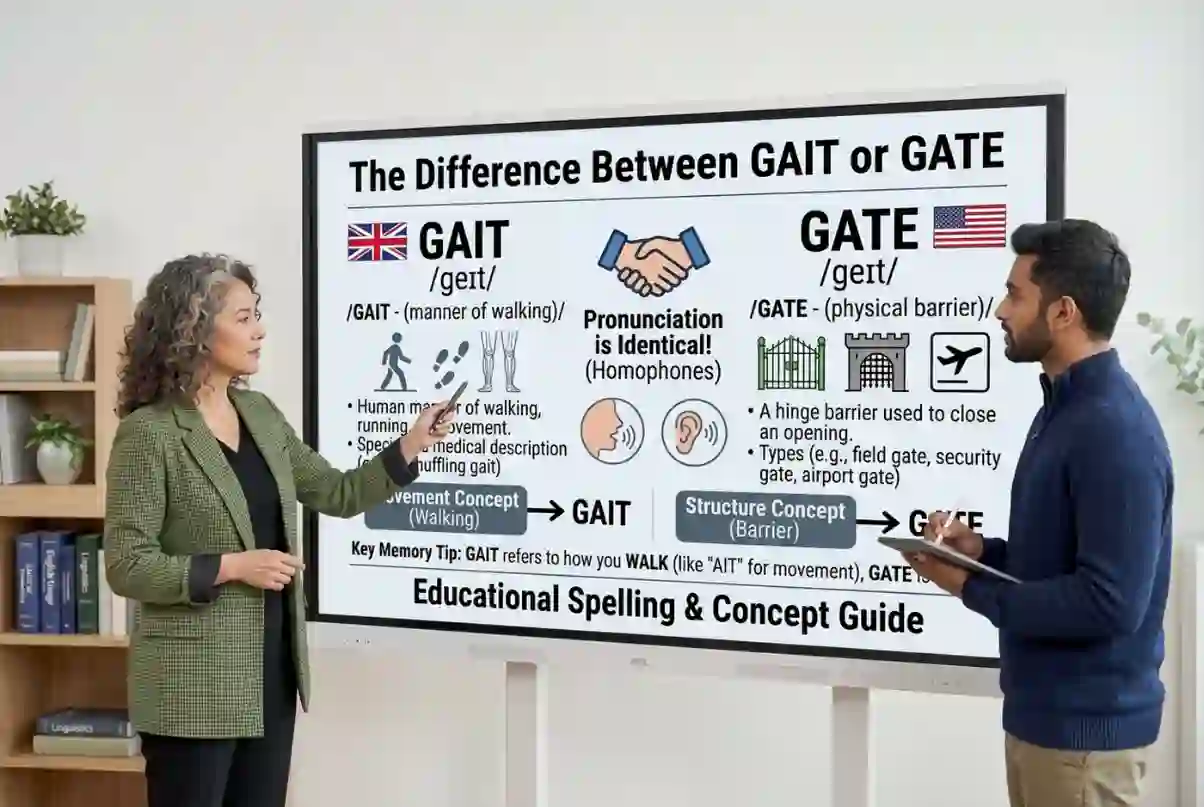
The difference between gait vs gate comes down to meaning, not spelling preference. Both words are correct English words, but they describe entirely different things. Gait refers to the way a person or animal walks or moves. Gate usually refers to a movable barrier that opens and closes to control access to a place. Since both words sound exactly alike in most English accents, writers often confuse them when typing quickly or relying on memory.
Imagine a doctor describing how a patient walks. The doctor might write, “The patient has an unusual gait.” Now imagine a homeowner explaining how visitors enter a yard. The homeowner might say, “Please close the gate.” Switching these words would change the meaning of each sentence and could make the writing confusing.
Fortunately, the distinction is easy to remember once you connect each spelling with its meaning. This guide explains the definitions, pronunciation, grammar, word origins, common mistakes, and everyday uses of both words. You’ll also find practical examples from medical writing, animal care, workplace communication, travel, and daily conversation. By the end, you’ll know exactly when to use gait and when to use gate.
Quick Answer
Gait means the way a person or animal walks or moves. Gate means a barrier that opens and closes to control entry or exit. Both words are correctly spelled, and they sound alike in standard English. Use gait when discussing movement and gate when referring to an entrance or barrier.
Gait vs Gate at a Glance
| Feature | Gait | Gate |
|---|---|---|
| Meaning | A way of walking or moving | A barrier or controlled entrance |
| Part of speech | Noun | Noun; also a verb in some contexts |
| Pronunciation | /ɡeɪt/ | /ɡeɪt/ |
| Syllables | One | One |
| Main context | Walking, movement, medicine, animal care | Fences, entrances, airports, access |
| Plural | Gaits | Gates |
| Common phrase | Walking gait | Garden gate |
| Example | The horse has a smooth gait. | The horse walked through the gate. |
| Common mistake | Using gate for walking style | Using gait for a barrier |
| Regional spelling | Standard across major English varieties | Standard across major English varieties |
The key distinction is simple. Gait describes movement. Gate describes a barrier or entrance.
What Does Gait Mean
Gait is a noun that describes the manner or pattern of walking or moving. It can refer to a person’s walking style, an animal’s movement, or a particular pattern of locomotion.
For example, a person might walk with short steps after an injury. A doctor could describe the person’s gait as uneven. A horse might have a smooth gait that makes its movement look graceful.
The word is common in medical, scientific, sports, and animal care contexts. However, you can also use it in ordinary conversation.
Examples include:
- The doctor examined his gait.
- Her gait changed after the long hike.
- The horse has a steady gait.
- The runner developed a faster gait during training.
- The dog’s gait looked unusual after the long walk.
In each sentence, gait refers to the way someone or something moves while walking or traveling on foot or legs.
Gait in Everyday English
You don’t need to be a medical professional to use gait correctly. The word can describe any recognizable way of walking.
For instance, you might recognize a friend by their gait from a distance. Perhaps they take long strides, swing their arms in a particular way, or walk with a distinctive rhythm.
A sentence such as “I recognized him by his gait” means that the person’s way of walking helped you identify him.
The word can also describe changes in movement. Someone who feels tired may develop a slower gait. A person carrying a heavy bag might walk with an uneven gait.
In everyday speech, people often say the way someone walks instead of their gait. Both expressions are natural, but gait is shorter and more precise in technical descriptions.
Gait in Medicine
In medicine, gait refers to a person’s walking pattern. Doctors, physical therapists, and other health professionals may observe gait to assess balance, coordination, strength, and movement.
A gait assessment can help a professional identify movement patterns that need further evaluation. For example, a clinician might observe short steps, uneven weight distribution, or difficulty maintaining balance.
Common medical expressions include:
- Gait assessment.
- Gait analysis.
- Abnormal gait.
- Normal gait.
- Gait training.
- Gait disorder.
A gait assessment involves observing or measuring how someone walks. Gait training refers to exercises or instruction designed to improve walking ability.
The term itself doesn’t identify a specific medical condition. An unusual gait can have many possible explanations, so a professional must interpret the observation in context.
Gait in Animal Care
Veterinarians, horse trainers, and animal handlers also use gait to describe movement.
The word is especially common when discussing horses because horses have distinct movement patterns. Walking, trotting, and cantering are familiar examples of horse gaits.
A veterinarian might observe an animal’s gait to look for signs of discomfort or changes in movement. A trainer might discuss the smoothness, rhythm, or speed of a horse’s gait.
Examples include:
- The horse has a balanced gait.
- The veterinarian watched the dog’s gait.
- The trainer noticed a change in the horse’s gait.
- The animal moved with a slow and steady gait.
In these contexts, gait focuses on movement rather than the location where the animal enters or exits.

What Does Gate Mean
Gate is a noun that usually refers to a movable barrier used to close or control an opening. A gate may stand in a fence, wall, garden entrance, driveway, or airport boarding area.
A gate can keep people or animals inside a space, prevent unwanted entry, or control access to a particular area.
For example, a homeowner might install a gate to keep a dog in the yard. An airport uses boarding gates to direct passengers toward their flights.
Common examples include:
- Please close the garden gate.
- The horse walked through the gate.
- We waited near Gate 12 at the airport.
- The security guard opened the main gate.
- The children played beside the school gate.
Unlike gait, the word gate usually refers to a physical structure or a designated access point.
Gate in Everyday English
The most familiar meaning of gate involves an opening that can be closed.
A garden gate provides access to a garden. A driveway gate controls entry to private property. A farm gate can keep livestock in a field.
The word also appears in many everyday instructions.
“Leave the gate open” means not to close the barrier. “Meet me at the gate” means to meet near a particular entrance or access point.
These expressions are easy to understand because the context usually makes the intended meaning clear.
Gate at an Airport
Airports use gate to identify the area where passengers board or leave an aircraft.
For example, a boarding pass might list Gate 24. That number identifies the designated boarding area, although airports can change gate assignments.
Common expressions include:
- Boarding gate.
- Departure gate.
- Arrival gate.
- Airport gate.
- Gate number.
- Boarding at the gate.
A sentence such as “Our flight leaves from Gate 24” refers to the airport’s designated boarding area. It has nothing to do with the way passengers walk.
Gate in Technology and Access Control
The word gate also appears in technology and security.
An electronic gate may open after someone enters a code, scans a card, or uses an authorized access system. A computer system may use a gateway to connect networks or manage communication between systems.
In digital services, a payment gateway helps process payments between a customer, merchant, and relevant financial systems.
These uses extend the basic idea of controlled passage or access. The word still connects to the concept of allowing something to pass through a defined point.
Gait vs Gate Which One Is Correct
Both gait and gate are correct spellings. The right choice depends on the meaning of your sentence.
Use gait when you mean a person’s or animal’s walking pattern.
Correct: The doctor observed the patient’s gait.
Incorrect for this meaning: The doctor observed the patient’s gate.
Use gate when you mean a barrier or entrance.
Correct: The farmer repaired the gate.
Incorrect for this meaning: The farmer repaired the gait.
The mistake isn’t that one spelling is correct and the other is wrong. The mistake is choosing a correctly spelled word that doesn’t fit the intended meaning.
This distinction is common with homophones, which are words that sound alike but have different meanings and often different spellings.
Why People Confuse Gait vs Gate
The main reason people confuse these words is that they sound the same. When speaking, listeners can’t rely on the spelling to distinguish them. They use context instead.
Several other factors can lead to errors.
They Sound Exactly Alike
Both words are pronounced /ɡeɪt/ in standard English. They have the same initial consonant, vowel sound, and final consonant.
Because pronunciation provides no clear difference, writers must remember which spelling matches the meaning.
Their Spellings Look Similar
The two words have four letters and begin with the same three letters. The final vowel changes from i in gait to e in gate.
That small difference is easy to overlook while typing quickly, especially when the writer already knows the meaning but hasn’t memorized the spelling.
Spellcheck May Not Catch the Error
A spellchecker usually identifies words that aren’t in its dictionary. Both gait and gate are valid English words, so a basic spellchecker may accept either one.
For example, a sentence such as “The doctor checked his gate” contains a real word but probably expresses the wrong meaning.
Grammar and spelling tools can catch some context errors, but they don’t always understand the writer’s intention. Reading the sentence carefully remains important.
Autocorrect Can Choose the Wrong Word
Autocorrect may replace one word with another based on typing patterns or the words around it. Since gait and gate are both common enough to appear in dictionaries, automatic correction may not identify the intended word.
This problem is especially likely when typing a message quickly on a phone.
Writers May Remember the Sound but Forget the Meaning
A person who has heard gait in conversation may recognize the word without remembering its spelling. When writing later, they may choose gate because it looks familiar.
A short memory trick can solve this problem: gait goes with walking; gate goes with an entrance.
Search Results Can Reinforce Confusion
People sometimes encounter incorrect spellings in online comments, social posts, or poorly edited articles. Repeated exposure can make an error look familiar.
Familiarity doesn’t make a spelling correct. When a word choice matters, consult a trusted dictionary and check the meaning in context.
Gait vs Gate in Grammar
Although gait and gate sound alike, their grammar and common uses differ slightly. Both work as nouns, but gate can also function as a verb.
Gait as a Noun
The word gait is a countable noun. You can use it with an article, describe it with an adjective, or make it plural.
Examples:
- The patient has an unusual gait.
- Her natural gait is smooth.
- The therapist examined his walking gait.
- The horses displayed different gaits.
In the first sentence, an comes before unusual gait because gait is a singular countable noun and unusual begins with a vowel sound.
And in the second example, natural describes the type of gait. In the final example, gaits refers to multiple movement patterns.
Gate as a Noun
The word gate is also a countable noun.
Examples:
- A gate stood at the entrance.
- The gate was locked.
- We walked through the main gate.
- Several gates surround the property.
Use a or an according to the sound that follows, not simply the first letter. Since gate begins with a consonant sound, you would say a gate, not an gate.
The plural form is gates.
Gate as a Verb
Unlike gait, gate can also function as a verb.
As a verb, gate can mean to restrict someone’s movement or access, especially in certain institutions. It can also refer to controlling access through a gate or applying a gating mechanism in a technical setting.
Examples:
- The university gated the area during construction.
- The system gates access to restricted files.
- The security team gated the entrance.
This verb use is more specialized than the everyday noun meaning. In ordinary conversation, people are much more likely to use gate as a noun.
Gait Does Not Normally Function as a Verb
In standard contemporary English, gait is primarily a noun. If you want to describe the action, use a verb such as walk, stride, stroll, or move.
For example:
Incorrect: She gaited across the room.
Natural: She walked across the room with a steady gait.
The second sentence uses walked for the action and gait for the manner of movement.
Specialized or historical uses may appear in particular fields, but they aren’t needed for ordinary writing.
Gait vs Gate Pronunciation
Both words have the same pronunciation in standard English.
| Word | IPA | Syllables | Stress |
|---|---|---|---|
| Gait | /ɡeɪt/ | One | Single syllable |
| Gate | /ɡeɪt/ | One | Single syllable |
The opening sound /ɡ/ is the voiced velar stop found at the beginning of go. The vowel /eɪ/ is the long vowel sound heard in day. The final /t/ is the voiceless alveolar stop heard at the end of cat.
Together, the sounds form one syllable.
Are Gait and Gate Homophones
Yes. Gait and gate are homophones because they share the same pronunciation but have different meanings and spellings.
Other familiar homophone pairs include:
- Right and write.
- Pair and pear.
- Sea and see.
- Flour and flower.
- Brake and break.
Homophones create spelling challenges because a listener may know exactly which word a speaker means without being able to tell how it should be written.
Do British and American Speakers Pronounce Them Differently
The two words are homophones in standard British and American English. Accent differences can affect the exact sound of the vowel, but speakers generally pronounce gait and gate alike within their own accent.
Canadian and Australian English follow the same basic pattern.
There is no standard regional spelling distinction between these words. You don’t write gait in British English and gate in American English. Both spellings exist in all these varieties, with different meanings.
Gait vs Gate in Real Life
The easiest way to learn the difference is to see both words in realistic situations. Each example below uses the spelling that matches the intended meaning.
Daily Conversation
- I noticed that the dog had an unusual gait.
- Please close the gate before the cat gets outside.
- Her gait changed after she started wearing new shoes.
- We waited beside the gate until our friends arrived.
- The horse moved with a smooth and steady gait.
These sentences show the basic contrast. A gait is a movement pattern, while a gate is a physical barrier or entrance.
Medical and Health Contexts
- The doctor examined the patient’s gait during the appointment.
- The physical therapist recommended gait training after the injury.
- The nurse noticed that his gait appeared unsteady.
- The clinical report included notes about the patient’s walking gait.
- Researchers measured gait speed during the study.
In medical writing, gait is a standard term. It describes the pattern or mechanics of walking rather than a particular entrance or barrier.
Animal Care
- The veterinarian observed the horse’s gait before recommending further tests.
- The farmer repaired the gate leading into the pasture.
- The trainer praised the horse for its balanced gait.
- The dog ran through the open gate and into the garden.
- The animal’s gait changed after a long period of rest.
Animal care often uses both words, making it a useful context for learning the difference.
Workplace Communication
- The safety report described the worker’s gait after the incident.
- The delivery driver left the package beside the side gate.
- The research team recorded changes in gait during the experiment.
- Please make sure the security gate is locked at the end of the shift.
- The occupational therapist assessed the employee’s gait during rehabilitation.
The correct spelling helps the reader understand the subject immediately, especially in reports that discuss movement or access.
Emails and Messages
- Please meet me at the airport gate at 6 p.m.
- The doctor mentioned that my gait may improve with practice.
- Can you check if the garden gate is closed?
- I’ve attached the report on gait patterns for the team.
- The gate near the parking area will remain closed today.
In emails, the surrounding sentence usually makes the meaning clear. Still, choosing the correct spelling keeps your message professional and avoids distracting errors.
Academic Writing
- The study examined gait patterns in adults of different ages.
- The researchers measured gait speed across several walking conditions.
- The report describes how the gate controls access to the experimental area.
- The paper compares normal gait with several altered walking patterns.
- The laboratory gate remained closed during data collection.
Academic writing benefits from precise vocabulary. A word choice error can change the subject of a sentence, so proofread carefully when writing about movement, engineering, or access control.
Journalism and Public Information
- The report described the athlete’s gait after the competition.
- Airport staff directed passengers to the correct boarding gate.
- The veterinarian said the animal’s gait needed further observation.
- The damaged gate was replaced before the park reopened.
- Investigators reviewed the footage to study the suspect’s gait.
Journalists often use gait when describing how someone walks and gate when reporting on entrances, facilities, or airport operations.
Social Media and Informal Writing
- My dog has the funniest gait when he gets excited.
- Don’t forget to shut the gate after bringing the bikes inside.
- I can recognize my brother by his gait from across the street.
- We finally found the right gate after walking around the airport.
- The horse’s gait looked amazing in that video.
Informal writing follows the same spelling rules as formal writing. A casual tone doesn’t make the words interchangeable.
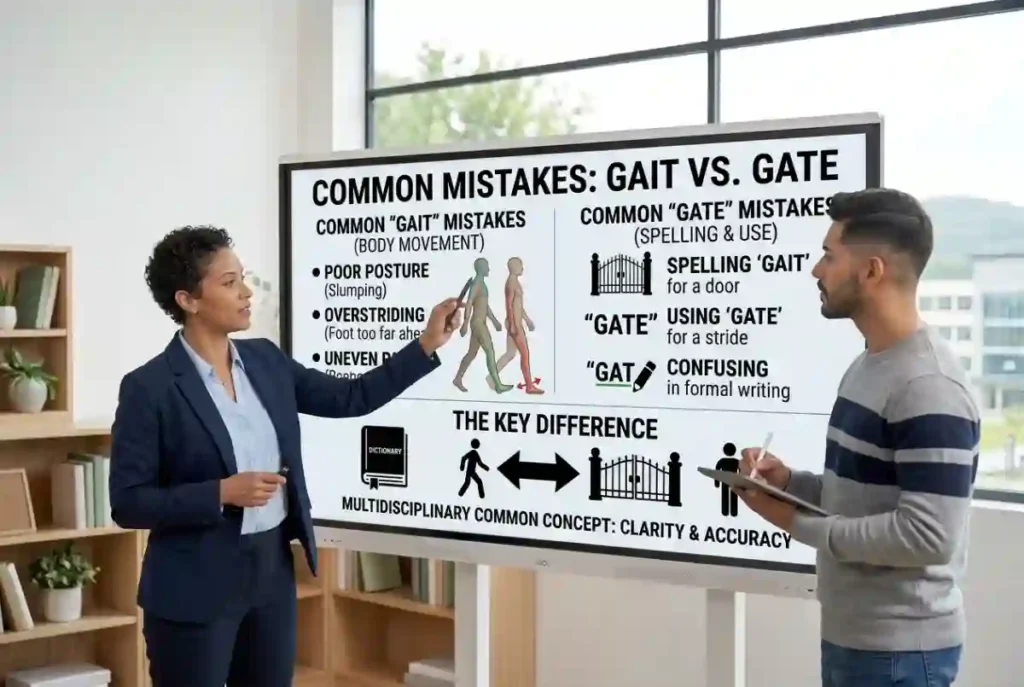
Common Mistakes With Gait vs Gate
The most frequent error is using one spelling when the other meaning is intended. Since both are valid words, the sentence may look correct at first glance.
Mistake One Using Gate for Walking Style
Incorrect: The doctor noticed that the patient’s gate was uneven.
Correct: The doctor noticed that the patient’s gait was uneven.
The corrected sentence refers to the patient’s walking pattern.
Mistake Two Using Gait for a Barrier
Incorrect: Please close the gait before leaving the farm.
Correct: Please close the gate before leaving the farm.
The second sentence refers to a barrier that can be opened and closed.
Mistake Three Assuming One Word Is a Misspelling
Neither word is a misspelling. Both have established meanings and standard dictionary entries.
The problem occurs only when the spelling doesn’t match the intended meaning.
Mistake Four Trusting Spellcheck Without Reviewing Context
A spellchecker may accept “The horse walked through the gait” because gait is a real word. Yet the sentence probably needs gate.
Use automated tools as a first check, not as a replacement for proofreading.
Mistake Five Treating Them as Regional Variants
Some English words change spelling between regions. Color and colour are a familiar example.
Gait and gate do not follow that pattern. They have different meanings in British, American, Canadian, and Australian English.
Mistake Six Assuming Pronunciation Will Solve the Problem
Because the words sound alike, saying them aloud won’t help you identify the correct spelling. You need to consider the sentence’s meaning.
Spelling Rules and Word Forms For Gait vs Gate
The words gait and gate follow ordinary English spelling patterns, but their forms are worth reviewing.
Singular and Plural Forms
| Singular | Plural | Meaning |
|---|---|---|
| Gait | Gaits | Walking patterns |
| Gate | Gates | Barriers or entrances |
Examples:
- The runner has a distinctive gait.
- The runners displayed different gaits.
- The garden has a wooden gate.
- Several gates surround the property.
Both words form their plurals by adding s. Neither requires a spelling change before the plural ending.
Possessive Forms
To show ownership, add an apostrophe and s to the singular noun.
- The patient’s gait was steady.
- The horse’s gait changed.
- The gate’s hinges need repair.
- The airport’s gate assignment changed.
For plural nouns ending in s, the possessive normally takes an apostrophe after the final s.
- The horses’ gaits varied.
- The gates’ locks were replaced.
These examples follow standard possessive rules. The apostrophe marks possession and does not change the pronunciation of the underlying word.
Adjectives and Related Forms
The word gait appears in compounds such as gait analysis, gait speed, and gait training. These combinations are common in medical, scientific, and sports contexts.
The word gate appears in compounds such as gatekeeper, gateway, gatehouse, and gatekeeping.
Notice that gatekeeping can also have a figurative meaning. It may describe controlling who gets access to information, a group, a profession, or an opportunity.
Capitalization
Neither word requires capitalization in the middle of a sentence unless it appears in a proper name or at the start of a sentence.
Correct: The patient has an unusual gait.
Correct: Passengers should proceed to Gate 8.
In the second sentence, Gate may be capitalized as part of an airport’s displayed designation or a particular sign. Ordinary references to a gate don’t require capitalization.
Gait vs Gate in Figurative Language
Both words appear in expressions that go beyond their most basic meanings, but they behave differently.
Gait in Descriptive Writing
Writers can use gait to help readers picture a person or animal.
For example:
“His slow gait suggested that he was tired.”
The sentence describes movement and invites the reader to imagine the person’s pace and posture.
In fiction, gait can also help identify a character. A writer may describe a character’s stiff gait, quick stride, or uneven steps without explaining every movement in detail.
The word is especially useful when the manner of walking matters to the scene.
Gate in Figurative Expressions
The word gate appears in several expressions involving access or control.
Gatekeeper can mean a person who controls access to a resource or opportunity.
Gatekeeping can describe the act of deciding who is allowed to join a group, use a resource, or participate in an activity.
Gateway can mean a physical entrance or a route toward something else.
For example, “The course served as a gateway to a new career” uses gateway figuratively. It describes an opportunity that opens a path rather than a literal gate.
The basic idea of passage or access remains present even when the meaning becomes abstract.
Gait vs Gate Word Origins
Understanding the history of these words can help explain why their spellings differ despite their identical pronunciation.
The Origin of Gait
The English word gait is connected to older forms of English associated with going, walking, or a manner of movement. Its history is linked to the verb go and related Germanic forms describing movement or a way of proceeding.
Over time, gait developed into a noun describing how a person or animal walks. Today, it is used in ordinary descriptions of movement as well as in specialized fields such as medicine, biomechanics, and animal science.
The spelling reflects the word’s history rather than a modern spelling rule that learners can apply to other words.
The Origin of Gate
Gate comes from Old English geat, meaning an opening or entrance. The word developed into the modern noun for a barrier that controls access through an opening.
Related forms appear in older Germanic languages. The historical connection reflects the long-standing importance of entrances and barriers in homes, settlements, and enclosed land.
Today, gate can refer to a garden entrance, an airport boarding area, a security barrier, or an abstract point of access.
Why the Spellings Are Different
The two words developed through separate historical paths. Their modern pronunciations eventually became identical in standard English, but their spellings continued to reflect their distinct histories.
This is common in English. Words can sound alike even when they come from different origins and serve different purposes.
For practical writing, you don’t need to memorize their full histories. The important point is that gait and gate are separate words, not alternative spellings of one word.
British vs American English
There is no meaningful spelling difference between British and American English for gait and gate.
Both words have the same core meanings in major English varieties.
| English variety | Gait | Gate |
|---|---|---|
| American English | Walking pattern | Barrier or entrance |
| British English | Walking pattern | Barrier or entrance |
| Canadian English | Walking pattern | Barrier or entrance |
| Australian English | Walking pattern | Barrier or entrance |
Accent differences can affect the exact pronunciation of the shared vowel sound. However, speakers in these regions generally pronounce the two words alike within their own accent.
For that reason, don’t try to decide between gait and gate by using a regional spelling rule. Decide based on meaning.
Gait vs Gate Related Words and Expressions
Learning related vocabulary can make the difference easier to remember.
Words Related to Gait
Stride refers to a long step or the length of a step. It can also describe the way someone walks.
Pace refers to the speed of walking or movement.
Stroll means to walk in a relaxed way.
Limp means to walk unevenly, often because of pain or injury.
Trot describes a particular gait used by horses and some other animals.
Gait analysis refers to the study of walking patterns.
These words overlap in the general area of movement, but they aren’t exact synonyms.
For example, a person’s pace can be fast or slow, while their gait describes the broader pattern of walking. Someone may have a slow gait, but slow describes the pace more directly.
Words Related to Gate
Entrance refers to a place or way of entering.
Exit refers to a way out.
Barrier is something that blocks or controls passage.
Fence is a structure used to enclose an area or mark a boundary.
Gateway can refer to an entrance or a route toward something.
Gatekeeper refers to someone who controls access.
These words help describe different parts of the same concept. A gate may form part of a fence, mark an entrance, or act as a barrier.
Opposites and Contrasts
Neither gait nor gate has one direct opposite that works in every context.
For gait, contrasting terms depend on the movement being described. A smooth gait might contrast with an uneven gait. A fast gait might contrast with a slow gait.
For gate, a contrasting concept might be an open passage or an unobstructed entrance. However, these are contextual contrasts rather than exact antonyms.
Memory Tricks for Gait vs Gate
A good memory trick links spelling to meaning. The more concrete the link, the easier it is to recall.
Remember Gait With Walking
Think of gait as the way your legs carry you when you walk.
You can remember the sentence:
My gait shows how I walk.
Both gait and walk describe movement in this example.
Another helpful association is gait analysis, a familiar term in medicine and sports science. Whenever you see gait in this expression, it refers to movement patterns.

Remember Gate With an Entrance
Think of a garden gate, farm gate, or airport gate.
You open a gate to enter or leave a place. The word connects naturally with access and passage.
Try this sentence:
The gate opens, and I walk through it.
Here, gate refers to the barrier, while walk describes the action.
Use a Quick Mental Test
When choosing between the words, ask yourself:
Am I describing how someone walks, or am I naming an entrance?
If you’re describing movement, choose gait.
If you’re referring to a barrier or access point, choose gate.
This test works in almost every ordinary sentence.
Expert Editor’s Note About Gait vs Gate
From an editor’s perspective, gait and gate are a classic context error. Both are legitimate spellings, and both are recognized English words. The problem is selecting the wrong one for the sentence.
A dictionary can confirm that a word exists, but the writer still needs to choose the correct meaning. Spellcheck alone may not catch the error because both words pass a basic spelling check.
When editing a medical report, for example, I would check every instance of gait to confirm that the sentence concerns walking or movement. In a travel article, I would check gate references to make sure they identify the intended entrance or boarding area.
The same principle applies to all homophones. Good proofreading goes beyond spelling. It checks meaning, context, and the writer’s intention.
For formal writing, use gait for walking patterns and gate for barriers or controlled access. Don’t replace one with the other just because the words sound alike.
Frequently Asked Questions For Gait vs Gate
What is the main difference between gait and gate
Gait describes the way a person or animal walks. Gate describes a barrier or entrance that controls access. For example, a doctor may assess a patient’s gait, while an airport passenger may wait near a boarding gate. Both spellings are correct, but they aren’t interchangeable.
Are gait and gate pronounced the same
Yes. In standard American English, both words are pronounced /ɡeɪt/. They have one syllable and the same vowel sound. The same homophone relationship applies in standard British English, although regional accents can affect the exact sound. Since pronunciation doesn’t distinguish them, context must guide the spelling choice.
Is gait a real word
Yes. Gait is a standard English noun used to describe a person’s or animal’s way of walking or moving. It appears in everyday language and in specialist fields such as medicine, physical therapy, biomechanics, and veterinary care. Common phrases include walking gait, gait analysis, and gait training.
Is gate a noun or a verb
Gate is most commonly a noun referring to a barrier or entrance. It can also function as a verb in contexts involving access control or restriction. For example, a security system may gate access to a restricted area. In ordinary conversation, the noun form is far more common.
What is the plural of gait
The plural of gait is gaits. You can use it when describing different ways of walking or distinct movement patterns. For example, “The study compared the gaits of several horses.” The word forms its plural by adding s, just like many other regular English nouns.
What is the plural of gate
The plural of gate is gates. For example, “The property has two gates.” Both the singular and plural forms refer to barriers or access points. To show possession, write the gate’s lock for one gate or the gates’ locks for multiple gates.
Can gait and gate be used in the same sentence
Yes. For example, “The horse’s gait changed as it approached the gate.” In this sentence, gait describes how the horse moves, while gate refers to the barrier ahead. Using both words together is a useful way to remember their different meanings.
Why doesn’t spellcheck correct gait and gate
Most spellcheckers recognize both as valid words. If you write “The patient walked through the gait,” a basic spellchecker may not flag the error because gait is spelled correctly. However, the sentence probably needs gate. Reviewing meaning and context helps catch mistakes that automated spelling checks miss.
Gait vs Gate Final Verdict
The difference between gait vs gate is easy to remember once you focus on what each word describes.
Gait means a way of walking or moving. Doctors assess a person’s gait, trainers observe a horse’s gait, and researchers study walking patterns through gait analysis.
Gate means a barrier or entrance. You close a garden gate, walk through a farm gate, or wait near an airport gate.
Both words sound alike, and both are correctly spelled. Neither is a regional alternative to the other. The common mistake is using the right spelling for the wrong meaning.
For everyday writing, remember this simple rule:
Gait is how you walk. Gate is what you walk through.
Once that connection sticks, you’ll know which word to use without second guessing yourself.

Founding Editor
Maya spent six years as a copyeditor at a regional newspaper before starting Grammist, which is where the “answer first” format came from: newsroom style guides don’t have room for a preamble.
She writes and reviews most of the word-pair and spelling entries, and has final say on anything that goes out under the Grammist name.