
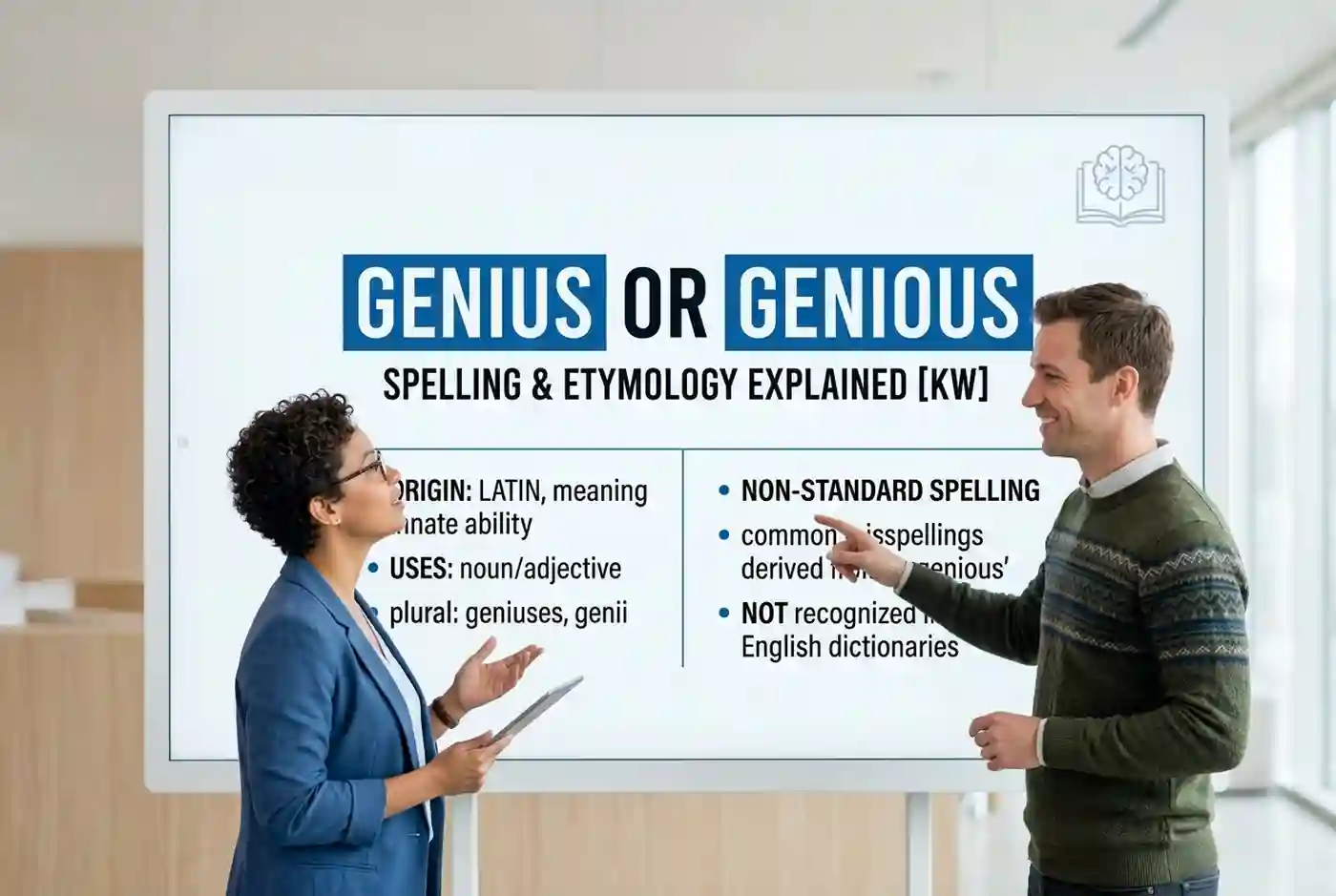
Have you ever paused while typing genious or genius and wondered which spelling is correct? You are not alone. This word often causes confusion because the incorrect version looks believable, especially if you are familiar with English words such as serious, curious, and ingenious.
The correct spelling is genius. The spelling genious is incorrect when you mean a person with exceptional intelligence, creativity, or skill. Although the two forms look similar, standard English recognizes genius as the correct word for this meaning.
A genius can be a person with remarkable mental ability or someone who shows extraordinary talent in a particular field. The word can also describe that exceptional ability itself. For example, you might call a brilliant scientist a genius or describe an unusually clever idea as a stroke of genius.
The confusion often comes from an extra letter. Writers may add an o because the ending ious appears in many familiar English words. The separate word ingenious can also make the incorrect spelling seem natural.
This guide explains the correct spelling, meaning, pronunciation, grammar, and word history. You will also find practical examples, common mistakes, memory tricks, and answers to frequently asked questions so you can use genius confidently in everyday conversations and professional writing.
Quick Answer
Genius is the correct spelling. It means a person with exceptional intelligence, creativity, or ability, or the remarkable ability itself. Genious is a common misspelling and is not the standard form of this English word. Use genius in school assignments, emails, articles, workplace documents, and everyday conversations.
Genious or Genius at a Glance
| Feature | Genius | Genious |
|---|---|---|
| Correct spelling | Yes. | No. |
| Meaning | Exceptional intelligence, creativity, or talent. | No standard meaning for this intended word. |
| Part of speech | Primarily a noun. | Incorrect spelling of the noun. |
| Pronunciation | /ˈdʒiː.ni.əs/. | Intended to represent the same word. |
| Plural form | Geniuses. | Not applicable. |
| British English | Correct. | Incorrect for this meaning. |
| American English | Correct. | Incorrect for this meaning. |
| Formal writing | Accepted. | Should be corrected. |
| Common example | She is a musical genius. | She is a musical genious. |
| Memory tip | Remember the ending ius. | Avoid adding an extra o. |
The central distinction is straightforward. Genius is the correct English word, while genious is an incorrect spelling when the writer intends to refer to exceptional ability or a remarkably talented person.
Genius or Genious Which Spelling Is Correct
The correct spelling is genius, with the letters G, E, N, I, U, and S in that order.
Here are two examples.
Correct: The young scientist is a genius.
Incorrect: The young scientist is a genious.
The first sentence uses the accepted spelling. The second contains an extra o that does not belong in the word.
You should use genius in formal essays, business emails, academic papers, website articles, social media posts, and personal messages. The spelling does not change between American and British English.
There is one small qualification. Someone might deliberately use Genious as a username, brand name, fictional name, or other creative label. That does not make it the standard spelling of the ordinary English word.
For normal writing, remember this rule.
Write genius, not genious.
What Does Genius Mean
The word genius has two main connected meanings.
First, it refers to an unusually high level of natural intellectual or creative ability. This meaning focuses on a person’s talent or mental power rather than on the person alone.
Second, it describes someone who possesses that exceptional ability. A person can be called a scientific genius, a musical genius, or a mathematical genius because of their remarkable skills in a particular field.
Cambridge Dictionary defines genius as exceptional natural ability or skill, especially in areas such as science and art. It also identifies the word as a noun with both countable and uncountable uses. You can consult its Cambridge Dictionary entry for genius for definitions and examples.
Consider these sentences.
- Her genius for mathematics became clear at an early age.
- The inventor was a genius at solving difficult problems.
- His musical genius helped him compose remarkable pieces.
- Finding that shortcut was a stroke of genius.
- The team showed real genius when it redesigned the process.
Each example uses the correct spelling. The meaning depends on the sentence, but the central idea involves exceptional ability or unusually clever thinking.
How Genius Works in Different Contexts
Although people often associate genius with intelligence, the word covers more than academic achievement. Its meaning can shift slightly depending on the field or situation.
Genius in Science and Mathematics
In science and mathematics, genius often refers to exceptional reasoning, original ideas, or an unusual ability to understand difficult concepts.
For example, a scientist who develops an important new theory might be described as a scientific genius. A student who solves difficult mathematical problems with unusual insight might also be called a mathematical genius.
However, the word is usually a judgment of exceptional ability rather than a formal scientific measurement. Calling someone a genius does not establish a specific intelligence score or prove that the person excels in every area.
Genius in Art and Music
Creative fields use genius to describe remarkable artistic ability and original expression.
A composer who creates influential music may be called a musical genius. An artist who develops a striking new visual style might be described as an artistic genius.
In these examples, the word refers to creative power as much as intellectual ability. Talent, imagination, technical skill, and original thinking may all contribute to the judgment.
Genius in Everyday Life
People also use the word in casual conversations to praise an ordinary but clever solution.
Imagine that a friend discovers a simple way to organize a crowded kitchen. You might say, That is genius.
This informal expression means the idea is exceptionally clever or useful. It does not necessarily mean your friend possesses extraordinary intelligence in every part of life.
The context makes the intended meaning clear.
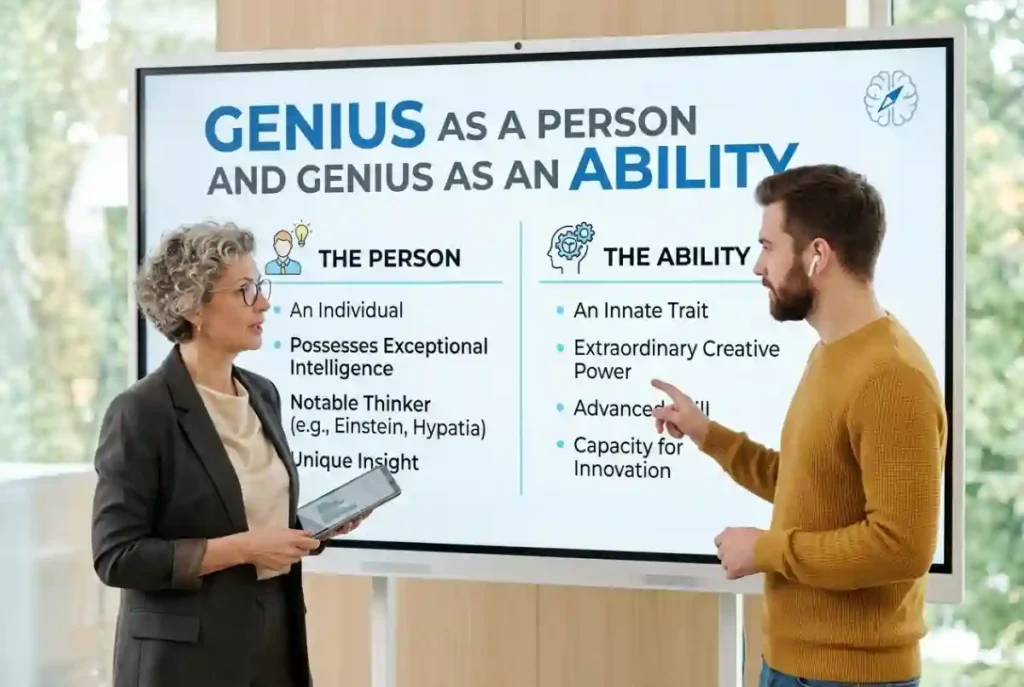
Genius as a Person and Genius as an Ability
One useful grammar distinction is the difference between a person who is a genius and the ability that makes the person remarkable.
Compare these examples.
Maya is a genius.
Here, genius refers to Maya as a person.
Maya has a genius for design.
In this sentence, the word refers to her exceptional ability.
Maya’s genius transformed the project.
The word describes her remarkable talent or creative power.
All three sentences are correct, but their structures differ. In the first, genius identifies a person, in the second, it appears in the phrase a genius for design, in the third, the possessive form Maya’s shows that the ability belongs to Maya.
Learning these patterns will help you use the word naturally instead of repeating the same sentence structure.
Why People Confuse Genius or Genious
The spelling mistake is understandable because English does not always use one predictable pattern for every word ending. Several factors make genious look convincing even though it is incorrect for the intended meaning.
The Extra Letter Looks Natural
Many English words contain the ending ious. Examples include serious, curious, obvious, and various.
Because these words are familiar, writers may assume that genius follows the same pattern. Adding an o creates genious, a spelling that looks reasonable at a glance.
Unfortunately, English spelling depends on individual word histories and established conventions. A familiar pattern cannot always predict the correct spelling of another word.
The Word Ingenious Causes Confusion
The adjective ingenious is closely related in meaning to cleverness and inventive thinking. It contains the letter sequence ious, which may encourage people to transfer that spelling to genius.
Compare the two words.
- Genius is primarily a noun for exceptional ability or a person who possesses it.
- Ingenious is an adjective describing someone or something that shows cleverness and inventiveness.
For example, She is a genius describes the person. By contrast, She designed an ingenious device describes the device as clever and inventive.
The words are related in meaning, but their spelling and grammatical roles differ.
Pronunciation Does Not Reveal the Extra Letter
The accepted pronunciation of genius does not contain an extra syllable for an o. The letters in the written word can therefore feel less obvious to someone trying to spell the word by sound alone.
A writer who relies on pronunciation may add the extra letter because the resulting spelling appears to match the familiar ious pattern. Yet pronunciation is not always enough to identify English spelling.
When a word causes repeated trouble, learning its exact letter sequence is more reliable than trying to reconstruct its spelling from sound.
Fast Typing Creates Mistakes
Many spelling errors happen during quick writing. A person may type genious without noticing the additional letter and send the message immediately.
This is common in text messages, social media captions, comments, and short emails. Familiar words can be misspelled simply because the writer is moving quickly.
A brief proofreading pass can catch this error before it reaches the reader.
Autocorrect Does Not Catch Every Error
Spelling tools can help, but they are not perfect. Their behavior depends on the software, dictionary, language settings, and context.
Some tools may flag genious and suggest genius. Others may miss the mistake or handle it differently. A word may also escape correction if it resembles a proper name or a term that appears in a personal dictionary.
For that reason, do not rely on autocorrect alone. Knowing the correct form remains the best defense.
Online Repetition Can Reinforce the Error
When an incorrect spelling appears across several websites or social media posts, readers may begin to assume that it is acceptable.
Repeated exposure, however, does not establish correct spelling. A typo can be copied from one page to another and continue circulating for years.
If you need to verify a doubtful spelling, check a reliable dictionary rather than counting how many websites use the same form.
The Difference Between Genius or Genious
This is the most useful related distinction to learn because it explains part of the confusion.
Genius is a noun that describes exceptional ability or a person who possesses it.
Ingenious is an adjective that describes cleverness, inventive thinking, or a skillfully designed solution.
Compare these examples.
- The engineer is a genius.
- The engineer developed an ingenious solution.
- Her genius helped the company solve the problem.
- Her ingenious design reduced the time required for the task.
In the first and third sentences, the noun genius names exceptional ability or its possessor. In the other two, the adjective ingenious describes the engineer’s solution and design.
A useful way to remember the distinction is to ask what you are describing. If you mean the talented person or the exceptional ability itself, use genius. If you mean a clever idea, invention, design, or method, ingenious may be the better word.
Not every clever person must be a genius, and not every ingenious idea proves that its creator has exceptional talent in every field. The terms overlap, but they do not mean exactly the same thing.
Genius or Genious in British and American English
There is no British or American spelling difference in this pair.
Writers in the United States use genius. Writers in the United Kingdom use genius. The same spelling is also used in standard Canadian and Australian English.
You do not need to memorize different national versions or change the spelling for an international audience.
| English variety | Correct form | Incorrect form for the intended meaning |
|---|---|---|
| American English | Genius. | Genious. |
| British English | Genius. | Genious. |
| Canadian English | Genius. | Genious. |
| Australian English | Genius. | Genious. |
The pronunciation can vary slightly across individual accents, but that does not change the accepted spelling.
Genius Grammar and Correct Usage
Understanding the grammar of genius helps you avoid errors beyond the spelling itself. The word is primarily a noun, and it can refer to a person or to exceptional ability.
Genius as a Countable Noun
A countable noun names something that can be counted. When genius describes a person, it is normally countable.
Examples include:
- She is a genius.
- He became a respected genius in his field.
- The professor described the young musician as a genius.
- Two geniuses worked together on the invention.
The singular form usually takes an article when it refers to a person.
Correct: He is a genius.
Incorrect: He is genius.
The second sentence is not the usual standard construction when you mean that he is a gifted person. A natural alternative is He is a genius.
Genius as an Uncountable Noun
The word can also refer to exceptional ability itself. In that meaning, it can be uncountable.
For example:
- Her genius changed the direction of the project.
- The painting shows the artist’s genius.
- We admired the genius behind the invention.
In these sentences, genius does not identify a person as a countable item. It refers to the quality or ability.
This distinction explains why the word can appear with an article in one sentence and without one in another.
He is a genius.
The noun refers to a person.
He has genius.
The noun refers to an exceptional quality. This version is grammatical but often sounds more formal or literary than everyday alternatives such as He has extraordinary ability.
The Correct Article for Genius
Use a genius, not an genius, when referring to one gifted person.
The choice between a and an depends on the first sound of the following word, not simply on its first written letter.
Genius begins with the sound /dʒ/, like the first sound in jump. That is a consonant sound, so the correct phrase is a genius.
Examples:
- She is a genius at chess.
- He is a genius with computers.
- They hired a genius to help solve the problem.
Remember that the article rule is based on sound. The same principle applies to other English nouns and adjectives.
The Plural of Genius
The standard plural form is geniuses.
Examples:
- The two geniuses shared their research.
- Many geniuses have changed the way people understand science.
- The competition attracted several young geniuses.
Do not write geniouses to form the plural. The incorrect spelling of the singular does not become correct when you add a plural ending.
There is also a less common plural form, genii, which comes from Latin. In modern everyday English, geniuses is the normal choice when referring to exceptionally talented people. The related Latin form has also been used for the plural of the older sense involving guardian spirits.
Cambridge Dictionary lists geniuses as the plural of genius. You can review its entry for geniuses for examples of this form.
The Possessive Form of Genius
Use an apostrophe to show possession.
- The genius’s idea impressed the judges.
- The young genius’s research earned international attention.
- The geniuses’ discovery changed the project.
The first two examples refer to one person. The final example uses the plural form geniuses and places the apostrophe after the plural ending.
Notice the difference.
The genius’s idea means the idea belongs to one genius.
The geniuses’ idea means the idea belongs to more than one genius.
The correct spelling of the noun remains genius in the singular and geniuses in the plural.
Can Genius Be an Adjective
In ordinary conversation, speakers sometimes use genius in an adjective like way.
For example:
- That was a genius idea.
- Your plan is genius.
- What a genius move.
These expressions are common in informal English. They communicate enthusiastic praise for a clever action or idea.
In formal writing, an adjective such as ingenious, brilliant, or remarkable may be more suitable.
For example, instead of writing That was a genius solution in a formal report, you could write That was an ingenious solution.
The informal usage is not the same as the misspelling genious. Genius remains the correct spelling in both formal and informal contexts.
Genius Pronunciation Guide
The standard pronunciation of genius in both British and American English is represented by the International Phonetic Alphabet as /ˈdʒiː.ni.əs/. Cambridge Dictionary provides this pronunciation for both varieties in its English pronunciation guide.
The word has three syllables.
GEE.nee.uhs.
The first syllable carries the main stress. The final syllable is unstressed.
Here is a simple breakdown.
| Feature | Explanation |
|---|---|
| Syllables | Three. |
| Main stress | First syllable. |
| First sound | The soft j sound in jump. |
| Main vowel | A long ee sound in the first syllable. |
| Final syllable | An unstressed sound ending with s. |
| Standard IPA | /ˈdʒiː.ni.əs/. |
The spelling mistake is not caused by a separate accepted pronunciation of genious. Writers sometimes choose the wrong letters because they expect the written form to follow a familiar spelling pattern.
To practise, say the word slowly, paying attention to the three syllables. Then use it in a full phrase such as a musical genius or a stroke of genius.
Common Pronunciation Mistakes About Genius or Genious
The main pronunciation problem is misplaced stress or an unclear vowel sequence.
Some learners may try to say the word as a single compressed sound. Others may place too much emphasis on the final syllable.
Keep the first syllable strongest and let the final syllable remain light.
It also helps to learn the word in context instead of practising it alone.
- A mathematical genius.
- A stroke of genius.
- Several young geniuses.
- An act of pure genius.
These phrases help you connect the spoken word with its standard written form.
The Word Origin of Genius
The history of genius explains why it does not follow the spelling pattern that some people expect.
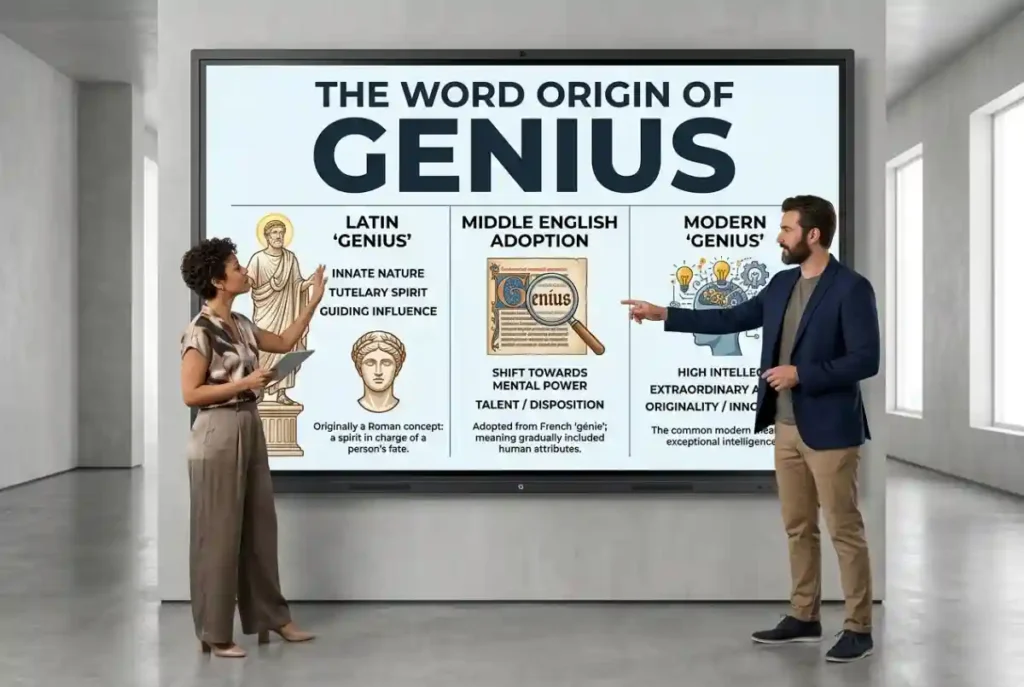
According to the Online Etymology Dictionary, the English noun came from Latin genius. In ancient Roman belief, the term referred to a guardian spirit associated with a person or family. It also developed meanings related to an individual’s inborn nature, character, wit, and talent.
The word entered English in the late fourteenth century with meanings connected to a guardian or guiding spirit. Over time, its meaning expanded.
By the sixteenth century, it could refer to a person’s characteristic nature or disposition. During the seventeenth century, uses referring to exceptional natural intelligence, skill, and talent became established.
Today, the most familiar meaning is a remarkably intelligent or creative person, or the outstanding ability that such a person displays.
This history also helps explain why genius and ingenious are related in meaning. Both connect with ideas of natural ability and inventive thinking, but English has preserved different spellings and grammatical forms for them.
Why Genius Ends in IUS
English spelling does not follow one universal ending rule. Some words end in ious, while others use different sequences of letters even when their pronunciation seems similar.
For example:
- Serious.
- Curious.
- Obvious.
- Ingenious.
- Genius.
The first four words end in ious, while genius ends in ius. The similarity between these words can encourage a writer to add an unnecessary letter.
A reliable way to learn the spelling is to treat genius as an individual word with its own established form rather than trying to make it fit the ending of ingenious.
There is no standard spelling rule that changes genius into genious. The correct approach is to memorize the accepted form and check it when needed.
Genius Examples for Everyday Writing
Learning the correct form becomes easier when you see it in different situations. The following examples show how genius works in conversations, schoolwork, professional writing, creative projects, and online messages.
Genius in Everyday Conversation
- My brother is a genius at fixing old computers.
- That is a genius way to organize your kitchen.
- She has a real genius for solving puzzles.
- We watched a documentary about a musical genius.
- His simple idea was a stroke of genius.
Each example uses the accepted spelling. Notice that the word can refer to a person, a skill, or a clever idea.
Genius in the Workplace
- The team showed real genius when it redesigned the ordering system.
- Our new colleague is a genius at finding software problems.
- Her genius for planning helped the company avoid costly delays.
- That was a genius move during the difficult negotiation.
- The manager praised the team for its ingenious solution.
The final sentence uses ingenious rather than genius. This example highlights the difference between the noun and the adjective.
Genius in Emails
- Your suggestion was a stroke of genius.
- I think we have a genius solution to the scheduling problem.
- Thank you for sharing such a clever idea with the team.
- The new process shows real ingenuity.
In professional emails, genius can sound enthusiastic and informal. More neutral expressions such as an excellent solution or a highly effective idea may suit a formal business message better.
Genius in Academic Writing
- The paper explores the relationship between creative genius and scientific discovery.
- The researcher demonstrated exceptional talent in mathematical reasoning.
- The article examines how society recognizes and rewards genius.
- Several influential geniuses contributed to the development of modern physics.
Academic writing often benefits from explaining what makes a person or idea exceptional instead of relying on the word genius alone. Clear evidence gives the description more weight.
Genius in Journalism and Literature
- The journalist described the inventor as a genius whose work changed the industry.
- The novel follows a young genius who struggles to fit into ordinary school life.
- Critics praised the composer’s genius and originality.
- The biography explores the private life of a celebrated scientific genius.
Journalists and authors can use genius to express admiration, but the word can also suggest that the subject is unusually gifted or difficult to understand. The surrounding details should support the description.
Genius on Social Media
- That shortcut is genius.
- Her latest design is pure genius.
- Whoever invented this feature is a genius.
- This is a genius idea for saving time.
These examples use the word in a casual and enthusiastic way. Online communication often favors short expressions of praise, so genius can work as an informal adjective or part of a wider phrase.
Examples of Correct and Incorrect Spelling
The contrast becomes clear when the misspelled form appears beside the accepted one.
| Incorrect sentence | Correct sentence |
|---|---|
| She is a genious at chess. | She is a genius at chess. |
| That was a stroke of genious. | That was a stroke of genius. |
| The young genious solved the problem. | The young genius solved the problem. |
| His genious helped the team succeed. | His genius helped the team succeed. |
| They hired two geniouses. | They hired two geniuses. |
| This is a genious idea. | This is a genius idea. |
| The scientist was a genious. | The scientist was a genius. |
| Her genious for music was clear. | Her genius for music was clear. |
In each incorrect sentence, the intended meaning is clear, but the spelling is not accepted for the word being used.
The correction is usually simple. Remove the extra o and check the surrounding grammar.
Genius or Genious Common Mistakes to Avoid
Adding an Extra O
The most frequent mistake is writing genious instead of genius.
Incorrect: The artist was a genious.
Correct: The artist was a genius.
The extra letter comes from an assumed spelling pattern rather than the accepted form of the word.
Confusing Genius and Ingenious
These words are related but not interchangeable in every sentence.
Incorrect for the intended adjective: She designed a genius device.
More precise: She designed an ingenious device.
The first form is possible in informal speech, but the second is the more established adjective choice for formal writing.
Using the Wrong Plural
Some writers carry the same spelling mistake into the plural.
Incorrect: The two geniouses worked together.
Correct: The two geniuses worked together.
The plural ending is es, added to the correct singular spelling.
Forgetting the Article
When genius refers to one person, it normally requires an article or another suitable determiner.
Incorrect: My sister is genius.
Correct: My sister is a genius.
The noun can be uncountable when it refers to exceptional ability itself, so this article rule depends on the meaning and sentence structure.
Assuming Every Website Is Correct
A word may appear on a blog, in a comment, or in a social media post without being spelled correctly.
Check a reliable dictionary when you need to confirm a doubtful spelling. Repeated online use alone does not turn genious into an accepted standard spelling.
Treating Genius as a Formal Measure
Calling someone a genius is a description, not a precise test result.
The word can express admiration for intelligence, creativity, or skill, but it does not provide a universal score. In professional or academic writing, explain the person’s actual achievements when that detail matters.
Memory Tricks for Genius
A good memory trick should make the correct spelling easy to retrieve without adding more confusion.
Remember the Ending IUS
The most direct method is to memorize the last three letters.
GENIUS ends in IUS.
Do not insert an extra o before the u.
Writing the word several times may help build familiarity with its exact letter sequence.
Link Genius With the Word Intelligent
Both words begin with ideas associated with intelligence and ability, but their spelling patterns differ.
Try remembering this short phrase.
A genius is intelligent, not genious.
The line is deliberately simple. Its purpose is to reinforce the correct spelling each time you recall it.
Keep Genius and Ingenious Separate
Think of the noun and adjective as two related but distinct tools.
A genius is a person with exceptional ability.
An ingenious idea is a clever and inventive idea.
This contrast provides a useful mental reminder. The noun genius does not need the extra o found in ingenious.
Practise With a Familiar Phrase
Choose a phrase that you can recall easily.
- A stroke of genius.
- A mathematical genius.
- A musical genius.
- Several geniuses.
Each expression reinforces the accepted spelling through natural use.
Proofread the Final Letters
When checking your own writing, focus briefly on the ending.
If you see genious, replace it with genius when the intended meaning is exceptional ability or a talented person.
A targeted check is often more effective than rereading every sentence with equal attention.
Genius or Genious Related Words and Useful Expressions
Building a strong vocabulary means learning words that share related meanings without treating them as identical.
| Word or expression | Meaning | Example |
|---|---|---|
| Genius. | Exceptional ability or a person with it. | She is a genius at mathematics. |
| Ingenious. | Clever and inventive. | He found an ingenious solution. |
| Ingenuity. | The ability to think creatively and solve problems. | The project required considerable ingenuity. |
| Intelligent. | Able to learn, understand, and reason well. | She is an intelligent student. |
| Brilliant. | Exceptionally clever, impressive, or successful. | That was a brilliant idea. |
| Gifted. | Naturally talented or highly capable. | He is a gifted musician. |
| Prodigy. | A young person with remarkable ability. | The child was a chess prodigy. |
| Savant. | A person with exceptional skill or knowledge in a particular area, often used in specific contexts. | The story features a musical savant. |
| Mastermind. | A person who plans or directs a complex activity. | She was the mastermind behind the project. |
| Stroke of genius. | An exceptionally clever idea or action. | The final change was a stroke of genius. |
These words overlap in some situations, but each adds a different shade of meaning. For example, intelligent is broader and more neutral than genius. A person can be intelligent without being considered a genius.
Likewise, an ingenious method can be clever even if the person who developed it is not known for exceptional ability in other areas.
Genius and Intelligent
Genius generally expresses a stronger or more exceptional level of ability than intelligent.
An intelligent student may learn quickly, understand difficult subjects, and reason well. Calling that student a genius makes a stronger claim about the level or originality of their ability.
Compare these sentences.
She is intelligent and works hard.
This gives a positive but fairly broad description.
She is a genius at mathematical reasoning.
This expresses exceptional ability in a specific field.
The distinction is not a precise ranking system. Speakers sometimes use genius informally for something merely clever, while formal writing may reserve it for unusually remarkable ability.

Genius and Brilliant
The word brilliant can describe a person, an idea, a performance, or a result.
For example, She gave a brilliant presentation praises the presentation. It does not necessarily claim that the speaker is a genius.
By comparison, She is a genius at explaining difficult ideas describes an exceptional ability that the person possesses.
The two words can sometimes communicate similar praise, but their grammatical uses and emphasis differ.
Expert Editor’s Note About Genius or Genious
From an editing perspective, the main correction is simple. Write genius rather than genious when referring to exceptional ability or a remarkably gifted person.
The deeper challenge is choosing the right related word for the sentence. Genius is primarily a noun. Ingenious is an adjective. Ingenuity is another noun that describes creative problem solving.
Reliable dictionaries support these distinctions. Cambridge Dictionary identifies genius as a noun and lists geniuses as its regular plural. The Online Etymology Dictionary traces its history to Latin and explains how the word developed from a term associated with a guardian spirit toward meanings related to character, talent, and exceptional ability.
For formal writing, I recommend checking three things.
First, confirm the spelling. The correct sequence is G E N I U S.
Second, check the grammatical role. Use genius for the person or ability, and consider ingenious when you need an adjective meaning clever and inventive.
Third, make sure the strength of the word suits the evidence. Calling someone a genius is stronger than simply calling them intelligent. In academic and professional writing, a specific description of the person’s achievement may be more useful than an unsupported label.
Frequently Asked Questions About Genius or Genious
Is genious ever correct in English
Genious is not the accepted standard spelling when you mean a person with exceptional intelligence or ability. It may appear as a chosen name, username, brand, or creative spelling, but those uses do not change the ordinary dictionary spelling. In a school assignment, business email, or article, use genius for the intended meaning.
Why do people spell genius as genious
The mistake often comes from familiar English endings such as ious in serious, curious, and ingenious. Writers may assume genius follows the same pattern and insert an extra o. Quick typing and missed proofreading can also contribute. The most reliable solution is to memorize the ending ius and verify doubtful spellings in a dictionary.
What is the plural of genius
The regular plural is geniuses. For example, Several young geniuses presented their inventions at the science fair. The form geniouses is incorrect when the intended word is geniuses. A less common form, genii, exists because of the word’s Latin history, but geniuses is the normal choice in modern everyday English.
Is genius a noun or an adjective
Genius is primarily a noun. It can name an exceptionally talented person or the exceptional ability itself. In informal English, speakers also use it in expressions such as That was genius or a genius idea. In formal writing, brilliant or ingenious may be more suitable when you need a conventional adjective.
What is the difference between genius and ingenious
Genius is a noun for exceptional ability or a person who possesses it. Ingenious is an adjective meaning clever and inventive. You might describe a scientist as a genius and the scientist’s design as ingenious. The meanings overlap because both involve ability and cleverness, but the words have different grammatical jobs.
How do you pronounce genius
The word is pronounced /ˈdʒiː.ni.əs/ in standard British and American dictionary notation. It has three syllables, with the main stress on the first. Think of the opening sound in jump, followed by the long ee sound. Pronunciation can vary slightly among accents, but the spelling remains genius.
Is genius spelled the same in American and British English
Yes. Both American and British English use genius. Canadian and Australian English follow the same standard spelling as well. There is no regional spelling variation that makes genious correct for this meaning. Writers can use genius confidently for readers in any of these English speaking regions.
How can I remember the spelling of genius
Remember that genius ends in IUS. The word does not contain an extra o before the u. You can also practise familiar expressions such as a stroke of genius, a mathematical genius, and several geniuses. Linking the noun genius with the adjective ingenious while keeping their spellings separate is another useful strategy.
Final Verdict Genius or Genious
The correct spelling is genius. The form genious is a common mistake when the writer means exceptional intelligence, creativity, or a person with remarkable talent.
Remember the main points.
- Genius is the accepted spelling.
- Genious is incorrect for this intended meaning.
- Genius is primarily a noun.
- Geniuses is the normal plural.
- Ingenious is a separate adjective meaning clever and inventive.
- American, British, Canadian, and Australian English use the same spelling.
The best practical approach is to memorize the final letters, check the word during proofreading, and learn it in familiar phrases. You do not need a complicated rule to get this one right.
When in doubt, remember the extra letter has no place in genius.

Founding Editor
Maya spent six years as a copyeditor at a regional newspaper before starting Grammist, which is where the “answer first” format came from: newsroom style guides don’t have room for a preamble.
She writes and reviews most of the word-pair and spelling entries, and has final say on anything that goes out under the Grammist name.