

The difference between function vs functionality can be confusing because both words describe what something does. You’ll often see them used in software documentation, product reviews, business reports, technical guides, and everyday conversations. Although they’re closely related, they don’t mean exactly the same thing.
A function is a specific job, action, or purpose that something performs. Functionality refers to the range of functions a product or system offers, or how well those functions work in practice. For example, a calculator’s function is to perform calculations. Its functionality might include addition, subtraction, percentages, memory storage, and scientific calculations.
The distinction matters when you’re writing about technology, explaining a product, or describing a process. Saying that an app has a useful function highlights one particular capability. Saying that it offers useful functionality refers to its broader set of capabilities.
Both words are correct, and neither is a misspelling of the other. The challenge is choosing the word that matches your intended meaning. Their grammatical roles also differ in useful ways, especially when you need to form plurals or describe specific features.
This guide explains the meaning of each word, their main differences, and how to use them naturally in American English. You’ll also find practical examples from software, business communication, academic writing, and everyday speech, along with grammar tips and common mistakes to avoid.
Function vs Functionality Quick Answer
A function is a specific task or purpose performed by a person, object, or system. Functionality describes the range of capabilities a product or system provides, or how well those capabilities work. For example, saving a document is a function, while a document editor’s overall set of tools represents its functionality.
Function vs Functionality At A Glance
| Feature | Function | Functionality |
|---|---|---|
| Main meaning | A specific task or purpose | The range or quality of available capabilities |
| Part of speech | Noun | Noun |
| Countable | Usually countable in the relevant sense | Usually uncountable |
| Plural form | Functions | Functionalities, in specialized contexts |
| Common context | Programming, mathematics, general use | Software, product design, technology |
| Example | The search function finds files. | The app offers useful search functionality. |
| Focus | An individual action or role | A broader set of capabilities or how they operate |
| Common adjective | Functional | Functional |
| Related verb | Function | Function |
| Typical question | What does it do? | What capabilities does it offer? |
The main distinction is straightforward. Function often identifies an individual capability, while functionality usually describes capabilities as a group or their practical operation.
However, context can change the emphasis. In technical discussions, functionality can refer to the ability of a feature to work correctly, not just the number of features available.
What Does Function vs Functionality Mean
What Does Function Means
A function is a job, purpose, action, or role performed by something. The word can describe almost anything that does a particular job, from a household appliance to a computer program or a person working in an organization.
The exact meaning depends on the subject.
Function In Everyday English
In everyday English, a function is the purpose of something or the job it performs.
Consider these examples.
- The main function of a refrigerator is to keep food cold.
- The alarm function wakes me up every morning.
- One function of a school is to educate children.
- The heart’s function is to pump blood through the body.
- Her function on the team is to coordinate the schedule.
Each example identifies a particular role or purpose.
The word doesn’t necessarily refer to technology. A doorbell has a function, a teacher performs a function, and a public office may serve a specific function within a community.
Function In Software
In software, a function can refer to a particular capability or operation available to the user. It can also have a more precise meaning in programming, where a function is a defined unit of code that performs a task.
For example, a photo editing app might include these functions.
- Crop an image.
- Adjust brightness.
- Remove red eye.
- Rotate a photo.
- Export an image.
Each item describes a specific capability.
In programming, a function might take input, process it, and return a result. For instance, a function can calculate a total price from the quantity and cost of an item.
These meanings are related, but they aren’t identical. A user facing feature and a programming function can serve different purposes even when they contribute to the same result.
Function In Mathematics
In mathematics, a function is a relationship that assigns exactly one output to each permitted input.
For example, consider the function:
(f(x)=2x+3)
If (x=4), the output is (11).
Here, function has a precise mathematical meaning. It describes a rule connecting an input to an output.
This is different from the broader product design meaning of functionality. A mathematical function follows a formal definition, while a product’s functionality concerns what it can do.
Function In Business
In business, a function is a specific responsibility or area of work.
Common examples include:
- The finance function manages budgets and financial reporting.
- The marketing function promotes products and services.
- The human resources function supports hiring and employee management.
- The operations function coordinates daily business activities.
A company may have several functions, each responsible for a different part of its work.
In this context, functionality would usually be the wrong choice if you simply mean a department’s role or responsibility.
What Does Functionality Mean
Functionality is a noun that describes the capabilities available in a system, product, application, or device. It can also describe how effectively those capabilities work.
The word is especially common in software development, product design, engineering, and technical writing.
Functionality In Everyday Technology
Imagine that you’re choosing a new smartphone.
One phone lets you make calls and send messages. Another also supports wireless payments, advanced photography, voice commands, and screen recording.
The second phone offers a broader range of functionality.
The word describes the collection of capabilities available to the user rather than one isolated action.
Here are a few natural examples.
- The new app offers better functionality.
- The website has limited functionality on mobile devices.
- The update adds useful functionality for business users.
- The software’s functionality meets our basic needs.
- The device provides enough functionality for everyday tasks.
In each sentence, functionality refers to a broader set of capabilities or the way those capabilities are provided.
Functionality In Software Development
Software teams use functionality to describe what an application can do and how its capabilities operate.
For example, an online store might provide the following functionality.
- Product search and filtering.
- Shopping cart management.
- Secure checkout.
- Order tracking.
- Customer account management.
- Product reviews.
Together, these capabilities form part of the store’s functionality.
Developers and product managers might also discuss functionality in terms of quality. If a search feature exists but fails to return relevant results, the application technically has that feature, but its functionality may be limited or defective.
This is an important distinction. A product can contain many features yet deliver poor functionality if those features don’t work reliably or don’t meet users’ needs.
Functionality In Product Design
Product designers consider functionality alongside usability, accessibility, appearance, and performance.
A product may have a wide range of functions but still frustrate users if those functions are difficult to find or operate.
For example, a camera might include dozens of shooting modes. However, if users can’t understand the controls, the camera’s practical value suffers.
In product design, functionality often answers two related questions.
- What can the product do?
- How well can users access and use those capabilities?
The first question focuses on the available features. The second focuses on their practical operation.
Functionality In Business Communication
Business professionals use functionality when discussing the capabilities of tools, platforms, and systems.
For example:
- The new platform offers functionality for tracking customer requests.
- We need additional functionality before launching the service.
- The reporting functionality is available to premium users.
- The software lacks the functionality required by our sales team.
These statements describe capabilities as part of a broader system.
When discussing one specific task, however, function may be more direct.
Instead of saying, “The functionality that sends reminders is broken,” you could write, “The reminder function is broken.”
The second sentence identifies the exact capability that needs attention.
The Main Difference Between Function vs Functionality
The difference comes down to focus.
A function is often one specific task, purpose, or operation. Functionality usually refers to the set of capabilities a system provides or the practical ability of those capabilities to work.
Think about a television.
Its basic function is to display video and play sound. Its broader functionality may include streaming apps, voice control, screen sharing, accessibility settings, and automatic picture adjustment.
The function describes an individual purpose. Functionality describes the broader capabilities that support the user experience.
One Capability Versus A Collection Of Capabilities
Consider a note taking app.
Its search function lets users find specific notes, its reminder function alerts users about tasks, its sharing function lets people collaborate.
The app’s functionality includes these capabilities and other features that help users create, organize, and manage notes.
This distinction is useful when writing product descriptions or explaining software requirements.
If you mean one identifiable operation, use function. If you mean the overall set of available capabilities, use functionality.
Capability Versus Practical Operation
The distinction can become more subtle in technical writing.
A team might say:
“The application has an export function.”
This means the application includes a capability for exporting data.
The same team might say:
“The export functionality is unreliable.”
This focuses on how the export capability works in practice.
The second statement may refer to the entire export process, including file formats, data handling, error messages, and compatibility.
Therefore, functionality doesn’t always mean multiple functions. It can also describe how a particular capability operates as part of a system.

Is Functionality Just A Fancy Word For Function
No. The words overlap, but they aren’t interchangeable in every sentence.
Function is often more precise when you’re describing a single task. Functionality is useful when you mean a collection of capabilities or their practical operation.
Compare these examples.
The app has a translation function.
This identifies one capability.
The app offers translation functionality.
This can describe translation tools as a broader capability, potentially including language selection, automatic detection, and text or voice translation.
The app’s functionality is limited.
This refers to the app’s overall capabilities or how they operate. Replacing functionality with function would change the focus and may make the sentence less natural.
There is no need to choose the longer word just because it sounds more technical. Good writing uses the shortest accurate term.
Function vs Functionality Which Word Should You Use
Choose function when you mean a specific task, purpose, role, or operation.
Choose functionality when you mean a range of capabilities or how well those capabilities work as part of a system.
Use this quick guide.
| What you want to express | Better choice | Example |
|---|---|---|
| One specific capability | Function | The app has a search function. |
| A collection of capabilities | Functionality | The app offers advanced search functionality. |
| The purpose of an object | Function | The function of the filter is to remove dust. |
| A system’s overall capabilities | Functionality | The system has limited functionality. |
| A programming unit | Function | This function calculates the total. |
| A feature that isn’t working | Function | The login function is broken. |
| How well a system’s capabilities work | Functionality | The software’s functionality needs testing. |
| A department’s role | Function | Finance is a core business function. |
If you’re writing for a general audience, specific words such as feature, tool, capability, or task may be clearer than functionality.
For instance, “The app includes a tool for editing photos” is often easier to understand than “The app includes photo editing functionality.”
The best choice depends on your audience and the detail you need to convey.
Function vs Functionality In Grammar
Both function and functionality are nouns. They can serve as subjects, objects, or complements in a sentence. Their main grammatical difference involves countability and how speakers use them in context.
Function is commonly countable when it refers to an individual task or role. You can say a function, the function, or several functions.
Functionality is usually uncountable when it refers to a system’s overall capabilities. You would normally say the functionality or some functionality, rather than a functionality.
Is Function Countable Or Uncountable
The noun function is countable in many common contexts.
Examples include:
- The app has a useful function.
- This function saves time.
- We need three additional functions.
- Each function serves a different purpose.
- The software performs several functions.
The plural form is functions.
However, function can also describe a general purpose or role without emphasizing a countable item.
For example:
The main function of this department is customer support.
Here, function refers to the department’s primary responsibility. Although the noun remains countable in principle, the sentence focuses on one central role.
Is Functionality Countable Or Uncountable
Functionality is usually an uncountable noun in modern technical and business English.
Natural examples include:
- The software offers additional functionality.
- This functionality saves time.
- The device lacks basic functionality.
- We need to improve the system’s functionality.
- The update provides more functionality for users.
Notice that these sentences don’t use a before functionality.
Instead, writers can use expressions such as:
- a useful feature
- a new capability
- an additional function
- a range of functions
- a set of capabilities
These alternatives allow you to refer to individual items clearly.
The plural functionalities does appear in specialized technical writing. It usually refers to distinct types or areas of functionality. However, many editors prefer functions, features, or capabilities when the writer means separately identifiable items.
Can You Say A Functionality
You may encounter a functionality in product documentation, business discussions, and technical meetings. Some speakers use it to mean one feature or capability.
However, the expression can sound unnatural to many English speakers because functionality usually behaves as an uncountable noun.
For clearer writing, use one of these alternatives.
Instead of:
The app has a new functionality for sharing files.
Write:
The app has a new file sharing function.
Or:
The app includes a new file sharing feature.
Instead of:
We need three functionalities.
Write:
We need three additional functions.
Or:
We need three additional capabilities.
The revised versions identify the countable items directly.
Can You Say Functionalities
Yes. Functionalities is a valid plural form, particularly in specialized technical contexts.
For example:
The team tested the platform’s core functionalities before release.
This sentence is understandable and grammatically possible. Still, an editor might prefer core functions or core features because these terms sound more direct.
Use functionalities when the technical context makes the meaning clear and the term fits the organization’s established language. Otherwise, choose a more familiar countable noun.
Function vs Functionality In Sentence Structure
Both words can appear in similar sentence patterns.
As The Subject
The function controls the display brightness.
The functionality controls available display settings.
The first sentence refers to a specific operation. The second refers to a broader capability or system behavior.
As The Direct Object
The developer tested the function.
The developer tested the software’s functionality.
In the first sentence, the developer tested a particular operation. In the second, the focus is broader and may include several related operations.
After A Linking Verb
This is an important function of the software.
This is an important part of the software’s functionality.
The second example adds part of because functionality is normally uncountable. That phrasing also helps the reader understand that the discussion concerns one aspect of a larger system.
In Possessive Forms
Both nouns can show possession.
- The function’s output was incorrect.
- The application’s functionality was limited.
- The functions’ results differed.
- The systems’ functionality varied.
An apostrophe can help distinguish a singular noun from a plural noun.
The function’s output means the output of one function.
The functions’ output would refer to output associated with multiple functions, although a writer might choose a more natural alternative depending on the sentence.
The application’s functionality means the functionality of the application.
Function vs Functionality And Word Forms
The two nouns belong to the same word family, but their related forms have different uses.
| Word | Part of speech | Meaning or use |
|---|---|---|
| Function | Noun | A task, purpose, role, or operation |
| Function | Verb | To work or operate |
| Functions | Plural noun | More than one function |
| Functional | Adjective | Working or serving a practical purpose |
| Functionally | Adverb | In terms of function or operation |
| Functionality | Noun | Capabilities or practical operation |
| Functionalities | Plural noun | Distinct capabilities in specialized usage |
The related adjective functional is particularly useful.
For example:
The system is functional.
This means the system works or performs its intended purpose.
The system has useful functionality.
This means the system offers capabilities that serve the user’s needs.
The two statements are related, but they don’t communicate exactly the same thing. A system can be functional while still lacking advanced functionality.
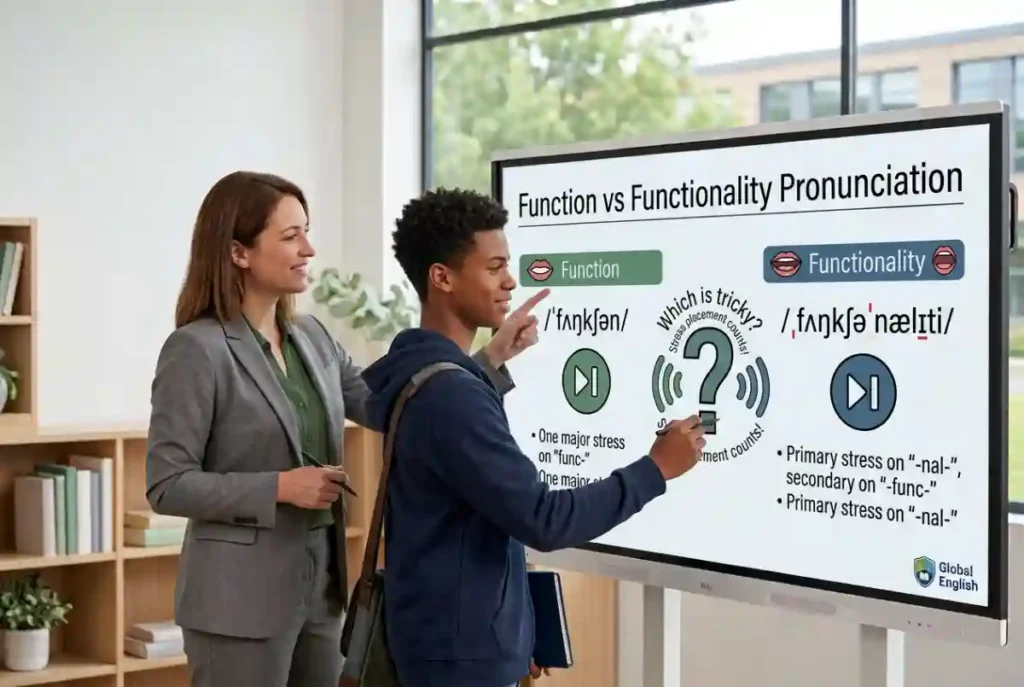
Function vs Functionality Pronunciation
The words share a common root, so their pronunciation is related. However, they differ in length and stress.
| Word | IPA | Syllables | Main stress |
|---|---|---|---|
| Function | /ˈfʌŋk.ʃən/ | 2 | First syllable |
| Functionality | /ˌfʌŋk.ʃəˈnæl.ə.ti/ | 6 | Main stress on nal |
Pronunciation can vary slightly by accent and dictionary transcription. The forms shown here represent a common American English pronunciation.
How To Pronounce Function
Say function as FUNK shun.
The stress falls on the first syllable.
The ending sounds like shun, not tion pronounced as two separate syllables.
Practice these phrases.
- main function
- search function
- basic function
- function of the device
How To Pronounce Functionality
Say functionality in six syllables:
funk shuh NAL uh tee
The main stress falls on NAL.
Because the word is longer, learners sometimes place the stress too early or pronounce every syllable with equal force. English speakers usually give the stressed syllable greater prominence.
Practice these phrases.
- software functionality
- improved functionality
- limited functionality
- functionality testing
A useful method is to say the shorter word first, then add the ending gradually. This helps you preserve the original sound while learning the longer form.
Function vs Functionality Spelling
Neither word is a misspelling of the other.
Function is the shorter noun. Functionality is formed from functional plus the noun forming suffix ity, with spelling changes that produce the established form.
The correct spellings are:
- function
- functions
- functional
- functionality
- functionalities
Avoid invented alternatives such as functionallity or functionnality in standard English writing.
The most useful strategy is to learn the word family together. Recognizing function inside functionality makes both spelling and meaning easier to remember.
Why People Confuse Function vs Functionality
The confusion usually comes from the fact that both words describe what something does.
In everyday conversation, people may use them loosely. In software and business writing, their meanings can overlap enough that the distinction seems unimportant.
Still, several patterns explain why writers mix them up.
They Share The Same Root
Both words come from the same word family. Functionality contains the word function, so readers naturally connect the meanings.
That connection is correct, but it doesn’t make the words interchangeable.
Think of use and usefulness. Both relate to using something, but one can describe an action while the other describes a quality.
The same general pattern helps explain function and functionality.
Technical Language Encourages Longer Words
In software discussions, functionality can sound more technical or comprehensive. As a result, writers sometimes use it when a simpler term would be clearer.
For example:
The login functionality is broken.
This is acceptable, particularly when discussing the broader login process.
However:
The login function is broken.
is more direct if one specific operation has failed.
Longer terminology does not automatically make writing more precise. The noun should reflect the actual problem.
Workplace Jargon Blurs The Difference
Teams often use functionality as a broad label for product capabilities. Over time, the word can become a catchall term.
Someone might say:
We need more functionality.
That could mean more features, better integration, stronger reporting, or improved reliability.
The statement may be clear in a meeting where everyone knows the project. Outside that context, it leaves too much open to interpretation.
A better version identifies the need.
We need a function that exports reports to Excel.
This sentence describes a specific requirement.
Both Words Can Describe Software
Software is one of the main areas where the terms overlap.
A single function contributes to a product’s functionality. At the same time, functionality can describe the behavior of a single feature or an entire application.
That overlap is real. It doesn’t erase the difference in emphasis.
When in doubt, name the specific operation if you can. Use functionality when the discussion genuinely concerns the wider set of capabilities or their overall operation.
Function vs Functionality In Real Life
The best way to understand the distinction is to see how the words behave in different settings.
Daily Conversation
In everyday speech, function often sounds more natural when you are discussing one task.
Examples:
- The timer function helps me manage my breaks.
- The main function of this button is to turn the screen off.
- My phone has a function that blocks unwanted calls.
- The app’s functionality is better than it used to be.
- I like the phone’s simple functionality.
- This device has limited functionality without an internet connection.
The first three examples identify particular tasks. The final three describe the broader capabilities of the device or app.
Workplace Communication
Workplace writing often requires more detail than casual speech.
Examples:
- The search function needs to support partial matches.
- Our reporting functionality needs improvement.
- Each function must pass its assigned test.
- The new platform provides functionality for tracking leads.
- The payment function failed during testing.
- We should review the system’s functionality before launch.
A useful editing habit is to replace vague technical language with a specific capability whenever possible.
For instance, improve the functionality might mean adding filters, reducing errors, or making the interface easier to use. A detailed requirement helps everyone understand the task.
Emails
In emails, choose the word that makes your request easy to understand.
Examples:
Hi Alex,
The export function isn’t working as expected. Could you check the error and let me know when we can test it again?
Hi Jordan,
The current reporting functionality doesn’t cover all the metrics our team needs. Could we discuss the missing capabilities during tomorrow’s meeting?
The first email identifies one problem. The second describes a broader gap in the system.
Academic Writing
Academic writing often uses function to describe a role or purpose.
Examples:
- The primary function of the model is to classify the input data.
- The study examines the function of feedback in language learning.
- Researchers evaluated the functionality of the digital learning platform.
- The software’s functionality was assessed through a series of user tests.
The difference is especially important in research methods. If a study examines one specific operation, function may be more precise. If it evaluates the wider capabilities of a system, functionality may fit better.
Journalism And Product Reviews
Journalists and reviewers often describe both individual features and the overall product experience.
Examples:
- The camera’s night mode function improves low light photos.
- The device offers useful functionality for travelers.
- The new update adds a function for scheduling messages.
- The software’s functionality remains limited on older devices.
A product review becomes more informative when the writer names the actual capability instead of relying on broad terms.
Social Media
Informal writing allows more flexibility, but the distinction still helps.
Examples:
- This app needs a better search function.
- The new update adds useful functionality.
- I barely use the advanced functions.
- The software has plenty of functionality but a confusing interface.
These sentences sound natural because each word fits the intended scope.
Function vs Functionality In Software Development
Software development is one of the most important contexts for this comparison. Both terms appear in requirements, product specifications, testing plans, technical support documents, and user guides.
Although developers may use the words differently across teams, a practical distinction helps keep documentation clear.
A function often refers to a specific operation. Functionality usually refers to a set of capabilities or the behavior those capabilities provide.
Function In Programming
In programming, a function is a named or otherwise defined block of code designed to perform a task. Depending on the language and programming model, it may accept inputs, process data, and return an output.
For example, a function might calculate sales tax.
This function takes a price and a tax rate, then returns the calculated tax.
In this technical context, function has a specific meaning. It isn’t simply a general feature in an application.
Programming languages also use related terms such as method, procedure, and routine. Their exact meanings depend on the language and programming style.
A method is commonly associated with an object or class. A function may exist independently, depending on the language. A procedure often describes a block of code that performs an action, sometimes without returning a value.
These terms overlap in some programming environments, but they aren’t universally identical.
Functionality In Software Products
A software product’s functionality describes the capabilities it offers and how they operate.
For example, a project management application may include:
- Task creation.
- Deadline tracking.
- Team assignments.
- File attachments.
- Progress reports.
- Calendar integration.
These capabilities contribute to the product’s functionality.
Product teams may evaluate functionality during development to confirm that the system supports the required tasks. They may also review it after launch to identify missing capabilities or problems.
Functionality Testing
Functionality testing checks if a system or feature behaves as expected under specified conditions.
For example, testers might check if:
- A user can sign in with valid credentials.
- An incorrect password triggers an appropriate error.
- A search returns matching records.
- A payment request produces the correct result.
- A report exports to the selected file format.
In everyday technical writing, people may refer to this as functional testing. The exact testing terminology depends on the project and its test strategy.
The distinction matters because functionality is the broader capability or behavior being assessed, while a function may be one individual operation included in that assessment.
Functionality Versus Usability
Functionality and usability are related but different.
This word concerns what a product can do and how its capabilities operate.
Usability concerns how easily people can use the product to complete their tasks.
A mobile banking app may provide a transfer function, bill payment, transaction history, and spending reports. These capabilities form part of its functionality.
However, if users struggle to locate the transfer button, the app may have good functionality but poor usability.
A useful product evaluation considers both. A long list of capabilities does not guarantee a good user experience.
Functionality Versus Performance
Performance concerns how efficiently a system operates under particular conditions. It can involve response time, resource use, throughput, and stability.
Functionality concerns available capabilities and their behavior.
For example, a website might have excellent functionality but load slowly. It can support search, payments, user accounts, and order tracking while still performing poorly under heavy traffic.
The reverse can also happen. A website may load quickly but lack important capabilities.
These distinctions help teams describe problems accurately.
Instead of saying:
The website is bad.
A more useful report might say:
The website supports all required checkout functions but responds slowly during peak traffic.
The second sentence identifies a functionality strength and a performance problem.
Function vs Functionality In Product Requirements
Product requirements describe what a system must do.
A requirement might specify an individual function:
The application must allow users to reset their passwords by email.
A broader requirement might describe functionality:
The application must provide account recovery functionality for users who cannot access their accounts.
The first statement names one operation. The second describes a wider capability that may include password resets, identity checks, and account recovery steps.
In well written requirements, the distinction should support clarity rather than create more jargon.
If the requirement concerns one specific action, describe that action. If it covers several related operations, define the overall capability and list its component functions.
Function vs Feature vs Functionality
These three words often appear together in product development, but each has a slightly different emphasis.
| Term | Typical meaning | Example |
|---|---|---|
| Function | A specific task or operation | The app saves a draft. |
| Feature | A user facing capability or product element | The app includes automatic draft saving. |
| Functionality | The range or operation of available capabilities | The app offers automatic saving and recovery functionality. |
The boundaries aren’t rigid. Product teams may use function and feature interchangeably in some settings.
Still, a useful distinction is that a function emphasizes what an operation does, while a feature emphasizes a capability presented to the user. Functionality can describe the larger collection of those capabilities.
For a general audience, feature is often the clearest choice when discussing a visible product benefit.
For example:
The app has a new feature that lets users schedule messages.
This is direct and easy to understand.
Function vs Capability
Capability refers to the ability to do something. It is often a useful alternative to functionality, especially when describing systems or organizations.
Compare these examples.
The software has a function for generating reports.
This identifies a specific operation.
The software has reporting capabilities.
This describes what the software can do in a broader sense.
The software offers reporting functionality.
This is also correct, particularly in technical documentation.
Capability is often easier for general readers to understand because it connects directly to the idea of being able to perform a task.
However, capability may refer to potential ability rather than an implemented feature. For example, a company may have the capability to develop a tool even though the tool does not exist yet.
Context determines the best choice.
Function vs Purpose
Purpose describes the reason something exists or the goal it is intended to achieve. Function describes the role or task it performs.
The difference is subtle.
The purpose of the alarm is to wake me up.
This explains why the alarm exists.
The alarm’s function is to produce a sound at the set time.
This describes what the alarm does.
In many everyday sentences, the words overlap. Still, purpose usually focuses on the intended goal, while function focuses on the role or operation.
Functionality is broader still when it describes the capabilities of a product or system.
Function vs Operation
Operation can refer to the process of doing something or the way a system works. Function more often identifies a particular task or purpose.
For example:
The function of the filter is to remove unwanted particles.
This explains the filter’s purpose.
The operation of the filter depends on water pressure.
This explains how the filter works.
In technical writing, operation can also mean a specific action performed by a system. That makes it possible for function and operation to overlap.
When the distinction matters, describe the task with function and the process with operation.
Functionality Versus Compatibility
Compatibility describes the ability of products, systems, or components to work together.
Functionality describes available capabilities or how they work.
A software tool may offer strong functionality but have limited compatibility with older devices. Another tool may work on many devices but provide only basic functionality.
For example:
The application has useful functionality but doesn’t support our older operating system.
The sentence separates the application’s capabilities from its compatibility limits.
This distinction is especially useful when writing product comparisons, technical support articles, and purchasing guides.
Functionality Versus Reliability
Reliability concerns consistent operation over time or under specified conditions.
Functionality concerns capabilities and their behavior.
A system might provide many functions but fail frequently. In that case, it has broad functionality but poor reliability.
For example:
The platform offers useful reporting functionality but often loses connection during large exports.
The sentence praises one aspect while identifying a reliability problem.
Clear technical writing separates these ideas instead of treating every problem as a general lack of functionality.
Function vs Functionality In Professional Editing
An experienced editor looks for the intended meaning first. The goal isn’t to replace every use of functionality with function or to ban technical vocabulary. The goal is to make the sentence as precise and readable as possible.
When To Keep Functionality
Keep functionality when the sentence concerns a system’s broader capabilities or the way those capabilities work.
For example:
The new version expands the platform’s functionality.
This is natural because the update may add several related capabilities.
Another example:
The team evaluated the functionality of the scheduling system.
This suggests a broader evaluation of how the system operates.
When To Replace Functionality
Replace functionality when the writer means one clear feature or operation.
Instead of:
The functionality that creates reports is unavailable.
Write:
The report generation function is unavailable.
Or use simpler language:
The app cannot generate reports right now.
The last sentence is often the best choice for general readers because it describes the problem directly.
Avoid Using Functionality As A Substitute For Every Technical Noun
Technical language can become vague when writers use functionality to cover several different ideas.
For example:
We need to improve the functionality of the customer experience.
This sentence is unclear. Does the team need better software features, a simpler interface, faster response times, or improved customer support?
A more useful version would identify the real problem.
We need to add order tracking and make the checkout process easier to use.
Specific language saves time and reduces confusion.
What Dictionaries And Style Guides Support
General dictionaries treat function as a noun referring to a purpose, role, or activity, and also as a verb meaning to work or operate. In technical fields, it can have more specialized meanings.
Functionality refers to the quality of being functional or the range of functions available in a system, product, or process.
This supports the main distinction in this guide. The words belong to the same family, but they emphasize different things.
General editorial guidance also favors clear and direct language. A writer shouldn’t choose a longer word simply because it sounds more professional.
For a general audience, the app can export reports is often clearer than the app provides report exporting functionality.
Both statements may communicate the same fact, but the first takes less effort to understand.
Technical documentation can justify the longer form when it describes a defined group of capabilities. Even then, writers should use the term consistently.
Common Mistakes With Function vs Functionality
Several errors appear regularly in workplace writing and technical documentation.
Using Functionality For One Simple Action
Less direct: The application has functionality for printing documents.
Clearer: The application has a print function.
The second sentence identifies one specific operation.
Treating Functionality As A Countable Noun
Less natural: The platform includes a functionality for scheduling meetings.
Clearer: The platform includes a meeting scheduling function.
The revised sentence uses a countable noun for one identifiable capability.
Assuming Functionality Means Quality
Functionality can describe the capabilities a system provides. It doesn’t automatically mean those capabilities are good.
For example:
The app has extensive functionality but a confusing interface.
The app offers many capabilities, yet users may still struggle to operate it.
If you mean quality, explain what works well or poorly.
Confusing Functionality With Performance
A system may have the right functions but operate slowly.
Instead of saying:
The functionality is poor because the page loads slowly.
Consider:
The page loads slowly even though the required functions are available.
The revised version distinguishes performance from available capabilities.
Using Technical Language When Plain English Works
A sentence such as:
The functionality enables users to initiate a data transfer.
may be appropriate in a formal specification.
For a general audience, this is easier:
The feature lets users transfer data.
The best wording depends on the reader, not on how technical the sentence sounds.

Memory Tricks For Function vs Functionality
Use these simple reminders to keep the words straight.
Function means one job.
Think of a button that performs one action.
Functionality means the available capabilities.
Think of everything a device or application can do.
A second trick is to connect the word endings.
Function is the core word.
Functional describes something that works or serves a purpose.
Functionality describes the capabilities or practical operation associated with something functional.
Remembering the word family makes it easier to spell the words and understand how they relate.
Related Words And Expressions
These related terms can help you write with greater precision.
| Word | Meaning | Example |
|---|---|---|
| Feature | A particular product capability | The app has a translation feature. |
| Capability | The ability to perform a task | The system has image recognition capabilities. |
| Purpose | The reason something exists | The purpose of the tool is to simplify scheduling. |
| Operation | The process or manner of working | The device’s operation is simple. |
| Performance | How well something operates against relevant measures | The system’s performance improved after the update. |
| Usability | How easy a product is to use | The redesign improved usability. |
| Reliability | The ability to work consistently | The software’s reliability improved. |
| Compatibility | The ability to work with another system or product | The app has broad device compatibility. |
| Functional | Working or serving a practical purpose | The website is functional but outdated. |
| Functional requirement | A statement describing what a system must do | The system must let users reset passwords. |
These words are related, but they aren’t interchangeable in every sentence. Choose the one that describes the exact concept you mean.
Frequently Asked Questions
What is the difference between function and functionality
A function is a specific task, purpose, or operation. Functionality describes the capabilities available in a system or how those capabilities work in practice. For example, an app’s search function finds information, while its search functionality may include filtering, suggestions, sorting, and handling search errors.
Is functionality grammatically correct
Yes. Functionality is a standard English noun used widely in technology, product design, engineering, and business writing. It is usually uncountable, as in the software offers useful functionality. When you need to refer to one item, function, feature, or capability is often more natural.
What is the plural of function and functionality
The plural of function is functions. The plural functionalities also exists, especially in specialized technical writing, but functionality is usually treated as an uncountable noun. For clear general writing, use functions, features, or capabilities when referring to separate items.
Can functionality refer to one feature
Yes. In technical contexts, functionality can describe the behavior or operation of a single feature. For example, the search functionality is unreliable can refer to one search feature and its behavior. However, the search function is unreliable may be more direct if you’re discussing one specific operation.
Is functionality the same as usability
No. Functionality concerns the capabilities a product provides and how they operate. Usability concerns how easily people can use those capabilities to achieve their goals. A product can offer extensive functionality but still have poor usability if its controls are confusing or difficult to find.
What is the difference between function and feature
A function is an operation or task performed by a system. A feature is a capability or product element presented to users. The terms overlap in some technical settings, but feature is often more natural in consumer writing. For example, automatic translation is a feature that may rely on several functions behind the scenes.
Should I write functionality or functions in technical documentation
Use functions when you mean separate operations. Use functionality when you mean a broader set of capabilities or the way those capabilities work. In technical documentation, consistency matters. Define terms clearly when the distinction affects requirements, testing, or implementation.
Is functionality a buzzword
Not necessarily. Functionality is a useful technical term when it describes a system’s capabilities or operation. It becomes vague when writers use it in place of a specific feature, task, or benefit. If a simpler word communicates the meaning accurately, prefer the simpler word.
Final Verdict
The difference between function vs functionality is mainly a difference in focus.
A function is a specific task, purpose, role, or operation. Functionality describes the capabilities a system provides or how those capabilities work in practice.
Both terms are correct, and neither is a misspelling. The most common mistake is using functionality when you mean one simple function or feature.
For clear everyday writing, name the specific operation whenever possible. Use functionality when the broader capabilities of a product or system are the real subject.
The best technical writing isn’t the writing with the longest words. It’s the writing that makes the meaning clear the first time.

Founding Editor
Maya spent six years as a copyeditor at a regional newspaper before starting Grammist, which is where the “answer first” format came from: newsroom style guides don’t have room for a preamble.
She writes and reviews most of the word-pair and spelling entries, and has final say on anything that goes out under the Grammist name.