
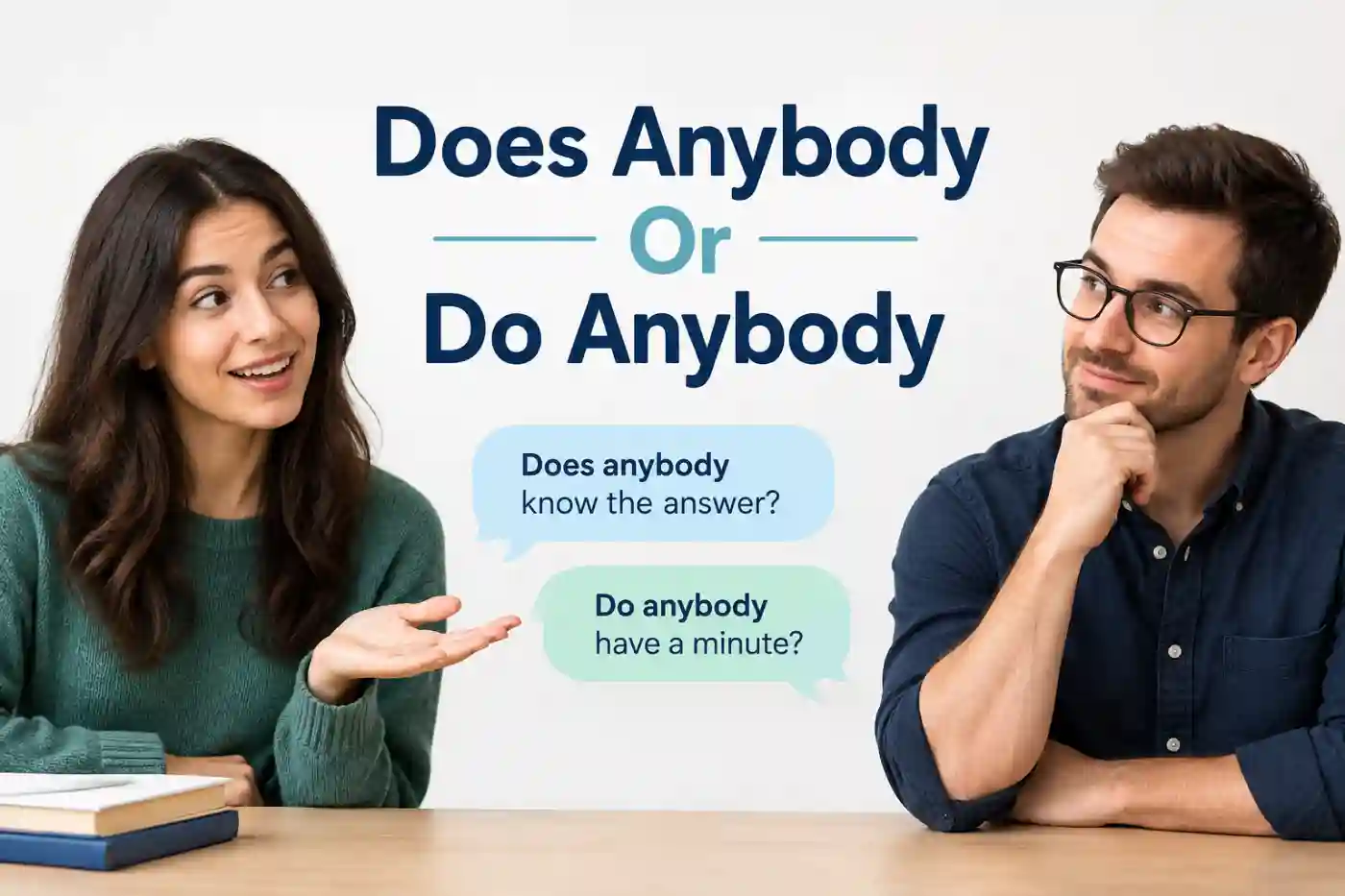
If you have ever stopped before asking a simple question and wondered about does anybody vs do anybody, you’re dealing with a common English grammar problem. The two forms look almost identical. The difference comes down to one small word: anybody.
The correct form in standard English is does anybody when anybody is the subject of a present tense question. For example, you should write Does anybody know the answer? rather than Do anybody know the answer?
The reason is simple once you understand how English treats indefinite pronouns. Anybody refers to an unspecified person or people, but grammatically it works as a singular indefinite pronoun. That means it takes singular verb forms such as does, is, and has. Cambridge Grammar confirms that anybody is used with a singular verb.
This guide explains the difference between does anybody and do anybody from every useful angle. You’ll learn the basic rule, the grammar behind it, common sentence patterns, pronunciation, examples from everyday English, common mistakes, the relationship between anybody and anyone, and the situations where do can still appear near anybody without being wrong.
Does Anybody Or Do Anybody Quick Answer
Use does anybody when anybody is the subject of a present tense question. Anybody is a singular indefinite pronoun, so it takes the singular auxiliary does. Do anybody is not standard English in this structure. Say Does anybody know? and Does anybody have a question? instead.
Does Anybody Or Do Anybody Comparison Table
| Form | Correct | Meaning | Example | Main use |
|---|---|---|---|---|
| Does anybody | Yes | Asks if any person does something | Does anybody know the answer? | Present tense questions |
| Do anybody | No in standard English | Attempts to use do with anybody as the subject | Do anybody know the answer? | Avoid this structure |
| Did anybody | Yes | Asks if any person did something | Did anybody call? | Past tense questions |
| Can anybody | Yes | Asks about ability or possibility | Can anybody help me? | Modal verb questions |
| Has anybody | Yes | Asks if any person has something or has done something | Has anybody seen my keys? | Present perfect and possession |
| Is anybody | Yes | Asks about a state or presence | Is anybody home? | Questions with be |
The key point is that does anybody and do anybody are not two standard alternatives. When anybody functions as the subject of a present simple question, does is the correct auxiliary.
Does Anybody vs Do Anybody Which One Is Correct
Does anybody is correct.
Do anybody is not correct in standard English when anybody is the subject.
Consider these examples:
- Does anybody know where the meeting is?
- Does anybody have a spare pen?
- Does anybody want some coffee?
- Does anybody understand this question?
- Does anybody remember her name?
Now compare them with the incorrect forms:
- Do anybody know where the meeting is?
- Do anybody have a spare pen?
- Do anybody want some coffee?
- Do anybody understand this question?
- Do anybody remember her name?
The problem in each incorrect sentence is subject and verb agreement. Anybody is treated as singular. The auxiliary verb therefore needs to be the third person singular form does.
Cambridge Grammar states that anyone, anybody, and anything are indefinite pronouns and that they take singular verbs. The British Council gives the same general rule for indefinite pronouns.
Why Anybody Takes Does
The word anybody can refer to an unknown person or to any person within a larger group. That can make it feel plural in meaning.
Imagine a teacher looking at a classroom full of students and asking:
Does anybody have a question?
The teacher is speaking to many people. Still, the grammatical subject is anybody. English treats anybody as a singular indefinite pronoun.
This is similar to the way English handles someone, somebody, everyone, everybody, and nobody.
We say:
- Does somebody need help?
- Does someone know the answer?
- Does everybody understand?
- Does everyone agree?
- Does nobody care?
We don’t change the auxiliary simply because several people could be included in the meaning. The grammatical form of the pronoun controls the verb.
Cambridge explains that indefinite pronouns ending in body and one take singular verbs.
Understanding Anybody
Anybody is an indefinite pronoun.
An indefinite pronoun refers to a person or thing without identifying that person or thing specifically. In this case, anybody refers to an unspecified person.
For example:
Anybody can join the discussion.
The sentence doesn’t identify a particular person. It means any person who meets the relevant condition can join.
In questions, anybody commonly appears when the speaker doesn’t know if a person exists or is available.
Examples include:
- Does anybody know the answer?
- Does anybody live here?
- Does anybody need help?
- Does anybody have a charger?
- Does anybody want dessert?
Cambridge defines anybody as a pronoun and identifies it as an alternative form of anyone.
Understanding Does Anybody
Does is the third person singular present form of the auxiliary verb do.
English uses do and does to form many present simple questions.
Compare:
- Do you know?
- Do they know?
- Do we know?
- Does he know?
- Does she know?
- Does anybody know?
The pattern becomes much easier when you compare anybody with they.
As Does he know?
Does she know?
Does anybody know?
All three subjects take does.
That is the grammatical reason the phrase works.

Understanding Do Anybody
Do is the present form used with I, you, we, and they in ordinary present simple questions and negatives.
Examples include:
- Do I need a ticket?
- Do you understand?
- Do we have enough time?
- Do they live nearby?
Plural nouns also take do:
- Do the students understand?
- Do the teachers agree?
- Do your friends know?
- Do the children want lunch?
The problem appears when someone treats anybody like a plural noun simply because it can refer to many possible people.
That is a meaning based mistake rather than a grammar rule.
Does Anybody Know Vs Do Anybody Know
The correct expression is:
Does anybody know?
For example:
- Does anybody know where Mike is?
- Does anybody know what time the store opens?
- Does anybody know the answer?
- Does anybody know how this works?
- Does anybody know why the meeting was canceled?
The incorrect form is:
Do anybody know?
This does not follow standard subject and auxiliary agreement.
LanguageTool also identifies do anybody as an error when anybody is the subject of this type of question.
Does Anybody Have Vs Does Anybody Has
There is another mistake that often appears after people learn the correct phrase.
The correct sentence is:
Does anybody have a question?
Not:
Does anybody has a question?
This happens because does already carries the third person singular marking.
The main verb stays in its base form after does.
So we say:
- Does anybody have a pen?
- Does anybody know the answer?
- Does anybody want coffee?
- Does anybody need help?
- Does anybody remember the address?
Not:
- Does anybody has a pen?
- Does anybody knows the answer?
- Does anybody wants coffee?
- Does anybody needs help?
- Does anybody remembers the address?
This rule is worth remembering because it solves two common errors at once.
The correct pattern is:
Does + anybody + base verb
For example:
Does + anybody + know?
Does + anybody + have?
As Does + anybody + want?
And Does + anybody + need?
The Basic Grammar Pattern For Does Anybody vs Do Anybody
The present simple question pattern is straightforward.
Does + singular subject + base verb?
When the subject is anybody, the pattern becomes:
Does + anybody + base verb?
Examples:
- Does anybody work here?
- Does anybody speak Spanish?
- Does anybody remember the rules?
- Does anybody want to come?
- Does anybody understand the instructions?
The word after anybody should normally be the base form of the main verb.
This is why does anybody knows is wrong. The singular marking belongs to does, not to knows.
Does Anybody vs Do Anybody Why The Meaning Can Cause Confusion
The biggest source of confusion is the gap between meaning and grammatical number.
Anybody can refer to one person. It can also refer to any person within a large group.
For example:
Does anybody want to join us?
There could be ten people who want to join. There could be one. And there could be none.
Yet anybody remains grammatically singular.
English does this with many indefinite pronouns.
Consider everybody.
Everybody can refer to a whole room:
Does everybody understand?
The meaning involves many people. The grammar still treats everybody as singular.
The same thing happens with anybody.
This distinction is one of the most useful ideas to understand if you’re learning English grammar at an intermediate or advanced level.
Does Anybody vs Do Anybody In Different Tenses
The choice between do and does changes when the tense changes.
In the present simple, use does with anybody.
Does anybody know?
In the past simple, use did.
Did anybody know?
In the present perfect, use has.
Has anybody seen my phone?
With the verb be, use is.
Is anybody home?
With modal verbs, the modal comes directly before anybody.
Can anybody help?
Will anybody attend?
Should anybody contact you?
So the broader rule is not simply that anybody always goes with does. The real rule is that anybody takes singular verb forms when it is the grammatical subject.
That distinction matters.
Does Anybody In Questions With Be
When the main verb is be, you don’t normally use do or does.
Say:
- Is anybody here?
- Is anybody listening?
- Is anybody available?
- Is anybody home?
- Was anybody there?
Do not say:
- Does anybody be here?
- Does anybody be listening?
The verb be has its own question structure.
This is a useful reminder that the rule concerns subject and verb agreement. It isn’t a command to put does before every sentence containing anybody.
Does Anybody With Modal Verbs
Modal verbs also follow their own structure.
Examples include:
- Can anybody help me?
- Could anybody explain this?
- Will anybody be there?
- Would anybody like some tea?
- Should anybody have questions, please contact the office.
- Might anybody know the answer?
Notice that we don’t say:
Does anybody can help me?
The modal can already performs the auxiliary function.
The correct form is:
Can anybody help me?
This distinction helps advanced learners avoid stacking auxiliary verbs unnecessarily.
Using Does Anybody Naturally
The grammar rule is only half the story. Good English also depends on using the expression naturally.
Does Anybody In Everyday Conversation
You will hear does anybody frequently in ordinary American English.
Examples include:
- Does anybody have a charger?
- Does anybody want pizza?
- Does anybody know a good restaurant?
- Does anybody need a ride?
- Does anybody have change for a twenty?
- Does anybody know where the bathroom is?
- Does anybody remember what happened?
- Does anybody want to watch a movie?
These questions sound natural because they follow normal conversational patterns.
In casual speech, speakers sometimes shorten questions by leaving out the auxiliary.
For example:
Anybody have a charger?
This is a conversational form of:
Does anybody have a charger?
The shorter version is common in informal speech, but it does not change the standard grammar rule for the complete question. A discussion on English Language and Usage describes this kind of shortened question as an informal conversational construction.
Does Anybody In Workplace English
In workplace communication, the full form does anybody is usually the safer choice.
Examples:
- Does anybody have the latest report?
- Does anybody know when the client will arrive?
- Does anybody need additional information?
- Does anybody have questions about the proposal?
- Does anybody know who approved this request?
In an email, you might write:
Does anybody have a copy of the original document?
That sounds clear and professional.
For a more formal message, you can also use does anyone:
Does anyone have a copy of the original document?
Cambridge notes that anyone and anybody have the same meaning, while anybody tends to be a little less formal and anyone is more common in writing.

Does Anybody In Academic Writing
Academic writing generally favors precise sentence structures.
You might see:
- Does anybody know the origin of this theory?
However, in formal academic prose, anyone may sometimes sound more natural:
- Does anyone know the origin of this theory?
The difference is mainly one of tone. The grammar is the same.
For formal writing, focus on clarity rather than trying to avoid anybody at all costs.
Does Anybody In Social Media
Social media often uses shortened conversational structures.
You may see:
- Anybody know a good dentist?
- Anybody have recommendations?
- Anybody want tickets?
- Anybody know what happened?
These forms are understandable and common in informal online communication.
They are best understood as shortened conversational questions. They don’t establish do anybody as a standard grammatical alternative.
For polished writing, use the complete structure:
Does anybody know a good dentist?
For a casual post, the shortened form can fit the tone.
Does Anybody Else
Another very common pattern is does anybody else.
Use it when you’re asking if another person shares an experience, opinion, need, or action.
Examples:
- Does anybody else feel tired today?
- Does anybody else have this problem?
- Does anybody else remember that movie?
- Does anybody else want coffee?
- Does anybody else need help?
- Does anybody else think this is strange?
The word else doesn’t change the agreement rule.
You still have:
Does + anybody + else + base verb
Not:
Do + anybody + else + base verb
Does Anybody Ever
The word ever can appear naturally in questions with anybody.
Examples:
- Does anybody ever use this feature?
- Does anybody ever read these reports?
- Does anybody ever come here on weekends?
- Does anybody ever ask about the price?
- Does anybody ever complain?
Again, anybody remains singular.
Does Anybody Still
You can also use still to ask about a continuing situation.
Examples:
- Does anybody still use this software?
- Does anybody still remember the old system?
- Does anybody still need help?
- Does anybody still work there?
The auxiliary remains does.
Does Anybody Want
This pattern appears constantly in everyday English.
Examples:
- Does anybody want coffee?
- Does anybody want lunch?
- Does anybody want to come with us?
- Does anybody want another slice?
- Does anybody want to go first?
After does, use the base form want.
Not wants.
Does Anybody Have
This is another highly common pattern.
Examples:
- Does anybody have a pen?
- Does anybody have a question?
- Does anybody have a spare ticket?
- Does anybody have experience with this software?
- Does anybody have a better idea?
The word have stays in its base form because does already carries the present tense agreement.
Does Anybody Need
Examples:
- Does anybody need help?
- Does anybody need a ride?
- Does anybody need more time?
- Does anybody need anything from the store?
- Does anybody need a copy?
The same grammar applies.
Does Anybody Understand
Examples:
- Does anybody understand this rule?
- Does anybody understand what happened?
- Does anybody understand the instructions?
- Does anybody understand how this works?
- Does anybody understand the difference?
These examples are useful because they show how naturally the structure appears in real conversation.
Does Anybody Mean Everyone
No.
Anybody and everybody have different meanings.
Anybody usually refers to any person within an open group.
Everybody refers to all people in a particular group or situation.
Compare:
Does anybody want coffee?
This asks if at least one person wants coffee.
Does everybody want coffee?
This asks about the whole group.
The two words may appear in similar grammatical structures, but their meanings are different.
Does Anybody Mean Anyone
Usually, yes.
Anybody and anyone generally have the same meaning. Cambridge describes them as having no difference in meaning, although anybody is somewhat less formal and anyone is more common in writing.
Compare:
- Does anybody know the answer?
- Does anyone know the answer?
Both are correct.
The choice usually depends on tone and personal preference.
Anybody vs Anyone
The difference between anybody and anyone is mainly stylistic.
Anybody often sounds slightly more conversational.
Anyone can sound slightly more neutral or formal.
For example:
Does anybody want another cup of coffee?
This feels relaxed and conversational.
Does anyone have questions about the report?
This can sound a little more polished in a workplace or classroom.
Neither form is grammatically better.
Both take singular verb forms.
- Does anybody know?
- Does anyone know?
- Anybody knows? No.
- Anyone knows? No.
In complete present simple questions, use does.
Anybody vs Somebody
Anybody and somebody don’t have the same meaning.
It is used for questions and negative sentences.
Examples:
- Does anybody need help?
- I don’t know anybody here.
- Did anybody call?
Somebody often refers to an unspecified person when the speaker expects or assumes that such a person exists.
Examples:
- Somebody called you.
- Somebody left a message.
- Can somebody help me?
Both are singular indefinite pronouns.
So we say:
- Does anybody know?
- Does somebody know?
Not:
- Do anybody know?
- Do somebody know?
Anybody vs Everybody
Both are grammatically singular.
Examples:
- Does anybody know?
- Does everybody know?
But the meaning changes.
Anybody means any person.
Everybody means all people in the relevant group.
For example:
Does anybody have a question?
The speaker is asking if at least one person has a question.
Does everybody have a question?
The speaker is asking about the entire group.
This is an important difference in meaning even though the grammar looks almost identical.
Anybody vs Nobody
Nobody is also grammatically singular.
Examples:
- Nobody knows the answer.
- Does anybody know the answer?
- Nobody wants to leave.
- Does anybody want to leave?
Notice the contrast.
Nobody knows.
Does anybody know?
Cambridge and the British Council both classify nobody as a singular indefinite pronoun.
Why Do Does Anybody vs Do Anybody Appears Online
You may encounter do anybody online. Seeing it doesn’t make it standard English.
Several factors can explain its appearance.
One possibility is a simple subject and verb agreement mistake. Another is influence from informal speech or a regional variety of English. Search results and online discussions can also repeat mistakes many times until they start to look familiar.
This is why frequency on the internet isn’t enough to establish a grammar rule.
For standard American English writing, use does anybody when anybody is the subject of a present simple question.
Can Do Appear Near Anybody
Yes.
This point deserves attention because saying do anybody is always impossible would be too broad.
The word do can appear in a sentence containing anybody when another structure controls the verb.
For example:
Do you know anybody here?
Here, you is the subject. Therefore, do is correct.
The sentence contains anybody, but anybody isn’t the subject.
Another example is:
What do you think anybody can learn from this?
Again, you is the subject of the question.
The mistake happens when people assume that the presence of anybody automatically requires does. The real question is:
What is the subject of the clause?
That is the question professional editors ask.
Do Any People vs Does Anybody
This comparison makes the grammar especially clear.
Say:
Do any people work here?
Here, people is plural, so do is correct.
Say:
Does anybody work here?
Here, anybody is singular, so does is correct.
Compare the structures:
| Subject | Correct auxiliary | Example |
|---|---|---|
| Anybody | Does | Does anybody work here? |
| Anyone | Does | Does anyone work here? |
| People | Do | Do people work here? |
| Students | Do | Do students work here? |
| He | Does | Does he work here? |
| They | Do | Do they work here? |
This comparison gives you a reliable shortcut. Don’t decide based on how many people the sentence might refer to. Look at the grammatical subject.
Pronunciation Of Does Anybody vs Do Anybody
The phrase is usually spoken smoothly in connected speech.
The word does is commonly pronounced /dʌz/ in American English.
Cambridge gives the American pronunciation of anybody as /ˈen.iˌbɑː.di/.
The main stress in anybody falls on the first syllable.
The phrase may sound less distinct in rapid conversation because English speakers naturally connect words. That can make the auxiliary easy to miss when listening.
This may partly explain why learners sometimes reproduce the wrong form. Listening to fast speech can make grammatical details less obvious.
Common Pronunciation Mistakes For Does Anybody vs Do Anybody
A common learner problem is focusing too heavily on spelling.
The most useful approach is to learn the phrase as a grammatical pattern rather than memorizing it as isolated sounds.
Practice these pairs:
- Does anybody know?
- Does anybody have?
- Does anybody want?
- Does anybody need?
- Does anybody remember?
The goal is to make the structure automatic.
Spelling And Form
Both does and anybody are written as single words.
Anybody is not normally written as two words.
Correct:
anybody
Incorrect:
any body
The second form can appear only when any and body have their literal meanings in a different grammatical structure. That is uncommon and not the form used for the indefinite pronoun.
The standard indefinite pronoun is anybody.
Cambridge lists anybody among the indefinite pronouns ending in body.
Does Anybody vs Do Anybody Word Origin And Structure
The word anybody belongs to a larger family of indefinite pronouns that use combinations such as any + body, any + one, and any + thing.
This includes:
- anybody
- anyone
- anything
- anywhere
These forms express an open or unspecified reference.
The structure helps explain why anybody is a pronoun rather than an ordinary plural noun. English grammar treats it as a single grammatical unit.
Cambridge describes these forms as indefinite pronouns and notes that they take singular verbs.
Does Anybody vs Do Anybody In British And American English
The rule for does anybody is consistent in standard British and American English.
You can use:
Does anybody know?
in both varieties.
The main difference is stylistic preference. Cambridge notes that anybody is a little less formal than anyone and that anyone appears more often in writing.
Canadian and Australian English also use the same standard subject and verb agreement pattern.
So this isn’t a case where American English prefers does anybody while British English prefers do anybody.
The standard grammatical structure remains the same.
Does Anybody vs Do Anybody Real Life Examples
The best way to understand this grammar pattern is to see it working in different situations.
Daily Conversation
- Does anybody know where my keys are?
- Does anybody want some pizza?
- Does anybody need a ride home?
- Does anybody have a phone charger?
- Does anybody remember his name?
Workplace Communication
- Does anybody have the updated file?
- Does anybody know when the meeting starts?
- Does anybody need more information?
- Does anybody have experience with this software?
- Does anybody know who manages this account?
Classroom English
- Does anybody know the answer?
- Does anybody have a question?
- Does anybody understand the assignment?
- Does anybody want to read the next paragraph?
- Does anybody remember this rule?
Academic Contexts
- Does anybody know the origin of this expression?
- Does anybody recognize this pattern?
- Does anybody have evidence to support this claim?
- Does anybody disagree with the proposed interpretation?
- Does anybody know how this term developed?
Online Conversations
- Does anybody know where I can find this?
- Does anybody else have the same problem?
- Does anybody know what happened?
- Does anybody have recommendations?
- Does anybody want to join?
Customer Service
- Does anybody need assistance?
- Does anybody have an order number?
- Does anybody know who placed this request?
- Does anybody need help with the form?
- Does anybody have additional questions?
Common Mistakes For Does Anybody vs Do Anybody
Several mistakes tend to appear together.
Mistake One
Do anybody know the answer?
Correct:
Does anybody know the answer?
Mistake Two
Does anybody knows the answer?
Correct:
Does anybody know the answer?
After does, use the base form.
Mistake Three
Do anybody has a question?
Correct:
Does anybody have a question?
Both the auxiliary and main verb need to follow the correct structure.
Mistake Four
Does anybody wants coffee?
Correct:
Does anybody want coffee?
Don’t add the third person singular ending to the main verb after does.
Mistake Five
Do anyone know?
Correct:
Does anyone know?
Anyone follows the same singular pattern as anybody.
Mistake Six
Does anybody can help?
Correct:
Can anybody help?
Can is a modal verb, so it forms the question without does.
Mistake Seven
Does anybody be there?
Correct:
Is anybody there?
Use the correct form of be rather than adding does.

A Simple Memory Trick For Does Anybody vs Do Anybody
Think of anybody as they for verb agreement.
You say:
Does he know?
You say:
Does she know?
Therefore:
Does anybody know?
You can use the same trick with other indefinite pronouns.
- Does somebody know?
- Does someone know?
- Does everybody know?
- Does everyone know?
- Does nobody know?
The trick works because these pronouns take singular verb forms.
Another Memory Trick For Does Anybody vs Do Anybody
Remember this short pattern:
Anybody does.
Then turn it into a question:
Does anybody?
For example:
Anybody knows the answer.
The natural statement would actually be:
Anybody knows the answer only in limited structures and usually not as a normal standalone statement. A better example is:
Anybody can help.
For a present simple question with a regular action verb, use:
Does anybody know?
The safest memory rule is still:
Anybody takes singular agreement.
That is the principle you can reuse in many different sentences.
Expert Editors Advice For Does Anybody vs Do Anybody
A professional editor doesn’t simply look at the two words immediately next to each other. The editor identifies the grammatical subject and then checks the auxiliary verb.
That distinction matters because English questions can contain several nouns and pronouns.
Consider:
Do you know anybody who works here?
The sentence contains anybody, but you is the subject of the main question. That’s why do is correct.
Now consider:
Does anybody know you?
Here, anybody is the subject. That’s why does is correct.
This is a much better way to understand the rule than memorizing a simple statement such as anybody always takes does.
Professional editing also requires attention to register. In formal writing, the complete question is generally preferable:
Does anybody have additional information?
In casual conversation, you may hear:
Anybody have anything else?
Both can communicate naturally in their appropriate settings, but they belong to different levels of formality.
Cambridge’s guidance supports the distinction between anybody and anyone as mainly a matter of formality and usage rather than meaning.
What Dictionaries And Grammar Guides Say About Does Anybody vs Do Anybody
Major English learning references agree on the core rule.
Cambridge identifies anybody as an indefinite pronoun that takes a singular verb.
The British Council also explains that indefinite pronouns such as anybody, everybody, nobody, and somebody take singular verbs.
LanguageTool identifies do anybody as an error in constructions such as Do anybody use a Mac? and suggests does anybody instead.
These sources point to the same practical conclusion: when anybody is the subject of a present simple question, use does.
A Useful Exception To Remember Does Anybody vs Do Anybody
There is one important qualification.
Don’t turn the rule into anybody always means does.
For example:
Can anybody help me?
This is correct.
Has anybody called?
This is correct.
Is anybody home?
This is correct.
Did anybody see him?
This is correct.
Would anybody like some coffee?
This is correct.
The common factor is singular agreement. The exact auxiliary depends on the tense and sentence structure.
That is the deeper grammar rule.
Final Questions About Does Anybody vs Do Anybody
Is Does Anybody Grammatically Correct
Yes. Does anybody is the standard form when anybody is the subject of a present simple question. For example, Does anybody know the answer? and Does anybody need help? Anybody is an indefinite pronoun and takes singular agreement in standard English. Cambridge and the British Council both describe anybody as a singular indefinite pronoun.
Is Do Anybody Ever Correct
Not when anybody is the subject of a standard present simple question. However, the word do can appear in a sentence that also contains anybody when another word is the subject. For example, Do you know anybody here? is correct because you is the subject and anybody is the object.
Why Do We Say Does Anybody Instead Of Do Anybody
We use does because anybody is grammatically singular. It works like other singular indefinite pronouns such as someone, somebody, everyone, everybody, and nobody. The number of people that anybody could refer to doesn’t change its grammatical number.
Is Does Anybody Have Correct
Yes. Does anybody have a question? is correct. After the auxiliary does, the main verb stays in its base form. That means have is correct and has is not. The same pattern gives us Does anybody know? rather than Does anybody knows?
Is Does Anybody Know Correct
Yes. Does anybody know? is one of the most common correct forms. The structure is does + anybody + base verb. You can use it to ask if any person knows something. For example, Does anybody know where the meeting is?
Is Anybody Singular Or Plural
Anybody is grammatically singular. It can refer to any person within a group or to an unspecified person, so its meaning can involve many possible people. Still, standard English uses singular verb agreement with anybody. Cambridge explicitly gives singular verb examples such as Has anyone got a dictionary?
Is Anybody More Formal Than Anyone
No. The usual distinction goes in the other direction. Cambridge notes that anybody is a little less formal than anyone and that anyone is more common in writing. The two words generally have the same meaning and follow the same grammar rules.
Can I Say Anybody Have
Yes, but context matters. Anybody have a pen? is a common shortened conversational question. The full standard question is Does anybody have a pen? The shorter version is natural in casual speech and informal communication, but the complete form is safer for formal writing.
Can Anybody Take A Plural Verb
In standard English, anybody normally takes singular verb agreement when it is the subject. For example, Anybody who wants to join can sign up. However, English commonly uses singular they when referring back to an indefinite pronoun such as anybody when the person’s gender is unknown. Cambridge and the British Council both describe this usage.
Final Takeaway
The difference between does anybody and do anybody comes down to subject verb agreement.
Use does anybody when anybody is the subject because anybody is grammatically singular.
Does anybody know the answer?
Does anybody want some coffee?
Does anybody have a question?
In standard English do anybody is generally incorrect when anybody is the subject.
The confusion happens because anybody refers to an unspecified person and may feel plural in meaning. Grammatically though, it takes a singular verb. That means you use does rather than do.
Remember this simple rule: anybody = does.
Once you recognize anybody as a singular indefinite pronoun, the correct form becomes easy to choose. Use does anybody in questions and formal writing when anybody is the subject. Avoid do anybody unless do belongs to a different part of the sentence and has another grammatical function.
When in doubt, trust the grammar rather than the sound. Does anybody is the standard choice.

Founding Editor
Maya spent six years as a copyeditor at a regional newspaper before starting Grammist, which is where the “answer first” format came from: newsroom style guides don’t have room for a preamble.
She writes and reviews most of the word-pair and spelling entries, and has final say on anything that goes out under the Grammist name.