
If you have ever typed a social media caption or text message and paused over faves or favs you are not alone. Both forms appear across casual American English. You may see someone write These are my faves while another person writes These are my favs. At first glance the extra e can make one form look more correct than the other.
The good news is simple. Faves and favs are both accepted informal short forms related to favorites. They mean the same basic thing when they refer to multiple favorite people or things. Fave is a well established informal word. Dictionaries list it as a noun and adjective and recognize faves as its plural.
Fav is also used as a short form of favorite. It became especially common in digital communication and social media. Dictionary.com notes that fav and fave can function as informal forms of favorite and that fav has also been used as a verb in online settings.
This guide explains the difference between faves and favs in plain English. You will learn which form sounds more natural in different situations. You will also see how to use each form in sentences and why neither belongs in most formal writing.
Quick Answer
Faves and favs are both informal short forms of favorites. They mean the same thing when used as plural nouns. Faves comes from fave while favs comes from fav. Both are common in casual writing and online communication. For formal writing use favorites instead.
Faves Or Favs At A Glance
| Feature | Faves | Favs |
|---|---|---|
| Full form | Favorites | Favorites |
| Singular | Fave | Fav |
| Plural | Faves | Favs |
| Meaning | Favorite people or things | Favorite people or things |
| Part of speech | Informal noun | Informal noun |
| Pronunciation | /feɪv/ | /feɪv/ |
| Formality | Informal | Informal |
| Common setting | Texts and social media | Texts and social media |
| American English | Common | Common |
| British English | Common | Used informally |
| Standard formal writing | Usually avoid | Usually avoid |
| Possessive plural | Faves’ | Favs’ |
| Singular possessive | Fave’s | Fav’s |
The central point is worth remembering. The two forms do not represent two different meanings. They are two informal ways of shortening the same full word.
What Does Faves Mean
Faves is the plural form of fave.
The word fave is an informal shortening of favorite in American English. It can describe a person or thing that someone likes most. Dictionary.com lists faves as the plural form of fave. Merriam Webster also lists fave as a noun with faves as its plural.
For example:
- These songs are my faves.
- Those restaurants are some of my faves.
- My old faves are still on the playlist.
- These books have become family faves.
- Cats are one of my faves when it comes to pets.
In each sentence faves means favorite things or people.
The word can sound warm and conversational. It often appears in lifestyle writing and casual online content.
What Does Favs Mean
Favs is an informal plural built from fav.
Fav is a shortened form of favorite. Dictionary.com describes fav as an informal shortening and notes that it can work as a noun or adjective. It also documents its use as a verb in online settings.
Examples include:
- These are my favs.
- I saved my favs before deleting the app.
- Which songs are your favs?
- Here are five of my favs from the collection.
- I always go back to my old favs.
The meaning is the same as faves in these examples.
One small difference comes from style rather than meaning. Favs looks more clipped because it removes the final e from fave. That compact shape can feel especially natural in short digital messages.
Are Faves And Favs Both Correct
Yes. Both forms are used as informal short forms of favorites.
Still there is an important distinction between being acceptable in informal English and being suitable for formal writing.
Faves has especially strong dictionary support because fave is an established dictionary entry with the plural faves. Collins also lists fave as an informal short form of favourite and gives faves as its plural.
Favs is also widely used. Dictionary.com identifies fav as a short form of favorite and gives examples of its casual use.
So the best answer is not that one is correct and the other is wrong.
The better answer is that both are informal and both are acceptable in casual contexts.
Faves Or Favs For Formal Writing
For formal writing use favorites.
That includes:
- Academic papers.
- Business reports.
- Formal emails.
- Professional documents.
- Legal documents.
- Official applications.
- School assignments.
- Research writing.
For example:
Informal: These are my favs.
Formal: These are my favorite options.
The full form sounds clearer and more professional.
The same principle applies to fave and fav in the singular.
Informal: This is my fave movie.
Formal: This is my favorite movie.
Neither shortened form is automatically bad English. The issue is register. Informal language belongs in settings where an informal tone is expected.
Why People Confuse Faves or Favs
The confusion comes from the way English creates shortened words.
When speakers shorten a longer word they do not always follow one fixed spelling rule.
Consider the original word:
favorite
The common spoken shortening is:
fave
Another shortened spelling is:
fav
Both are pronounced like fave in ordinary use.
Once a speaker wants the plural form another choice appears.
From fave the normal plural becomes:
faves
From fav the plural becomes:
favs
That gives us two parallel patterns.
fave → faves
fav → favs
The forms look different but the underlying meaning stays the same.
Why Fave Has An Extra E
The spelling fave closely reflects its pronunciation.
The word is pronounced like save with an f instead of an s.
The final e helps readers recognize the long vowel sound.
Compare:
- fave
- save
- cave
- wave
- gave
The spelling pattern is familiar to English readers.
By contrast fav is a clipped form. It removes the final e and creates a shorter written form.
That makes fav visually compact. It also explains why favs can feel natural in short digital messages.
Why Favs Has No E
Favs is built directly from fav.
The process is simple:
fav + s = favs
The result is a short informal plural.
English has many shortened forms that do not behave exactly like full words. Digital communication has encouraged this kind of clipping because people often want to communicate quickly with fewer characters.
The spelling favs therefore makes sense as an informal abbreviation even though fave has stronger dictionary treatment as a standalone word.
Faves Or Favs In American English
American English uses both forms.
The full word is:
favorite
American English does not normally use the British spelling favourite.
Cambridge identifies favorite as the US spelling of favourite.
The informal forms can then appear as:
- fave
- fav
- faves
- favs
All four are associated with informal usage.
For American readers fave often feels very natural because it preserves the familiar sound of the word.
Fav can feel more clipped and digital.
Neither spelling changes the basic meaning.
Faves Or Favs In British English
British English uses favourite as the full form.
The informal word fave is well established in British usage. Collins describes it as an informal short form of favourite.
For example:
- This is my fave book.
- Those are some of my faves.
- That café is one of my old faves.
The shorter fav also appears in informal digital communication.
Still the full British form remains:
favourite
The American full form is:
favorite
The difference between faves and favs is therefore not the same as the difference between favorite and favourite. The latter is a regional spelling difference. The former is an informal shortening choice.
Faves Or Favs In Canadian English
Canadian English uses both American and British spelling patterns depending on the word and context.
For the full word you may encounter favorite and favourite. Informal digital communication also makes forms such as fave and fav easy to encounter.
The same basic meaning remains.
The regional difference matters most when you are writing the full word for a Canadian audience. For casual shortened forms the distinction is much less important.
Faves Or Favs In Australian English
Australian English normally uses favourite as the full spelling.
Informal English can still use fave and favs.
Australian English often embraces casual language in everyday communication. The choice between the two short forms usually depends more on personal style and platform conventions than on a strict regional rule.
Faves And Favs Pronunciation
Both fave and fav are generally pronounced /feɪv/.
That is the same sound used in the first part of favorite.
The plural forms are pronounced with a final z sound.
Faves is /feɪvz/.
Favs is also /feɪvz/.
The written difference therefore does not create a meaningful pronunciation difference.
This is one reason the two forms can feel interchangeable in speech.
Faves Or Favs As Nouns
Both forms can work as informal nouns.
For example:
- These are my faves.
- Those are my favs.
- She shared her holiday faves.
- He posted his music favs.
- The restaurant made my list of faves.
The noun refers to favorite people or things.
The meaning is usually clear from context.
Fave And Fav As Adjectives
Fave can also appear before a noun.
Examples include:
- my fave movie
- her fave restaurant
- his fave song
- our fave teacher
- their fave game
Fav can work in the same position.
Examples include:
- my fav movie
- her fav restaurant
- his fav song
- our fav teacher
- their fav game
Both are informal.
For professional writing use favorite instead.
Fave And Fav As Verbs
There is an interesting digital meaning connected with fav and favorite.
Online platforms have used favorite as a verb to describe saving or marking content as a favorite. Dictionary.com notes that fav can also be used as a verb in online communication.
For example:
- I faved that post.
- She faved the photo.
- He faved my message.
This use is strongly tied to digital communication.
The exact verb forms can vary by platform and community.
You may also encounter:
- faved
- faving
These forms are informal and should be used with care outside casual online settings.
The Plural Rule For Faves
The plural of fave is faves.
This follows the ordinary English pattern of adding s.
fave → faves
The final e stays in place.
That gives:
- one fave
- two faves
- several faves
- my favorite faves
The last example is grammatically possible but stylistically repetitive. A better sentence would often be:
These are some of my faves.
The Plural Rule For Favs
The plural of fav is favs.
The pattern is:
fav → favs
There is no extra e because the base form does not contain one.
Examples include:
- one fav
- two favs
- several favs
- my top favs
Faves Or Favs In Everyday Conversation
In everyday conversation people usually say favorite rather than fave or fav.
The shortened forms become more natural in texts and online messages.
For example:
- What are your favorite movies?
- What are your faves?
Both questions communicate the same idea.
The second sounds more casual.
That difference in tone is important. Shortened words often create a friendly and relaxed feeling. They can make a message sound more personal.
A friend might text:
These are my summer faves.
A formal report would more likely say:
These are the most popular choices.
The context decides which style fits.
Faves Or Favs In Text Messages
Texting is one of the most natural settings for both forms.
People often shorten words in messages because the conversation is fast and informal.
Examples include:
- What are your current faves?
- Send me your favs.
- This is my new fave.
- That song is my fav right now.
- Here are my top faves.
- I saved a few new favs.
There is no need to use a shortened form in every message. The point is simply that both forms fit naturally in casual digital communication.
Faves Or Favs On Social Media
Social media has helped spread both forms.
You may see:
- My weekend faves.
- Five of my favs.
- My beauty faves.
- Travel favs.
- My favorite movie faves.
- Old school faves.
The shortened forms work especially well in captions.
They also appear in hashtags and short labels where space matters.
Still the full word can be more polished.
For example:
My favorite books this year
sounds more neutral than:
My book faves this year
The second version is more casual and lifestyle focused.
Faves Or Favs In Workplace Communication
The answer depends on the workplace and the message.
An informal team chat may comfortably use favs or faves.
For example:
Drop your lunch faves in the chat.
That can sound friendly.
A formal client email should use favorites.
For example:
Please identify your preferred options.
The issue is not grammar alone. Professional communication often benefits from precise and neutral language.
Faves Or Favs In Emails
A personal email can use either form if the tone is casual.
For example:
Here are my travel faves from the trip.
A professional email should usually avoid the short forms.
Instead write:
Here are my favorite options from the list.
This makes the message sound polished without making it stiff.
Faves Or Favs In Academic Writing
Academic writing should normally use the full word.
Avoid:
The researchers selected their favs.
Use:
The researchers selected their preferred options.
Or:
The researchers selected their favorite examples.
The best choice depends on the meaning.
Academic writing values precision. Informal abbreviations can make a scholarly sentence sound too casual.
Faves Or Favs In Journalism
Journalistic style depends on the publication.
News reporting often favors standard vocabulary.
Feature writing and lifestyle journalism may use informal language to create personality.
For example:
The singer shares her holiday faves.
This can work well as a casual headline.
A formal news report may instead use:
The singer shares her favorite holiday destinations.
The shortened form is therefore a style choice.
Faves Or Favs In Marketing
Marketing often uses informal language to create connection.
You may see phrases such as:
- Customer faves.
- Staff faves.
- Editor faves.
- This week’s favs.
- Our top faves.
These expressions are common in retail and lifestyle content.
The tone is friendly.
Still businesses should think about their audience. A luxury brand may prefer customer favorites because it sounds more polished. A casual lifestyle brand may choose customer faves because it feels warmer.
Faves Or Favs In Formal Documents
Formal documents should normally avoid both short forms.
Use:
favorites
or:
favourites
depending on your regional spelling.
Examples include:
- favorite products
- favorite destinations
- favorite authors
- favorite choices
- favorite songs
This advice is especially useful for students and professionals.
A short form that works perfectly in a text message can look out of place in a formal report.
Faves Or Favs In School Writing
Teachers often expect standard vocabulary in essays.
If a student writes:
My favorite book is…
that is completely normal.
If a student writes:
My fave book is…
the grammar is understandable but the register is casual.
The teacher may not mark it as a spelling error. The larger issue is style.
Students should learn to separate informal English from formal academic English.
That skill becomes more important as writing becomes more advanced.
Faves Or Favs In Creative Writing
Creative writing gives authors more freedom.
A character might naturally say:
That is my fave song.
The form can reveal personality.
A teenager in a text message might write:
That is my fav song.
A narrator in a literary essay would normally use:
That is my favorite song.
Shortened forms can therefore be useful when the goal is to represent natural speech or digital communication.

Faves Or Favs In Captions
Both forms work well in captions.
Examples include:
- My weekend faves.
- A few of my faves.
- Travel favs from this year.
- Current beauty faves.
- My top food faves.
- Old favorites that never get old.
There is no universal rule that says one must be used.
The best choice is the one that matches the voice of the caption.
Faves Or Favs In Lists
Short labels often favor favs because it is compact.
For example:
My Favs
can work well as a folder label.
My Faves
also works.
The second version feels slightly more like a spoken word because it preserves the visible e from fave.
Neither form changes the meaning.
Faves Or Favs In Apps
Digital products often use very short labels.
You may encounter terms such as:
- Favs.
- Favorites.
- Saved.
- Likes.
- Bookmarks.
The exact label depends on the platform.
Historically the word favorite has had a special role in computing because a favorite can refer to a saved website or resource. Collins lists this computing meaning for favourite and favorite.
That digital meaning helps explain why shortened forms became common online.
Faves And Favs Compared With Favorites
The three forms can be understood like this.
| Form | Meaning | Tone | Best setting |
|---|---|---|---|
| Favorite | One preferred person or thing | Neutral | General writing |
| Fave | One favorite | Informal | Casual writing |
| Fav | One favorite | Very informal | Casual digital writing |
| Favorites | Multiple preferred people or things | Neutral | General writing |
| Faves | Multiple favorites | Informal | Casual writing |
| Favs | Multiple favorites | Very informal | Casual digital writing |
The table shows that the biggest difference is register.
The meaning remains essentially the same.
Faves Or Favs And Punctuation
A common mistake is adding an apostrophe to make the plural.
Incorrect:
my fave’s
when you mean several favorites.
Correct:
my faves
The same applies to fav.
Incorrect:
my fav’s
when you mean several favorites.
Correct:
my favs
An apostrophe usually signals possession or a contraction. It does not normally create an ordinary plural.
Faves And Possession
Possessive forms need an apostrophe.
For one fave:
My fave’s name is Sarah.
For several faves:
My faves’ names are listed below.
The same principle applies to fav.
For one fav:
My fav’s cover is beautiful.
For several favs:
My favs’ covers are on the shelf.
These forms are grammatically possible but they can look visually awkward. In polished writing the full word often reads better.
Faves Or Favs And Capitalization
Neither form normally needs a capital letter in the middle of a sentence.
Use:
These are my faves.
Not:
These are my Faves.
A capital letter can appear in a title or heading according to the style of the publication.
For example:
My Favorite Books
is standard title style.
A casual heading might be:
My Faves
The capitalization is a formatting choice rather than a spelling rule.
Faves Or Favs And Apostrophes
The apostrophe question deserves extra attention because online writing often creates confusion.
If you mean multiple favorite things use:
faves
or:
favs
Do not write:
fave’s
or:
fav’s
unless you mean possession.
For example:
That is my fave’s cover.
Here the apostrophe marks possession.
Those are my faves.
Here there is no possession.
The distinction is simple.
Plural means more than one.
Possessive means something belongs to someone or something.
Faves Or Favs And Grammar
Both forms usually function as informal nouns.
They can also function as informal adjectives before another noun.
Examples:
My faves are these songs.
Here faves is a noun.
These are my fave songs.
Here fave modifies songs.
The same pattern works with fav.
These are my fav songs.
The grammar is understandable but highly informal.
In standard formal writing use:
These are my favorite songs.
Fave And Fav As Singular Forms
The singular forms are fave and fav.
Use fave when you want the shortened form that looks closest to its pronunciation.
Use fav when you want a very compact form.
Examples:
- This is my fave.
- This is my fav.
- She is my fave singer.
- She is my fav singer.
- That is my fave restaurant.
- That is my fav restaurant.
All of these are informal.
Faves And Favs As Plural Forms
The plural forms are:
faves
and:
favs
Examples:
- These are my faves.
- These are my favs.
- Those books are my faves.
- Those books are my favs.
- These songs are old faves.
- These songs are old favs.
The meaning is unchanged.
Faves Or Favs In Possessive Phrases
Possessive phrases can become awkward when shortened forms are used.
For example:
My faves’ covers are colorful.
This is grammatical but visually crowded.
A smoother version is:
The covers of my favorite books are colorful.
This is another reason formal writing tends to favor the full form.
The shortened forms are most useful when the surrounding language is already casual.
Twenty Natural Examples
Here are natural examples showing how native speakers may use both forms.
- These songs are my faves.
- Those are my favorite books.
- Send me your favs.
- This is my new fave.
- That café is one of my faves.
- Which movie is your fav?
- I saved all my favs before changing phones.
- These are some of my old faves.
- She shared her summer faves online.
- He posted his travel favs.
- This restaurant is a family fave.
- That song became an instant fav.
- My faves are mostly comedies.
- These artists are among my favs.
- She always recommends her favorite authors.
- Those cookies are my personal faves.
- This is my current fav song.
- We talked about our childhood faves.
- The article lists the editor’s favorite books.
- I have several new faves on my playlist.
These examples show the central pattern clearly.
Faves and favs work naturally in casual writing.
The full word favorite works across both casual and formal settings.
Common Mistakes With Faves
One common error is treating faves as incorrect because it looks unusual.
It is not incorrect. Dictionaries recognize fave and its plural faves.
Another mistake is writing fave’s when you mean more than one.
Use faves for the plural.
A third mistake is assuming that the extra e makes faves more formal.
It does not.
Faves remains informal even though it has strong dictionary support.
Common Mistakes With Favs
Some writers assume favs is a spelling error.
That is too strong.
The form is widely used as an informal shortening of favorite. Dictionary.com specifically recognizes fav as a short form of favorite.
Another mistake is using fav’s as a plural.
Use:
favs
not:
fav’s
A third mistake is using favs in a formal academic paper.
The spelling is not the main issue. Register is.
Faves Or Favs And Style
The best choice often depends on the personality of the writing.
Choose faves when you want a casual and friendly tone.
For example:
Here are my weekend faves.
Choose favs when you want a shorter and more clipped style.
For example:
My top favs this month.
Use favorites when you want neutral standard English.
For example:
Here are my favorite choices.
This three way distinction gives writers more control.
Faves Or Favs And Word History
The story behind these short forms is older than social media.
It is easy to assume that fave and fav were invented by modern internet users. The evidence shows a longer history.
Dictionary.com dates fave to the late 1930s and explains that it developed through shortening.
Dictionary.com also records historical use of fav. Its discussion notes that fav appeared later as a written shortening while fave had already been used for decades.
That history matters because it shows that informal shortening is not a new feature of social media.
English speakers have always shortened familiar words.
The internet simply made these forms much more visible.
The Origin Of Favorite
The full word favorite has a much older history.
American Heritage traces favorite through Middle French and Italian roots to Latin favor. The underlying idea is connected with favor and preference.
Modern English uses favorite as both an adjective and a noun.
For example:
This is my favorite book.
Here favorite is an adjective.
This book is my favorite.
Here favorite is a noun.
The shortened forms inherit these basic meanings in informal use.
How Fave Developed
The form fave is a clipping.
A clipping keeps part of a longer word while dropping the rest.
favorite
becomes:
fave
The shortened form preserves the opening sound and enough spelling to remain recognizable.
It also creates a word that looks natural in English because the final e supports the long vowel sound.
That helps explain why fave became an established informal word rather than remaining only a private abbreviation.
How Fav Developed
Fav is another clipping.
It removes more letters than fave.
The result is:
fav
The form is especially convenient for short digital messages.
The two forms therefore represent different approaches to shortening the same word.
Fave preserves more of the visible structure.
Fav is more compact.
Neither approach changes the meaning.
Faves Or Favs And Digital Culture
Digital culture has made short forms much more common.
Text messages reward brevity.
Social media captions favor compact language.
App interfaces often need short labels.
Online communities also develop their own vocabulary.
The word favorite became especially important in digital settings because platforms have long allowed users to save or mark content they liked. Collins lists a computing sense of favorite and favourite connected with saved web pages and online resources.
That environment created fertile ground for forms such as fav and fave.
Faves Or Favs And Social Media
Social media helped turn these short forms into everyday vocabulary.
People began talking about their favorite photos.
They saved favorite posts.
Shared for favorite products.
Short forms fit naturally into those interactions.
Dictionary.com notes that fav has been used in connection with social media activity and online favorites.
This digital history explains why fav can sometimes function as a verb.
For example:
I faved the post.
That usage is informal and platform dependent.
Are Faves And Favs Slang
They are best described as informal shortened forms.
Fave has dictionary recognition as an informal word. Collins labels it informal and gives it as a shortened form of favourite.
Fav is also treated as an informal short form.
The word slang can sometimes be used broadly for casual vocabulary. In careful language discussion informal shortening is more precise.
That distinction matters because fave is not simply random internet slang. It has a documented history and established usage.
Is Faves More Correct Than Favs
Not in the simple sense of correct versus incorrect.
Faves has clear dictionary support because it is the regular plural of the established informal noun fave.
Favs is also widely used as the plural of fav.
So the better distinction is:
Faves is a well established informal plural of fave.
Favs is an informal plural of fav.
Both can be understood as short forms of favorites.
Which Form Sounds More Natural
Both can sound natural.
Personal preference plays a major role.
Some writers prefer faves because it matches the pronunciation more clearly.
Others prefer favs because it is shorter.
The choice can also reflect the tone of a platform.
A lifestyle blog may use faves.
A short social post may use favs.
A professional article will usually use favorites.
There is no universal rule that forces one informal form.
Which Form Should You Use
Use faves when you want a friendly casual form.
Use favs when you want a compact casual form.
Favorites is used when you want neutral standard American English.
Use favourites when you follow British spelling.
Here is the practical rule:
Casual writing: faves or favs.
Neutral writing: favorites.
British formal writing: favourites.
This rule is easy to apply and works in most situations.
Faves Or Favs In Search Queries
Search users often type the exact informal form they have seen online.
That means both faves and favs can appear in real search behavior.
For a writer the goal should not be to force both forms into every paragraph.
A natural article can mention the variants once and then use them where they genuinely fit.
Search engines are increasingly good at understanding related forms.
A useful page should therefore answer the actual language question rather than repeat the keyword.
Faves Or Favs For Voice Search
Someone asking a voice assistant may say:
Is faves a word?
A direct answer is:
Yes. Faves is the plural of fave. Fave is an informal short form of favorite.
Another user may ask:
Is favs correct?
A useful answer is:
Yes. Favs is an informal plural of fav. It means favorites.
The answer should come first.
The explanation can follow.
That structure works well for both voice search and human readers.
Expert Editor’s Note
A professional editor would first identify the register.
For casual text messages, faves or favs can sound natural and friendly.
In academic papers, favorites is the more appropriate and reliable choice.
To add personality to a marketing caption, an informal form can make the wording feel more playful and engaging.
The editor would also watch for apostrophes.
Faves is plural.
Favs is plural.
Neither needs an apostrophe simply because it refers to more than one thing.
Editors also need to consider audience.
An American audience will expect favorite in standard writing.
A British audience will expect favourite.
The informal forms cross regional boundaries more easily.
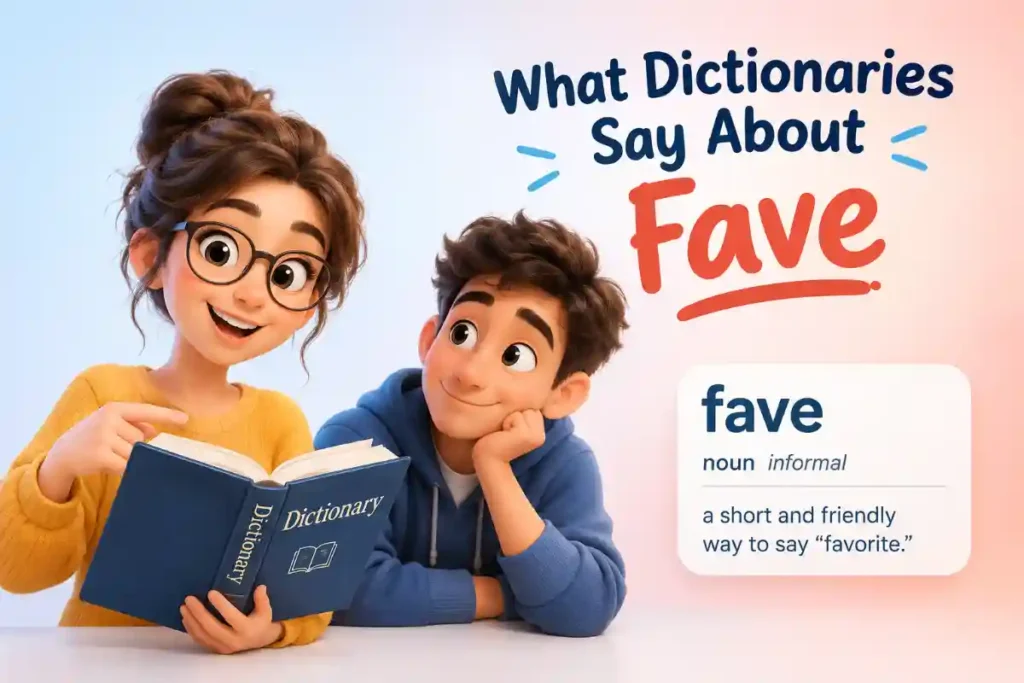
What Dictionaries Say About Fave
Dictionary evidence strongly supports fave.
Dictionary.com lists fave as an American informal word and gives faves as its plural. It also provides the pronunciation /feɪv/.
Merriam Webster lists fave as a noun and gives faves as the plural.
Collins describes fave as an informal short form of favourite and gives examples of its use as both a noun and adjective.
That is strong evidence that fave is more than a casual typo.
What Dictionaries Say About Favorite
The full word favorite is standard American English.
Cambridge defines it as something or someone that is liked most or enjoyed most. It also identifies favorite as the American spelling of favourite.
Collins gives favorite as the American form and favourite as the British form.
The full word is therefore the best choice when you need a neutral form.
Common Internet Misconceptions
One misconception is that faves is the only correct form.
That is too narrow.
Favs is also widely used as an informal shortening.
Another misconception is that favs is simply a misspelling of faves.
It is better understood as a separate shortening of favorite.
A third misconception is that either form is appropriate in every setting.
Neither is ideal for formal academic or professional writing.
Another mistake is assuming that the spelling difference changes pronunciation.
Both are normally pronounced /feɪvz/ in the plural.
Related Words
Several words belong to the same vocabulary group.
Favorite
The standard American form.
This is my favorite song.
Favourite
The standard British form.
This is my favourite song.
Fave
An informal short form.
This is my fave song.
Fav
A more compact informal short form.
This is my fav song.
Favorites
The standard American plural.
These are my favorite songs.
Favourites
The standard British plural.
These are my favourite songs.
Faves
The informal plural of fave.
These are my faves.
Favs
The informal plural of fav.
These are my favs.
Similar Expressions
English has many informal ways to talk about preferred things.
You might say:
- top picks
- favorites
- go to choices
- personal picks
- best loved
- must haves
- top choices
- personal favorites
The right expression depends on the context.
Top picks often suggests a recommendation.
Favorites emphasizes personal preference.
Faves sounds casual.
Must haves suggests something strongly recommended.
Common Mistakes To Avoid
Keep these rules in mind.
- Do not write fave’s when you mean more than one fave.
- Do not write fav’s when you mean more than one fav.
- Do not treat faves as a spelling error.
- Do not assume favs has a different meaning.
- Do not use either short form automatically in formal writing.
- Do not confuse favorite with favourite when writing for a specific regional audience.
- Do not assume social media spelling rules apply to academic writing.
These simple points cover most usage problems.
Frequently Asked Questions
Is faves a real word
Yes. Faves is the established plural of the informal noun fave. Dictionary.com lists fave and gives faves as its plural. Merriam Webster also lists fave as a noun with faves as its plural. The word is informal rather than a formal replacement for favorites.
Is favs a real word
Yes. Favs is an informal plural formed from fav. The shortened form fav means favorite and is common in casual digital communication. Dictionary.com documents fav as an informal short form and notes its use in social media contexts.
Are faves and favs the same
Yes. When they refer to multiple favorite people or things they have the same basic meaning. Faves comes from fave while favs comes from fav. The difference is mainly spelling and style. Both are informal. For formal writing use favorites in American English or favourites in British English.
Which is better faves or favs
Neither is universally better. Faves has a slightly fuller spelling and comes from the established informal word fave. Favs is shorter and can feel more compact. Both work in casual writing. Choose the form that matches your personal style and audience. For formal writing choose favorites instead.
Should I use faves in formal writing
Usually no. Faves is informal. It works well in texts social media captions casual blogs and friendly messages. Formal writing should normally use favorites in American English. A school paper might say my favorite books rather than my faves. The full form is clearer and fits a wider range of audiences.
Is fav short for favorite
Yes. Fav is an informal shortened form of favorite. It is common in casual messages and digital communication. It can work as an adjective or noun. Online communities have also used it as a verb for marking content as a favorite.
What is the plural of fave
The plural of fave is faves. The spelling keeps the final e and adds s. For example you can write These are my faves. Do not add an apostrophe to create the ordinary plural. Fave’s normally signals possession rather than more than one fave.
What is the plural of fav
The plural of fav is favs. Simply add s to the shortened form. For example Those songs are my favs is natural informal English. Do not write fav’s when you only mean more than one favorite. The apostrophe is not needed for an ordinary plural.
Final Verdict
Faves and favs are both acceptable informal forms.
Faves is the plural of fave.
Favs is the plural of fav.
Both refer to favorite people or things.
The difference is not meaning. It is mainly spelling and style.
Faves has strong dictionary support as the plural of the established informal word fave. Favs is also widely used as the plural of fav.
For casual writing you can use either one.
For formal writing use favorites in American English or favourites in British English.
If you want one simple rule to remember keep this in mind:
Fave becomes faves. Fav becomes favs. Favorite becomes favorites.
Once you know the base form the plural is easy.

Founding Editor
Maya spent six years as a copyeditor at a regional newspaper before starting Grammist, which is where the “answer first” format came from: newsroom style guides don’t have room for a preamble.
She writes and reviews most of the word-pair and spelling entries, and has final say on anything that goes out under the Grammist name.