
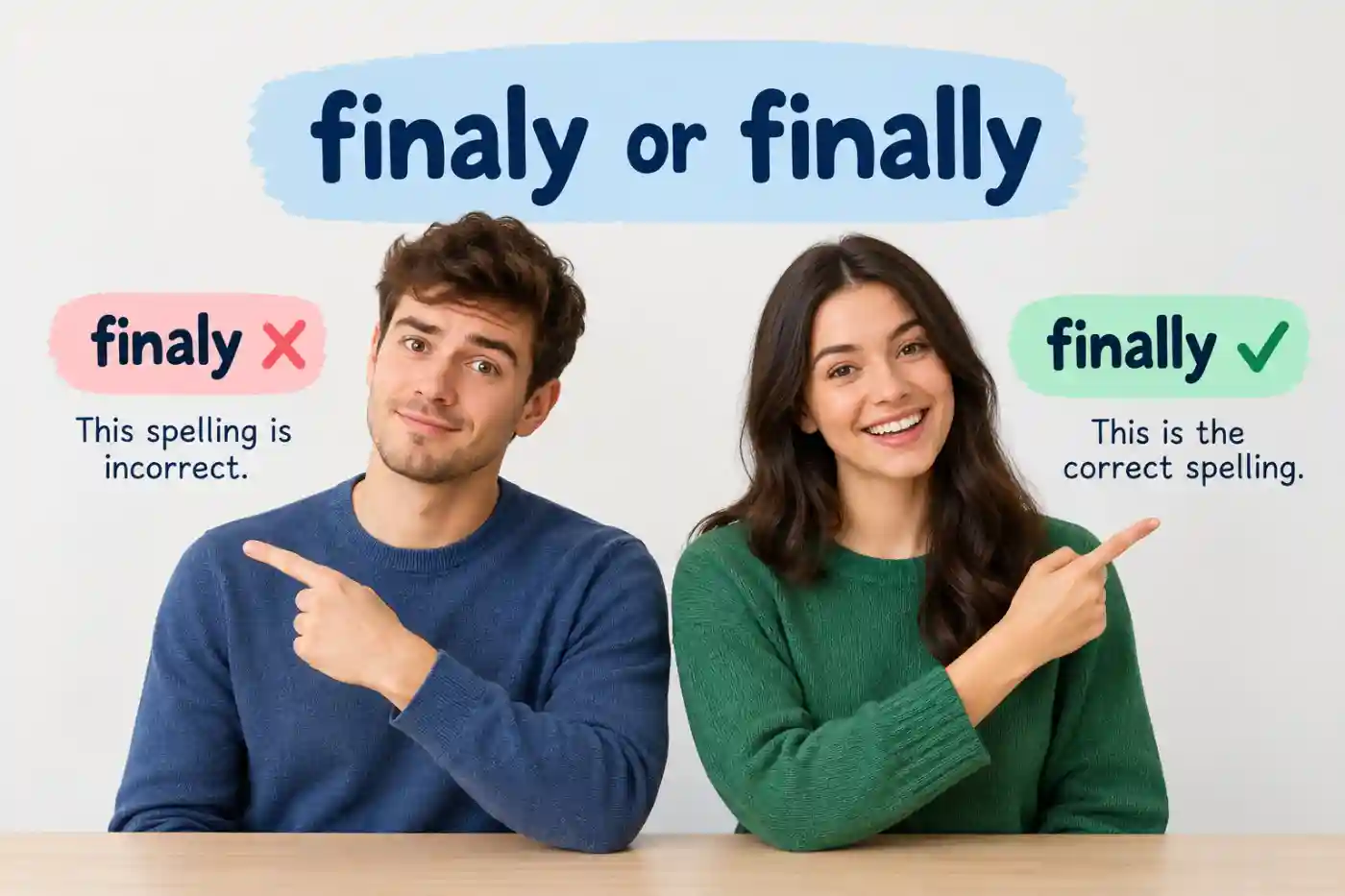
Finaly vs Finally is a common English spelling question because both forms may look plausible, but only one is correct in standard English. Finally is the correct spelling, while finaly is a misspelling. The difference is one extra letter, but that small detail matters in everyday conversation, academic assignments, emails, and professional writing.
The word finally is an adverb formed by combining the adjective final with the suffix ly. It can mean at last, after a delay, or as the last point in a sequence. For example, you might say, “We finally arrived at the station,” or use finally to introduce the last point in a presentation.
This guide explains finaly vs finally, including the correct spelling, meaning, pronunciation, grammar, and common mistakes. You will also learn why finally has two consecutive l letters, how to remember the spelling, and how finally differs from related expressions such as at last, eventually, lastly, and in the end.
Most importantly you’ll have a simple memory trick that makes this spelling easy to remember.
Quick Answer
Finally is the correct spelling. Finaly is a misspelling and should not be used in standard English. Finally is an adverb that means after a long wait, at the end of a process, or as the last point in a sequence. Remember the spelling with two l’s: final + ly = finally.
Finaly vs Finally at a Glance
| Feature | Finaly | Finally |
|---|---|---|
| Correct spelling | No | Yes |
| Standard English word | No | Yes |
| Part of speech | Not standard | Adverb |
| Meaning | No established standard meaning | At last or at the end |
| Spelling pattern | Missing one l | Final + ly |
| Formal writing | Incorrect | Correct |
| Informal writing | Usually a typo | Correct |
| Example | Incorrect: We finaly arrived. | Correct: We finally arrived. |
The key point is that these are not two alternative spellings. Unlike some words that have accepted British and American forms, finaly is not a standard regional variant. Use finally in American English, British English, Canadian English, and Australian English.
Which One Is Correct
Finally is the only correct spelling in standard English.
Use it when you want to say that something happened after a delay, that an action reached its last stage, or that you are presenting the last item in a series.
Correct examples include:
- We finally finished the project.
- She finally answered my message.
- Finally, remember to save your work.
Avoid writing finaly in emails, essays, reports, social media posts, and other forms of communication. Spellcheckers may catch the error, but learning the correct form will help you avoid it in the first place.
What Does Finally Mean
Finally is an adverb with several closely related meanings. It often describes something that happens after waiting, after a series of events, or at the end of a process.
Finally means after a long wait
Use finally when something happens later than expected or after patience has been required.
Examples:
- The bus finally arrived after forty minutes.
- I finally found the keys I had misplaced.
- After months of practice, he finally passed the exam.
- We finally received a reply from the company.
In these examples, the word emphasizes the wait or effort that came before the result. It often carries a sense of relief, satisfaction, or impatience.
Finally means at the end
You can also use finally to describe the last action in a sequence or the final stage of a process.
Examples:
- First, mix the ingredients. Next, add the milk. Finally, bake the mixture.
- She reviewed the draft and finally approved it.
- The team tested the software and finally released the update.
Here, finally helps readers follow the order of events. It signals that the process has reached its last stage.
Finally introduces the last point
Writers and speakers often use finally to introduce the last item in a list of ideas.
Examples:
- First, we need a clear plan. Second, we need enough time. Finally, we need a reliable team.
- Finally, I want to thank everyone who helped with the event.
- Finally, consider how this decision will affect future costs.
In this use, finally helps organize information. It does not always suggest a long wait.
Why People Confuse Finaly and Finally
The spelling mistake usually happens because people overlook the second l. Several factors can make that error more likely.
The missing letter is easy to overlook
The words finaly and finally look almost identical. Only one letter separates them, so a quick glance may not reveal the mistake.
When typing at speed, people often focus on the meaning of a sentence rather than the exact spelling of each word. As a result, a missing letter can slip through.
Pronunciation does not reveal the spelling
In ordinary speech, the two spellings would usually be pronounced the same because finaly is simply a misspelled version of finally. You cannot reliably hear the missing l.
That is why listening alone will not solve this spelling problem. You need to recognize the written pattern.
Typing quickly causes errors
On a keyboard or phone, repeated letters can be easy to miss. Someone may type finaly without noticing that the word needs another l.
Autocorrect may fix the mistake, but it does not always do so. A spelling checker can also miss errors in some settings or when the word appears in a context it cannot interpret well.
People remember the sound rather than the structure
Many spelling mistakes happen because people learn a word by hearing it but do not learn how it is formed.
The ending ly is familiar in English. Someone may remember that finally ends in ly but forget that the base word final already ends in l. Understanding the word structure makes the correct spelling easier to recall.
Online mistakes can reinforce the wrong form
If you see finaly in a comment, post, or message, you might assume it is an acceptable variant. Repeated exposure can make an incorrect spelling look familiar.
However, familiarity does not make a spelling correct. Dictionaries and standard editing practice recognize finally, not finaly.
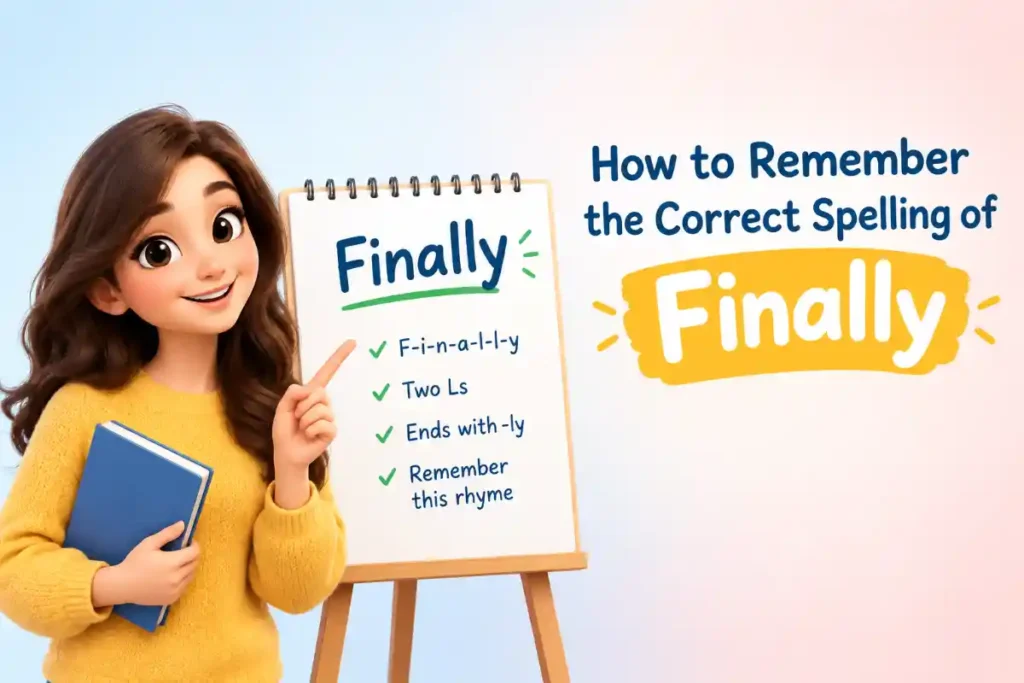
How to Remember the Correct Spelling of Finally
The easiest way to remember finally is to divide it into two parts.
Final + ly = Finally.
The word final already ends with one l. When you add ly, you keep that l and add another one as the suffix begins with l.
A simple spelling trick
FINAL
Base word
+
LY
Suffix
=
FINALLY
Correct spelling
Remember both l’s. One belongs to final, and the other begins the suffix ly.
Here are three ways to make the spelling stick.
- Think of the base word. Write final first, then add ly.
- Look for the double l. Before sending a message, check that finally contains two consecutive l’s.
- Practice with a complete sentence. Write “I finally finished my work” a few times to connect the spelling with its meaning.
A short memory sentence can help too: The final step is finally complete. Both words contain the same double l pattern when the adjective and suffix meet.
The Spelling Rule Behind Finally
The word finally follows a common pattern in English word formation. Writers add the suffix ly to an adjective to create an adverb.
For example:
| Adjective | Adverb |
|---|---|
| Final | Finally |
| Slow | Slowly |
| Quick | Quickly |
| Clear | Clearly |
| Careful | Carefully |
| Sudden | Suddenly |
| Complete | Completely |
The suffix ly often changes an adjective into an adverb. An adjective describes a person, place, thing, or state. An adverb can describe how, when, or in what way something happens.
Compare these sentences:
- This is the final chapter.
- We finally reached the final chapter.
In the first sentence, final describes the noun chapter. In the second, finally tells the reader when the action of reaching the chapter occurred.
Why Finally Has Two L’s
The spelling becomes clearer when you look at the parts.
- Final contains one l at the end.
- Ly begins with another l.
- Combining the two parts gives finally.
You do not remove the final l from final before adding ly. Both letters remain in the resulting word.
This is a useful distinction because English spelling rules vary depending on the suffix. Some words change their spelling when a suffix is added, but final does not lose its last letter here.
Is Finally an Exception to the Rule
No. The spelling follows directly from the structure of the word. There is no unusual doubling rule that you need to memorize separately.
The same pattern appears in other adjective and adverb pairs. For example, usual becomes usually, and personal becomes personally. The spelling of each word depends on its base form and the suffix added to it.
However, not every word ending in ly is formed by adding that suffix to a modern adjective. English contains many words with different histories, so it is best to learn common word families rather than assume that every ending follows the same rule.
Finally vs Final
The words final and finally are related, but they serve different grammatical purposes.
Final is usually an adjective. It describes something that comes last or ends a process.
Finally is an adverb. It often tells us that an event happened at last or that a last step is being introduced.
| Word | Part of speech | Meaning | Example |
|---|---|---|---|
| Final | Adjective | Last or concluding | This is the final chapter. |
| Finally | Adverb | At last or at the end | I finally read the chapter. |
Here is another comparison.
The final decision came on Friday.
The adjective final describes the noun decision.
The committee finally made a decision on Friday.
The adverb finally describes the timing of the committee’s action.
This difference is important in both speech and writing. Using the wrong form can make a sentence sound unnatural or change its grammatical structure.
Finally vs At Last vs Eventually
These expressions can overlap, but they do not always convey the same feeling.
Finally
Finally emphasizes that something has happened at the end of a wait, process, or sequence.
Example: We finally reached the hotel after a long drive.
The word can suggest relief or simply mark the last stage.
At last
At last often places more emphasis on relief, satisfaction, or impatience after waiting.
Example: At last, the missing package arrived.
This expression can sound more emotional than finally, although the two are often interchangeable.
Eventually
Eventually means that something happens after some time or after a series of events. It does not necessarily emphasize the final moment as strongly as finally.
Example: After several interviews, she eventually found a job.
The sentence focuses on the outcome after a period of time.
Compare the three:
- We finally solved the problem.
- At last, we solved the problem.
- We eventually solved the problem.
All three sentences are correct. The first highlights the result after effort or delay. The second sounds more expressive. The third focuses on the outcome after time passed.
Finally vs Lastly
Finally and lastly both introduce the last point in a sequence. In many contexts, either word works.
For example:
- First, check the address. Next, confirm the date. Finally, send the email.
- First, check the address. Next, confirm the date. Lastly, send the email.
Both sentences are grammatical.
Still, finally has more uses. It can describe something happening after a delay, as in “She finally called me.” Lastly is more closely tied to the last item in a list or sequence.
For most everyday writing, finally is a natural and flexible choice.
Finally vs Finely
The words finally and finely differ by only a few letters, but their meanings are quite different.
Finally means at last or at the end.
Finely often means in small pieces, in a delicate way, or with great precision.
Examples:
- We finally completed the report.
- Chop the onions finely.
- The artist finely detailed the edges of the drawing.
The word finely is related to fine, not final. If you are talking about the end of a process, use finally. If you mean something is cut into small pieces or made with delicate detail, finely may be the right choice.
Finally vs Finalize
Finally and finalize come from the same word family, but they are different parts of speech.
Finally is an adverb.
Finalize is a verb that means to complete or settle the details of something.
Compare:
- We finally finished the proposal.
- We need to finalize the proposal.
The first sentence describes when the work was completed. The second describes the action of completing the remaining details.
You can use both in one sentence:
We finally finalized the contract after several rounds of discussion.
That sentence is grammatical, although some editors might prefer a more direct alternative such as “We finally completed the contract after several rounds of discussion.”
The important point is that finally cannot replace finalize, and finalize cannot replace finally.
Finally vs Finalized
Finalized is usually the past tense or past participle of the verb finalize. It describes something that someone has completed or settled.
Finally describes timing or sequence.
Examples:
- We finally approved the plan.
- We finalized the plan yesterday.
- The finalized plan is ready for review.
In the first sentence, finally emphasizes that the approval came after some time. In the second, finalized identifies the action. In the third, it acts as a participial adjective describing the plan’s completed state.

Is Finally Formal or Informal
Finally works in both formal and informal English.
In conversation, it can express relief, impatience, or satisfaction.
- You finally made it.
- I finally found my phone.
- The weekend is finally here.
In professional writing, it can mark the last step in a process or the final point in a discussion.
- Finally, the team reviewed the results.
- Finally, the report recommends further testing.
- The company finally approved the revised budget.
The word itself is not too casual for formal use. What matters is how it fits the sentence and the purpose of the writing.
Can You Start a Sentence With Finally
Yes. Starting a sentence with finally is grammatically correct.
Writers commonly use it to introduce the last point in a list, the final stage of a process, or an event that happened after a delay.
Examples:
- Finally, we reached an agreement.
- Finally, consider the long term cost.
- Finally, the results confirmed the original prediction.
When finally introduces a sentence as a transition, a comma often follows it.
However, you do not need a comma every time the word appears near the beginning. If it is closely integrated into the sentence as an adverb of timing, punctuation can depend on the sentence structure and the style being used.
For example:
She finally understood the lesson.
No comma is needed here because finally directly modifies understood.
Compare that with:
Finally, she understood the lesson.
The comma works because finally is presented as an introductory transition.
Section 3 of 3
Finally in Everyday English
The best way to understand finally is to see how people use it in real situations. Its meaning often depends on the context, but the spelling never changes.
Daily Conversation
- I finally got some time to relax.
- We finally decided where to eat.
- She finally called me back.
- The rain finally stopped.
- My brother finally learned how to drive.
These sentences use finally to show that an event happened after waiting, effort, or uncertainty.
Workplace Communication
- We finally completed the project ahead of schedule.
- The manager finally approved the request.
- Our team finally resolved the technical issue.
- The client finally confirmed the meeting time.
- The company finally announced its new policy.
In workplace writing, finally can communicate the completion of a process. However, it can also suggest that a decision took longer than expected. Consider the tone before using it in sensitive business communication.
Emails and Professional Messages
- I finally received the documents you sent last week.
- Finally, please review the attached report before Friday.
- We have finally reached an agreement on the revised terms.
- Finally, thank you for your patience throughout the process.
The first and third examples describe events that happened after a delay. The second introduces a final instruction. In the fourth, finally introduces a closing point, although simply writing “Thank you for your patience” may sound more natural in many professional emails.
Academic Writing
- The results finally supported the original hypothesis.
- Finally, the study considers the limitations of the proposed method.
- The researchers finally reached a conclusion after reviewing the evidence.
- Finally, future research should examine a larger sample.
Academic writers use finally to describe the outcome of a process or introduce the last point in an argument. When listing several points, make sure the sequence is clear and that the transition genuinely signals the last item.
Journalism and Online Writing
- The city finally reopened the bridge after months of repairs.
- The long awaited update finally arrived on Monday.
- Finally, the company responded to questions about the delay.
- Fans celebrated when the team finally won the championship.
These examples show how finally can highlight a delayed outcome. In journalism, it can also affect tone. The word may imply that an action took too long, so writers should use it carefully when reporting events objectively.
Common Mistakes With Finally
Even though finally is a common word, several errors appear in everyday writing.
Writing Finaly Instead of Finally
Incorrect: We finaly finished the assignment.
Correct: We finally finished the assignment.
The incorrect form leaves out one l. Remember to combine final and ly without removing either letter.
Confusing Finally With Final
Incorrect: This is the finally chapter.
Correct: This is the final chapter.
The noun chapter needs an adjective, so final is the correct choice.
Using Finally When Finalize Is Needed
Incorrect: Please finally the report before submitting it.
Correct: Please finalize the report before submitting it.
The verb finalize means to complete or settle the details. Finally is an adverb and cannot perform that verb’s role.
Adding Unnecessary Punctuation
Incorrect: She, finally, completed the task.
Correct: She finally completed the task.
The commas in the incorrect example are unnecessary in an ordinary sentence. Commas can set off finally when the writer wants a particular pause or emphasis, but they should not interrupt the sentence without a reason.
Repeating Finally Too Often
Incorrect: Finally, we checked the data. Finally, we reviewed the charts. Finally, we wrote the report.
Better: We checked the data, reviewed the charts, and wrote the report.
Use finally when it helps readers follow the sequence. Repeating it before every action makes the writing clumsy. A clear sentence often communicates the same information more naturally.
British vs American English
There is no spelling difference between British and American English for this word.
| Variety of English | Correct spelling |
|---|---|
| American English | Finally |
| British English | Finally |
| Canadian English | Finally |
| Australian English | Finally |
The spelling finaly is not an accepted alternative in any of these standard varieties.
Pronunciation can vary slightly by accent, but that does not affect the spelling. If you are writing for a US audience, use finally in the same way you would for a British or Australian audience.
Word Origin and History
The word finally developed from final, which came into English through French and Latin roots. The Latin word finalis means relating to an end or boundary and comes from finis, meaning an end or limit.
English later used the suffix ly to form the adverb finally. The result describes something done at the end or something that happens after a period of time.
This word history also explains related words such as:
- Final, meaning last or concluding.
- Finale, meaning the closing part of a performance or work.
- Finalize, meaning to complete or settle the details.
- Finalist, meaning someone who reaches the final stage of a competition.
- Finality, meaning the state of being final or settled.
Understanding these connections helps learners recognize the word family and remember the correct spelling.
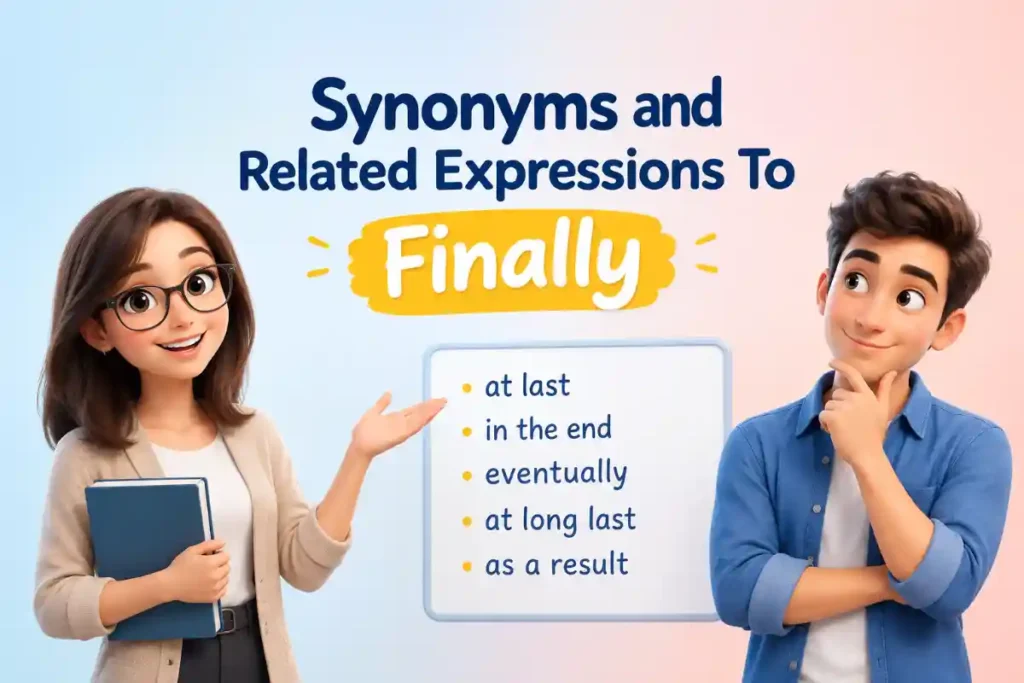
Synonyms and Related Expressions To Finally
Depending on the sentence, you can sometimes replace finally with another expression.
| Word or phrase | Typical meaning | Example |
|---|---|---|
| At last | After waiting | At last, the train arrived. |
| Eventually | After some time | She eventually found a solution. |
| In the end | After considering events or choices | In the end, we stayed home. |
| Ultimately | As the final result | Ultimately, the choice is yours. |
| Lastly | As the final item | Lastly, check the references. |
| At the end | At the final point | At the end, we reviewed the results. |
These expressions are related, but they are not always interchangeable.
For instance, ultimately often emphasizes a final result or conclusion. Lastly usually introduces the final item in a sequence. Eventually focuses on something happening after time passes.
Choose the word that matches your intended meaning instead of swapping synonyms automatically.
Expert Editor’s Note
From an editor’s perspective, finally is a straightforward spelling choice. The main issue is remembering the second l and using the adverb in the right grammatical position.
Major dictionaries recognize finally as the standard spelling. They do not treat finaly as a valid alternative. Standard spelling references and professional editing practices therefore support the same recommendation: write finally every time.
An editor will also consider how the word affects tone. In a sentence such as “The company finally answered,” the adverb can suggest that the response was overdue. If the writer wants a neutral report, “The company answered on Tuesday” may be more precise.
Likewise, finally is useful when introducing the last point in an explanation, but transitions lose their value when repeated too often. Good editing means using the word when it helps the reader understand the order of events.
Frequently Asked Questions
Is finaly ever correct
No. Finaly is a common spelling mistake, not a standard English word with the same meaning as finally. Use finally in schoolwork, professional communication, websites, and everyday messages. If you see finaly in an online post, it is usually a typo rather than a regional spelling difference.
Why does finally have two l’s
The word combines final with the suffix ly. Since final ends in l and ly begins with l, both letters remain when the two parts are joined. Remembering this word structure is more reliable than trying to memorize the spelling as a string of letters.
What part of speech is finally
Finally is an adverb. It can describe when an action happens, as in “She finally arrived,” or introduce the last point in a sequence, as in “Finally, check your work.” Its related adjective is final, as in “the final chapter.”
Is finally the same as eventually
Not exactly. Both words can describe something that happens after time passes, but finally often emphasizes the arrival of the outcome or the end of a process. Eventually focuses more on the fact that something happened after a period of time. The best choice depends on the sentence.
Can finally be used in formal writing
Yes. Finally is appropriate in academic papers, business reports, formal emails, and other professional writing. It can describe the outcome of a process or introduce a final point. Use it only when it adds meaning, and avoid repeating it at the start of several sentences in a row.
Does finally need a comma
Not always. Use a comma when finally acts as an introductory transition, as in “Finally, we reviewed the results.” No comma is usually needed when it directly modifies the verb, as in “We finally reviewed the results.” Let the sentence structure guide your punctuation.
What is an easy way to remember finally
Remember the formula final + ly = finally. The base word final ends in l, and the suffix ly begins with another l. When you combine them, both letters stay. Practicing a sentence such as “I finally finished the task” can help make the spelling automatic.
What is the difference between final and finally
Final is usually an adjective that describes something as last or concluding. Finally is an adverb that means at last, after a delay, or as the last point in a sequence. For example, “This is the final step” describes the step, while “We finally completed the step” describes when the action happened.
Final Thoughts
Finally is the correct spelling. Finaly is incorrect and should be avoided in standard English.
The simplest way to remember the word is to split it into its parts: final + ly. Keep both l’s, and you will have the correct spelling every time.
Use finally to describe something that happens after a wait, marks the end of a process, or introduces the last point in a sequence. Avoid confusing it with final, finalize, or eventually, since each word has its own role.
One small spelling habit can prevent a common writing mistake. Remember the two l’s, and you can finally put this confusion to rest.

Founding Editor
Maya spent six years as a copyeditor at a regional newspaper before starting Grammist, which is where the “answer first” format came from: newsroom style guides don’t have room for a preamble.
She writes and reviews most of the word-pair and spelling entries, and has final say on anything that goes out under the Grammist name.