
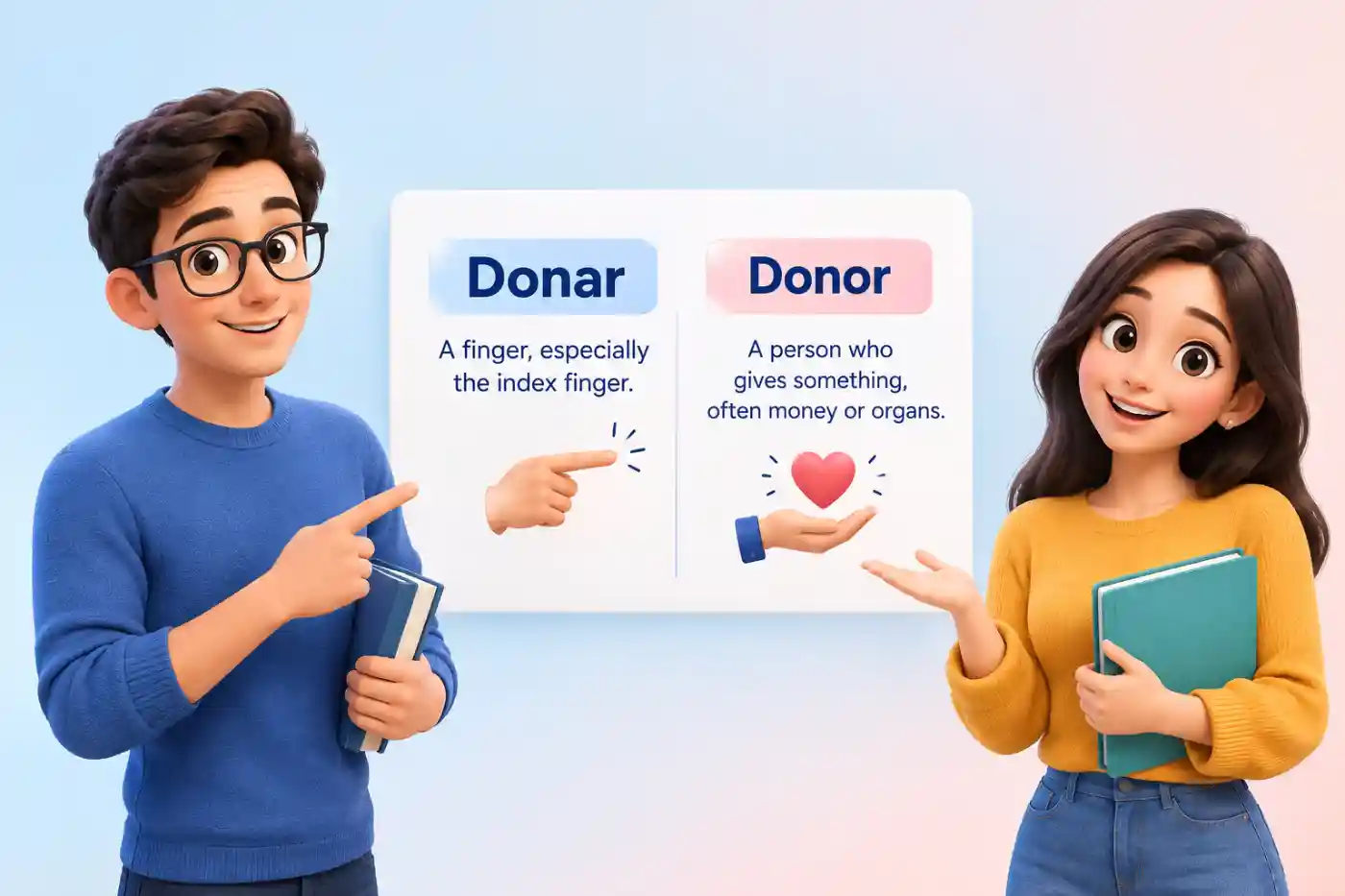
If you’re trying to decide between donar or donor, the correct English spelling is donor when you mean a person or organization that gives money, blood, organs, goods, or something else of value. Donar is not the standard English noun for that meaning.
The confusion is understandable. The two forms look almost identical and can sound similar in some accents. There’s also a useful twist: donar is a real word in Spanish, where it means to donate or give. That can create extra confusion for bilingual writers. Cambridge and Collins both list Spanish donar as the equivalent of the English verb donate. (Cambridge Dictionary)
In standard American English, however, the noun you need is donor. Dictionaries define it as someone who gives money or goods to an organization or gives blood or a body part for medical purposes. (Cambridge Dictionary)
This guide explains the difference clearly. You’ll learn the correct spelling, meaning, pronunciation, grammar, word origin, common expressions, regional usage, real world examples, common mistakes, and an easy memory trick that makes the spelling stick.
Donar Or Donor Quick Answer
Use donor when you mean a person or organization that gives something of value. For example, write blood donor, organ donor, or charity donor. Donar is not the standard English spelling for this meaning. However, donar is a Spanish verb meaning to donate. (Cambridge Dictionary)
Donar Or Donor At A Glance
| Feature | Donor | Donar |
|---|---|---|
| Standard English spelling | Correct | Incorrect for this meaning |
| Part of speech in English | Noun | Not the standard English noun |
| Main meaning | Someone who gives something | Not the English word for a giver |
| Common use | Money, blood, organs, goods, support | Spanish verb meaning to donate |
| American English | Donor | Not standard |
| British English | Donor | Not standard |
| Canadian English | Donor | Not standard |
| Australian English | Donor | Not standard |
| Plural | Donors | Not applicable for the English meaning |
| Related verb | Donate | Spanish donar means donate |
| Example | She is a blood donor. | Incorrect: She is a blood donar. |
The key point is simple: donor is the English noun you want.
What Donor Means
Donor is a countable noun. It describes a person or organization that gives something of value to another person or organization.
The word has several common uses.
A donor can give:
- Money to a charity.
- Blood to a medical service.
- An organ to another person.
- Tissue for medical treatment.
- Food to a community organization.
- Clothing to people who need it.
- Goods or supplies to an organization.
- Financial support to a project or institution.
Cambridge defines donor as a person who gives blood or part of their body to help someone who is sick. It also defines the word as someone who gives money or goods to an organization. Oxford gives a similar definition and includes people and organizations that give money, clothes, food, or other gifts to charities. (Cambridge Dictionary)
So the basic idea is:
Donor = the giver.
That distinction becomes especially useful when you compare donor with donate.
Donor Is A Noun
One of the easiest ways to avoid mistakes is to identify the part of speech.
Donor is mainly a noun.
For example:
- The donor gave $500 to the shelter.
- The hospital thanked every donor.
- She became a blood donor.
- The organization contacted its largest donors.
- An anonymous donor funded the project.
You wouldn’t normally use donor as the verb in standard English.
Incorrect:
She will donor money to the charity.
Correct:
She will donate money to the charity.
Incorrect:
We donor clothes every winter.
Correct:
We donate clothes every winter.
The relationship is easy to remember.
Donor names the person or organization.
Donate describes the action.
Donation names the thing given or the act of giving.
For example:
The donor made a donation and decided to donate again next year.
That sentence uses all three related forms correctly.
What Donar Means In English
For standard English writing, donar is not the normal noun for someone who gives a donation.
So if you are writing about a charity, blood drive, organ transplant, fundraiser, school, hospital, or nonprofit organization, use donor.
Incorrect:
The charity thanked every donar.
Correct:
The charity thanked every donor.
Incorrect:
He became an organ donar.
Correct:
He became an organ donor.
Incorrect:
We need more blood donars.
Correct:
We need more blood donors.
There is an important language detail here.
Donar is a real word in Spanish. Cambridge lists Spanish donar as a verb meaning to donate or give. Collins does the same. (Cambridge Dictionary)
For example, the Spanish phrase donar sangre means to donate blood. That does not make donar an English noun.
This distinction matters for English learners because a word can be perfectly correct in one language and incorrect in another.

Why Donor Is The Correct English Word
The English noun donor belongs to the same word family as donate and donation.
Consider this pattern:
| Word | Part of speech | Meaning |
|---|---|---|
| Donate | Verb | To give something |
| Donor | Noun | Someone who gives something |
| Donation | Noun | Something given or the act of giving |
| Donated | Past form | Gave something |
| Donating | Present participle | Giving something |
Examples make the relationship clearer.
Maria donated $100.
Maria is the donor.
Maria made a donation.
The $100 is a donation.
This is why replacing the second o in donor with a creates a problem. The resulting word does not function as the standard English noun.
Donor Pronunciation
The pronunciation can help explain why people sometimes spell the word incorrectly.
Cambridge gives the American English pronunciation as /ˈdoʊ.nɚ/ and the British English pronunciation as /ˈdəʊ.nər/. (Cambridge Dictionary)
The first syllable carries the main stress.
In American English, the final sound is commonly an unstressed er sound. That final sound can be easy to spell incorrectly because English spelling and pronunciation don’t always line up perfectly.
This is especially noticeable when people write words based on how they hear them.
The spelling is still:
donor
not:
donar
A similar spelling issue appears in other English words where the final unstressed vowel is not pronounced as clearly as it is written.
Donor Pronunciation In American English
For an American audience, donor is commonly pronounced with two syllables.
The stress falls on the first syllable.
The Cambridge American pronunciation is:
/ˈdoʊ.nɚ/ (Cambridge Dictionary)
The beginning uses the same vowel sound found in words such as go and nose.
The ending has the unstressed American er sound found in words such as teacher and mother.
The pronunciation can sound slightly different from speaker to speaker because accents affect unstressed vowels. That variation doesn’t change the spelling.
Why People Spell Donor As Donar
The most common reason is probably sound.
When an unstressed vowel becomes less distinct in everyday speech, writers can have trouble deciding which letter belongs on the page. Someone who hears the final part as an ar sound may naturally write donar.
That approach makes sense phonetically but doesn’t match standard English spelling.
There are also several other reasons for the confusion.
Sound Based Spelling
People sometimes spell unfamiliar words according to what they hear.
This happens often with words containing weak vowels.
Visual Similarity
The words donor and donar differ by only one letter. A quick glance may not reveal the error.
Spanish Influence
Spanish uses donar as a verb meaning to donate. (Cambridge Dictionary)
Someone who knows Spanish may naturally recognize donar and accidentally transfer it into English.
Keyboard Errors
The letters o and a are close enough in many typing patterns that a quick keyboard mistake can happen.
Autocorrect And Spellcheck
Some writing tools catch donar as an error in English. Others may not flag it in every situation because spelling tools depend on their language settings and dictionaries.
Pattern Confusion
English has many nouns ending in ar. Writers may unconsciously apply a familiar spelling pattern to donor.
The important point is that these reasons explain the mistake. They don’t make donar an accepted English alternative.
Donar Or Donor In Common Phrases
The easiest way to learn the correct spelling is to see it in phrases you’re likely to encounter.
Blood Donor
A blood donor is someone who gives blood for medical use.
Correct:
She became a blood donor last year.
Incorrect:
She became a blood donar last year.
Cambridge specifically lists blood donor as a standard expression. (Cambridge Dictionary)
Organ Donor
An organ donor is someone who gives or agrees to give an organ for transplantation.
Correct:
He registered as an organ donor.
Incorrect:
He registered as an organ donar.
Kidney Donor
A kidney donor gives a kidney for transplantation.
Correct:
The kidney donor was carefully evaluated before the procedure.
Charity Donor
A charity donor gives money or other support to a charitable organization.
Correct:
The charity thanked every donor for supporting the campaign.
Anonymous Donor
An anonymous donor gives something without having their identity publicly disclosed.
Correct:
An anonymous donor gave the museum a large gift.
Oxford and Cambridge both provide examples involving anonymous donors. (Cambridge Dictionary)
Corporate Donor
A corporate donor is a company or business that provides financial or material support.
Correct:
Several corporate donors supported the community program.
Cambridge lists corporate donors among its common collocations. (Cambridge Dictionary)
Donor Or Donar In Grammar
Because donor is a countable noun, you can use singular and plural forms.
Singular Form
The singular is:
donor
Examples:
- The donor arrived early.
- She is a generous donor.
- The hospital contacted the donor.
- An anonymous donor provided the funds.
Use an article when needed.
She is a donor.
He became an organ donor.
Plural Form
The plural is:
donors
Simply add s.
Examples:
- The donors received thank you letters.
- Several donors supported the project.
- The charity has hundreds of donors.
- Blood donors must meet certain eligibility requirements.
The plural does not become donars.
Incorrect:
The organization thanked its donars.
Correct:
The organization thanked its donors.

Donor Possessive Form
The possessive form depends on the number of donors.
For one donor:
donor’s
Example:
The donor’s name was kept private.
For multiple donors:
donors’
Example:
The donors’ contributions helped fund the program.
This distinction is important in formal writing.
Compare:
The donor’s contribution.
One donor owns or made the contribution.
The donors’ contributions.
Multiple donors made the contributions.
Donor And Donate
These words are closely related but they perform different jobs.
Donor is the person or organization that gives.
Donate is the action.
Compare:
The donor donated $1,000.
The first word identifies the giver. The second describes the action.
More examples:
Many donors donate regularly.
The donor decided to donate blood.
Each donor can donate according to the rules of the organization.
This distinction is one of the most useful grammar points in the entire topic.
Donor And Donation
Donation refers to something that is given or to the act of giving.
Cambridge defines donation as money or goods given to help a person or organization, or the act of giving them. (Cambridge Dictionary)
Compare these sentences:
The donor made a donation.
The donation helped the shelter.
The donor decided to donate again.
Each word has a different role.
A simple formula works well:
Donor = giver.
Donate = action.
Donation = gift or act of giving.
Donor And Giver
Giver is a broader and more casual word.
A donor usually gives something for a charitable, medical, institutional, or similar purpose.
For example:
She is the donor who funded the scholarship.
You could also say:
She is the person who gave the money.
But donor sounds more precise in formal contexts.
Cambridge lists giver, donor, benefactor, philanthropist, sponsor, and backer as related words, while their meanings are not identical. (Cambridge Dictionary)
Donor
Someone who gives money, goods, blood, organs, or another valuable resource.
Benefactor
Someone who provides help or financial support, often over time.
Philanthropist
Someone who gives substantial support to charitable or public causes.
Sponsor
A person or organization that supports something financially or otherwise, often in exchange for recognition or association.
Backer
Someone who supports a person, project, or idea.
These words overlap, but they aren’t interchangeable in every sentence.
Donor And Donator
You may also encounter donator.
It is understandable because the ending seems logical. However, donor is the normal and established choice in everyday English for the person who gives something.
Oxford and Cambridge both use donor as the standard noun. (Cambridge Dictionary)
If you’re writing an email, article, report, website page, medical document, or school assignment, donor is the natural choice.
Donor And Doner
Don’t confuse donor with doner.
Doner commonly appears in doner kebab, the food made from seasoned meat cooked on a rotating spit.
So these words have completely different meanings.
The hospital needs an organ donor.
We ordered a doner kebab.
The spelling matters because one letter can change the meaning entirely.
Donar In Spanish
This is the most important exception to understand.
In Spanish, donar is a legitimate verb. It means to donate or to give. Cambridge lists donar as a Spanish verb, with examples involving blood and books. (Cambridge Dictionary)
Collins also translates Spanish donar as to donate or to give depending on context. (Collins Dictionary)
So a Spanish speaker might correctly write:
donar sangre
That means:
donate blood
But an English speaker should write:
donate blood
And the person who gives the blood is:
blood donor
This is a good example of why spelling cannot always be judged by looking at a related word in another language.
Donar As A Proper Name
There is another reason you might see Donar outside Spanish.
Donar appears in discussions of Germanic mythology. Encyclopedia.com identifies Donar as a Germanic name associated with Thor. (Encyclopedia)
That is a completely different use from the English noun donor.
For example, a historical or mythology article might mention Donar as a proper name.
That doesn’t make donar a valid English spelling for a person who gives money or blood.
Context matters.
If you’re writing about charity or medical donation, use donor.
If you’re discussing a proper name, historical term, or Spanish vocabulary, donar may appear for an entirely different reason.
Donar Or Donor In American English
For American English, the answer is straightforward.
Use donor.
American dictionaries and learner dictionaries recognize donor as the noun for someone who gives money, goods, blood, an organ, or another valuable thing. Cambridge’s American Dictionary gives the pronunciation /ˈdoʊ·nər/ and defines the word in both charitable and medical contexts. (Cambridge Dictionary)
Examples include:
- blood donor
- organ donor
- tissue donor
- charity donor
- anonymous donor
- corporate donor
- major donor
- private donor
- financial donor
- living donor
Donar is not an American English spelling of this noun.
British English
British English also uses donor.
Oxford lists donor as the noun for a person or organization that gives money, clothes, food, or other gifts to a charity. (Oxford Learner’s Dictionaries)
The British pronunciation differs slightly from the American pronunciation, but the spelling remains the same.
American English:
donor
British English:
donor
So this isn’t a case like color and colour.
There is no standard British spelling donar.
Canadian English
Canadian English also uses donor for this meaning.
You can write:
The charity thanked its donors.
You don’t need to change the spelling for a Canadian audience.
Australian English
Australian English likewise uses donor.
For example:
The hospital is looking for more blood donors.
The same spelling works naturally in Australian writing.
So across the major varieties of English, the standard form remains donor.
Donor In Professional Writing
Correct spelling matters even more in professional writing because small errors can affect credibility.
Imagine these phrases on a medical website:
organ donar registration
blood donar information
donor eligibility
The first two contain spelling errors. The third is correct.
In professional communication, use donor in:
- Medical records.
- Charity websites.
- Fundraising emails.
- Annual reports.
- Academic papers.
- News articles.
- School assignments.
- Grant documents.
- Business reports.
- Public information pages.
- Donation forms.
- Hospital communications.
Professional editors generally prefer the established dictionary form donor because it is clear, standard, and widely understood.
Twenty Real Life Examples For Donar Or Donor
Here are natural examples showing how donor works in different contexts.
- The hospital thanked every blood donor.
- She became an organ donor after learning more about transplantation.
- An anonymous donor gave the library enough money to expand its collection.
- The charity relies on monthly donors to support its programs.
- Several corporate donors contributed to the community project.
- The donor asked the organization to keep the gift private.
- Every donor received a thank you message.
- The nonprofit welcomed new donors through its website.
- He has been a regular donor for several years.
- The museum received a large donation from a private donor.
- The scholarship was created with help from a generous donor.
- The hospital is recruiting eligible blood donors.
- The donor’s family requested privacy.
- The organization published a list of its major donors.
- A local business became a donor to the food bank.
- The research team worked with tissue donors.
- The charity sent its donors an annual report.
- The foundation received support from several international donors.
- She decided to donate her old clothes rather than throw them away.
- The donor made the contribution without asking for public recognition.
Notice that donor always refers to the person or organization that gives. The action is expressed with donate.
Common Mistakes With Donar And Donor
The most common mistake is simple.
Incorrect:
blood donar
Correct:
blood donor
Another common error is using donar as a verb.
Incorrect:
I want to donar money to the charity.
Correct:
I want to donate money to the charity.
Some writers also confuse donor with doner.
Incorrect:
She is an organ doner.
Correct:
She is an organ donor.
Another mistake involves the plural.
Incorrect:
The charity thanked its donars.
Correct:
The charity thanked its donors.
The possessive form can also cause trouble.
Incorrect:
The donors contribution was generous.
Correct:
The donor’s contribution was generous.
For several donors:
The donors’ contributions were generous.
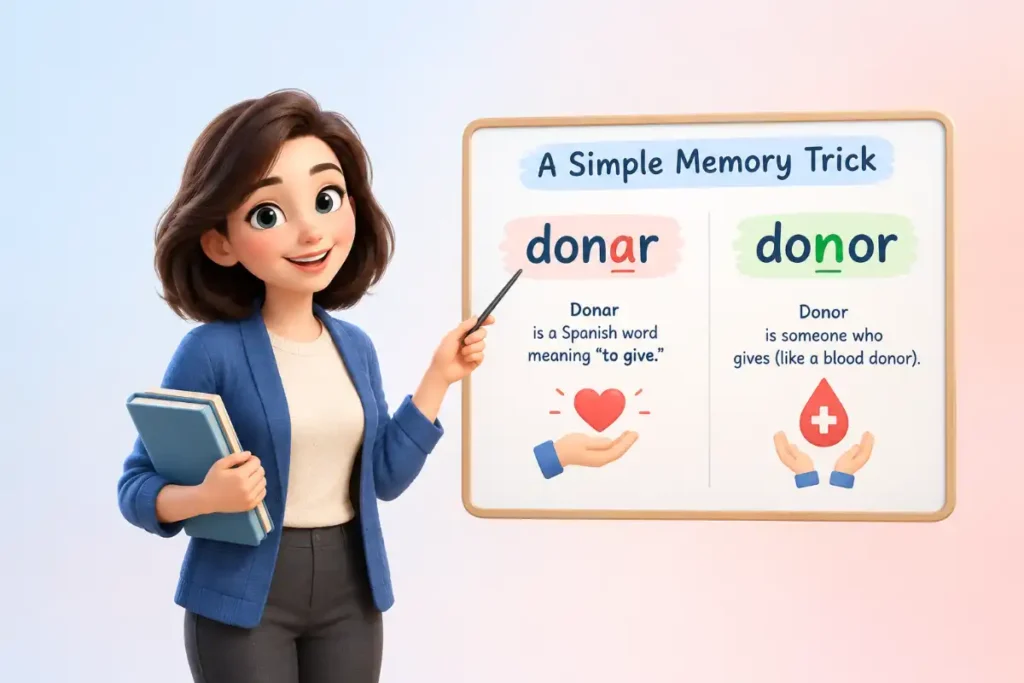
A Simple Memory Trick Donar And Donor
Here is the easiest memory trick.
Think:
Donor has O for one who gives.
The middle vowel stays o.
You can also connect the word family:
donate → donation → donor
All three belong together.
Try this sentence:
The donor made a donation because she wanted to donate.
Once you remember the family, donar starts to look out of place.
Another useful trick is to remember that donar is the Spanish verb. If you’re writing in English and need the noun for the person who gives, switch to donor.
Word Origin Of Donor
The word has a long history.
Dictionary.com traces donor to late Middle English donour, which came through Anglo French from Latin dōnātor. The Latin form is connected to dōnāre, meaning to give. (Dictionary.com)
That history connects naturally with the modern English family:
- donor
- donate
- donation
- donation related vocabulary
The spelling has developed through the history of English and French rather than being created by simply adding a letter to donate.
This is useful because English spelling often preserves older patterns that don’t perfectly match modern pronunciation.
In other words, the spelling donor isn’t random. It belongs to a long established word family.
Related Words For Donor
Several words sit close to donor in meaning.
Giver
A broad and simple term for someone who gives something.
Benefactor
A person who provides financial or other help to another person or organization.
Philanthropist
A person who gives money or resources to support charitable or public causes.
Contributor
Someone who gives money, effort, ideas, material, or other support.
Sponsor
Someone who supports a person, activity, organization, or project.
Supporter
Someone who provides help or approval.
Donor
The most direct word for someone who gives money, goods, blood, organs, tissue, or another valuable resource in a donation context.
These terms overlap, but choosing the right one makes your writing more precise.
Related Expressions
You’ll often see donor used in established phrases.
Common examples include:
- Blood donor.
- Organ donor.
- Living donor.
- Deceased donor.
- Anonymous donor.
- Major donor.
- Individual donor.
- Corporate donor.
- Private donor.
- International donor.
- Donor organization.
- Donor funding.
- Donor support.
- Donor database.
- Donor campaign.
- Donor recognition.
- Donor relations.
Cambridge’s dictionary data also show established combinations such as anonymous donor, corporate donors, and deceased donor. (Cambridge Dictionary)
What Professional Editors Recommend
A professional editor would make the choice quickly.
If the sentence is in English and you mean someone who gives money, goods, blood, an organ, or another valuable thing, use donor.
There is no reason to replace the second o with a.
A good editing process is to look at the role of the word.
Ask:
Am I naming the person who gives?
Use donor.
Am I describing the act of giving?
Use donate.
Am I naming the gift or act of giving?
Use donation.
This three word distinction solves most mistakes.
Dictionaries support this usage. Cambridge defines donor as a noun for people who give blood, body parts, money, or goods. Oxford defines it as a person or organization that makes gifts to a charity or similar organization. (Cambridge Dictionary)
Frequently Asked Questions
Is Donar A Correct English Word
Donar is not the standard English noun for a person who gives money, blood, organs, goods, or other resources. Use donor in that context. However, donar is a legitimate Spanish verb meaning to donate or give. It can also appear as a proper name or historical term in other contexts. (Cambridge Dictionary)
Is Donor The Correct Spelling
Yes. Donor is the standard English spelling for a person or organization that gives something of value. Examples include blood donor, organ donor, and charity donor. Cambridge and Oxford both list donor as an established English noun. (Cambridge Dictionary)
Why Do People Spell Donor As Donar
The main reason is pronunciation. In some accents, the unstressed final part of donor can sound less distinct, which may lead someone to write donar. Spanish can also contribute to the confusion because donar is a Spanish verb meaning to donate. Neither reason changes the standard English spelling. (Cambridge Dictionary)
Is Donor Used In British English
Yes. Donor is standard in British English as well as American English. The pronunciation differs somewhat between the two varieties, but the spelling remains the same. Oxford lists donor as the standard noun for someone who gives money, food, clothes, or other gifts to a charity or similar organization. (Oxford Learner’s Dictionaries)
What Is The Plural Of Donor
The plural of donor is donors. You simply add s. For example, The charity thanked its donors for their support. Do not write donars. The same spelling remains in medical, charitable, academic, and everyday contexts.
Is Donar The Verb Form Of Donor
No. The English verb is donate. The noun for the person who gives is donor, and the noun for the gift or act of giving is donation. For example, The donor decided to donate money and make another donation next year. In Spanish, however, donar is a verb meaning to donate. (Cambridge Dictionary)
What Is The Difference Between Donor And Donation
A donor is the person or organization that gives something. A donation is the thing given or the act of giving. For example, The donor made a donation to the charity. In that sentence, the donor is the giver and the donation is the gift.
How Do You Remember Donor Spelling
Remember donor as part of the word family donate, donor, and donation. You can also use the phrase donor means the one who gives. If you see donar in an English sentence about charity or medical giving, check it carefully because donor is almost certainly the form you need.
Final Verdict
When you mean a person or organization that gives money, blood, organs, goods, or another valuable resource, donor is the correct English word.
Donar is not the standard English spelling for this meaning.
The easiest way to remember the difference is:
Donor = the giver.
Donate = the action.
Donation = the gift or act of giving.
There is one useful language detail to keep in mind. Donar is a real Spanish verb meaning to donate. It also appears in historical and proper name contexts. Those uses don’t change the standard English spelling.
So if you’re writing blood donor, organ donor, charity donor, anonymous donor, or major donor, keep the second o.
When the person gives, remember the donor.

Founding Editor
Maya spent six years as a copyeditor at a regional newspaper before starting Grammist, which is where the “answer first” format came from: newsroom style guides don’t have room for a preamble.
She writes and reviews most of the word-pair and spelling entries, and has final say on anything that goes out under the Grammist name.