
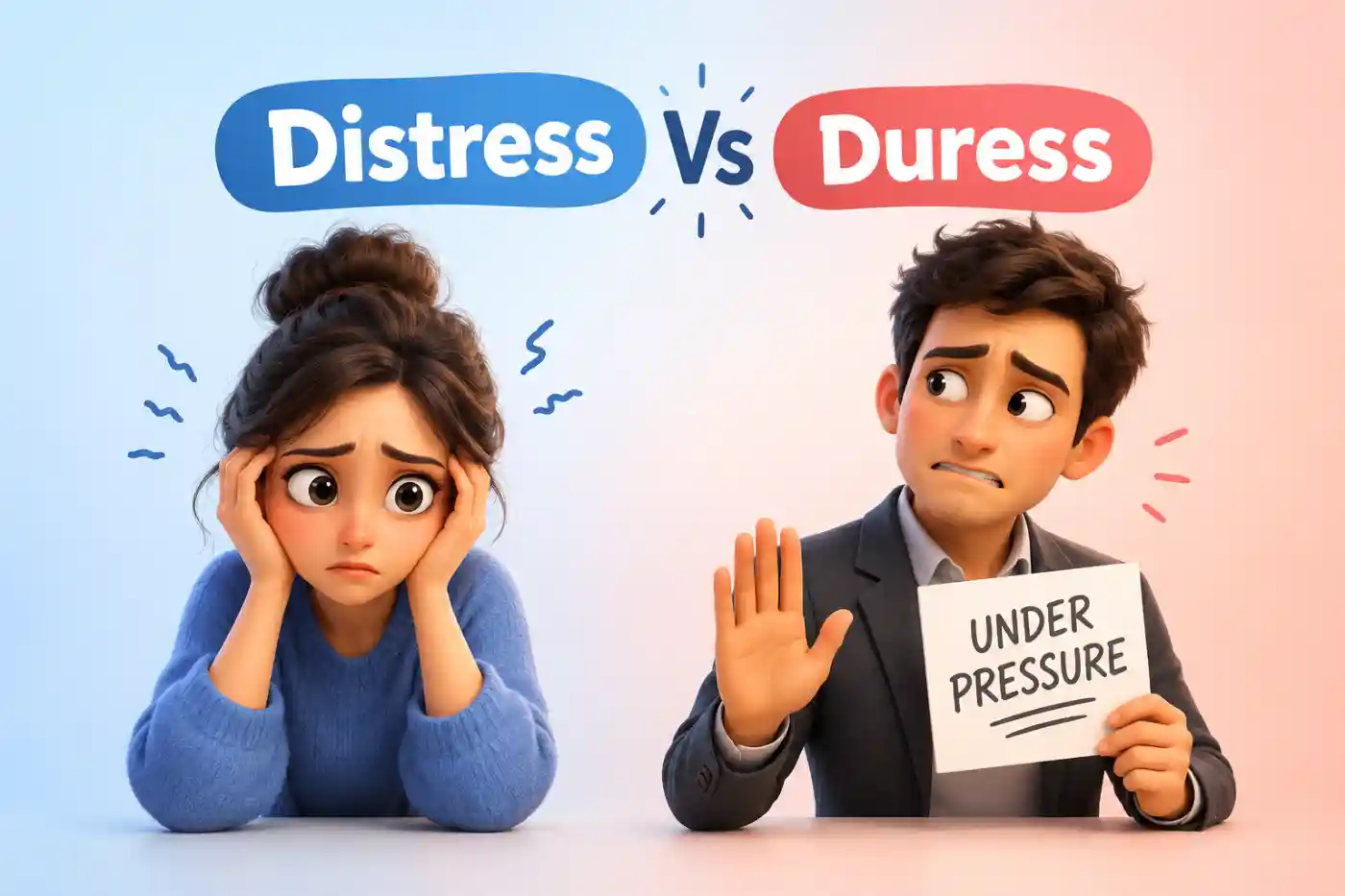
Distress vs duress is a classic English word choice problem. The two words look similar. They also sound similar enough to cause confusion. Yet they describe two very different situations.
Distress usually refers to serious emotional or physical suffering. It can describe worry, sadness, pain, danger, hardship, or a strong need for help. You might feel distress after losing someone you love. A business can experience financial distress. A boat in danger can send a distress signal.
Duress is about pressure or force. It usually means that someone is being threatened, intimidated, or coerced into doing something they don’t freely want to do. The word appears especially often in legal and formal contexts. The familiar expression is under duress.
That small difference matters. If someone is upset after receiving terrible news, they’re in distress. If someone signs an agreement because another person threatens them, they may have acted under duress.
This guide explains the difference between distress vs duress in plain American English. You’ll learn their meanings, grammar, pronunciation, origins, common phrases, legal use, everyday examples, common mistakes, and simple ways to remember which word fits.
Quick Answer
Distress means serious suffering, worry, pain, or danger. Duress means pressure, threats, or force that makes someone act against their free choice. Use distress for suffering and duress for coercion. For example, a family can be in distress after a disaster, while someone can sign a contract under duress.
Distress Vs Duress At A Glance
| Feature | Distress | Duress |
|---|---|---|
| Main meaning | Suffering or serious trouble | Pressure or coercion |
| Main idea | Someone is suffering | Someone is being forced |
| Part of speech | Noun and verb | Noun |
| Common phrase | In distress | Under duress |
| Common contexts | Emotions, health, emergencies, finance | Law, contracts, threats, coercion |
| Emotional element | Often central | May be present but isn’t the main meaning |
| Everyday use | Common | More formal |
| Legal use | Has some specialized uses | Strongly associated with legal language |
| Example | The child was in distress. | He signed under duress. |
The easiest rule is this:
Distress = suffering.
Duress = coercion.
That distinction will solve most word choice questions.
What Does Distress Mean
Distress is a noun that describes extreme worry, sadness, pain, suffering, or a situation involving serious danger. It can also function as a verb meaning to make someone very upset or worried. (Cambridge Dictionary)
Consider these examples:
- The accident caused emotional distress.
- The child was in distress.
- The family experienced financial distress.
- The sailor sent a distress signal.
- The news distressed her.
In each case, the central idea is suffering or serious difficulty.
Distress doesn’t always mean sadness. It can describe physical suffering, emotional pain, financial trouble, or an emergency.
For example:
The patient showed signs of distress.
The person may be experiencing physical difficulty.
The company is facing financial distress.
The company is struggling financially.
The hikers were in distress after becoming lost.
They were in danger and needed help.
This wide range of uses makes distress a much more flexible word than duress.
What Does Duress Mean
Duress is a noun referring to threats or pressure used to force someone to do something. Cambridge classifies it as a formal word and gives under duress as a standard expression. (Cambridge Dictionary)
For example:
He signed the agreement under duress.
This means he didn’t make the decision freely. Pressure or threats influenced him.
She claimed that she acted under duress.
The important point isn’t simply that she was upset. The important point is that someone or something pressured her into acting.
Duress is strongly associated with legal language. You’ll often encounter it in discussions involving contracts, confessions, criminal cases, consent, threats, or coercion.
The word can appear outside law as well. Still, it tends to sound formal and serious.
The Core Difference Between Distress And Duress
The most useful way to separate these words is to focus on the situation rather than their spelling.
Ask:
Is the person suffering?
Use distress.
Is the person being forced?
Use duress.
Compare these sentences:
She was in distress after hearing the news.
He was emotionally upset.
She signed the document under duress.
She was pressured or threatened into signing it.
The first sentence describes a person’s condition.
The second describes coercive pressure affecting a person’s choice.
That distinction is more useful than trying to memorize complicated dictionary definitions.
Distress Focuses On Suffering
Distress can describe what someone experiences when facing a painful or difficult situation.
Common causes include:
- Grief.
- Accidents.
- Serious illness.
- Fear.
- Personal loss.
- Financial problems.
- Natural disasters.
- Dangerous situations.
- Emotional trauma.
- Severe worry.
For example:
The family was in distress after the house was damaged by the storm.
Nothing in this sentence suggests that another person forced the family to do something. The focus is their suffering.
Duress Focuses On Coercion
Duress changes the focus from suffering to freedom of choice.
Imagine someone tells an employee:
Sign this document or I’ll harm you.
If the employee signs because of that threat, the situation involves coercion. In appropriate legal or formal language, the employee may say they signed under duress.
The key question becomes:
Why did the person act?
If the answer is because someone used threats or coercive pressure, duress may be the appropriate word.
Distress Vs Duress In One Simple Example
Imagine two people receiving the same bad news.
Person A becomes upset and starts crying.
And Person A is in distress.
Person B is threatened by someone and forced to sign a document.
Person B acts under duress.
Both situations may involve fear. Both may be unpleasant. But the underlying ideas are different.
Distress describes suffering.
Duress describes coercion.
Distress Vs Duress Vs Stress
It’s also useful to add stress to the comparison because many learners connect all three words with pressure.
| Word | Basic meaning | Example |
|---|---|---|
| Stress | Pressure or tension | I’m stressed about my exam. |
| Distress | Serious suffering or emotional pain | The accident caused great distress. |
| Duress | Coercive pressure or threats | He signed under duress. |
Stress can be ordinary and temporary. You might feel stress before a job interview or a difficult test.
Distress is stronger. It suggests serious worry, pain, suffering, danger, or trouble.
Duress is different again. It involves pressure that affects someone’s freedom to choose.
So you can think of the three words like this:
Stress is pressure.
Distress is serious suffering.
Duress is coercive pressure.
When To Use Distress
Use distress when your sentence focuses on suffering or serious trouble.
Common situations include:
Emotional distress
The person is suffering emotionally.
Physical distress
The person is experiencing physical difficulty or suffering.
Financial distress
A person, company, or organization is facing serious financial problems.
Distress signal
A signal sent by someone or something in danger and needing help.
In distress
A person, animal, vehicle, vessel, or other subject is suffering or in danger.
Examples:
- The child was clearly in distress.
- The accident caused considerable emotional distress.
- The company is experiencing financial distress.
- The animal appeared to be in distress.
- The pilot issued a distress call.
- The family suffered severe distress after the loss.
- The patient showed signs of physical distress.
When To Use Duress
Use duress when the sentence involves coercion, threats, intimidation, or forced action.
Common situations include:
- Signing a contract.
- Giving consent.
- Making a confession.
- Making a decision.
- Taking an action.
- Entering an agreement.
- Acting against one’s wishes.
- Facing threats.
Examples:
- He signed the contract under duress.
- She said she acted under duress.
- The defendant claimed duress.
- The confession was allegedly made under duress.
- They argued that the agreement was entered into under duress.
- He gave the statement under duress.
The most important collocation to remember is under duress.
Distress Vs Duress Grammar
Grammar makes the distinction even clearer.
Distress can be both a noun and a verb.
As a noun:
The accident caused great distress.
As a verb:
The news distressed her.
As an adjective, you can use the related forms distressed and distressing.
She looked distressed.
It was a distressing experience.
Duress is normally used as a noun.
The most natural structure is:
under duress
For example:
He acted under duress.
She signed the document under duress.
You generally shouldn’t invent casual verb forms such as duressed. English already gives you clearer structures such as was forced, was pressured, or acted under duress.
Distress As A Noun
Distress is usually an uncountable noun when it means suffering or worry.
Natural examples include:
- emotional distress.
- severe distress.
- financial distress.
- considerable distress.
- physical distress.
- signs of distress.
You normally don’t need an article when talking about distress in this general sense.
She experienced emotional distress.
The accident caused severe distress.
You can use the when talking about a specific instance or clearly identified condition.
The distress caused by the accident lasted for months.
Distress As A Verb
As a verb, distress means to make someone very upset or worried. Cambridge lists this use directly. (Cambridge Dictionary)
Examples:
- The news distressed him.
- I didn’t mean to distress you.
- The images distressed the viewers.
- The child’s condition distressed her parents.
The verb normally takes a direct object.
The news distressed her.
Not:
The news distressed to her.
This is a small grammar point, but it matters in polished writing.
Distressed And Distressing
Two related forms often cause confusion.
Distressed describes the person or thing experiencing distress.
She looked distressed.
The patient appeared distressed.
Distressing describes something that causes distress.
The news was distressing.
It was a distressing experience.
A useful pattern is:
Person = distressed.
Situation = distressing.
Compare:
I was distressed by the news.
The news was distressing.
Duress As A Noun
Duress is generally an uncountable noun.
You normally won’t say:
a duress
Instead, you say:
under duress
The witness acted under duress.
You can also find expressions such as:
- claim duress.
- allege duress.
- act under duress.
- sign under duress.
- consent under duress.
- economic duress.
The exact legal meaning can depend on the jurisdiction and the facts of a case. For legal documents, professional legal advice is more reliable than treating a dictionary definition as a complete statement of law.
Distress Vs Duress Pronunciation
The words also have different vowel sounds.
Distress is pronounced:
distress (/dɪˈstres/)
Cambridge gives the American pronunciation as /dɪˈstres/. (Cambridge Dictionary)
Duress has more variation across English accents.
duress (/dʊˈres/)
Cambridge’s American English entry gives /dʊˈres/. Its broader English entry also records other regional pronunciations. (Cambridge Dictionary)
Both words normally carry stress on the second syllable.
The spelling can make them look almost like close relatives. The pronunciation doesn’t make them interchangeable.
Common Pronunciation Mistakes
One common mistake is giving duress the vowel sound associated with distress.
Another is placing the main stress on the wrong syllable.
For both words, give the second syllable the stronger beat:
dis TRESS
du RESS
The exact first vowel in duress varies across English varieties. For American English, the dictionary pronunciation above is a useful guide.
Distress Vs Duress Common Phrases
Learning collocations is one of the fastest ways to build natural vocabulary.
Common Expressions With Distress
Emotional distress
The phrase often appears in discussions of emotional suffering.
Financial distress
This refers to serious financial difficulty. Cambridge also uses the term for financial failure or difficulty meeting debt or operating costs. (Cambridge Dictionary)
In distress
This means someone or something is suffering or in danger and needs help. (Cambridge Dictionary)
Distress signal
A signal used to show that help is urgently needed.
Distress call
A call requesting urgent assistance.
Distressed person
Someone who is upset, suffering, or in serious difficulty.
Common Expressions With Duress
Under duress
This is the most important phrase to learn.
Signed under duress
The person signed because of coercive pressure.
Acted under duress
The person acted because they were being forced or pressured.
Consent under duress
The person’s apparent consent was affected by coercion.
Economic duress
A formal expression involving coercive economic pressure.
The phrase under duress is so established that it should be your first choice when describing coercion.
Distress Vs Duress In Legal Writing
This is where precision becomes especially important.
Legal writing often uses duress to describe circumstances involving coercion. For example:
The defendant claimed that he acted under duress.
The agreement was challenged on the grounds of duress.
The word distress can also appear in legal language, but it doesn’t automatically mean coercion. It can refer to emotional suffering or other forms of serious difficulty. Cambridge also records an older specialized legal meaning of distress involving the seizure and sale of property for debt. (Cambridge Dictionary)
So don’t assume that a legal sentence automatically requires duress.
Look at the meaning.
If the sentence describes suffering, distress may be correct.
If it describes coercion or threats that affect a person’s choice, duress may be correct.
Distress Vs Duress In Workplace Writing
Workplace writing provides plenty of opportunities to confuse these terms.
Consider:
The employee experienced emotional distress because of the accident.
Correct if the focus is emotional suffering.
Now compare:
The employee signed the agreement under duress.
Correct if coercive pressure affected the employee’s decision.
But consider:
The employee was under duress because the project deadline was Friday.
This sounds exaggerated in ordinary workplace English. A deadline may create stress or pressure. It doesn’t automatically create duress.
Better:
The employee was under considerable pressure because of the deadline.
Or:
The employee was stressed by the approaching deadline.
That distinction helps your writing sound precise rather than dramatic.
Distress Vs Duress In Academic Writing
Academic writing benefits from precise word choice.
Instead of writing:
The participants experienced duress after the disaster.
Use:
The participants experienced distress after the disaster.
If you mean emotional suffering.
If your research concerns coercion, then duress may be appropriate:
The study examined how coercive pressure affected decisions made under duress.
In academic writing, don’t choose the more sophisticated looking word simply because it sounds formal. Choose the word that communicates the exact idea.
That is a useful editorial rule for almost every vocabulary question.
Distress Vs Duress In Everyday Conversation
Distress is much easier to use naturally in everyday speech.
You might say:
- The child was in distress.
- She was visibly distressed.
- The news caused him a lot of distress.
- The dog seemed distressed.
Duress sounds much more formal.
In everyday conversation, speakers are more likely to say:
- He was forced to sign it.
- She felt pressured into agreeing.
- They threatened him.
- He didn’t really have a choice.
In a legal or formal setting, under duress becomes much more natural.
Real Life Examples Of Distress
Here are examples across different situations.
Daily Conversation
I could tell she was in distress, so I asked if she needed help.
The child became distressed when he couldn’t find his parents.
Workplace
The employee reported severe emotional distress after the incident.
The company is facing financial distress after months of declining sales.
We understand that the delay has caused considerable distress and inconvenience.
Academic Writing
The researchers examined the relationship between chronic stress and psychological distress.
Journalism
Rescue teams found several passengers in distress after the vessel lost power.
Emergency Situations
The crew sent a distress signal after the engine failed.
Literature
The character’s distress becomes clear as the story unfolds.
Social Media
That video was genuinely distressing to watch.
Notice how each example focuses on suffering, worry, danger, or emotional impact.
Real Life Examples Of Duress
Now compare examples involving coercion.
Daily Conversation
He said he agreed under duress.
This sounds formal, but it can be used outside legal writing when the speaker wants to emphasize serious pressure.
Workplace
The employee claimed that the resignation letter was signed under duress.
Contract Writing
The party alleged that the agreement had been signed under duress.
Legal Discussion
The defense argued that the statement was made under duress.
Formal Report
The witness stated that he acted under duress.
Academic Writing
The paper examines decision making under conditions of coercion and duress.
Journalism
The witness later claimed that the confession had been obtained under duress.
The common thread is clear. Someone’s freedom of choice is being questioned.
Distress Vs Duress In Financial Contexts
Money creates another interesting distinction.
Financial distress is a standard expression.
A person, household, business, or organization can experience financial distress because of serious money problems.
Examples:
- The company entered financial distress.
- Rising debt caused financial distress.
- The family experienced financial distress after the loss of income.
Duress can also appear in financial contexts, but the meaning changes.
Economic duress refers to coercive economic pressure. The focus isn’t simply financial hardship. The focus is pressure that affects a person’s ability to choose freely.
So:
Financial distress = serious financial trouble.
Economic duress = coercive pressure involving economic circumstances.
Those ideas can overlap in complicated situations, but they aren’t synonyms.
Why People Confuse Distress And Duress
There are several reasons these words cause trouble.
First, they look alike. Both begin with d and contain similar letters.
Second, both words can appear in serious situations. A person can experience distress during a crisis. A person can experience fear or suffering while acting under duress.
Third, both words have historical connections to ideas of hardship and difficulty. Their modern meanings have developed in different directions, but their related histories help explain why they can feel semantically close.
Fourth, both words occur in formal writing. Learners sometimes assume that formal vocabulary with a similar sound must have similar meanings.
The safest approach is not to rely on appearance.
Look at the action.
Suffering? Distress.
Coercion? Duress.
The Word Origin Of Distress
The history of distress reaches back through Old French and Latin. The word is connected with older forms expressing ideas such as pressure, constraint, trouble, or hardship.
Over time, English developed several related senses. Modern distress now covers emotional suffering, physical difficulty, danger, financial trouble, and other serious forms of hardship.
This history helps explain why the word can describe both a person’s emotional state and a dangerous situation.
For example:
She was in emotional distress.
And:
The boat was in distress.
Those uses may look different, but both involve serious difficulty or danger.
The Word Origin Of Duress
Duress also has roots connected with force, hardship, and constraint. It entered English through Anglo French and French forms related to harshness or force.
Over time, its meaning became closely associated with coercion.
That development explains its strong connection with legal language.
Today, duress is most useful when someone’s freedom of choice is affected by threats or coercive pressure.
British And American English
The basic distinction between distress and duress remains the same in American and British English.
Distress means suffering, serious worry, pain, danger, or related difficulty.
Duress refers to coercive pressure or threats.
Pronunciation can vary by region, especially with duress. Cambridge records different British and American pronunciations. (Cambridge Dictionary)
The vocabulary distinction itself doesn’t change simply because you move from the United States to the United Kingdom.
Canadian and Australian English also use both words with essentially the same core distinction. Formal legal usage can vary because legal systems use their own terminology and doctrines.
For general English writing, the same practical rule works:
Distress means suffering.
Duress means coercion.
Is Distress More Common Than Duress
In ordinary American English, distress has a much broader range of uses.
You can talk about emotional distress, financial distress, a person in distress, a distress signal, a distressed animal, or distressing news.
Duress has a narrower range and carries a more formal tone. It is especially common in legal and formal contexts.
That doesn’t make one word better than the other. They simply serve different purposes.
A good editor chooses based on meaning rather than frequency.
Common Mistakes With Distress And Duress
Mistake One
He signed the contract in distress.
This sentence can be grammatically possible if you mean he was emotionally upset while signing.
But if you mean he was forced to sign, the clearer expression is:
He signed the contract under duress.
Mistake Two
She was under duress after losing her job.
If the sentence only means she was suffering emotionally because of job loss, distress is the better choice.
She experienced severe distress after losing her job.
Mistake Three
The child was under duress because he was scared.
Fear alone doesn’t establish duress.
A better sentence is:
The child was in distress because he was scared.
If someone threatened or forced the child to act, then duress could become relevant.
Mistake Four
I am under duress because I have three deadlines.
For most everyday situations, this is too strong.
Try:
I’m under a lot of pressure because I have three deadlines.
Or:
I’m stressed because I have three deadlines.
Mistake Five
She felt duress after hearing the news.
Use:
She felt distress after hearing the news.
Duress isn’t simply another word for emotional pain.
Distress And Duress Are Not Interchangeable
This is the most important point in the entire article.
You cannot replace one word with the other just because both sentences describe a difficult situation.
Consider:
The accident caused emotional distress.
This describes suffering.
Now:
He signed the agreement under duress.
This describes coercion.
Changing the words would change the meaning.
This is why precise vocabulary matters. A single word can tell the reader what kind of problem occurred.
Memory Tricks For Distress And Duress
You don’t need a complicated mnemonic.
Use this:
Distress = pain and suffering.
Duress = pressure and force.
You can also remember the common phrases:
In distress.
Under duress.
Those two expressions make the distinction easy to recall.
Another useful trick is to imagine two questions.
How does the person feel?
Think distress.
Why did the person do it?
Think duress when threats or coercion caused the action.
Related Words To Distress
Useful related words include:
- Suffering.
- Pain.
- Anxiety.
- Worry.
- Anguish.
- Hardship.
- Trouble.
- Grief.
- Fear.
- Upset.
- Despair.
- Difficulty.
The exact synonym depends on the context.
Stress is not always a perfect synonym because it can describe ordinary pressure.
Anguish often suggests deep emotional suffering.
Hardship usually emphasizes difficult circumstances.
Distress can cover several of these ideas.
Related Words To Duress
Useful related words include:
- Coercion.
- Force.
- Threat.
- Intimidation.
- Pressure.
- Compulsion.
- Constraint.
- Harassment.
Again, context matters.
Pressure is much broader than duress.
You can be under pressure without being under duress.
Coercion is closer in meaning because it involves compelling someone to act.
Force can also be broader because it may refer to physical force rather than the wider legal concept associated with duress.
Distress And Duress Opposites
Neither word has one perfect opposite in every context.
For distress, possible contrasts include:
- Comfort.
- Relief.
- Calm.
- Peace.
- Contentment.
- Security.
For duress, possible contrasts include:
- Freedom.
- Choice.
- Voluntary action.
- Consent.
- Independence.
These aren’t exact dictionary opposites in every sentence, but they help clarify the underlying concepts.
Expert Editor’s Note
A professional editor doesn’t choose between distress and duress by asking which word sounds more sophisticated.
The editor asks what the sentence needs to communicate.
If the writer means emotional suffering, distress is the natural choice.
If the writer means coercion, duress is the precise choice.
Collocation also matters. Native English speakers naturally use expressions such as in distress, emotional distress, financial distress, and under duress.
That is why dictionary definitions alone aren’t enough. Good word choice depends on meaning, grammar, collocation, tone, and context.
Cambridge’s entries support this distinction clearly. It defines distress in terms of extreme worry, sadness, pain, danger, or urgent need, while its American English entry for duress focuses on threats used to force a person to act. (Cambridge Dictionary)
A Practical Editing Test Distress And Duress
When proofreading a sentence, replace the target word with a simple phrase.
If you can replace it with:
suffering
then distress may be right.
If you can replace it with:
being forced
then duress may be right.
For example:
The accident caused distress.
Replace distress with suffering:
The accident caused suffering.
The meaning works.
Now:
He signed under duress.
Replace duress with being forced:
He signed because he was being forced.
The meaning works.
This simple test is surprisingly effective.
Twenty More Examples
Here are additional examples that show the difference in context.
- The storm left several families in distress.
- The patient appeared to be in considerable distress.
- The news caused her deep emotional distress.
- The company is struggling with financial distress.
- The pilot sent a distress signal after the engine failed.
- The child became distressed after hearing the loud noise.
- The documentary contained several distressing scenes.
- The animal was clearly in distress.
- The accident caused distress throughout the community.
- The family sought help during a period of financial distress.
- He claimed that he signed the agreement under duress.
- She said that the confession was made under duress.
- The witness claimed to have acted under duress.
- The agreement was challenged on grounds of duress.
- He argued that threats had placed him under duress.
- She refused to say that her decision was voluntary and claimed duress.
- The defendant raised duress as part of his legal argument.
- The employee said that the resignation had occurred under duress.
- The company denied the allegation of economic duress.
- The lawyer asked the witness if anyone had pressured him into making the statement.
The final example avoids duress because plain English makes the idea clearer. That’s another useful editorial lesson: don’t use a formal word simply because you can.
Frequently Asked Questions
Is Distress The Same As Duress
No. Distress means serious suffering, worry, pain, danger, or hardship. Duress means coercive pressure, threats, or force that makes someone act against their free choice. For example, a person can experience distress after an accident, while someone can sign a contract under duress if threats or coercion affected the decision.
What Is The Difference Between Distress And Duress In Law
In legal contexts, distress can refer to suffering or can have specialized legal meanings depending on the jurisdiction. Duress generally concerns coercion that affects a person’s ability to act freely. Legal definitions can vary by jurisdiction, so a dictionary definition shouldn’t replace professional legal advice for an actual case.
Is It Correct To Say Under Distress
In distress is the standard expression when you mean someone is suffering or in danger. Under duress is the standard expression when you mean someone is being forced or pressured. You can say that someone acted while experiencing distress, but under distress is not the usual collocation for that meaning.
Is It Correct To Say In Duress
No. The standard expression is under duress. For example, write He signed the agreement under duress. If you’re describing suffering rather than coercion, use in distress, as in The child was in distress.
Can Someone Experience Distress And Duress At The Same Time
Yes. The concepts can occur together. For example, a person who is threatened into signing a document may experience emotional distress because of the situation and may also have acted under duress. The words describe different aspects of the same event. Distress describes suffering, while duress describes coercive pressure.
Is Duress A Formal Word
Yes. Cambridge labels duress as formal and also identifies it as a legal term in its Business English material. (Cambridge Dictionary) In everyday American conversation, people often use simpler expressions such as pressure, threatened, or forced. The phrase under duress is especially common in formal and legal writing.
What Is The Plural Of Distress Or Duress
Both distress and duress are normally uncountable nouns when they refer to suffering or coercion. You usually don’t need plural forms. Instead of saying duresses, writers generally use phrases such as instances of duress, claims of duress, or acts of coercion when multiple cases need to be discussed.
How Can I Remember Distress Vs Duress
Use the simplest memory rule: distress means suffering and duress means coercion. You can also remember the standard phrases in distress and under duress. If the sentence focuses on pain, fear, sadness, danger, or hardship, think distress. If it focuses on threats, force, or lack of free choice, think duress.
Final Verdict
Distress and duress are not interchangeable.
Use distress for serious suffering, emotional pain, worry, physical difficulty, danger, or hardship.
Use duress for coercion, threats, intimidation, or pressure that forces someone to act against their free choice.
The two words can appear in the same situation, but they describe different parts of it.
A person can be in distress because they’re suffering.
A person can act under duress because they’re being forced.
If you remember only one rule, remember this:
Distress is about suffering. Duress is about coercion.
Once that distinction becomes familiar, this pair stops being a spelling puzzle and becomes a simple question of meaning.

Founding Editor
Maya spent six years as a copyeditor at a regional newspaper before starting Grammist, which is where the “answer first” format came from: newsroom style guides don’t have room for a preamble.
She writes and reviews most of the word-pair and spelling entries, and has final say on anything that goes out under the Grammist name.