
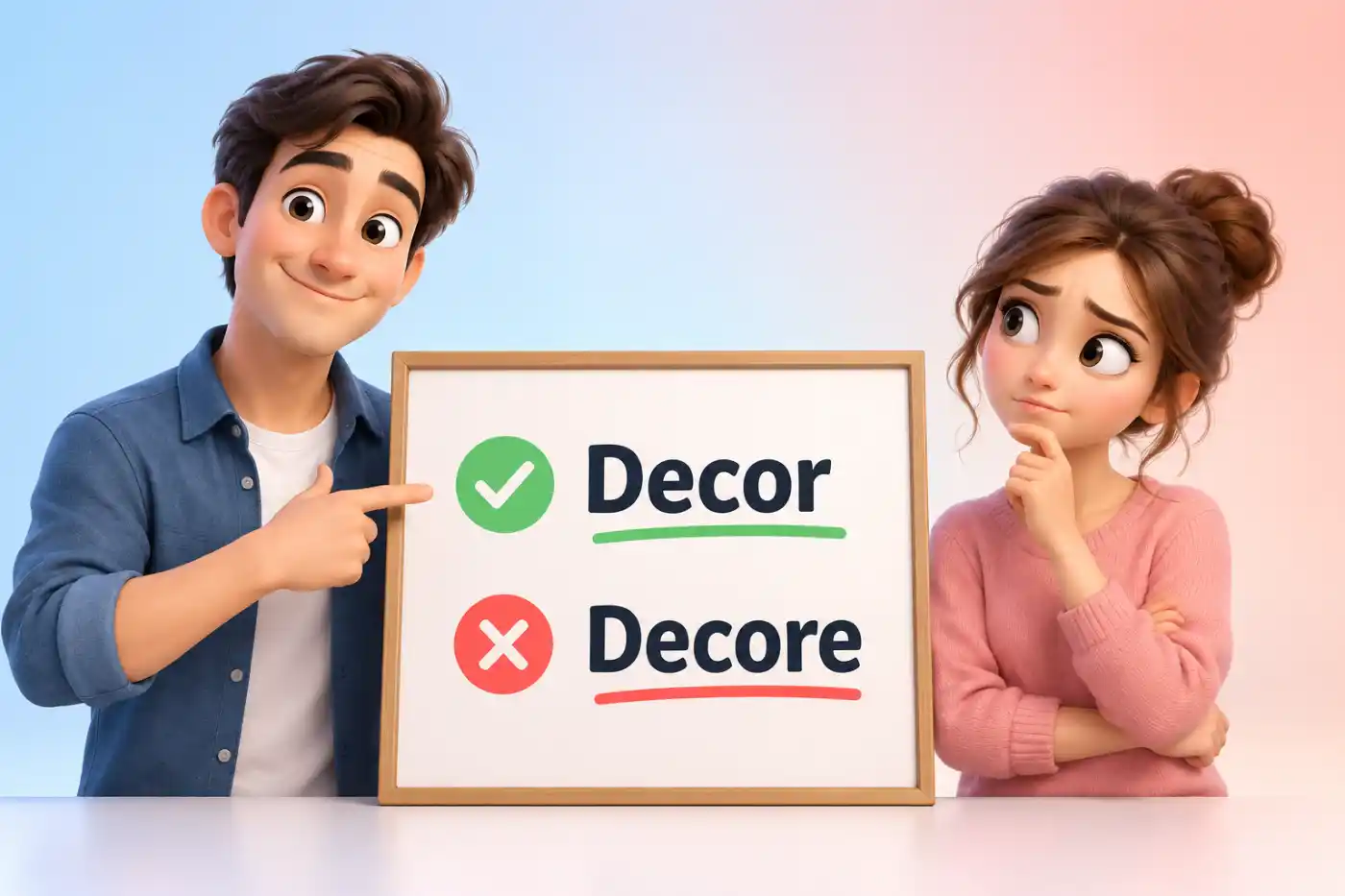
Have you ever typed decore or decor and stopped because both forms looked possible. The confusion is understandable. English has many words that change slightly when they move between languages. French loanwords can make spelling even less predictable. In this case though, the answer is fairly straightforward.
Decor is the correct and standard English word when you mean the style, colors, furniture, furnishings, and arrangement used to make a room or space look a certain way. Decore is not the standard English spelling of this noun.
For example, you can write, The restaurant has beautiful decor.
You should not write, The restaurant has beautiful decore.
The confusion often comes from the pronunciation of decor and from the related words decorate, decoration, and decorative. Those words contain an extra syllable or different ending. It is easy to assume that decor should follow the same spelling pattern.
This guide explains the difference in detail. You’ll learn what decor means, how to pronounce it, where it came from, how it works in a sentence, how American English uses it, and why decore appears so often as a spelling mistake. You’ll also get practical examples and an editor’s method for remembering the correct form.
Quick Answer
Decor is the correct standard English spelling. It means the style, color, furniture, and arrangement of a room or building. Decore is generally a misspelling when this meaning is intended. Use decor in American English writing. The related words include decorate, decoration, and decorative.
Decore or Decor At a Glance Comparison
| Feature | Decore | Decor |
|---|---|---|
| Correct standard English spelling | No for the intended meaning | Yes |
| Main meaning | Not the standard noun for interior style | The style and arrangement of a room or space |
| Part of speech | Not normally used as the intended English noun | Noun |
| Word type | Common spelling error | French loanword used in English |
| Pronunciation | Not a standard form for this meaning | American English commonly uses /deɪˈkɔr/ |
| Origin | Not the standard English form | From French décor |
| Grammar role | Usually an error when intended to mean decor | Noun |
| Formality | Not applicable as the standard noun | Neutral and widely accepted |
| Frequency of use | Rare as a standard English word | Common |
| Typical context | Usually a spelling mistake | Interior style and appearance |
| Example | The word is usually incorrect here | The room has modern decor. |
The distinction is simple once you connect spelling with meaning.
Decor is the word used for the style and arrangement of a room or building. Cambridge defines it as the color, style, and arrangement of objects in a room. Its American English definition also includes the choice of color, furniture style, and arrangement of objects.
Decore is not the standard spelling for that meaning.
That makes this a different kind of confusion from word pairs such as words that have two legitimate meanings. Here, one form is standard for the intended noun and the other is generally a spelling mistake.
Decore or Decor Which Word Should You Use
Use decor.
That is the form you want in ordinary American English writing when you’re talking about the appearance or style of an interior space.
Correct:
The hotel has elegant decor.
Correct:
I love the decor in this restaurant.
That’s Correct:
We changed the living room decor.
Incorrect for standard English:
The hotel has elegant decore.
Incorrect for standard English:
I love the decore in this restaurant.
The reason people often choose decore is easy to understand. English contains related words such as decorate, decoration, and decorative. A writer may remember the root idea but add an extra letter or sound to make the noun look more familiar.
There is another reason for the mistake. The word comes from French décor. English has borrowed many French words while changing their spelling or pronunciation over time. That history can make the spelling feel less predictable than an ordinary native English word.
Still, the modern rule is clear.
Use decor when you mean the style and arrangement of a room.
Is Decore Ever Acceptable
For standard American English writing, decore should not be used as the normal spelling of this noun.
You may encounter similar looking forms in names, brands, usernames, foreign language material, or other specialized contexts. Those cases don’t change the standard English spelling.
If you’re writing a blog post, school paper, product description, business email, interior design article, or social media caption, use decor.
Why Writers Add The Final E
The most likely reason is pattern matching.
English has many words where an ending changes the spelling.
Consider:
- Decorate.
- Decoration.
- Decorative.
- Decorator.
Because these words are related, writers sometimes expect the shorter noun to be spelled decore. But English doesn’t always preserve the same visible pattern across related words.
The correct noun is decor.
This is a useful lesson in proofreading. A word can look logical and still be wrong. Good writers don’t rely only on what looks familiar. They check the established spelling and the meaning of the word.

Decore or Decor Understanding Decore
The first thing to understand about decore is that it isn’t the standard English noun you should use for interior style.
If you see a sentence such as:
The house has beautiful decore.
the writer almost certainly means:
The house has beautiful decor.
The mistake is especially common because the word decor is pronounced with a strong final sound that can encourage writers to imagine an additional letter.
The relationship between pronunciation and spelling is not always one to one in English. A sound may suggest a spelling that isn’t actually standard.
That is exactly what can happen here.
Why Decore Looks Plausible
At first glance, decore looks reasonable.
It resembles:
- Decorate.
- Decorative.
- Decoration.
- Decorated.
A writer may unconsciously apply the spelling pattern from those words to the shorter noun.
There is also a visual temptation to treat decore as if it were a complete English word with a silent final e.
That doesn’t make it standard.
Decore in Editing
From an editor’s perspective, context is important.
If an article says:
The designer selected the decore for the hotel lobby.
the correction is straightforward.
Change decore to decor.
If the text contains a proper name that happens to use Decore, however, don’t automatically change it. Names and trademarks follow their own spelling conventions.
That distinction matters in professional editing. A skilled editor doesn’t correct unfamiliar words simply because they look unusual.
Understanding Decor
Decor is a noun that describes the style and visual arrangement of a room or building.
Cambridge defines it as the color, style, and arrangement of objects in a room. The American definition similarly describes the choice of color, furniture style, and arrangement of objects.
For example:
The restaurant has modern decor.
Here, decor refers to the overall visual character of the restaurant.
It can include many things:
- Furniture.
- Wall colors.
- Artwork.
- Lighting.
- Rugs.
- Curtains.
- Decorative objects.
- Patterns.
- Materials.
- Arrangement of objects.
- Overall visual style.
Decor doesn’t necessarily refer to one individual object.
If you say:
The room has beautiful decor.
you’re talking about the combined appearance of the space.
Decor Is a Noun
Decor functions as a noun.
You can use it after a determiner:
The decor is beautiful.
It can be used with an adjective:
The modern decor feels warm.
You can use it after a preposition:
We were impressed by the decor.
You can also use it in compound expressions:
The restaurant decor is elegant.
The office decor feels dated.
Decor Can Describe More Than Homes
Although people often associate decor with houses and apartments, the word has a much wider range.
You can talk about:
- Restaurant decor.
- Hotel decor.
- Office decor.
- Store decor.
- Wedding decor.
- Event decor.
- Bedroom decor.
- Bathroom decor.
- Classroom decor.
- Theater decor.
Cambridge examples show decor being used for homes, businesses, offices, and other spaces.
The central idea remains the same. The word describes the visual style and arrangement of a space.
The Biggest Differences Between Decore or Decor Explained
The most important difference is simple.
Decor is the correct English noun.
Decore is generally a spelling mistake when you mean interior style.
Let’s examine the distinction from several angles.
Spelling
The correct form is:
decor
It has five letters.
The common incorrect form is:
decore
It adds a final e.
That final e doesn’t belong in the standard English noun.
Meaning
Decor means the style and arrangement of a room or building.
For example:
The hotel has traditional decor.
Decore doesn’t carry this standard English meaning.
Grammar
Decor is a noun.
You can write:
The decor looks expensive.
And You can also write:
I like the decor.
You shouldn’t treat decor as the verb meaning to decorate.
For that meaning, use decorate.
Pronunciation
American English commonly pronounces decor as day KOR. Cambridge gives the American pronunciation as /deɪˈkɔːr/.
The pronunciation can make the spelling feel slightly unexpected because the final sound doesn’t correspond to a final written e.
Writing Style
Decor is completely normal in modern American English.
It works in:
- Casual writing.
- Professional writing.
- Interior design articles.
- Product descriptions.
- Journalism.
- Marketing.
- Academic discussion.
- Home improvement content.
Everyday Usage
Americans commonly use decor when discussing the appearance of homes restaurants offices hotels and other spaces.
For example:
I like the decor in this coffee shop.
The new decor makes the room feel brighter.
Regional Usage
The spelling decor is standard across major English varieties.
British English and American English may differ in pronunciation. The spelling remains decor.
The word can also carry slightly different stylistic associations depending on the setting. In American English it is particularly common in conversations about interior design and home style.
Professional Writing
In professional writing, decor is safe and natural.
For example:
The restaurant’s decor reflects its coastal theme.
A writer should not replace it with decore simply because the latter looks more complete.
Why People Confuse Decore or Decor
This spelling mistake has several causes.
Related Words Create Confusion
Look at these words:
- Decor.
- Decorate.
- Decoration.
- Decorative.
- Decorator.
They all share the same basic idea. Yet their endings differ.
English frequently forms related words through changes in suffixes. Writers sometimes transfer the spelling of one form to another.
Pronunciation Creates Confusion
The American pronunciation of decor is commonly day KOR.
Someone who hears the word before seeing it in writing may not immediately know that the written form ends with r.
This is particularly common for language learners.
Autocorrect Doesn’t Always Help
If you type decore, your software may flag it. But automatic spelling tools aren’t perfect.
They can also struggle with proper names and specialized vocabulary.
More importantly, spelling software can’t replace meaning based proofreading.
A word can be spelled correctly and still be the wrong word. In this particular case, the problem is easier because decore is generally not the standard noun at all.
Online Usage Can Reinforce Errors
People often encounter misspellings online. Once a spelling appears repeatedly, it can start to look familiar.
Familiarity isn’t proof of correctness.
A common mistake can become visually comfortable without becoming standard English.
Learning Through Sound
Language learners often hear a word before they see it.
If someone hears decor and tries to spell it using familiar English patterns, decore can seem logical.
That is why learning the word together with its written form is useful.
The Influence of Decorate
This may be the biggest source of confusion.
The verb is decorate.
The noun describing the action is decoration.
The adjective is decorative.
The noun describing a room’s style is decor.
Those forms are related but they don’t all end the same way.

Decore or Decor Grammar Rules You Should Know
Understanding how decor functions grammatically makes the word easier to use correctly.
Decor as a Noun
Decor is a noun.
The decor is beautiful.
The subject is decor.
The verb is is.
The adjective is beautiful.
Decor With An Adjective
You can place an adjective before decor.
The modern decor creates a calm atmosphere.
The colorful decor makes the restaurant feel cheerful.
The minimalist decor suits the apartment.
Common adjectives include:
- Modern.
- Traditional.
- Elegant.
- Rustic.
- Minimalist.
- Contemporary.
- Colorful.
- Simple.
- Luxurious.
- Vintage.
- Cozy.
Decor With A Preposition
It frequently appears after prepositions.
We liked the decor in the hotel.
The decor of the restaurant feels traditional.
She was impressed by the decor.
Decor With A Possessive
You can identify who or what owns or has the decor.
The restaurant’s decor is impressive.
The hotel’s decor feels outdated.
Our home’s decor has changed.
Is Decor Countable
In everyday American English, decor is commonly treated as an uncountable noun when referring to the overall style of a space.
For example:
The decor is beautiful.
I love the decor.
Cambridge’s learner entry labels decor as a noun with no plural form. Its broader dictionary entry also gives singular and uncountable usage.
You generally don’t need to write decors when talking about the style of one or more spaces.
Instead, say:
The decor in the two restaurants is different.
or:
The restaurants have different decor styles.
Decor Versus Decorations
This distinction is useful.
Decor refers to the overall style and arrangement.
Decorations usually refers to individual objects or items added to make a place attractive.
For example:
The restaurant has beautiful decor.
This describes the overall look.
We put decorations on the tables.
This describes specific objects.
Cambridge defines decoration as something added to an object or place to make it more attractive or the act of doing so.
That difference can prevent another common writing mistake.
Sentence Examples For Decore or Decor That Sound Natural
Ten Examples With Decore
Because decore is not the standard spelling for this meaning, these examples show incorrect usage.
- The restaurant has beautiful decore.
- I love the decore in your living room.
- The hotel changed its decore last year.
- The office has modern decore.
- We chose furniture to match the decore.
- The designer specializes in luxury decore.
- The cafe has colorful decore.
- Their home has simple decore.
- The wedding venue had elegant decore.
- The new decore makes the room feel larger.
In standard English, replace decore with decor in each sentence.
Ten Examples With Decor
- The restaurant has beautiful decor.
- I love the decor in your living room.
- The hotel changed its decor last year.
- The office has modern decor.
- We chose furniture to match the decor.
- The designer specializes in luxury decor.
- The cafe has colorful decor.
- Their home has simple decor.
- The wedding venue had elegant decor.
- The new decor makes the room feel larger.
These examples show how naturally decor fits into everyday American English.
Decore or Decor Common Writing Mistakes and How to Avoid Them
Mistake One
The room has beautiful decore.
Correct:
The room has beautiful decor.
Mistake Two
I love your home decore.
Correct:
I love your home decor.
Mistake Three
The hotel updated its decore.
Correct:
The hotel updated its decor.
Mistake Four
The decore was inspired by nature.
Correct:
The decor was inspired by nature.
Mistake Five
Using decor as a verb.
Incorrect:
We will decor the room tomorrow.
Correct:
We will decorate the room tomorrow.
This is an important distinction.
Decor is the noun.
Decorate is the verb.
Decoration is the noun referring to the act of decorating or something used as an ornament.
Decorative is an adjective.
Mistake Six
Using decoration when decor is more precise.
For example:
The restaurant has beautiful decoration.
This isn’t always grammatically wrong, but it may not express the intended idea as naturally as:
The restaurant has beautiful decor.
The first sentence can suggest decorative objects or ornamentation. The second describes the overall style of the space.
Decore or Decor Pronunciation Made Simple
Pronunciation is one reason this word can be confusing.
American Pronunciation
Cambridge gives the American pronunciation of decor as:
/deɪˈkɔːr/.
A simple pronunciation guide is:
day KOR
The stress falls on the second syllable.
You can think of it as:
day + kor
The second part receives the stronger emphasis.
British Pronunciation
Cambridge lists British pronunciations that can sound closer to:
DAY kor
or in some varieties:
DEK or
The exact sound can vary by speaker and regional accent.
Common Pronunciation Mistakes
Some speakers may pronounce decor as if it were spelled exactly like an English word ending in ore.
Others may over pronounce the French influence.
For ordinary American English, the practical pronunciation is simple:
day KOR.
You don’t need an elaborate French accent when speaking American English.
Pronunciation Tip
Say the phrase:
home decor
naturally.
The word should sound like day KOR in common American English.
Then connect the sound with the five letter spelling.
Decor has no final e.
Decore or Decor Word History and Origin
The history of decor explains why its spelling may look unusual.
The English word comes from French décor, meaning the decorative arrangement or appearance of a setting. Dictionary.com traces decor to French décor and the French verb décorer, meaning to decorate. It also notes that decor was originally a theater term.
That theatrical history is worth knowing because decor was closely associated with the visual setting of a production.
A theater production needs more than actors and dialogue. It also needs a physical environment that helps establish the place, period, mood, and atmosphere.
That idea naturally expanded into broader English usage.
Today, decor can refer to the visual style of a room, restaurant, hotel, office, store, event space, or other environment.
French Influence
The accent in the French form is décor.
English commonly writes the borrowed word as decor without the accent.
This is not unusual. English often adopts foreign words and adjusts their spelling to fit English writing conventions.
In American English, decor is a familiar loanword.
The Connection With Decorate
Decor is related to the broader family that includes:
- Decorate.
- Decoration.
- Decorative.
- Decorator.
Cambridge defines decorate as a verb meaning to add something to an object or place to make it more attractive. It also uses decorate for painting or putting paper on walls in the relevant regional sense.
The relationship is clear.
You decorate a room.
The room has decor.
You may add decorations.
A particular item may be decorative.
That family connection helps explain why writers sometimes create the incorrect spelling decore.
Decore or Decor Usage Across English Speaking Countries
American English
In American English, decor is common and natural.
You can use it in home design writing, restaurant reviews, real estate descriptions, business writing, lifestyle articles, and everyday conversation.
For example:
I love the decor in this apartment.
The restaurant has modern decor.
Cambridge’s American Dictionary gives decor the meaning of the choice of color, furniture style, and arrangement of objects in a room.
British English
British English also uses decor.
The pronunciation can vary from American English, but the spelling remains the same.
British writers may also use decoration in contexts where American writers often use more specific phrases such as redecoration for interior painting or wallpapering. Cambridge notes this regional distinction in its entry for decoration.
That difference doesn’t change the spelling of decor.
Canadian English
Canadian English generally follows the same standard spelling.
Use decor when referring to the visual style and arrangement of a room.
For example:
The hotel has modern decor.
Australian English
Australian English also uses decor for interior style.
The spelling remains decor.
As with British English, pronunciation may differ from American pronunciation, but there is no standard spelling change to decore.
The Main Regional Lesson
The spelling is stable.
Decor is the standard English form across major English varieties.
You shouldn’t treat decore as an American or British alternative.
Real World Usage
Context helps make the word choice automatic.
Daily Conversation
People often use decor when talking about homes and restaurants.
I like the decor here.
Your living room has beautiful decor.
The new decor looks great.
School Writing
A student might write:
The author describes the decor of the mansion to create a mysterious atmosphere.
Here decor helps describe the setting.
A literature student could also use the word when discussing theater.
The stage decor helped establish the historical setting.
Business Communication
Businesses use decor when discussing customer spaces.
The new decor gives the store a more welcoming appearance.
The restaurant updated its decor before reopening.
Academic Writing
Decor can appear in writing about architecture, design, theater, culture, sociology, hospitality, and visual studies.
For example:
The hotel’s decor reflects the region’s traditional design influences.
Books
Writers use decor to establish atmosphere.
The room’s dark decor created a sense of mystery.
The word can quickly communicate the visual character of a place without describing every object individually.
Journalism
Lifestyle journalists frequently use decor when writing about restaurants, homes, hotels, fashion related spaces, and interior design.
For example:
The restaurant combines vintage decor with a modern menu.
Online Writing
Decor is extremely common in online content.
You may see:
- Home decor.
- Kitchen decor.
- Bedroom decor.
- Office decor.
- Wedding decor.
- Christmas decor.
- Wall decor.
- Farmhouse decor.
- Modern decor.
- Luxury decor.
Social Media
Social media captions often use decor in short phrases.
Loving the new home decor.
Weekend decor project.
Simple decor can change a room.
These uses are informal but grammatically straightforward.

Similar Words and Frequently Confused Terms For Decore or Decor
Decor And Decoration
Decor means the overall style and arrangement of a space.
Decoration can refer to the act of decorating or an object added to make something attractive.
The room has elegant decor.
The decorations are on the table.
Cambridge supports this distinction in its dictionary definitions.
Decor And Decorative
Decor is a noun.
Decorative is an adjective.
The decor is beautiful.
The vase is decorative.
Don’t use decorative as a noun when you mean the overall style of a room.
Decor And Decorate
Decor is the noun.
Decorate is the verb.
The decor looks elegant.
We will decorate the room tomorrow.
Cambridge identifies decorate as a verb meaning to make something more attractive by adding things to it or by changing its appearance.
Decor And Interior Design
These ideas are related but not identical.
Decor describes the visual style and arrangement of a space.
Interior design is a broader discipline involving space planning, function, materials, lighting, furniture, and aesthetics.
You can talk about the decor of a room without discussing the entire design process.
Decor And Ornamentation
Ornamentation focuses more specifically on decorative details or embellishment.
Decor can describe the overall visual style.
For example:
The building has elaborate ornamentation.
The hotel’s decor is modern and understated.
Decor And Furnishings
Furnishings usually refers to furniture and other items that furnish a room.
Decor is broader and focuses on the overall visual character.
A sofa is a furnishing.
The room’s color scheme, furniture, artwork, lighting, and arrangement can all contribute to its decor.
Professional Editor’s Advice
A strong editor approaches this spelling question through meaning rather than appearance.
When you see decore, ask what the writer intends.
If the sentence is about interior style, the correction is almost certainly decor.
Read The Whole Sentence
Don’t edit the word in isolation.
Consider:
The designer chose the perfect decore for the lobby.
The context clearly points to interior style.
Change it to:
The designer chose the perfect decor for the lobby.
Check Related Words
If you see decore, look at nearby words.
Words such as these are strong clues:
- Room.
- Interior.
- Furniture.
- Style.
- Color.
- Design.
- Restaurant.
- Hotel.
- Home.
- Office.
- Wall.
- Lighting.
These contexts strongly suggest decor.
Separate Noun From Verb
One of the most useful proofreading questions is:
Am I naming the style or describing the action.
If you’re naming the style, use decor.
If you’re describing the action of making a place attractive, use decorate.
Compare:
The decor is beautiful.
We will decorate the room.
This simple distinction eliminates many errors.
Don’t Overcorrect Proper Names
If a business, product, website, surname, or organization deliberately uses Decore as its name, preserve the official spelling when appropriate.
Standard dictionary spelling and proper names follow different rules.
For ordinary English writing, though, use decor.
Don’t Assume More Letters Mean More Correct
Writers sometimes feel that a word ending in a vowel looks more complete.
That’s not a reliable editing principle.
English contains many short words with unexpected endings.
Decor is one of them.
The correct spelling doesn’t need an extra e.
Frequently Asked Questions
Is Decore a Correct English Word
Decore is not the standard spelling of the English noun meaning the style and arrangement of a room. If you’re talking about interior style, use decor. You may encounter Decore in names, brands, or foreign language contexts, but those specialized uses don’t make it the standard English spelling. For normal American English writing, decor is the correct choice.
Is Decor the Correct Spelling
Yes. Decor is the standard English spelling for the style, color, furniture, and arrangement of a room or building. Cambridge defines it as the color, style, and arrangement of objects in a room. American English uses the same spelling.
Why Do People Spell Decor as Decore
The mistake probably comes from the related words decorate, decoration, and decorative. These words can make writers expect an ending with an extra vowel. Pronunciation can also contribute to the confusion. The correct noun is decor. It does not need a final e.
What Does Decor Mean
Decor means the style, color, furniture, furnishings, and arrangement that give a room or other space its visual character. You can talk about home decor, restaurant decor, hotel decor, office decor, or event decor. Cambridge describes it in terms of the color, style, and arrangement of objects in a room.
Is Decor a Noun or a Verb
Decor is a noun. It names the style or arrangement of a space. The related verb is decorate. For example, you can write The decor is beautiful and We will decorate the room. Treating decor as the verb would be a grammar mistake in standard English.
How Do You Pronounce Decor
In American English, decor is commonly pronounced day KOR. Cambridge gives the American IPA form /deɪˈkɔːr/. The stress falls on the second syllable. British pronunciation can vary and may sound different from the common American form.
Is Decor Short for Decoration
Decor is closely related to decoration but it isn’t simply an informal abbreviation that can replace the word in every sentence. Decor refers especially to the style and arrangement of a space. Decoration can refer to the act of making something attractive or to individual decorative objects. The distinction becomes clear when you compare room decor with Christmas decorations.
Can You Say Home Decore
For standard English writing, write home decor, not home decore. Home decor is a common phrase in American English and refers to the style and decorative arrangement of a home. The same rule applies to phrases such as office decor, bedroom decor, restaurant decor, and wedding decor.
Does Decor Have a Plural Form
Decor is commonly treated as an uncountable noun when it means the overall style of a space. Cambridge’s learner dictionary lists it as a noun with no plural form. If you need to compare several styles, use phrases such as different decor styles rather than trying to create an unnecessary plural.
What Is The Difference Between Decor And Decorative
Decor is a noun that refers to the visual style or arrangement of a space. Decorative is an adjective that describes something intended to make a place or object more attractive. For example, The decor is elegant uses decor as a noun, while The vase is decorative uses decorative as an adjective. The words are related but they serve different grammatical roles.
Final Verdict
The correct spelling is decor.
Use decor when you mean the style, colors, furniture, furnishings, and arrangement that create the visual character of a room or space.
Don’t use decore as the standard English spelling for this meaning.
The grammar is simple.
Decor is a noun.
Decorate is a verb.
Decoration can refer to the act of making something attractive or to something used as a decoration.
Decorative is an adjective.
The easiest memory trick is this:
Decor ends with R.
Think of the phrase room decor. Both words end in a strong consonant sound in the phrase, and the standard spelling stays short.
Another useful trick is to remember the word family:
Decor
Decorate
Decoration
Decorative
The forms are related but they don’t all share the same ending.
If you’re writing about the look of a home, restaurant, hotel, office, or event space, choose decor. It is the standard form used in modern English and the form readers expect to see.
The extra e in decore may look harmless, but it turns a familiar English word into a spelling error in ordinary usage. Once you connect the spelling directly to the meaning, the choice becomes easy.

Founding Editor
Maya spent six years as a copyeditor at a regional newspaper before starting Grammist, which is where the “answer first” format came from: newsroom style guides don’t have room for a preamble.
She writes and reviews most of the word-pair and spelling entries, and has final say on anything that goes out under the Grammist name.