
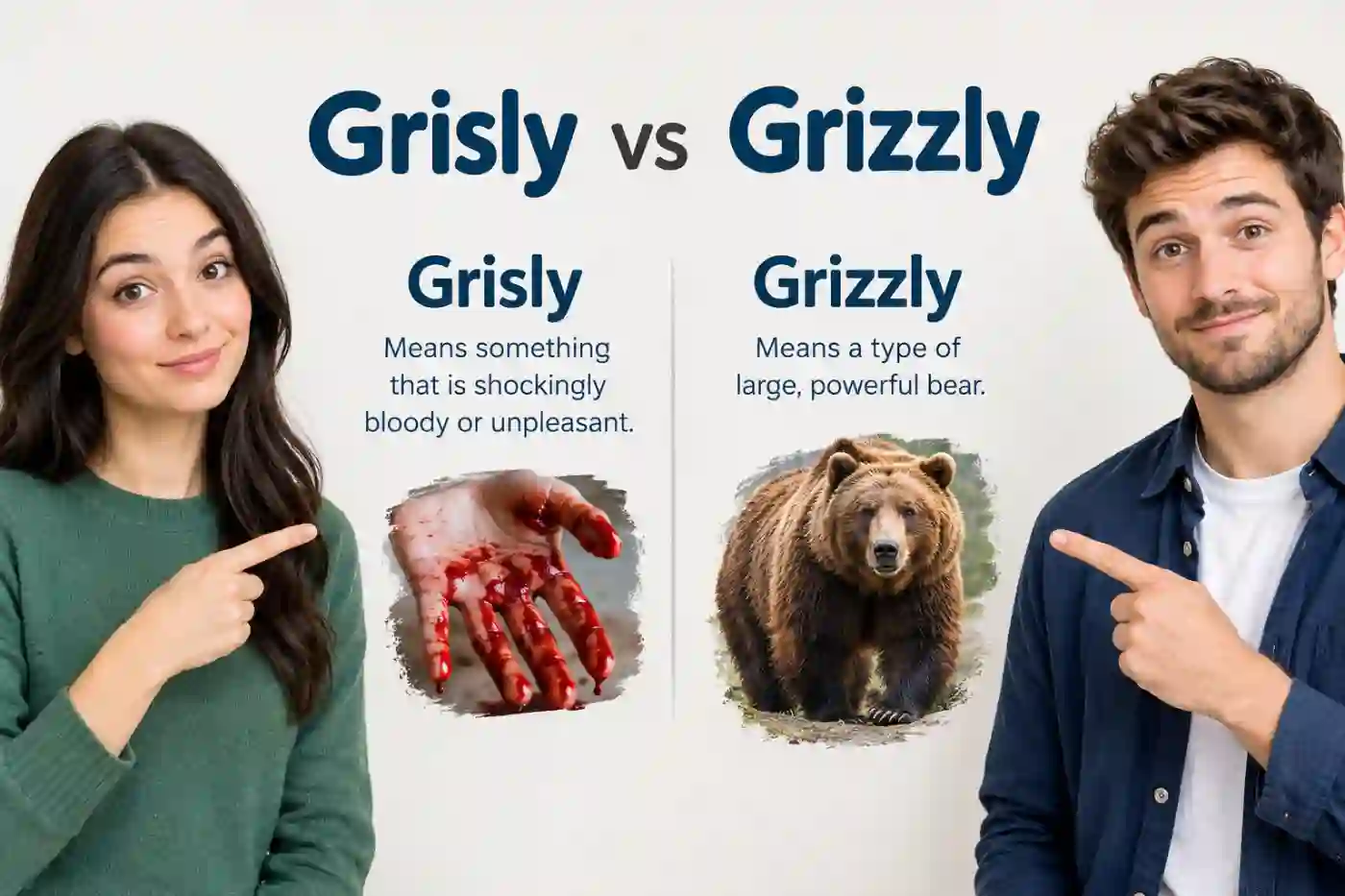
The difference between grisly vs grizzly comes down to meaning and usage. Both words are spelled correctly, both sound alike in most varieties of English, and both can appear in descriptions of frightening situations. However, they don’t mean the same thing.
Grisly describes something horrifying, gruesome, or deeply unpleasant, such as a grisly crime scene or a grisly discovery. Grizzly usually refers to the large North American bear, but it can also describe something that is gray or grayish, especially in words such as grizzly beard.
The confusion is easy to understand. These words differ by only one letter, and their pronunciation is nearly identical. Spellcheck may not catch the mistake because both spellings are valid English words. Choosing the wrong one can change the meaning of a sentence, especially in news reports, storytelling, and everyday conversation.
In this guide, you’ll learn the meanings of both words, their spelling and pronunciation, their origins, and the situations in which each belongs. You’ll also find practical examples, memory tricks, common mistakes, and answers to frequently asked questions.
Quick Answer
Grisly means horrifying, gruesome, or disturbing. Use it to describe a shocking discovery, a violent crime, or an unpleasant sight. Grizzly usually means a large North American bear and can also describe something grayish. Remember that a grisly scene is horrifying, while a grizzly bear is an animal.
Grisly vs Grizzly Comparison Table
The easiest way to distinguish these words is to look at what they describe. One expresses horror. The other most often names an animal.
| Feature | Grisly | Grizzly |
|---|---|---|
| Correct spelling | Grisly | Grizzly |
| Main meaning | Horrifying or gruesome | A large North American bear |
| Other meaning | No common separate meaning | Grayish or gray in appearance |
| Part of speech | Adjective | Noun or adjective |
| Pronunciation | GRIZ lee | GRIZ lee |
| Syllables | Two | Two |
| Stress | First syllable | First syllable |
| Common context | Crime reports and frightening events | Wildlife and animal descriptions |
| Example | The detective found a grisly scene. | A grizzly crossed the trail. |
| Related word | Gruesome | Grizzly bear |
Both words are correct English spellings. Neither is a misspelling of the other. The mistake happens when a writer uses the right spelling for the wrong meaning.
What Does Grisly Mean
Grisly is an adjective that means horrifying, gruesome, or deeply disturbing. It describes something that causes shock, fear, disgust, or horror because of its unpleasant nature.
Writers often use grisly when describing violence, death, serious injuries, or shocking discoveries. The word can also describe a frightening detail in a book, movie, or news story.
For example:
- The police investigated a grisly murder.
- The hikers made a grisly discovery in the woods.
- The documentary showed grisly details of the battle.
- The reporter described the grisly aftermath of the accident.
In each example, grisly tells readers that something is disturbing or horrifying. It doesn’t identify a person, animal, or object by itself. Instead, it describes the nature of the situation.
How to Use Grisly in a Sentence
Use grisly before a noun when you want to describe something horrifying.
Common combinations include:
- A grisly murder.
- A grisly discovery.
- A grisly scene.
- A grisly accident.
- A grisly detail.
- A grisly sight.
- A grisly tale.
- A grisly reminder.
You can also use the word in a sentence with a linking verb.
For example, you could write, “The details were grisly.” Here, the adjective follows the verb were and describes the details.
The word often appears in serious writing, including journalism, crime reporting, historical accounts, and literary criticism. However, it can also appear in casual conversation when someone wants to describe something particularly unpleasant.
For example, a person might say, “That movie was good, but the opening scene was pretty grisly.”
Does Grisly Always Mean Violent
No. Violence is a common context, but it isn’t a requirement.
A grisly description usually involves something horrifying or deeply unpleasant. That could involve death or injury, but it might also involve a disturbing fictional scene or a frightening discovery.
The central idea is the feeling of horror. If a situation is merely unpleasant, inconvenient, or disappointing, grisly may be too strong.
For example, a messy kitchen after a party is usually not a grisly sight. A disturbing discovery at an abandoned building could be.
This distinction helps you choose a word that matches the seriousness of the situation.
What Does Grizzly Mean
Grizzly is most commonly a noun referring to a grizzly bear, a large brown bear found in parts of North America. The word can also function as an adjective describing something gray or grayish, especially hair, fur, or a beard.
Examples include:
- A grizzly wandered through the forest.
- The wildlife photographer spotted a grizzly near the river.
- The hikers followed the trail from a safe distance after seeing a grizzly bear.
- His grizzly beard made him look much older.
- The old sailor had a grizzly appearance.
In the first three examples, grizzly refers to a bear. In the final two, it describes a grayish appearance.
Grizzly as a Noun
When grizzly refers to the animal, it acts as a noun.
A grizzly is a type of brown bear. Grizzly bears are known for their large bodies, powerful shoulders, long claws, and ability to live in a range of habitats.
The full expression grizzly bear is especially common when writers want to identify the animal clearly. In a passage that already mentions bears, the shorter word grizzly often works just as well.
For example:
“The group saw a grizzly bear near the stream. They watched the grizzly from a safe distance before returning to their vehicle.”
The second sentence uses grizzly as a noun because the animal has already been identified.
Grizzly as an Adjective
Grizzly can also describe a gray or grayish appearance. This use is less common in everyday writing than the animal meaning.
For example:
- The old man’s grizzly beard reached his chest.
- A grizzly patch of hair showed beneath his cap.
In these sentences, the word describes appearance rather than an animal. Context makes the meaning clear.
If you want to describe a beard that has a mixture of gray and white hair, grayish, gray, or salt and pepper may sound more natural in many modern contexts. Still, grizzly has a recognized history as a descriptive word.
Grisly vs Grizzly Which One Is Correct
Both grisly and grizzly are correct. The right choice depends on the meaning of your sentence.
Use grisly when you mean horrifying or gruesome. Use grizzly when you mean the bear or describe something grayish.
Consider these examples.
Correct: The newspaper reported a grisly murder.
Incorrect for this meaning: The newspaper reported a grizzly murder.
The second sentence would confuse readers because grizzly doesn’t normally mean gruesome.
Now consider the animal.
Correct: A grizzly bear appeared near the campsite.
Incorrect for this meaning: A grisly bear appeared near the campsite.
The second sentence suggests a horrifying bear rather than identifying a particular kind of bear. It might work in unusual creative writing, but it isn’t the standard way to name the animal.
How to Choose the Right Word
Ask yourself one simple question. Am I describing something horrifying, or am I referring to a bear or a grayish appearance?
- If the answer is horrifying, use grisly.
- If the answer is a bear, use grizzly.
- If the answer is grayish, grizzly may fit, although gray or grayish may be clearer.
This quick test works for most everyday writing, school assignments, news articles, and professional documents.
Why People Confuse Grisly vs Grizzly
These words are easy to mix up because they share almost the same spelling and pronunciation. Their meanings, however, are quite different.
They Differ by Only One Letter
The words have the same length and share most of their letters. The main spelling difference appears near the end.
- Grisly uses one z sound represented by the letter s.
- Grizzly uses the letter z and has a double z.
The visual difference is small enough that readers may overlook it when typing quickly.
They Sound Almost Identical
In standard American English, grisly and grizzly are generally pronounced the same way or very similarly. This makes it difficult to identify the correct spelling by sound alone.
Someone may know the word they want to use but still choose the wrong spelling because the pronunciation offers little help.
The best solution is to connect each spelling to its meaning rather than relying on sound.
Both Words Are Valid
Spellcheckers usually flag misspelled words. However, they may not catch a mistake involving two correctly spelled words.
If you type “The grizzly details shocked the audience,” your software might accept the sentence because grizzly is a real word. The sentence still needs editing if you mean that the details were horrifying.
This is a good reminder to check meaning as well as spelling.
The Bear Association Is Memorable
Many people learn the phrase grizzly bear at an early age. The animal’s name is familiar, so they may accidentally use grizzly in contexts that require grisly.
Others may remember grisly from crime stories but forget its exact spelling. Because both words appear in descriptions of frightening subjects, the meanings can become mixed up.
Autocorrect Cannot Always Help
Autocorrect often focuses on spelling rather than the meaning of a sentence. Since both words are valid, it may leave the wrong choice unchanged.
For important writing, read the entire sentence after using spellcheck. Ask if the word makes sense in context. A correctly spelled word can still be the wrong word.
Key Differences Between Grisly vs Grizzly
The spelling difference is small, but the grammatical role and meaning can change how a sentence reads. These distinctions matter most when writing about frightening events, wildlife, or a person’s appearance.
Meaning and Context
Grisly focuses on the disturbing nature of something. Grizzly usually identifies a bear or describes a grayish appearance.
Compare these sentences.
- The investigators found a grisly scene.
- The investigators found a grizzly near the road.
The first sentence describes a horrifying scene. The second describes an encounter with a bear.
Part of Speech
Grisly functions as an adjective. It describes a noun and doesn’t ordinarily function as a noun itself.
Grizzly can be a noun or an adjective. As a noun, it refers to a grizzly bear. As an adjective, it can describe something grayish.
This difference explains why the two words don’t work interchangeably in every sentence.
Tone and Register
Both words appear in standard English, but their typical uses differ.
Grisly often appears in serious reporting, crime writing, horror fiction, and accounts of tragic events. It carries a strong emotional meaning.
Grizzly is common in wildlife writing, outdoor guides, nature documentaries, and conversations about bears. Its descriptive use can also appear in writing about age or appearance.
Neither word is automatically more formal than the other. The subject determines which one fits.
Pronunciation of Grisly vs Grizzly
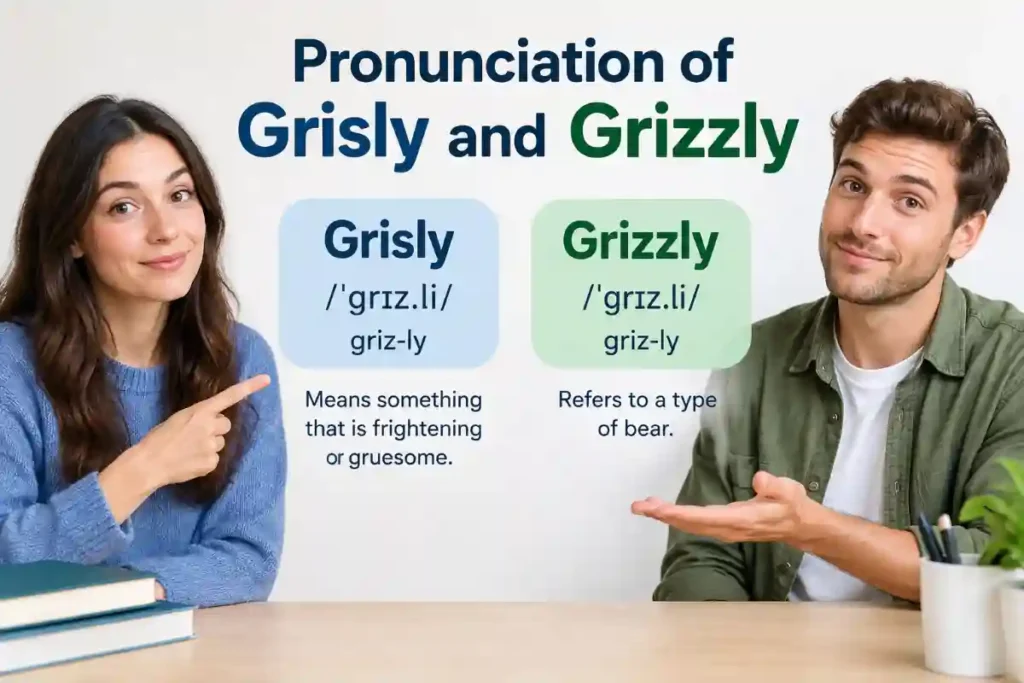
Both words have two syllables and carry stress on the first syllable.
| Feature | Grisly | Grizzly |
|---|---|---|
| IPA | /ˈɡrɪz.li/ | /ˈɡrɪz.li/ |
| Syllables | Gris ly | Griz zly |
| Stress | First syllable | First syllable |
| First vowel | Short i | Short i |
| Typical American pronunciation | GRIZ lee | GRIZ lee |
The International Phonetic Alphabet transcriptions above represent the common pronunciation in American English. Some dictionaries may show slightly different phonetic details based on their transcription system.
How to Pronounce Each Word
Start with the same opening sound for both words. The first syllable rhymes with his and is. Finish with the unstressed sound heard in lee.
The words sound alike to many English speakers. Therefore, pronunciation alone won’t reliably tell you which spelling to use.
When speaking, the context usually makes the intended meaning clear. When writing, you need to remember the spelling associated with that meaning.
Grisly vs Grizzly Word Origins
Understanding the history of these words can make them easier to remember. Their similar sounds don’t mean they share the same meaning or developed in the same way.
The Origin of Grisly
Grisly comes from older forms of English associated with fear and terror. It is related to the verb grise, an older word meaning to shudder or feel horror.
Over time, grisly developed its familiar meaning of horrifying, gruesome, or frightening. Today, it commonly describes disturbing sights, violent events, and shocking discoveries.
Its history connects the word to the emotional response it describes. Something grisly inspires horror or disgust.
The Origin of Grizzly
The word grizzly is associated with the idea of being gray or having grayish hair. Its history connects it to grizzle, a word used to describe gray or partly gray coloring.
The name grizzly bear is commonly linked to the bear’s grizzled or gray tipped fur. This name refers to its appearance rather than to the frightening nature of the animal.
A grizzly bear can certainly be dangerous, but the word grizzly doesn’t mean gruesome. Its established animal meaning is separate from the emotional meaning of grisly.
Why Their Origins Matter
The word histories provide a useful memory aid.
Think of grisly as a word connected with horror. Think of grizzly as a word connected with gray coloring and the bear.
These associations won’t explain every historical detail, but they offer a practical way to keep the modern meanings separate.
British and American English
The distinction between grisly and grizzly remains the same in major varieties of English, including American, British, Canadian, and Australian English.
| Variety of English | Grisly | Grizzly |
|---|---|---|
| American English | Horrifying or gruesome | Bear or grayish |
| British English | Horrifying or gruesome | Bear or grayish |
| Canadian English | Horrifying or gruesome | Bear or grayish |
| Australian English | Horrifying or gruesome | Bear or grayish |
Unlike pairs such as color and colour, these words don’t represent a regional spelling difference. You shouldn’t switch from one spelling to the other based on your audience’s location.
For example, an American newspaper and a British newspaper can both describe a disturbing discovery as grisly. Both can also use grizzly bear to name the animal.
The main difference is meaning, not geography.
Real Life Examples of Grisly vs Grizzly
The best way to remember the difference is to see each word in context. The following examples cover everyday conversation, professional writing, news reports, education, and storytelling.
Everyday Conversation
- “That horror movie had a grisly opening scene.”
- “We spotted a grizzly while driving through the national park.”
- “The details of the accident were too grisly for the children.”
- “A grizzly wandered across the road ahead of us.”
- “His grizzly beard made him look like an old sea captain.”
Workplace and Emails
- “The reporter described the grisly details of the investigation.”
- “Please remove the grisly photographs from the presentation intended for younger students.”
- “Our wildlife team recorded a grizzly near the northern boundary.”
- “The editor asked the writer to tone down the grisly description.”
- “The park guide explained how visitors should respond to a grizzly encounter.”
Academic Writing
- “The historian examined grisly accounts of violence during the conflict.”
- “The research team studied grizzly bear behavior in different habitats.”
- “The novel uses grisly imagery to explore fear and mortality.”
- “The wildlife report documented the movement of a grizzly through the region.”
Journalism and News Reports
- “Investigators returned to the site after a grisly discovery.”
- “Officials warned hikers after a grizzly was seen near a popular trail.”
- “The documentary included a grisly account of the historical event.”
- “The wildlife agency released updated guidance on grizzly encounters.”
Literature and Storytelling
- “The author builds suspense through a grisly description of the abandoned house.”
- “A grizzly appeared at the edge of the clearing in the final chapter.”
- “The detective uncovered a grisly secret that had remained hidden for years.”
- “The traveler watched the grizzly disappear into the trees.”
Social Media and Informal Writing
- “That episode was entertaining, but the ending was seriously grisly.”
- “We finally saw a grizzly during our camping trip.”
- “I wasn’t prepared for the grisly details in that true crime podcast.”
- “Seeing a grizzly in the wild must be an unforgettable experience.”
Notice how the meaning changes with the context. The frightening scenes and details are grisly. The animals are grizzlies.
Grisly vs Grizzly Common Mistakes to Avoid
Even experienced writers can mix up words that sound alike. These are the errors worth watching for.
Using Grizzly to Mean Gruesome
Incorrect: The article described a grizzly murder.
Correct: The article described a grisly murder.
Use grisly when you mean horrifying or gruesome. Reserve grizzly for the bear or its grayish descriptive sense.
Using Grisly for the Animal
Incorrect: We saw a grisly bear in the forest.
Correct: We saw a grizzly bear in the forest.
The standard name of the animal is grizzly bear. Although a writer could creatively describe a fictional bear as grisly, that would mean the bear looked or behaved in a horrifying way, not that it belonged to the grizzly bear group.
Assuming One Word Is Incorrect
Neither word is a misspelling of the other. The problem is choosing the wrong word for the intended meaning.
This distinction is important for proofreading. A spellchecker may accept both words, so you must review the sentence itself.
Treating the Words as Regional Variants
Grisly isn’t the British spelling of grizzly, and grizzly isn’t the American spelling of grisly. Both words are used across English speaking regions with the same basic distinction.
Using Grisly for Every Unpleasant Situation
The word grisly carries a strong sense of horror. Using it to describe a minor inconvenience can sound exaggerated.
For example, “The grisly traffic jam delayed us for ten minutes” sounds unusual unless the writer intends a humorous or dramatic effect.
For ordinary problems, words such as annoying, messy, or unpleasant may be more appropriate.
Memory Tricks for Grisly vs Grizzly
A simple association can help you choose the right spelling without stopping to think for too long.

Grisly means gruesome.
Remember the phrase grisly details. Both words begin with the same letters and help you think of a disturbing scene.

Grizzly means bear.
Picture a grizzly bear standing in a forest. The double zz can remind you of the animal’s familiar name.
You can also use this short rule.
Horror is grisly. The animal is grizzly.
Repeat that sentence a few times, then test yourself with a new example. For instance, if you want to describe a shocking discovery, choose grisly. If you want to name a bear, choose grizzly.
Grisly vs Grizzly Related Words and Expressions
Knowing a few related terms can help you express the intended meaning more precisely.
Synonyms for Grisly
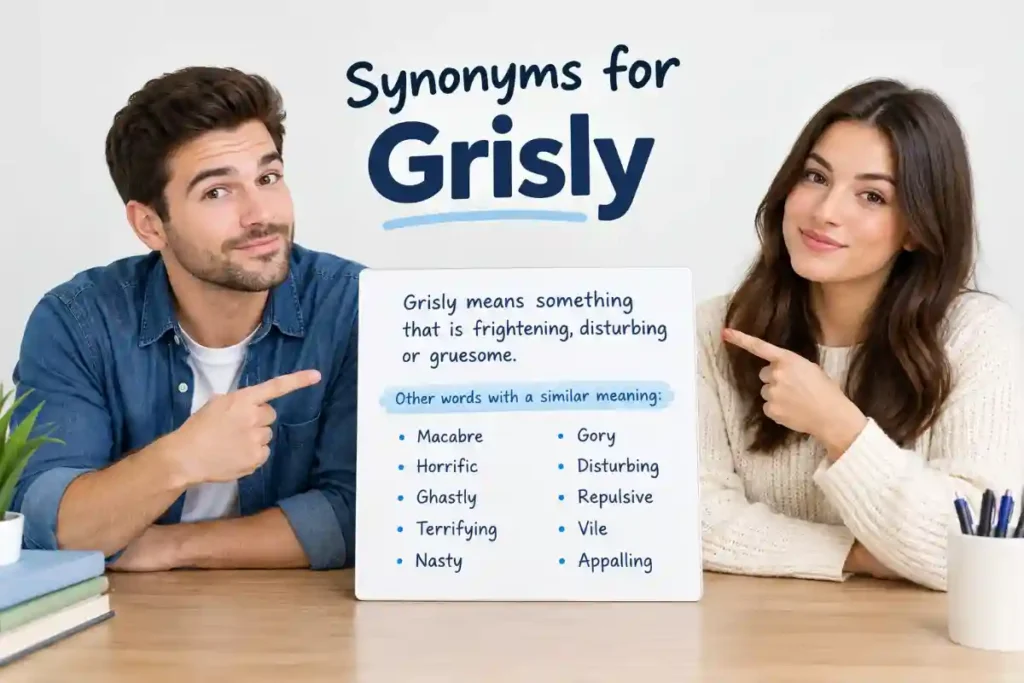
Use these words when you want to describe something horrifying or deeply unpleasant.
- Gruesome. Extremely unpleasant or horrifying, often because of violence or injury.
- Horrifying. Causing intense fear or shock.
- Gory. Involving graphic details of blood or injury.
- Macabre. Focused on death or other disturbing subjects.
- Ghastly. Horrible or frightening in appearance or effect.
- Shocking. Causing strong surprise or distress.
These words overlap, but they aren’t always interchangeable. Gory specifically suggests graphic violence, while macabre often relates to death or dark subjects. Grisly broadly conveys a sense of horror or gruesomeness.
Related Words for Grizzly
When you mean the animal, related terms include:
- Brown bear. A bear species that includes grizzly bears.
- Wildlife. Animals living in their natural environment.
- Habitat. The natural home of an animal.
- Grizzled. Gray or partly gray, especially when describing hair or a beard.
- Grayish. Somewhat gray in color.
The word grizzled is especially useful to know because it helps explain the descriptive history associated with grizzly.
Opposites and Contrasting Words
Grisly doesn’t have one exact opposite for every context. Depending on the sentence, possible contrasts include pleasant, peaceful, beautiful, or comforting.
For example, a grisly scene might contrast with a peaceful scene. A grisly description might contrast with a gentle or reassuring account.
Grizzly, when used to name an animal, doesn’t have a direct opposite. If you mean its grayish descriptive sense, words such as golden, bright, or dark might provide a contrast, depending on the context.
Expert Editor’s Note
When proofreading grisly and grizzly, don’t rely on spelling software alone. Both are valid words, and automated tools may not recognize a contextual error.
Professional editors check the intended meaning first. If a sentence describes a murder, injury, shocking discovery, or disturbing detail, grisly is usually the appropriate choice. If it names the North American bear, grizzly is correct.
Dictionaries distinguish the words by meaning and grammatical use. General style guides don’t normally treat them as competing regional spellings because each has its own established definition.
For formal writing, the safest approach is to choose the word that says exactly what you mean. In creative writing, you can use either word in an unusual way for a deliberate effect, but the context must make that intention clear.
Frequently Asked Questions
Is grisly or grizzly the correct spelling.
Both spellings are correct. Grisly means horrifying or gruesome, while grizzly usually refers to a large North American bear. The right choice depends on the sentence. If you’re describing a disturbing scene, use grisly. If you’re naming the animal, use grizzly.
Does grisly mean scary.
Yes, but it usually means more than simply scary. Grisly describes something horrifying, gruesome, or deeply disturbing. It often refers to violent events, shocking discoveries, or unpleasant details. A dark room might be scary, but a disturbing description of a violent crime could be grisly.
Why is it called a grizzly bear.
The name grizzly bear is associated with the bear’s grizzled or gray tipped fur. The word relates to a grayish appearance rather than to the idea of being gruesome. Although grizzly bears can be dangerous, their name doesn’t mean frightening or horrifying.
Are grisly and grizzly pronounced the same.
In standard American English, the two words are generally pronounced the same way. Both have two syllables, with stress on the first syllable. Because their sounds are so similar, pronunciation won’t reliably tell you which spelling is correct. You need to use the meaning and context of the sentence.
Can grizzly describe a person.
Yes. Grizzly can describe a grayish appearance, especially a person’s beard or hair. For example, a writer might describe an older sailor as having a grizzly beard. In modern everyday English, gray, grayish, or grizzled may sound more natural, depending on the intended meaning.
Is grisly the same as gruesome.
The words are close in meaning and often work in similar contexts. Both can describe something horrifying or deeply unpleasant. However, gruesome is a more common general synonym in many situations. Grisly is also widely used for disturbing events, violent crimes, and shocking discoveries.
Is grizzly a noun or an adjective.
Grizzly can be both. As a noun, it refers to a grizzly bear. As an adjective, it can describe a grayish appearance, especially in hair or a beard. The sentence determines its grammatical role. For example, “A grizzly crossed the path” uses the word as a noun.
What is an easy way to remember grisly vs grizzly.
Remember this simple phrase: Horror is grisly. The animal is grizzly. Use grisly for something gruesome or disturbing. Use grizzly when talking about the bear. This memory trick works because it connects each spelling to its most familiar meaning.
Final Thoughts on Grisly vs Grizzly
The difference between grisly and grizzly is simple once you connect each word to its meaning. Grisly describes something horrifying or gruesome. Grizzly usually refers to the bear and can also describe a grayish appearance.
The most common mistake is writing grizzly when you mean grisly. Since both spellings are valid, always check the meaning of the sentence instead of trusting spellcheck alone.
Remember the rule: Horror is grisly. The bear is grizzly. Keep that distinction in mind, and you’ll choose the right word with confidence.

Founding Editor
Maya spent six years as a copyeditor at a regional newspaper before starting Grammist, which is where the “answer first” format came from: newsroom style guides don’t have room for a preamble.
She writes and reviews most of the word-pair and spelling entries, and has final say on anything that goes out under the Grammist name.