
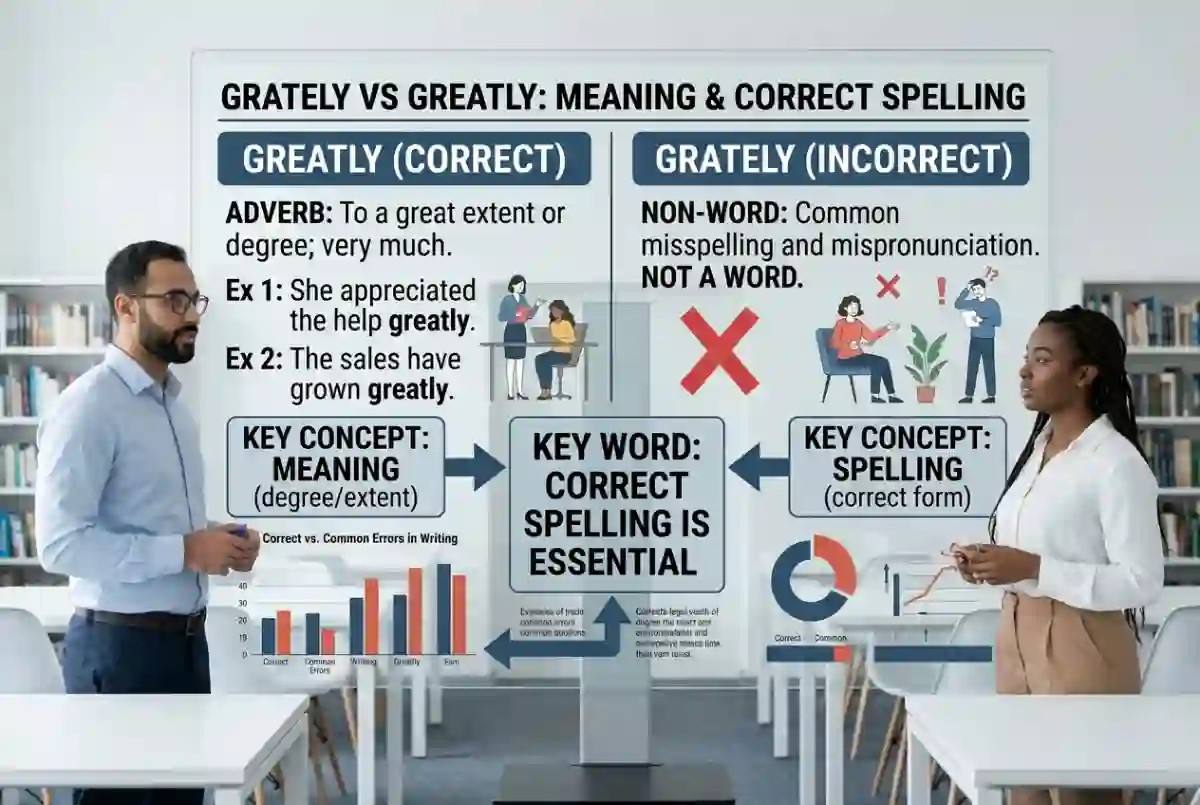
Grately vs Greatly have you ever written grately when you meant to say greatly? You’re not alone. These two spellings look similar, but only one is the standard English word. If you’re writing an email, preparing an assignment, or editing an article, knowing the difference helps you avoid a simple mistake that can affect the quality of your writing.
In the comparison grately vs greatly, greatly is the correct spelling. It means to a large degree, very much, or significantly. For example, you can say, “Your advice greatly improved my work.” The spelling grately is a common misspelling, not a standard alternative.
The confusion makes sense. English has several adjectives that form adverbs by adding ly, and the word great becomes greatly. However, the final letters of great can tempt writers to insert an extra letter or change the spelling by mistake.
This guide explains the correct spelling, meaning, pronunciation, grammar, word origin, and everyday use of greatly. You’ll also see natural examples, learn why grately is incorrect, and discover a simple way to remember the right form. By the end, you’ll know how to use greatly confidently in casual conversation, professional emails, academic writing, and other situations.
Quick Answer
Greatly is the correct spelling. It means to a large degree or very much and is used to modify verbs, adjectives, or other expressions of degree. Grately is a misspelling and should not be used in standard English. Write “I greatly appreciate your help” rather than “I grately appreciate your help.”
Grately vs Greatly at a Glance
| Feature | Grately | Greatly |
|---|---|---|
| Correct spelling | No | Yes |
| Standard English word | No | Yes |
| Meaning | No established standard meaning | To a large degree or very much |
| Part of speech | Common misspelling | Adverb |
| Related adjective | Great | Great |
| Common use | Typographical or spelling error | Expressing degree or extent |
| Example | Incorrect: I grately appreciate it. | Correct: I greatly appreciate it. |
| Formal writing | Avoid | Accepted |
| American English | Incorrect | Correct |
| British English | Incorrect | Correct |
The main rule is straightforward. Use greatly whenever you want to express a large degree or strong effect. The alternative grately is not a recognized standard spelling of that word.
What Does Greatly Mean
Greatly is an adverb that means to a large degree, very much, or significantly. It tells readers how strongly something happens, changes, matters, or affects a person or situation.
The word often appears with verbs that describe change, improvement, influence, appreciation, concern, or importance.
For example:
- Regular practice greatly improved her writing.
- I greatly appreciate your support.
- The new policy greatly reduced costs.
- His opinion greatly influenced my decision.
- We were greatly concerned about the delay.
In each sentence, greatly adds information about the degree or extent of the action or feeling. It tells the reader that the effect was substantial rather than small.
Greatly as an Adverb
An adverb modifies a verb, an adjective, another adverb, or sometimes a complete statement. The word greatly most commonly modifies verbs, especially in everyday and professional writing.
Consider this sentence:
The changes improved the website.
The sentence tells us that the website became better.
Now add greatly.
The changes greatly improved the website.
The second sentence emphasizes the size of the improvement. The changes did more than make a small difference.
Here is another example.
I appreciate your help.
This is a polite and complete sentence.
I greatly appreciate your help.
The added adverb expresses stronger appreciation. It sounds sincere and works well in professional emails, thank you messages, and formal communication.
Common Meanings of Greatly
Although greatly has one central meaning, its exact sense depends on the sentence.
To a large degree.
The storm greatly damaged the building.
This means the damage was extensive.
Very much.
I greatly admire her dedication.
This expresses strong admiration.
Significantly.
The new system greatly reduced processing time.
This highlights an important change.
To a considerable extent.
His experience greatly contributed to the team’s success.
This means his experience played a major role in the outcome.
These meanings overlap. In most cases, you can understand greatly by asking how much something changed or how strongly someone feels.
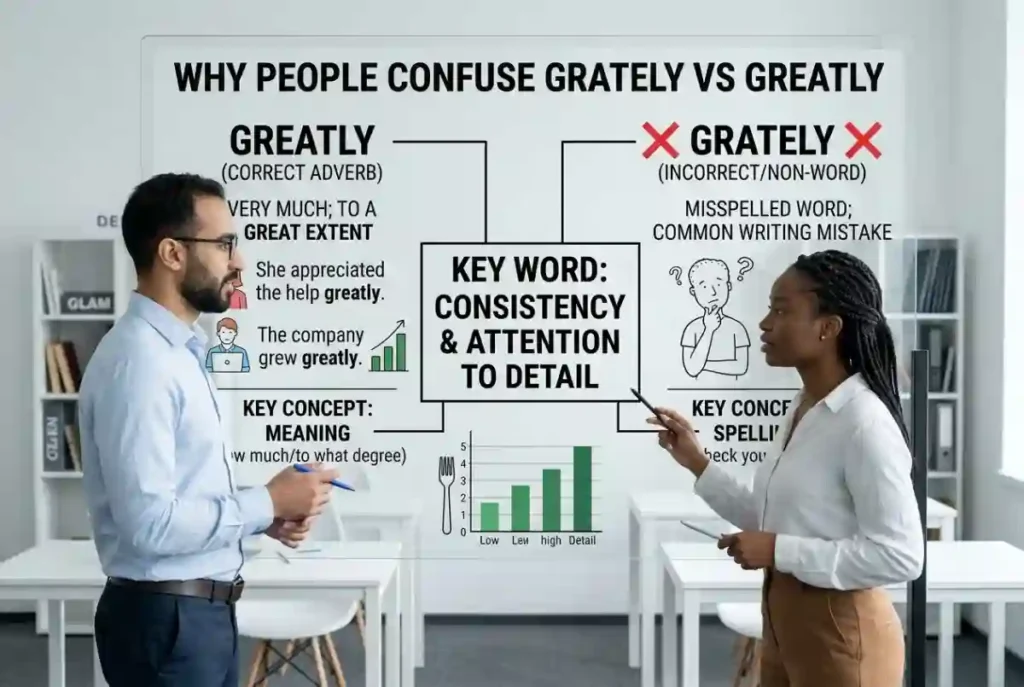
Why People Confuse Grately vs Greatly
The mistake usually comes from the way English spelling works. Both forms look plausible to someone who knows the word great but has not memorized its adverb form.
Several factors make the error more likely.
The Words Look Similar
The two spellings share nearly all their letters. The difference is the letter sequence near the end.
Greatly follows the spelling of great and adds ly.
Some writers mistakenly rearrange the letters and produce grately. Because the error looks familiar, it may go unnoticed during a quick review.
This is especially common when people type quickly or write without checking a dictionary.
The Pronunciation Can Cause Doubt
The correct word is pronounced with one syllable before the final sound represented by ly. The letters do not always make spelling choices obvious to English learners.
However, grately is not a standard pronunciation based spelling variant. The correct written form remains greatly.
Writers Apply Spelling Patterns Incorrectly
Many English adverbs form by adding ly to an adjective.
For example:
- Quick becomes quickly.
- Careful becomes carefully.
- Slow becomes slowly.
- Great becomes greatly.
A writer who understands this pattern may still make a typing error when adding the suffix. The correct rule helps, but familiarity with the finished word matters too.
Typing Quickly Creates Errors
When someone types a familiar phrase such as “I greatly appreciate it” many times, the fingers can move faster than the writer checks the spelling.
A small letter change can slip into the sentence. Spellcheck tools may catch the mistake, but not every writing system flags every error.
Autocorrect Does Not Catch Everything
Spellcheckers and predictive text tools can help, but they are not perfect. Some tools may miss unusual errors, especially in names, informal writing, or text that has not been reviewed carefully.
The safest habit is to learn the correct form and read the sentence once before sending it.
Repeated Online Errors Can Look Correct
Seeing a misspelling repeatedly can make it look familiar. Familiarity, however, does not make a spelling correct.
If you encounter grately in a social media post or an online comment, treat it as a spelling error unless the writer is using it as a deliberately invented name or expression.
Grately vs Greatly Which One Is Correct
Greatly is correct in standard English. Grately is an incorrect spelling when the intended meaning is to a large degree or very much.
The distinction is not a matter of personal preference or regional English. American, British, Canadian, and Australian English all use greatly.
Use these examples as a guide.
Correct: I greatly appreciate your kindness.
Incorrect: I grately appreciate your kindness.
Correct: The decision greatly affected the company.
Incorrect: The decision grately affected the company.
Correct: Her confidence has greatly improved.
Incorrect: Her confidence has grately improved.
In each pair, the sentence needs greatly to express the intended degree. There is no standard spelling rule that makes grately an acceptable alternative.
Greatly vs Great
The difference between great and greatly is grammatical as well as meaningful.
Great is usually an adjective. It describes a noun or gives information about a person, thing, or experience.
Examples:
- She is a great teacher.
- We had a great day.
- That was a great achievement.
- He has great confidence.
Greatly is an adverb. It usually modifies a verb and explains the extent of an action or effect.
Examples:
- She greatly helped the team.
- We greatly enjoyed the trip.
- The discovery greatly changed our understanding.
- His confidence has greatly increased.
Notice the difference in these two sentences.
She made a great improvement.
Here, great describes the noun improvement.
She greatly improved.
Here, greatly modifies the verb improved.
A simple grammar check can help you choose the right form. If you are describing a person, object, or thing, you may need great. If you are explaining the degree of an action or change, greatly may be the better choice.
Greatly vs Greatly Appreciated
The expression greatly appreciated is common in professional communication. It means that something is valued or welcomed very much.
For example:
- Your feedback is greatly appreciated.
- Any help you can provide would be greatly appreciated.
- Your patience during this process is greatly appreciated.
The phrase works because greatly modifies the idea of appreciation. It adds emphasis without changing the basic meaning.
Writers sometimes use the phrase too often in emails. If every message says that help is greatly appreciated, the wording can start to sound routine. You can vary the expression with alternatives such as:
- Thank you for your help.
- I really appreciate your support.
- Your assistance means a lot to us.
- Thank you for taking the time to help.
Choose the wording that suits your relationship with the reader. A formal request may benefit from greatly appreciated, while a short message to a colleague may sound more natural with thanks for your help.
Grammar Rules for Grately vs Greatly
Grammar Rules for greatly
The grammar of greatly is simple once you know its role as an adverb.
Greatly Usually Modifies Verbs
The word often appears before a main verb.
- The new process greatly improved efficiency.
- Her comments greatly influenced the discussion.
- The discovery greatly expanded our knowledge.
It can also appear after an auxiliary verb and before the main verb.
- The service has greatly improved.
- Costs have greatly increased.
- His health has greatly benefited from the changes.
The placement depends on the verb structure. In standard English, an adverb like greatly commonly appears before the main verb when an auxiliary verb is present.
Greatly Can Modify Participles
The word can modify a past participle that forms part of a verb phrase or acts like an adjective.
- The project was greatly delayed.
- The community was greatly affected.
- Her work is greatly respected.
In these examples, greatly describes the degree of delay, effect, or respect.
Greatly Does Not Change for Tense
Unlike a verb, greatly has no tense forms. It stays the same when the sentence moves from the past to the present or future.
- The change greatly helped us.
- The change greatly helps us.
- The change will greatly help us.
The verb changes to show time. The adverb remains unchanged.
Greatly Does Not Have a Plural Form
Adverbs do not usually change to match singular or plural nouns. You write greatly in the same form regardless of the subject.
- The new rule greatly affects the company.
- The new rules greatly affect the companies.
The noun and verb change to match the sentence. The adverb does not.
Greatly Does Not Need a Hyphen
In ordinary sentences, write greatly as one word. It does not require a hyphen or an apostrophe.
Correct: The project greatly improved the results.
Incorrect: The project great ly improved the results.
Incorrect: The project greatly improved the result’s.
The last example changes the sentence into a possessive form and does not express the intended meaning. Use punctuation only when the sentence requires it for another reason.
How to Pronounce Grately vs Greatly
Greatly
The standard pronunciation of greatly is commonly represented in IPA as /ˈɡreɪtli/ in both American and British English, with some accent variation in the details.
The word has two syllables:
great + ly
The main stress falls on the first syllable. The word begins with the same sound as great and ends with the familiar adverb ending ly.
A useful way to learn the pronunciation is to say great first and then add the final syllable without changing the original vowel sound.
Avoid treating grately as a separate standard pronunciation. It is a spelling error rather than a recognized alternative word.
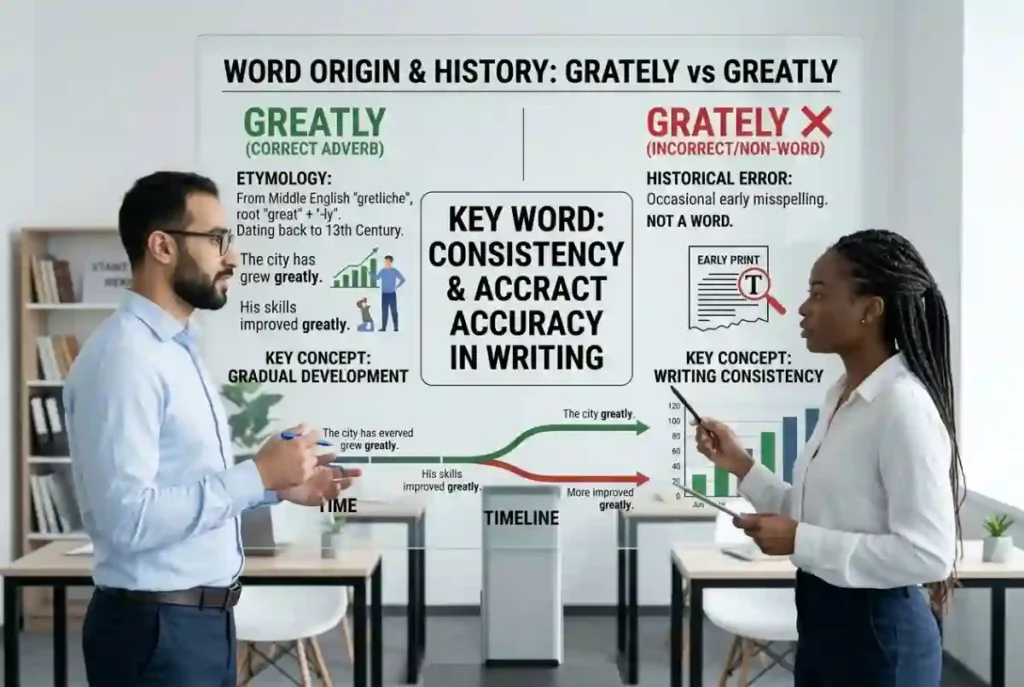
Word Origin and History Of Grately vs Greatly
The word greatly comes from the adjective great combined with the adverb forming suffix ly.
The adjective great has a long history in English. It developed from Old English grēat, which referred to something large or big. Over time, its meaning expanded to include importance, excellence, strong ability, and considerable degree.
The suffix ly has roots in older English forms that helped create adverbs from adjectives. In modern English, the same pattern appears in words such as slowly, clearly, carefully, and greatly.
This history explains the spelling. The correct adverb is formed from great + ly, producing greatly.
There is no established historical development that makes grately a standard form of this adverb.
Grately vs Greatly British vs American English
There is no regional spelling difference between greatly in American English and greatly in British English. Both varieties use the same spelling and the same central meaning.
The same is true in Canadian and Australian English. Writers in these regions should use greatly when they mean to a large degree or very much.
Some English words have different spellings across regions. For example, American English usually uses color, while British English uses colour. That pattern does not apply to greatly.
The spelling is consistent across major English varieties.
Greatly in Everyday Conversation
Although greatly can sound formal in some situations, it appears naturally in daily conversation, especially when someone wants to emphasize a strong effect or feeling.
Examples include:
- Your advice greatly helped me.
- I greatly enjoyed the concert.
- The extra practice greatly improved my confidence.
- That decision greatly changed our plans.
- Her support greatly matters to the team.
- I greatly appreciate your honesty.
- The new schedule greatly reduced my stress.
- His attitude has greatly improved.
- We greatly enjoyed our time together.
- This opportunity has greatly benefited my family.
A small note about natural phrasing: in casual speech, people often choose really, a lot, or so much instead of greatly. For example, “I really appreciate it” may sound more relaxed than “I greatly appreciate it.”
Both can be correct. The best choice depends on tone and context.
Greatly in Workplace Writing
In professional writing, greatly helps describe major effects, improvements, contributions, and changes. It works well in reports, performance reviews, business updates, and project summaries.
Examples include:
- The new process greatly improved productivity.
- Her research greatly contributed to the final report.
- The software update greatly reduced processing time.
- Your assistance has greatly benefited the project.
- The new training program greatly improved employee confidence.
- These changes will greatly simplify the approval process.
The word is especially useful when the effect is substantial. Still, it should not replace evidence. If you write that a new process greatly improved productivity, provide data or a clear example when the context calls for proof.
For example, “The new process greatly improved productivity by reducing average completion time from four hours to two” gives the reader a specific reason to believe the claim.
Greatly in Emails
The expression greatly appreciate is common in work emails because it conveys gratitude politely.
Here are natural examples:
- I greatly appreciate your time and consideration.
- Your quick response is greatly appreciated.
- I would greatly appreciate your feedback on the proposal.
- We greatly appreciate your continued support.
- Your help with the presentation would be greatly appreciated.
- I greatly appreciate the opportunity to work with your team.
The phrase can sound formal, so use it when the situation calls for professional courtesy. For a close colleague, a shorter sentence may sound warmer.
For example, “Thanks for helping me with this” is often more natural than a long expression of appreciation in an informal chat.
Greatly in Academic Writing
Academic writers use greatly to describe the degree of influence, change, improvement, or impact. The word can work well in essays, research papers, and formal explanations.
Examples include:
- The findings greatly expanded our understanding of the subject.
- Environmental conditions greatly influenced the results.
- This discovery greatly changed the direction of the research.
- The new method greatly improved the accuracy of the measurements.
- Access to reliable data greatly strengthened the analysis.
In academic writing, make sure the word matches the evidence. If a study shows only a small change, slightly or modestly may be more accurate than greatly.
Precision matters more than dramatic wording. A strong academic sentence describes the size of the effect honestly.
Greatly in Journalism and General Articles
Journalists and article writers often use greatly to describe changes in public life, technology, business, health, and the environment.
Examples include:
- The new policy greatly affected local businesses.
- Rising costs have greatly changed household spending.
- The invention greatly influenced modern communication.
- The storm greatly damaged roads across the region.
- Better access to education can greatly improve career opportunities.
Writers should avoid using greatly as an empty intensifier. If a sentence already makes the size of a change clear, the word may not add much value.
Compare these examples.
The new law greatly changed the rules.
The new law changed the rules by requiring every business to submit monthly reports.
The second sentence gives more information. In some contexts, a clear explanation is stronger than an intensifier.
Grately vs Greatly in Literature and Creative Writing
In fiction and other creative writing, greatly can describe strong emotion, change, admiration, or influence.
Examples include:
- She greatly feared the consequences of her decision.
- His kindness greatly affected the young traveler.
- The loss greatly changed the way she saw the world.
- He greatly admired the courage of his friend.
However, creative writers do not need to use greatly every time they want to show strong emotion. A direct action or concrete detail can create a stronger effect.
Instead of writing “She was greatly upset,” a writer might show the character leaving the room, struggling to speak, or refusing to answer a question.
The best choice depends on the style of the story and the effect the writer wants.
Synonyms and Related Words Of Grately vs Greatly
Several words can replace greatly, but they do not all mean exactly the same thing.
| Word | Main meaning | Example |
|---|---|---|
| Significantly | To an important degree | The change significantly improved safety. |
| Considerably | By a noticeable amount | Costs considerably increased. |
| Substantially | To a large or important extent | The proposal substantially changed the plan. |
| Dramatically | In a striking or major way | Sales dramatically increased. |
| Profoundly | Deeply or with a lasting effect | The experience profoundly affected her. |
| Extensively | Over a broad range or to a large extent | The team extensively reviewed the records. |
| Remarkably | In a way that deserves attention | The patient remarkably improved. |
| Seriously | To a severe or important degree | The delay seriously affected the project. |
Choose the synonym that matches the exact meaning. For example, profoundly often suggests a deep or lasting effect, while significantly can sound more measured and factual.
Greatly vs Significantly
Both words can describe an important degree of change.
The update greatly improved performance.
The update significantly improved performance.
The sentences are similar. However, significantly often suits technical and academic writing because it can describe a measured or meaningful difference. In statistics, the phrase statistically significant has a specific technical meaning that greatly does not carry.
Use greatly when you want a general statement about a large effect. Choose significantly when you want a more precise or analytical tone.
Greatly vs Deeply
These words overlap when describing strong feelings or lasting effects, but they are not interchangeable in every sentence.
I greatly appreciate your help.
This expresses strong gratitude.
I deeply appreciate your help.
This often sounds more personal or heartfelt.
Likewise, someone may be deeply affected by a painful experience. The word deeply emphasizes emotional or lasting impact, while greatly emphasizes degree.
Greatly vs Highly
Both adverbs can express a strong degree, but they usually appear in different combinations.
Highly recommended is a natural expression.
Greatly recommended is much less common in ordinary English.
By contrast, greatly appreciated is natural and widely used.
The lesson is simple: synonyms are not always interchangeable. Learn common word partnerships along with dictionary meanings.
Grately vs Greatly Common Mistakes to Avoid
Writing Grately Instead of Greatly
This is the main spelling error.
Incorrect: I grately appreciate your support.
Correct: I greatly appreciate your support.
Using Great Instead of Greatly
Incorrect: The new system great improved the process.
Correct: The new system greatly improved the process.
Use the adverb when you need to modify the verb improved.
Using Greatly When Another Word Is More Precise
The word can be vague if you do not explain the effect.
Weak: The policy greatly affected the company.
More specific: The policy greatly increased operating costs and delayed the company’s expansion plans.
The second sentence gives the reader useful details.
Assuming Greatly Is Always Formal
The word is common in formal writing, but it can also appear in conversation. It may sound slightly more polished than really or a lot, depending on the sentence.
Assuming Every Intensifier Means the Same Thing
Greatly, very, highly, deeply, and significantly serve different purposes. Choose the word that fits the verb and the intended meaning.

Memory Tricks for Greatly
Remember this simple rule:
Great + ly = Greatly.
The adjective great keeps its spelling when you add ly. You do not insert an extra letter or rearrange the final letters.
You can also remember a familiar sentence:
I greatly appreciate your help.
Because this expression appears so often in emails and conversations, learning it as a complete phrase can help you remember the correct spelling.
For an extra check, compare the word with similar adverbs:
- Great becomes greatly.
- Clear becomes clearly.
- Slow becomes slowly.
- Careful becomes carefully.
The pattern reinforces the correct spelling without requiring you to memorize a complicated rule.
Expert Editor’s Note
From an editor’s perspective, greatly is the only standard spelling for the intended adverb. A professional proofreader should correct grately unless the spelling is deliberately used as a name, brand, or creative invention.
The best editors also check the sentence around the word. Correct spelling matters, but word choice matters too. If greatly exaggerates a small change, a more measured word may be more accurate.
For example, if a survey shows a tiny improvement, writing that satisfaction greatly increased may mislead the reader. A phrase such as increased slightly would communicate the result more honestly.
In formal writing, use greatly when the degree is substantial and the context supports that claim. In casual writing, consider really or a lot if they sound more natural for your audience.
Frequently Asked Questions
Is grately a real word
Grately is not a standard English word with the intended meaning of greatly. It is generally a misspelling. You may encounter it as a username, invented name, or deliberate creative form, but those uses do not make it a standard spelling. In ordinary writing, use greatly.
How do you spell greatly
Spell it g r e a t l y. The word comes from great plus the suffix ly. Keep the letters in great in their original order and add ly at the end. A helpful example is “I greatly appreciate your help.”
What does greatly mean in simple English
Greatly means very much or to a large degree. It describes the strength or extent of an action, change, feeling, or effect. For example, “The new plan greatly improved our results” means the plan made a substantial improvement.
Is greatly an adjective or an adverb
Greatly is an adverb. It usually modifies a verb by explaining how much something happens or how strong an effect is. In “The news greatly surprised me,” the word modifies surprised. The related adjective is great, as in “a great achievement.”
Is greatly correct in formal writing
Yes. Greatly is standard English and works well in formal reports, academic writing, business emails, and professional communication. Use it when you need to describe a substantial effect or strong feeling. Make sure the context supports the degree you are claiming.
What is another word for greatly
Possible alternatives include significantly, considerably, substantially, profoundly, and dramatically. The best choice depends on context. Significantly often suits analytical writing, while profoundly can emphasize a deep effect. These words have different shades of meaning, so they should not be substituted automatically.
Is greatly the same as very much
The meanings overlap, but the grammar differs. Greatly is an adverb and often appears before a verb, as in “I greatly appreciate it.” Very much is a two word expression that can also express strong degree, as in “I appreciate it very much.” Both sentences are correct.
Why do people write grately
People usually write grately because the two spellings look similar or because they type too quickly. The error can also come from uncertainty about how to add ly to great. Repeated online mistakes may make the incorrect form look familiar, but the standard spelling remains greatly.
Final Verdict
In the comparison grately vs greatly, the correct spelling is greatly. It means to a large degree, very much, or significantly. The spelling grately is incorrect when used as a substitute for this standard adverb.
Remember the simple pattern: great + ly = greatly. Use the word to describe a strong effect, a major change, or a deep level of appreciation. Before publishing or sending your writing, check the spelling and make sure the word accurately describes the degree you intend.
A small spelling choice can make a big difference in clear writing. Get the word right, and let your meaning speak for itself.
Suggested Internal Links
Consider linking this article to related English spelling and vocabulary guides:
- Great vs Grate.
- Great vs Greater.
- Grateful vs Greatful.
- Definitely vs Definately.
- Truly vs Truely.
- Really vs Greatly.
- Significant vs Substantial.
- Adjectives vs Adverbs.
Use descriptive anchor text that matches each page’s topic. Only add links to articles that exist on your website.
Meta Description
Grately vs greatly explained with the correct spelling meaning pronunciation grammar and examples. Learn why greatly is correct and avoid common mistakes.

Founding Editor
Maya spent six years as a copyeditor at a regional newspaper before starting Grammist, which is where the “answer first” format came from: newsroom style guides don’t have room for a preamble.
She writes and reviews most of the word-pair and spelling entries, and has final say on anything that goes out under the Grammist name.