
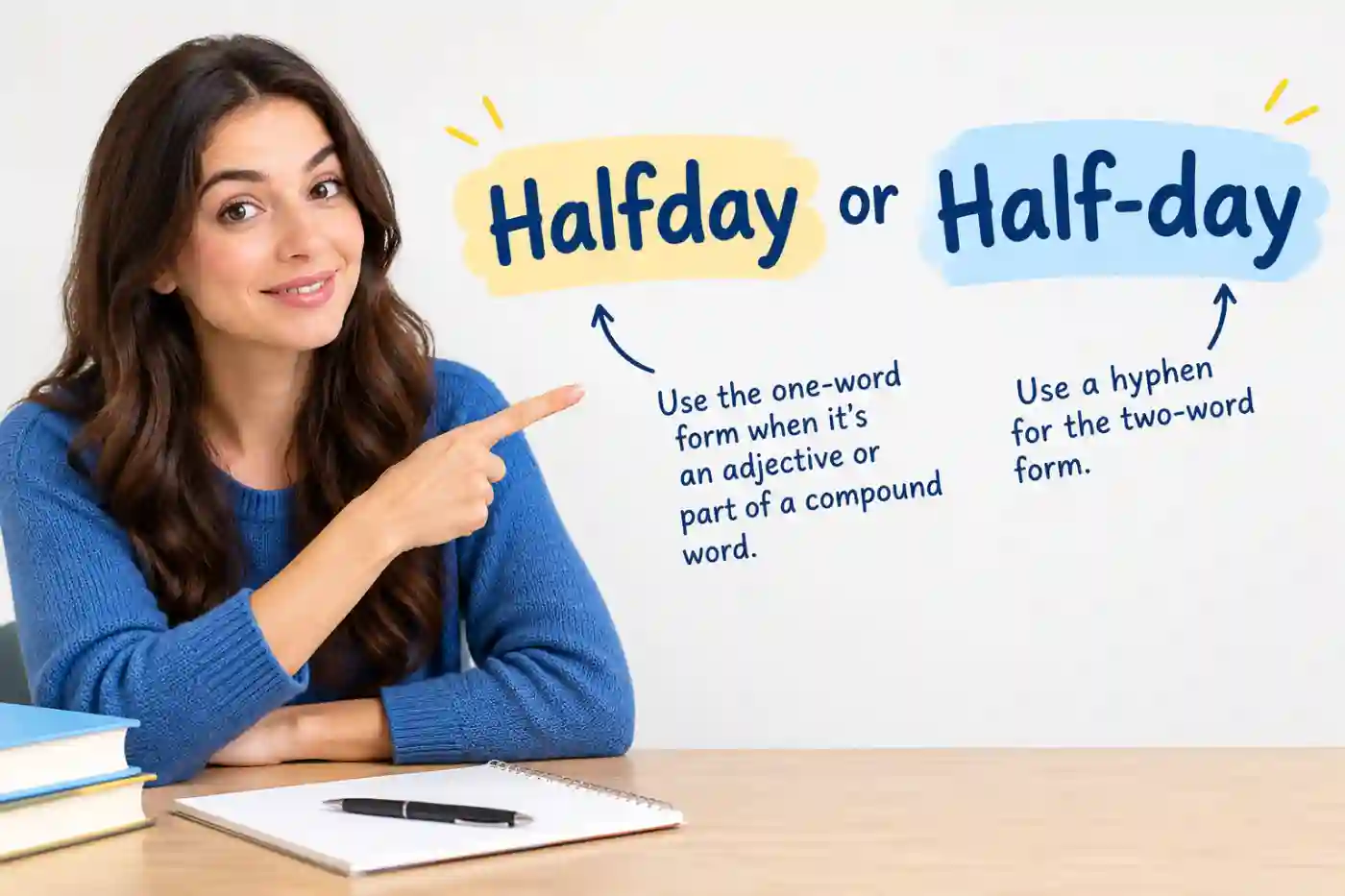
Halfday or Half-Day the correct choice depends on how you use the expression. Half-day is the standard spelling when you mean a period of half a day, especially when it describes a noun. For example, you might attend a half-day workshop or request half-day leave. In ordinary writing, half day is also correct when the two words form an open phrase, as in “We worked for half a day.”
The spelling halfday, written as one word, is generally not standard English. Although people sometimes use it in informal messages, search queries, or quick notes, it is best to avoid it in professional and academic writing.
The confusion comes from English compound words. Some combinations begin as separate words, develop a hyphenated form, and sometimes become a single word over time. The word half also appears in many expressions, including half time, halfway, half brother, and half an hour. These expressions do not all follow the same spelling pattern.
This guide explains the difference between halfday, Halfday or Half-Day . You will learn when to use each form, how hyphenation works, what British and American English recommend, and how to write the expression naturally in emails, workplace messages, school notices, and everyday conversation.
Halfday or Half-Day Quick Answer
Half-day is the standard hyphenated form when the expression describes a noun, as in “a half-day course.” Half day is also correct in phrases such as “I worked for half a day.” Avoid halfday in standard English because it is not the usual accepted spelling.
Halfday vs Half-Day vs Half Day
These three spellings may look similar, but they do not have the same status in standard English. The main distinction is between the nonstandard closed spelling halfday and the accepted open and hyphenated forms.
| Form | Is it correct? | Meaning and usage | Example |
|---|---|---|---|
| Halfday | Generally nonstandard | Not the usual spelling in edited English | Avoid writing “a halfday course.” |
| Half-day | Correct | Common before a noun or when treating the expression as a compound modifier | We attended a half-day seminar. |
| Half day | Correct in suitable contexts | Used as an open phrase referring to half of a day | I spent half a day at the office. |
The key is to consider the expression’s role in the sentence. A hyphen often helps readers recognize that half-day works as a unit before a noun. The open form half day can also appear in ordinary sentences, although half a day is often the more natural choice when referring to a duration.
Is half-day one word or two words?
Half-day is written as two words joined by a hyphen. Half day is written as two separate words without a hyphen. Halfday is written as one closed word, which is not the standard spelling for this expression.
For example:
- Correct: We booked a half-day tour.
- Correct: The tour lasted half a day.
- Usually incorrect: We booked a halfday tour.
The hyphen does not turn the expression into one word. It connects two elements so readers can understand them as a compound.
Is half-day one word or a compound word?
Half-day is a hyphenated compound. A compound forms when two or more words work together as a single unit of meaning. English compounds can be written as open compounds, hyphenated compounds, or closed compounds.
Examples include:
- Open compound: ice cream.
- Hyphenated compound: part-time.
- Closed compound: classroom.
These patterns help explain why half-day is normally written with a hyphen in expressions such as half-day training. However, English spelling is not governed by one universal rule that determines the form of every compound. Established usage and dictionary guidance matter.
What Does Half-Day Mean?
A half-day is a period lasting approximately half of a normal day or a working or school day. Its exact length depends on the activity and the schedule.
For instance, a half-day school session might run from 8 a.m. until noon. A half-day training course could last four hours, while a half-day sightseeing trip might take five hours. The expression does not automatically mean exactly twelve hours.
Half-day as an adjective
The hyphenated form is especially useful when the expression appears before a noun and describes its duration or arrangement.
Examples include:
- A half-day workshop.
- A half-day examination.
- A half-day excursion.
- A half-day orientation.
- A half-day appointment.
- A half-day school schedule.
In each example, half-day tells the reader what kind of workshop, examination, excursion, appointment, or schedule is involved.
Consider these two sentences:
“ We attended a half-day workshop.”
“The workshop lasted half a day.”
The first sentence uses half-day as a compound modifier before the noun workshop. The second describes the duration of the event through the phrase half a day.
Half-day as a noun
The hyphenated form can also function as a noun in some contexts, particularly in workplace scheduling and administrative language.
Examples include:
- Friday is a half-day at our office.
- The school has scheduled a half-day for staff training.
- Employees may request a half-day off.
Usage varies by organization and style guide. Some writers prefer half day in certain noun constructions, while others use half-day. The important point is to follow the established spelling used by your dictionary, workplace, or publication and remain consistent.
What counts as a half-day?
A half-day does not have one fixed duration in every setting.
In a workplace, it may mean half of the usual working shift. At school, it may refer to a shortened school day. For a tour operator, it may describe an excursion lasting part of the morning or afternoon.
For example, an eight-hour workday might be divided into two four-hour periods. In another workplace, a half-day could be based on a seven-hour schedule, making each half three and a half hours.
When exact timing matters, state the hours rather than relying on the expression alone.
Instead of writing “The training lasts half a day,” you could write “The training runs from 9 a.m. to 1 p.m.”
Halfday or Half-Day
What Does Half Day Mean?
Half day is an open expression made up of the word half and the noun day. It refers to half of a day or part of a schedule that is treated as one half.
In many everyday sentences, English speakers naturally use the longer phrase half a day. The article a makes the duration clear.
Examples:
- We waited for half a day.
- She spent half a day preparing the presentation.
- I took half a day to finish the report.
- They explored the city for half a day.
The form half day can also appear without the article in established expressions, particularly in scheduling and administrative contexts.
For example:
– The office operates on a half day Friday schedule.
This sentence is less clear than a version with a hyphen or a rewritten phrase. Better alternatives include “The office has a half-day schedule on Friday” and “The office closes at noon on Friday.”
Half a day vs half-day
These expressions can communicate similar ideas, but they serve different grammatical purposes.
Half a day is a noun phrase that directly expresses a duration. It is usually the clearest choice when describing how long something takes.
Half-day is especially useful as a compound modifier before another noun.
Compare the examples:
- I spent half a day studying.
- I attended a half-day study session.
- The journey took half a day.
- We booked a half-day excursion.
The first and third sentences emphasize duration. The second and fourth use the hyphenated expression to describe an activity.
This is a useful writing distinction, not an absolute rule that makes every other construction incorrect.
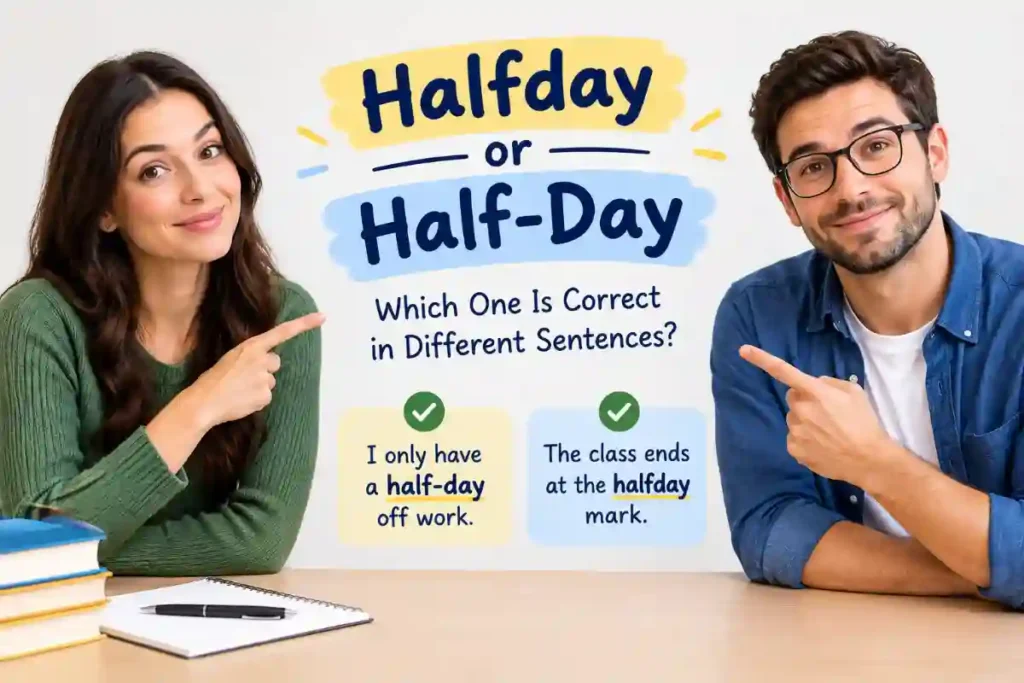
Halfday or Half-Day Which One Is Correct in Different Sentences?
The best spelling depends on the sentence. Use these examples as a practical reference.
| Sentence | Best choice | Reason |
|---|---|---|
| We booked a half-day tour. | Half-day | It modifies tour. |
| The tour lasted half a day. | Half a day | It expresses duration. |
| Friday is a half-day at school. | Half-day | It functions as a scheduling label. |
| I worked for half a day. | Half a day | It describes the time spent working. |
| She signed up for a half-day class. | Half-day | It modifies class. |
| The class took half a day. | Half a day | It describes the duration. |
| I need a half-day leave request form. | Half-day | It modifies the compound noun phrase. |
| The company offers half-day training. | Half-day | It describes the type of training. |
| We spent the morning at the museum. | Neither required | A direct time reference may be clearer. |
| I will be absent for halfday. | Half a day or a half-day | The original closed spelling is nonstandard. |
One helpful principle is to avoid treating half-day and half a day as interchangeable in every grammatical position. They can express related meanings, but the sentence structure determines which form sounds natural.
Why People Confuse Halfday or Half-Day
Several features of English make this expression easy to misspell. Understanding them can help you recognize the correct form in other compound expressions too.
English compounds follow different spelling patterns
English has no single spelling rule that applies to all compound words. Some combinations remain separate, some use hyphens, and others eventually become one word.
For example, ice cream is usually written as two words, part-time uses a hyphen, and bedroom is a closed compound.
Writers sometimes assume that a familiar expression should also become one word. That assumption explains forms such as halfday, but familiarity alone does not establish standard spelling.
The word half appears in many expressions
English uses half in a wide range of combinations, including:
- Half an hour.
- Half a dozen.
- Halfway there.
- Half brother.
- Half-time.
- Half-hearted.
- Half-day.
These expressions have different grammatical functions and established spelling conventions. The fact that halfway is one word does not mean that half-day should also be written as halfday.
Informal writing encourages shortcuts
People often remove spaces and punctuation in text messages, search queries, usernames, filenames, and social media posts. This can produce forms that are easy to type but unsuitable for formal writing.
Someone might search for halfday meaning or type halfday leave into a quick message. Those searches can still communicate the intended meaning, but they do not prove that the closed spelling is correct.
Autocorrect does not always settle spelling questions
Spellcheckers and predictive keyboards can overlook errors, accept specialized terms, or suggest alternatives based on context. A spelling that survives an automated check is not necessarily the best choice for an edited article.
When a spelling question matters, consult a reliable dictionary or an established style guide rather than relying entirely on a keyboard suggestion.
Regional and workplace habits can differ
Schools, employers, and scheduling systems sometimes use half day, half-day, or a shortened label such as half day leave. These local conventions may become familiar to employees and students.
That variation does not mean all forms are equally suitable in every context. For general English writing, half-day and half a day are safer choices than halfday.
Grammar Rules for Halfday or Half a Day
Understanding the grammar makes the spelling easier to remember. The most important distinction is between a compound modifier and a phrase that expresses duration.
Use half-day before a noun
When half-day comes directly before a noun and describes it, the hyphen clearly connects the two words.
Examples:
- We organized a half-day conference.
- He completed a half-day induction program.
- The children attended a half-day camp.
- Our team scheduled a half-day planning session.
- She booked a half-day photography class.
In each sentence, the compound tells the reader what kind of event, program, camp, session, or class is involved.
The same pattern works in professional documents, school notices, event listings, and service descriptions.
Use half a day to describe duration
When you want to explain how much time an activity takes, half a day is often the most natural choice.
Examples:
- The repair took half a day.
- We spent half a day reviewing the proposal.
- It took me half a day to organize the files.
- They traveled for half a day before reaching the village.
The structure is straightforward: half expresses a fraction, a introduces the singular count noun day, and the complete phrase identifies a duration.
Do you need an article before half-day?
The answer depends on the sentence.
When a singular count noun follows half-day, you generally use an article or another suitable determiner.
- Correct: We attended a half-day course.
- Correct: She booked the half-day session.
- Correct: They offered another half-day workshop.
However, half-day can appear without an article when it is used in a different grammatical structure.
For example, “The program includes half-day training” is a natural construction in which training is an uncountable noun.
Likewise, “Employees can request half-day leave” is common in some administrative settings, although a full sentence such as “Employees can request a half-day of leave” may be clearer for a broad audience.
Is half-day singular or plural?
The expression can be singular or plural depending on the sentence.
Examples:
- We scheduled a half-day workshop.
- The company offers three half-day workshops.
- She requested one half-day of leave.
- The school has two half-days next month.
Notice that the plural form of half-day is generally half-days, with the plural ending added to the compound.
When referring to school schedules, half-days is particularly natural:
“The students have two half-days this week.”
For a duration, however, the expression often remains unchanged:
“We spent half a day there.”
The plural form half days can also occur in suitable open constructions, but writers should avoid switching randomly between open and hyphenated forms in the same document.
Can half-day be used with numbers?
Yes. Numbers can describe the number of half-day sessions or help specify a schedule.
Examples:
- The course includes two half-day sessions.
- We booked three half-day tours.
- The workshop runs over four half-days.
- The company offers a five-day program with two half-day training sessions.
When a compound adjective includes a number and a unit of time, the exact construction matters.
For example, a half-day course and a two-hour course are clear. You would normally write a two-hour course, not a two hours course, because the unit in a compound modifier is singular.
However, half-day is an established expression, so it does not need to be rewritten as half-a-day.
What happens when half-day follows a noun?
A hyphen is often helpful before a noun, but it is not automatically required in every position.
Compare:
- We arranged a half-day meeting.
- The meeting lasted half a day.
- The meeting was half a day long.
The first sentence uses a compound modifier. The second uses a duration phrase. The third uses a phrase that describes the length of the meeting.
If you write “The meeting was a half-day,” the sentence may sound incomplete unless the surrounding context makes the meaning clear. A more natural version is “The meeting was a half-day event” or “The meeting lasted half a day.”
The goal is to choose a construction that communicates the intended meaning clearly.
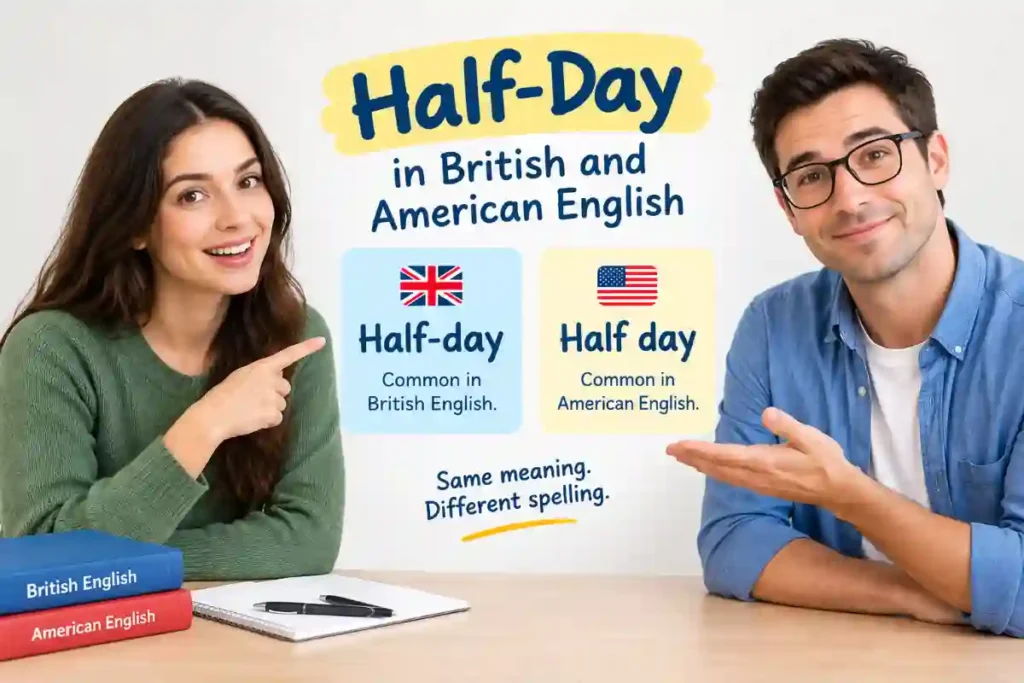
Half-Day in British and American English
The spelling of half-day is broadly understood in both British and American English. The main differences tend to involve workplace terminology, scheduling conventions, and local style preferences rather than a major difference in the basic meaning.
American English
In American English, half-day is a familiar form in school schedules, workplace arrangements, training programs, and event descriptions.
Examples:
- The school has a half-day on Wednesday.
- I have a half-day training session tomorrow.
- We booked a half-day fishing trip.
- The office will close at noon for a half-day schedule.
American writers also commonly use half a day when discussing the amount of time something takes.
For example, “It took half a day to finish the repairs” is natural American English.
British English
British English also uses half-day and half a day. The exact phrasing may depend on the situation.
Examples:
- The children have a half-day at school.
- I attended a half-day course.
- It took half a day to complete the work.
- She requested a half-day of annual leave.
In the United Kingdom, expressions involving annual leave, time off, and school hours may be more common in certain administrative contexts than their American equivalents.
The spelling principle remains the same. Use the form that fits the sentence and the conventions of the document.
Canadian English
Canadian English shares many spelling and usage patterns with both British and American English. Half-day is a clear choice for a compound modifier, while half a day works naturally to express duration.
For example:
“The college offers a half-day orientation session.”
“The trip took half a day.”
In a Canadian workplace, an employee handbook might use half-day leave as a category. Another organization might prefer half a day of leave. Follow the employer’s established terminology when completing official forms.
Australian English
Australian English also uses half-day for shortened sessions, activities, and scheduled events.
Examples include:
- The school is holding a half-day session.
- We booked a half-day tour.
- The workshop will take half a day.
- Staff can request a half-day of leave.
Australian organizations may use their own conventions in rosters, attendance systems, and leave policies. These conventions do not make halfday the preferred general spelling.
Which regional form should you choose?
For writing intended for an international audience, use the following practical approach:
- Write half-day workshop before a noun.
- Write half a day when describing duration.
- Avoid halfday in standard edited English.
- Follow your organization’s established style for leave forms and scheduling labels.
This approach is clear across major varieties of English.
Real Life Examples of Halfday or Half-Day
The following examples show how the expressions work in everyday situations. They also illustrate why context matters more than memorizing a single spelling in isolation.
Daily conversation
- “I’m taking a half-day off tomorrow.”
- “We spent half a day exploring the old town.”
- “Would you like to join us for a half-day hike?”
- “It took half a day to clean the garage.”
The first and third examples use half-day to describe time off and a hike. The second and fourth use half a day to express duration.
Workplace communication
- “The company has arranged a half-day training session.”
- “I need half a day to finish the quarterly report.”
- “Our team will attend a half-day planning workshop.”
- “The technician spent half a day repairing the equipment.”
The hyphenated form works well in descriptions of planned activities. The open phrase works naturally when reporting the time required for a task.
Emails and formal messages
- “I would like to request a half-day of annual leave on Friday.”
- “The department has scheduled a half-day meeting for next week.”
- “Please confirm the start time for the half-day orientation.”
- “The review process may take half a day to complete.”
These examples are suitable for professional communication. In a leave request, it is helpful to specify the date and the hours involved if the workplace requires precise scheduling.
Halfday or Half-Day For School and education
- “The students will attend a half-day program on Thursday.”
- “The teacher spent half a day preparing the lesson.”
- “Our school has two half-days during the examination period.”
- “The museum organized a half-day educational visit.”
These examples cover both the compound modifier and the duration phrase. They also show the correct plural form half-days.
Travel and leisure
- “We booked a half-day boat trip along the coast.”
- “The guided tour lasted half a day.”
- “They planned a half-day cycling excursion.”
- “We spent half a day visiting local markets.”
Travel providers often use half-day tour as a product description. In a travel report, half a day is usually a natural way to describe how long the activity took.
Academic writing
- “Participants completed a half-day training program before the study.”
- “Each participant spent half a day completing the assessment.”
- “The researchers organized a half-day workshop for teachers.”
- “The preliminary observations required half a day of fieldwork.”
In academic writing, clarity is more important than choosing the shortest phrase. If the exact duration affects the study, state the number of hours rather than relying on a general expression.
Journalism and public notices
- “The school will operate on a half-day schedule because of staff training.”
- “The festival includes a half-day program for families.”
- “The repair work took half a day longer than expected.”
- “Officials announced a half-day closure for the affected offices.”
Public notices should make timing easy to understand. If a half-day closure affects access to a service, include the opening and closing times whenever possible.
Social media and informal writing
- “Finally enjoying a half-day away from my desk.”
- “We spent half a day at the beach, and it was worth it.”
- “A half-day adventure with the family.”
- “It took half a day to get everything ready.”
Informal writing can be relaxed without sacrificing correct spelling. You do not need to join half and day into one word to make a caption shorter.
These examples also show that the spelling does not change simply because the sentence appears in a social media post rather than a formal document.
Halfday or Half-Day Common Mistakes to Avoid
Even experienced English speakers sometimes make mistakes with compound expressions. The following errors are easy to correct once you understand the difference between spelling, grammar, and meaning.
Writing halfday as one word
Incorrect: “We have a halfday workshop tomorrow.”
Correct: “We have a half-day workshop tomorrow.”
The problem is the closed spelling. Standard English normally uses the hyphenated form when the expression modifies a noun.
Using half-day when half a day sounds more natural
Less natural: “The project required a half-day to complete.”
Better: “The project required half a day to complete.”
The second sentence uses the ordinary duration phrase. The hyphenated form is not necessary when half a day expresses how long the work took.
Adding unnecessary hyphens
Incorrect: “The session lasted half-a-day.”
Correct: “The session lasted half a day.”
Do not add a hyphen between half, a, and day. The standard duration phrase consists of three separate words.
Confusing half-day with half-time
Half-day and half-time refer to different things.
- A half-day describes a period covering part of a day.
- Half-time commonly refers to the break between two halves of a sporting event or a reduced working arrangement, depending on context.
For example, “The school has a half-day on Friday” does not mean the school operates at half-time.
Assuming every compound with half follows the same rule
The word half appears in closed, open, and hyphenated expressions. For example, halfway is one word, half an hour is an open phrase, and half-hearted is commonly hyphenated.
Learn the established spelling of each expression instead of applying one rule to all of them.
Treating a spellcheck result as proof
A word processor may fail to flag halfday, especially if its dictionary or settings allow custom terms. A green checkmark or the absence of a red underline does not guarantee that a word is suitable for formal writing.
Use a reputable dictionary and review the word in its full sentence.
Memory Tricks for Halfday or Half-Day
A simple memory technique can help you choose the right form without checking a dictionary every time.
Remember the two main patterns For Halfday or Half-Day
Before a noun, connect the words.
Think of half-day course or half-day trip. The hyphen connects the words so they work together as a description.
For duration, remember half a day.
Think of half a day to finish the work. The three words form a natural phrase describing time.
Never close the expression into halfday.
Remember that half-day has a hyphen and half a day has spaces. Neither standard form joins the words into halfday.
A quick test
Ask yourself what you want to communicate.
- Are you describing a workshop, course, shift, or tour? Use half-day workshop, half-day course, half-day shift, or half-day tour.
- Are you explaining how long something lasted? Use half a day.
- Are you writing halfday as one word? Change it to the appropriate standard form.
This method works for most everyday situations.
Halfday or Half-Day Related Words and Expressions
Understanding related expressions helps you avoid spelling mistakes in other combinations involving half.
| Expression | Meaning | Example |
|---|---|---|
| Half an hour | Thirty minutes | The call lasted half an hour. |
| Halfway | At the middle point | We were halfway through the journey. |
| Half-hearted | Lacking enthusiasm or effort | He made a half-hearted attempt. |
| Half-time | The midpoint break in some sports or a reduced work arrangement | The players rested at half-time. |
| Half price | Fifty percent of the usual price | The tickets were half price. |
| Part-time | Working fewer than standard full-time hours | She has a part-time job. |
| Full-day | Lasting for an entire day | We booked a full-day excursion. |
| All-day | Continuing throughout the day | They attended an all-day conference. |
| Half a day | A duration equal to half a day or part of a schedule | The repair took half a day. |
These expressions do not all share the same spelling pattern. Their established forms depend on convention, grammar, and usage.
Half-day vs full-day
Half-day and full-day describe different durations.
A half-day event occupies part of a day, while a full-day event is intended to cover an entire day or the usual full schedule.
Examples:
- We booked a half-day tour of the city.
- We booked a full-day tour of the city.
In both examples, the compound modifies tour, so the hyphen helps readers understand the description.
The precise length of either event depends on the provider’s schedule. If timing matters, check the stated start and end times.

Half-day vs half-time
A half-day refers to part of a day. Half-time has different meanings depending on the context, including the interval in some sports and a reduced working schedule.
For example:
“The students have a half-day on Friday.”
“The teams met again after half-time.”
The two expressions should not be substituted for one another.
Half-day vs half a day
This is the most important comparison for everyday writing.
Use half-day when it describes a noun:
“We attended a half-day seminar.”
Use half a day when it expresses duration:
“We spent half a day at the seminar.”
Both sentences are correct. The choice depends on the grammatical structure, not on a difference in the amount of time described.
What Dictionaries and Style Guides Recommend About Halfday or Half-Day
A reliable spelling decision should rest on established usage, not on guesses about how English compounds ought to work.
English dictionaries commonly record compound expressions according to their established forms. General dictionary resources such as Merriam-Webster and the Cambridge Dictionary are useful starting points when checking spelling, meaning, and grammatical usage.
For this expression, the practical editorial approach is to distinguish the hyphenated compound from the open duration phrase. Do not assume that halfday is acceptable simply because it appears in a search result, informal message, or locally maintained scheduling system.
Style guides may differ in their treatment of some compound modifiers. A publication might have a general rule about hyphenating compound adjectives, while a company may use a fixed label such as half day leave in its internal forms. When editing for a specific organization, its documented house style should take priority, provided the wording remains clear.
For general audience writing, the following choices are dependable:
- A half-day course for a course lasting part of a day.
- Half a day for a duration.
- A half-day of leave or half a day of leave when the sentence calls for that construction.
- Halfday should generally be avoided.
An experienced editor also considers readability. Sometimes the best solution is to rewrite the sentence rather than debate the hyphen.
For example, “The event is half-day” is awkward in many contexts. “The event lasts half a day” or “The event is a half-day program” communicates the meaning more naturally.
Halfday or Half-Day Frequently Asked Questions
Is halfday a correct English word?
Halfday is not the usual standard spelling for this expression in edited English. Use half-day when describing a noun, as in “a half-day course,” or half a day when expressing duration. A closed form may appear in a proper name, product label, or specialized system, but that does not make it the general spelling.
Is half-day hyphenated or written as two words?
Half-day is written as two elements joined by a hyphen. The alternative half day is written as two separate words and can occur in suitable constructions. For example, “We attended a half-day workshop” and “We spent half a day there” are both correct.
Should I write half-day leave or half a day of leave?
Both expressions can be correct. Half-day leave is common in workplace and administrative language, while half a day of leave is a clear alternative in general prose. Follow the terminology used by your employer for official requests. If the time off needs precise approval, state the date and hours.
Is it correct to say I took a half-day off?
Yes. “I took a half-day off” is a natural sentence in English. You can also say “I took half a day off.” Both forms communicate that you took time away from work or another regular commitment for part of a day.
Is half-day one word or two words?
It is two words joined by a hyphen, not one closed word. Half-day is a hyphenated compound, while half a day is a three-word phrase. The form halfday is generally nonstandard in ordinary English writing.
What is the plural of half-day?
The usual plural of the hyphenated noun is half-days. For example, “The school has two half-days this month.” When you are describing duration, you can write “We spent half a day there.” Choose the plural form based on the sentence’s meaning and grammatical structure.
Does British English use half-day differently from American English?
The basic usage is similar in British and American English. Both use half-day in expressions such as half-day course and half-day session. Both also use half a day to describe duration. Some workplace and school terms differ by region, but halfday is not the preferred general spelling.
Can I write half day without a hyphen?
Yes, in suitable constructions. For example, half day can appear in scheduling labels, and half a day is a standard duration phrase. However, when the expression directly modifies a noun, half-day workshop is a clear and conventional choice. The closed spelling halfday should generally be avoided.Use these as suggested article topics and link them to your published pages when the content is available.
Halfday or Half-Day Final Verdict
The safest choice is simple: write half-day when describing a noun, such as half-day course or half-day workshop. Use half a day when explaining how long something takes, as in “The project took half a day.” Avoid halfday in standard English writing.
The main mistake is assuming that similar expressions must follow the same spelling pattern. English compounds develop their own established forms, so context and conventional usage matter.
Remember this rule: Use the hyphen to describe the event and the phrase half a day to describe the time.
Meta description: Halfday or half-day? Learn the correct spelling, understand the difference between half-day and half a day, and explore examples and grammar rules.

Founding Editor
Maya spent six years as a copyeditor at a regional newspaper before starting Grammist, which is where the “answer first” format came from: newsroom style guides don’t have room for a preamble.
She writes and reviews most of the word-pair and spelling entries, and has final say on anything that goes out under the Grammist name.