
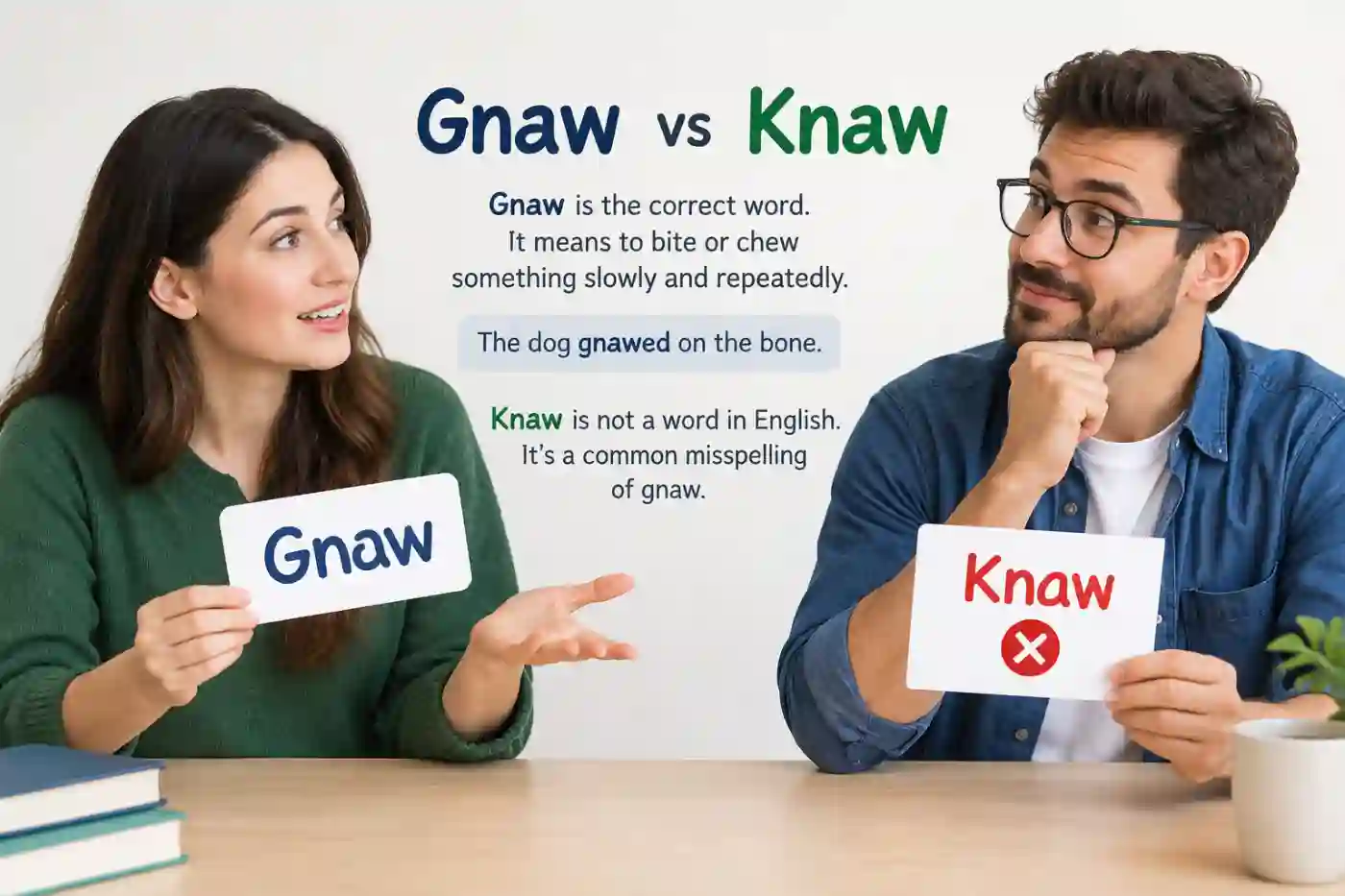
Have you ever wondered if gnaw or knaw is the correct spelling when describing an animal chewing on a bone or someone slowly eating away at a problem? The two words look similar, but only one is the standard spelling in modern English. The correct word is gnaw. The spelling knaw is a common mistake.
The confusion makes sense. English has several words that begin with a silent k, such as know, knee, and knife. In these words the first letter is not pronounced. Since gnaw also begins with a silent letter, it can be tempting to spell it with a k instead of a g.
However, the words follow different spelling patterns. In gnaw, the g is silent and the n carries the opening sound. In knaw, the initial k would follow a different pattern, and the word is not the standard spelling for the meaning most people intend.
This guide explains the difference between gnaw and knaw, including their meanings, pronunciation, grammar, word history, and everyday usage. You’ll also find practical examples, common mistakes, memory tricks, and answers to frequently asked questions. By the end, you’ll know how to spell gnaw correctly and use it naturally in both literal and figurative sentences.
Quick Answer
Gnaw is the correct spelling of the verb meaning to bite or chew something repeatedly. It can also mean to cause persistent worry or gradually wear something away. Knaw is a misspelling in standard modern English. Remember that the g in gnaw is silent, just as the k in know is silent.
Gnaw or Knaw at a Glance
| Feature | Gnaw | Knaw |
|---|---|---|
| Standard spelling | Correct | Incorrect for the intended meaning |
| Part of speech | Verb | Not a standard spelling of this verb |
| Meaning | To bite or chew repeatedly | No standard meaning as the intended verb |
| Pronunciation | /nɔː/ in many British accents and /nɑː/ in many American accents | No standard pronunciation for the misspelling |
| Present tense | gnaw | Not standard |
| Past tense | gnawed | Not standard |
| Present participle | gnawing | Not standard |
| Common context | Animals chewing, worry, erosion | Usually a spelling mistake |
| Example | The mouse will gnaw the wood. | The mouse will knaw the wood. |
| Formal writing | Use gnaw | Correct to gnaw |
The key point is simple. If you mean biting, chewing, wearing something away, or causing persistent worry, write gnaw.
Meaning and Correct Spelling
Gnaw or Knaw Which One Is Correct
Gnaw is the correct modern English spelling for the verb meaning to chew or bite something repeatedly. It also describes something that gradually wears away or a feeling that continues to trouble someone.
The spelling knaw does appear in historical and nonstandard word records. Wiktionary lists it as an archaic spelling of gnaw and also records a nonstandard use related to know. However, these historical or unusual forms do not make knaw appropriate for ordinary modern writing. (Wiktionary)
For school assignments, business emails, articles, reports, and everyday messages, use gnaw when you mean to chew repeatedly.
Correct: The puppy likes to gnaw on its toy.
Incorrect in standard modern English: The puppy likes to knaw on its toy.
What Does Gnaw Mean
Gnaw is a verb that means to bite or chew something repeatedly, often in a way that gradually damages or wears it down. The word commonly describes animals such as mice, rats, rabbits, and dogs. It can also describe a feeling that keeps troubling someone or a force that slowly wears something away.
The word has three main uses.
Gnaw Means To Chew Repeatedly
This is the literal meaning. An animal or person repeatedly bites an object, often using the front teeth.
Examples include:
- The mouse began to gnaw on the cardboard box.
- The dog likes to gnaw on a rubber toy.
- A rabbit gnawed the carrot into small pieces.
- The puppy gnawed the corner of the cushion.
- The squirrel gnawed through the hard shell.
The action often continues for some time. A single quick bite is not usually enough to convey the full sense of gnaw.
Gnaw Means To Wear Something Away
The word can describe the gradual removal or damage of material. Teeth may do the work directly, but the expression can also describe a process that resembles repeated biting.
For example:
- Rats gnawed through the wooden door.
- The animal gnawed a small hole in the fence.
- Water slowly gnawed away at the soft rock.
- The sharp chemical began to gnaw at the metal.
- Repeated friction gnawed away at the surface.
In these examples, the focus is on gradual damage. The material does not disappear all at once. It wears away bit by bit.
Gnaw Means To Cause Persistent Worry
English also uses gnaw figuratively. A troubling thought or feeling can seem to bite at someone from the inside. This meaning is common with words such as guilt, doubt, fear, anxiety, and regret.
Examples include:
- Guilt continued to gnaw at him.
- A small doubt began to gnaw at her confidence.
- The fear of failure gnawed at his mind.
- Regret gnawed at her long after the argument.
- The unanswered question kept gnawing at me.
Nobody is literally chewing on another person’s mind in these sentences. The verb creates a vivid image of a feeling that keeps returning and slowly causes distress.
What Does Knaw Mean
Knaw is not the standard modern spelling of the verb gnaw. If you are writing about an animal chewing a bone or a worry that will not go away, use gnaw.
You may encounter knaw in old texts, word lists, online discussions, or informal messages. Some historical records identify it as an archaic spelling of gnaw. That fact is useful when reading older material, but it does not change the spelling expected in current standard English.
The distinction is similar to the difference between a historical spelling and the form used in modern edited writing. A form can appear in a historical source without being the best choice for present day communication.
Consider these sentences.
Modern standard English: The rat gnawed through the bag.
Nonstandard spelling: The rat knawed through the bag.
The first sentence is the form you should use in ordinary writing.
Why People Confuse Gnaw or Knaw
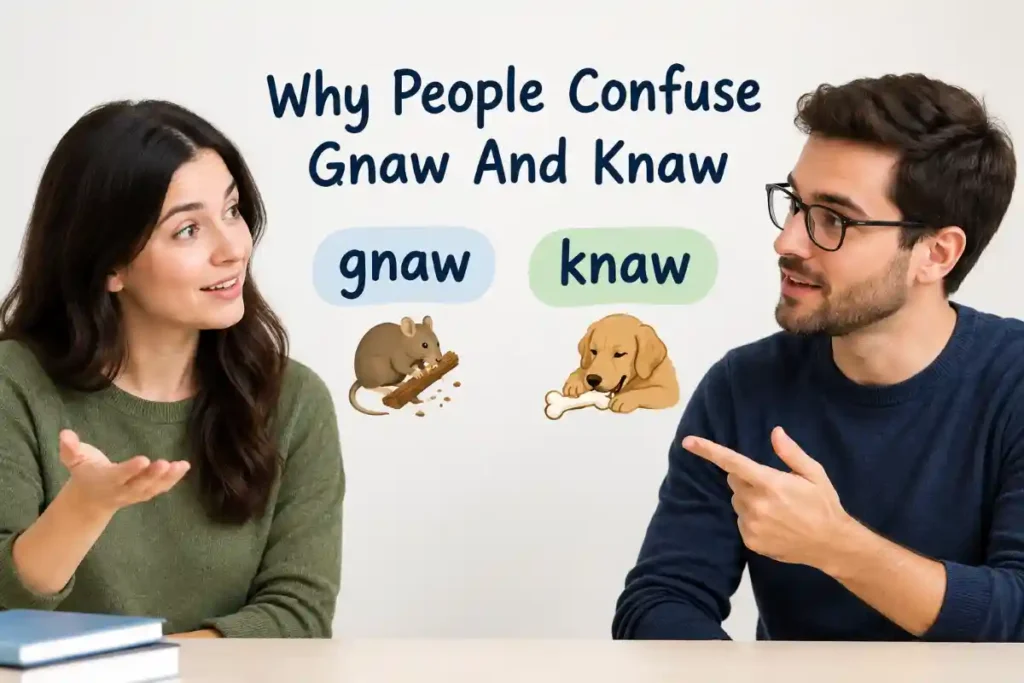
The confusion usually comes from the silent first letter in gnaw. English spelling does not always give learners a clear clue about pronunciation. In this case the first letter is written but not spoken.
Several familiar words may contribute to the mistake.
Silent Letters In English
English has many words in which a written consonant is silent. The k in know, knee, and knife is silent. The g in gnaw, gnat, and gnome is also silent in standard modern pronunciation.
Because both patterns exist, a learner may remember the sound correctly but choose the wrong initial letter.
Compare these words:
| Word | Silent letter | First sound |
|---|---|---|
| gnaw | g | n |
| gnat | g | n |
| gnome | g | n |
| know | k | n |
| knee | k | n |
| knife | k | n |
The shared opening sound can make the spelling confusing. However, each word has its own established spelling. You cannot replace the initial letter simply because another word follows a similar sound pattern.
The Influence Of Know
The word know is one of the most familiar examples of a silent k. Since know and gnaw both begin with the /n/ sound, learners sometimes transfer the spelling pattern from one word to the other.
That is an understandable mistake, but it is not a reliable spelling rule.
Think of know and gnaw as separate words with separate histories. Their pronunciation patterns overlap, but their spellings remain different.
Pronunciation Does Not Reveal The Spelling
In many English accents, gnaw and the intended pronunciation of knaw may sound alike. The difference is visible in writing rather than audible in ordinary speech.
This means a spellchecker may catch the error, but a listener usually cannot identify it from the sound alone.
For that reason, learning the written form is more useful than trying to hear a difference that standard pronunciation does not provide.
Typing And Autocorrect
A person typing quickly may enter knaw because the fingers follow a familiar pattern or because the writer remembers the sound but not the spelling. Autocorrect may leave the error untouched if it does not recognize the intended word in context.
The safest approach is to learn the word directly and check it during proofreading. Do not rely on autocorrect as the only spelling check.
Online Posts And Informal Messages
Misspellings spread when people repeat them in comments, captions, and messages. A reader may see the same incorrect form several times and begin to assume that it is acceptable.
Repeated exposure does not make a spelling standard. For published articles, schoolwork, and professional communication, consult a reliable dictionary when a word seems uncertain.
Gnaw Or Knaw Comparison Table
| Question | Answer |
|---|---|
| Which spelling is correct today? | Gnaw |
| What does it mean? | To bite or chew repeatedly |
| Can it describe worry? | Yes |
| Can it describe gradual damage? | Yes |
| Is knaw the usual modern spelling? | No |
| Does gnaw have a silent letter? | Yes. The g is silent. |
| What is the past tense? | Gnawed |
| What is the ing form? | Gnawing |
| Is the word used in American English? | Yes |
| Is the word used in British English? | Yes |
Gnaw or Knaw What Is The Difference In One Sentence
This word Gnaw is the standard spelling for repeated chewing or persistent worry, while knaw is not the form to use in ordinary modern English.
That is the essential distinction. The remaining sections explain how to pronounce the word, use its verb forms, understand its history, and avoid common mistakes.
How To Pronounce Gnaw
The word gnaw has one syllable. Its first letter is silent, so the word begins with the same consonant sound heard at the start of name.
Cambridge Dictionary gives the British pronunciation as /nɔː/ and the American pronunciation as /nɑː/. The vowel differs by accent, but the initial g remains silent.
The word does not rhyme with know in every accent, even though the two words begin with the same consonant sound. Their vowels can differ, especially in American English.
American English Pronunciation
In American English, gnaw is commonly pronounced /nɑː/. The vowel is similar to the sound in father for many American speakers.
Say the word slowly, starting with the /n/ sound. Do not add a hard /g/ before it.
British English Pronunciation
In British English, the word is commonly pronounced /nɔː/. The vowel is similar to the vowel in thought for speakers who maintain that distinction.
Regional accents can affect the exact vowel quality. The silent g remains the same.
Common Pronunciation Mistakes
Avoid these errors when saying gnaw.
- Do not pronounce the g.
- Do not add a separate syllable at the beginning.
- Do not assume the word sounds exactly like know in every accent.
- Do not confuse the spelling with the pronunciation.
A useful practice sentence is:
The dog likes to gnaw on a bone.
Say the sentence naturally and keep the first sound of gnaw as /n/.
Gnaw or Knaw Grammar Explained
Gnaw is a regular verb in modern English. Its main forms are gnaw, gnaws, gnawed, and gnawing. The past tense and past participle normally use the ending ed.
| Verb form | Word | Example |
|---|---|---|
| Base form | gnaw | Rabbits gnaw on hard food. |
| Third person singular | gnaws | The mouse gnaws the box. |
| Past tense | gnawed | The dog gnawed the toy. |
| Past participle | gnawed | The wood has been gnawed. |
| Present participle | gnawing | The puppy is gnawing a bone. |
| Infinitive | to gnaw | The animal needs something to gnaw. |
The spelling stays consistent across these forms. You should not change the initial g to k when adding an ending.
Gnaw In The Present Tense
Use gnaw with I, you, we, and they in the simple present. Add s for he, she, or it.
Examples:
- I gnaw on the end of a pencil when I feel nervous.
- They gnaw at the tough pieces of food.
- The rabbit gnaws on a wooden toy.
- My dog gnaws on his favorite chew toy.
- A mouse gnaws through soft packaging.
The verb describes a repeated or ongoing action. In figurative use it can describe a feeling that regularly returns.
Doubt gnaws at her confidence.
This sentence uses the simple present to describe a continuing effect.
Gnaw In The Past Tense
The simple past form is gnawed.
Examples:
- The puppy gnawed the corner of the blanket.
- The rats gnawed through the plastic container.
- He gnawed on a piece of bread while waiting.
- A troubling thought gnawed at her all night.
- The animal gnawed a hole in the fence.
The ending is ed, but the pronunciation is usually /d/ because the base verb ends in a voiced sound.
Gnawed As A Past Participle
Use gnawed with auxiliary verbs such as has, have, had, or in passive constructions.
Examples:
- The dog has gnawed the toy into pieces.
- The rats had gnawed through the cable before anyone noticed.
- The damaged corner was gnawed by the puppy.
- The old wooden post had been gnawed by animals.
The past participle is the same as the simple past form in standard modern usage.
Older or literary sources sometimes use gnawn as a past participle. That form is uncommon today, so gnawed is the safer choice for modern writing.
Gnawing As A Present Participle
Add ing to form gnawing.
Examples:
- The dog is gnawing on a bone.
- The rabbit was gnawing the edge of the box.
- She sat quietly, gnawing on her lower lip.
- A gnawing fear kept him awake.
- The constant uncertainty was gnawing at her patience.
The word gnawing can function as part of a verb phrase or as an adjective.
In The dog is gnawing the bone, it forms part of the present continuous verb.
In a gnawing worry, it describes a worry that keeps troubling someone.
How To Use Gnaw In A Sentence
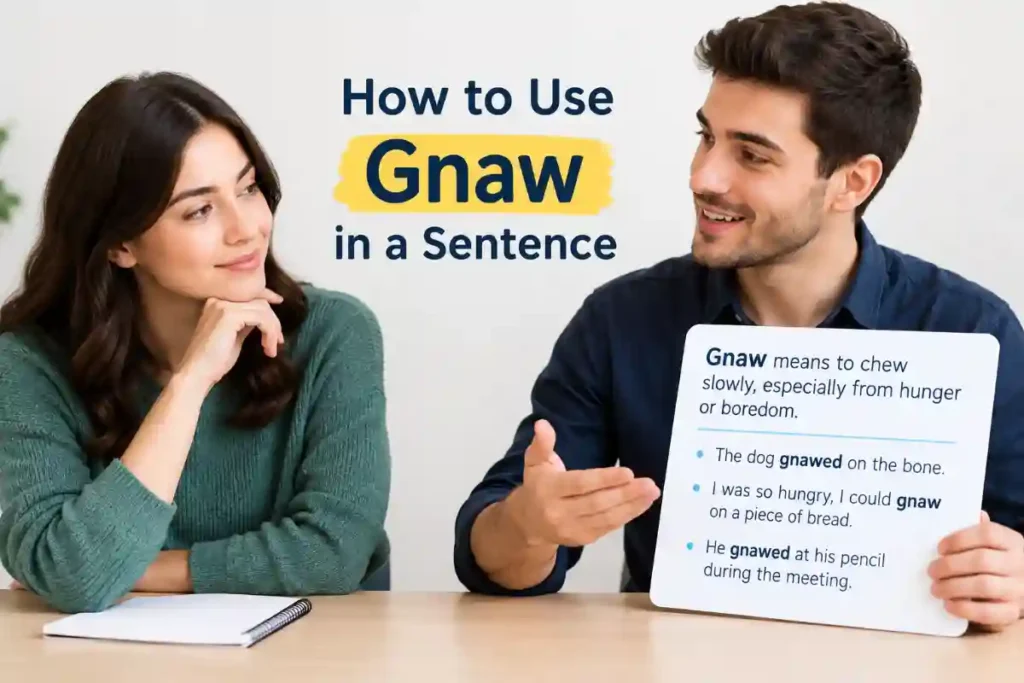
The verb can take a direct object or appear with a preposition. The best construction depends on the meaning.
Gnaw Something
Use this pattern when you name the object being chewed.
Subject + gnaw + object.
Examples:
- The dog gnawed the bone.
- The mouse gnawed the cardboard.
- The rabbit gnawed the wooden stick.
- The puppy gnawed my slipper.
The object comes directly after the verb. You do not need on or at in this construction.
Gnaw On Something
Use gnaw on when you want to emphasize the repeated act of chewing.
Examples:
- The dog gnawed on a bone.
- She gnawed on a pencil while thinking.
- The rabbit gnawed on a piece of wood.
- He gnawed on the last piece of bread.
Both gnaw a bone and gnaw on a bone are correct. The version with on often draws attention to the activity itself.
Gnaw At Something
The expression gnaw at can describe literal biting or a persistent mental or emotional effect.
Examples:
- The puppy gnawed at the blanket.
- The rats gnawed at the wooden panel.
- A sense of guilt gnawed at him.
- The unanswered question gnawed at her.
- His doubts began to gnaw at his confidence.
When the subject is an emotion or thought, the phrase is figurative. It suggests that the feeling continues to cause discomfort.
Gnaw Through Something
Use gnaw through when repeated chewing breaks through an object.
Examples:
- The rats gnawed through the cable cover.
- The mouse gnawed through the paper bag.
- The animal gnawed through the thin wooden barrier.
- The puppy nearly gnawed through its toy.
The preposition through highlights the result. The animal or object has penetrated the material by repeated biting.
Gnaw Away At Something
The phrase gnaw away at often describes gradual physical damage or a slow loss of confidence, strength, or peace of mind.
Examples:
- Water slowly gnawed away at the riverbank.
- The repeated criticism gnawed away at his confidence.
- Financial worries gnawed away at her peace of mind.
- Years of neglect had gnawed away at the building’s structure.
This expression works well when the effect develops over time.
Literal And Figurative Uses Of Gnaw
A strong understanding of gnaw includes both its physical meaning and its figurative meaning.
Literal Meaning
The literal use describes repeated biting or chewing.
The beaver gnawed the branch until it broke.
The action is physical and visible. The animal uses its teeth to remove material.
Figurative Meaning
The figurative use describes a feeling or thought that continues to cause distress.
The possibility of failure gnawed at him.
The fear does not physically bite the person. Instead, it repeatedly enters his thoughts and causes emotional discomfort.
How To Tell The Difference
Look at the subject and object.
If the subject is an animal and the object is food, wood, or another material, the meaning is probably literal.
If the subject is guilt, fear, doubt, worry, or regret, the meaning is usually figurative.
Context can also combine the two ideas. A writer may describe hunger as gnawing at someone’s stomach to make the physical sensation feel vivid.
Gnaw In Everyday Conversation
Although gnaw is common in writing, it also appears in everyday speech. People use it to describe pets chewing toys, children biting objects, and thoughts that will not leave them alone.
Here are natural examples.
- My dog keeps trying to gnaw on my shoes.
- The puppy needs a safe toy to gnaw.
- I caught the rabbit gnawing on the fence.
- That worry has been gnawing at me all morning.
- Guilt began to gnaw at him after the argument.
- She was gnawing on a pencil while studying.
- The mouse had gnawed through the cereal box.
- A little doubt kept gnawing at her confidence.
In conversation, a simpler word such as chew may sound more natural when you are describing ordinary eating. Gnaw becomes especially useful when the chewing is persistent, forceful, or gradually damaging something.
Gnaw In Workplace Writing
The figurative meaning can help describe a persistent concern in a professional setting.
Examples:
- The unresolved issue continued to gnaw at the project manager.
- Concerns about the deadline were gnawing at the team.
- The mistake gnawed at her long after the meeting.
- Uncertainty about the contract began to gnaw at the client.
- The risk of further delays gnawed at the department head.
These sentences have an expressive tone. They work in narrative reports, reflective writing, and informal business communication. In a highly formal report, a direct phrase such as continued to concern the team may be more suitable.
For example:
Expressive: The possibility of another delay gnawed at the project manager.
Neutral: The possibility of another delay continued to concern the project manager.
Both are correct. The first creates a stronger emotional image, while the second sounds more direct and restrained.
Gnaw In Emails And Academic Writing
Choose the word based on your audience and purpose.
In a personal email, you might write:
The thought of missing the deadline has been gnawing at me.
That sounds natural because the sentence describes a personal worry.
Academic writing usually calls for more precision. A sentence such as Uncertainty gnawed at the researchers may work in a literary or historical discussion, but it could sound too figurative in a scientific report.
A more direct alternative would be:
The researchers remained concerned about the uncertainty.
The same principle applies to workplace emails. Figurative language can add personality, but direct language is often easier to interpret in instructions, formal requests, and technical explanations.
More Real Life Examples About Gnaw or Knaw
These examples show how gnaw works across several contexts.
Animals And Nature
- The beaver gnawed through a branch near the river.
- A mouse had gnawed a hole in the bag of flour.
- The puppy spent the afternoon gnawing on a rubber bone.
- Rabbits often gnaw on firm plant material.
- The squirrel gnawed at the hard shell until it cracked.
- The old fence showed marks where animals had gnawed the wood.
Feelings And Personal Experience
- Regret gnawed at her after she left.
- The thought of the missed opportunity kept gnawing at him.
- A persistent fear gnawed at the back of her mind.
- Doubts began to gnaw away at his confidence.
- Hunger gnawed at the travelers as they crossed the valley.
- The memory of the argument gnawed at him for days.
Workplace And Education
- The unfinished report gnawed at her during the weekend.
- The possibility of a mistake continued to gnaw at the analyst.
- His poor exam result gnawed at him long after the test.
- Questions about the project’s direction gnawed at the team.
- The unresolved problem gnawed at the engineer until she found a solution.
Writing And Journalism
- The river slowly gnawed away at the bank.
- The scandal gnawed away at public trust.
- A growing sense of uncertainty gnawed at the community.
- The years had gnawed away at the abandoned building.
- The character’s guilt gnawed at him throughout the novel.
Each sentence uses the correct spelling. The meaning changes with context, but the spelling remains gnaw.
The Origin And History Of Gnaw or Knaw
The word gnaw has a long history in English. It comes from Old English gnagan, meaning to gnaw or bite off little by little. It is related to words in other Germanic languages, including German nagen and Old Norse gnaga. Etymological sources trace these words to an older Germanic root associated with gnawing.
The original meaning is closely connected to the way the word works today. An animal gnaws by repeatedly biting something, often removing small pieces over time.
The figurative meaning developed from this physical action. If repeated chewing can wear away wood, the same image can describe worry that slowly wears away at someone’s peace of mind.
Why The G Is Silent
English has preserved many spellings from earlier stages of the language even after pronunciation changed.
In older English, initial consonant combinations could be pronounced differently from their modern forms. Over time, some opening consonant sounds disappeared from speech while the letters remained in writing.
The same general pattern helps explain words such as gnat and gnome. Their initial g is silent in modern English.
The spelling of gnaw therefore reflects its history rather than a sound by sound guide to modern pronunciation.
How Knaw Fits Into The History
The spelling knaw appears in historical word records as an archaic variant of gnaw. This is a useful reminder that English spelling has not always been fixed in the way it is today.
Older documents can preserve spellings that look unusual to modern readers. A historical variant may help explain a passage from an earlier period, but it does not automatically belong in present day writing.
For modern articles, essays, emails, and other standard writing, gnaw is the recommended spelling.
Gnaw or Knaw In British And American English
The spelling gnaw is standard in both British and American English. Unlike pairs such as colour and color, this word does not have a common British and American spelling difference.
The main variation is pronunciation.
| Feature | British English | American English |
|---|---|---|
| Standard spelling | gnaw | gnaw |
| Common IPA | /nɔː/ | /nɑː/ |
| Silent initial letter | g | g |
| Past tense | gnawed | gnawed |
| Present participle | gnawing | gnawing |
Cambridge Dictionary records the two pronunciations while retaining the same spelling.
Canadian and Australian English also use gnaw as the standard spelling. Local accents may affect the vowel sound, but the written form remains the same.
Common Mistakes With Gnaw
Learning the correct spelling is only part of using the word well. You should also understand its verb forms and how it fits into a sentence.
Mistake One Writing Knaw
Incorrect: The dog likes to knaw on a bone.
Correct: The dog likes to gnaw on a bone.
The mistake comes from confusing the silent g in gnaw with the silent k in know.
Mistake Two Writing Gnawed Incorrectly
Incorrect: The mouse gnaw the box yesterday.
Correct: The mouse gnawed the box yesterday.
The time reference yesterday calls for the simple past tense. Since gnaw is a regular verb, its past form is gnawed.
Mistake Three Adding An Unnecessary Preposition
Incorrect: The puppy gnawed on through the toy.
Correct: The puppy gnawed through the toy.
Use gnaw through when the action breaks through a material. Use gnaw on when you want to describe the repeated act of chewing.
Mistake Four Confusing Gnaw or Knaw
The two words begin with the same sound in standard pronunciation, but they have different meanings.
Know means to have information or understanding.
Gnaw means to chew repeatedly or to cause persistent distress.
Examples:
- I know the answer.
- The dog will gnaw on the toy.
The words are not interchangeable.
Mistake Five Assuming Gnaw Always Describes Animals
The verb often describes animals chewing objects, but its figurative meaning is equally useful.
Correct: The thought of failure continued to gnaw at him.
This sentence describes worry, not physical chewing.
Mistake Six Using Gnaw For Every Type Of Chewing
The word often suggests repeated or forceful biting. For ordinary eating, eat or chew may be more natural.
The child chewed the bread slowly.
This sounds more natural than saying the child gnawed the bread if the action was ordinary chewing.
However, The child gnawed at the tough crust works well because it suggests persistent effort.
Gnaw Compared With Similar Words
Choosing a synonym depends on the exact action or feeling you want to describe.
| Word | Meaning | Example |
|---|---|---|
| Bite | Cut or grip something with the teeth | The dog bit the toy. |
| Chew | Work food or another object with the teeth | She chewed the food slowly. |
| Gnaw | Bite repeatedly, often wearing something away | The mouse gnawed the wood. |
| Nibble | Take small bites | The rabbit nibbled the leaf. |
| Munch | Chew food steadily, often with enjoyment | He munched on an apple. |
| Erode | Wear away gradually | Water eroded the riverbank. |
| Worry | Feel anxious about something | She worried about the result. |
| Torment | Cause severe mental or physical distress | The memory tormented him. |
These words overlap in some situations, but they are not exact substitutes.
Gnaw is especially useful when you want to show persistence. The repeated action or feeling matters.
Gnaw And Chew
Both verbs describe working something with the teeth. However, chew is the more general term.
You can chew food during an ordinary meal. Gnawing usually suggests repeated biting at something that takes effort to break down or wear away.
Gnaw And Bite
A bite can happen once. Gnawing usually involves repeated biting.
The dog bit the stick once.
The dog gnawed on the stick for several minutes.
The second sentence emphasizes an ongoing action.
Gnaw And Erode
Both words can describe gradual damage. Erode is more general and often appears in scientific or technical writing. Gnaw creates an image of repeated biting.
The river eroded the bank sounds neutral and technical.
The river gnawed away at the bank sounds more vivid and descriptive.
Gnaw And Worry
These words overlap in figurative use, but their grammar differs.
She worried about the exam.
The exam results gnawed at her.
The first sentence describes her mental state directly. The second emphasizes a continuing emotional effect.
Memory Tricks To Remember Gnaw
A good memory trick links spelling to meaning.
Remember The Silent G
Think of three words together.
Gnaw. Gnat. Gnome.
All three begin with a silent g in standard modern English.
This group helps you remember the unusual opening letter.
Connect Gnaw With Gradual Damage
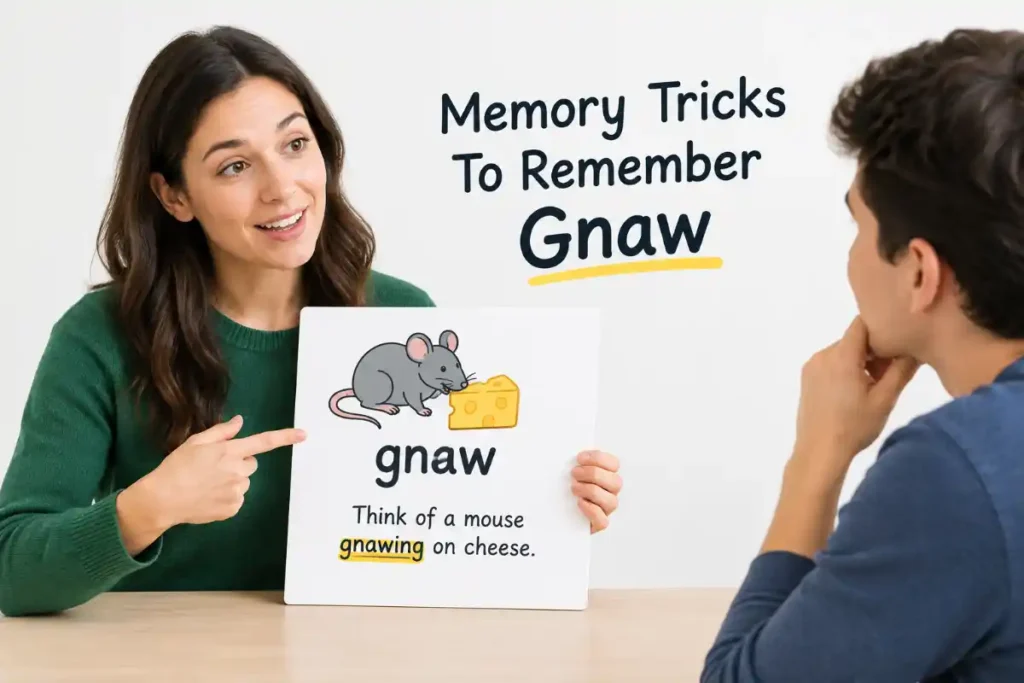
Imagine a mouse chewing a hole through a box one tiny bite at a time. That slow process captures the main idea of gnaw.
The word describes repeated action that can gradually wear something away.
Remember The Phrase Gnaw Away
The expression gnaw away works for both physical damage and emotional distress.
- The rats gnawed away at the wood.
- Doubt gnawed away at her confidence.
Remembering this phrase makes it easier to recall the correct spelling.
Keep Knaw Out Of Modern Writing
A simple rule is to associate knaw with the correction you need to make.
If you type knaw while describing chewing, replace it with gnaw.
Repeated exposure to the correct spelling in meaningful sentences will make the right form easier to recall.
An Editor’s Advice On Gnaw Or Knaw
A professional editor would normally correct knaw to gnaw when the intended meaning is chewing or persistent worry. Standard dictionaries list gnaw as the modern verb and provide its established forms and meanings. (Oxford Learner’s Dictionaries)
There is one important editorial detail. If knaw appears in a historical document, a quotation, or a discussion of an unusual spelling, an editor should consider the context before changing it. Historical spellings may be relevant to the text.
For ordinary modern writing, the recommendation is clear.
- Use gnaw in essays, reports, articles, and emails.
- Use gnawed for the usual past tense.
- Use gnawing for the present participle and related adjective.
- Keep knaw out of standard writing when you mean repeated chewing.
Good editing is not just about correcting letters. It is about preserving the intended meaning while following the spelling expected by modern readers.
Frequently Asked Questions
Is gnaw or knaw correct?
Gnaw is the correct modern spelling when you mean to chew something repeatedly or describe a feeling that keeps troubling someone. Knaw is not the standard spelling for these meanings in current English. Although historical records list knaw as an archaic variant, modern writers should use gnaw in ordinary communication.
Why is the g silent in gnaw?
The spelling reflects the word’s history. Gnaw comes from Old English gnagan. English pronunciation changed over time, and the initial g became silent while remaining in the written form. This pattern also appears in words such as gnat and gnome. The spelling preserves an older form of the word rather than matching every sound heard today.
What is the past tense of gnaw?
The standard past tense is gnawed. For example, you can write, The dog gnawed on its toy yesterday. The past participle is also normally gnawed, as in The dog has gnawed through the box. The older form gnawn appears in some historical or literary sources but is uncommon in modern everyday English.
Does gnaw mean worry?
Yes. In figurative language, gnaw can describe a thought or feeling that causes ongoing distress. For example, Guilt gnawed at him means that his guilt continued to trouble him. This use comes from the image of repeated biting or gradual damage. It is common with nouns such as guilt, doubt, fear, and anxiety.
Is gnaw pronounced like know?
The words begin with the same /n/ sound in standard modern pronunciation, but their vowels can differ. Cambridge gives gnaw as /nɑː/ in American English and /nɔː/ in British English. The pronunciation of know varies by accent as well. The safest approach is to learn each word’s spelling and pronunciation separately.
Can gnaw be used for objects other than food?
Yes. Animals may gnaw wood, cardboard, toys, bones, and other materials. The verb can also describe gradual damage caused by a force that resembles repeated biting. For example, Water gnawed away at the rock uses the word figuratively to describe erosion. The object does not have to be food.
Is gnaw a regular or irregular verb?
In modern standard English, gnaw is normally a regular verb. Its main forms are gnaw, gnaws, gnawed, and gnawing. The past tense and past participle both use gnawed. You may encounter the older form gnawn in historical sources, but gnawed is the usual choice for current writing.
What is a good way to remember gnaw?
Remember the silent g in gnaw, gnat, and gnome. You can also picture a mouse slowly chewing a hole through a box. The image connects the unusual spelling with the word’s meaning. When writing about repeated chewing or persistent worry, choose gnaw rather than knaw.
Final Verdict
The correct spelling is gnaw. It means to bite or chew something repeatedly, to wear something away gradually, or to describe a feeling that continues to cause distress. The spelling knaw is not the standard modern form for these meanings, even though it appears as an archaic variant in historical word records.
Remember the silent g and keep the verb forms consistent: gnaw, gnaws, gnawed, and gnawing. Use gnaw for literal chewing and for figurative expressions such as guilt gnawed at him.
When the word describes repeated biting or a worry that will not let go, remember to write gnaw.

Founding Editor
Maya spent six years as a copyeditor at a regional newspaper before starting Grammist, which is where the “answer first” format came from: newsroom style guides don’t have room for a preamble.
She writes and reviews most of the word-pair and spelling entries, and has final say on anything that goes out under the Grammist name.