

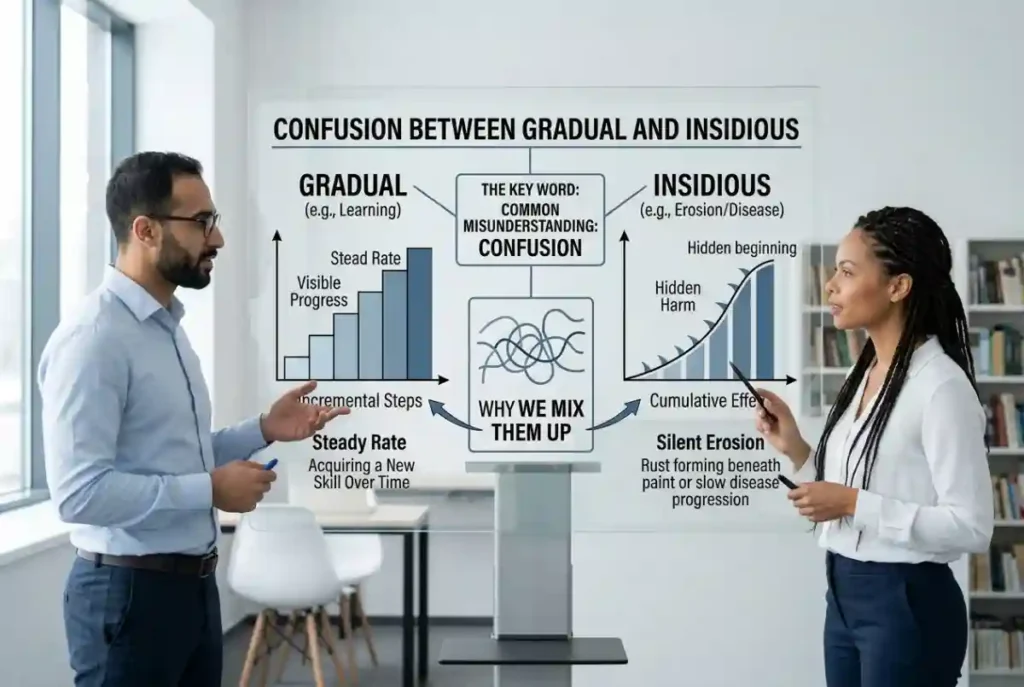
The difference between gradual vs insidious comes down to how a change develops and what makes it important. Both words can describe something that happens over time, but they don’t mean the same thing. Gradual describes a change that takes place slowly in stages. Insidious describes something harmful that develops quietly or gradually in a way that’s difficult to notice.
For example, a gradual improvement in your English means your skills get better little by little. An insidious problem might develop without obvious warning signs and cause serious harm before anyone recognizes it.
The distinction matters because these words aren’t interchangeable in everyday conversation, academic writing, medical discussions, or news reports. A gradual change can be harmless or beneficial. An insidious process usually carries a negative meaning because it involves hidden danger, harm, or a damaging influence that can go unnoticed.
In this guide, you’ll learn the exact meaning of each word, how to use it in a sentence, and why writers sometimes confuse them. You’ll also find practical examples, pronunciation guidance, synonyms, common mistakes, and advice on choosing the right word for formal and informal writing.
The easiest rule to remember is this: gradual tells you that something changes slowly, while insidious warns you that something harmful may be developing unnoticed.
Quick Answer
Gradual means happening slowly over time or in small stages. Insidious means developing in a subtle and often harmful way that makes the danger difficult to recognize. A gradual change can be positive, negative, or neutral. An insidious process usually suggests hidden harm, a damaging influence, or a problem that worsens before people notice it.
Gradual vs Insidious Comparison Table
| Feature | Gradual | Insidious |
|---|---|---|
| Part of speech | Adjective | Adjective |
| Main meaning | Happening slowly in stages | Developing subtly while causing harm |
| Main focus | Pace of change | Hidden danger or harmful effects |
| Usual tone | Neutral | Negative or cautionary |
| Positive use | Common | Rare |
| Negative use | Common | Very common |
| Does it imply harm | No | Usually yes |
| Does it imply concealment | No | Often |
| Common contexts | Growth, learning, recovery, change | Disease, corruption, threats, manipulation |
| Adverb form | Gradually | Insidiously |
| Noun form | Gradualness | Insidiousness |
| Example | Her recovery was gradual. | The disease had an insidious onset. |
The central difference is straightforward. Gradual describes the pace of a process, while insidious describes a process that can cause harm without attracting attention.
What Gradual Means
Gradual is an adjective that describes something happening slowly, usually through small stages or changes rather than all at once.
A gradual process may take minutes, days, months, or years. The word does not tell you how long the process must last. It tells you that the change develops step by step.
For example, a student may make gradual progress in writing. A city may experience gradual growth. The temperature may drop gradually as evening approaches.
None of these examples automatically suggests danger. The change could be helpful, harmful, or simply part of ordinary life.
How to use gradual in a sentence
Use gradual when you want to describe a slow process or a change that happens in stages.
- The patient made gradual progress during recovery.
- The company introduced a gradual change to its work schedule.
- Her confidence improved through gradual practice.
- A gradual decline in sales forced the store to review its costs.
- The road follows a gradual slope toward the river.
Notice how the word works in different situations. It can describe progress, decline, physical movement, personal development, and organizational change.
The word itself does not tell readers to celebrate or fear the process. The surrounding sentence supplies that information.
Does gradual mean slow
Yes, but there is a useful distinction.
Slow can describe a low speed or a long duration. Gradual emphasizes change that happens in small amounts or stages.
For example, a slow computer may take a long time to open a file. A gradual improvement in computer performance means the machine becomes more effective little by little.
Similarly, a slow decision maker may take a long time to choose. A gradual change in someone’s opinion means their view shifts in stages.
The words overlap, but they do not always describe the same thing.
Does gradual mean steady
Often, but not in every case.
A gradual change usually involves small steps. Those steps may occur at a fairly steady rate, but the rate does not have to remain exactly the same.
For instance, a person’s confidence might improve gradually over several months, with faster progress during some weeks and slower progress during others.
The word gradual describes the overall pattern. It does not promise a perfectly even rate of change.
What Insidious Means
Insidious is an adjective used for something that develops or spreads subtly and causes harm, often before people recognize the danger.
Cambridge Dictionary defines it as a way of causing harm gradually and secretly. Oxford Learner’s Dictionaries also emphasizes the combination of gradual development and serious harm.
The word carries a warning. Something insidious may appear harmless, ordinary, or difficult to recognize at first. Its effects can become serious before anyone understands what is happening.
Imagine a small leak behind a wall. At first, there may be no visible stain. Over time, moisture damages the wood and creates conditions for mold. The problem can be called insidious because it develops out of sight and causes damage before the full extent becomes clear.
The same word can describe harmful social influences, dishonest practices, damaging habits, or problems that quietly weaken an organization.
How to use insidious in a sentence
Use insidious when the hidden or subtle nature of a harmful process matters.
- The disease had an insidious onset.
- The company failed to recognize the insidious effects of corruption.
- Misinformation can have an insidious influence on public opinion.
- An insidious leak damaged the building over several months.
- The author explored the insidious nature of prejudice.
Each example suggests more than a slow process. The word draws attention to a threat or damaging influence that can be hard to recognize.
Does insidious always mean slow
Not as an absolute rule, although gradual development is central to its common modern meaning.
An insidious problem often builds up slowly or spreads quietly. However, the key idea is not simply speed. It is the combination of harmful effects and subtle development.
A harmful influence can be insidious because people fail to recognize its effects. A gradual change, by contrast, can be perfectly visible and understood at every stage.
For this reason, slow is not always a good replacement for insidious.
Does insidious mean intentional
Not necessarily.
The word has historical links to deceit and traps, and it can describe deliberate deception. In modern English, however, it also applies to harmful processes that have no human intention behind them.
An insidious disease does not have a plan. An insidious effect of pollution does not require pollution to act with intent.
The word describes the subtle and harmful nature of the process, not always a conscious attempt to cause damage.
The Main Difference Between Gradual vs Insidious
The easiest way to understand the difference is to separate pace from hidden harm.
Gradual tells you how change happens. Insidious suggests that a harmful process develops subtly and may go unnoticed.
Consider two sentences about a person’s health.
Her recovery was gradual.
The person improved slowly over time. The sentence does not suggest that the recovery was dangerous or hidden.
The condition had an insidious onset.
The condition began in a subtle way and may have been difficult to recognize at first. The word emphasizes the risk of overlooking the problem.
Now consider two sentences about an organization.
The organization experienced gradual change.
The organization changed in stages. The sentence does not explain if those changes were good or bad.
The organization suffered the insidious effects of corruption.
Corruption quietly damaged the organization, possibly before its leaders fully understood the extent of the harm.
The difference becomes clearer when you ask what the sentence needs to communicate.
- If the focus is on slow development, choose gradual.
- If the focus is on subtle harm, choose insidious.
- If both ideas matter, insidious may communicate both at once.
Why People Confuse Gradual vs Insidious
The words overlap because both can describe processes that unfold over time. That shared idea can make them seem interchangeable, especially to English learners who are still building their vocabulary.
However, the overlap is limited to part of their meaning.
Both can describe change over time
A gradual decline develops little by little. An insidious decline may also develop little by little, but it carries a warning that the process is harmful and perhaps difficult to detect.
This shared sense of development is the main source of confusion.
Both can appear in formal writing
Writers use both words in academic work, news reports, medical discussions, and professional documents.
Their formal use does not make them synonyms. A writer describing a gradual shift in public opinion may simply be explaining a trend. A writer describing an insidious influence is warning that the influence has a harmful or damaging character.
Insidious is less familiar to many learners
Gradual appears in common discussions about learning, improvement, growth, and change. Insidious is more specialized and often appears in serious or critical contexts.
A learner may recognize that an insidious process happens slowly but overlook the negative meaning attached to it.
The best solution is to learn each word with a complete example rather than memorize a short translation.
The difference is not regional spelling
Gradual and insidious are standard words in American and British English. The core distinction remains the same in Canadian and Australian English.
This is a difference in meaning, not a spelling choice between regional forms.
Can Gradual vs Insidious Be Used Interchangeably
Usually not.
Replacing one with the other can change the meaning or tone of a sentence.
| Original sentence | What it means |
|---|---|
| The change was gradual. | The change happened in stages. |
| The change was insidious. | The change was harmful and developed subtly. |
| Her decline was gradual. | Her condition or performance worsened over time. |
| Her decline was insidious. | Her decline involved subtle harm that may have been hard to detect. |
| The company adopted a gradual approach. | The company introduced changes in stages. |
| The company faced an insidious threat. | The company faced a harmful threat that developed subtly. |
The words may describe the same event from different angles, but they do not give readers the same information.
A gradual change can be easy to observe. An insidious problem may remain hidden until its effects become difficult to ignore.
Gradual vs Insidious When Both Words Can Describe the Same Situation
Sometimes a process is both gradual and insidious.
Imagine that a company’s safety standards decline over several years. At first, managers approve small shortcuts. Later, employees begin treating those shortcuts as normal. Eventually, the company faces a serious safety problem.
You could describe the decline as gradual because it happened in stages.
You could describe it as insidious because the harmful pattern developed quietly and became normalized before people recognized the danger.
The words focus on different features of the same process.
Another example involves a damaged building. Water slowly weakens a hidden support beam. The weakening is gradual because it happens over time. The damage is insidious because it may remain unnoticed while the risk increases.
This is a useful principle for advanced writers. You do not always need to choose one word and reject the other. You need to decide which aspect of the situation deserves emphasis.
Gradual vs Insidious in Everyday English
The best word often becomes clear when you consider the situation.
Personal growth and learning
Use gradual for progress that takes place over time.
- Her confidence grew gradually as she practiced speaking in public.
- The gradual improvement in his reading skills surprised his teacher.
- Learning a new language requires gradual progress and regular practice.
Using insidious in these examples would change the tone. It would suggest that the development involved hidden harm rather than ordinary learning.
However, an insidious influence could affect someone’s personal development. For example, an insidious pattern of self criticism might slowly damage a person’s confidence.
Health and medicine
Medical writing uses both words, but they serve different purposes.
A gradual recovery describes improvement that occurs over time. An insidious onset describes a condition that begins subtly and may be difficult to recognize.
For example:
- The patient experienced gradual improvement after treatment.
- The symptoms appeared gradually over several weeks.
- The disease had an insidious onset.
- The condition produced an insidious effect on the patient’s health.
The last two examples emphasize the difficulty of recognizing the problem.
Importantly, insidious is a descriptive word, not a medical diagnosis. It does not tell you how serious a condition is in any particular person. Medical professionals assess the actual symptoms, test results, and clinical history.
Business and the workplace
In business, gradual change can be part of a sensible plan.
A company might introduce a gradual transition to new software. Managers may prefer gradual growth because it allows them to manage resources carefully.
Insidious describes a different kind of situation. It may refer to corruption, harmful workplace behavior, or a pattern of poor decisions that damages an organization over time.
Compare these examples:
- The company introduced a gradual change to its reporting system.
- Gradual growth allowed the business to hire staff at a manageable pace.
- The insidious effects of workplace bullying damaged employee morale.
- An insidious culture of dishonesty weakened the company’s reputation.
The distinction matters in professional communication. Calling a planned transition insidious would make it sound harmful rather than carefully managed.
News and journalism
Journalists use gradual to explain trends and insidious to describe harmful developments that may escape public attention.
For example, a report might describe the gradual decline of a local industry. That phrase explains the pace of the decline without assigning blame.
A report about an insidious spread of misinformation makes a stronger claim. It suggests that misleading information is spreading in a subtle way and causing damage.
Because insidious carries a negative judgment, journalists should support that characterization with evidence. A gradual trend can be measured through data. An insidious influence may require evidence of hidden effects, manipulation, or harm that people have overlooked.
Academic writing
Academic writers should use gradual when describing a change in stages. They should use insidious when the subtle and harmful nature of a process is central to the argument.
For instance:
- The study documented a gradual increase in average temperatures.
- Researchers observed gradual changes in the participants’ responses.
- The authors examined the insidious effects of institutional bias.
- The report warned about the insidious spread of misleading claims.
The final two sentences contain a stronger interpretation than the first two. In academic work, the evidence should justify that stronger wording.
Literature and storytelling
Writers can use both words to shape a reader’s response.
A gradual transformation might show a character becoming more confident or a landscape changing with the seasons. The word allows the reader to follow the change without assuming it is harmful.
An insidious influence creates tension. It may suggest that a character is being manipulated or that a seemingly harmless situation is becoming dangerous.
For example:
The character’s gradual transformation gave the story a realistic pace.
The novel explored the insidious influence of power on the main character.
The first sentence emphasizes development. The second warns the reader about a harmful influence.
Grammar and Word Forms To Gradual vs Insidious
Both gradual and insidious are adjectives. They describe nouns or provide information about a subject through a linking verb.
Their basic grammar is similar, although their related word forms differ.
Using gradual correctly
Place gradual before a noun when it directly describes the noun.
- a gradual decline
- a gradual recovery
- a gradual transition
- a gradual increase
- a gradual change
You can also place it after a linking verb such as become, seem, or remain.
- The change was gradual.
- The decline became gradual rather than sudden.
- Progress remained gradual throughout the first month.
The adjective stays in the same form for singular and plural nouns.
The improvement was gradual.
The improvements were gradual.
There is no need to add an s to the adjective.
Using insidious correctly
The same basic patterns work with insidious.
- an insidious threat
- an insidious influence
- an insidious disease
- an insidious pattern of behavior
- an insidious effect on society
After a linking verb, you can write:
- The threat was insidious.
- The influence became insidious.
- The effects seemed insidious.
Again, the adjective does not change to agree with a plural noun.
The influence was insidious.
The influences were insidious.
The noun changes number. The adjective remains the same.
Gradually and insidiously
The adverb forms are gradually and insidiously.
An adverb often describes how an action or process occurs.
- Her confidence improved gradually.
- The temperature fell gradually.
- The harmful practice spread insidiously.
- The problem developed insidiously over several years.
The choice still depends on meaning. Gradually describes the pace of an action. Insidiously suggests that the action is harmful and develops subtly.
You can use both adverbs in one sentence when the meaning calls for it.
The problem developed gradually and insidiously.
This sentence emphasizes both the slow pace and the subtle harmful effects. The combination is grammatical, although you should avoid using two words together when one already communicates everything the reader needs to know.
Gradualness and insidiousness
The corresponding nouns are gradualness and insidiousness.
Gradualness refers to the quality or state of developing in stages.
Insidiousness refers to the subtle or stealthy quality of something harmful.
Both nouns are correct, but they are less common in everyday conversation than the adjectives.
For example:
The gradualness of the transition helped employees adapt.
The insidiousness of the campaign became clear only after its effects were examined.
In ordinary writing, a simpler construction may sound more natural.
Instead of the gradualness of the change, write the change happened gradually.
Instead of the insidiousness of the problem, write the problem caused subtle harm that went unnoticed.
The longer noun forms are useful when you need to discuss the qualities themselves. Otherwise, the adjective or adverb usually makes the sentence easier to read.
Pronunciation Guide Of Gradual vs Insidious
The words have different pronunciations and stress patterns.
Gradual
Adjective · Three syllables
/ˈɡrædʒ.u.əl/
Stress falls on the first syllable.
Insidious
Adjective · Four syllables
/ɪnˈsɪd.i.əs/
Stress falls on the second syllable.
Pronunciation can vary slightly between accents and dictionary transcription systems. The pronunciations above follow common dictionary forms.

How to pronounce gradual
Say gradual with the strongest stress at the beginning.
The opening sound resembles the beginning of grass. The middle contains a sound like the beginning of judge, followed by a light ending.
A common learner mistake is to give every syllable equal stress. English usually has a clearer stress pattern, so make the first syllable more prominent.
How to pronounce insidious
Say insidious with the main stress on the second syllable.
The opening syllable is short. The stressed part sounds like the beginning of sit. The remaining syllables are lighter.
A common mistake is to stress the first syllable because it appears at the beginning of the word. Remember that the strongest stress falls on the second syllable.
Does pronunciation affect the meaning
No. Pronunciation helps listeners identify the word, but the distinction in meaning comes from the vocabulary itself.
Both words are adjectives. Neither is a regional spelling of the other. A speaker who pronounces them correctly still needs to choose the right word for the intended meaning.
Gradual vs Insidious Word Origins and Etymology
The histories of these words offer a useful way to remember their meanings.
The origin of gradual
Gradual comes through French and Latin word history. It is connected with the Latin gradus, meaning a step or stage.
That connection fits the modern meaning. A gradual process advances in small steps instead of making one sudden jump.
Think about climbing a staircase. You move from one step to the next until you reach the top. A gradual change follows a similar pattern, although it does not need to follow a perfectly even path.
The word has long been used to describe movement, development, and change that takes place in stages.
The origin of insidious
Insidious comes from Latin insidiosus, meaning deceitful, cunning, or treacherous. It is connected with insidiae, a word associated with an ambush or trap. English adopted the word in the sixteenth century.
This history provides a strong memory aid.
An ambush is dangerous partly because the threat is not obvious until it is too late to avoid it. Similarly, an insidious problem can develop quietly while people fail to recognize its harmful effects.
The word’s modern meaning does not always imply that someone deliberately planned the harm. However, its history helps explain why it often suggests a hidden threat or a deceptive appearance.
What the word origins teach us
The two histories point toward different ideas.
Gradual connects with steps and stages.
Insidious connects with traps and concealed danger.
You do not need to memorize Latin to use these words correctly. Their origins simply give you an easy way to remember the difference.
More Than 20 Real Life Examples About Gradual vs Insidious
The following examples show how gradual and insidious work across different situations. Pay attention to the meaning of each sentence rather than simply memorizing the words.
Everyday conversation
- Her confidence grew gradually after she started speaking English every day.
- The gradual change in weather made it easier to enjoy outdoor activities.
- An insidious habit of comparing himself with others slowly damaged his self confidence.
- The problem seemed harmless at first but had an insidious effect on their friendship.
Workplace and business
- The company adopted a gradual approach to introducing the new software.
- Gradual improvements in customer service helped the business earn better reviews.
- The insidious effects of workplace bullying became clear after several employees resigned.
- Management failed to recognize the insidious spread of dishonest practices within the department.
Academic writing
- The researchers observed a gradual increase in reading speed over the study period.
- Participants showed gradual improvement after receiving regular feedback.
- The paper examined the insidious effects of prejudice on decision making.
- The researchers warned that the insidious spread of misinformation could weaken public trust.
Health and medicine
- The patient experienced gradual improvement during rehabilitation.
- Her symptoms developed gradually over several weeks.
- The disease had an insidious onset that made early recognition difficult.
- The doctor explained that some conditions can have an insidious course.
News and public issues
- The town experienced a gradual decline in its population.
- A gradual shift in consumer preferences changed the local market.
- The investigation revealed the insidious influence of corruption on public services.
- The report described the insidious spread of misleading claims across online communities.
Literature and creative writing
- The author’s gradual development of the main character made the ending more convincing.
- The story explored the insidious influence of fear on human behavior.
- A gradual change in the character’s attitude hinted at a larger conflict.
- The novel portrayed an insidious threat that grew more dangerous as the story unfolded.
These examples illustrate the main rule. Gradual describes change in stages, while insidious emphasizes a subtle and harmful process.
Gradual vs Insidious Common Mistakes to Avoid
Even advanced English learners can choose the wrong word when they focus only on the idea of slow development.
Mistake One
Incorrect usage: The gradual disease caused hidden damage.
This sentence is grammatically possible, but gradual disease does not clearly express the idea that the disease caused hidden harm.
Clearer option: The disease had an insidious effect on the patient’s health.
Use gradual when the pace of change matters. Use insidious when the subtle and harmful nature of the process matters.
Mistake Two
Incorrect usage: The company made an insidious transition to its new software.
This sentence makes a routine business change sound harmful or threatening.
Better: The company made a gradual transition to its new software.
If the transition involved a hidden harmful practice, insidious could be appropriate. Without that meaning, it is too strong.
Mistake Three
Incorrect usage: Her confidence grew insidiously after months of practice.
This sentence suggests that her confidence developed in a subtle and harmful way. If the writer simply means that her confidence improved slowly, the adverb is misleading.
Better: Her confidence grew gradually after months of practice.
Mistake Four
Incorrect assumption: Insidious always means deliberate deception.
The word can describe deceptive or treacherous behavior, but it also describes harmful processes that do not involve intent. An insidious illness, for example, does not need a conscious plan to cause harm.
Mistake Five
Incorrect assumption: Gradual and insidious are synonyms.
The words overlap in their association with slow development, but they communicate different ideas.
A gradual improvement can be beneficial and easy to observe. An insidious influence usually suggests harm that develops subtly.
Mistake Six
Incorrect assumption: Insidious always means invisible.
An insidious problem is often difficult to notice at first, but it does not have to remain completely invisible. Its effects may be visible while their cause or full significance remains unclear.
Mistake Seven
Incorrect assumption: Gradual always means steady.
Gradual change happens in stages, but those stages do not have to occur at an identical rate. A gradual recovery may speed up or slow down over time.
Synonyms and Related Words To Gradual vs Insidious
Choosing the right synonym depends on which part of the meaning you want to express.
Synonyms for gradual
| Word | Meaning | Example |
|---|---|---|
| Slow | Happening at a low speed or over a long time | The recovery was slow. |
| Steady | Continuing at a fairly consistent rate | Sales showed steady growth. |
| Progressive | Developing or advancing over time | The policy introduced progressive changes. |
| Incremental | Happening through small additions or steps | The team made incremental improvements. |
| Gradational | Moving through a series of stages or degrees | The color showed a gradational change. |
| Gradualistic | Favoring or involving gradual development | The theory takes a gradualistic view of change. |
These words overlap with gradual, but each has its own use.
Incremental is especially useful when a process involves small, identifiable steps. Steady emphasizes consistency. Slow focuses more directly on speed or duration.
Synonyms for insidious
| Word | Meaning | Example |
|---|---|---|
| Stealthy | Moving or acting without attracting attention | The threat spread through stealthy means. |
| Subtle | Difficult to notice or recognize | The message had a subtle but harmful effect. |
| Treacherous | Dangerous or unreliable in a deceptive way | The plan concealed a treacherous purpose. |
| Deceptive | Giving a false impression | The harmless appearance was deceptive. |
| Covert | Hidden from public view | The group carried out a covert operation. |
| Corrupting | Causing moral or institutional damage | The report examined a corrupting influence. |
These words do not all mean the same thing as insidious.
For example, covert means hidden or concealed, but it does not automatically mean harmful. Subtle means difficult to notice, but something subtle can be harmless. Treacherous emphasizes danger or betrayal.
Insidious combines several of these ideas, especially subtle development and harmful consequences.

Opposites of Gradual vs Insidious
Opposites of gradual
Depending on the sentence, useful opposites include:
- Sudden.
- Abrupt.
- Immediate.
- Rapid.
- Instantaneous.
For example:
Gradual change: The temperature decreased gradually.
Sudden change: The temperature dropped suddenly.
The opposite depends on what you want to emphasize. A process can be rapid without being completely instantaneous.
Opposites of insidious
There is no single perfect opposite for insidious in every context. However, these words can express contrasting ideas:
- Open.
- Obvious.
- Overt.
- Transparent.
- Harmless.
For example:
Insidious threat: The threat developed quietly and caused harm.
Open threat: The threat was openly expressed and easy to recognize.
Insidious influence: The influence caused harm without attracting attention.
Transparent influence: The influence was openly acknowledged and easy to understand.
An opposite should fit the intended meaning. Replacing insidious with obvious may describe visibility, but it does not necessarily express the opposite of harmfulness.
Expert Editor’s Note About Gradual vs Insidious
From an editor’s perspective, the main problem with gradual vs insidious is not spelling or grammar. It is choosing the word that conveys the right degree of warning.
Both are standard English adjectives. Both can appear before nouns or after linking verbs. Their difference lies in meaning and tone.
A professional editor would usually keep gradual when the sentence describes change over time without suggesting hidden danger.
For example:
The gradual increase in demand required additional staff.
There is no reason to replace gradual with a more dramatic word. The sentence simply reports a trend.
An editor might choose insidious when the text describes harm that develops quietly.
The insidious effects of corruption weakened public trust.
This sentence makes a stronger claim. The word tells readers that the corruption caused harm in a subtle or difficult to detect way.
That stronger claim should fit the facts. Calling a problem insidious when the evidence shows only slow development can make the writing sound exaggerated.
What dictionaries tell us
Cambridge defines gradual through the idea of change happening slowly over time or in stages. Its definition of insidious emphasizes gradual and secret harm. Oxford Learner’s Dictionaries similarly connects insidious with gradual development and serious harm.
The dictionary evidence supports a clear editorial rule.
Use gradual to describe the pace of change. Use insidious to emphasize a subtle harmful process.
What sounds natural to native speakers
Native speakers commonly use phrases such as:
- Gradual improvement.
- Gradual decline.
- Gradual change.
- Gradual recovery.
- Insidious disease.
- Insidious threat.
- Insidious influence.
- Insidious effects.
These common combinations are called collocations. Learning them helps you choose words naturally rather than translating directly from another language.
In formal writing, the best choice is the one that matches the evidence and the intended tone. In everyday conversation, the same rule applies, even if the sentence is shorter.
Frequently Asked Questions
Is gradual the same as insidious?
No. Gradual means that something happens slowly or in stages. Insidious describes something that develops subtly and causes harm, often before people recognize the danger. A gradual process can be positive, neutral, or negative. An insidious process usually carries a negative meaning. The words overlap in slow development but are not interchangeable.
Can something be gradual and insidious at the same time?
Yes. A process can develop slowly while causing hidden harm. For example, corruption may spread gradually through an organization while its effects remain unnoticed. In that case, gradual describes the pace, while insidious emphasizes the subtle and harmful nature of the process.
What is the difference between gradual and slowly?
Gradual is an adjective that describes a process or change. Slowly is an adverb that describes how an action happens. You can say a gradual recovery or the patient recovered slowly. Both describe a slow process, but the words have different grammatical roles and cannot always replace each other directly.
Does insidious always have a negative meaning?
In modern English, insidious almost always carries a negative or cautionary meaning. It describes something harmful, dangerous, deceptive, or damaging that develops subtly. It does not always imply deliberate intent, though. An insidious illness can develop without any intention to cause harm.
Is gradual a positive or negative word?
Gradual is neutral. It describes the pace of change without judging the result. A gradual recovery is positive, a gradual decline is negative, and a gradual shift in temperature may be neither. The surrounding words tell readers how to interpret the change.
What is the adverb form of gradual and insidious?
The adverb forms are gradually and insidiously. For example, you can say her confidence improved gradually or the harmful influence spread insidiously. The first adverb describes the pace of improvement. The second emphasizes a subtle process with harmful effects.
Can I use insidious in academic writing?
Yes. Insidious appears in academic writing, especially when discussing disease, social problems, corruption, discrimination, or harmful influences. However, it is a strong descriptive word. Use it when the evidence supports the idea of subtle harm rather than simply describing a slow change.
What is an easy way to remember gradual vs insidious?
Remember that gradual is about steps and insidious is about hidden harm. A gradual change happens little by little. An insidious problem develops in a subtle way that can make its harmful effects difficult to recognize. If the sentence only needs to describe pace, gradual is usually the better choice.
Final Verdict
The difference between gradual vs insidious is simple once you focus on what each word communicates.
Gradual means happening slowly or in stages. It works for positive changes such as improvement and recovery, negative changes such as decline, and neutral processes such as temperature shifts.
Insidious means developing subtly while causing harm or creating danger that may be difficult to recognize. It is a stronger, more negative word that deserves careful use.
Remember the key distinction:
Gradual describes the pace. Insidious describes subtle harm.
Do not choose insidious just because something happens slowly. Use it when the hidden or harmful nature of the process matters. When you need to describe ordinary change without implying danger, gradual is the clearer choice.
A good writer does more than describe what happens. A good writer chooses the word that shows readers exactly

Founding Editor
Maya spent six years as a copyeditor at a regional newspaper before starting Grammist, which is where the “answer first” format came from: newsroom style guides don’t have room for a preamble.
She writes and reviews most of the word-pair and spelling entries, and has final say on anything that goes out under the Grammist name.