

Choosing between girlie or girly can be confusing because both spellings appear in everyday English, fashion posts, social media captions, and casual conversations. Unlike many commonly confused word pairs, this one doesn’t have a simple rule that makes one spelling wrong.
Both girlie and girly are correct English words. They can describe something associated with girls or women, especially a style that seems feminine, cute, playful, or traditionally girlish. However, the two forms can carry slightly different tones, and the best choice depends on the context.
For example, you might describe a pink outfit as girly or call a collection of cute accessories girlie. Both can work, but one may sound more natural than the other in a particular sentence. The spelling also matters when you’re choosing a social media caption, writing a product description, or using the word in a more formal setting.
This guide explains the meaning of each word, how they differ, which spelling works best in American English, and how to use both naturally. You’ll also find examples, pronunciation guidance, common mistakes, and practical tips for choosing the right word without second guessing yourself.
Quick Answer
Girlie and girly are both correct spellings. Both can describe something feminine, cute, or traditionally associated with girls and women. Girly is a common choice for describing style or appearance, while girlie often has a playful or informal tone. Choose the form that best fits your sentence and intended meaning.
Girlie vs Girly At A Glance
| Feature | Girlie | Girly |
|---|---|---|
| Correct spelling | Yes | Yes |
| Main use | Informal adjective and noun | Mainly adjective |
| Common meaning | Feminine, cute, playful, or associated with girls | Feminine, cute, or associated with girls |
| Tone | Often playful or informal | Often casual and descriptive |
| Common context | Captions, nicknames, informal expressions | Fashion, style, appearance, everyday descriptions |
| Example | She loves girlie accessories. | She loves girly outfits. |
| Plural form | Girlies when used as a noun | Usually no plural form as an adjective |
| Pronunciation | Usually /ˈɡɜːrli/ in American English | Usually /ˈɡɜːrli/ in American English |
| Formal writing | Often too informal | Also informal in many contexts |
| Is it a misspelling | No | No |
The main point is that girlie is not an incorrect version of girly. Both are established spellings, although writers may prefer one form in a particular context.
What Does Girly Mean
Girly is an informal adjective that describes something associated with girls or women, especially qualities, styles, or interests that people traditionally consider feminine.
For example, a person might describe a pink dress covered in flowers as a girly dress. Someone else might call a bedroom girly because it has pastel colors, decorative pillows, and floral patterns.
Common examples include:
- She likes girly clothes.
- The room has a girly look.
- Pink is part of her girly style.
- My sister prefers girly accessories.
- The party had a cute and girly theme.
In these examples, girly describes a style or appearance. It doesn’t necessarily say anything about a person’s personality, abilities, or interests.
The word can also carry different meanings depending on the speaker’s attitude. One person may use it as a compliment, while another may use it dismissively to suggest that something is too feminine or childish.
For that reason, context matters. Calling a friend’s outfit girly may sound affectionate in a casual conversation. Using the same word to dismiss a colleague’s ideas could sound disrespectful.
Girly As A Description Of Style
Fashion is one of the most common contexts for girly.
A girly style might include:
- Pink or pastel clothing.
- Floral prints and delicate patterns.
- Ribbons, bows, or decorative accessories.
- Skirts, dresses, and other traditionally feminine designs.
- Cute bags, jewelry, or hair accessories.
These are examples rather than rules. A person doesn’t have to wear pink or dresses to be feminine, and clothing doesn’t belong exclusively to one gender.
The word describes a style that people commonly associate with femininity. It doesn’t define what a girl or woman must like.
Girly As A Description Of Personality
People sometimes use girly to describe someone’s behavior, interests, or general manner.
For example:
- She’s quite girly and loves talking about makeup.
- My friends say I have a girly personality.
- He enjoys traditionally girly hobbies such as nail art and fashion design.
These sentences reflect the speaker’s view of femininity. They aren’t universal descriptions of what girls or women are like.
A more precise sentence may work better when the intended meaning is specific. Instead of saying someone has a girly personality, you could say that she enjoys makeup, loves fashion, or prefers cute accessories.
That wording tells the reader more and avoids relying on gender stereotypes.
What Does Girlie Mean
Girlie is also a correct English word. It often carries the same broad meaning as girly, especially in informal descriptions of feminine styles, interests, and objects.
For example:
- She bought some girlie stationery.
- The store sells girlie accessories.
- We planned a girlie afternoon with movies and snacks.
- Her gift basket had a girlie theme.
The spelling often feels playful or affectionate. However, that impression isn’t a strict grammatical rule. The tone depends on the sentence and the people using it.
In some contexts, girlie can also function as a noun referring informally to a girl or woman. That use may sound affectionate in one situation and patronizing in another.
Girlie As An Informal Adjective
As an adjective, girlie can describe things associated with traditionally feminine tastes or styles.
Consider this sentence.
She chose a girlie notebook covered in pink hearts.
The word describes the notebook’s appearance. It suggests a cute or feminine design.
Another example is:
We had a girlie movie night.
This informal expression can refer to a gathering centered on movies, snacks, and activities the group associates with a feminine or traditionally girls’ night atmosphere.
The expression doesn’t mean that only girls can enjoy the event. It describes the theme or social tone.
Girlie As A Noun
The word girlie can also refer to a girl or woman in informal speech.
For example:
Come on, girlie. We’re going to be late.
Depending on the relationship and tone, this could sound playful or familiar. In another situation, it could sound condescending, especially if a stranger uses it toward an adult woman.
The plural is girlies.
For example:
The girlies are meeting for brunch on Saturday.
This use has become familiar in some online communities and social settings as a playful way to refer to a group of friends. Its tone depends on the speaker and audience.
Still, not every woman appreciates being called girlie or girly. When writing to someone you don’t know well, using their name or a neutral term is usually safer.
Which One Is Correct
Both spellings are correct. You don’t need to replace girlie with girly every time you see it, and you shouldn’t treat girly as a misspelling of girlie.
The choice comes down to usage and context.
Choose girly when you want a straightforward adjective describing a feminine style or appearance.
For example:
She prefers girly clothes and floral patterns.
Choose girlie when you want a similarly informal description with a playful or affectionate feel.
For example:
She bought a few girlie gifts for her friends.
These are useful tendencies, not strict rules. Many speakers use the two forms interchangeably, and their meanings overlap.
Is Girly More Correct Than Girlie
No. Both are standard enough to appear in dictionaries and ordinary English usage. The spelling girly is a familiar adjective form, while girlie is also established as an adjective and noun.
Some editors may prefer girly for a general description because it is direct and widely recognizable. Others may retain girlie when the tone is deliberately playful or when it forms part of a familiar expression.
The best editorial choice is to stay consistent and consider your audience.
Is Girlie Just A Misspelling Of Girly
No. Girlie is a legitimate spelling, not simply a typing error.
The two forms developed as accepted variants. Their uses overlap, so a spellchecker may accept both even when a writer has a preference for one.
For example, both sentences are understandable and grammatically acceptable.
- She likes girly fashion.
- She likes girlie fashion.
Neither sentence is automatically wrong. The first may feel more straightforward to many readers, while the second may sound more playful.
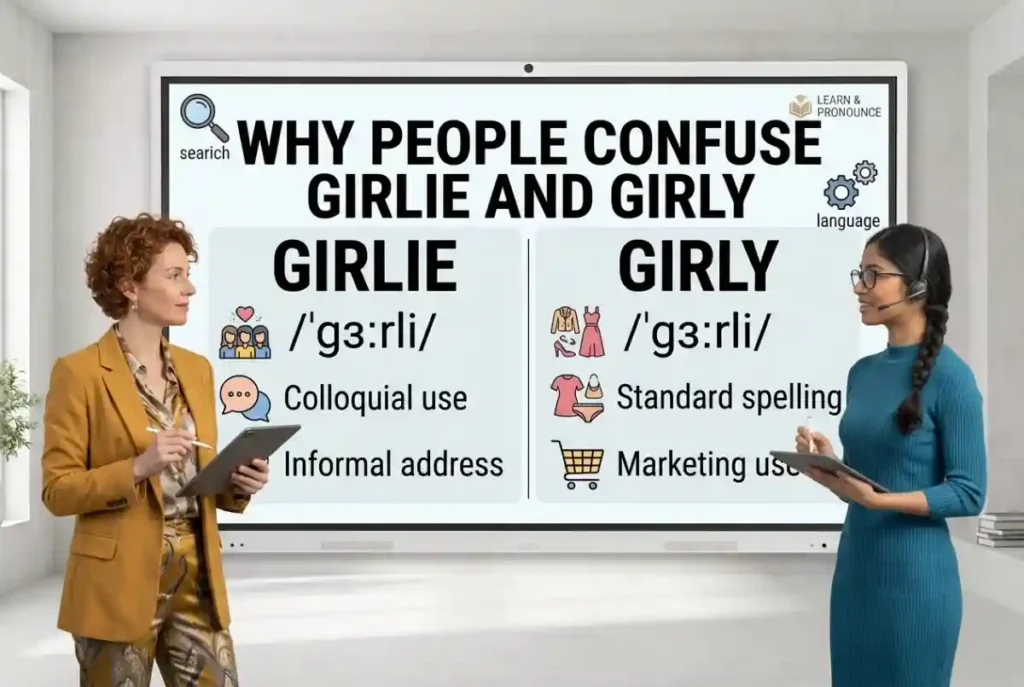
Why People Confuse Girlie And Girly
The confusion is understandable because the two words share nearly all their letters and sound alike in ordinary speech.
Several factors make the choice less obvious.
The Words Sound The Same
In most common pronunciations, girlie and girly are pronounced identically. When people hear the word, they can’t tell which spelling the speaker would use.
A listener may hear someone describe a room as girly and later see the word written as girlie. Since the meaning is similar, the alternative spelling can seem like an error even though it isn’t.
Both Words Describe Similar Things
The meanings overlap in fashion, beauty, social activities, and personal style.
A pink handbag might be called girly or girlie. The same applies to cute stationery, decorative gifts, or a feminine themed party.
Because both spellings work in many of the same sentences, learners don’t always have a clear reason to choose one.
The Ending Creates Uncertainty
English uses several endings to form words that describe qualities or characteristics. The endings in girly and girlie look different, but both have become accepted forms.
Learners may wonder if the final y should be changed to ie, as happens in some other English spelling patterns. There isn’t a universal rule that requires this change.
Social Media Encourages Both Forms
Online writing is informal, and users often choose spellings for tone or personal style.
One creator may use girly in a fashion caption. Another may write girlie era or address followers as girlies.
Repeated exposure to both forms makes them familiar. However, online popularity doesn’t mean one spelling has become the only correct option.
Spellcheck Does Not Always Settle The Question
A spelling tool may accept both forms because both are valid words. That doesn’t mean they are interchangeable in every grammatical context.
For example, girlies can be a plural noun, while girly is normally an adjective. A spelling checker might accept a word without confirming that it fits the sentence.
The writer still needs to check the intended meaning and grammar.
The Difference Between Girlie And Girly
The clearest difference is their typical grammatical use rather than a fixed difference in meaning.
Girly is mainly an adjective. It describes a style, appearance, or quality.
Girlie can be an adjective too, but it also has an informal noun use.
Compare these examples.
| Sentence | Meaning |
|---|---|
| She has a girly style. | Her style is traditionally feminine. |
| She has a girlie style. | The same broad meaning with a potentially more playful tone. |
| Hey, girlie. | An informal way to address a girl or woman. |
| The girlies are coming over. | An informal plural noun referring to a group of girls or women. |
This distinction is especially helpful when you need to choose a spelling for a sentence rather than simply describe an outfit.
Difference In Tone
Many writers perceive girlie as more playful, affectionate, or old fashioned in some contexts. Girly often feels like a simple descriptive adjective.
However, this difference isn’t fixed. A person can use girly affectionately or girlie critically. Tone depends on the surrounding words, the relationship between speakers, and the situation.
Difference In Grammar
The most useful grammatical distinction is that girly normally functions as an adjective, while girlie can be either an adjective or a noun.
For example:
The room looks girly.
Here girly describes the room.
The girlies are here.
Here girlies is the plural form of the noun girlie.
Understanding the role each word plays in the sentence is more useful than memorizing a supposed rule that one spelling is more correct.
Grammar Rules For Girlie And Girly
The grammar becomes easier once you identify the part of speech.
Using Girly As An Adjective
An adjective describes a noun or gives information about a person or thing.
You can place girly before a noun.
- She bought a girly dress.
- They decorated the room with girly colors.
- My friend likes girly accessories.
You can also place it after a linking verb such as look, seem, or feel.
- The outfit looks girly.
- Her bedroom seems girly.
- This design feels too girly for my taste.
The word stays the same in each sentence. It doesn’t change to agree with a singular or plural noun.
For example, both a girly outfit and three girly outfits are correct.
Using Girlie As An Adjective
The adjective girlie follows the same basic pattern.
- She bought a girlie dress.
- They chose girlie decorations.
- The store has a girlie collection.
The word does not need a different form for plural nouns when it functions as an adjective.
Write girlie dresses, not girlies dresses, when you mean dresses with a feminine or playful style.
Using Girlie As A Noun
When girlie refers informally to a girl or woman, it behaves like a regular countable noun.
| Form | Example |
|---|---|
| Singular | That girlie is my cousin. |
| Plural | Those girlies are my cousins. |
| With an article | A girlie waved at us. |
| With a possessive | The girlie’s bag was on the chair. |
| Plural possessive | The girlies’ bags were on the chair. |
These examples demonstrate the grammar, but the noun can sound patronizing in some situations. Use it with care when referring to people.
Can You Say Girlies
Yes. Girlies is the correct plural spelling of the noun girlie.
For example:
- The girlies are planning a weekend trip.
- We invited all the girlies to brunch.
- The girlies shared their favorite beauty tips.
In casual online speech, the word can function as a friendly way to address or refer to a group of friends. It is less suitable for formal reports or professional documents.
Remember that girly doesn’t become girlies when you describe more than one object.
Correct: The store sells girly bags.
Incorrect: The store sells girlies bags.
The difference comes from grammar, not simply from the spelling.
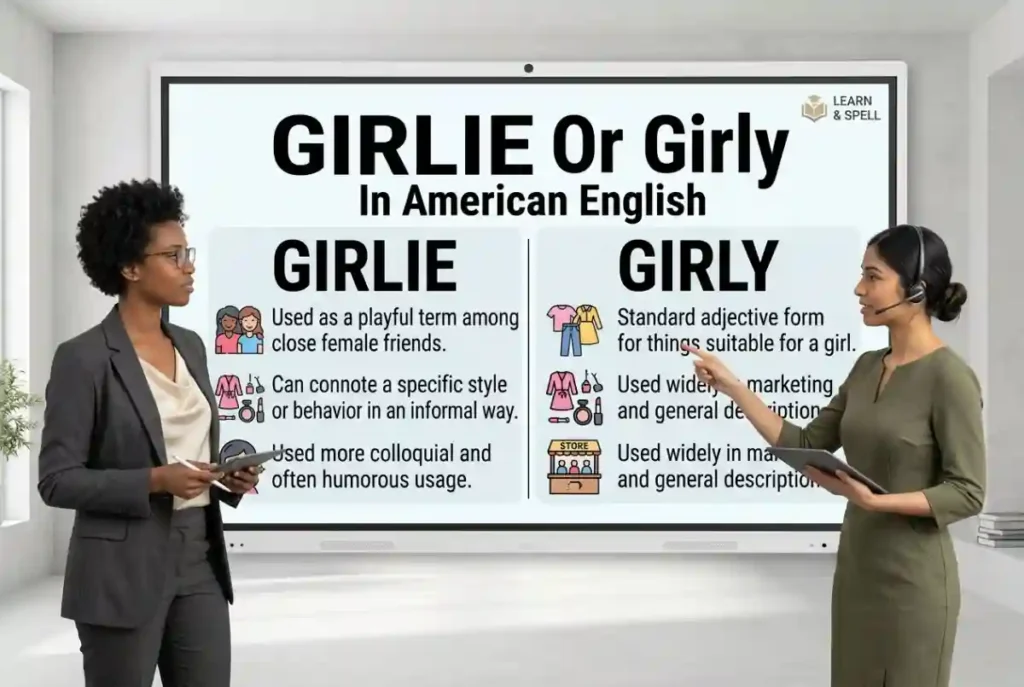
Girlie Or Girly In American English
Both spellings are used in American English. Neither is an exclusively British spelling, and neither needs to be changed to match American spelling conventions.
In the United States, girly is a familiar adjective in phrases such as girly clothes, girly room, and girly style. The form girlie also appears in informal speech, fashion descriptions, nicknames, and social media language.
The same general distinction applies in British English, Canadian English, and Australian English. Local preferences may differ, but the basic meanings remain similar.
For an American audience, girly is a practical default when you need an adjective to describe a style or appearance. Use girlie when it fits the voice of the sentence or when you need the noun form.
Which Spelling Should American Writers Choose
For most general writing, choose the spelling that best fits the sentence.
Consider these examples.
Product description: This pink bag has a cute girly design.
Social media caption: It’s giving girlie energy.
Casual conversation: The girlies are getting ready for the concert.
Formal report: The collection features traditionally feminine designs.
The final example avoids both words because a more precise expression may suit a professional audience better.
There is no need to force girly or girlie into every context. Good writing uses the word that communicates the intended meaning clearly.
Pronunciation Of Girlie And Girly
In American English, girlie and girly are generally pronounced the same way.
The usual pronunciation is /ˈɡɝːli/ in American English. The word has two syllables, with the main stress on the first syllable.
Pronunciation guide
Girlie
Two syllables. Stress the first.
/ˈɡɝːli/
Girly
Two syllables. Stress the first.
/ˈɡɝːli/
The exact vowel sound can vary slightly across English accents. The key point is that the difference between the two words is usually written rather than spoken.
Common Pronunciation Mistakes
Some learners may try to pronounce the ending of girlie differently from the ending of girly. In ordinary English speech, that distinction isn’t generally needed.
Focus on saying the two syllables smoothly and placing the stress at the beginning.
The pronunciation alone won’t tell you which spelling a writer intended. You must rely on the sentence and the context.
Word Origin And History
The words girly and girlie belong to a family of English words built around girl.
The noun girl has a long history in English. Its earlier use was broader than its modern meaning and could refer to a young person of either sex. Over time, its meaning narrowed to refer primarily to a female child or young woman.
The forms girly and girlie developed as related expressions describing qualities associated with girls or femininity. The ending y commonly forms adjectives in English, as in cloudy, hairy, and sporty.
The spelling ie also appears in informal and familiar forms of English words. In girlie, it contributes to an established variant spelling and can appear in affectionate or informal usage.
The important lesson is that these forms developed through ordinary language use. There isn’t a spelling rule requiring every word ending in y to have an alternative ending in ie.
Is Girlie Offensive
Girlie is not automatically offensive, but it can sound disrespectful depending on how you use it.
As an adjective, it may simply describe a feminine style.
She likes girlie stationery.
That sentence is generally harmless.
As a noun used to address someone, however, the word can carry a different tone.
Listen, girlie.
Depending on the situation, this could sound friendly, teasing, dismissive, or patronizing.
The same issue can arise with girly when someone uses it to belittle a person’s interests or abilities.
For example, saying that an activity is too girly may imply that feminine interests are less valuable. That implication comes from the speaker’s attitude rather than the spelling itself.
Choosing Respectful Language
If you’re writing for a broad audience, consider describing the specific quality instead of relying on a gender label.
Instead of:
She likes girly colors.
You could write:
She likes pink and pastel colors.
Instead of:
The room has a girly look.
You could write:
The room has a soft color palette with floral details.
These alternatives give readers a clearer picture. They also avoid suggesting that particular colors or styles belong to one gender.
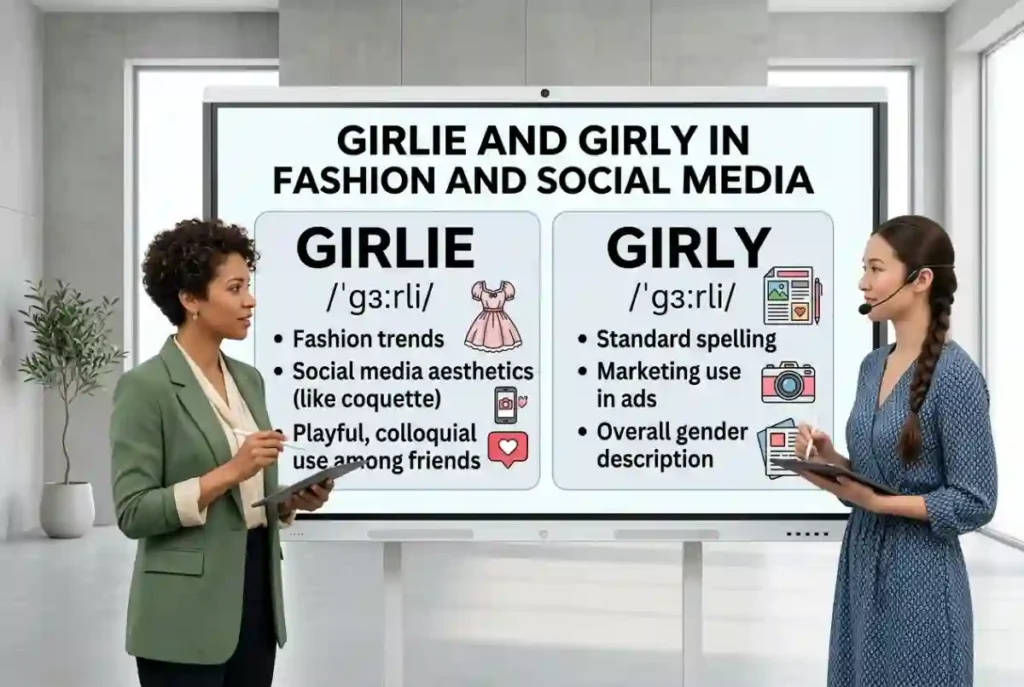
Girlie And Girly In Fashion And Social Media
Fashion and social media use both forms frequently because the words can communicate a style in very little space.
A caption such as My girly outfit for spring describes a feminine look.
A caption such as A little girlie moment sounds playful and personal.
The choice can also reflect a creator’s writing style. Some people prefer girlie because it feels cute or expressive. Others use girly because it is straightforward.
Examples include:
- My girly outfit for the weekend.
- A girlie night with my favorite people.
- Cute girly accessories for everyday wear.
- The girlies are ready for a shopping trip.
- Adding a few girlie details to my bedroom.
- A girly look with a simple modern finish.
- Just a girlie afternoon with coffee and movies.
- My favorite girly finds this month.
These examples suit informal content. For a product catalog or professional fashion article, you may want a more descriptive term such as feminine, romantic, playful, or pastel inspired.
Twenty Five Natural Examples Of Girlie or Girly
The following examples show how both spellings work in different situations.
Everyday Conversation
- My sister loves girly clothes.
- That dress has a cute girlie look.
- She says her bedroom is too girly.
- We planned a girlie movie night.
- I prefer simple clothes over girly outfits.
- The girlies are meeting at the café.
- Her bag has a playful girly design.
Fashion And Shopping
- This store sells girly accessories.
- She chose a girlie bracelet for her friend.
- The new collection has a soft and girly style.
- I found some girlie gifts for my cousins.
- Those girly shoes would look great with a skirt.
Workplace And Business
- The brand uses a girly color palette in its new campaign.
- The product description calls the collection girlie and playful.
- Our research found that customers preferred a simpler design.
- The marketing team replaced the word girly with a more precise description of the product.
The last two examples show that you don’t always need either word. Specific language often works better in professional writing.
Emails And Messages
- I’m planning a girlie afternoon for Saturday.
- Would you like to join us for a girly brunch?
- I found a few cute girlie gifts for the party.
- The decorations look more girly than I expected.
Social Media
- A little girlie moment with my best friends.
- Today’s outfit is cute and girly.
- The girlies understood the assignment.
- Adding more pink for a girly spring look.
- Just a girlie day filled with coffee and shopping.
These examples use informal language intentionally. In academic writing, a formal report, or a professional email to an unfamiliar audience, a more exact description may be more suitable.
Common Mistakes To Avoid
Even though both spellings are correct, writers can still make mistakes when using them.
Treating Girlie As Incorrect
The spelling girlie is not automatically wrong. Don’t change it simply because you are more familiar with girly.
Treating Girly As A Noun
When you want to refer informally to a group of friends as a noun, girlies is the usual plural form.
Write:
The girlies arrived early.
Not:
The girlys arrived early.
Adding An Unnecessary Plural Ending
Adjectives generally don’t change to match the number of nouns they describe.
Write:
She bought three girly dresses.
Not:
She bought three girlies dresses.
Assuming Girlie Always Sounds Affectionate
The word can sound friendly, but it can also sound patronizing. Consider the audience and the relationship before using it to address someone.
Assuming Girly Always Describes A Woman
The word can describe objects, styles, designs, or interests. It doesn’t have to describe a person.
Using The Words In Place Of A More Exact Description
Sometimes girly is too broad to communicate the details you want.
If you mean floral, pastel, delicate, playful, or romantic, use that word when it provides a clearer picture.
Memory Tricks To Remember The Difference
You don’t need to memorize a complicated spelling rule. A few practical reminders are enough.
Remember that both spellings are correct. This is the most important point.
Think of girly as your default adjective. Use it for clothing, appearance, colors, and general style.
Remember girlies as a plural noun. If you’re talking about a group of friends in an informal setting, the girlies is a familiar expression.
Think about tone before choosing girlie. The spelling may suit a playful caption or affectionate expression, but it can sound overly familiar when used to address a stranger.
Finally, read the full sentence aloud. If the word describes a style, either spelling may work. If it refers to a person or a group, check the grammar carefully.
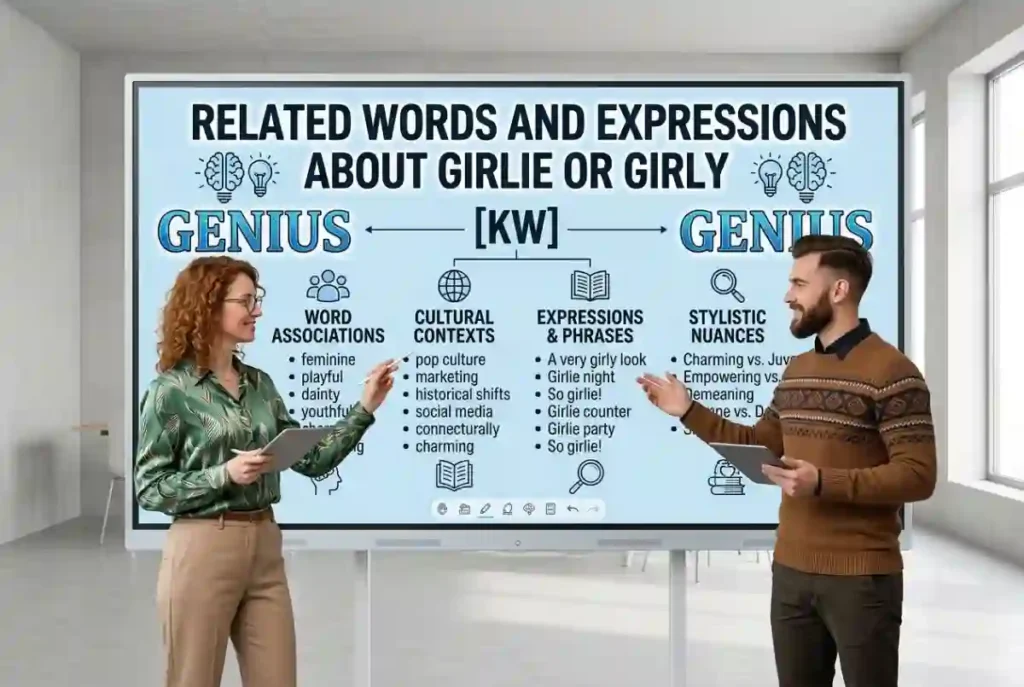
Related Words And Expressions About Girlie or Girly
Several related words can help you describe feminine styles more precisely.
| Word | Meaning | Example |
|---|---|---|
| Feminine | Associated with qualities traditionally linked to women | She prefers a feminine style. |
| Girlish | Resembling or associated with a girl, sometimes suggesting youth | Her handwriting has a girlish quality. |
| Cute | Attractive in a sweet or appealing way | Those are cute shoes. |
| Playful | Lighthearted and fun | The design has a playful feel. |
| Romantic | Soft or decorative in style | She chose a romantic floral dress. |
| Delicate | Fine or subtle in appearance | The necklace has a delicate design. |
| Pink | A color often used in traditionally feminine designs | She bought a pink handbag. |
| Tomboyish | Associated with behavior or clothing traditionally considered masculine for girls | She preferred a tomboyish style as a child. |
These words aren’t perfect synonyms. Each one describes a different quality, so choose the word that matches the meaning you want to express.
Girly vs Girlish
The words girly and girlish are related but not identical in tone.
Girly commonly describes a feminine style or appearance.
Girlish can describe qualities associated with a girl, including youthfulness, innocence, or behavior perceived as childlike.
For example:
She chose a girly pink dress.
This describes the style of the dress.
She gave a girlish laugh.
This suggests a quality associated with youth or a girl.
The difference is subtle, but girlish can carry stronger associations with age or youthful behavior.
Girly vs Feminine
Feminine is often a more neutral or formal choice.
The collection has a feminine design.
That sentence sounds suitable for a product description or fashion article.
The collection has a girly design.
This sounds more casual and may suggest a cute or youthful style.
If you want a professional tone, feminine is often a useful alternative.
Frequently Asked Questions
Is girlie or girly the correct spelling
Both spellings are correct. Girly is commonly used as an adjective to describe a feminine style or appearance. Girlie can serve the same purpose and can also function as an informal noun referring to a girl or woman. Choose the spelling that fits the sentence and keep your usage consistent.
Is girly an American word
Girly is used in American English and other varieties of English. It isn’t limited to the United States. British, Canadian, and Australian speakers also use the word, although individual preferences and expressions may differ. The spelling is not a special American alternative to girlie.
What is the plural of girlie
The plural of girlie, when used as a noun, is girlies. For example, you can write, The girlies are meeting for lunch. When girlie functions as an adjective, it doesn’t change to match a plural noun. Write girlie dresses rather than girlies dresses.
Can I use girlie in formal writing
You can use girlie in formal writing if you are discussing the word itself or quoting an expression that uses it. However, it often sounds informal in ordinary professional writing. For a neutral description, consider words such as feminine, playful, delicate, or romantic.
Does girlie mean cute
It can suggest a cute or playful style, especially when used as an adjective. However, girlie doesn’t always mean cute. It can refer more broadly to things associated with girls or femininity, and its tone depends on the context. As a noun, it can also be an informal way to refer to a girl or woman.
Is girlie a slang word
Girlie is informal and can function as a casual form of address or a playful noun. Some uses may be described as slang in everyday conversation. The adjective use is also established in English. The word isn’t automatically inappropriate, but it may sound too familiar or patronizing in some situations.
What is the difference between girly and girlish
Girly usually describes a feminine style, appearance, or interest. Girlish often suggests qualities associated with a girl, including youthfulness or childlike behavior. The meanings overlap, but they aren’t identical. For fashion descriptions, girly is often the more natural choice. For a description of someone’s manner or laugh, girlish may fit better.
Which spelling should I use in a caption
Either spelling can work in a casual caption. Use girly for a straightforward description such as a girly outfit. Choose girlie if you want a playful expression such as a girlie day with friends. The most important thing is to make the caption sound natural for your audience and the mood you want to convey.
Expert Editor’s Note
From an editing perspective, girlie and girly are both valid forms, but the grammatical role matters.
For a general description of fashion, appearance, or style, girly is a clear and familiar choice. The form girlie is also acceptable as an adjective, and it offers an established noun form that appears in informal expressions.
Professional writers should avoid claiming that one spelling is always correct and the other is always wrong. That would confuse a stylistic preference with a spelling rule.
In a fashion blog, either spelling may suit the writer’s voice, in a formal product description, feminine or a more precise word may communicate the design better, in a message to friends, girlie may add the playful tone the writer wants.
Consistency also matters. If you choose girly throughout a product guide, don’t switch to girlie randomly unless the context calls for it.
The best editorial decision is the one that respects established usage, fits the sentence, and gives the reader the right impression.
Final Verdict
Both girlie and girly are correct spellings. Neither is a universal replacement for the other, and neither should automatically be marked as a mistake.
Use girly as a practical default when describing feminine clothing, appearance, accessories, or style. Use girlie when it suits a playful or informal tone, and remember that it can also function as a noun. When referring to a group of friends, girlies is the usual plural form.
Most importantly, don’t let the spelling distract you from the meaning. Choose the word that sounds natural in your sentence, suits your audience, and expresses exactly what you intend.
Both spellings belong in English. The right choice depends on how you use them.

Founding Editor
Maya spent six years as a copyeditor at a regional newspaper before starting Grammist, which is where the “answer first” format came from: newsroom style guides don’t have room for a preamble.
She writes and reviews most of the word-pair and spelling entries, and has final say on anything that goes out under the Grammist name.