
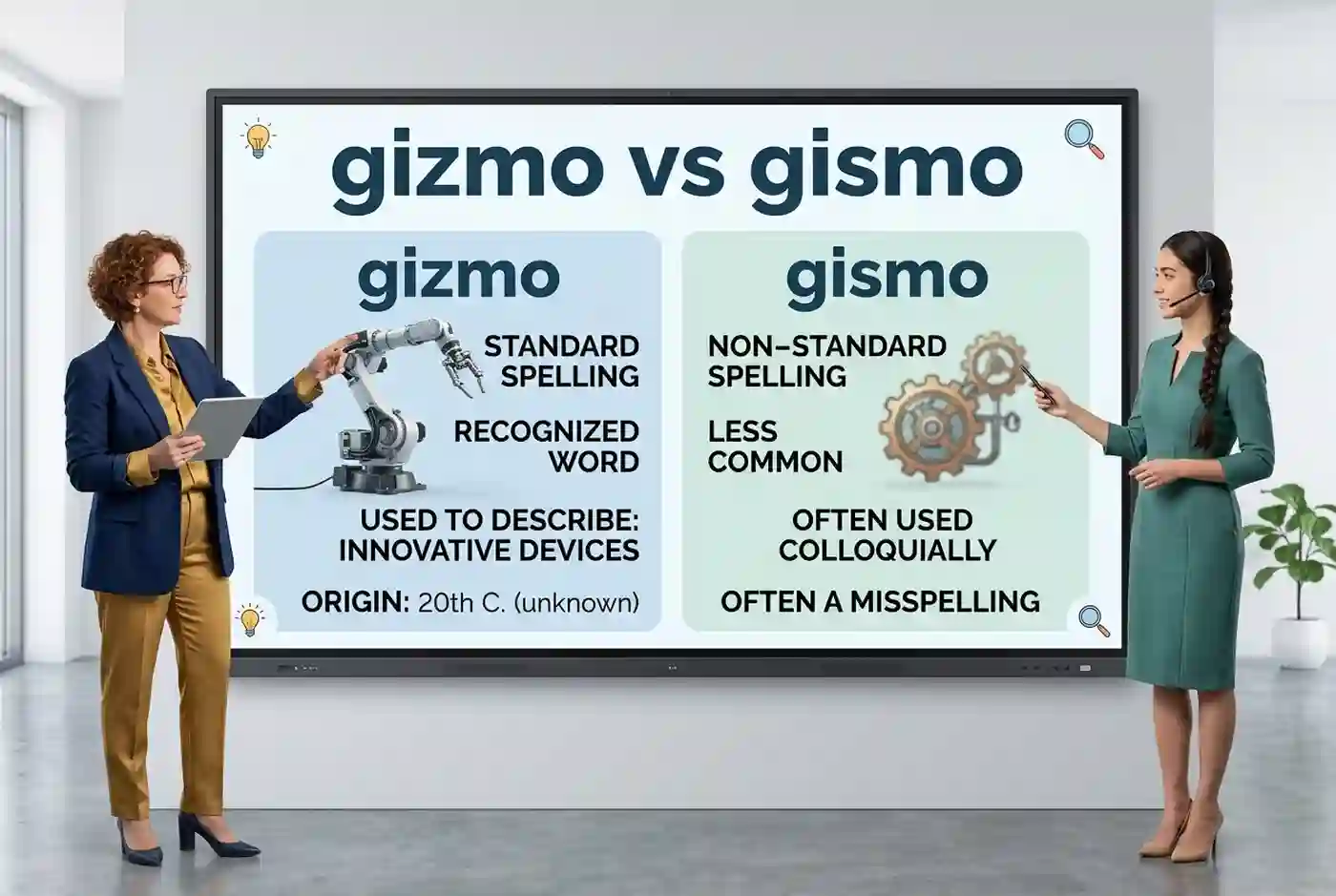
The spelling question gizmo vs gismo can be confusing because both forms appear in English dictionaries and have the same meaning. If you have ever written gismo and wondered if you made a spelling mistake you are not alone. The good news is that both spellings are recognized. However, one is the better default for most modern writing.
Gizmo is an informal noun that means a gadget, small device, or piece of equipment. People also use it when they cannot remember an object’s exact name or when its name does not matter. Gismo is an accepted alternative spelling of the same word. It does not describe a different kind of object.
The main difference is spelling preference rather than meaning or pronunciation. Major dictionaries, including Cambridge and Oxford, recognize both forms. For everyday American English and most general writing, gizmo is the practical choice because it is the form most readers are likely to expect.
This guide explains the meaning of each spelling, the pronunciation, the plural forms, and the history of the word. You will also find natural examples from everyday conversation, work, technology, and formal writing. By the end, you will know which form to choose and how to use it with confidence.
Quick Answer
Both gizmo and gismo are accepted spellings of an informal noun for a small device, gadget, or object whose exact name is unknown. Gizmo is the safer default for most modern writing. Gismo is a recognized variant, not a separate word, and the two forms share the same meaning and pronunciation.
Gizmo vs Gismo at a Glance
| Feature | Gizmo | Gismo |
|---|---|---|
| Correct spelling | Yes | Yes |
| Meaning | A small device or gadget | A small device or gadget |
| Part of speech | Noun | Noun |
| Grammatical category | Informal countable noun | Informal countable noun |
| Pronunciation in American English | /ˈɡɪz.moʊ/ | /ˈɡɪz.moʊ/ |
| Pronunciation in British English | /ˈɡɪz.məʊ/ | /ˈɡɪz.məʊ/ |
| Singular | Gizmo | Gismo |
| Plural | Gizmos | Gismos |
| Meaning difference | None | None |
| Typical style | Informal | Informal |
| Recommended default | Yes | Use when appropriate for your source or style |
The table shows the central point. These spellings do not represent two words with different definitions. They are alternative written forms of the same informal noun.
Cambridge Dictionary lists gismo as another spelling of gizmo. Oxford Learner’s Dictionaries also records both forms and recognizes the plural forms gizmos and gismos. (
What Does Gizmo Mean
Gizmo means a gadget, device, tool, or small piece of equipment. The word is informal, so it often sounds natural in conversation when the speaker does not know the technical name of an object or does not need to specify it.
For example, imagine you are repairing a kitchen appliance. You notice a small plastic part but cannot remember its name. You might tell someone, “Can you hand me that little gizmo on the counter?”
Your listener will probably understand that you mean a device or part without needing an exact technical description.
The word also works when the object has a known name but the speaker chooses a casual expression.
Consider these examples.
- I bought a new kitchen gizmo that slices vegetables.
- This little gizmo measures the temperature inside the room.
- My brother loves collecting electronic gizmos.
- The mechanic replaced a broken gizmo inside the machine.
In each case, gizmo refers to a practical object or device.
The word can also have a slightly playful tone. Calling a complicated device a gizmo may suggest that it looks clever, unusual, or difficult to understand. Still, the word does not automatically mean that the object is complicated or advanced.
A simple tool can be a gizmo in casual conversation. So can a sophisticated electronic device.
What Does Gismo Mean
Gismo has the same meaning as gizmo. It refers to a gadget, device, or piece of equipment, often when the speaker does not know or does not need the exact name.
For example, these two sentences communicate the same idea.
- The new gizmo connects to the television.
- The new gismo connects to the television.
The spelling changes, but the meaning does not.
The alternative form appears in major dictionaries, so it is not simply a spelling invented by someone who confused the letters. Cambridge labels it another spelling of gizmo, while Oxford records it as an alternative form with the same definition.
Even so, a recognized spelling variant is not always the most suitable choice for a particular audience. Writers generally benefit from choosing one familiar form and using it consistently. For most general English content, that form is gizmo.
Which Spelling Should You Use
Use gizmo in ordinary writing unless you have a clear reason to use gismo.
The spelling gizmo is the better default for articles, blog posts, school assignments, product descriptions, emails, and general business communication. It is also the form to choose when teaching the word to English learners.
Here are some natural examples.
- The store sells a useful gizmo for cleaning keyboards.
- I cannot remember what that little gizmo is called.
- This electronic gizmo makes the job much easier.
- The company introduced a new gizmo for home security.
All four sentences use the familiar spelling.
You can still encounter gismo in dictionaries, older writing, or a source that follows a particular spelling preference. You do not need to treat every occurrence as an error.
A useful editorial rule is to distinguish between a spelling that exists and a spelling that should be your first choice. Both forms exist. For consistency and reader familiarity, choose gizmo.
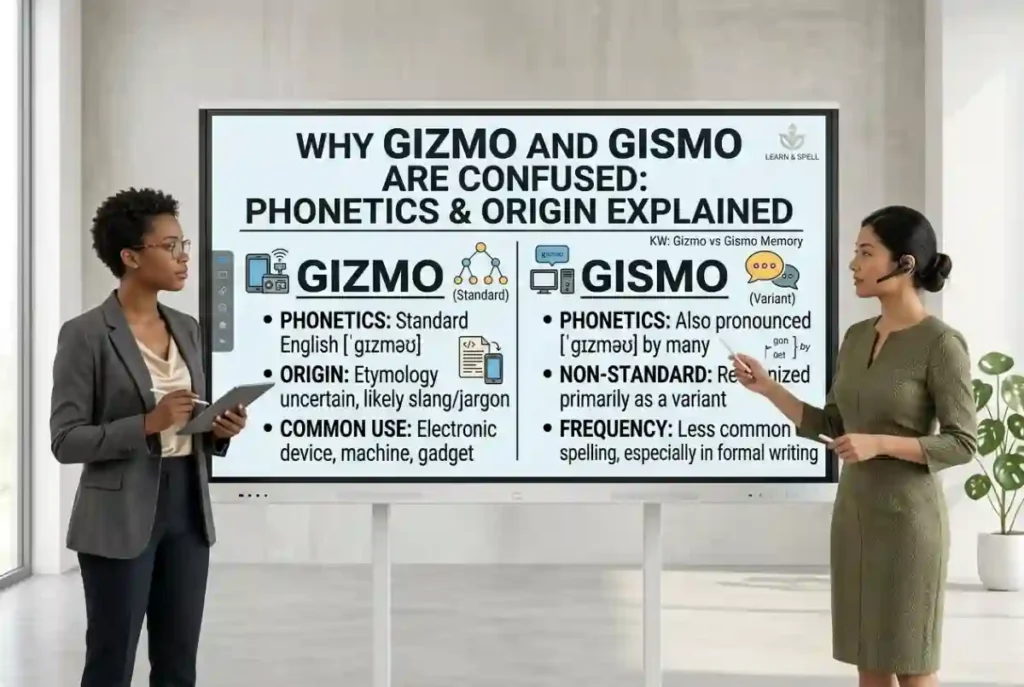
Why Gizmo and Gismo Are Confused
The confusion starts with pronunciation. Both words sound the same in ordinary English, so listening alone does not tell you which spelling a writer has chosen.
The difference is just one letter. In gizmo, the letter is z. In gismo, it is s. That small change makes the two forms look like competing spellings of the same word.
Several other factors contribute to the confusion.
Sound and spelling do not match one to one. The letter s can represent a /z/ sound in English words such as music and rose. In gismo, it also represents the /z/ sound, so the spelling does not change the way most speakers say the word.
Both forms have dictionary support. Many spelling questions involve one accepted word and one clear mistake. This case is different because dictionaries recognize both forms. A spelling checker may still favor one based on its dictionary or language settings.
People often learn the word through speech. Someone who hears gizmo in a conversation may write gismo because the sound alone offers no reliable clue about the intended spelling.
Repeated exposure reinforces familiar forms. Readers who frequently see gizmo may find gismo unusual. Someone familiar with the alternative may consider it equally natural. Neither reaction changes the shared definition.
Autocorrect can add uncertainty. A writing tool may accept both words, suggest one over the other, or behave differently according to its settings. Its response does not prove that the other form is invalid.
The practical lesson is straightforward. Learn the conventional spelling you plan to use, then keep it consistent.
Is Gismo a Misspelling of Gizmo
Not necessarily. Gismo is a recognized spelling variant, so it is not automatically an error.
However, if your goal is to use the most familiar spelling in modern general English, choose gizmo. This is especially sensible for educational writing, website content, and work that needs a consistent editorial style.
A teacher might recommend gizmo to a student because it is the preferred form for ordinary use. That advice does not require the teacher to claim that gismo never existed or is always wrong.
The distinction matters for proofreading. An editor should not automatically label every instance of gismo as a spelling error without considering context. If the task calls for standard contemporary usage, changing it to gizmo may be a sensible editorial choice. If the text reproduces an original source, preserving the original spelling may be more appropriate.
In short, the spelling you should prefer and the spelling a dictionary recognizes are two related but different questions.
Usage Grammar and Word History
Gizmo vs Gismo Pronunciation
Both spellings have the same pronunciation in standard American and British English.
| Variety | Pronunciation | Syllables |
|---|---|---|
| American English | /ˈɡɪz.moʊ/ | Two |
| British English | /ˈɡɪz.məʊ/ | Two |
The stress falls on the first syllable in both varieties.
For an easy pronunciation guide, think of the word as GIZ moh. The first part rhymes with the beginning of gizzard, while the second part sounds like mow in American English.
The British pronunciation uses a slightly different vowel in the second syllable. However, the spelling choice between gizmo and gismo does not create a separate pronunciation.
English learners should remember that the letter s does not always represent the /s/ sound. It can represent /z/ in some words, which helps explain why the two spellings sound identical.
There is no need to pronounce gismo with an /s/ sound simply because it contains the letter s. The established pronunciation follows the word rather than a strict letter by letter reading.
Gizmo vs Gismo Grammar
Both forms work as informal countable nouns. This means you can use them with articles such as a and the, and you can make them plural when referring to more than one device.
The grammar is the same for both spellings.
Singular examples.
- I found a gizmo in the drawer.
- The technician tested a new gismo.
- That gizmo looks useful.
- Can you move the gismo from the desk?
Plural examples.
- The shop sells several gizmos.
- These gismos need new batteries.
- I enjoy learning about electronic gizmos.
- The old gismos no longer work.
When you use the alternative spelling, keep its plural form consistent. Write gismo in the singular and gismos in the plural. For the preferred form, write gizmo and gizmos.
Singular Plural and Possessive Forms
The basic forms are simple to remember.
| Grammar form | With gizmo | With gismo |
|---|---|---|
| Singular | gizmo | gismo |
| Plural | gizmos | gismos |
| Singular possessive | gizmo’s | gismo’s |
| Plural possessive | gizmos’ | gismos’ |
The possessive form shows ownership or a relationship.
For example, “The gizmo’s screen is cracked” means the screen belonging to the gizmo is cracked. In the plural, “The gizmos’ screens are cracked” refers to screens belonging to several devices.
The spelling difference does not change the grammar rule. Add an apostrophe and s to the singular noun to form the singular possessive. For a regular plural ending in s, place the apostrophe after the final s.
Can Gizmo Be Used as a Verb
In ordinary modern English, gizmo is mainly a noun. It names an object rather than an action.
You would normally write:
- The engineer tested the gizmo.
- She ordered two gizmos.
- This gizmo controls the lights.
You would not normally use gizmo as a verb in standard general writing. If you need to describe an action, choose a more precise verb such as operate, connect, adjust, repair, or install.
This is useful in professional communication. Calling a tool a gizmo is fine in casual conversation, but a technical report should name the object and explain what it does whenever that information is available.
Gizmo vs Gismo in American and British English
Neither spelling belongs exclusively to American English or British English. Dictionaries in both traditions recognize the word and its alternative form.
The difference is not like color and colour, where regional spelling conventions often favor different forms. In the case of gizmo and gismo, the spelling choice is a variant within the same vocabulary item.
American writers can use gizmo. British writers can use gizmo. The alternative gismo is also documented in both varieties.
Canadian and Australian readers will generally recognize the same meaning. If you are writing for a particular publication or company, follow its editorial style. Otherwise, gizmo remains a sensible choice for general audiences.
The important point is not to treat gismo as a uniquely British spelling or gizmo as an exclusively American one. The available dictionary evidence does not support that distinction.
Gizmo vs Gismo Formality and Context
Gizmo is informal, so it suits everyday conversation and light, accessible writing. It is especially useful when the exact name of an object is unknown or irrelevant.
Consider these situations.
In daily conversation, you might say, “Can you pass me that little gizmo?” The casual noun keeps the sentence natural.
In a technology article, you might write, “The device includes a small gizmo that monitors temperature.” This can work when the exact technical term is not important, though a more precise description may help readers.
In a formal scientific report, gizmo is usually too vague if the object has a known technical name. Instead of writing “The gizmo measured the pressure,” name the sensor or instrument if you know which one you mean.
In a product review, gizmo can add personality. A writer might call a compact tool a clever little gizmo to keep the tone friendly. A technical specification should state the product name and function.
The alternative spelling gismo shares the same informal register. Changing the z to an s does not make the word more formal.
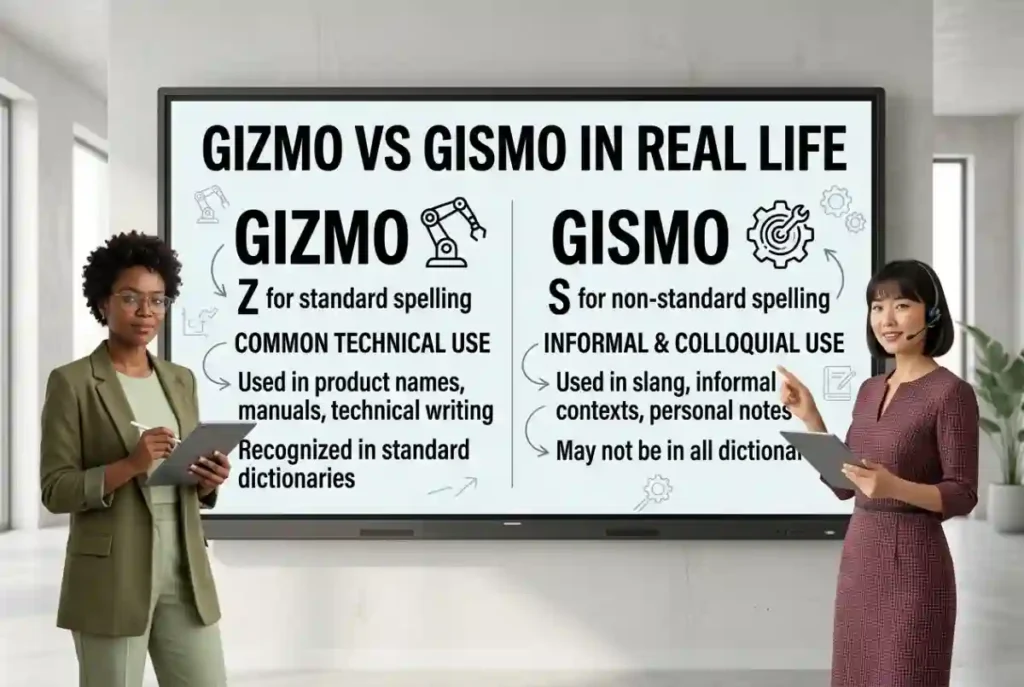
Gizmo vs Gismo in Real Life
The following examples show how the words fit into everyday communication. The first spelling is the recommended default in most cases.
Daily conversation
- I bought a little gizmo that opens jars.
- What does this gizmo do?
- Put that gizmo back in the kitchen drawer.
- My dad loves buying new electronic gizmos.
- I found a strange gizmo under the car seat.
Workplace communication
- The team tested a new gizmo for measuring air quality.
- Please label the gizmo before you put it in storage.
- The technician repaired the small gizmo inside the control panel.
- We need a more reliable device for this task.
- The supervisor asked me to explain how the gizmo works.
Emails and messages
- I found the gizmo you mentioned during our meeting.
- Could you send me the product details for that gizmo?
- The new gizmo arrived this morning.
- Thanks for showing me how to use the gizmo.
- I will bring the gizmo to the office tomorrow.
Academic and technical writing
- The device contains a small component that records temperature.
- The researcher used a sensor to measure changes in pressure.
- The report describes how the electronic gizmo operates.
- The equipment requires a new control unit.
- The experiment examined the performance of a small measuring device.
Informal writing and social media
- This little gizmo has made cooking much easier.
- I finally figured out how to use this gizmo.
- The newest gizmo in my toolbox is surprisingly useful.
- My favorite kitchen gizmo saves me time every morning.
- I have no idea what this thing is called, but the gizmo works.
These sentences illustrate an important point. Gizmo works well when the precise name is unknown or unimportant. In technical and academic settings, a specific noun such as sensor, switch, adapter, or controller may communicate more clearly.
If you see gismo in an informal source, you can understand it in the same way. The two forms do not call for different sentence structures.
Can You Use Gizmo in Formal Writing
You can use the word in formal writing when its informal tone suits the purpose. However, it is rarely the strongest choice in a highly technical or academic document.
Imagine writing an equipment report. The sentence “The gizmo failed during testing” tells the reader very little. It may work in a conversation between colleagues who both know the object, but it is too vague for readers who need precise information.
A more useful version would be “The temperature sensor failed during testing.” The revised sentence names the object and gives the reader a clearer picture of the problem.
In a friendly blog post, the less formal wording might be perfectly suitable. Style depends on the audience and the purpose of the document.
The spelling choice still follows the same general rule. If you decide to use this informal noun, gizmo is the recommended default.
Common Mistakes With Gizmo vs Gismo
Several errors can arise when people confuse spelling preference with meaning.
Mistake one is treating gismo as a completely invalid word. Major dictionaries recognize it as a variant. The more accurate advice is to prefer gizmo in most general writing.
Mistake two is assuming the words have different meanings. They do not. Both refer to a gadget, device, or object with an unspecified or unimportant name.
Mistake three is using the wrong plural. If you choose gizmo, the plural is gizmos. If you choose gismo, the plural is gismos.
Mistake four is believing the pronunciation must change. The conventional pronunciation is the same for both spellings.
Mistake five is assuming the alternative indicates a regional difference. The spelling distinction is not a simple divide between American and British English.
Mistake six is using gizmo when exact technical language is necessary. The term can be vague. In formal documents, name the part, tool, or device if you know its correct name.
Mistake seven is changing spelling halfway through an article. Even accepted variants can make a document look inconsistent when mixed without a reason. Pick the form that fits your style and use it throughout.
Gizmo vs Gismo Word Origin and History
The exact origin of gizmo remains uncertain. The Online Etymology Dictionary records the word from 1942 and notes its use in Marine and Navy speech for an unnamed object. It suggests that the word may have been invented rather than inherited from a clearly identified older word. (Online Etymology Dictionary).
That history fits the way people use the word today. When someone forgets an object’s name or does not want to explain it, gizmo provides a convenient label.
Think of a person looking inside an unfamiliar machine. They might point to a small part and say, “That gizmo is making a strange noise.” The speaker can communicate the basic idea without knowing the component’s technical name.
The word belongs to a broader family of informal expressions for objects whose exact names are unknown or unimportant. Words such as thingamajig, doohickey, doodad, and widget can serve a similar purpose.
There is no clear historical evidence that the spelling gismo developed a separate meaning. Dictionaries treat it as an alternative form of gizmo, so it is best understood as a spelling variant rather than a separate word with its own origin story.
Gizmo vs Gismo Similar Words and Related Expressions
Several words can replace gizmo, but the best choice depends on the object and the situation.
Gadget usually means a small device or tool, often one that is clever or useful. It works in both casual and product related writing.
Device is more neutral and often more suitable for formal communication. A device can be a simple tool or a complex electronic system.
Contraption can suggest a device that looks unusual, complicated, or awkward. It may carry a humorous tone.
Widget can mean a small device or component. It also has special uses in business and software.
Doohickey is a playful informal name for an object whose exact name is unknown.
Thingamajig serves a similar purpose. It is useful in casual speech when the speaker cannot recall the correct noun.
Doodad is another informal expression for an object or small item whose name is unknown or unimportant.
Here are examples showing how the choice changes the tone.
- The gadget connects to my phone.
- The device measures air pressure.
- That contraption looks difficult to repair.
- The widget controls the display.
- Hand me that doohickey on the table.
- I cannot remember what the thingamajig is called.
These words overlap, but they are not exact substitutes in every sentence. A technical device may be a gadget in casual speech, but a scientific report may need the word sensor or instrument. Choose the most precise term that fits your audience.

Memory Tricks for Gizmo vs Gismo
A simple memory trick is to connect gizmo with zip. Both words contain the letter z, so you can picture a tiny device that zips through a task.
Another useful approach is to remember the phrase gizmos and gadgets. The two words sound natural together and reinforce the spelling with z.
You can also remember this short rule.
Gizmo is the go to spelling. Gismo is the alternative.
When you are writing quickly, use gizmo unless you have a reason to follow a source that uses gismo. This habit avoids unnecessary hesitation and keeps the spelling consistent.
For English learners, learning the word in a phrase is often more useful than memorizing its letters alone. Practice expressions such as a useful gizmo, an electronic gizmo, and a new gizmo for the kitchen. These common patterns help reinforce both meaning and usage.
Expert Editor’s Note on Gizmo vs Gismo
From an editorial point of view, the choice between gizmo and gismo is mainly a question of consistency and audience expectations.
The major dictionaries consulted for this guide recognize both forms. Cambridge treats gismo as another spelling of gizmo, while Oxford records the same meaning for both forms. Merriam Webster also lists gismo as a variant of gizmo.
This evidence supports a clear practical recommendation. Use gizmo as your standard spelling unless a publication, quotation, historical document, or established house style gives you a reason to retain gismo.
Editors should also pay attention to the word’s informal tone. It is effective when the exact name of a device is unknown or unnecessary. When accuracy matters, replace it with the device’s actual name.
For example, a casual sentence might say, “This gizmo keeps the room cool.” A technical guide would be clearer if it named the thermostat, fan, sensor, or other component that performs the task.
A strong editor does not simply choose the spelling that looks familiar. The editor considers dictionary evidence, consistency, audience, and the purpose of the sentence.
Frequently Asked Questions About Gizmo vs Gismo
Is gizmo or gismo the correct spelling
Both spellings are recognized. Gizmo is the recommended default for most modern writing, while gismo is an accepted variant. Major English dictionaries record both forms with the same meaning. If you are unsure which spelling to use in an article, email, or school assignment, choose gizmo and use it consistently.
Do gizmo and gismo mean the same thing
Yes. Both words refer to a gadget, device, or small piece of equipment. Speakers also use them when they cannot remember an object’s exact name or do not need to specify it. There is no standard difference in meaning between the two spellings, so the choice is about written form rather than the object being described.
How do you pronounce gizmo
In American English, gizmo is commonly pronounced /ˈɡɪz.moʊ/. The British pronunciation is /ˈɡɪz.məʊ/. Both forms have two syllables, with the stress on the first. The alternative spelling gismo has the same established pronunciation, so changing the letter does not change how you say the word.
What is the plural of gizmo
The plural of gizmo is gizmos. The plural of the alternative spelling gismo is gismos. Both forms follow the normal pattern of adding s to a regular countable noun. For example, you can write “The store sells several gizmos” or “The drawer contains several gismos.”
Is gismo considered a spelling mistake
Not automatically. Gismo appears in major dictionaries as an accepted variant of gizmo. However, gizmo is the more practical choice for most general writing. A teacher or editor may recommend it to maintain consistency, but that advice does not mean the alternative spelling is nonexistent or has a different definition.
Is gizmo formal or informal English
Gizmo is informal English. It works well in conversation, friendly emails, blogs, and accessible product descriptions. In technical reports and academic papers, a precise term such as sensor, adapter, or controller is often better. The alternative spelling gismo has the same informal tone and does not make a sentence more formal.
Does gismo have a different pronunciation
No. Both spellings are normally pronounced the same way in American and British English. The letter s in gismo represents the same /z/ sound that appears in gizmo. The difference is written rather than spoken, so listeners usually cannot tell which spelling a person has chosen unless they see it written down.
Where did the word gizmo come from
The exact origin of gizmo is uncertain. The Online Etymology Dictionary records it from 1942 and notes its early use in Marine and Navy speech for an object without a known name. The word later became a familiar informal term for gadgets, devices, and other small pieces of equipment.
Final Verdict
When comparing gizmo vs gismo, remember that both spellings are accepted and share the same meaning. Neither word refers to a different kind of device, and neither has a separate standard pronunciation.
For most modern writing, gizmo is the best choice. It is a familiar informal noun for a gadget, device, or object whose exact name is unknown or unimportant. Use gismo when you need to preserve that variant in a source or follow a specific editorial preference.
The most common mistake is to assume that gismo must be wrong simply because gizmo is more familiar. The more accurate conclusion is that one spelling makes a better default while the other remains recognized.
When you need a quick rule, remember this. Write gizmo for everyday use, keep the spelling consistent, and name the exact device when precision matters.

Founding Editor
Maya spent six years as a copyeditor at a regional newspaper before starting Grammist, which is where the “answer first” format came from: newsroom style guides don’t have room for a preamble.
She writes and reviews most of the word-pair and spelling entries, and has final say on anything that goes out under the Grammist name.