
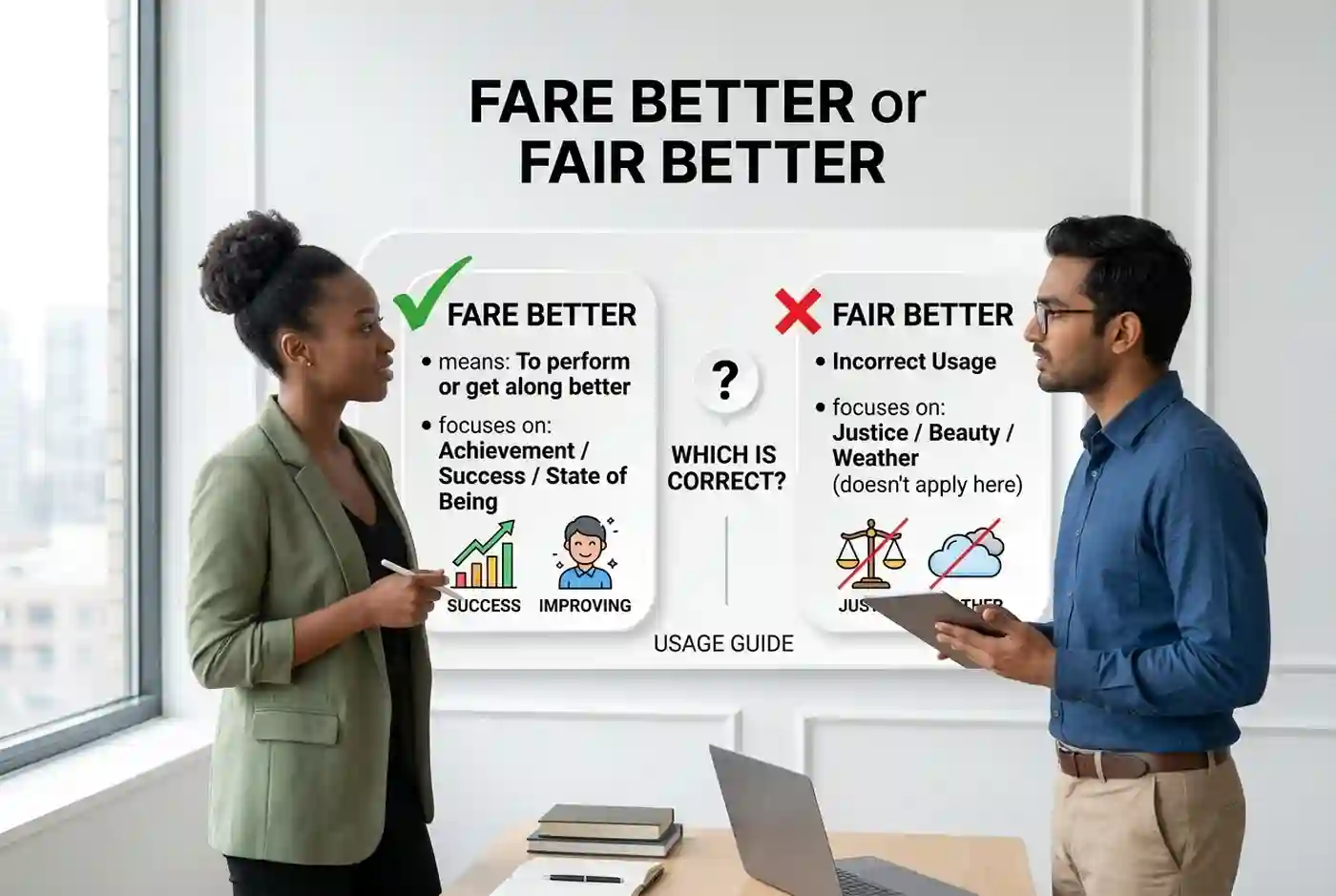
If you are unsure about fare better or fair better you are dealing with one of the most common sound alike word problems in English. The two words are pronounced the same in most varieties of English but they have completely different meanings and grammatical functions.
The correct phrase is fare better when you mean to perform better to succeed more or have a better outcome. For example you can say that students who prepare carefully tend to fare better on exams. You can also say that one company fared better than another during a difficult year. Oxford defines the verb fare as meaning to be successful or unsuccessful in a particular situation and specifically gives patterns such as fare well fare badly and fare better.
Fair better is not the standard expression for this meaning. Fair is normally an adjective meaning reasonable impartial or moderately good. It does not normally function as the verb needed in the expression.
This distinction becomes much easier once you understand the verb fare. This guide explains the meaning grammar pronunciation spelling word history common mistakes and natural usage of fare better. It also explains why fair better looks tempting and how to remember the correct spelling permanently.
Quick Answer
Fare better is correct when you mean to do better perform better or achieve a better result. Fair better is incorrect in this standard expression. Fare is a verb meaning to get along or perform in a particular situation. Fair is usually an adjective meaning reasonable impartial or moderately good.
Fare Better or Fair Better At A Glance
| Feature | Fare Better | Fair Better |
|---|---|---|
| Correct standard phrase | Yes | No |
| Meaning | Perform or succeed better | Not the standard expression |
| Key word | Fare | Fair |
| Part of speech | Verb | Usually adjective |
| Pronunciation | /fer/ or /feər/ | /fer/ or /feər/ |
| Grammar | Fare is followed by better | Fair does not normally work before better in this structure |
| Common context | Performance success results outcomes | Fair treatment reasonable prices moderate quality |
| Formality | Standard and somewhat formal | Not applicable in this phrase |
| Example | Students fare better with practice. | Incorrect for this meaning |
| Past form | Fared better | Not faired better |
| Main memory clue | Fare means do or get along | Fair means reasonable or just |
The most important fact is simple:
Use fare when you are talking about how someone or something is doing.
What Does Fare Mean
The verb fare means to get along to do or to experience a particular result or level of success.
Oxford defines fare as an intransitive verb used with adverbs such as well badly and better. Its examples include people or organizations faring well or badly in particular situations.
American Heritage gives the verb meaning to get along and also defines it as meaning to happen or develop in a particular way.
That gives us the basic idea:
Fare = do or get along in a particular situation.
So:
She fared well in the competition.
He fared badly in the interview.
The company fared better than expected.
The new policy may fare better than the old one.
The plants fare better in warm weather.
All of these sentences describe performance or outcome.
Fare Means Do
In modern English fare often works as a more formal alternative to do or get along.
Compare:
How did you do in the exam.
How did you fare in the exam.
The second sentence is more formal and somewhat more literary but completely natural.
You can also say:
How is the new project doing.
How is the new project faring.
The first is more conversational.
The second sounds more formal.
Fare Means Experience An Outcome
Fare can also describe how something turns out.
The plan fared well.
The proposal fared badly.
The business fared better than expected.
The treatment did not fare as well as doctors had hoped.
The word does not require a physical journey. In modern usage it is often about progress performance or results.
What Does Fair Mean
Fair is a completely different word.
It has several meanings including:
- Reasonable.
- Impartial.
- Just.
- Acceptable.
- Moderately good.
- Pleasant or clear in descriptions of weather.
- Light in color in some contexts.
- A public event or market when used as a noun.
For example:
The price is fair.
The judge was fair.
She received fair treatment.
The results were fair.
They attended the county fair.
None of these meanings creates the standard phrase fair better.
The problem becomes especially clear when you look at grammar. In fare better the word fare is a verb. In most common uses fair is an adjective.
Why Fare Better Is Correct
The expression fare better follows a normal English structure.
Fare + comparative adverb.
Fare tells us how someone or something performs.
Better tells us that the performance or outcome is more favorable than another result or an earlier situation.
For example:
Students fare better with regular practice.
Older buildings may fare better in dry climates.
Some businesses fare better during economic uncertainty.
This is the same basic pattern found in:
fare well.
Badly.
Poorly.
Better.
Worse.
Cambridge describes fare well as meaning that someone or something is successful and gives examples such as schools and political parties faring well. It also uses fare better in examples about improved outcomes.

Why Fair Better Is Incorrect
Fair better does not work as the standard expression when you mean perform better.
The problem is grammatical and semantic.
Fair does not mean to perform.
It normally describes something.
For example:
The price is fair.
The decision was fair.
The treatment was fair.
The result was fair.
But in fare better, fare itself carries the meaning of performing or getting along.
So:
They fare better under pressure.
is correct.
They fair better under pressure.
is incorrect in standard English.
This is not a British versus American spelling issue. It is a difference between two separate words.
Fare Better Means Perform Better
One of the easiest ways to understand the phrase is to replace it mentally with perform better or do better.
Students who study regularly fare better on exams.
They perform better on exams.
They do better on exams.
The meaning is closely related.
However fare has a particular style. It is often used when the writer is comparing how people groups systems businesses plans or other things handle a situation.
Fare Better Means Have A Better Outcome
Fare better does not always refer to performance in the narrow sense.
It can describe the outcome of a situation.
For example:
The northern region fared better during the storm.
This does not mean the region was competing in a contest. It means the region experienced a more favorable outcome.
Similarly:
The company fared better than expected.
This means the company performed or developed more successfully than people expected.
Fare Better Than
The pattern fare better than is especially common.
For example:
Small businesses may fare better than large companies during certain market changes.
This sentence compares outcomes.
You can also say:
She fared better than her classmates.
The second treatment group fared better than the first.
The newer model fared better than the older one.
The phrase fare better than is therefore useful when comparing results.
Fare Better Than Expected
Another common structure is:
fare better than expected.
Examples include:
The economy fared better than expected.
The patient fared better than expected.
The project fared better than expected.
The team fared better than expected.
This construction is common in journalism business writing academic discussion and everyday conversation.
Collins specifically lists examples of fare better involving industries businesses films and other subjects that achieve more favorable results.
Fare Better In A Sentence
Here are some natural examples.
Students tend to fare better when they get enough sleep.
Small businesses may fare better with careful planning.
The team fared better after changing its strategy.
She fared better in the second interview.
The new model fared better in testing.
The company fared better than its competitors.
Plants fare better when they receive enough sunlight.
Children often fare better when they have consistent support.
The region fared better than expected after the storm.
The treatment group fared better than the control group.
These examples all use fare as a verb describing an outcome.
Fare Better Grammar
Understanding the grammar of fare makes the spelling almost impossible to forget.
Fare Is An Intransitive Verb
Fare is normally an intransitive verb in this meaning.
That means it does not normally take a direct object.
You do not usually say:
The company fared the market.
Instead you say:
The company fared well in the market.
Or:
The company fared better than its competitors.
The verb describes the subject’s performance or outcome rather than directly acting on an object.
Oxford identifies fare as an intransitive verb in this usage.
Present Tense Forms
The basic forms are:
I fare.
You fare.
We fare.
They fare.
He fares.
She fares.
It fares.
For example:
The team fares well under pressure.
The company fares better in larger markets.
Notice the s in the third person singular.
Past Tense
The past tense is:
fared
Examples:
She fared well.
He fared badly.
The company fared better than expected.
The team fared worse after the injury.
Present Participle
The present participle is:
faring
Examples:
The company is faring well.
How are you faring at your new job.
The industry is faring better this year.
Past Participle
The past participle is:
fared
Examples:
The business has fared well.
The project has fared better than expected.
The region had fared poorly before the reforms.
Fare Better In Different Tenses
The phrase changes naturally according to tense.
Present
They fare better with regular practice.
Present Progressive
They are faring better now.
Past
They fared better last year.
Present Perfect
They have fared better than expected.
Past Perfect
They had fared better under the previous system.
Future
They will fare better next season.
Modal
They may fare better with additional training.
Conditional
They would fare better with more preparation.
The word fare remains the core verb. Only its grammatical form changes.
Fare Better With
The phrase fare better with introduces a condition or approach that produces a more favorable outcome.
Examples:
Students fare better with regular revision.
Some plants fare better with less water.
The company may fare better with a smaller team.
Children may fare better with a consistent routine.
This construction is common because it lets writers explain what conditions lead to better outcomes.
Fare Better In
You can also use fare better in to identify a situation or environment.
Examples:
She fares better in small groups.
The team fares better in warm weather.
The company fares better in international markets.
He fared better in the second round.
The phrase identifies the setting in which performance improves.
Fare Better Than
Use fare better than for direct comparison.
The new system fares better than the old one.
This treatment group fared better than the control group.
She fared better than expected.
This is one of the most useful patterns to learn as a complete phrase.
Fare Better Compared With
In formal writing you may also see:
The new method fared better compared with the older approach.
However than is usually more concise.
The new method fared better than the older approach.
Strong editing often removes unnecessary words when a shorter construction communicates the same meaning.
Fair Better And Grammar
Why cannot we simply use fair as a verb here.
Because fair and fare have different grammatical histories and meanings.
Fair is commonly an adjective.
The decision was fair.
The price is fair.
The treatment was fair.
Fare is the verb.
The company fared well.
Better.
Badly.
The two words sound alike but spelling tells us which grammatical word we are using.
This is a classic example of a homophone.
Fair Can Be A Verb In Other Contexts
There is one important nuance.
It would be too broad to say that fair can never function as a verb. English contains rare or specialized verb uses of fair. Dictionary.com notes that fair can be used as a verb in particular contexts although it is not the normal verb in the idiomatic expression fare well.
That does not make fair better correct when you mean perform better.
In ordinary standard English:
fare better means perform better.
That is the expression writers should use.
Fare Better vs Fair Better Pronunciation
The two words are pronounced alike in most major varieties of English.
Cambridge gives fare as approximately /feər/ in British English and /fer/ in American English.
Fair has the same basic pronunciation in these varieties.
This is exactly why the mistake happens.
If you hear someone say:
They will fare better.
you cannot identify the spelling from the sound alone.
You need context.
Syllables
Both words have one syllable.
fare
fair
Stress
Because each word has one syllable there is no internal stress pattern to learn.
The Main Pronunciation Problem
The pronunciation does not tell you which spelling to choose.
This means learners must connect the phrase with meaning rather than sound.
Think:
Fare = perform.
Fair = reasonable.
That distinction is more reliable than trying to hear the difference.
Why People Confuse Fare And Fair
The main reason is simple.
They sound the same.
This makes them homophones.
English contains many pairs like this.
Their meanings are different but their pronunciation is identical or nearly identical.
Examples include:
to and two.
there and their.
right and write.
hear and here.
principal and principle.
fare and fair.
The spelling therefore carries information that pronunciation does not.
Visual Similarity
Fare and fair are also visually close.
Both begin with fa.
They both contain r.
Both contain the same final sound.
The only major spelling difference is the vowel sequence.
That makes them easy to confuse during fast typing.
Keyboard Mistakes
A person who knows the phrase but types quickly may write:
fair better.
instead of:
fare better.
Spellcheck may not always catch this because fair is itself a correctly spelled English word.
This is an important type of spelling error.
A basic spellchecker can identify nonexistent words.
It may not identify a correctly spelled word used in the wrong context.
That is why proofreading requires attention to meaning.
Autocorrect
Autocorrect can make the problem more confusing because both words are valid.
If you type fair the software has no reason to assume you meant fare.
Context sensitive grammar tools may sometimes catch the problem but they cannot always understand the intended meaning.
Human context remains important.
Social Media And Informal Writing
Fast informal writing creates more opportunities for homophone errors.
People often type quickly and rely on sound based memory.
Once an incorrect phrase appears online it can be repeated by other writers.
That can make a mistake look more established than it really is.
Frequency on social media does not determine standard grammar.
Dictionary evidence and established usage do.
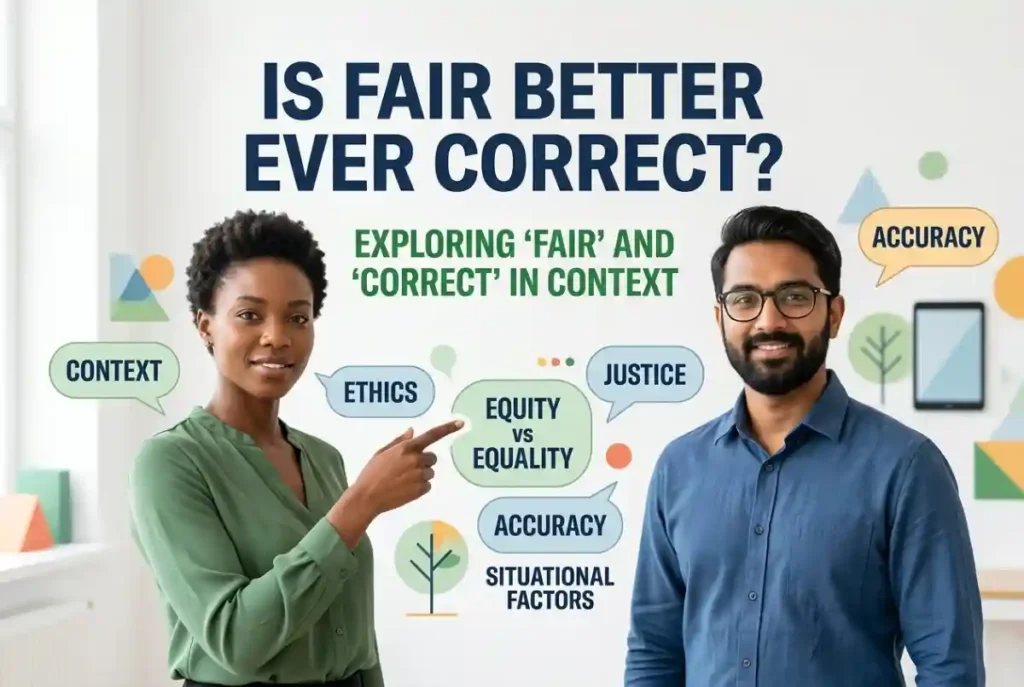
Is Fair Better Ever Correct
This needs a careful answer.
Fair better is not the standard phrase when the intended meaning is perform better or achieve a better outcome.
However English can contain unusual combinations where fair functions differently.
That does not mean fair better is an accepted replacement for fare better.
If your intended meaning is:
perform better.
do better.
succeed more.
achieve a better result.
use:
fare better.
For ordinary editing and professional writing this is the safe and correct choice.
Fare Better vs Do Better
The closest everyday replacement for fare better is do better.
Compare:
Students fare better when they revise.
Students do better when they revise.
The meanings are similar.
The style is different.
Do better is very common and conversational.
Fare better is more formal and often sounds analytical.
That makes fare especially common in journalism academic writing reports research discussion and comparisons.
Fare Better vs Perform Better
Perform better is another close synonym.
Compare:
The new system performs better than the old one.
The new system fares better than the old one.
Both are correct.
Perform better emphasizes performance.
Fare better emphasizes the overall outcome or how something manages in a particular situation.
This distinction is subtle but useful.
A machine can perform better because it produces better results.
A company can fare better because it handles difficult economic conditions more successfully.
The two expressions often overlap.
Fare Better vs Succeed
Succeed is stronger in one sense because it directly states success.
Fare better is comparative.
For example:
The company succeeded.
The company fared better than its competitors.
The second sentence does not necessarily mean the company was completely successful. It means its outcome was more favorable than the comparison point.
This is why fare better is useful when discussing relative performance.
Fare Better vs Thrive
Thrive suggests strong growth or success.
Fare better is more neutral.
A company may fare better than another company without thriving.
For example:
The smaller company fared better during the downturn.
This means it handled the downturn more successfully.
It does not necessarily mean the company experienced major growth.
Fare Better vs Improve
Improve means become better.
Fare better means perform or develop more successfully.
Compare:
The student’s grades improved.
The student fared better after receiving extra tutoring.
The first sentence focuses on change.
The second focuses on outcome.
Both can describe positive development but they are not identical.
Fare Better In Workplace English
Fare better is common in professional writing because it provides a concise way to compare outcomes.
Examples:
Employees may fare better with flexible schedules.
Smaller teams often fare better when communication is direct.
The company fared better than analysts expected.
The new strategy is expected to fare better in international markets.
The product fared better among younger customers.
These sentences sound natural in reports and business journalism.
Fare Better In Emails
You can use the phrase in professional email writing.
For example:
The revised process may fare better if we introduce it gradually.
The second proposal appears to fare better under the current budget.
The new approach has fared better than the original plan.
However in a casual email you might simply write:
The new approach seems to be working better.
That sounds more conversational.
Fare Better In Academic Writing
Fare better is particularly useful when comparing groups or outcomes.
Examples:
Students who receive regular feedback tend to fare better academically.
The second group fared better under the revised conditions.
Participants using the new method fared better than those using the traditional method.
The phrase works well in academic prose because it expresses relative success without claiming absolute success.
Fare Better In Journalism
Journalists frequently use fare better when comparing companies regions political groups markets teams or economic sectors.
Examples:
Small retailers fared better during the holiday period.
The northern region fared better than expected.
The film fared better overseas than at home.
The sector fared better than analysts had predicted.
This usage is well established. Collins lists examples involving industries business sectors and films that fared better in particular circumstances.
Twenty Five Natural Examples For Fare Better or Fair Better
Here are natural examples showing how fare better works in different contexts.
- Students usually fare better when they study consistently.
- She fared better in the second interview.
- The team fared better after changing its strategy.
- Small businesses may fare better during periods of rapid change.
- The new treatment group fared better than the control group.
- Children often fare better with a stable routine.
- The company fared better than investors expected.
- Some plants fare better in indirect sunlight.
- The northern region fared better during the storm.
- He fared better in mathematics than in science.
- The new model fared better in independent testing.
- Employees may fare better with clearer instructions.
- The second proposal fared better with the review committee.
- The economy has fared better than predicted.
- The team is faring better this season.
- The smaller retailer fared better than its larger rival.
- Students who receive regular feedback tend to fare better.
- The business would fare better with a simpler pricing system.
- The project may fare better with additional funding.
- She will probably fare better in a smaller class.
- The film fared better overseas than at home.
- The region fared better than expected after the disruption.
- Some people fare better when they work in quiet environments.
- The revised policy has fared better than the original version.
- The company could fare better if it focused on its core market.
Notice the repeated pattern.
The subject fares or fared.
The word better compares the result.
The phrase describes performance or outcome.
Common Mistakes With Fare Better
Mistake One
He will fair better next year.
Correct:
He will fare better next year.
The subject is expected to perform better.
Use fare.
Mistake Two
They fair better under pressure.
Correct:
They fare better under pressure.
Again the verb describes how they perform.
Mistake Three
She faired better after changing jobs.
Correct:
She fared better after changing jobs.
The past tense of fare is fared.
It is not faired.
Mistake Four
The team fared good.
Better:
The team fared well.
Fare is a verb so the usual adverb is well.
However:
The team fared better.
is correct because better functions naturally in the comparative construction.
Mistake Five
The business fared best than expected.
Correct:
The business fared better than expected.
Use better for comparison.
Use best for the highest level among three or more possibilities.
Mistake Six
The business fared more better.
Correct:
The business fared better.
Better is already the comparative form.
Do not normally add more.
Fared Better or Faired Better
This is another important spelling question.
The correct expression is:
fared better
Not:
faired better
The past tense of the verb fare is fared.
For example:
The company fared better last year.
The team fared better after the change.
The new policy fared better than expected.
The spelling faired may look logical because fair is a familiar word. But it is not the standard past form of fare.
Why Fared Looks Strange
The pronunciation of fared and faired is also essentially the same.
That creates another homophone problem.
English spelling is not always predictable from pronunciation.
The correct forms are:
fare.
fared.
faring.
fares.
The form fair belongs to a different word family.
Fare Better In Different Forms
Understanding the full word family makes the phrase easier to use.
Fare
They fare well.
Fares
The company fares well in this market.
Fared
The company fared well last year.
Faring
The company is faring well.
To Fare
The team hopes to fare better next season.
The base verb is fare.
The comparative phrase is fare better.
The past form is fared better.
The progressive form is faring better.
Fare Better And Punctuation
The phrase itself does not require special punctuation.
For example:
Students fare better with regular practice.
The phrase can appear in a sentence with commas if the sentence structure requires them.
For example:
In general, students fare better when they receive regular feedback.
The comma belongs to the larger sentence structure rather than to the phrase itself.
Do not insert punctuation between fare and better.
Incorrect:
Students fare, better with practice.
Correct:
Students fare better with practice.
Fare Better or Fair Better In British And American English
Fare better is standard in both British and American English.
It is also used in Canadian and Australian English.
There is no regional spelling difference that changes fare better into fair better.
Oxford provides both British and American pronunciation information for fare and identifies the verb as a standard word used for success or performance.
Cambridge likewise uses fare in expressions such as fare well and fare better.
This means the answer is consistent across the major English varieties.
Is Fare Better More Formal
It can sound somewhat more formal than do better.
Compare:
How did you do on the test.
How did you fare on the test.
The first is more conversational.
The second sounds more formal or polished.
That does not mean fare better is old fashioned. It remains common in journalism professional writing academic writing and analytical discussion.
Word Origin Of Fare
The history of fare explains why the modern verb is connected to ideas of traveling and getting along.
Oxford traces the verb to Old English roots associated with traveling going and getting on well or badly. It is related to German fahren and Dutch varen among other Germanic forms.
The American Heritage Dictionary also traces fare through Middle English to Old English faran meaning to travel.
The older idea of traveling or proceeding gradually developed into the modern sense of how someone or something gets on.
That connection remains visible in phrases such as:
fare well, fare badly, fare better, and fare worse.
In other words the verb originally carried a sense related to how one proceeds through a journey. Modern English extended that idea to situations and outcomes.
Word Origin Of Fair
Fair has a separate history.
Its modern meanings developed through older senses involving beauty pleasantness suitability and justice.
That history has nothing to do with the verb fare used in fare better.
This is another reason not to treat fair and fare as spelling variations.
They are historically separate words despite having the same pronunciation in modern English.
Fare Better And Farewell
There is an interesting connection between fare well and farewell.
Farewell developed from the expression fare well, meaning essentially to go or proceed well.
Dictionary.com notes that farewell is based on the phrase fare well and carries the older sense of wishing someone well as they go.
This gives you a useful memory connection:
fare well → fare better
Both use fare as the verb describing how someone proceeds or gets along.
Fair does not belong in that family.
Fare Well vs Fair Well
The standard phrase is:
fare well
not:
fair well
For example:
I hope you fare well in your new job.
The company continues to fare well.
Some plants fare well in warm conditions.
Cambridge explicitly defines fare well as meaning to be successful.
This is another strong clue.
If you can replace the phrase with do well, you probably need fare.
Do well.
Fare well.
Do better.
Fare better.
Fare Better And Fare Worse
The opposite of fare better is often fare worse.
For example:
Older systems may fare worse under these conditions.
The second group fared worse than the first.
The company could fare worse if costs continue to rise.
This pair makes the grammar clear.
fare better
fare worse
The verb fare stays the same while the comparative adverb changes.
Fare Better And Fare Poorly
You can also say:
fare poorly.
For example:
The product fared poorly in early testing.
The company fared poorly during the recession.
This confirms that fare is the verb carrying the meaning of performance or outcome.
The words after fare describe the quality of that outcome.
Memory Tricks For Fare Better
The best memory trick is to connect fare with perform.
Fare Means Perform
Think:
fare better = perform better.
If the sentence is about performance use fare.
Fare Means Get Along
Think:
How did you fare.
means:
How did you do.
Fair Means Reasonable
Think:
fair price, fair decision, fair treatment.
These are all about fairness or reasonableness.
One Letter Changes The Meaning
Remember:
Fare = function or outcome.
Fair = fairness.
The words sound alike but the meanings are different.
A Five Second Test
When you see fare better or fair better ask:
Can I replace the phrase with do better.
If yes use:
fare better.
For example:
The students fare better with practice.
The students do better with practice.
The substitution works.
Now try:
The students fair better with practice.
Here fair does not perform the required verb function.
The answer is clear.
Expert Editors Note
A professional editor would correct fair better to fare better when the writer means perform better or achieve a better result.
The same editor would also correct faired better to fared better.
This is not a matter of style preference. It is a matter of using the correct lexical item.
Major dictionaries support this distinction. Oxford identifies fare as an intransitive verb meaning to be successful or unsuccessful in a particular situation and specifically lists fare better among its common patterns. Cambridge also gives fare well and fare better in examples describing success. Collins lists fare better as a recognized expression and gives examples involving industries businesses and films.
A good editor also considers clarity.
If the audience is informal you may prefer:
They did better.
If the writing is formal or comparative you may prefer:
They fared better.
Both are natural.
The important point is that fare is the correct verb.
Related Words And Expressions to Fare Better or Fair Better
Understanding related expressions makes fare easier to remember.
Fare Well
Means do well or succeed.
Fare Badly
Means experience a poor result.
Fare Poorly
Means perform unsuccessfully.
Fare Better
Means perform more successfully.
Fare Worse
Means perform less successfully.
Do Better
A common everyday alternative to fare better.
Perform Better
A more direct alternative when talking specifically about performance.
Succeed
A stronger word that directly expresses success.
Improve
Means become better rather than simply achieve a better outcome.
Thrive
Means grow or succeed strongly.
These words overlap but they are not interchangeable in every sentence.
Fare As A Noun
Fare is also a noun and this creates another source of confusion.
A fare can mean the price paid for transportation.
The bus fare increased.
The taxi fare was expensive.
The train fare is reasonable.
Fare can also mean food served as part of a particular style or tradition.
The restaurant serves traditional Italian fare.
The festival offered local fare.
These noun meanings are completely different from the verb in fare better.
Fare As A Verb And Noun
Compare:
The bus fare was expensive.
Here fare is a noun.
The company fared well.
Here fare is a verb.
The spelling is identical but the grammatical function is different.
This is a useful reminder that English words can have several meanings and parts of speech.
What Professional Proofreaders Look For
When proofreading a sentence containing better the first question is not simply which spelling looks familiar.
The editor asks:
What does the verb mean.
If the sentence describes performance or outcome then fare is appropriate.
For example:
The company ___ better than expected.
The answer is:
The company fared better than expected.
If the sentence describes fairness then fair may be appropriate in another grammatical structure.
For example:
The company offered a fair price.
The word fair describes the price.
This distinction between grammatical role and sound is essential.
Why Spellcheck May Not Catch Fare Better
This mistake is particularly interesting because both fare and fair are correctly spelled words.
A spellchecker sees:
fair.
It recognizes a legitimate English word.
It does not automatically know that the writer intended:
fare.
Context sensitive tools may catch some errors but not every one.
This is why careful proofreading still matters.
A dictionary is useful for checking meaning but the writer must also check the role the word plays in the sentence.
Fare Better In Formal Academic Prose
Academic writers often use fare better when comparing outcomes.
For example:
Participants who received regular feedback fared better than those who did not.
This is concise and objective.
The phrase avoids unnecessarily strong claims.
It says one group achieved a more favorable outcome. It does not automatically claim that every participant succeeded.
That makes fare better particularly useful for measured comparison.

Fare Better In Scientific Writing
Scientific writing often compares groups conditions treatments or environments.
Examples:
The experimental group fared better under the revised conditions.
The seedlings fared better at moderate temperatures.
The new material fared better during repeated testing.
The second sample fared better under pressure.
The phrase can be useful because it describes relative performance without adding emotional language.
Fare Better In Business Writing
Business writers use fare better to discuss companies markets products and strategies.
Examples:
Smaller firms may fare better during periods of rapid change.
The revised pricing strategy is expected to fare better.
The company fared better than analysts predicted.
The new product fared better in overseas markets.
The word has a measured professional tone that fits comparative analysis.
Fare Better In Everyday Conversation
Although fare is somewhat more formal than do it is not unnatural in conversation.
For example:
How did you fare on the test.
I think I fared better this time.
You will fare better if you leave early.
However many speakers would simply say:
How did you do on the test.
I think I did better this time.
You will do better if you leave early.
The difference is mainly register rather than correctness.
Final Comparison
Here is the distinction one last time.
Fare better means perform better or experience a better result.
Fair better is not the standard phrase for that meaning.
Fared better is the correct past form.
Faired better is not the standard past form of fare.
Fare well means do well or succeed.
Fair well is not the standard spelling for that expression.
The spelling matters because the words are homophones.
Common Search Questions About Fare Better
People often search for this issue in several slightly different ways. The following answers cover the most useful variations.
Is It Fare Better or Fair Better
The correct phrase is fare better when you mean perform better do better or achieve a better result. Fare is a verb meaning to get along or experience a particular outcome. Fair is generally an adjective meaning reasonable impartial or moderately good. Because the two words sound alike they are easy to confuse in speech and informal writing.
Is Fared Better Correct
Yes. Fared better is the correct past tense form when you mean performed better or experienced a better outcome. For example, The new system fared better than the old one. The past tense of fare is fared. Faired better is not the standard spelling for this meaning.
What Does Fare Better Mean
Fare better means to perform better to succeed more or experience a more favorable outcome. For example, Students who prepare carefully tend to fare better on exams. The phrase can describe people businesses teams products systems regions and many other subjects. It is especially useful when comparing outcomes.
Is Fare Better Formal English
Fare better is standard English and can sound somewhat more formal than do better. It is common in journalism academic writing business reports professional communication and analytical writing. In casual conversation people often choose do better. For example, How did you fare on the exam is grammatical but How did you do on the exam is more conversational.
What Is The Difference Between Fare And Fair
Fare can be a verb meaning to get along or experience a particular result. It can also be a noun meaning a transportation charge or food. Fair is usually an adjective meaning reasonable impartial or moderately good. It can also be a noun for an event or market. The two words are homophones but they have different meanings.
Can You Say Fair Better
Not in standard English when you mean perform better. The established expression is fare better. Fair does have other grammatical uses but it is not the normal verb in this phrase. If you mean that someone performs more successfully then fare better is the correct choice.
Is It Fare Well or Fair Well
The standard expression meaning to succeed or do well is fare well. For example, The team fared well in the tournament. Fare is the verb meaning to get along or perform. Fair well is not the standard spelling for this expression. The phrase farewell also developed historically from fare well.
What Is The Opposite Of Fare Better
Depending on context the opposite can be fare worse, fare badly, or fare poorly. Fare worse is particularly useful for comparisons. For example, The older model fared worse than the newer one. Fare badly and fare poorly describe an unsuccessful outcome without necessarily making a direct comparison.
Final Thoughts
The correct phrase is fare better.
Use it when you mean that someone or something performs better succeeds more or experiences a more favorable outcome.
For example:
Students fare better when they prepare carefully.
The company fared better than expected.
The new system may fare better under different conditions.
The key mistake to avoid is replacing fare with fair simply because the two words sound identical.
Remember the core distinction:
Fare is about how something does.
Fair is about reasonableness or justice.
If you can replace the phrase with do better or perform better, choose fare better.
Once that connection becomes automatic, this spelling problem disappears. When the question is how something is doing, let fare do the work.

Founding Editor
Maya spent six years as a copyeditor at a regional newspaper before starting Grammist, which is where the “answer first” format came from: newsroom style guides don’t have room for a preamble.
She writes and reviews most of the word-pair and spelling entries, and has final say on anything that goes out under the Grammist name.