
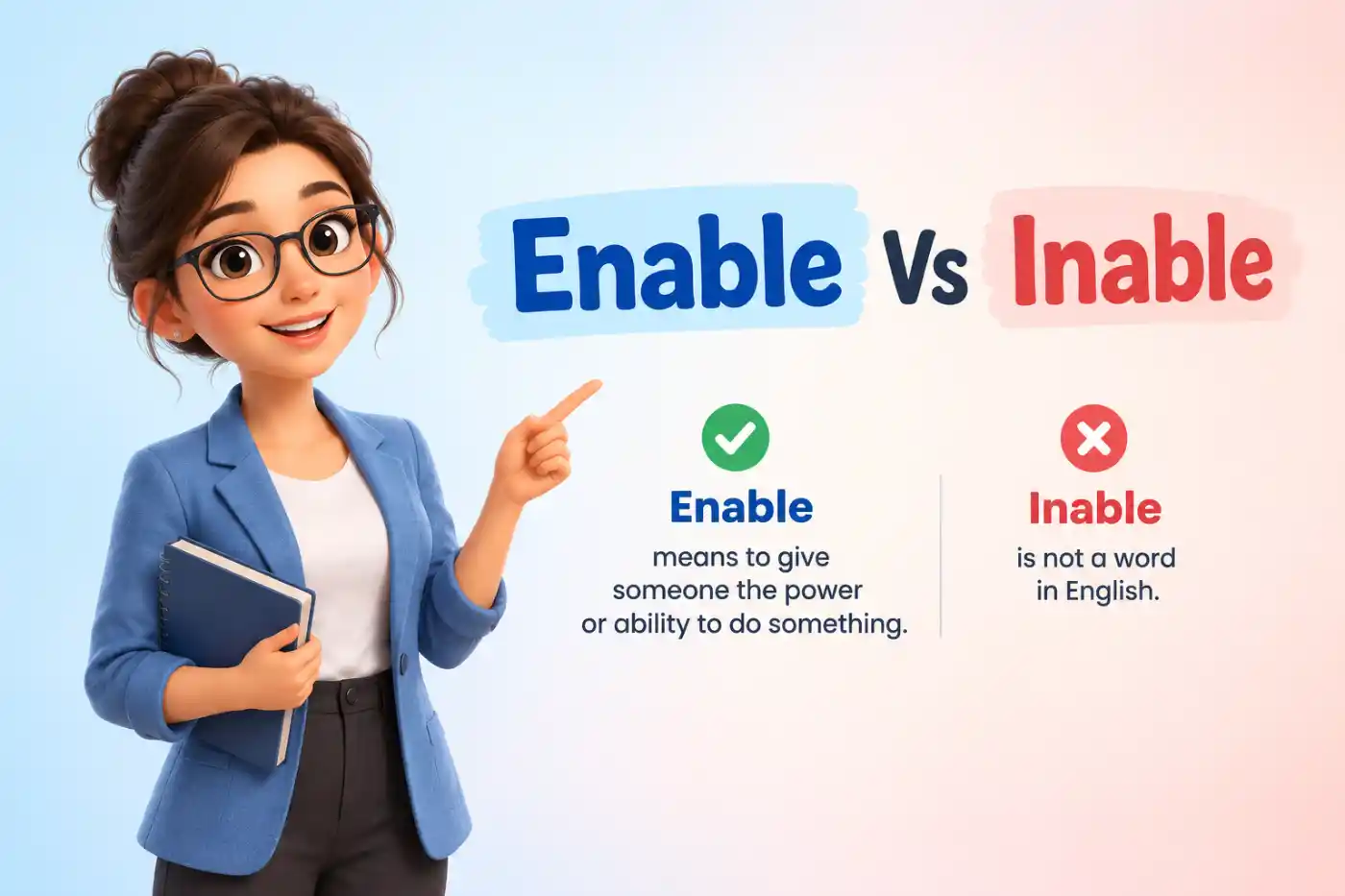
If you have searched for enable vs inable, you probably want a simple answer. The correct modern English word is enable when you mean to make something possible or give someone the ability, means, or opportunity to do something. Inable is not the normal word for this meaning in present day standard English. If you mean not able, the word you need is unable.
The confusion is understandable. Enable and inable look almost identical on the page. English also uses several prefixes that change the meaning of a word. That can make inable look like a logical opposite of enable or able. The problem is that English vocabulary doesn’t always follow a neat formula. In this case, standard English uses unable for a lack of ability and enable for making something possible.
This distinction matters in school assignments, workplace emails, technical instructions, academic writing, websites, and everyday communication. A single letter can point readers toward a different meaning.
This guide explains the difference between enable and inable in detail. You’ll learn the correct spelling, meaning, pronunciation, grammar, word history, common mistakes, sentence patterns, related words, and practical ways to remember the correct form.
Quick Answer
Enable is the correct standard English word when you mean to make something possible, give someone the ability to do something, or activate a feature. Inable isn’t normally used in modern standard English. If you mean not able, use unable. Oxford records historical use of inable but identifies enable as the modern form.
Enable Vs Inable At A Glance
| Feature | Enable | Inable |
|---|---|---|
| Standard modern English | Yes | No |
| Normal modern usage | Common | Rare and nonstandard |
| Part of speech | Verb | Historical adjective and verb |
| Main meaning | Make possible or give ability | Historical forms included unable or enable |
| Modern formal writing | Recommended | Avoid |
| Common alternative | Allow or permit | Unable when meaning not able |
| Example | The update enables faster payments. | Avoid this form in ordinary modern writing. |
The table gives you the practical answer quickly. If you’re writing something today and you’re choosing between these forms, enable is the normal choice when you mean make possible.
However, there’s an important detail that many short spelling articles miss. Saying that inable has never existed isn’t quite accurate. Historical English did use inable. Oxford notes that enable comes from Middle English and was formerly also written as inable. Wiktionary records older uses of inable meaning unable and older uses meaning enable. Those historical forms don’t make inable a suitable replacement for enable or unable in modern standard English.
That small historical point gives us a more accurate answer.
What Does Enable Mean
Enable is a verb. It means to make someone or something able to do something, make something possible, or provide the means or conditions needed for an action.
Cambridge defines enable as making someone able to do something or making something possible. Oxford gives similar meanings and also lists a computing sense in which enable means making a system, device, or feature ready for use.
Consider these examples.
- The new software enables employees to work from home.
- Better lighting enables drivers to see the road clearly.
- The scholarship enabled her to attend college.
- This setting enables automatic updates.
- The new bridge enables easier access to the town.
In each sentence, something creates a possibility or provides the means for an action.
That is the central idea behind enable.
Enable As A Verb
Enable is normally a transitive verb. That means it generally takes an object.
For example:
The training enabled the workers to use the equipment safely.
Here, training is the subject. Workers are the object. To use introduces the action made possible by the training.
The common structure is:
enable + person or thing + to + verb
Examples include:
- The course enabled students to improve their writing.
- The device enables users to monitor their heart rate.
- The new policy enables businesses to apply online.
- The payment system enables customers to check out quickly.
Oxford specifically gives the pattern enable somebody to do something. Cambridge also shows enable followed by an object and a to infinitive.
This pattern is worth remembering because it prevents a common grammar mistake.
Incorrect:
The program enables users create reports.
Correct:
The program enables users to create reports.
The word to belongs in this structure.
What Does Inable Mean
For modern English learners and writers, the practical answer is simple. Inable is not the normal standard English word you should use today.
If you write inable in an ordinary email, essay, report, article, or technical document, readers will usually assume you made a spelling mistake.
However, historical usage makes the story more interesting.
Oxford says that enable comes from Late Middle English and notes that it was formerly also used as inable. Wiktionary records inable as an obsolete or nonstandard English adjective meaning unable and as an obsolete or nonstandard verb meaning enable.
So two statements can both be true.
Inable has appeared in English.
Inable is not the standard modern choice for ordinary writing.
That’s why a good editor won’t simply pretend the historical form never existed. Language changes over time. A form can appear in older texts and still be unsuitable for current standard English.
For present day writing, use the word that expresses your intended meaning.
Use enable for make possible.
Use unable for not able.
Enable Vs Inable And Unable
This is where the confusion becomes much easier to understand.
Many people searching for enable vs inable aren’t really deciding between two valid modern words. They may actually be trying to choose among three forms.
| Word | Meaning | Part of speech | Example |
|---|---|---|---|
| Enable | Make possible or give ability | Verb | The tool enables faster work. |
| Unable | Not able | Adjective | I was unable to attend. |
| Inable | Historical or nonstandard form | Adjective or verb in older usage | Avoid it in normal modern writing. |
The distinction is clear once you connect each word to its job.
Enable describes an action that creates ability or possibility.
Unable describes a person or thing that lacks ability.
Inable isn’t the standard modern form for either job.
Compare these sentences.
The training enabled Maria to operate the machine.
This says the training gave Maria the ability or opportunity to operate the machine.
Maria was unable to operate the machine.
This says Maria couldn’t operate it.
The meanings move in opposite directions. One creates a possibility. The other describes a lack of ability.
Why People Confuse Enable Vs Inable
The mistake doesn’t come from nowhere. Several features of English make inable look convincing.
The Words Look Similar
Enable and inable share most of their letters.
That visual similarity can fool the eye, especially when you’re reading quickly. The difference is only the vowel near the beginning.
This kind of spelling confusion happens often in English because many words have related prefixes and endings.
English Has Several Negative Prefixes
English uses several prefixes to express negative meanings.
Examples include:
- inactive
- incomplete
- inaccurate
- impossible
- irregular
- irresponsible
- unable
Because in or im appears in several negative words, a writer might naturally guess that inable means not able.
That guess makes sense at first glance.
It just isn’t the standard modern form.
English has developed from many languages over centuries. Its spelling and word formation don’t follow one simple mathematical rule.
The Sound Can Cause Confusion
Enable is pronounced:
/ɪˈneɪbəl/
The main stress falls on the second syllable. Cambridge gives the same pronunciation for American and British English.
Because the first syllable is unstressed, some listeners may not clearly distinguish the opening sound in quick conversation.
That can lead people to spell the word based on what they think they hear.
Still, the standard spelling remains enable.
People Expect An Opposite Form
Another common assumption is:
able → enable → inable
But English doesn’t work that neatly.
The standard negative adjective is unable, not inable.
There is also disable, which can mean to switch something off or prevent something from functioning.
So the useful modern family looks more like this:
- able
- enable
- unable
- disable
- inability
Learning the whole family is more useful than trying to invent a missing form.
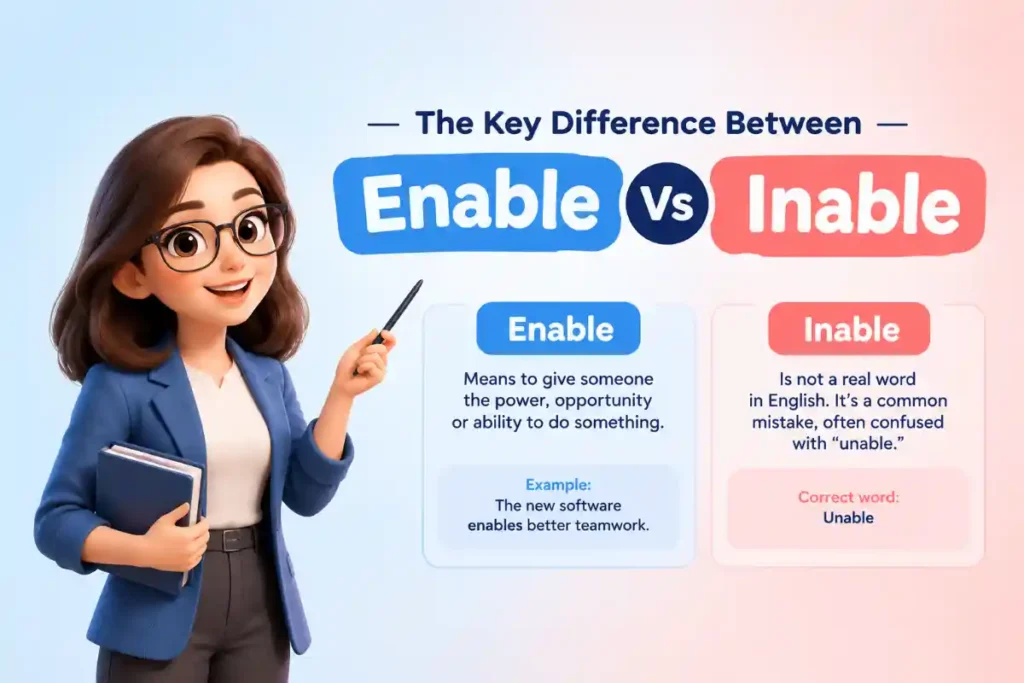
The Key Difference Between Enable Vs Inable
A useful way to remember the difference is to focus on direction.
Enable moves toward possibility.
Unable describes a lack of ability.
For example:
The new equipment enabled the team to finish the work.
The equipment helped make the action possible.
The team was unable to finish the work.
The team could not complete the action.
This distinction becomes especially important in professional writing. Changing enable to unable doesn’t merely create a spelling issue. It can reverse the meaning of a sentence.
Grammar Rules For Enable
Enable has a fairly predictable grammar pattern.
Enable Someone To Do Something
This is one of the most useful structures to learn.
enable + person + to + base verb
Examples:
- The grant enabled the organization to expand.
- The training enabled employees to work safely.
- The new system enables customers to pay online.
- Her experience enabled her to solve the problem.
- The map enabled us to find the trail.
Don’t remove to from this structure.
Incorrect:
The course enabled me improve my writing.
Correct:
The course enabled me to improve my writing.
Cambridge Grammar Today specifically describes enable as taking a direct object followed by a to infinitive.
Enable Something To Happen
Enable can also describe conditions that make an event possible.
Examples:
- The design enables the machine to operate efficiently.
- The new road enables faster travel.
- Better insulation enables the building to retain heat.
- The platform enables users to share files.
Oxford gives examples of enable being used to describe the creation of conditions that allow something to happen or exist.
Enable Something
In technology, enable can also mean activate or turn on a function.
Examples:
- Enable notifications.
- Enable location services.
- Enable two factor authentication.
- Enable automatic updates.
- Enable dark mode.
Here, the object is usually a feature, setting, service, or function.
This is one of the most familiar modern uses of the word.
Enable Verb Forms
Enable is a regular verb.
| Form | Word |
|---|---|
| Base form | enable |
| Third person singular | enables |
| Past tense | enabled |
| Past participle | enabled |
| Present participle | enabling |
Oxford lists these standard forms.
Examples:
Present
This feature enables users to save time.
Past
The upgrade enabled faster processing.
Present participle
The new system is enabling better communication.
Perfect form
The update has enabled customers to access their accounts more easily.
Spelling When Adding Endings
The spelling stays fairly straightforward.
enable → enables, enable → enabled, and enable → enabling
Notice the spelling of enabling.
You don’t write enableing.
The final silent e is removed before the suffix ing.
So:
enable + ing = enabling
Not:
enableing
This is a useful spelling pattern that also appears in words such as make and making.
Pronunciation Of Enable Vs Inable
The American English pronunciation is:
/ɪˈneɪ.bəl/
Cambridge gives this pronunciation for American English and British English.
The word has three syllables.
e • na • ble
The strongest stress falls on the middle syllable.
The first syllable is relatively weak, which can partly explain why some people hear or remember the beginning incorrectly.
A common mistake is to pronounce the word as though it begins with a strong long ee sound. Standard pronunciation doesn’t use that pattern.
The easiest approach is to listen to the word and pay attention to the stressed middle syllable.
Enable In American English
Enable is a standard and common word in American English.
It appears in ordinary conversation, business writing, education, technology, healthcare, government, journalism, and academic writing.
Examples include:
- The new policy enables small businesses to apply online.
- This feature enables users to save their settings.
- The scholarship enabled him to continue his education.
- The device enables remote monitoring.
- The agreement enables both companies to share data.
There is no American spelling variation that changes enable to inable.
Enable In British English
British English also uses enable.
Oxford lists enable as a standard English verb and gives the same basic meanings found in American English.
The spelling doesn’t change between British and American English.
That’s important because some English words do have regional spelling differences.
For example, British English often uses forms such as colour and organise while American English commonly uses color and organize.
Enable is not one of those words.
American English: enable.
British English: enable.
Canadian English: enable.
Australian English: enable.
The standard spelling remains the same.

Enable In Technology
Technology has made enable especially common.
When a device or application has a feature, the word enable often means activate or turn that feature on.
Examples include:
- Enable notifications.
- Enable Bluetooth.
- Enable automatic backups.
- Enable camera access.
- Enable location services.
- Enable two factor authentication.
- Enable parental controls.
- Enable voice access.
Oxford specifically includes a computing meaning for enable that describes making a system, device, or feature ready for use.
This technical use is so common that many people first encounter the word in a settings menu.
The opposite in this context is usually disable.
For example:
Enable notifications.
means turn notifications on.
Disable notifications.
means turn notifications off.
Don’t use unable in this technical context.
You wouldn’t normally say:
Unable notifications.
That doesn’t express the intended meaning.
Enable Vs Disable
Enable and disable are often confused because they appear together in software and device instructions.
They are contrasting verbs.
Enable means activate or make possible.
Disable means turn off, prevent, or make something unavailable.
Examples:
Enable automatic updates.
Disable automatic updates.
The administrator enabled access.
The administrator disabled access.
This pair is especially important in technical writing because a single word can change an instruction completely.
Enable Vs Allow
Enable and allow are often close in meaning, but they aren’t always identical.
Allow usually focuses on permission.
Enable often focuses on making something possible by providing the means, conditions, ability, or opportunity.
Compare:
The manager allowed me to leave early.
The manager gave permission.
The new system enabled me to finish the report faster.
The system made the action possible or easier.
Cambridge lists allow among the related meanings of enable, while Oxford explains enable as creating the necessary conditions for something to happen.
That distinction isn’t absolute. In many sentences, the two words can overlap.
Still, professional writers should consider the exact relationship they want to express.
Enable Vs Empower
Empower means giving someone power, authority, confidence, or control to act.
Enable is broader.
For example:
The training enabled employees to use the new system.
This focuses on ability or opportunity.
The manager empowered employees to make their own decisions.
This focuses more on authority or control.
The words overlap in some contexts, but they aren’t perfect substitutes.
Enable Vs Facilitate
Facilitate means make an action easier or help a process happen.
Enable means make something possible or provide the conditions needed for it.
For example:
The software enables users to create reports.
The software facilitates faster report creation.
Both sentences can work, but they emphasize different ideas.
Enable focuses on capability.
Facilitate focuses on ease or support.
Real Life Examples Of Enable
The best way to understand a word is to see it doing real work in sentences.
Everyday Conversation
- This app enables me to track my spending.
- The new bus route enables people to get downtown faster.
- Her support enabled me to stay calm.
- The extra time enabled us to finish the project.
- Good planning enables you to avoid many problems.
Workplace Writing
- The new software enables employees to access files remotely.
- The training enabled our team to complete the task safely.
- This process enables managers to review applications more quickly.
- The system enables customers to update their information online.
- The agreement enables both companies to work together.
Academic Writing
- The study enables researchers to compare the two groups.
- Better data enables scientists to identify important patterns.
- The framework enables students to analyze complex ideas.
- The evidence enabled the researchers to develop a clearer explanation.
- The method enables more accurate comparisons.
Technology
- Enable automatic updates before leaving the settings page.
- This feature enables users to share documents securely.
- The device enables wireless communication.
- Enable notifications if you want alerts from the application.
- The update enables faster file transfers.
These examples show how flexible the word is. Enable can describe people, systems, technology, policies, education, money, tools, and conditions.
Common Mistakes With Enable
Mistake One
The training enabled me improve.
Correct:
The training enabled me to improve.
Remember the pattern enable someone to do something.
Mistake Two
The new system inabled users to apply.
Correct:
The new system enabled users to apply.
The past tense is enabled.
Mistake Three
I was inable to attend.
Correct:
I was unable to attend.
The standard adjective meaning not able is unable.
Mistake Four
The update was unable automatic backups.
Correct:
The update enabled automatic backups.
Unable describes lack of ability. Enable describes creating or activating ability.
Mistake Five
The app enable users to save files.
Correct:
The app enables users to save files.
A singular third person subject takes enables in the present tense.
Mistake Six
The program enables users creating reports.
Correct:
The program enables users to create reports.
Use the to infinitive after the object.
Why Inable Looks So Logical
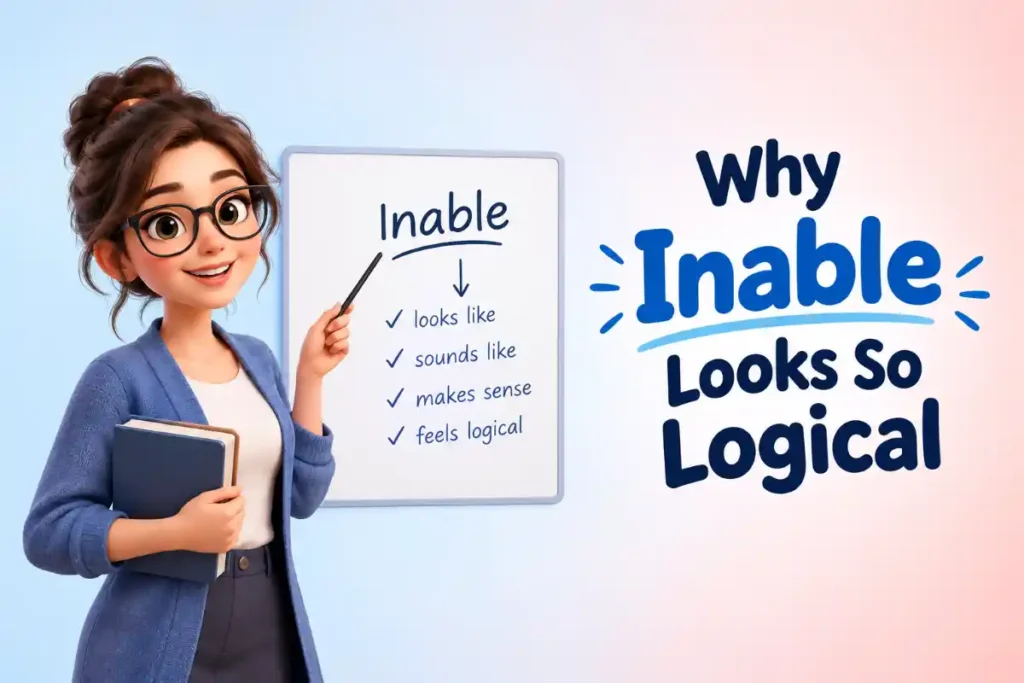
This deserves special attention because it explains the mistake better than simply saying don’t spell it that way.
English uses negative prefixes in many ways.
We have:
- able → unable
- active → inactive
- accurate → inaccurate
- complete → incomplete
- possible → impossible
- regular → irregular
So a learner might reasonably think:
able → inable
That looks logical.
But vocabulary isn’t built entirely through rules that speakers can apply freely. Many words have forms that developed through centuries of use.
The correct negative form became unable.
The verb meaning make possible became enable.
That’s why trying to create inable from a simple prefix rule doesn’t work for standard modern English.
The History Of Enable Vs Inable
The history is more interesting than a basic spelling article might suggest.
Oxford traces enable to Late Middle English and notes that the word was formerly also used as inable.
That historical note matters because it shows that spelling wasn’t always fixed in the form modern readers expect.
Wiktionary records two historical English uses of inable. One developed from in plus able and meant unable. Another developed from in plus able and was used as a verb meaning enable. Both are marked obsolete or nonstandard today.
Modern English eventually settled on clearer standard forms.
Today:
enable means make possible.
unable means not able.
disable can mean turn off or prevent from functioning.
inable isn’t the normal modern choice.
This is a good example of why historical word formation doesn’t always predict modern spelling.
The Word Family Around Enable
Understanding related forms makes the spelling easier to remember.
Able
Able is an adjective meaning capable of doing something.
She is able to solve the problem.
Enable
Enable is a verb meaning make able or make possible.
The training enabled her to solve the problem.
Unable
Unable is an adjective meaning not able.
She was unable to solve the problem.
Inability
Inability is a noun meaning lack of ability.
His inability to access the system delayed the work.
Enabled
Enabled is the past tense and past participle of enable. It can also function as an adjective.
The feature is enabled.
Enabling
Enabling is the present participle and can also function as an adjective.
The technology is enabling faster communication.
Cambridge and Oxford both list related forms such as enabled, enabling, enablement, and enabler.
Once you see the family together, inable starts to look less natural.
The Difference Between Unable And Inability
These two forms are closely related but have different grammatical jobs.
Unable is an adjective.
She was unable to attend.
Inability is a noun.
Her inability to attend caused a problem.
The structure changes because the part of speech changes.
You can’t normally replace one with the other without changing the sentence.
Incorrect:
Her unable to attend caused a problem.
Correct:
Her inability to attend caused a problem.
This distinction is useful for academic and professional writing.
Memory Tricks For Enable Vs Inable
A good memory trick should help you remember meaning, not just spelling.
Think Of Enable As Make Able
Look at the word:
enable
You can connect it mentally with:
make able
For example:
The training enabled me to work independently.
The training made it possible for me to work independently.
Remember Unable For Not Able
If you’re describing something a person cannot do, think:
unable = not able
I am unable to attend.
That simple connection covers most situations.
Think Of Disable For Turn Off
For technology:
enable = turn on
disable = turn off
This makes the technical meaning easy to remember.
Don’t Build Inable From A Prefix
If your brain suggests inable, pause.
Ask:
Am I trying to say make possible?
Use enable.
Am I trying to say not able?
Use unable.
Am I trying to say turn off?
Use disable.
That three word check catches most mistakes.
Enable In Formal Writing
Enable is perfectly appropriate in formal writing.
It appears in academic work, business documents, technical manuals, reports, government documents, and professional communication.
For example:
The proposed framework enables researchers to evaluate the results more efficiently.
That sentence is formal but natural.
However, writers should avoid using enable simply because it sounds more sophisticated than a simpler alternative.
Sometimes allow, let, or help is clearer.
Compare:
The software enables users to save files.
The software lets users save files.
The second version is more conversational.
In a technical manual, enable may be the better choice because the action involves activating a feature.
In casual conversation, let may sound more natural.
Good editing isn’t about choosing the most formal word. It’s about choosing the clearest word for the situation.
Enable In Academic Writing
Enable works well in academic writing when the evidence supports a relationship between a condition and an outcome.
Examples:
The new method enabled researchers to collect more detailed data.
Improved access to information enables students to conduct more independent research.
The model enables comparison across several variables.
Be careful not to overstate causation.
If something merely helped an outcome, helped or supported may be more accurate than enabled.
For example, saying a particular factor enabled a result can suggest that it made the result possible.
That is stronger than saying it simply contributed to the result.
This is an important editorial point. Word choice isn’t just about grammar. It also communicates the strength of the relationship between ideas.
Enable In Business Writing
Enable is common in business communication.
Examples include:
- The new process enables faster customer service.
- The platform enables teams to collaborate remotely.
- The investment enabled the company to expand.
- The training enabled employees to use the new system.
- The agreement enables both organizations to share resources.
Business writers should still watch for unnecessary jargon.
Phrases such as enablement, enabler, and enabling framework can be useful in specific professional contexts, but plain English is often clearer.
Instead of:
This initiative will enablement the organization to improve performance.
Write:
This initiative will enable the organization to improve performance.
The noun enablement exists, but it doesn’t belong where the verb enable is required. Cambridge and Oxford both recognize enablement as a noun meaning the process of making something possible or ready for use.
Enable In Technical Writing
Technical writers use enable in two main ways.
The first means make something possible.
The connection enables the device to communicate with the server.
The second means activate a feature.
Enable automatic updates.
Both uses are standard.
Technical writers should be especially careful with enable, disable, unable, and available.
These words don’t mean the same thing.
Enable means activate or make possible.
Disable means deactivate or prevent.
Unable means not capable.
Available means ready or accessible for use.
Using the wrong one can create a confusing instruction.
Enable And Passive Voice
Enable can appear in passive constructions.
For example:
The feature was enabled by the administrator.
Here, the feature receives the action.
Another example is:
The system was enabled after the installation was complete.
Passive voice is grammatically correct. Still, active voice is often clearer when the actor matters.
Compare:
The administrator enabled the feature.
The feature was enabled by the administrator.
The first sentence is shorter and more direct.
Neither is automatically better. The right choice depends on what the sentence needs to emphasize.
Enable And Punctuation
Enable doesn’t require any unusual punctuation.
The main concern is sentence structure.
Correct:
The new software enables users to manage their accounts.
Correct:
The new software enables users to manage their accounts, even when they are traveling.
The comma separates the additional clause in the second example.
Don’t add a comma between enables and the object.
Incorrect:
The software enables, users to manage their accounts.
Correct:
The software enables users to manage their accounts.
The same basic punctuation principle applies to similar verb structures.
Common Internet Myths
Myth One
Inable is simply the opposite of enable.
Not in modern standard English.
The usual word for not able is unable.
Myth Two
Inable is always completely meaningless.
That’s too absolute.
Historical English records uses of inable. Oxford specifically notes historical use, and Wiktionary records obsolete or nonstandard senses.
The practical modern rule is still simple: don’t use inable in ordinary contemporary writing.
Myth Three
Enable and unable are just different spellings of the same word.
They have different meanings and different grammatical roles.
Enable is a verb.
Unable is an adjective.
Myth Four
If a word looks logical, English must accept it.
English doesn’t work like a perfectly regular formula.
Many words developed through historical changes that aren’t predictable from modern spelling rules.
Expert Editor’s Note About Enable Vs Inable
A professional editor would normally replace inable with either enable or unable, depending on the intended meaning.
The first question isn’t simply, “Is this spelling right?”
The better question is:
What is the writer trying to say?
If the sentence means make possible, use enable.
The training enabled staff to use the system.
For not able, use unable.
Staff were unable to access the system.
If the sentence means turn off a feature, use disable.
The administrator disabled the feature.
This approach is better than blindly replacing every occurrence of inable with enable.
Context controls the correction.
That matters because spelling correction should never change the intended meaning.
A Practical Editing Test For Enable Vs Inable
When you encounter inable, follow these steps.
- Read the whole sentence.
- Ask what the writer means.
- If the meaning is make possible, change it to enable.
- If the meaning is not able, change it to unable.
- If the meaning is turn off or prevent operation, consider disable.
- Read the sentence again to make sure the grammar still works.
- Check the verb form if the sentence is in the past or continuous tense.
For example:
The new system inabled users to work remotely.
The intended meaning is clearly make possible.
Correct:
The new system enabled users to work remotely.
Now consider:
I was inable to attend the meeting.
The intended meaning is not able.
Correct:
I was unable to attend the meeting.
This small editing test works in most ordinary situations.
Related Words Enable Vs Inable
Several words belong to the same semantic area.
Able
Means capable.
She is able to complete the task.
Enable
Means make possible or give ability.
The tool enables her to complete the task.
Unable
Means not able.
She is unable to complete the task.
Inability
Means lack of ability.
Her inability to complete the task caused a delay.
Disable
Means turn off, deactivate, or prevent normal operation.
The administrator disabled the account.
Allow
Means give permission or make possible.
The manager allowed us to leave early.
Permit
Means officially allow.
The permit allows visitors to enter the building.
Facilitate
Means make a process easier or help it happen.
The software facilitates communication.
Empower
Means give someone power, authority, or confidence to act.
The program empowers students to make decisions.
Knowing these related words gives you more precise choices when writing.
Synonyms For Enable
Depending on context, useful alternatives include:
- allow
- permit
- make possible
- facilitate
- support
- assist
- empower
- authorize
- activate
- provide
- equip
These words aren’t interchangeable in every sentence.
For example, activate works well for a software feature.
Activate the account.
Authorize works better when permission or official approval is involved.
The manager authorized the payment.
Facilitate works when something makes a process easier.
The new system facilitates communication.
A good writer chooses the synonym that matches the exact idea.
Opposites Of Enable
The best opposite depends on context.
Disable
Use it for features, systems, accounts, or functions.
Disable notifications.
Prevent
Use it when something stops an action from happening.
The barrier prevented access.
Block
Use it when something stops movement, access, or communication.
The firewall blocked the connection.
Prohibit
Use it when rules or authority forbid an action.
The policy prohibits outside access.
Restrict
Use it when access or ability is limited.
The settings restrict access to certain users.
There isn’t one universal opposite for enable.
That’s another reason inable isn’t useful as a supposed opposite.
Frequently Confused Expressions
Enable To
Correct:
The program enables users to create reports.
Able To
Correct:
Users are able to create reports.
Unable To
Correct:
Users are unable to create reports.
Enable For
This can be correct when the structure and meaning support it.
The update enables support for new devices.
However, don’t automatically use enable for when you actually need enable someone to do something.
Enabled By
Correct:
The feature was enabled by the administrator.
Enabled With
Correct in suitable technical contexts.
The device is enabled with wireless connectivity.
The exact construction depends on what follows the verb.
How Native Speakers Usually Handle The Problem
Native speakers generally don’t treat enable and inable as competing modern spellings.
In ordinary writing, enable is familiar and established.
If they want the negative meaning, they normally use unable.
If they’re talking about switching off a feature, they normally use disable.
That means the easiest way to sound natural is not to memorize a complicated rule. Learn the three useful forms as separate words.
Enable means make possible.
Unable means not able.
Disable means turn off or prevent.
Once that pattern becomes automatic, inable stops looking tempting.
FAQs About Enable Vs Inable
Is Enable The Correct Spelling
Yes. Enable is the standard modern English spelling for the verb meaning to make something possible, give someone the ability or opportunity to do something, or activate a feature. Cambridge and Oxford both list enable as a standard verb and provide examples of its use with people, systems, and technology.
Is Inable A Correct English Word
Inable has appeared in historical English, so it isn’t accurate to claim that the form has never existed. Oxford notes that enable was formerly also used as inable, while historical sources record obsolete or nonstandard uses. In present day standard English, however, inable isn’t the form you should normally use. Choose enable or unable according to the intended meaning.
Should I Use Inable Or Unable
Use unable when you mean not able. For example, write I was unable to attend the meeting. Don’t normally write I was inable to attend the meeting. Unable is the established modern adjective for expressing a lack of ability.
What Is The Difference Between Enable And Unable
Enable is a verb meaning make possible or give someone the means or ability to do something. Unable is an adjective meaning not able. Compare The training enabled her to work independently with She was unable to work independently. The first describes something that creates ability. The second describes a lack of ability.
What Is The Opposite Of Enable
There isn’t one universal opposite. Disable is the usual contrast when talking about software, devices, features, or accounts. Prevent, block, restrict, and prohibit can work in other contexts. If you mean a person cannot do something, use unable, not inable.
How Do You Use Enable In A Sentence
A common structure is enable someone or something to do something. For example, The new software enables employees to work remotely. You can also use enable with features and systems, as in Enable automatic updates. Oxford and Cambridge both document these standard patterns.
Is Enable Used In American English
Yes. Enable is a standard American English verb. Cambridge’s American Dictionary gives the pronunciation /ɪˈneɪ.bəl/ and defines it as making someone or something able to do something by providing what is necessary. The spelling enable is also used in British, Canadian, and Australian English.
How Can I Remember Enable And Unable
Use a simple meaning test. Enable means make possible. Unable means not able. For technology, remember another useful pair: enable means turn on and disable means turn off. If you see inable in your writing, stop and decide which of these meanings you actually need.
Final Takeaway Enable Vs Inable
The answer to enable vs inable is straightforward for modern writing.
Use enable when you mean make something possible, give someone the means or ability to act, or activate a feature.
When you mean not able use unable.
Use disable when you mean turn off or prevent a system or feature from operating.
Avoid inable in ordinary modern English. Although historical sources show that the form existed, it isn’t the standard choice for current writing.
The most useful pattern to remember is simple:
Enable makes something possible. Unable means not able. Disable turns something off.
Once you remember those three ideas, this spelling problem becomes much easier to spot and correct.

Founding Editor
Maya spent six years as a copyeditor at a regional newspaper before starting Grammist, which is where the “answer first” format came from: newsroom style guides don’t have room for a preamble.
She writes and reviews most of the word-pair and spelling entries, and has final say on anything that goes out under the Grammist name.