
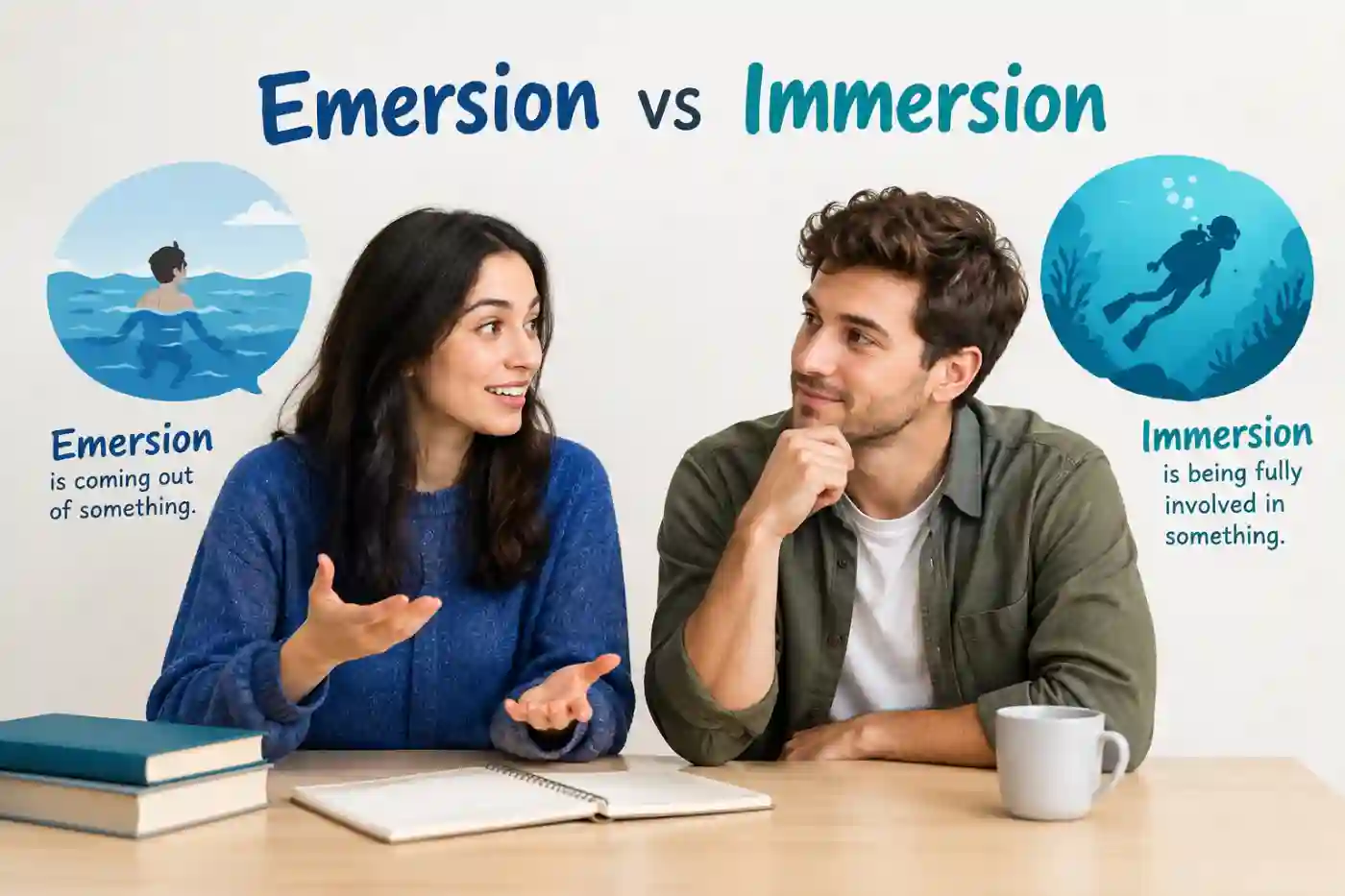
Emersion vs immersion can be confusing because the two words look almost the same and are closely related in meaning. The difference comes down to direction. Immersion describes going into something or becoming deeply involved in it. Emersion describes coming out or emerging from something.
That small change in the first part of the word creates a major difference in meaning.
You are far more likely to need immersion in everyday English. People talk about language immersion, immersion in a book, immersion in a culture, immersion in water, and immersive experiences. Emersion is a real English word too, but it appears much less often. It is especially useful in astronomy and in technical descriptions of something emerging from water or another surrounding medium. (Collins Dictionary)
The confusion becomes easier to solve once you connect each noun with its related verb. Immersion comes from immerse. Emersion is connected with emerge. One points inward. The other points outward.
This guide explains the difference clearly. You will learn the meaning, spelling, pronunciation, grammar, word history, regional usage, common mistakes, real examples, and simple memory tricks that can help you choose the right word without stopping to second guess yourself.
Emersion vs Immersion Quick Answer
Immersion means going into something, being submerged in it, or becoming deeply involved in an activity, subject, language, or experience. Emersion means emerging or coming out, especially from water or an eclipse. Immersion is common in everyday English. Emersion is much less common and mainly appears in specialized contexts. (Collins Dictionary)
Emersion vs Immersion At A Glance
| Feature | Emersion | Immersion |
|---|---|---|
| Correct spelling | Emersion | Immersion |
| Part of speech | Noun | Noun |
| Basic meaning | Emerging or coming out | Going into or being surrounded |
| Main direction | Out | In |
| Commonness | Uncommon | Very common |
| Water context | Coming out of water | Going into or being under water |
| Language context | Rare | Very common |
| Education | Rare | Common |
| Culture | Rare | Common |
| Astronomy | Common technical use | Also has a specialized use |
| Related verb | Emerge | Immerse |
| Typical audience | General and technical | General and technical |
| Example | The satellite’s emersion was observed. | The students joined an English immersion program. |
The table shows the central distinction. Immersion is associated with entering or becoming deeply involved. Emersion is associated with emerging or becoming visible again.
That distinction holds across the main uses of the two words.
Is Emersion A Correct Word
Yes. Emersion is a legitimate English noun. It is not simply a misspelling of immersion.
Major dictionaries recognize the word. Collins defines emersion as the act or instance of emerging and also gives a specific astronomy meaning involving the reappearance of a celestial body after an eclipse or occultation. Dictionary.com gives the same specialized astronomy sense and also records emersion as an older term for the act of emerging. (Dictionary.com)
The important point is usage.
A word can be correct without being common.
That is exactly what happens with emersion. You may rarely see it in everyday conversation, yet it remains useful in technical writing and certain scientific contexts.
For example:
- The telescope recorded the emersion of the moon from the occultation.
- The diver’s emersion marked the end of the experiment.
- The researchers documented the animal’s emersion from the water.
In ordinary conversation, people would often choose simpler wording such as coming out of the water, emerging from the water, or appearing again.
What Does Emersion Mean
Emersion means the act of emerging or coming out.
The word can describe physical movement from beneath a surface. It can also describe the reappearance of something that had been hidden or obscured.
Its strongest specialized use appears in astronomy. In that context, emersion refers to the reappearance of a celestial body after it has been hidden by an eclipse, occultation, or transit.
Think of a star disappearing behind another celestial object. When the star becomes visible again, astronomers can describe that event as its emersion.
The same basic idea works with water.
Imagine a diver beneath the surface. The diver rises and breaks through the water. That upward movement can be described as emersion.
The core idea is always outward movement or renewed visibility.
Emersion In Simple English
You can think of emersion as:
coming out
emerging
rising into view
becoming visible again
The word is a noun. Its related verb is emerge.
Examples include:
- The emersion of the diver was recorded on video.
- Scientists observed the emersion of the satellite.
- The turtle’s emersion from the water lasted only a few seconds.
- The astronomer carefully recorded the time of emersion.
Not every sentence needs the word emersion. In fact, using it simply to sound formal can make a sentence less natural.
A good editor chooses the word because it fits the meaning and context, not because it looks sophisticated.

What Does Immersion Mean
Immersion means entering something, being completely surrounded by something, or becoming deeply involved in something.
It has both a physical meaning and a figurative meaning.
In its physical sense, immersion can describe placing an object under a liquid or submerging a person in water. Collins also defines immersion as complete involvement in a subject or activity.
- The immersion of the equipment in water lasted five minutes.
- The swimmer practiced controlled immersion.
- The wood showed signs of prolonged immersion in water.
- The baptism involved immersion in water.
The figurative meaning is extremely common.
You can be immersed in:
- A book.
- A language.
- A culture.
- A project.
- A subject.
- A film.
- A game.
- A conversation.
- A new environment.
For example:
- She became immersed in the novel.
- The students experienced full immersion in Spanish.
- He was completely immersed in his research.
- The game creates a strong sense of immersion.
This figurative meaning explains why immersion appears so often in modern English.
The Core Difference Between Emersion vs Immersion
The simplest distinction is direction.
Immersion means going in.
Emersion means coming out.
Picture a person standing beside a swimming pool.
The person jumps into the water. That is immersion.
The person later climbs out of the water. That is emersion.
The words form a useful conceptual pair:
Immerse → go in.
Emerge → come out.
You do not need to memorize a complicated grammar rule. You only need to identify the movement or idea in the sentence.
Ask yourself:
Is something entering or becoming deeply involved?
Use immersion.
Is something emerging or becoming visible again?
Use emersion.
This simple test handles most situations.
Why Emersion vs Immersion Are Confused
The spelling is the biggest reason.
Emersion vs Immersion end in ersion. Both contain similar vowel and consonant sounds. They describe states or actions involving a relationship with something surrounding the subject.
They also have related Latin histories. Emersion comes from Latin emersus and is connected with emergere, meaning to emerge. Immersion traces back to Latin immersio, connected with immergere, meaning to plunge or dip into.
Modern speakers usually encounter immersion much more often than emersion. That creates another source of confusion.
Someone who sees emersion for the first time may assume that the writer accidentally left out the im.
That assumption is understandable, but it is not correct.
There is also a useful semantic connection between the words.
Immerse and emerge describe opposite directions.
That relationship is the best way to remember the nouns.
Emersion vs Immersion In Different Contexts
Water
Water is one of the clearest contexts for comparing these words.
Immersion describes entering or being under the water.
Emersion describes coming out of the water.
Examples:
- The swimmer practiced immersion techniques.
- The equipment must remain under water during immersion.
- The diver’s emersion took place several minutes later.
- The researchers observed the animal’s gradual emersion.
In everyday English, however, people often choose simpler expressions.
Instead of saying the swimmer’s emersion, someone might say the swimmer came out of the water.
That does not make emersion wrong. It simply reflects normal usage.
Language Learning
Immersion is the standard word for intensive exposure to a language.
You can say:
- English immersion.
- Spanish immersion.
- A language immersion program.
- An immersion course.
- Full language immersion.
For example:
The school offers an English immersion program for new students.
Using emersion in this context would change the meaning and create an error.
You are talking about becoming surrounded by and deeply exposed to a language. That is immersion.
Education
Immersion is also common in education more generally.
A student can experience immersion in a subject, environment, or learning program.
Examples include:
- Cultural immersion.
- Educational immersion.
- Immersion learning.
- An immersion program.
- Total immersion.
The word suggests sustained and close involvement.
Technology
Modern technology uses immersion frequently.
You may encounter phrases such as:
- Immersive technology.
- Virtual reality immersion.
- Immersive gaming.
- Immersive media.
- Immersive learning.
Here, immersion describes the feeling of being deeply surrounded by or involved in an artificial environment.
Emersion does not normally carry this meaning.
Astronomy
Astronomy gives both words specialized meanings.
In traditional astronomical terminology, immersion can refer to the disappearance of a celestial body as it enters an eclipse or occultation.
Emersion describes its reappearance afterward. Collins lists these specialized senses and explicitly contrasts the two terms. (Collins Dictionary)
This creates one of the clearest technical contrasts:
Immersion → disappearance from view.
Emersion → reappearance into view.
The terms are especially useful because they describe two stages of the same astronomical event.
Emersion vs Immersion In Grammar
Both emersion and immersion are nouns.
They can function as subjects or objects in sentences.
Emersion As A Noun
Examples:
- The emersion occurred shortly after sunset.
- Scientists recorded the emersion.
- The diver’s emersion was gradual.
You can also use the plural emersions when referring to multiple events.
Example:
- The researchers recorded several emersions during the study.
Immersion As A Noun
Examples:
- The immersion lasted ten minutes.
- Language immersion can improve exposure to natural speech.
- The device requires complete immersion in water.
Immersion is often used as an uncountable noun when discussing an experience or general process.
For example:
Language immersion can help learners build practical vocabulary.
It can also be countable when referring to a specific event or instance.
Related Verbs
The related verbs make the distinction easier.
Immerse means to put into something or involve deeply.
Emerge means to come out or become visible.
Examples:
- She immersed herself in the project.
- The diver emerged from the water.
- He immersed himself in Spanish.
- The moon emerged from the shadow.
Notice the direction again.
The grammar follows the meaning.
Spelling Rules For Emersion vs Immersion
There is no standard spelling variation that makes emersion and immersion interchangeable.
The first letter matters because it changes the word and its meaning.
Emersion begins with e.
Immersion begins with im.
Do not remove or add letters simply because one form looks more familiar.
The best spelling strategy is to connect each noun with its verb:
Emersion → emerge.
Immersion → immerse.
This is more reliable than trying to memorize the spelling by visual appearance alone.
Pronunciation Of Emersion vs Immersion
The two words sound similar, which adds to the confusion.
In American English, dictionary sources give pronunciations of emersion using forms represented by /ɪˈmɜrʒən/ and /ɪˈmɜrʃən/. Immersion is also commonly pronounced with a similar opening and a stress pattern centered on the second syllable.
The exact final sound can vary. Some speakers use a sound similar to the sound in vision, while others use a sound closer to mission. Both dictionaries record this variation for these words.
The important pronunciation point is stress.
Both words normally receive strong stress on the second syllable.
If you hear the words without seeing them written, the similarity can make the distinction difficult. That is one reason spelling and context matter so much.
Emersion vs Immersion Word Origin And History
The history of these words explains why they look so similar.
Emersion entered English from Latin roots connected with emergere, meaning to rise or come out. Collins dates the English word to the seventeenth century and traces it to Latin ēmersus.
Immersion has a related but different history. Collins traces it to Late Latin immersio, associated with the act of dipping in or plunging into something.
The two words therefore share a broad historical connection with movement in relation to a surrounding environment.
Their meanings developed in opposite directions.
That gives modern English speakers a helpful memory tool:
Emerse and emerge point outward.
Immerse points inward.
British And American English
The basic distinction is the same in American and British English.
Immersion is widely used in both varieties for physical submersion and deep involvement.
Emersion also exists in both varieties, but it remains much less common. Collins lists an astronomy sense and a general sense of emerging in British English. Its American English entry also records emersion as a word for emerging and gives the specialized astronomical sense.
Pronunciation can vary by region. Dictionary.com gives separate American and British pronunciations for emersion.
Canadian and Australian English follow the same broad distinction. You can safely use immersion for language learning, deep involvement, and submersion. Emersion remains a specialized term and is far less common in general conversation.
The key point is that this is not mainly a British versus American spelling issue.
It is a meaning and usage issue.
Emersion vs Immersion Examples And Mistakes
Real Life Examples Of Immersion
Immersion is common enough to appear in everyday conversation, education, science, technology, business, and entertainment.
Here are natural examples across different contexts.
Daily Conversation
- I got completely immersed in that book last night.
- The kids enjoyed being immersed in the warm water.
- She became immersed in the conversation.
- He was so immersed in the movie that he forgot to check his phone.
- The swimmer practiced controlled immersion in the pool.
Language Learning
- The school offers an English immersion program.
- Language immersion gives students more opportunities to hear natural speech.
- She improved her Spanish through complete immersion.
- The program combines classroom lessons with cultural immersion.
- Living with a host family gave him a deeper immersion in the language.
Workplace
- New employees receive an immersion experience during their first week.
- She became deeply immersed in the research project.
- The training gives staff practical immersion in the new system.
- He spent several months immersed in the company’s operations.
Academic Writing
- The study examined the effects of immersion on language development.
- Prolonged immersion affected the material’s physical properties.
- Cultural immersion can expose students to unfamiliar social practices.
- The researchers measured the effects of water immersion on the samples.
Technology
- The virtual reality system creates a strong sense of immersion.
- Better sound design can increase immersion in a game.
- The platform uses interactive features to create an immersive learning environment.
These examples show why immersion is such a useful word. It works in both literal and figurative situations.
Real Life Examples Of Emersion
Emersion is less common, so examples tend to appear in technical, scientific, or carefully descriptive writing.
Water
- The diver’s emersion occurred several minutes after the equipment check.
- The animal’s emersion was captured by an underwater camera.
- The researchers recorded each emersion from the pool.
- The seal’s brief emersion was visible from the boat.
Astronomy
- The astronomer recorded the emersion of the celestial body.
- The telescope captured the satellite’s emersion after the occultation.
- The timing of the emersion helped researchers calculate the event precisely.
- The observers waited for the predicted moment of emersion.
Technical Writing
- The instrument was monitored during immersion and emersion.
- The experiment measured temperature changes before and after emersion.
- The material showed visible changes following prolonged immersion and later emersion.
These examples show an important editorial point. Emersion is correct when the meaning calls for emergence. It should not replace immersion simply because the two words look related.
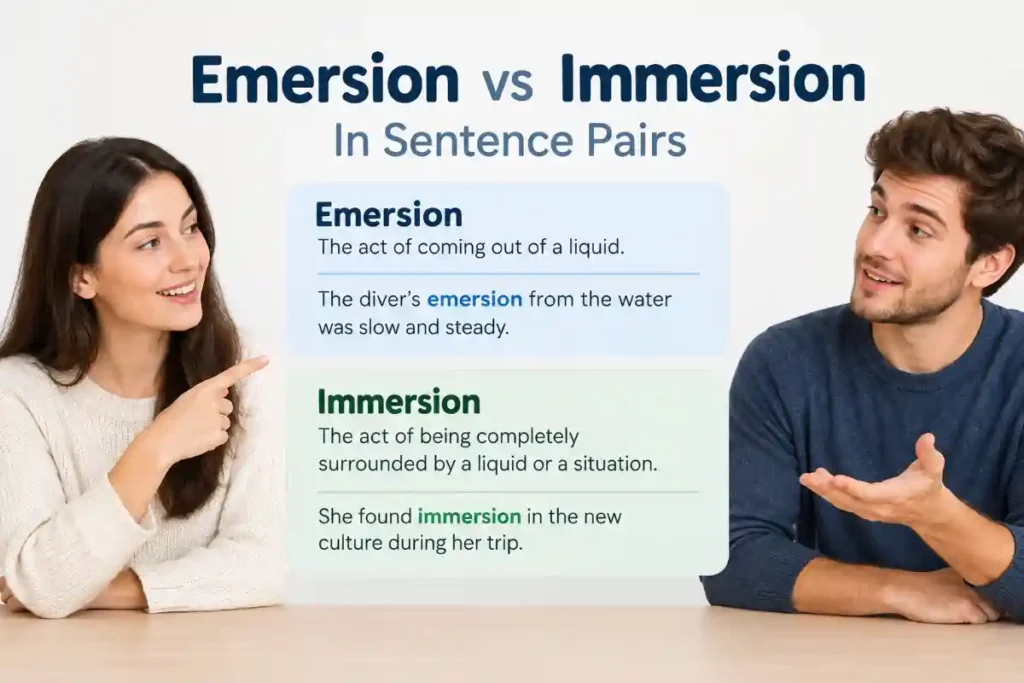
Emersion vs Immersion In Sentence Pairs
Side by side examples can make the difference easier to understand.
Immersion: The diver entered the water for full immersion.
Emersion: The diver came back to the surface after the immersion.
Immersion: The school uses language immersion to teach Spanish.
Emersion: Emersion has no role in this language learning context.
Immersion: The scientist placed the sample under water for immersion.
Emersion: The scientist removed the sample and observed its emersion.
Immersion: She became immersed in the novel.
Emersion: Emersion would not describe her involvement with the novel.
Immersion: The game offers deep immersion.
Emersion: Emersion would only fit if something were emerging or becoming visible.
The contrast is especially useful because it prevents a common mistake.
Do not decide based on how the word looks.
Decide based on what the subject is doing.
Common Mistakes With Emersion vs Immersion
Mistake One Using Emersion For Language Learning
Incorrect:
The university offers an English emersion program.
Correct:
The university offers an English immersion program.
Language learning involves deep exposure and involvement. The standard term is immersion.
Mistake Two Treating Emersion As A Misspelling
Incorrect assumption:
Emersion isn’t a real English word.
Correct understanding:
Emersion is a real word with a specialized meaning.
Dictionaries recognize it. Its use is simply much less common than immersion.
Mistake Three Using Immersion For Coming Out
Incorrect:
The diver’s immersion from the water was captured on film.
Better:
The diver’s emersion from the water was captured on film.
For everyday readers, an even more natural sentence would be:
The diver’s emergence from the water was captured on film.
That last option is often the clearest choice.
Mistake Four Assuming Rare Means Wrong
A word does not become incorrect simply because you rarely see it.
English contains many specialized words that ordinary speakers may encounter only occasionally.
Emersion is one of them.
The better question is not Have I seen this word often?
The better question is Does its meaning fit the sentence?
Mistake Five Confusing Emersion With Emergence
This is an important distinction.
Emergence is the common general word for the act of becoming visible, appearing, developing, or coming into existence.
Emersion is more specialized. It can refer to emerging from water and has a technical astronomy meaning involving reappearance after an eclipse or occultation.
For general writing, emergence is often the more natural choice.
For example:
The emergence of new technology changed the industry.
You would not normally replace emergence with emersion here.
Emersion vs Emergence
These three words deserve careful attention:
| Word | Core idea | Typical use |
|---|---|---|
| Emersion | Coming out or reappearing | Water and astronomy |
| Emergence | Appearing or developing | General English |
| Immersion | Going into or becoming deeply involved | Water, language, education, culture, technology |
Consider these examples.
The emergence of social media changed communication.
Something new developed or became visible.
The diver’s emersion was recorded by the camera.
The diver came out of the water.
The students benefited from language immersion.
The students became deeply exposed to a language.
The three words overlap around the general idea of movement or change, but their practical uses are different.
Memory Tricks For Emersion vs Immersion
The best memory tricks connect spelling with meaning.
Remember E For Emerge
Emersion starts with E.
Think:
E = Emerge = Exit.
This gives you three connected ideas.
E.
Emerge.
Exit.
Emersion means coming out.
Remember Im For Into
Immersion starts with Im.
Think:
Im = Into.
Immersion means going into something or becoming deeply involved in it.
This is not a complete linguistic explanation of the prefix. It is simply a useful memory aid for English learners.
Use The Swimming Pool Test
Imagine a swimmer.
Going into the pool means immersion.
Coming out means emersion.
If you can picture the movement, you can usually choose the word.
Connect The Verbs
This may be the strongest memory trick.
Immerse → immersion.
Emerge → emersion.
If you remember the verbs, the nouns become easier.
Synonyms And Related Words For Emersion vs Immersion
Understanding related vocabulary can help strengthen the distinction.
Words Related To Immersion
Depending on the context, related words include:
- Submersion.
- Involvement.
- Absorption.
- Engagement.
- Exposure.
- Concentration.
- Participation.
- Involvement.
- Integration.
These words are not perfect replacements in every sentence.
For example, language immersion and language exposure overlap in meaning but do not always describe the same educational method.
Words Related To Emersion
Depending on the context, related words include:
- Emergence.
- Reappearance.
- Rising.
- Surfacing.
- Egress.
- Coming out.
Again, context matters.
In astronomy, reappearance may help a general reader understand emersion more easily.
In a technical report, emersion may be the more precise term.
Related Verbs
The most useful verbs are:
- Immerse.
- Emerge.
- Submerge.
- Surface.
- Absorb.
- Engage.
Compare:
She immersed herself in the course.
She emerged from the course with new skills.
The meanings are completely different.
Can Emersion And Immersion Be Interchanged
No.
They should not be treated as interchangeable synonyms.
Immersion describes entering, submerging, or becoming deeply involved.
Emersion describes emerging or coming out.
The two words can appear in the same discussion because one event may follow another.
For example:
The equipment underwent immersion before its emersion from the water.
That sentence makes the relationship clear. First the object goes in. Later it comes out.
However, in normal writing, you should not force both terms into a sentence simply because they form an interesting pair.
Precision comes first.
Is Immersion Always About Water
No.
This is one of the most important points for English learners.
Immersion began with a physical idea involving being put into something. Modern English uses the word much more broadly.
You can have:
- Language immersion.
- Cultural immersion.
- Educational immersion.
- Immersion in literature.
- Immersion in music.
- Immersion in research.
- Immersion in a hobby.
- Immersion in virtual reality.
- Immersion in a project.
For example:
She became completely immersed in her research.
No water is involved.
The meaning is figurative. She became deeply involved in the subject.
Is Emersion Always About Water
No.
Water is an important context, but it is not the only one.
Emersion can describe emergence generally. It also has a specific astronomy meaning involving the reappearance of a celestial body after it has been hidden during an eclipse or occultation.
Still, the word is uncommon in general conversation.
If you are writing for a broad audience, consider using emergence, reappearance, surfacing, or coming out when those words express your meaning clearly.
A specialized term is useful when it adds precision. It is not useful simply because it sounds more formal.
Emersion vs Immersion In Formal Writing
In academic and professional writing, accuracy matters more than familiarity.
If your subject is language education, immersion is the established choice.
For astronomy and you are describing the reappearance of a celestial body, emersion can be the precise technical term.
If you are describing a general social or scientific development, emergence may be better.
Professional editors usually look at context before choosing the word.
That is an important habit for writers.
Do not ask only:
Which word looks right?
Ask:
What exactly am I trying to describe?
If the answer is entering or deep involvement, use immersion.
If the answer is emerging or reappearing, consider emersion.
For a broader process of appearing or developing, emergence may be the natural choice.
A Practical Editing For Test Emersion vs Immersion
When proofreading a sentence, replace the noun with its related verb.
If you have immersion, try immerse.
If you have emersion, try emerge.
For example:
The students experienced immersion in French.
Try the verb:
The students immersed themselves in French.
The meaning works.
Now consider:
The satellite experienced emersion.
Try the verb:
The satellite emerged.
Again, the meaning works.
This quick substitution test is useful because verbs make direction easier to see.
Emersion vs Immersion Editor Guide
A professional editor would not normally change emersion to immersion simply because immersion is more familiar.
The editor would first check the intended meaning.
That distinction matters because spelling correction and word choice are different tasks.
If a sentence says:
The school offers an English emersion program.
The editor should change emersion to immersion because the sentence refers to intensive language exposure.
If a scientific report says:
The emersion of the satellite was observed at the predicted time.
The editor should not automatically replace emersion. In astronomy, the word has a precise technical meaning connected with the reappearance of a celestial body after an eclipse or occultation.
That is the difference between proofreading by appearance and editing by meaning.
What Dictionaries Tell Us
Dictionary sources consistently distinguish the two terms.
Collins defines immersion as the act or state of being immersed and also uses it for deep involvement in a subject or activity. Its American English entry includes the physical sense of being immersed and the figurative sense of deep engagement.
Collins defines emersion as an act or instance of emerging and gives a specialized astronomy sense involving the reappearance of a celestial body.
Dictionary.com similarly records emersion as a noun meaning the emergence of a heavenly body from an eclipse, occultation, or transit. It also records an older general sense of emerging.
So the dictionary evidence supports a simple editorial rule:
Do not treat emersion as a misspelling of immersion.
Instead, determine which meaning the sentence requires.
Emersion vs Immersion Which Word Sounds More Natural
For most general readers, immersion sounds much more familiar.
That is because the word has many common uses.
People talk about language immersion, cultural immersion, immersion in a book, immersion in a project, water immersion, and immersive technology.
Emersion has a narrower range.
A reader may understand it from context, but many readers will rarely encounter it outside technical or specialized writing.
This creates an important style choice.
If you are writing a general article and want to describe something coming out of water, emerging from the water may sound more natural than emersion.
For example:
The diver emerged from the water.
That sentence is simple and clear.
In a technical paper where the event needs a precise noun, emersion may be appropriate.
Good writing is not about using the rarest accurate word. It is about choosing the clearest accurate word.
Common Phrases With Immersion
These phrases are natural and widely understood:
- Language immersion.
- English immersion.
- Cultural immersion.
- Full immersion.
- Total immersion.
- Immersion program.
- Immersion course.
- Water immersion.
- Immersion therapy.
- Immersion learning.
- Immersive experience.
- Immersive technology.
- Immersive environment.
Examples:
The district offers a Spanish immersion program.
The students spent a month in cultural immersion.
The documentary creates an immersive experience.
The equipment was tested under water immersion conditions.
Common Phrases With Emersion
Emersion has fewer common combinations.
You may encounter:
- Emersion from water.
- Emersion of a celestial body.
- Emersion after an occultation.
- Emersion from an eclipse.
- Emersion event.
- Time of emersion.
These expressions are most likely to appear in scientific or technical material.
This limited range is another reason learners sometimes assume the word is wrong.
It is not wrong. It is simply specialized.
Formal And Informal Usage
Immersion works naturally in both formal and informal English.
Informal:
I got totally immersed in that show.
Formal:
The study examined the effects of immersion on language acquisition.
Emersion is more likely to appear in formal or technical writing.
Informal:
The diver came back up.
Technical:
The diver’s emersion was recorded by the monitoring system.
For general audiences, plain language usually wins.
What Native Speakers Commonly Expect
A native speaker seeing immersion program will immediately understand the intended meaning.
A native speaker seeing emersion program will probably stop and reconsider the sentence because that combination is unusual and does not fit standard language learning terminology.
This is not because emersion is badly spelled.
It is because the meaning is wrong for the context.
That distinction is worth remembering.
Correct spelling does not guarantee correct word choice.
A word can be spelled perfectly and still be the wrong word.
Emersion vs Immersion In Academic Writing
Academic writers should be especially careful with these terms because technical accuracy matters.
Use immersion for:
- Language immersion.
- Cultural immersion.
- Immersion in a research topic.
- Physical immersion in water.
- Immersion based experimental methods.
Emersion for:
- The act of emerging.
- Reappearance from an eclipse or occultation.
- Specialized descriptions of coming out of water or another medium.
Emergence for broader ideas such as:
- The emergence of a new theory.
- The emergence of a social movement.
- The emergence of new technology.
- The emergence of a pattern.
The words may appear related, but academic precision depends on choosing the exact term.
Emersion vs Immersion In Science
Science often gives these words sharper meanings.
In astronomy, the pair can describe opposite stages of an observational event.
A celestial body can disappear from view during an eclipse or occultation. That event can be described using immersion.
When the celestial body becomes visible again, the event can be described as emersion. Collins specifically records these astronomy meanings.
The terminology gives scientists a compact way to describe a precise sequence.
In general science writing, though, the surrounding context determines the best word.
A researcher describing a specimen being placed under water may use immersion.
A researcher describing the specimen coming out may use emersion.
Emersion vs Immersion In Social Media
Social media creates another source of confusion.
Short posts often spread unusual spellings quickly. A word may appear repeatedly in captions or comments even when the writer has misunderstood its meaning.
That does not make the spelling or usage correct.
If you see emersion used in a sentence about language learning, check the meaning before copying it.
For example:
She enrolled in an English emersion course.
The intended phrase is almost certainly:
She enrolled in an English immersion course.
This is a useful reminder that online frequency is not the same as dictionary authority.
Search results can also contain repeated mistakes. A large number of pages using the same form does not automatically make that form standard English.

Why Autocorrect Does Not Solve The Problem
Spell checkers can identify some spelling errors, but they cannot always identify a correctly spelled word used in the wrong context.
Both emersion and immersion are legitimate words.
That means a spelling checker may accept either one.
It cannot reliably know your intended meaning from a short sentence.
For example:
The school offers an English emersion program.
The spelling of emersion is valid.
The word choice is not.
That is a semantic error rather than a simple spelling error.
Human proofreading still matters because good editing considers meaning, context, audience, and register.
A Simple Decision Guide
Use this quick test.
Choose Immersion When
- Something goes into water.
- Something becomes submerged.
- Someone becomes deeply involved.
- A student receives intensive language exposure.
- Someone becomes deeply involved in a subject.
- A person enters an environment and experiences it closely.
- A technology creates a strong sense of involvement.
Examples:
The course uses language immersion.
The equipment requires water immersion.
She became immersed in the project.
Choose Emersion When
- Something comes out of water.
- Something emerges from beneath a surface.
- A celestial body becomes visible again after being hidden.
- A technical description specifically requires the noun for emerging.
Examples:
The diver’s emersion was recorded.
The telescope captured the satellite’s emersion.
Choose Emergence When
- Something appears or develops.
- A new trend becomes visible.
- A new idea comes into existence.
- You are writing for a broad audience and need the normal general word for appearing or developing.
Examples:
The emergence of artificial intelligence changed the field.
The emergence of new evidence changed the discussion.
Frequently Asked Questions
Is emersion a real word
Yes. Emersion is a legitimate English noun. It means emerging or coming out and has a specialized astronomy meaning involving the reappearance of a celestial body after an eclipse or occultation. It is much less common than immersion, so many readers may not recognize it immediately.
What is the difference between emersion and immersion
Immersion describes going into something, being submerged, or becoming deeply involved in an activity or subject. Emersion describes coming out or emerging. The easiest memory aid is to connect immersion with immerse and emersion with emerge. The two words can describe opposite stages of the same physical or astronomical event.
Is English emersion correct
No, not for a language learning program. The standard expression is English immersion. An immersion program gives learners extensive exposure to English through instruction and communication. Emersion means emerging or coming out, so it does not express the intended idea in this context.
Is emersion the opposite of immersion
In many physical and technical contexts, they can describe opposite directions. Immersion involves going into or becoming submerged, while emersion involves coming out or emerging. In astronomy, immersion can refer to the disappearance of a celestial body and emersion to its later reappearance.
Is immersion only used for water
No. Immersion has a broad figurative meaning. Someone can be immersed in a book, language, culture, research project, conversation, game, or subject. This figurative sense is extremely common in modern English. Collins specifically defines immersion as complete involvement in a subject or activity.
What is the difference between emersion and emergence
Emersion is a specialized noun for emerging or coming out, with a notable use in astronomy. Emergence is the much more common general noun for appearing, developing, or becoming visible. For broad everyday writing, emergence is often the more natural choice when you are describing a new idea, trend, problem, or development.
How do you remember emersion and immersion
Connect each word with its verb. Immersion goes with immerse, which means going into something or becoming deeply involved. Emersion goes with emerge, which means coming out or becoming visible. You can also remember the simple direction test: immersion means in, while emersion means out.
Which word should I use in everyday English
You will usually need immersion. It is common in language learning, education, water related contexts, culture, entertainment, technology, and figurative descriptions of deep involvement. Use emersion only when its specific meaning fits. In many everyday situations involving something coming out, emergence, surfacing, or coming out may sound more natural.
Final Takeaway
The difference between emersion and immersion is easier than it first appears.
Immersion means going into something, being submerged, or becoming deeply involved.
Emersion means coming out, emerging, or becoming visible again. It is a real word, but it is much less common and often appears in technical or astronomical contexts.
The biggest mistake is assuming that emersion is simply a misspelling of immersion. It is not.
When you are writing about language learning, culture, education, deep involvement, or submersion, immersion is usually the word you need.
When you are describing something emerging or reappearing, emersion may be correct.
And when you are discussing a broad process of something appearing or developing, emergence may be the better choice.
The easiest rule to remember is this:
Immerse means go in. Emerge means come out.
Once that connection sticks, these two easily confused words stop being a guessing game.

Founding Editor
Maya spent six years as a copyeditor at a regional newspaper before starting Grammist, which is where the “answer first” format came from: newsroom style guides don’t have room for a preamble.
She writes and reviews most of the word-pair and spelling entries, and has final say on anything that goes out under the Grammist name.