
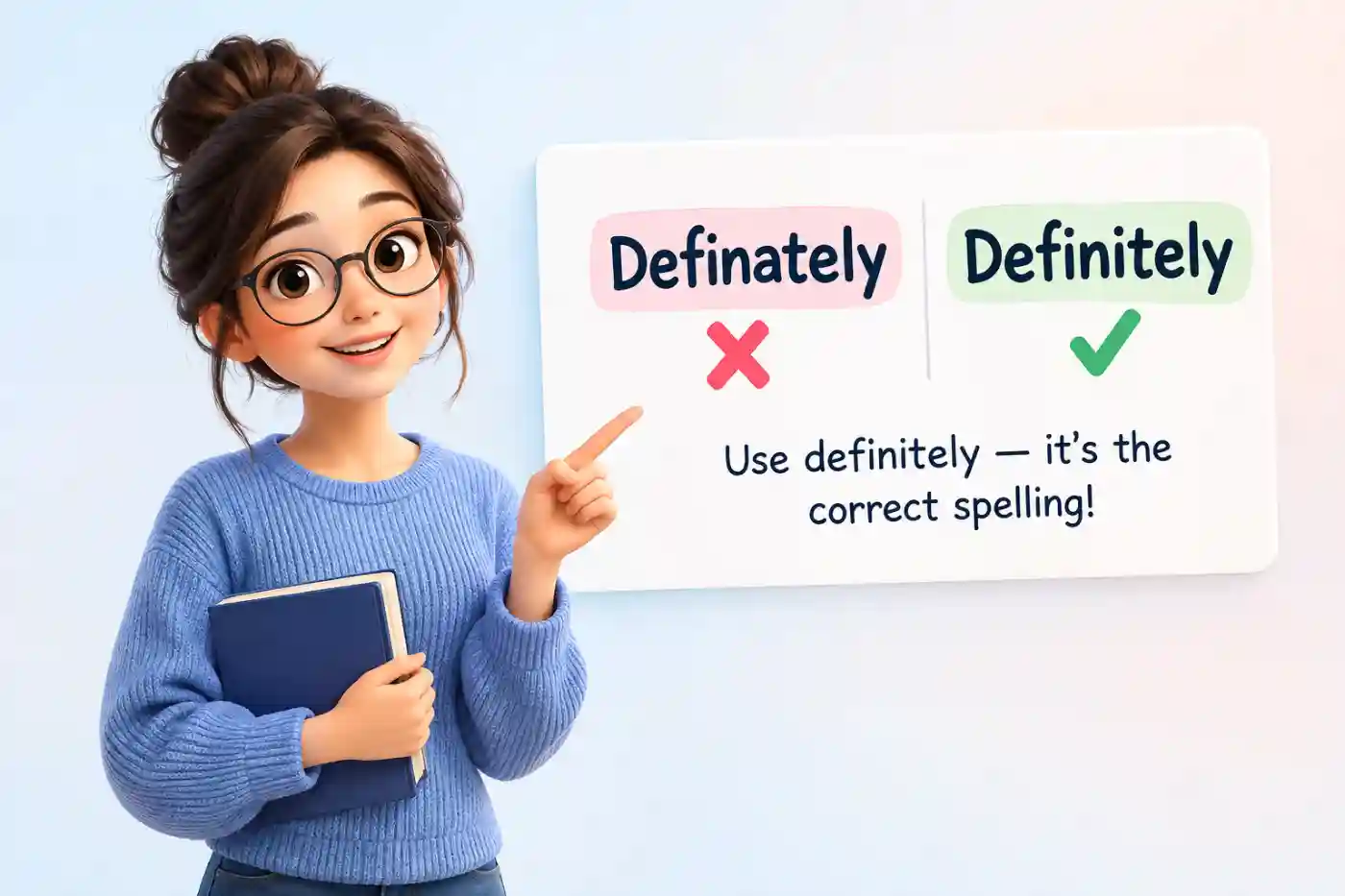
When you type definately or definitely you’re probably asking one simple question. Which spelling is correct. The answer is definitely. The spelling definately is a common misspelling and isn’t the standard form of the word.
This mistake is easy to make because the two forms look almost identical. The middle vowels can also sound less clear in normal speech. As a result it’s easy to write the spelling that seems natural instead of the spelling connected to the word’s root.
The correct word is closely related to definite and finite. That connection gives you a useful way to remember the spelling without memorizing every letter separately.
This guide explains the correct spelling, meaning, pronunciation, grammar, word origin, common mistakes, regional usage, memory tricks, related words, and practical proofreading advice.
Quick Answer
Definitely is the correct spelling. Definately is a common misspelling and should be corrected in standard English. Definitely is an adverb meaning certainly or without doubt. A useful spelling clue is the word finite inside definitely.
Definately Or Definitely At A Glance
| Feature | Definitely | Definately |
|---|---|---|
| Correct spelling | Yes | No |
| Standard English | Yes | No |
| Part of speech | Adverb | Not a standard word |
| Meaning | Certainly or without doubt | No separate standard meaning |
| American English | Standard | Incorrect |
| British English | Standard | Incorrect |
| Canadian English | Standard | Incorrect |
| Australian English | Standard | Incorrect |
| Formal writing | Correct | Incorrect |
| Informal writing | Correct | Incorrect |
| Main use | Expressing certainty | Usually a spelling mistake |
The important point is that this isn’t an American versus British spelling difference. English speakers in these major varieties use definitely.
Definately or Definitely Meaning
Definitely is an adverb that expresses certainty. It can mean certainly, without doubt, or in a clear and definite manner.
For example:
- I’ll definitely call you tonight.
- She definitely knows the answer.
- We definitely need more time.
- He definitely wants to join us.
The word can also stand alone as a response.
Are you coming with us?
Definitely.
In that context it expresses strong agreement or certainty.
Definately Meaning
Definately has no separate standard meaning. When someone writes definately while intending to mean certainly, they have misspelled definitely.
You may see the incorrect form in online comments, social media posts, text messages, search queries, or informal writing. Frequent online use doesn’t make it a standard spelling.
Use:
I definitely agree.
Not:
I definately agree.
Which One Is Correct
The correct spelling is definitely.
The spelling comes from the adjective definite with the adverb ending ly. The related word finite is also visible within the spelling.
That word family provides a useful reference when proofreading. Instead of trying to remember every letter independently, connect the word to finite and definite.

Why People Confuse Definately Or Definitely
Several factors make this word easy to misspell.
First, the two spellings have almost the same visual shape. A reader can easily overlook one vowel.
Second, pronunciation doesn’t give you a perfect letter by letter guide. Some unstressed sounds become less distinct during normal speech.
Third, the word is fairly long. Longer words naturally give writers more opportunities to make small spelling errors.
There’s also a useful pattern trap. English has many words that contain ate and later form adverbs with ately. That familiar pattern can make definately look reasonable even though the base word is definite.
Fast typing can reinforce the problem too. Once someone has typed a misspelling many times, they may stop seeing it during proofreading.
Definitely Pronunciation
Cambridge gives the American pronunciation as /ˈdef.ə.nət.li/ and the British pronunciation as /ˈdef.ɪ.nət.li/. The exact vowel sounds can vary by accent while the spelling remains definitely.
The main stress falls on the first syllable.
Pronunciation and spelling don’t always match perfectly in English. That’s why learning the relationship between related words can be more reliable than trying to spell a longer word entirely from sound.
The Spelling Pattern Inside Definitely
The most useful related forms are:
- finite
- definite
- definitely
- indefinite
- indefinitely
- infinite
- infinitely
These words share related roots and spelling patterns. Recognizing those connections can help you remember the correct form without memorizing a long list of individual spellings.
Definitely Grammar
Definitely is an adverb.
It commonly modifies a verb or strengthens a statement. Its position can change depending on the sentence structure.
Before a main verb
I definitely agree.
She definitely understands the problem.
After a form of be
He is definitely ready.
That is definitely true.
With an auxiliary verb
I will definitely help.
They have definitely arrived.
With a negative expression
I definitely do not want that.
She is definitely not interested.
It can also function as a short answer.
Will you come?
Definitely.
The main grammatical point is simple. Use the adverb when you want to express strong certainty.
Definitely In Formal Writing
Definitely is acceptable in formal and informal English.
The bigger issue in formal writing is the strength of the claim. The word expresses strong certainty, so it should match the evidence.
For example:
The results definitely support the conclusion.
That sentence makes a strong claim. In academic or professional writing, the writer should be confident that the available evidence supports that level of certainty.
Sometimes a more cautious expression is appropriate.
The results strongly support the conclusion.
The results appear to support the conclusion.
Good editing isn’t only about spelling. It also means choosing language that accurately reflects the evidence.
Definitely In Informal Writing
The word is very common in everyday conversation and casual writing.
Examples include:
- Definitely.
- I definitely want to go.
- That’s definitely him.
- I’ll definitely text you later.
- You should definitely try it.
There’s nothing wrong with using definitely in a text message or casual conversation. The spelling stays the same in informal writing.
Definitely In American British Canadian And Australian English
Definitely is the standard spelling across major varieties of English, including American, British, Canadian, and Australian English.
The spelling does not normally change based on the country where English is being used.
This is different from words such as color and colour, where regional spelling conventions can differ.
So you can safely use:
definitely
in American English.
definitely
in British English.
definitely
in Canadian English.
definitely
in Australian English.
The common spelling mistake definately does not become correct simply because of regional English differences.
Definitely Pronunciation
The pronunciation of definitely can help explain why the spelling causes trouble.
Cambridge gives the pronunciation as approximately:
US: /ˈdef.ə.nət.li/
UK: /ˈdef.ɪ.nət.li/
The middle vowel is relatively weak in normal speech, which can make the written form harder to reconstruct from sound alone.
A useful pronunciation guide is:
DEF uh nit lee
or, in a British pronunciation:
DEF ih nit lee
The important point is that pronunciation should not be used as the only guide to spelling. The spelling is best remembered through its connection with definite.
Definitely And Definite
Definitely comes directly from definite, so these words are closely connected.
Definite is an adjective. It can describe something clear, certain, specific, or clearly defined.
We need a definite answer.
Definitely is the corresponding adverb.
We definitely need an answer.
This relationship gives you an effective spelling shortcut.
Definite
becomes
Definitely
Notice that the i remains part of the spelling.
Definitely And Definitive
Definitely and definitive look similar, but they have different grammatical roles and meanings.
It is an adverb meaning certainly.
She will definitely arrive on time.
Definitive is an adjective meaning authoritative, conclusive, or providing a final answer.
The report provides a definitive explanation.
The two words share the same broader word family, but they should not be treated as interchangeable.
Definitely And Defiantly
Definitely and defiantly are another pair that can cause confusion because their spellings look similar.
It means certainly.
He definitely knows about the change.
Defiantly means in a way that shows resistance or open refusal to obey.
The child defiantly refused to leave the room.
The meanings are completely different.
A quick memory clue is:
definitely = certainty
defiantly = resistance
Using the wrong word can change the meaning of an entire sentence.
Definitely And Certainly
Definitely and certainly are close synonyms.
Both can express certainty.
I will definitely be there.
I will certainly be there.
The two words often work naturally in the same situations. Certainly can sometimes sound more formal or traditional, while definitely is extremely common in everyday English.
The best choice depends on the sentence, tone, and degree of emphasis you want.
Common Misspellings Of Definitely
Definately is the most common spelling error associated with definitely, but writers can make other mistakes too.
Some incorrect forms include:
- definately
- definatly
- definetly
- definitly
- definitelly
The correct spelling is:
definitely
A useful proofreading strategy is to avoid checking the whole word as one visual shape. Break it into its related form instead.
definite + ly = definitely
That makes the spelling easier to verify.
Common Mistakes With Definately or Definitely
The most common mistake is:
Incorrect: I will definately call you.
Correct: I will definitely call you.
Other misspellings include:
- definetly
- definatly
- definitly
- definatley
These errors usually involve changing, removing, or rearranging letters in the middle of the word.
Rather than memorizing every incorrect version, focus on recognizing the standard form when proofreading.
Common Internet Misconceptions
Seeing definately online doesn’t make it an accepted spelling.
Online writing contains many typos and informal spellings. Search frequency alone doesn’t determine standard English usage.
It’s also incorrect to describe definately as an American or British alternative. The standard spelling remains definitely in both varieties.
Autocorrect isn’t a perfect authority either. Different programs use different dictionaries and settings. A spelling tool can help identify errors but shouldn’t replace knowledge of the standard form.
Memory Tricks For Definitely
The easiest memory trick is to remember the related word finite.
Think of the word family as:
finite → definite → definitely
You can also remember that definitely has no A.
Another method is to start with definite and add ly.
This approach connects spelling with word formation instead of relying only on visual memory.
A Simple Proofreading Test
If you hesitate over the spelling, use this quick check.
- Ask what the word means.
- Replace it mentally with certainly.
- Check the spelling against definite.
- Read the whole sentence once.
For example:
I will definitely attend.
Replace the word:
I will certainly attend.
The meaning remains clear, confirming that definitely is the word you need.
Word Origin And Etymology
The spelling makes more sense when you understand the word’s history.
Etymonline traces definitely to definite + ly and dates the adverb to the 1580s. The adjective definite comes from Latin definitus, meaning bounded, limited, or defined. The Latin form is connected to definire, meaning to limit or determine, and ultimately to finis, meaning boundary or end.
This history helps explain the connection between finite, definite, and definitely.
The modern adverb was formed from definite with the common ending ly.
Related Words
Understanding related words can strengthen both spelling and vocabulary.
Definite
Definite is an adjective meaning clear, certain, exact, or settled.
I need a definite answer.
Definitely
Definitely is an adverb meaning certainly or without doubt.
I definitely agree.
Definitive
Definitive is an adjective meaning authoritative, conclusive, or final.
The report provides a definitive answer.
Definitively
Definitively is an adverb meaning in a conclusive or final manner.
The matter was resolved definitively.
Finite
Finite describes something that has limits.
The company has a finite budget.
Infinite
Infinite describes something without limits or an end.
The possibilities seem infinite.
Synonyms For Definitely
Depending on context, you can sometimes use:
- certainly
- surely
- absolutely
- clearly
- undoubtedly
- without doubt
- unquestionably
- for sure
These expressions aren’t identical in tone.
Certainly can sound more formal.
For sure is more conversational.
Absolutely can add stronger emphasis.
Undoubtedly often sounds more formal.
Choose the expression that fits the level of certainty and the tone of the sentence.
Opposites Of Definitely
Words and expressions that communicate less certainty include:
- maybe
- perhaps
- possibly
- probably
- potentially
- apparently
They aren’t exact grammatical opposites in every context, but they occupy a different point on the certainty scale.
Compare:
She will definitely arrive.
The speaker expresses strong certainty.
She may arrive.
The speaker leaves the outcome open.
Definitely In Real Life Writing
These examples show how the word works across different contexts.
Conversation
I’ll definitely be there tonight.
Workplace
I’ll definitely send the report this afternoon.
I’ll definitely follow up with you tomorrow.
Academic writing
The evidence definitely supports the main argument.
Social media
I’m definitely trying this recipe.
Journalism
The announcement definitely changed the direction of the discussion.
Personal writing
That was definitely one of the best trips I’ve taken.
The pattern stays the same. Definitely expresses certainty while its position changes according to the sentence structure.
What Editors Recommend
Professional editors correct definately to definitely because definitely is the standard spelling.
The most useful proofreading strategy is to recognize the word family and check the complete sentence.
Editors also consider meaning and tone.
For example:
The findings definitely prove the theory.
The spelling is correct. However, the statement makes a very strong claim.
If the evidence only provides substantial support, a more precise version might be:
The findings strongly support the theory.
That illustrates an important difference between proofreading and editing. Proofreading checks the mechanics. Editing also considers accuracy, clarity, tone, and the strength of a claim.
Definitely In Academic Writing
Students often use definitely to make a conclusion sound stronger.
That can work when the evidence supports certainty. However, academic writing usually benefits from precise claims.
Compare:
The results definitely prove the treatment works.
and:
The results strongly support the conclusion that the treatment works.
The second sentence gives the writer more room to match the wording to the evidence.
Use definitely when certainty is genuinely intended. Don’t add it simply to make a sentence sound more convincing.

Definitely In Professional Writing
There’s nothing unprofessional about definitely.
It works naturally in emails, reports, workplace messages, customer communication, and other professional settings.
For example:
I’ll definitely send the updated document today.
The word is clear and natural.
In technical, legal, or formal documents, strong claims should be supported by evidence. Correct spelling is only one part of professional writing.
Frequently Asked Questions
Is definately a word
Definately isn’t the standard spelling of an English word. In most cases, it’s a misspelling of definitely. The correct adverb means certainly or without doubt. If you’re writing for school, work, publication, or a general audience, use definitely.
Is definitely correct
Yes. Definitely is the standard spelling. It’s an adverb that expresses certainty or strong emphasis. For example, I definitely agree means I certainly agree. The spelling remains the same in American, British, Canadian, and Australian English.
How do you spell definitely
The correct spelling is definitely. A useful memory aid is the related word definite. You can also look for finite within the word.
Why do people spell definitely as definately
The mistake can come from pronunciation, visual similarity, fast typing, and confusion with other words that contain ate. The word is also long enough to make a small vowel mistake easy to overlook.
Is definitely American or British English
Definitely is standard in both American and British English. It’s also used in Canadian and Australian English. Pronunciation can differ between accents, but the spelling doesn’t change.
What is the easiest way to remember definitely
Remember the related word finite and connect it to definite. You can also remember that definitely has no A.
Is definitely a formal word
Yes. Definitely works in both formal and informal English. You can use it in conversation, emails, workplace writing, academic work, journalism, and everyday messages. In formal writing, the main consideration is the strength of the claim.
What is the difference between definitely and defiantly
Definitely means certainly or without doubt. Defiantly means in a resistant or rebellious manner. For example, She definitely agreed expresses certainty, while She defiantly refused describes resistance.
Final Takeaway
When choosing between definately or definitely, use definitely.
Definately is a common spelling mistake. It isn’t an American spelling, a British spelling, or an informal alternative.
The easiest way to remember the correct form is to connect it with definite and finite.
The next time you hesitate over the spelling, check the word family instead of relying only on pronunciation. That simple habit can help you avoid this common spelling mistake.

Founding Editor
Maya spent six years as a copyeditor at a regional newspaper before starting Grammist, which is where the “answer first” format came from: newsroom style guides don’t have room for a preamble.
She writes and reviews most of the word-pair and spelling entries, and has final say on anything that goes out under the Grammist name.