
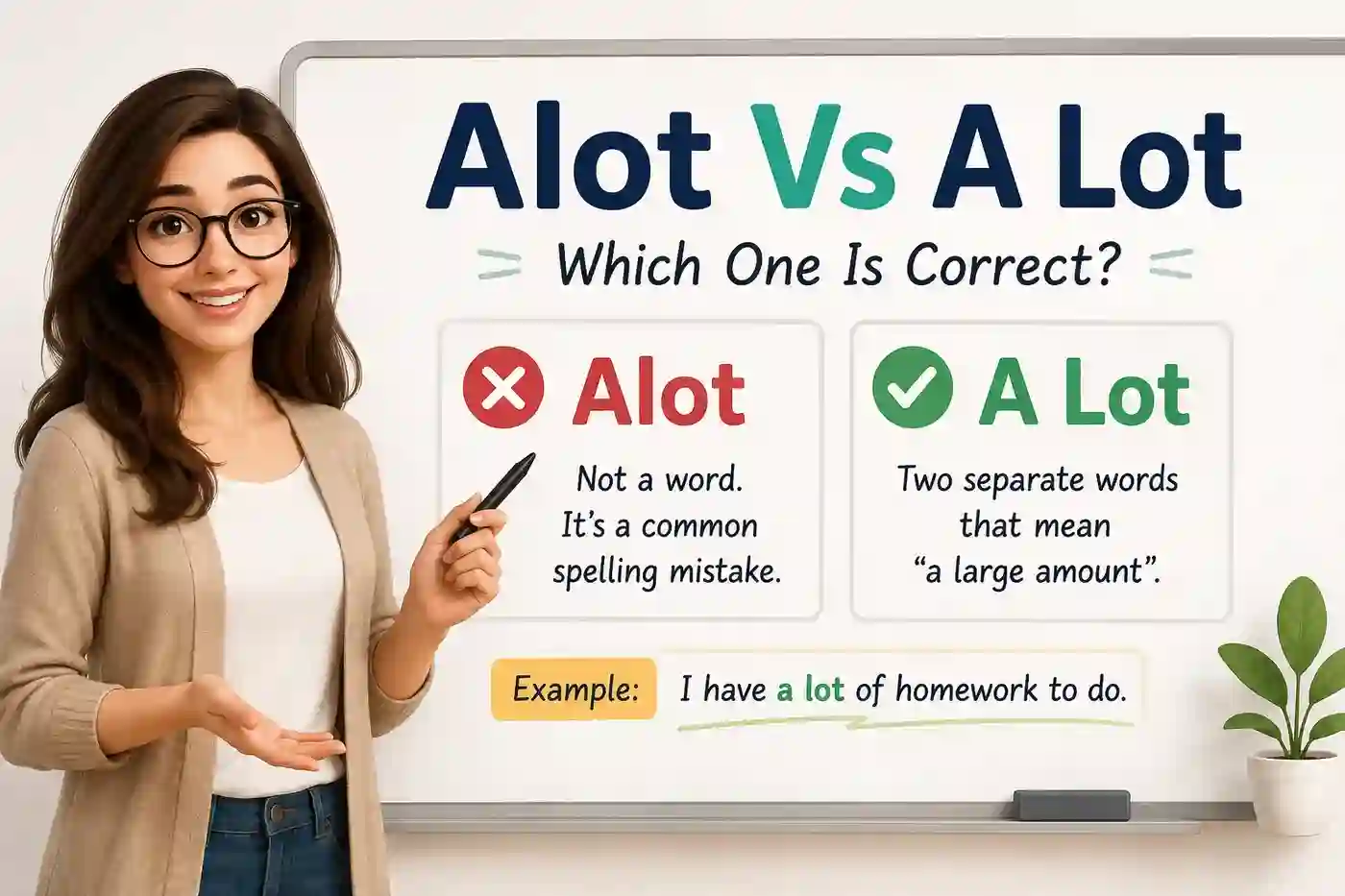
Have you ever stopped in the middle of a sentence because you could not remember if you should write alot or a lot? You are not alone. This is one of the most common spelling mistakes of alot-vs-a-lot in English, and it appears everywhere from text messages and social media posts to emails and even school assignments. Many people type it without thinking, then wonder later if it was correct.
The short answer is simple. A lot is the correct form in standard English. Alot is a misspelling and should not appear in formal or professional writing. Even though you may see it online every day, major dictionaries, grammar guides, and professional editors do not recognize it as a standard English word.
The confusion exists because English contains many single words that begin with a, such as already, almost, and alone. It feels natural to assume that alot should follow the same pattern. Add years of casual internet writing and autocorrect habits, and it is easy to see why so many writers make the same mistake.
This guide explains everything you need to know about alot vs a lot. You will learn the correct spelling, grammar rules, pronunciation, history, common mistakes, real life examples, expert editing tips, and simple memory tricks that make the correct choice easy every time.
Quick Answer
A lot is the only correct spelling in English. It means a large amount or a great number of something. Alot is a common misspelling and is not accepted in standard English. For school work, business writing, academic papers, and professional communication, always write a lot as two separate words.
At A Glance Comparison Of Alot Vs A Lot
| Feature | A Lot | Alot |
|---|---|---|
| Correct spelling | Yes | No |
| Standard English | Yes | No |
| Meaning | A large amount or many | No accepted meaning |
| Part of speech | Phrase | Misspelling |
| Word type | Determiner phrase or adverbial phrase depending on use | Incorrect form |
| Pronunciation | /ə ˈlɑt/ in American English | Pronounced the same by many people |
| Origin | Old English article plus noun | Modern spelling mistake |
| Grammar role | Modifies nouns verbs or adjectives depending on context | None |
| Formal writing | Accepted | Never accepted |
| Frequency of use | Very common | Common only as an error |
| Typical contexts | Conversation writing books business academic work | Informal online mistakes |
| Example sentence | I learned a lot from that experience. | I learned alot from that experience. Incorrect. |
Alot Vs A Lot Which Word Should You Use
Use a lot every time.
There are no exceptions in standard English. If you are writing an email, essay, article, report, resume, or social media caption, a lot is the correct choice.
Alot is simply a spelling error. It is not listed as a standard word in respected dictionaries, and professional editors routinely correct it before publication.
Many writers assume that if enough people use a spelling, it eventually becomes correct. English does evolve, but not every popular mistake becomes accepted. At this point, alot remains a misspelling in edited English.
Why Do Writers Mix Them Up
Several factors make this mistake surprisingly common.
- Both forms sound exactly the same when spoken.
- Fast typing encourages people to combine familiar word pairs.
- Social media often values speed over accuracy.
- Some people never receive direct grammar instruction about the difference.
- Many compound words exist in English, making alot appear believable at first glance.
Professional editors spot this error almost instantly because it appears so frequently.
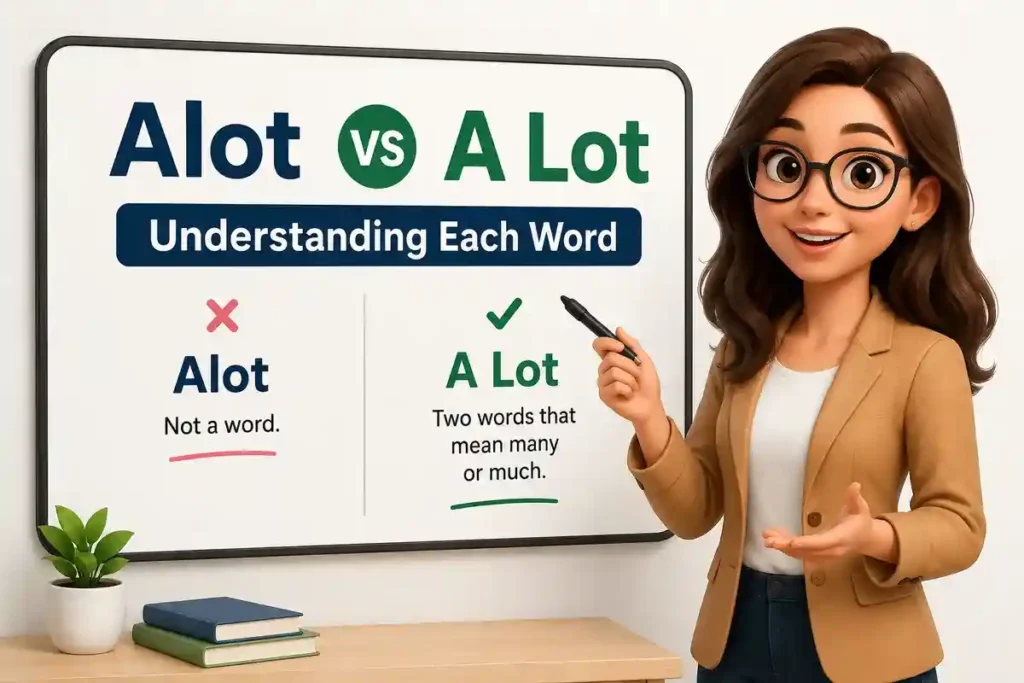
Alot Vs A Lot Understanding Each Word
Understanding A Lot
Definition.
A lot means a large amount, a great quantity, or very much.
It works as a phrase rather than a single word. Depending on the sentence, it can describe quantity or modify an action.
Examples include:
- We spent a lot of time studying.
- She drinks a lot of coffee.
- They laughed a lot during the movie.
In each example, the phrase expresses abundance.
Grammar Role
A lot usually functions as a quantity expression.
It commonly appears before nouns.
- A lot of people attended.
It can also modify verbs.
- They practiced a lot.
Its flexibility makes it one of the most useful expressions in everyday English.
Historical Background
The phrase developed naturally from combining the indefinite article a with the noun lot, which originally referred to a portion, share, or piece assigned by chance.
Over time, speakers began using it to describe large quantities instead of physical portions.
Today, it is deeply established in both spoken and written English.
Modern Relevance
Native speakers use a lot constantly because it sounds natural and fits almost every kind of conversation.
You will hear it in classrooms, television interviews, business meetings, podcasts, novels, newspapers, and everyday conversations.
Understanding Alot
Definition.
Alot has no accepted definition in standard English because it is not recognized as a proper word.
It appears mainly as a spelling mistake created by joining two separate words together.
Grammar Role
Since it is not a standard English word, it has no grammatical function.
Whenever you see alot, replace it with a lot.
Historical Background
The spelling became widespread during the rise of internet communication. Instant messaging, forums, and early social media encouraged faster typing, allowing spelling mistakes to spread quickly.
Despite its popularity online, dictionaries and style guides have continued to reject it.
Modern Relevance
Spell checkers, grammar tools, teachers, editors, and publishers consistently treat alot as incorrect.
Using it in professional writing may leave readers with the impression that the writer overlooked basic proofreading.
Alot Vs A Lot The Biggest Differences Explained
Although the two forms look similar, their status in English is completely different.
Spelling
A lot consists of two separate words.
Alot combines those words into one incorrect spelling.
This is the biggest and most important difference.
Meaning
Only a lot carries meaning in English.
It expresses a large amount or great quantity.
Since alot is not a recognized word, it has no independent meaning.
Grammar
A lot performs grammatical functions inside sentences.
It can describe quantity, intensity, or frequency depending on context.
Alot performs no grammatical role because it is not accepted as part of standard English.
Pronunciation
Interestingly, pronunciation does not help distinguish the two forms.
Both are pronounced the same in everyday speech.
That explains why many people continue making the spelling mistake.
Writing Style
Professional writers always choose a lot.
Editors immediately correct alot before publication.
Using the correct spelling demonstrates attention to detail and strengthens your credibility.
Everyday Usage
People say a lot naturally in conversation.
When typing quickly, some mistakenly combine the words into alot.
Speaking habits therefore contribute to the confusion.
Regional Preferences
American English, British English, Canadian English, and Australian English all agree on this rule.
Every major English variety recognizes a lot as correct.
None accepts alot as a standard spelling.
Professional Writing
Academic institutions, publishers, newspapers, government organizations, and businesses all expect the two word form.
If you want polished writing, always separate the words.
Why People Confuse Of Alot Vs A Lot
This mistake is easy to understand once you look at how people learn English.
Similar Pronunciation
English speakers pronounce a lot so smoothly that it often sounds like one word.
Children especially hear it as a single sound before they ever learn to write it.
Fast Typing
Modern communication rewards speed.
People often send messages without reviewing every word.
Small spelling mistakes become habits after enough repetition.
Compound Word Confusion
English includes many genuine compound words.
Examples include:
- already
- altogether
- almost
- always
Seeing these words makes alot appear reasonable even though it is incorrect.
Internet Influence
Casual writing spreads rapidly online.
A spelling mistake repeated thousands of times can begin to look familiar, even though familiarity does not make it correct.
Limited Proofreading
Many writers focus on ideas rather than spelling during the first draft.
Without careful editing, small mistakes survive into the final version.
Grammar Rules Of Using The phrase Alot Vs A Lot You Should Know
Understanding a few grammar rules makes this topic much easier.
A Lot Is A Quantity Expression
The phrase normally describes an amount or number.
Examples include:
- A lot of students finished early.
- We saved a lot of money.
- She reads a lot.
It Often Appears Before Of
One of its most common patterns is:
A lot of + noun
Examples:
- A lot of visitors arrived.
- A lot of water disappeared.
- A lot of questions remained.
This structure works with both countable and uncountable nouns.
It Can Modify Verbs
Examples include:
- They travel a lot.
- We practice a lot.
- He smiles a lot.
Here, the phrase describes how frequently or how much the action occurs.
How Of Alot Vs A Lot Use In Formal And Informal Writing
A lot works perfectly in conversation and most professional writing.
In highly formal academic or technical documents, writers sometimes choose more precise alternatives.
Examples include:
- many
- much
- numerous
- significant
- considerable
- substantial
- a great deal
These alternatives provide greater precision when exact tone matters.
Agreement With Nouns
When using a lot of, the verb agrees with the noun that follows.
Examples:
- A lot of students are absent.
- A lot of water is missing.
The noun determines the verb form, not the phrase itself.
Editing Rule Professionals Follow
Experienced editors use one simple habit.
If you ever write alot, separate it into a and lot during proofreading.
That single correction eliminates one of the most common spelling mistakes in English.
End of Section 1.
Sentence Examples Using For Alot Vs A Lot That Sound Natural
Seeing correct examples is one of the fastest ways to build good writing habits. The first set shows the correct phrase a lot in everyday English. The second set uses alot to show common mistakes you should avoid.
Correct Examples Using A Lot
- I learned a lot from my first job.
- She spends a lot of time reading mystery novels.
- We have a lot of work to finish today.
- They laughed a lot during the comedy show.
- A lot of families visited the park over the weekend.
- He drinks a lot of water after exercising.
- We traveled a lot before starting our business.
- A lot of people enjoy homemade food.
- My grandfather knows a lot about history.
- You can improve a lot with regular practice.
Incorrect Examples Using Alot
The following sentences contain a spelling mistake. In every example, alot should be changed to a lot.
- I learned alot from my first job.
- She spends alot of time reading mystery novels.
- We have alot of work to finish today.
- They laughed alot during the comedy show.
- Alot of families visited the park over the weekend.
- He drinks alot of water after exercising.
- We traveled alot before starting our business.
- Alot of people enjoy homemade food.
- My grandfather knows alot about history.
- You can improve alot with regular practice.
Common Writing Mistakes About Alot Vs A Lot And How To Avoid Them
This mistake may seem small, but it can make polished writing look careless. Professional editors notice it immediately because it appears so often.
Writing Alot Instead Of A Lot
This is by far the most common mistake.
Incorrect
- I have alot to do today.
Correct
- I have a lot to do today.
Remember that a and lot always stay separate.
Assuming It Is Accepted Because It Is Common Online
Many social media posts contain spelling mistakes. Popular usage does not change standard grammar rules.
If your writing is meant for school, work, publishing, or professional communication, always use a lot.
Forgetting To Proofread
Fast typing often creates small mistakes that your eyes skip over later.
A helpful proofreading habit is to search your document for alot before submitting it. If you find it, replace it with a lot.
Choosing A Lot When A More Precise Word Fits Better
While a lot is correct, skilled writers sometimes choose words that express their meaning more clearly.
Instead of:
- A lot of people attended.
You might write:
- Hundreds of people attended.
Instead of:
- She has a lot of experience.
You might write:
- She has extensive experience.
Specific language often makes writing stronger.
Forgetting The Verb Agreement Rule
The verb agrees with the noun after a lot of.
Correct
- A lot of books are on the table.
- A lot of milk is left in the refrigerator.
Many learners mistakenly match the verb with lot instead of the noun that follows.
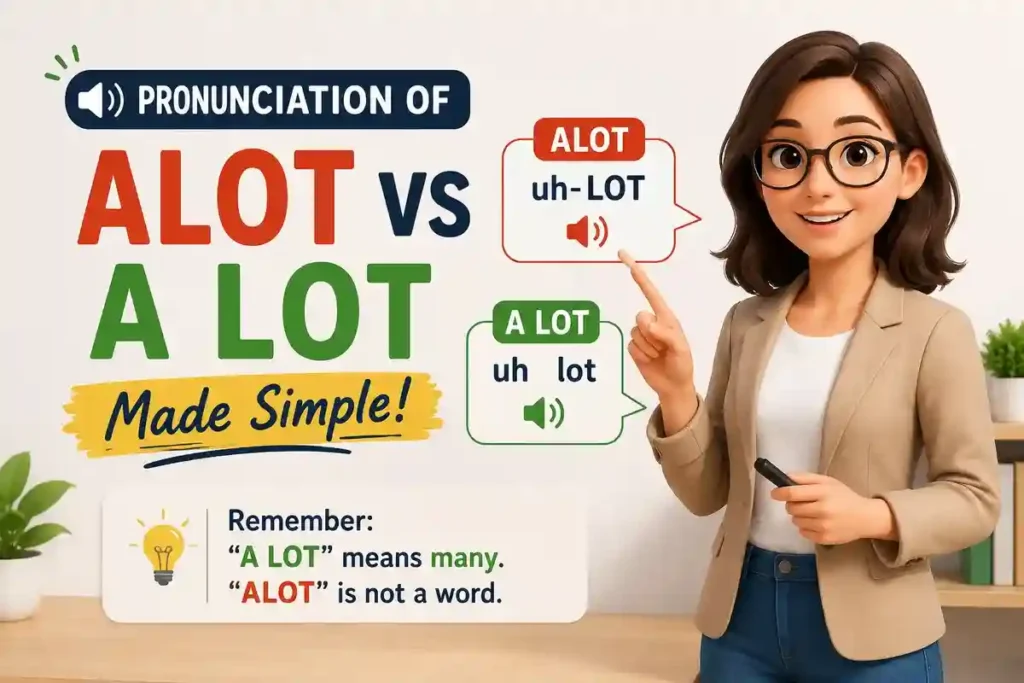
Pronunciation Of Alot Vs A Lot Made Simple
One reason this spelling mistake happens so often is that both forms sound exactly alike.
IPA Pronunciation
American English
A lot
/ə ˈlɑt/
British English
A lot
/ə ˈlɒt/
Since alot is not a standard word, it has no separate pronunciation. People simply pronounce it exactly like a lot.
Syllable Breakdown
A lot
uh LOT
The phrase contains two syllables.
Stress Pattern
The main stress falls on lot.
Say it naturally.
uh LOT
Avoid stressing the first word.
Common Pronunciation Mistakes
Most speakers pronounce the phrase correctly.
The problem appears only when writing it.
People hear one smooth sound and assume it must be one word.
Easy Pronunciation Tip
Think of the phrase as two separate building blocks.
A.
Lot.
Pause very slightly between them when practicing.
That tiny pause helps reinforce the correct spelling in your mind.
Word History Of Alot Vs A Lot And Its Origin
Understanding where a lot came from makes the spelling easier to remember.
Origin Of Lot
The noun lot entered English many centuries ago. It originally referred to an object used for drawing chances or dividing property. People cast lots to make decisions or assign shares.
Over time, the meaning expanded beyond physical objects.
A person’s lot came to mean their share, portion, or fate.
Eventually, English speakers began using a lot to describe a large amount rather than an assigned portion.
Development Of The Phrase
The phrase combines two ordinary words.
- a
- lot
English never merged them into one accepted word.
That is why dictionaries continue listing them separately.
Evolution Into Modern English
Today, a lot appears in almost every variety of spoken and written English.
Its meaning has stayed remarkably consistent.
Meanwhile, alot emerged much later as a spelling mistake rather than a natural language development.
Unlike genuine compound words, it never gained acceptance in formal English.
Usage Of Alot Vs A Lot Across English Speaking Countries
English changes from country to country, but this rule remains consistent.
American English
American writers always use a lot.
You will find it in newspapers, books, educational materials, and business communication.
British English
British English follows exactly the same spelling.
No major British style guide accepts alot.
Canadian English
Canadian English also treats a lot as the only correct form.
Professional editors routinely correct the one word version.
Australian English
Australian English follows the same rule.
Schools, universities, publishers, and businesses all expect a lot.
Is There Any Regional Difference
No.
Unlike words such as color and colour or center and centre, this spelling does not change across English speaking countries.
Every major variety of English agrees on the correct form.
Real World Usage
Seeing how experienced writers use the phrase in different settings helps build confidence.
Daily Conversation
People naturally say things like:
- Thanks a lot.
- I miss you a lot.
- We had a lot of fun.
These expressions sound friendly and natural.
School Writing
Students often write:
- I learned a lot from this science project.
- A lot of inventions changed history.
Teachers expect the two word spelling.
Business Communication
Professionals commonly write:
- Thank you a lot for your support.
Even better, many editors suggest:
- Thank you very much for your support.
Business writing often benefits from more precise wording.
Academic Writing
Researchers usually avoid repeating a lot because academic writing values precision.
Instead of:
- A lot of studies support this idea.
You may see:
- Numerous studies support this idea.
The original phrase remains correct, but stronger alternatives often improve academic style.
Books
Novelists frequently use a lot in dialogue because it reflects natural speech.
Characters sound more realistic when they speak the way people actually talk.
Journalism
Journalists use a lot when quoting sources or writing for general readers.
In analytical reporting, they often replace it with more specific quantities.
Online Writing
Blogs, forums, and websites commonly use a lot.
Unfortunately, online writing also spreads the incorrect spelling alot, which can mislead learners.
Social Media
Social media posts often prioritize speed over accuracy.
You may see alot thousands of times.
Do not let repeated exposure convince you that it is correct.
Professional writing follows established grammar rules, not internet trends.
Similar Words And Frequently Confused Terms
English includes many words and phrases that confuse writers for reasons similar to a lot.
All Right And Alright
All right remains the preferred spelling in formal writing.
Alright appears in many informal contexts but is still avoided by some editors.
Every Day And Everyday
Every day means each day.
Everyday is an adjective meaning ordinary or routine.
Examples:
- I exercise every day.
- These are my everyday shoes.
Any Time And Anytime
Any time usually refers to an amount of time.
Anytime often functions as an adverb meaning whenever.
Examples:
- Call me any time.
- You can visit anytime.
Into And In To
Into shows movement.
In to appears when in belongs with the preceding verb.
Examples:
- She walked into the room.
- She turned her paper in to the teacher.
Maybe And May Be
Maybe is an adverb meaning perhaps.
May be is a verb phrase.
Examples:
- Maybe it will rain.
- It may be too late.
Everyday Editing Tip
Whenever two forms look similar, pause for a moment and ask yourself what job the words perform in the sentence.
Understanding function is far more reliable than relying on memory alone.

Professional Editor Advice About Alot Vs A Lot
Years of editing reveal one consistent pattern. Most spelling mistakes are not caused by a lack of knowledge. They happen because writers move too quickly and trust their first draft.
If you want cleaner, more professional writing, build a simple editing routine.
Slow Down During Proofreading
Draft first and edit later. Looking at your writing with fresh eyes makes small mistakes much easier to catch.
Read Your Work Aloud
Reading aloud forces your brain to process each word instead of guessing what is on the page. Many spelling errors become obvious once you hear the sentence.
Search For Common Mistakes
Before sending an email or submitting a document, search for words you often misspell.
If you find alot, replace it with a lot.
This habit takes only a few seconds but prevents one of the most common grammar mistakes in English.
Choose More Specific Language When Possible
Although a lot is completely correct, stronger writing often comes from using more precise words.
Instead of saying:
- A lot of customers liked the product.
You could write:
- Most customers liked the product.
- Hundreds of customers liked the product.
- Many customers liked the product.
Specific language helps readers understand your message faster.
Learn Patterns Instead Of Memorizing Lists
Strong writers do not rely only on memory. They understand how English works.
Once you recognize that a lot is a phrase made from two separate words, the correct spelling becomes much easier to remember.
Practice With Real Sentences
Grammar sticks best through regular use. Write your own sentences using a lot until the correct spelling feels automatic.
Small daily habits lead to lasting improvement.
Frequently Asked Questions
Is alot ever a correct word?
No. Alot is not recognized as a standard English word. Dictionaries, style guides, teachers, and professional editors treat it as a misspelling. The correct form is a lot, written as two separate words in every type of standard English writing.
Why do people write alot instead of a lot?
Most people combine the words because they sound like a single word when spoken. Fast typing, casual online writing, and familiarity with other compound words also contribute to the mistake.
Is a lot one word or two words?
It is always two words. The phrase combines the article a with the noun lot to express a large amount or quantity.
Can I use alot in informal text messages?
People sometimes write alot in casual messages, but it is still considered incorrect. Using a lot shows better writing habits and avoids carrying the mistake into school or professional work.
Do American and British English use different spellings?
No. American English, British English, Canadian English, and Australian English all use a lot. None of these varieties accepts alot as the standard spelling.
Is a lot formal enough for business writing?
Yes. A lot is grammatically correct and acceptable in business writing. In some situations, words like many, much, numerous, or substantial may sound more precise, depending on the context.
How can I remember the correct spelling?
Think of a lot the same way you think of a little. Both expressions contain two separate words. If you would never write alittle, you should not write alot either.
Why does spell check underline alot?
Spell check flags alot because it is not a recognized English word. Replacing it with a lot resolves the error immediately.
Is a lot a noun or an adverb?
It depends on the sentence. A lot can function as a quantity phrase before a noun or modify a verb as an adverbial expression. Its role changes according to context.
Will using alot affect my writing?
It can. Readers often notice obvious spelling mistakes right away. Using a lot instead of alot makes your writing look more polished, accurate, and trustworthy.
Final Verdict
The choice is simple. A lot is the correct spelling in standard English, and alot is a misspelling. This rule stays the same across American, British, Canadian, and Australian English.
Whenever you want to describe a large amount or quantity, write a lot as two separate words. It works naturally in everyday conversations, school assignments, business emails, articles, and professional documents.
A simple memory trick can help. Think of a lot the same way you think of a little or a few. These are all separate words, so a lot follows the same pattern.
Good writing is often built on small details. Choosing the correct spelling shows care, strengthens your credibility, and helps readers focus on your message instead of your mistakes. Make a lot your default choice, and you will never have to second guess this rule again.

Founding Editor
Maya spent six years as a copyeditor at a regional newspaper before starting Grammist, which is where the “answer first” format came from: newsroom style guides don’t have room for a preamble.
She writes and reviews most of the word-pair and spelling entries, and has final say on anything that goes out under the Grammist name.