
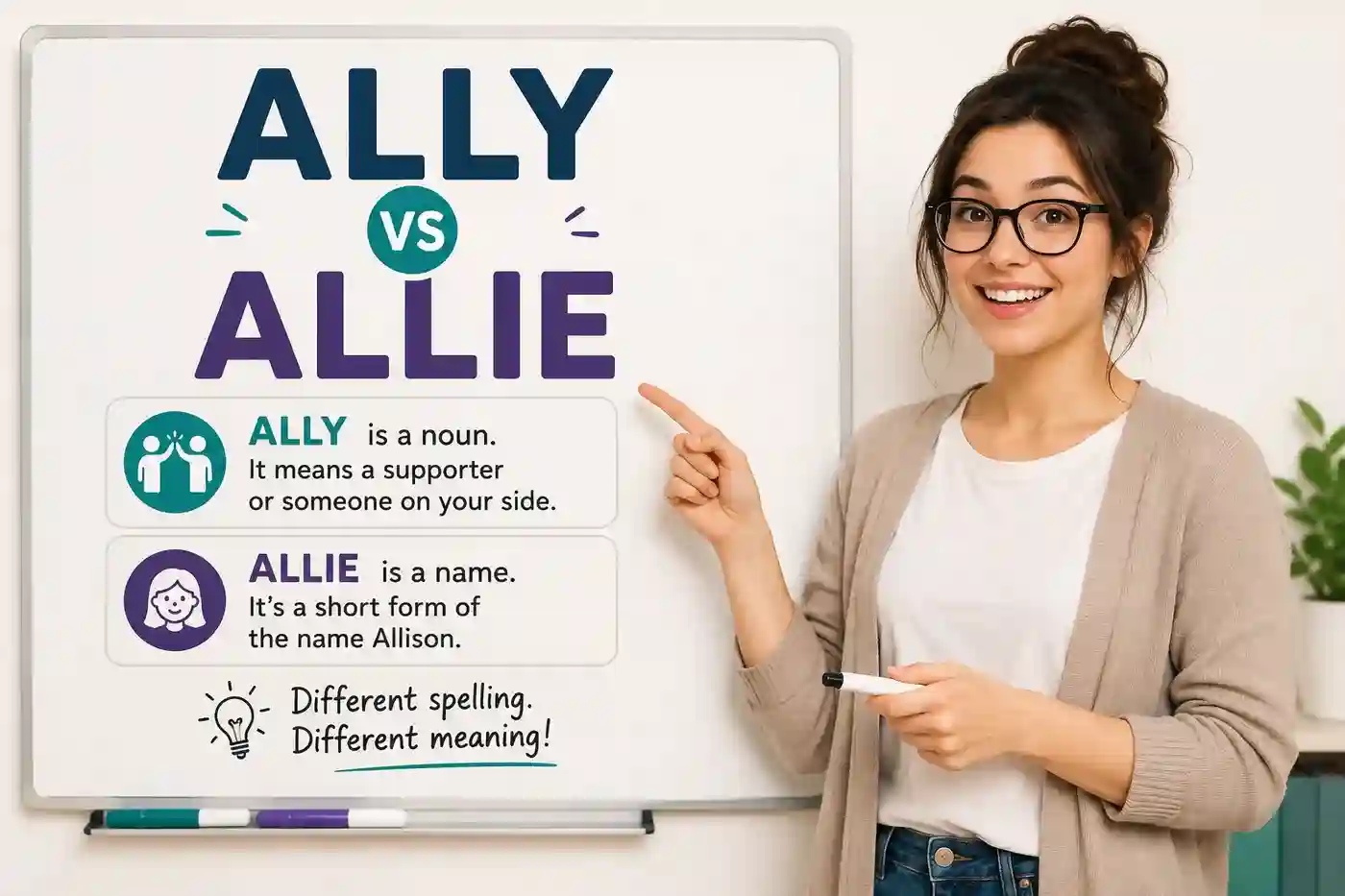
At first glance, ally and Allie look almost identical. They differ by just one letter, so it is easy to assume they are two spellings of the same word. That assumption leads many people to search for ally vs Allie, especially when proofreading a document, writing an email, or reading online content.
The truth is much simpler. These words are not spelling variants at all. They belong to different categories of English. Ally is a common noun and can also be used as a verb. It refers to a person, group, or country that supports another or joins forces for a shared goal. Allie, on the other hand, is usually a proper noun. It is a person’s first name or a nickname for names such as Allison, Alexandra, Alice, or Alyssa.
Because the words sound exactly alike, people often type one when they mean the other. Autocorrect, capitalization mistakes, and unfamiliarity with proper nouns make the confusion even more common.
This guide explains the difference in clear, everyday English. You will learn the meaning of each word, how they are used in grammar, common writing mistakes, pronunciation, word origins, practical examples, and professional editing tips. By the end, you will know exactly which word belongs in every situation and avoid one of the easiest mistakes to make in written English.
Quick Answer
Ally and Allie are not interchangeable. Ally is a noun or verb that refers to someone who supports another person or group. Allie is usually a person’s name or nickname. If you are talking about a supporter or partner, use ally. If you are referring to a person named Allie, capitalize Allie.
At A Glance Comparison Ally Vs Allie
| Feature | Ally | Allie |
|---|---|---|
| Correct spelling | Yes | Yes |
| Meaning | A supporter partner or someone united with another | A given name or nickname |
| Part of speech | Noun and verb | Proper noun |
| Word type | Common word | Personal name |
| Pronunciation | /ˈæl.aɪ/ | /ˈæl.aɪ/ |
| Origin | Old French and Latin | Modern English given name |
| Grammar role | Subject object or verb | Proper noun naming a person |
| Formality | Neutral | Neutral |
| Frequency of use | Common in everyday English | Common as a personal name |
| Typical contexts | Politics military friendships business social causes | Names introductions school records family conversations |
| Example sentence | She became a trusted ally during the project. | Allie won the science competition. |
Ally Vs Allie Which Word Should You Use
The correct choice depends entirely on what you are trying to say.
Use ally when you mean a supporter, partner, teammate, or someone who joins another person or group for a shared purpose. It can describe individuals, organizations, businesses, or even countries working together.
Examples:
- She has always been a loyal ally.
- Several countries became allies during the conflict.
- They decided to ally with a local charity.
Use Allie only when referring to a person whose name is Allie or whose nickname is Allie.
Examples:
- Allie called this morning.
- My cousin Allie loves photography.
- Allie will lead today’s meeting.
Although the words sound identical, they perform completely different jobs in English. One is a vocabulary word with a dictionary definition, while the other identifies a specific person.
Is One More Correct
Neither word is more correct than the other because they do not compete with each other. The correct choice depends on the context.
If you write, She is my strongest ally, replacing ally with Allie changes the sentence completely and makes it sound as though you are talking about someone named Allie instead of describing a supportive person.
Likewise, writing My friend ally is coming over is incorrect if Ally is the person’s name. Proper nouns should always begin with a capital letter.
Why Writers Get Confused
The confusion usually starts with pronunciation. Since both words sound exactly the same, people often choose the spelling they recognize first.
Typing quickly also increases the chances of making a mistake. Someone writing about a supportive coworker may accidentally type Allie, especially if they know someone with that name. The opposite happens just as often. A writer may lowercase Allie, making it look like the common noun ally.
Online discussions add to the confusion because people sometimes refer to ally as a nickname. While that happens occasionally, dictionaries and style guides still recognize Allie primarily as a proper name and ally as a common noun or verb.
Understanding Each Word Ally Vs Allie
Ally
Ally is a common English word that functions as both a noun and a verb. As a noun, it describes someone who supports another person, group, or cause. As a verb, it means to join together for a shared purpose or common goal.
Examples include:
- She became an ally during a difficult time.
- Small businesses often ally with local organizations.
- The two countries remained close allies for decades.
The word appears in many contexts, including politics, international relations, education, business, social movements, and everyday conversations. You might describe a trusted friend as an ally, a company as an ally in a business partnership, or a nation as an ally during a military alliance.
In recent years, the word has also become common in conversations about diversity, inclusion, and social justice. An ally is someone who actively supports people or communities facing unfair treatment or discrimination. In this context, the word emphasizes action and commitment rather than simple agreement.
Allie
Allie is usually a proper noun used as a person’s given name. It is also a popular nickname for longer names such as Allison, Alexandra, Alice, Alicia, and Alyssa.
Examples include:
- Allie enjoys reading mystery novels.
- My sister Allie starts college this fall.
- Everyone congratulated Allie after the presentation.
Unlike ally, Allie does not carry a dictionary meaning beyond identifying a person. Its purpose is to name someone rather than describe a role or relationship.
Because it is a proper noun, Allie should always begin with a capital letter. Writing allie in ordinary text is considered incorrect unless a person intentionally styles their name that way, which is uncommon.
Ally Vs Allie The Biggest Differences Explained
Although these words share the same pronunciation, they differ in almost every other way. Understanding those differences makes it much easier to choose the correct spelling.
Spelling
The most obvious difference is the final letter. Ally ends with y, while Allie ends with ie. That small spelling change creates two completely different words with different purposes.
Meaning
The meanings are not related.
Ally refers to a supporter, partner, or someone who joins another person or group for a shared goal.
Allie is a person’s name. It identifies an individual rather than describing a relationship or role.
Grammar
The grammatical difference is one of the easiest ways to tell them apart.
Ally functions as both a noun and a verb.
Examples:
- She is our strongest ally.
- Several organizations allied to support the campaign.
Allie functions only as a proper noun because it names a specific person.
Example:
- Allie finished the report before lunch.
Pronunciation
Both words are pronounced exactly the same in standard English. Since there is no difference in pronunciation, listeners depend entirely on context to understand which word the speaker means.
Writing Style
Professional writers choose the correct word by looking at the role it plays in the sentence rather than its pronunciation. If the sentence describes support, partnership, or cooperation, ally is the correct choice. If it names a person, Allie is the only correct spelling.
Everyday Usage
In everyday conversation, context removes almost all confusion because listeners naturally understand the intended meaning.
For example, if someone says, Allie is coming over this afternoon, everyone knows they are talking about a person.
If someone says, She has been my biggest ally, listeners understand that ally describes a supportive relationship.
Professional Writing
Editors rarely confuse these words because they focus on grammar instead of sound. During proofreading, they check capitalization first. If the word identifies a specific person, it should begin with a capital letter. If it describes a supporter or partner, it remains lowercase unless it starts a sentence.
This simple editing habit prevents one of the most common mistakes involving these two words and keeps writing clear for every reader.
Why People Confuse About Ally Vs Allie
The confusion between ally and Allie has very little to do with grammar. Instead, it comes from pronunciation, spelling, and capitalization. Since both words are pronounced exactly the same, readers often rely on context to understand the intended meaning. Writers, however, do not always have that advantage when typing quickly.
Another reason for the confusion is that one word is part of everyday English while the other is usually a person’s name. If you are unfamiliar with someone named Allie, you might assume every instance of the word should be spelled ally. The opposite also happens. People who know someone named Allie sometimes accidentally type the name when they actually mean a supporter or partner.
Identical Pronunciation
Both words are pronounced exactly the same. Since there is no spoken difference, listeners understand the meaning from the surrounding conversation instead of the pronunciation itself.
For example, these two sentences sound identical when spoken.
- Allie joined our team today.
- She became our strongest ally today.
Only the context tells you which word the speaker means.
Capitalization Mistakes
Capitalization is another common source of errors. Proper nouns should always begin with a capital letter, but common nouns should not unless they appear at the beginning of a sentence.
For example:
- Allie submitted the assignment early.
- She was a dependable ally throughout the project.
Changing the capitalization changes the meaning completely.
Typing Errors
Fast typing often leads to accidental substitutions. Since both spellings are familiar, many people overlook the mistake during proofreading.
Examples include:
- My ally is visiting tomorrow.
If you are talking about a friend named Allie, this sentence is incorrect.
Likewise:
- She became my trusted Allie.
This sentence is incorrect unless the person’s name is Allie.
Autocorrect And Spell Checkers
Most spell checkers accept both words because both are correct English words. Unfortunately, they cannot always recognize which one you intended.
That means proofreading is still essential. Grammar software can catch many mistakes, but it cannot always determine if you meant a person’s name or a common noun.
Common Misconceptions
Several misunderstandings appear regularly in grammar forums and online discussions.
- Myth: Ally and Allie are two spellings of the same word.
Fact: They are different words with different meanings. - Myth: Allie is simply the informal spelling of ally.
Fact: Allie is usually a proper name. - Myth: Capitalization does not matter.
Fact: Capitalization changes the role of the word and often changes the meaning of the sentence.
Understanding these differences helps you avoid mistakes that even experienced writers occasionally make.
Grammar Rules Of Ally Vs Allie You Should Know
Although ally and Allie sound identical, they follow different grammar rules because they belong to different parts of speech. Recognizing their grammatical role is the easiest way to choose the correct spelling.
Parts Of Speech
Ally can function as both a noun and a verb.
As a noun:
- She has always been my closest ally.
As a verb:
- Several organizations decided to ally against the proposal.
Allie functions as a proper noun because it names a specific person.
Example:
- Allie enjoys playing tennis every weekend.
Since proper nouns identify individuals, they are always capitalized.
Sentence Function
The role each word plays in a sentence is completely different.
As a noun, ally usually refers to a supportive person, group, or nation.
Example:
- Every successful leader needs a trusted ally.
As a verb, ally describes joining forces with someone.
Example:
- The two companies allied to develop new technology.
As a proper noun, Allie simply identifies a person.
Example:
- Allie organized the community event.
Verb Relationships
When ally functions as a verb, it changes form just like other regular verbs.
Examples:
- ally
- allies
- allied
- allying
Example sentences:
- They plan to ally with local businesses.
- The two organizations allied last year.
- Several groups are allying to support the project.
Since Allie is a name, it never changes form in the same way.
Sentence Placement
Both words can appear almost anywhere in a sentence, but their role remains clear.
Examples:
- My strongest ally arrived early.
- We trusted our ally from the beginning.
- Allie arrived before everyone else.
- Everyone congratulated Allie after the presentation.
Looking at the surrounding words usually makes the correct spelling obvious.
Formal And Informal Writing
Both words work naturally in formal and informal English.
Formal writing:
- The nation remained an important ally throughout the negotiations.
- Allie Johnson presented the research findings.
Informal writing:
- You’re a great ally.
- Allie is coming over tonight.
The level of formality does not affect the spelling. Only the meaning determines the correct choice.
The Importance Of Capitalization
One of the simplest proofreading habits is checking capitalization.
Ask yourself one question.
Is this word naming a specific person?
If the answer is yes, write Allie.
If the answer is no and the word describes support, partnership, or cooperation, write ally.
That single question prevents almost every mistake involving this word pair.
Sentence Examples Of Ally Vs Allie That Sound Natural
Seeing these words in everyday situations makes the difference much easier to remember.
Examples Using Ally
- She became my biggest ally during the project.
- Every successful team needs a dependable ally.
- Our company found a valuable ally in the local community.
- He remained a loyal ally through every challenge.
- The two countries became close allies after signing the agreement.
- Parents can be a child’s strongest ally at school.
- We decided to ally with another nonprofit organization.
- The senator proved to be an important ally in the negotiations.
- She thanked every ally who supported the campaign.
- A trusted ally can make difficult decisions easier.
Examples Using Allie
- Allie baked cookies for the neighborhood fundraiser.
- I met Allie during my first year of college.
- Allie enjoys hiking every weekend.
- Everyone congratulated Allie after the competition.
- Allie volunteered to lead the discussion.
- My cousin Allie recently moved to Seattle.
- Allie called to confirm the meeting.
- The teacher praised Allie for her creative project.
- We surprised Allie with a birthday party.
- Allie always arrives early for work.
Common Writing Mistakes About Ally Vs Allie And How To Avoid Them
Most mistakes happen because writers focus on pronunciation instead of meaning. Since both words sound exactly alike, it is easy to choose the wrong spelling without noticing.
Using A Name Instead Of A Noun
This is one of the most common mistakes.
Incorrect:
- She became my trusted Allie.
Correct:
- She became my trusted ally.
Unless the person’s name is Allie, the common noun ally is the correct choice.
Forgetting Capital Letters
Proper nouns always begin with a capital letter.
Incorrect:
- allie won first place.
Correct:
- Allie won first place.
This small detail makes a big difference because capitalization tells readers they are looking at a person’s name.
Confusing The Verb And The Name
Remember that ally can also be a verb.
Correct:
- The organizations agreed to ally for the project.
Writing Allie in this sentence creates an obvious grammar mistake because names cannot replace verbs.
Relying Too Much On Spell Check
Spell checkers usually accept both words because both are legitimate English words. They cannot always recognize your intended meaning.
For that reason, always read the sentence one more time before publishing or sending it.
Quick Proofreading Tips
- Ask if the word names a person.
- Check capitalization carefully.
- Look at the grammar of the sentence.
- Replace the word mentally with supporter. If the sentence still makes sense, ally is probably the correct choice.
- Read the sentence aloud to confirm the meaning.
These simple habits help eliminate almost every mistake involving ally and Allie before your writing reaches readers.
Pronunciation Of Ally Vs Allie Made Simple
One reason people confuse ally and Allie is that they are pronounced exactly the same. There is no difference in sound, so listeners rely entirely on context to understand which word the speaker means.
| Word | IPA | Syllables | Stress |
|---|---|---|---|
| Ally | /ˈæl.aɪ/ | Al ly | First syllable |
| Allie | /ˈæl.aɪ/ | Al lie | First syllable |
Easy Pronunciation Tips
- Say al as in alphabet.
- End with the eye sound.
- Keep the stress on the first syllable.
- Both words are pronounced exactly the same.
Common Pronunciation Mistakes
Most people pronounce these words correctly. The challenge is not saying them but choosing the correct spelling while writing. Since pronunciation offers no clue, always rely on the meaning of the sentence instead of the sound.
Word History Of Ally Vs Allie And Origin
Although ally and Allie sound alike, they come from very different origins.
The word ally traces its roots to the Old French word alié, which came from the Latin word alligare, meaning to bind together or unite. Over time, English adopted ally to describe people, organizations, or nations that cooperate for a shared purpose. Later, it also developed into a verb meaning to join forces.
Allie has a completely different history. It developed as a familiar given name and later became a popular nickname for longer names such as Allison, Alexandra, Alice, Alicia, and Alyssa. Unlike ally, it does not describe a role, relationship, or action. Its purpose is simply to identify a person.
Understanding these different origins makes it easier to remember that these words are unrelated despite their identical pronunciation.
Usage Of Ally Vs Allie Across English Speaking Countries
Unlike many confusing word pairs, ally and Allie do not change across regional varieties of English. Their meanings remain the same in every major English speaking country.
American English
Americans use ally to describe supporters, partners, friends, organizations, or countries working together. Allie remains a common girl’s name and nickname.
British English
British English follows the same pattern. Ally refers to cooperation or partnership, while Allie identifies a person.
Canadian English
Canadian English also treats these words the same way. There are no spelling differences or grammar changes based on region.
Australian English
Australian English uses both words with the same meanings found in other English speaking countries.
Regional Preference
Unlike pairs such as color and colour or afterward and afterwards, there is no regional spelling variation here. The only question is whether you are talking about a supporter or a person named Allie.
Real World Usage
Looking at real examples shows how naturally these words appear in different kinds of writing.
Daily Conversation
People often use ally to describe supportive relationships and Allie to refer to someone by name.
Examples:
- Sarah has always been my closest ally.
- Allie is coming over after work.
School Writing
Students frequently encounter ally in history, literature, and social studies.
Example:
- France became an important ally during the war.
A student named Allie might appear in another sentence entirely.
Example:
- Allie presented her science project today.
Business Communication
Business professionals often use ally to describe strategic partnerships.
Example:
- Our company found a valuable ally in the local supplier.
If someone named Allie works at the company, the name follows normal capitalization rules.
Example:
- Allie will lead tomorrow’s presentation.
Academic Writing
Researchers often use ally when discussing politics, sociology, history, or international relations.
Example:
- Community leaders can become valuable allies during public health campaigns.
Names like Allie appear only when identifying a participant, researcher, or author.
Books
Novelists use ally to describe trusted companions or political partnerships.
Example:
- The young prince searched for a loyal ally before confronting his enemies.
A character named Allie serves a completely different purpose.
Example:
- Allie smiled as she opened the letter.
Journalism
News reports regularly use ally when discussing diplomacy and international affairs.
Example:
- The president met with several allies before the summit.
Names such as Allie appear in interviews, sports stories, or local news.
Online Writing
Blogs and websites often use ally in articles about leadership, teamwork, diversity, and workplace culture.
Example:
- Every manager should strive to be an ally who listens and supports employees.
Social Media
Social media uses both words every day.
Examples:
- Everyone deserves an ally who stands beside them.
- Happy birthday to Allie.
Context always makes the intended meaning clear.
Similar Words And Frequently Confused Terms Of Ally Vs Allie
Several other words cause confusion because they resemble ally in spelling, pronunciation, or meaning.
Allies
Allies is simply the plural form of ally.
Example:
- The two countries remained close allies for decades.
Alliance
An alliance is a formal partnership or agreement between people, organizations, or nations.
Example:
- The companies formed a strategic alliance.
Supporter
A supporter is someone who encourages or helps another person, cause, or organization.
While every ally is a supporter, not every supporter becomes an ally through active cooperation.
Partner
A partner works together with another person toward a shared goal. In many situations, partner and ally have similar meanings, although partner usually suggests a closer working relationship.
Advocate
An advocate publicly supports a person, cause, or policy. An advocate may also be an ally, but advocacy focuses more on speaking up, while an ally often emphasizes ongoing support and cooperation.
Professional Editors Advice
Professional editors rarely confuse ally and Allie because they focus on grammar before spelling. Instead of asking which word looks right, they ask what job the word performs in the sentence.
The first step is checking if the word names a person. If it does, capitalize it as Allie. If it describes support, partnership, or cooperation, write ally.
Editors also pay close attention to surrounding words. Articles such as a or an often signal that ally is functioning as a common noun.
Example:
- She became an important ally.
If the word follows a title or appears alongside a surname, it is almost certainly a proper name.
Example:
- Allie Thompson joined the meeting.
Another helpful editing habit is replacing ally with supporter while proofreading. If the sentence still makes sense, you almost certainly chose the correct word.
Experienced writers also avoid depending entirely on spell check. Since both words exist in English, software cannot always recognize the intended meaning. A quick final review is still the best way to catch mistakes.
Frequently Asked Questions
Is Ally Or Allie The Correct Spelling
Both are correct, but they have different meanings. Ally refers to a supporter or partner, while Allie is usually a person’s name or nickname.
Is Allie A Real Word
Yes. Allie is a recognized given name and a common nickname for several longer names, including Allison and Alexandra.
Can Ally Be Used As A Verb
Yes. Ally functions as both a noun and a verb. As a verb, it means to join together or cooperate with someone for a shared purpose.
Why Do Ally And Allie Sound The Same
English contains many homophones, which are words that share the same pronunciation but have different meanings and spellings. Ally and Allie are one example of this pattern.
Is Ally Always Written In Lowercase
Usually, yes. Since ally is a common noun or verb, it remains lowercase unless it begins a sentence.
Should Allie Always Be Capitalized
Yes. Because Allie is a proper noun, it should begin with a capital letter in normal writing.
Can Ally Refer To Countries
Yes. In politics and international relations, ally commonly refers to a nation that cooperates with another nation through shared interests or agreements.
Is Allie Short For Another Name
Often, yes. Allie is commonly used as a nickname for Allison, Alexandra, Alice, Alicia, Alyssa, and several other names.
How Can I Remember The Difference
Think about the sentence. If you could replace the word with supporter or partner, use ally. If the word identifies a person, write Allie.
What Is The Most Common Mistake
The most common mistake is writing Allie when describing a supporter or writing ally instead of capitalizing a person’s name. Paying attention to context and capitalization prevents almost every error.
Final Verdict
Although ally and Allie sound exactly the same, they are completely different words with different purposes. Ally is a common noun and verb that describes support, partnership, or cooperation. Allie is a proper noun used as a person’s name or nickname.
The easiest way to choose the correct spelling is to ask yourself one simple question. Are you talking about a person or describing a role?
If you are naming someone, write Allie with a capital letter. If you mean a supporter, partner, or someone working toward a shared goal, write ally.
A simple memory trick can help. Ally ends with y, just like unity, reminding you that allies work together. Allie ends with ie, a common ending found in many personal names. Once you remember that distinction, choosing the correct word becomes quick and effortless.

Founding Editor
Maya spent six years as a copyeditor at a regional newspaper before starting Grammist, which is where the “answer first” format came from: newsroom style guides don’t have room for a preamble.
She writes and reviews most of the word-pair and spelling entries, and has final say on anything that goes out under the Grammist name.