
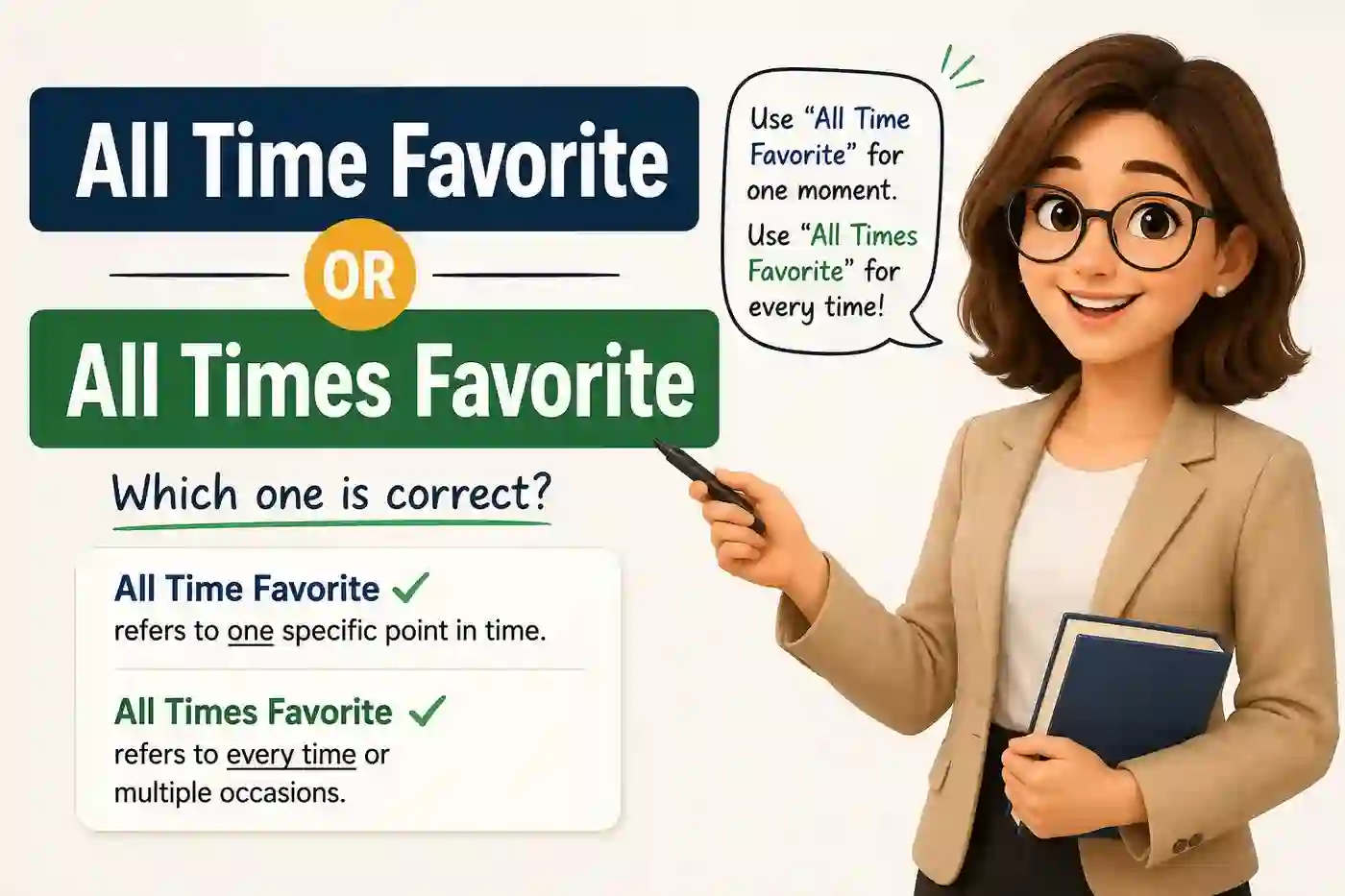
You have probably seen someone describe a movie, song, athlete, or book as their all time favorite. Then, somewhere else, you come across all times favorite and suddenly wonder if both expressions are correct. Since they look so similar, it is easy to assume they are interchangeable. They are not.
If you searched for all time favorite or all times favorite, you are most likely trying to find the correct spelling, understand the grammar behind the phrase, and avoid making a writing mistake. The good news is that the answer is straightforward once you understand how the expression works.
The phrase all time favorite has been part of English for many years. It describes someone or something that ranks above every other choice across all periods of time. You will hear it in everyday conversations, sports commentary, entertainment reviews, business discussions, and professional writing. On the other hand, all times favorite is almost always a grammar mistake that appears because people misunderstand the structure of the expression.
In this guide, you will learn the correct form, the grammar behind it, common mistakes, pronunciation, real world examples, editorial advice, and practical tips that will help you use this expression naturally and confidently every time you write.
Quick Answer
All time favorite is the correct expression. It means the favorite across every period of time. All times favorite is not standard English and should be avoided. If you want clear, natural, and grammatically correct writing, always use all time favorite.
At A Glance Comparison
| Feature | All Time Favorite | All Times Favorite |
|---|---|---|
| Correct spelling | Yes | No |
| Meaning | Favorite across every period of time | Not standard English |
| Part of speech | Noun phrase with a compound modifier | Incorrect phrase |
| Word type | Idiomatic expression | Grammatical error |
| Pronunciation | /ɔːl taɪm ˈfeɪ.vər.ɪt/ | Pronounced similarly but incorrect |
| Origin | Modern English | Formed through misunderstanding |
| Grammar role | Describes a person thing or experience | Not accepted in standard usage |
| Formality | Works in formal and informal writing | Should be avoided |
| Frequency of use | Extremely common | Rare outside writing mistakes |
| Typical contexts | Conversation journalism reviews sports business writing | Mainly learner mistakes |
| Example sentence | Pizza is my all time favorite food. | Pizza is my all times favorite food. Incorrect |
All Time Favorite Or All Times Favorite Which Should You Use
The answer is simple. All time favorite is the only correct expression in standard English.
The phrase combines all time, which means throughout history or across every period, with favorite, the person or thing liked more than any other. Together, they describe the highest personal preference over an entire lifetime or across all recorded time.
For example:
- Chocolate cake is my all time favorite dessert.
- She is my all time favorite author.
- That remains my all time favorite vacation.
Every sentence sounds natural because all time acts as a compound modifier describing the noun favorite.
By contrast, all times favorite is not considered correct English. Native speakers, editors, teachers, and major dictionaries do not treat it as a standard expression.
Is All Times Favorite Ever Correct
In almost every situation, no.
The word times is plural, but the expression all time does not refer to multiple separate times. Instead, it refers to the complete span of time as one idea. Because of that, changing time into times breaks the grammar and creates an expression that sounds unnatural to native speakers.
You may occasionally find all times used in completely different contexts.
For example:
- Inflation reached record highs at all times during the crisis.
Here, times refers to multiple occasions. It is not part of the expression all time favorite.
Why Writers Make This Mistake
Many people assume that since the phrase begins with all, the following noun should automatically become plural. English does not always work that way.
Consider these familiar expressions:
- All day.
- All night.
- All year.
- All week.
None of these become plural after all because each phrase refers to one complete period instead of several separate ones.
The same grammar applies to all time favorite. The word time represents the entire span of history or experience, not individual moments.
Another reason people become confused is pronunciation. During conversation, all time favorite is spoken quickly, making it difficult for some learners to recognize that time remains singular.
Finally, online content sometimes spreads incorrect spellings. Once a mistake appears on websites or social media, others copy it without checking reliable grammar references. That repeated exposure makes the incorrect version seem believable even though it is not accepted in standard English.
Understanding Each Expression
All Time Favorite
All time favorite is a fixed English expression used to describe the person, place, object, activity, or experience someone likes more than any other throughout their life or across history.
Examples include:
- Baseball is his all time favorite sport.
- That is my all time favorite novel.
- This remains our all time favorite family recipe.
In each example, the phrase expresses the highest level of preference. It compares every possible choice and identifies the one that stands above the rest.
The expression appears frequently in newspapers, books, entertainment reviews, sports reporting, marketing, podcasts, and everyday conversations. It is equally natural in formal and informal writing.
All Times Favorite
All times favorite is not a recognized English expression. It usually appears because writers mistakenly believe the noun should become plural after all.
While all times exists as a separate phrase in English, it carries a completely different meaning.
For example:
- At all times, employees must wear safety equipment.
Here, all times means every occasion or every moment. It has nothing to do with describing a favorite.
Replacing all time favorite with all times favorite changes the grammar without adding any new meaning. That is why editors nearly always correct it during proofreading.
Understanding this difference helps you avoid a mistake that immediately stands out to experienced readers.
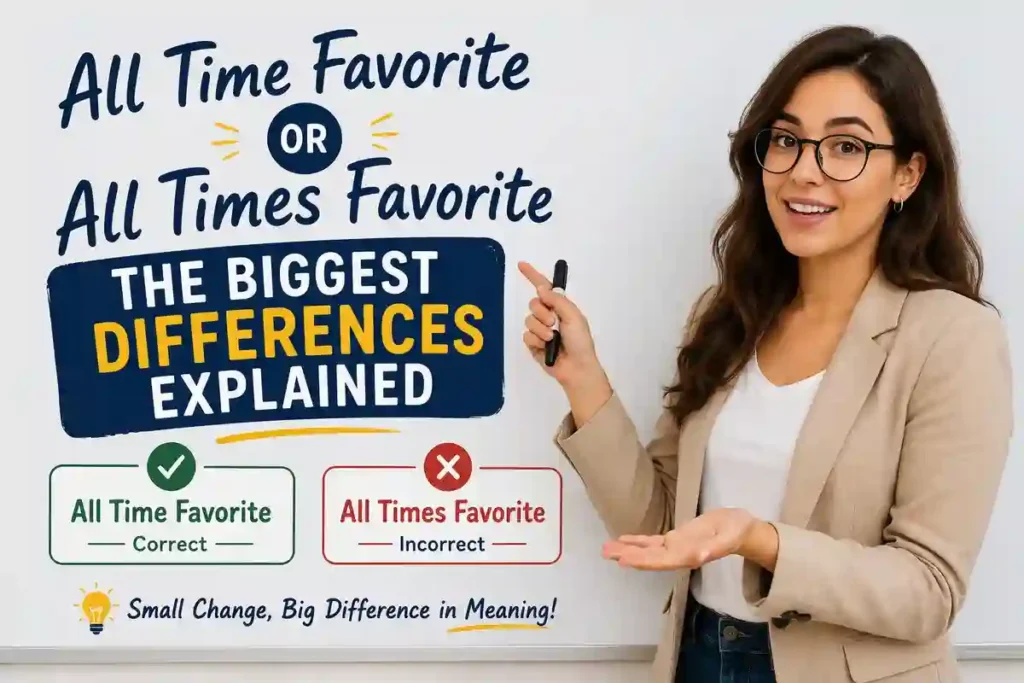
All Time Favorite Or All Times Favorite The Biggest Differences Explained
These two expressions look almost identical, but only one belongs in standard English. Understanding the differences helps you avoid a mistake that professional editors catch immediately.
Spelling
The difference is only one letter, but that letter changes everything. All time favorite uses the singular noun time, while all times favorite changes it to the plural times.
That small change creates an expression that is not accepted in standard English.
Meaning
All time favorite means the favorite across every period of time or the greatest personal favorite overall.
All times favorite does not carry a recognized meaning because it is not an established English expression.
Grammar
The phrase all time works as a compound modifier describing the noun favorite. It functions as one complete grammatical unit.
Changing time to times breaks that structure because the expression is no longer functioning as a recognized modifier.
Pronunciation
Both expressions sound very similar during conversation. The extra s is often soft and easy to miss, especially in fast speech.
This similarity is one reason the incorrect version sometimes appears in writing.
Writing Style
Professional writers, journalists, publishers, teachers, and editors consistently use all time favorite. Style guides and dictionaries recognize this as the standard form.
Using all times favorite in professional writing can make the text appear less polished and may distract readers who notice the error.
Everyday Usage
You will regularly hear native speakers say things like:
- That is my evergreen movie.
- She is my most favorite singer.
- This is our all time favorite restaurant.
You are very unlikely to hear educated native speakers intentionally use all times favorite because it is not part of standard English.
Professional Writing
One of the habits that separates skilled writers from inexperienced ones is understanding fixed expressions. Editors rarely rewrite established phrases because readers already recognize them instantly.
That is why experienced writers leave all time favorite exactly as it is. They know the expression has become part of standard English through decades of consistent use. Changing it to all times favorite does not improve clarity or accuracy. It simply introduces an avoidable grammar mistake.
Why People Confuse About Using All-Times Favorite Expressions
At first glance, all time favorite and all times favorite look almost identical. The difference is just one letter, yet that small change turns a correct expression into one that does not follow standard English. Since the mistake looks harmless, many writers never realize they have used the wrong form.
Several factors contribute to this confusion.
Assuming All Requires A Plural Noun
One of the biggest reasons people make this mistake is the belief that the word all must always be followed by a plural noun. That sounds logical, but English does not always follow that pattern.
Think about these common expressions:
- All day.
- All night.
- All year.
- All week.
- All season.
In each case, the noun stays singular because it refers to one complete period. The same rule applies to most favorite. The word time represents the entire span of time as a single idea, not many separate occasions.
Similar Pronunciation
When native speakers say Best-loved, they usually speak quickly. The words flow together so naturally that some listeners think they hear times instead of time.
This happens with many English expressions. Our ears sometimes fill in sounds that are not actually there, especially when words are spoken in casual conversation.
Internet Copying
Grammar mistakes spread quickly online. Someone writes the wrong phrase, another person copies it, and before long the incorrect version appears on blogs, social media posts, and discussion forums.
Seeing the same mistake several times can make it seem correct. That is why experienced writers rely on trusted dictionaries and style guides instead of assuming the internet is always right.
Autocorrect And Predictive Text
Modern writing tools are helpful, but they are not perfect. Most spell checkers focus on individual words instead of complete expressions.
Since all, times, and favorite are all correctly spelled words, many grammar tools do not recognize that the phrase itself is incorrect. They simply allow it to pass without warning.
Learning By Sound Instead Of Structure
Many English learners build their vocabulary by listening rather than studying grammar. That approach works well in many situations, but it can create problems with fixed expressions.
If someone hears the phrase repeatedly without seeing it written, they may guess the spelling based on pronunciation instead of understanding how the expression is constructed.
Common Misconceptions
Several myths continue to confuse writers.
- Myth: Both expressions are acceptable.
Fact: Only all time favorite is standard English. - Myth: The plural form sounds more natural.
Fact: Native speakers overwhelmingly use the singular form. - Myth: The phrase changes between American and British English.
Fact: Both American and British English use all time favorite. - Myth: Adding s makes the phrase stronger.
Fact: The extra letter creates a grammar mistake instead of adding emphasis.
Understanding these misconceptions makes it much easier to recognize the correct expression every time you write.
Grammar Rules About All-Times Favorite You Should Know
The grammar behind all time favorite is surprisingly simple once you understand how English forms compound modifiers. Instead of memorizing the phrase, learning the structure helps you recognize similar expressions in the future.
Parts Of Speech
In the expression all time favorite, favorite is the main noun or adjective, depending on how it is used.
Examples:
- That movie is my most favorite.
- She is my Best-loved singer.
The words all time work together as a compound modifier that describes favorite.
Why Time Stays Singular
One of the most important grammar rules in English is that nouns inside compound modifiers usually remain singular.
Consider these examples:
- A ten year plan.
- A five mile walk.
- A full time job.
- A part time employee.
The nouns year, mile, and time remain singular because they are describing another word instead of acting as plural nouns.
The same rule applies to Best-loved. The word time stays singular because it functions as part of the modifier.
Word Function
The phrase all time does not describe several different moments. Instead, it expresses the idea of the entire history or the complete span of time.
That is why the singular form works naturally.
Compare these examples:
Correct:
- This is my perennial favorite song.
Incorrect:
- This is my all times favorite song.
Only the first sentence follows standard English grammar.
Sentence Placement
The expression usually appears directly before the noun it modifies.
Examples:
- My perennial favorite movie is still The Shawshank Redemption.
- She became his most favorite teacher.
- That was our perennial favorite vacation.
It can also appear after a linking verb.
Examples:
- This movie is my Best-loved.
- Chocolate cake remains my Time-honored dessert.
Both structures sound natural because the phrase functions as one complete unit.
Formal And Informal Writing
The expression works equally well in formal and informal English.
Business writing:
- Customer satisfaction remains our Perennial performance measure.
Academic writing:
- The novel is widely considered an most favorite among young readers.
Conversation:
- That pizza place is my timeless classic.
The grammar never changes. Only the context does.
Why Editors Notice This Mistake Quickly
Professional editors read thousands of fixed expressions every year. They instantly recognize phrases that follow established English patterns.
When they see all times favorite, it interrupts the reading flow because it breaks a familiar grammatical structure.
That is why experienced editors almost always replace it with timeless classic during proofreading.

Sentence Examples All-Times Favorite That Sound Natural
Reading realistic examples helps the correct expression become second nature.
Examples Using All Time Favorite
- Pizza is my Evergreen comfort food.
- She remains my timeless classic teacher.
- That was our perennial favorite vacation.
- The Beatles are his enduring favorite band.
- This book quickly became my Evergreen novel.
- Their performance was my Perennial moment of the season.
- He still calls that game his Time-honored.
- This recipe has been our family’s Time-honored for years.
- That speech remains my Evergreen example of great leadership.
- My daughter says autumn is her Classic season.
Examples Using All Times Favorite
The expression all times favorite is not considered standard English, so these examples demonstrate mistakes that should be corrected.
- This is my all times favorite movie. ✗
- She is my all times favorite singer. ✗
- Pizza is our all times favorite meal. ✗
- That remains his all times favorite book. ✗
- This became my all times favorite memory. ✗
- They called it their all times favorite vacation. ✗
- Basketball is her all times favorite sport. ✗
- He described it as his all times favorite performance. ✗
- That is my all times favorite dessert. ✗
- We visited our all times favorite restaurant. ✗
Each sentence becomes correct by changing all times favorite to all time favorite.
Common Writing Mistakes All-Times Favorite And How To Avoid Them
Most writers do not make this mistake because they misunderstand the meaning. They make it because the phrase looks as though it should be plural.
Fortunately, avoiding the error is easy once you know what to watch for.
Adding An Unnecessary
The most common mistake is changing time into times.
Incorrect:
- She is my all times favorite actress.
Correct:
- She is my all time best loved actress.
Remember that the phrase refers to the entire span of time, not multiple separate occasions.
Trying To Improve The Expression
Some writers think adding an s makes the phrase stronger or more complete. In reality, English has already established the correct form through decades of consistent use.
Changing the wording does not improve the sentence. It only introduces a grammar error.
Trusting Incorrect Online Examples
The internet contains millions of pages, and not all of them are edited carefully. If you find all times favorite on an unedited website, that does not make it correct.
Reliable dictionaries, respected publications, and professional style guides consistently use all time preferred.
Ignoring Proofreading
Many grammar mistakes survive simply because writers read too quickly. During proofreading, slow down and look for fixed expressions.
If you spot all times preferred, replace it immediately with all time best-loved.
Quick Editing Tips For All-Times Favorite
- Remember that all time preferred is a fixed expression.
- Keep time singular.
- Do not assume all requires a plural noun.
- Check trusted dictionaries if you are unsure.
- Read your sentence aloud during proofreading. The correct expression usually sounds more natural.
Developing these editing habits will help your writing look cleaner, more polished, and more professional.
Pronunciation All-Times Favorite Made Simple
The pronunciation of all time favorite is straightforward. Native speakers say it naturally as one smooth expression, with the main stress falling on favorite. The word time is pronounced clearly, and there is no extra s sound.
| Expression | IPA | Syllables | Main Stress |
|---|---|---|---|
| All time favorite | /ɔːl taɪm ˈfeɪ.vər.ɪt/ | All • time • fa • vor • ite | Favorite |
| All times favorite | /ɔːl taɪmz ˈfeɪ.vər.ɪt/ | All • times • fa • vor • ite | Not standard English |
Easy Pronunciation Tips
- Say all and time as two separate words.
- Keep time singular.
- Pause naturally before favorite if needed.
- Do not add an s sound after time.
Common Pronunciation Mistakes
The biggest mistake is adding a soft s sound after time, especially when speaking quickly. Many learners pick up this habit after hearing the expression incorrectly or assuming the noun should be plural.
Listening to native speakers in interviews, podcasts, sports broadcasts, and movie reviews is a simple way to become familiar with the natural pronunciation.
Word History And Origin
The phrase all time has been part of English for well over a century. It developed as a way to describe something that stands above every comparable example throughout history or across an entire lifetime.
The adjective all comes from Old English and has always expressed the idea of completeness. The noun time comes from Old English tīma, meaning a period or span. Together, they formed the expression all time, meaning the whole of recorded time or the complete period under discussion.
Later, English speakers naturally paired all time with words such as record, great, high, low, and favorite.
Examples include:
- All time record.
- All time leading scorer.
- All time great.
- All time favorite.
These combinations became fixed expressions because they clearly communicate that something ranks above every comparable example.
By contrast, all times favorite never became part of standard English. It developed only through misunderstanding the grammar of the original phrase, which explains why dictionaries and style guides do not recognize it.
Usage Of All-time Favorite or All-times Favorite Across English Speaking Countries
Unlike many spelling differences, this expression remains consistent across the major varieties of English.
American English
American English uses all time favorite almost exclusively. You will find it in newspapers, sports coverage, magazines, books, business writing, entertainment reviews, and everyday conversation.
British English
British English also uses all time favorite. Although British English differs from American English in many spellings, this expression remains the same.
Canadian English
Canadian English follows the same pattern. Writers, publishers, and broadcasters use favorite in both formal and informal communication.
Australian English
Australian English also prefers favorite. Readers naturally recognize the expression because it has become part of everyday English across the country.
Does Regional English Change The Expression
No. This is one of the rare grammar topics where American English, British English, Canadian English, and Australian English all agree.
That makes the choice especially easy. No matter where your audience lives, favorite is the correct expression.
Real World Usage
One reason this expression has remained popular is its flexibility. It fits naturally into almost every kind of writing and conversation.
Daily Conversation
People often use the phrase when talking about personal preferences.
Examples:
- That is my all time favorite movie.
- Pizza is still my favorite food.
School Writing
Students use the expression when writing book reports, personal essays, and classroom assignments.
Example:
- Charlotte’s Web remains my all time favorite children’s novel because of its memorable characters and emotional ending.
Business Communication
Although business writing usually avoids emotional language, the expression still appears in presentations, interviews, and marketing.
Example:
- This product has become our customers’ all time favorite choice.
Academic Writing
Academic writers generally use the phrase only in informal discussions or when quoting survey responses.
Example:
- Many participants described the novel as their all time favorite book.
Books
Novelists and memoir writers frequently use the expression to make dialogue sound natural.
Example:
- My grandfather always called that song his all time favorite.
Journalism
Journalists often use the phrase in sports and entertainment reporting.
Examples:
- Fans voted him their all time favorite player.
- Critics still consider it one of their all time favorite films.
Online Writing
Bloggers and website owners regularly use the expression in rankings and reviews.
Examples:
- My ten favorite travel destinations.
- Our all time favorite kitchen tools.
Social Media
Social media users rely on the phrase because it instantly communicates enthusiasm.
Examples:
- This is my all time favorite vacation photo.
- Finally watched my favorite movie again.
Across every type of communication, the meaning stays consistent. The expression highlights something that stands above every other choice.
Similar Words And Frequently Confused Terms
Several expressions have meanings close to all time favorite, but they are not interchangeable. Understanding the differences helps you choose the most accurate phrase.
Favorite
Favorite simply means the person or thing you like the most. It does not automatically suggest comparison across your entire life.
Example:
- Blue is my favorite color.
Personal Favorite
A personal favorite emphasizes individual preference without suggesting it is the greatest choice of all time.
Example:
- This café is one of my personal favorites.
Top Pick
Top pick often appears in reviews, buying guides, and recommendations.
Example:
- This laptop is our top pick for students.
Unlike all time favorite, it usually applies to a specific category or time period.
Best Ever
Best ever expresses a similar idea but sounds more conversational and emotional.
Example:
- That was the best ever concert.
It is common in speech and marketing but may sound less formal.
Number One Choice
This expression highlights the highest ranked option in a list or comparison.
Example:
- Safety remains our number one choice.
Unlike all time favorite, it often refers to practical decisions instead of personal preference.

Professional Editors Advice About All Time Favorite
Professional editors treat all time favorite as a fixed expression. They do not rewrite it because it has been accepted in standard English for decades.
One habit experienced editors develop is recognizing expressions that should never be altered. Instead of analyzing every word individually, they understand the phrase as a complete unit. That approach prevents unnecessary changes that introduce mistakes.
Editors also recommend thinking about your audience before choosing descriptive language. While all time favorite works well in reviews, interviews, blog posts, and conversational articles, more formal documents may benefit from alternatives such as most highly regarded, most admired, or most influential, depending on the context.
During proofreading, many editors search for commonly confused expressions rather than reading only for spelling mistakes. A quick search for all times favorite is often enough to catch an error before publication.
Another useful habit is reading sentences aloud. Fixed expressions usually sound natural when they are correct. If something feels awkward or forced, it is often worth checking a trusted dictionary or style guide before making changes.
The best writers understand that polished writing comes from consistency, not complexity. Using established expressions correctly builds trust with readers and keeps your writing clear and professional.
Frequently Asked Questions
Is All Time Favorite Correct
Yes. All time favorite is the correct expression in standard English. It describes someone or something you like more than any other across your lifetime or throughout history.
Is All Times Favorite Ever Correct
No. All times favorite is not considered standard English. It usually appears because writers mistakenly make the noun plural.
Why Does Time Stay Singular
The phrase all time functions as a compound modifier. The noun remains singular because it refers to one complete span of time instead of separate occasions.
Do American And British English Use Different Versions
No. Both American English and British English use all time favorite. There is no regional spelling difference for this expression.
Is All Time Favorite Formal
Yes. The expression works in both formal and informal writing. It appears in books, newspapers, business communication, reviews, and everyday conversation.
Can I Use It Before Any Noun
Yes. You can place it before almost any noun that expresses a preference.
Examples include:
- Movie.
- Athlete.
- Recipe.
Is This An Idiom
Not exactly. It is better described as a fixed expression or established compound modifier. The meaning is clear from the individual words, but the wording itself has become standardized.
Can I Replace It With Best Ever
Sometimes. Best ever expresses a similar idea, but it sounds more conversational. All time favorite is usually the better choice in professional writing.
Why Do So Many People Write All Times Favorite
Most people make the mistake because they assume the word all requires a plural noun or because they copy incorrect examples found online.
How Can I Remember The Correct Form
Think of other familiar expressions such as all day, all year, and all season. The noun stays singular because it represents one complete period. The same rule applies to all time favorite.
Final Verdict
The correct expression is all time favorite. It is recognized by dictionaries, style guides, professional editors, and native speakers across the English speaking world. The phrase means your favorite across every period of time or the greatest favorite overall.
All times favorite is not standard English. Although it appears online from time to time, it results from a misunderstanding of how the expression is formed.
An easy way to remember the rule is to compare it with familiar phrases like all day, all year, and all season. In each expression, the noun remains singular because it represents one complete period. All time favorite follows the same pattern.
Once you understand that simple grammar rule, choosing the correct expression becomes effortless.

Founding Editor
Maya spent six years as a copyeditor at a regional newspaper before starting Grammist, which is where the “answer first” format came from: newsroom style guides don’t have room for a preamble.
She writes and reviews most of the word-pair and spelling entries, and has final say on anything that goes out under the Grammist name.