
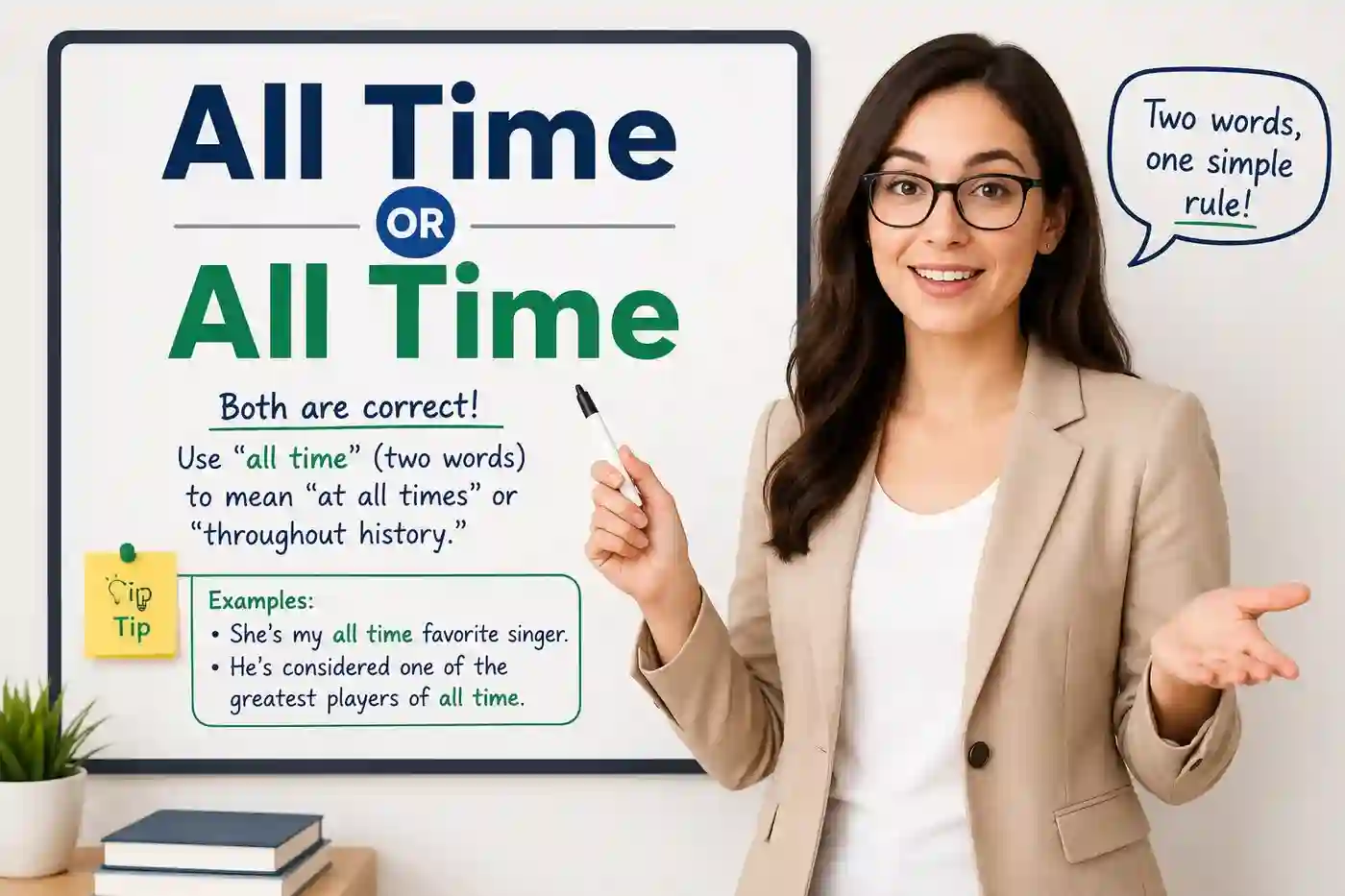
Have you ever paused while writing and wondered if you should use all time vs All Time? At first glance, it feels like there might be a hidden grammar rule or a spelling difference. Many people search this exact question because they assume one version is more correct than the other.
The truth is much simpler. There is no spelling difference between All Time and All Time. They are the same words written the same way. The only change you may see is capitalization, and that depends on context rather than grammar. For example, title capitalization follows different style rules than writing inside a sentence.
This confusion often comes from search engines, social media posts, or article titles that capitalize major words. Readers may think the capital letters create a different expression, but they do not. English uses capitalization for formatting, not to create a new meaning in this case.
In this guide, you’ll learn the correct way to use all time, when to capitalize it, what the phrase actually means, how professional editors handle it, and how to avoid common writing mistakes. You’ll also see natural examples that sound like everyday American English so you can use the phrase with confidence.
Quick Answer
There is no difference between All Time and All Time because they are the same phrase. If you see capital letters, they usually follow title capitalization rules. In regular sentences, write all time in lowercase unless style rules or a proper title require capitalization.
At A Glance Comparison
| Feature | All Time | All Time |
|---|---|---|
| Spelling | Correct | Correct |
| Meaning | Same meaning | Same meaning |
| Part of speech | Noun phrase or adjective phrase depending on context | Same |
| Grammar role | Describes the greatest across history or a complete period | Same |
| Pronunciation | /ɔl taɪm/ | /ɔl taɪm/ |
| Origin | Modern English | Same |
| Formality | Suitable for formal and informal writing | Same |
| Common use | Everyday English | Same |
| Difference | None | None |
| Example | She is the greatest athlete of all time. | She is the greatest athlete of all time. |
Which Form Should You Use
Use all time because it is the standard English phrase.
If someone asks All Time or All Time, the answer is simple. They are identical. There is no alternative spelling, no hidden grammar rule, and no difference in meaning.
The only choice you make involves capitalization.
Write all time in normal sentences.
Example.
- This is my favorite movie of all time.
Capitalize the words in titles, headings, or according to your chosen style guide.
Example.
- Greatest Movies of All Time.
Professional editors focus on consistency instead of inventing separate rules for identical phrases. If a document follows title case, capitalize the phrase in headings. If it follows sentence case, keep it lowercase inside regular text.
Understanding All Time
The phrase all time refers to the entire span of history or the highest ranking across every period.
It often appears after words like best, greatest, favorite, highest, or most successful.
Examples include:
- The highest scoring player of all time.
- My favorite vacation of all time.
- One of the greatest songs of all time.
In each example, the phrase compares something against every similar thing throughout history instead of limiting the comparison to one season, one decade, or one generation.
Meaning
The phrase expresses the idea of every period or every point in history.
Grammar Role
It usually works as part of a prepositional phrase beginning with of.
Example.
- She became the fastest runner of all time.
It can also work before a noun in some established expressions.
Examples.
- An all time record.
- An all time favorite.
- An all time classic.
In these cases, the phrase describes the noun instead of completing a comparison.
All Time Vs All Time Modern Relevance
You’ll find all time everywhere in modern English.
People use it in sports.
- The team’s all time leading scorer.
It is mostly used in entertainment.
- One of the best comedy shows of all time.
People use it in business.
- The company reported an all time high in sales.
People use it in everyday conversations.
- That was the funniest joke of all time.
Its flexibility makes it one of the most common expressions in spoken and written English.
The Biggest Differences Between All-Time Vs All Time Explained
Many readers expect a comparison between two different forms, but there isn’t one.
Here are the facts.
Spelling.
Both versions use the exact same spelling.
Meaning.
Both carry the same meaning.
Grammar.
Both follow the same grammar rules.
Pronunciation.
Both are pronounced exactly the same.
Writing Style.
The only visible change comes from capitalization. Titles often capitalize major words, while regular sentences usually do not.
Professional Writing.
Editors choose capitalization based on the publication’s style guide, not because one phrase is more correct than another.
Why People Get Confused
Several factors make people search this phrase.
- Search engines sometimes display capitalized titles that look different from normal writing.
- Headlines capitalize important words, creating the impression that capitalization changes meaning.
- Some websites compare identical phrases simply because people search for them.
- New English learners often assume every search query represents two different grammar choices.
- Copying text from books, blogs, or social media exposes readers to different capitalization styles.
The confusion is understandable, but the answer remains the same. The phrase itself never changes. Only the formatting does.
Grammar Rules For All Time Vs All Time You Should Know
Learning a few simple grammar rules will help you use all time naturally.
- It is used after superlatives.
- She is the greatest singer of all time.
- It is used before a noun only in well established expressions.
- An all time favorite.
- An all time record.
- Keep the phrase lowercase in ordinary sentences unless it begins the sentence.
- Capitalize it in titles if your style guide uses title case.
- Don’t treat ”All Time” as different words. They are the same phrase written with the same spelling.
This foundation will make the rest of the article much easier to understand.
Formal And Informal Writing For All Time Vs All Time
Both forms are suitable for every style of writing, including business reports, journalism, academic papers, sports writing, blogs, and everyday conversations.
For example:
Business writing:
- The company reported an all-time high in quarterly revenue.
Academic writing:
- The discovery ranks among the most influential breakthroughs of all time.
Sports journalism:
- She became the league’s all-time leading scorer.
The grammar never changes because of formality. It changes only because of the role the words play in the sentence.
A Simple Rule To Remember
If the words appear immediately before a noun and describe it together, use the hyphen.
If the words follow of or refer to the complete span of history, leave them as two separate words.
This is the same rule professional editors follow every day.
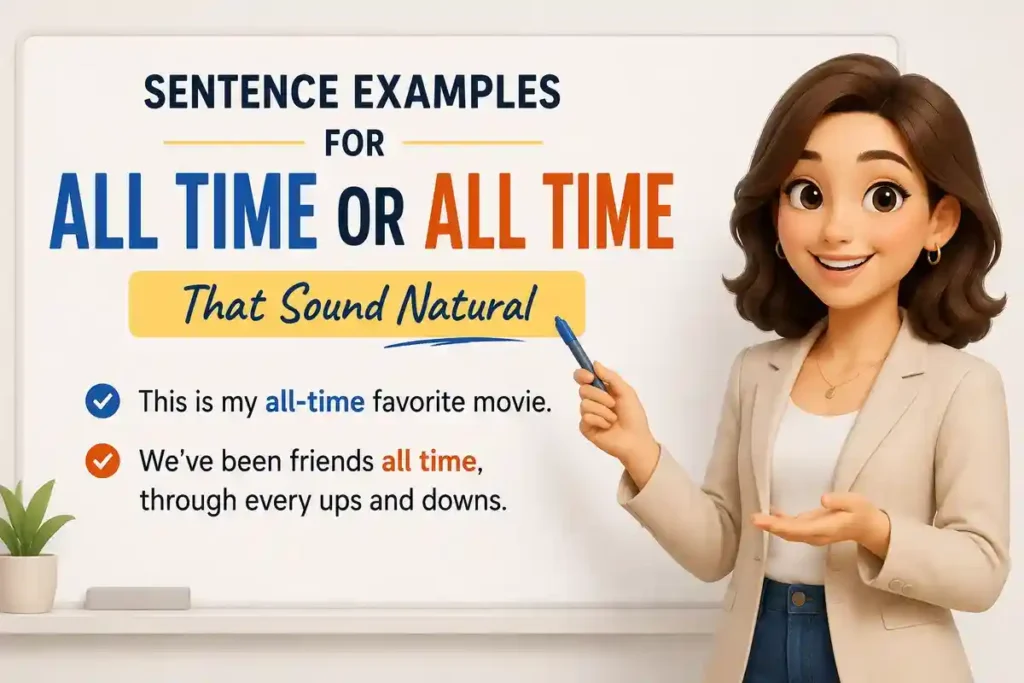
Sentence Examples All Time Vs All Time That Sound Natural
The examples below use a mix of related expressions instead of repeating the same wording over and over. That mirrors how fluent English speakers naturally communicate.
Everyday Conversations
- That was the best pizza I have ever eaten.
- She is still my favorite teacher from school.
- This vacation has been the highlight of my life.
- His performance will be remembered for years.
- That game produced one of the most exciting finishes I have seen.
- Our family still laughs about that camping trip.
- I cannot think of a better birthday celebration.
- That speech inspired everyone in the room.
- This coffee shop has become my favorite place in town.
- We still talk about that unforgettable concert.
Sports And Entertainment
- Many fans call Michael Jordan the greatest basketball player in history.
- The singer delivered a career defining performance.
- That movie remains a fan favorite decades after its release.
- The team celebrated a record setting season.
- The athlete reached a career milestone last weekend.
- Critics praised the novel as a modern classic.
- The stadium witnessed a historic comeback.
- The coach guided the club to its most successful season.
- The documentary earned praise around the world.
- The actor gave one of the strongest performances of his career.
Common Writing Mistakes Of All Time Vs All Time And How To Avoid Them
The phrase is simple, but writers still make a few common mistakes.
Confusing Capitalization With Grammar
Capital letters do not create a different expression. They simply follow formatting rules.
Sentence.
- This is my favorite book of all time.
Heading.
- Best Books Of All Time.
Using Strong Claims Without Evidence
Expressions that rank something above everything else should have a good reason behind them.
Instead of making unsupported claims, provide facts, rankings, reviews, or personal context.
Better.
- She became the school’s highest scoring player after breaking the previous record.
Repeating The Same Expression Too Often
Repeating one phrase throughout an article makes the writing sound forced.
Instead, rotate natural alternatives when the meaning stays clear.
Examples include:
- In history.
- Ever.
- Across the years.
- So far.
- Career best.
- Record setting.
- Lifetime favorite.
- Historic achievement.
This approach improves readability and creates a more natural flow.
Forgetting The Audience
Formal reports, academic papers, and casual conversations all have different expectations. Choose wording that matches the situation instead of relying on dramatic language every time.
Pronunciation All Time Vs All Time Made Simple
Native speakers pronounce the phrase consistently across English speaking countries.
IPA
American English
/ɔl taɪm/
British English
/ɔːl taɪm/
Syllable Breakdown
All.
Time.
Two syllables.
Word Stress
The second word usually receives the strongest emphasis during normal conversation.
Helpful Pronunciation Tips
- Say all clearly instead of shortening the vowel.
- Let time carry the natural emphasis.
- Practice by reading complete sentences instead of saying the phrase alone.
Word History And Origin
This expression combines two very old English words.
All comes from the Old English word eall, meaning every part or the whole amount.
Time comes from the Old English word tīma, meaning a period, season, or point in history.
As English developed, speakers naturally combined them to describe something that extends across every period or stands above everything that came before it. Today, the phrase appears in sports, literature, journalism, business, entertainment, and everyday conversation.
Usage Of All Time Vs All Time Across English Speaking Countries
The meaning remains the same across major English speaking countries.
American English
American writers frequently use it in sports reporting, entertainment news, business articles, and casual conversations.
Example.
- The company reached a record level of annual revenue.
British English
British publications follow the same grammar and use the expression in similar situations.
Example.
- She is considered one of the greatest writers in history.
Canadian English
Canadian English follows the same usage while editorial style guides determine capitalization in headings.
Australian English
Australian writers use the phrase naturally in news stories, sports coverage, and daily conversation without changing its meaning.
All Time Vs All Real World Usage
Understanding context helps you sound more natural.
Daily Conversation
- That was the funniest joke I have heard.
- She remains my favorite music teacher.
School Writing
Students often compare historical figures, books, inventions, or discoveries.
Example.
- The Wright brothers changed transportation forever.
Business Communication
Businesses often describe major milestones.
Example.
- The company reported its highest annual profit.
Academic Writing
Academic writing usually avoids exaggerated claims unless supported by research.
Example.
- The study produced the strongest results recorded during the project.
Journalism
News organizations often report record breaking events, elections, financial results, and sporting achievements.
Online Content
Blogs, reviews, and buying guides use this type of wording to emphasize recommendations and memorable experiences.
Social Media
People often use it to express excitement or personal opinions.
- That was the best concert I have ever attended.
Similar Words And Frequently Confused Terms About All Time Vs All Time
Several expressions carry similar ideas but are not interchangeable.
Ever
Refers to any point in history or someone’s experience.
Example.
- Is this the best meal you have ever tasted?
Lifetime
Refers to one person’s life instead of history as a whole.
Example.
- It was the opportunity of a lifetime.
Historic
Describes something important in history.
Example.
- The mission marked a historic achievement.
Legendary
Describes someone or something famous for remarkable achievements.
Example.
- She became a legendary coach.
Record Breaking
Focuses on surpassing previous achievements.
Example.
- The runner delivered a record breaking performance.
Professional Editors Advice
Experienced editors rarely rely on one expression throughout an article. They vary their language while keeping the meaning clear.
Good editing habits include:
- Replace repeated phrases with natural alternatives.
- Use specific facts instead of broad superlatives whenever possible.
- Keep capitalization consistent throughout the document.
- Read each paragraph aloud to catch awkward repetition.
- Let evidence support your conclusions instead of depending on dramatic wording.
- Choose language that matches the audience and purpose.
Strong writing sounds confident because it is precise. A well placed expression has far more impact than repeating the same words in every section.
Frequently Asked Questions
Is All-time A Real Word
Yes. it is a standard compound adjective. It describes a noun and means greatest, highest, best, or most significant across history. Dictionaries and major style guides recognize it as the correct form in this grammatical position.
Is All Time Ever Correct
Yes. it is correct when it refers to the entire span of history, especially in expressions like of all time. In these cases, the words do not form a compound adjective, so no hyphen is needed.
Why Does All-time Need A Hyphen
The hyphen shows that both words work together as one adjective before a noun. It improves clarity and helps readers understand that the words express one complete idea.
Why Does Of All Time Not Use A Hyphen
In the phrase of all time, the words form part of a noun phrase instead of describing a noun directly. Since they are not functioning as a compound adjective, the hyphen is unnecessary.
Is This Rule The Same In American And British English
Yes. Both American and British English follow the same grammar rule. Unlike many spelling differences, this punctuation rule does not change from one country to another.
Is All Time Favorite Wrong
Yes. When the phrase comes before the noun, it should be all-time favorite because it functions as a compound adjective.
Can I Write Greatest All-time Player
That construction is uncommon. Native speakers usually write the greatest player of all time depending on the intended meaning.
Do Grammar Checkers Catch This Mistake
Many grammar checkers identify missing hyphens, but not all of them explain the reason. Understanding the grammar yourself is still the most reliable approach.
How Can I Remember The Rule
Ask yourself one simple question. Are the words describing the next noun? If they are, use all-time.
What Is The Most Common Mistake
The most frequent mistake is leaving out the hyphen in expressions like all-time favorite.
Final Verdict
Both all-time vs all time are correct, but they are not interchangeable. The right choice depends entirely on grammar.
Use all-time when the words work together as a compound adjective before a noun. Use all time when referring to the entire course of history, especially in phrases like of all time.
An easy way to remember the rule is this. If the expression describes the next noun, add the hyphen. If it refers to history itself, leave the words separate.
Mastering this one grammar rule will help your writing look clearer, more polished, and professionally edited.

Founding Editor
Maya spent six years as a copyeditor at a regional newspaper before starting Grammist, which is where the “answer first” format came from: newsroom style guides don’t have room for a preamble.
She writes and reviews most of the word-pair and spelling entries, and has final say on anything that goes out under the Grammist name.