
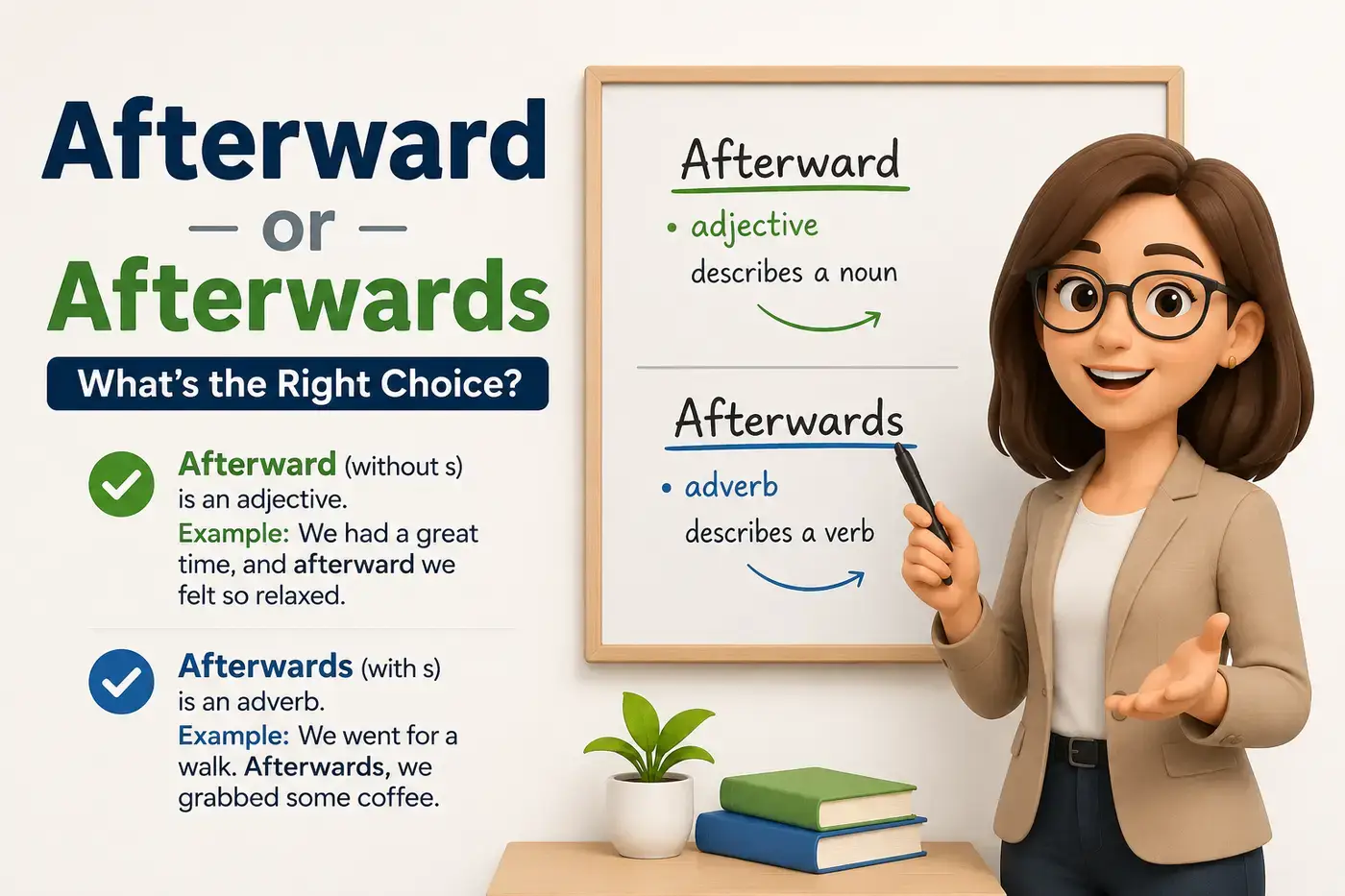
You finish writing an email and pause before typing the last sentence. Should you write afterward or afterwards? It looks like a tiny choice, but it can make you stop and think. Many people assume one spelling is right and the other is wrong. In reality, both words are correct. The real difference comes down to the type of English you are writing and the audience you want to reach.
If you searched for afterward or afterwards, you are probably looking for a clear answer. You may want to know which spelling sounds more professional, which one belongs in American English, or if editors treat one as more correct than the other. These questions are common because the two words share the same meaning and are pronounced almost the same.
The good news is that this is not one of those grammar rules filled with exceptions. Once you understand the small difference between these two forms, choosing the right one becomes easy. Professional editors rarely think about this choice because they follow the style guide that matches their audience and stay consistent from beginning to end.
In this guide, you will learn the meaning of each word, how they developed over time, the differences between American and British English, common writing mistakes, grammar rules, pronunciation tips, and practical examples from everyday life. By the end, you will know exactly which form fits your writing and feel confident every time you use it.
Quick Answer
Both afterward and afterwards are correct. They mean later or after that and work the same way in a sentence. American English usually prefers afterward, while British English more often uses afterwards. Pick the form that matches your audience and use it consistently throughout your writing.
At A Glance Comparison
| Feature | Afterward | Afterwards |
|---|---|---|
| Correct spelling | Yes | Yes |
| Meaning | Later or after that | Later or after that |
| Part of speech | Adverb | Adverb |
| Word type | Time adverb | Time adverb |
| Pronunciation | /ˈæf.tɚ.wɚd/ | /ˈɑːf.tə.wədz/ |
| Origin | Middle English | Middle English |
| Grammar role | Describes when something happens | Describes when something happens |
| Formality | Neutral | Neutral |
| Frequency of use | More common in American English | More common in British English |
| Typical contexts | Business writing journalism school writing everyday communication | Newspapers books academic writing everyday communication |
| Example sentence | We finished lunch. Afterward we visited the park. | We finished lunch. Afterwards we visited the park. |
Afterward Or Afterwards Which Word Should You Use
If you write for an American audience, afterward is usually the better choice. It follows modern American spelling conventions and appears more often in newspapers, business communication, educational materials, and government publications.
If your readers are in the United Kingdom or another country that follows British English, afterwards is usually the preferred form. It is the spelling people naturally expect in books, newspapers, and everyday writing across much of the English speaking world outside the United States.
The important point is that both words are correct. They carry exactly the same meaning and perform the same grammatical job. The only real difference is regional style.
For example:
- We finished the meeting. Afterward everyone went home.
- We finished the meeting. Afterwards everyone went home.
Both sentences are correct. The choice depends on the audience, not the grammar.
Is One Form More Correct
No. Dictionaries, grammar references, and professional style guides recognize both spellings as standard English. Neither word is more formal, more modern, or more grammatically correct than the other.
Editors usually choose one version based on the publication’s style guide. An American magazine will almost always use afterward, while a British newspaper will usually prefer afterwards. The goal is consistency, not proving that one spelling is better.
Why Writers Get Confused
It is easy to see why this pair causes confusion. The words look almost identical, sound nearly the same, and have exactly the same meaning. Since both appear in dictionaries and published writing, many learners wonder if one has a hidden grammar rule that the other does not.
The confusion grows because people regularly read content from different countries without realizing it. Someone might read an American news article that uses afterward and then open a British website using afterwards a few minutes later. Both writers are following the conventions of their audience, even though the spellings are different.
Grammar checkers can add to the uncertainty because many accept both forms without explaining the regional preference. As a result, writers often think they have missed an important grammar rule when the real issue is simply choosing the spelling that matches their readers.
Understanding Each Word
Afterward
Afterward is an adverb that means later, after that, or at a later time. It connects two events by showing that one happened following another. Instead of repeating longer expressions such as after that or later on, writers often choose afterward because it sounds natural and keeps the sentence concise.
Here are a few examples:
- We finished the presentation. Afterward everyone asked questions.
- She called her parents afterward.
- The doctor explained the test results afterward.
In modern American English, this spelling appears far more often than afterwards. You will see it in newspapers, business emails, government documents, school textbooks, and online articles written for readers in the United States.
Professional editors in the United States also prefer this form because it matches major American style guides. Choosing afterward does not make your writing more formal or less formal. It simply reflects American spelling conventions.
Afterwards
Afterwards is also an adverb with exactly the same meaning. It tells readers that something happened later or following another event. The extra s does not change the definition, grammar, or function of the word.
Consider these examples:
- We watched the concert. Afterwards we went out for dinner.
- She apologized afterwards.
- They celebrated afterwards with their friends.
This spelling is widely used in British English and appears regularly in newspapers, books, academic writing, and everyday communication across the United Kingdom. It is also common in many countries that follow British spelling conventions, including Australia and New Zealand.
Some learners assume the final s changes the meaning or creates a plural form. That is a common misunderstanding. Since afterwards is an adverb, ideas like singular and plural do not apply. The extra letter simply reflects a spelling tradition that remained popular in British English as the language evolved.
Afterward Or Afterwards The Biggest Differences Explained
At first glance, these two words seem interchangeable because they share the same meaning and grammatical role. In everyday writing, you can often replace one with the other without changing the message. The differences are subtle, but understanding them helps your writing feel polished and consistent.
Spelling
The most noticeable difference is the final letter. Afterward ends without s, while afterwards includes it. This is a regional spelling preference instead of a grammar rule. Neither spelling is incorrect.
Meaning
Both words mean later, after that, or following an earlier event. They express the same idea and can usually replace each other without changing the meaning of a sentence.
For example:
- We finished dinner. Afterward we took a walk.
- We finished dinner. Afterwards we took a walk.
The timeline remains exactly the same in both examples. Only the spelling changes.
Grammar
Both forms function as adverbs. They describe when something happens and help connect events in a clear sequence. Neither word can act as a noun, adjective, or verb, and both follow the same grammar rules in every sentence.
Pronunciation
Native speakers pronounce these words almost the same. The only noticeable difference is the soft s sound at the end of afterwards. During everyday conversation, many people hardly notice the distinction unless they are listening very closely.
Writing Style
American publications generally favor afterward, while British publications usually choose afterwards. Canadian and Australian writers use both forms, although British influence makes afterwards slightly more common in many publications.
Professional editors care far more about consistency than the spelling itself. Mixing both forms in the same article, report, or book can make the writing feel uneven. That is why newspapers, publishers, universities, and businesses usually follow a style guide and stick with one spelling from beginning to end.
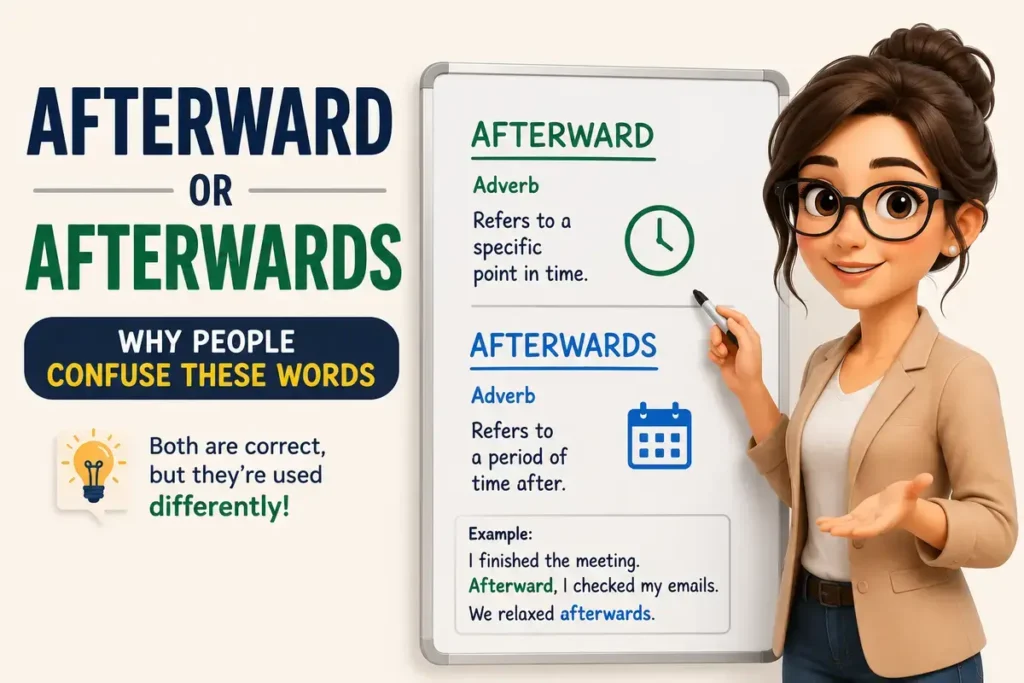
Why People Confuse These Words
It is easy to understand why so many people hesitate before choosing between afterward and afterwards. The words have the same meaning, sound almost identical, and appear in trusted dictionaries. Since both are correct, many writers assume there must be a hidden grammar rule that separates them. In reality, the difference is much simpler.
Similar Pronunciation
Most native speakers pronounce these words almost the same. The only noticeable difference is the soft s sound at the end of afterwards. During normal conversation, that sound is so subtle that many listeners barely notice it.
As a result, people often spell the word the way they have seen it most often instead of thinking about regional conventions.
Regional English
One of the biggest reasons for the confusion is the difference between American English and British English. American writers usually choose afterward, while British writers usually prefer afterwards.
Today, people read articles, blogs, books, and social media posts from around the world. It is common to see both spellings in a single afternoon. Without knowing the regional preference, it is easy to think one version is incorrect.
Autocorrect And Grammar Tools
Modern writing tools can create even more confusion. Some spell checkers automatically change the word based on the language setting of your device. Others accept both spellings without explaining why.
Imagine writing an article in American English. Your grammar checker may suggest afterward, but another tool using British English settings could recommend afterwards. Both suggestions are technically correct, which leaves many writers wondering which one they should trust.
Learning Habits
Many English learners memorize words without learning the reason behind different spellings. Later, they discover another version in a book or online article and assume they learned the wrong word.
The same confusion happens with many other pairs in English, especially words that differ between American and British spelling conventions. Once you recognize this pattern, choices like afterward and afterwards become much easier to understand.
Common Misconceptions
Several myths continue to circulate online. Here are some of the most common ones.
- Myth: Only afterward is correct.
Fact: Both spellings are standard English. - Myth: Afterwards is more formal.
Fact: Neither form is more formal. The choice depends on regional style. - Myth: The final s changes the meaning.
Fact: Both words mean exactly the same thing. - Myth: One spelling is old fashioned.
Fact: Both forms remain widely used in modern English.
Understanding these misconceptions helps you focus on the real issue, which is writing consistently for your audience.
Grammar Rules You Should Know
Although afterward and afterwards are simple words, using them naturally requires a basic understanding of how adverbs work. Once you know their grammatical role, you can place them confidently in almost any sentence.
Parts Of Speech
Both afterward and afterwards are adverbs. Their job is to describe when something happens. They answer questions like When did it happen? or What happened next?
For example:
- We finished our work. Afterward we went home.
- She apologized afterwards.
In both examples, the adverb tells us the action happened later.
Sentence Placement
These words are flexible and can appear in different parts of a sentence. The most common position is at the beginning or the end of the second clause.
Examples:
- We finished dinner. Afterward we watched a movie.
- We watched a movie afterward.
- Afterwards everyone left quietly.
- Everyone left quietly afterwards.
All of these sentences are natural and grammatically correct.
Connecting Ideas
Writers often use these adverbs to connect related events. They help create a smooth timeline without repeating longer phrases like after that or at a later time.
Compare these examples.
Less natural:
- We finished the meeting. After that we answered emails.
More natural:
- We finished the meeting. Afterward we answered emails.
The shorter form improves the flow without changing the meaning.
Verb Relationships
These words do not change the tense of a sentence. Instead, they describe the timing of an action.
For example:
- She completed the project yesterday. Afterwards she took a vacation.
- They are signing the contract today. Afterward they will meet the client.
- Finish your homework first. Afterwards you can watch television.
Notice that the verb tense changes according to the situation, not because of the adverb.
Formal And Informal Writing
Both spellings work in formal and informal English. You can use them in business reports, academic papers, emails, presentations, news articles, and everyday conversations.
For example:
Business email:
- We will review the proposal tomorrow. Afterward we will discuss the next steps.
Academic writing:
- The participants completed the survey. Afterwards the researchers analyzed the results.
Everyday conversation:
- Let’s grab coffee afterward.
The level of formality stays the same. Only the regional spelling preference changes.
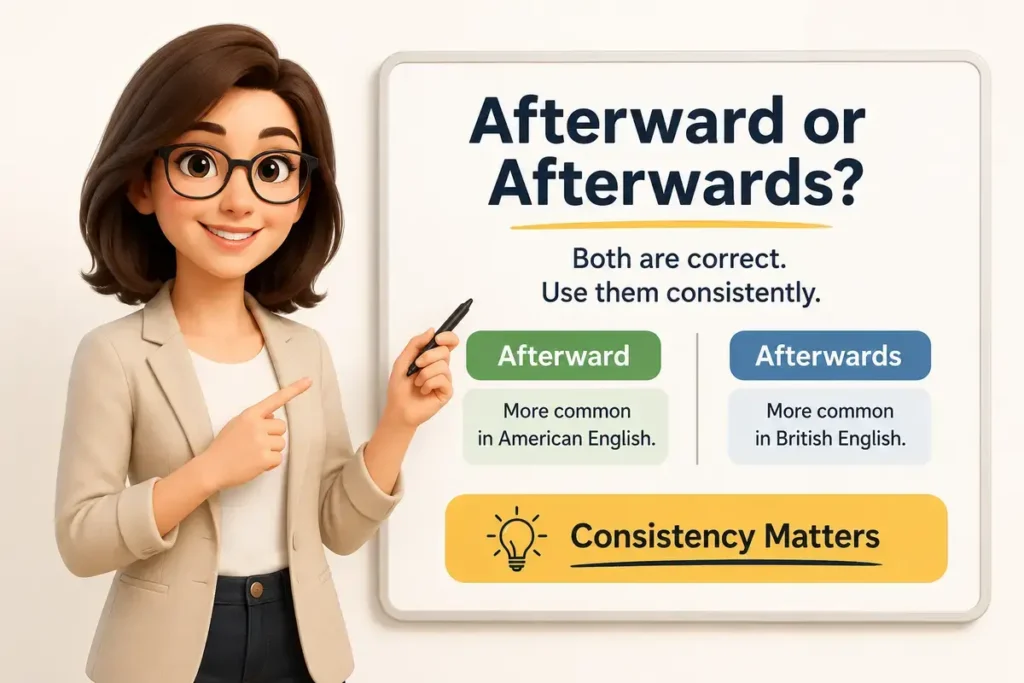
Consistency Matters
Professional editors pay close attention to consistency. If you choose afterward at the beginning of an article, continue using it throughout the rest of the piece. The same advice applies if you choose afterwards.
Mixing both spellings can distract careful readers and make the writing feel less polished, even though each word is correct on its own.
Sentence Examples
Seeing these words in realistic situations makes them much easier to remember.
Examples Using Afterward
- We finished lunch. Afterward we walked through the park.
- She thanked everyone afterward.
- The doctor explained the results afterward.
- Afterward we realized we had taken the wrong exit.
- The students stayed afterward to ask questions.
- He called me afterward to apologize.
- We packed everything afterward and headed home.
- Afterward the team celebrated their success.
- I felt much better afterward.
- The manager spoke with each employee afterward.
Examples Using Afterwards
- We visited the museum. Afterwards we had dinner downtown.
- She smiled afterwards because everything worked out.
- Afterwards the children played outside.
- They met for coffee afterwards.
- I spoke with the teacher afterwards.
- Afterwards everyone agreed on the final plan.
- He looked much calmer afterwards.
- We laughed about it afterwards.
- Afterwards the audience applauded for several minutes.
- They continued talking afterwards until the restaurant closed.
As you can see, the sentences remain natural no matter which spelling you choose. The difference lies in the regional style, not the meaning or grammar.
Common Writing Mistakes And How To Avoid Them
Most mistakes involving these words are not grammar mistakes. They usually happen because writers are unfamiliar with regional spelling conventions or edit inconsistently.
Mixing Both Spellings
One of the most common editing problems is switching between afterward and afterwards in the same document.
For example:
- We met after lunch. Afterward we reviewed the report.
- Afterwards everyone signed the agreement.
Both sentences are correct on their own, but using different spellings in the same document creates an inconsistent reading experience.
Instead, choose one spelling and use it throughout the entire piece.
Thinking One Form Is Wrong
Many people believe only one spelling is acceptable. This misconception often comes from seeing different style guides or reading content from different countries.
Remember that both forms are correct. Your audience should guide your decision.
Using The Wrong Regional Style
If you write for an American company, afterward will usually look more natural. If you are preparing content for a British publication, afterwards is often the better choice.
Matching your readers’ expectations makes your writing feel more professional.
Forgetting To Proofread
Consistency is one of the easiest things to check during proofreading. Before publishing your work, search the document for both spellings.
If you find both versions, decide which one fits your audience and replace the others. This simple editing habit gives your writing a cleaner and more polished appearance.
Quick Editing Tips
- Choose the spelling that matches your audience.
- Stay consistent from beginning to end.
- Do not assume one spelling is more correct than the other.
- Let your style guide determine the preferred form.
- Do one final search before publishing to catch mixed spellings.
Following these simple habits will help your writing look polished, consistent, and professionally edited.
Pronunciation Made Simple
Learning the pronunciation is easy because both words sound almost the same. The only noticeable difference is the soft s sound at the end of afterwards. Native speakers rarely emphasize this difference during everyday conversations, so both forms are immediately understood.
| Word | IPA | Syllables | Stress |
|---|---|---|---|
| Afterward | /ˈæf.tɚ.wɚd/ | Af ter ward | First syllable |
| Afterwards | /ˈɑːf.tə.wədz/ in British English | Af ter wards | First syllable |
Easy Pronunciation Tips
- Say after first.
- Add ward to make afterward.
- Add a soft s sound at the end for afterwards.
- Keep the stress on the first syllable in both words.
Common Pronunciation Mistakes
Most learners do not mispronounce these words. Instead, they either overpronounce the final s in afterwards or pause too long between after and ward.
Listening to native speakers in podcasts, news broadcasts, or interviews is a great way to hear the natural rhythm. After a little practice, both words become easy to pronounce confidently.
Word History And Origin
The story behind these words explains why both spellings still exist today.
The word afterward developed from the Old English word after, which means later in time or behind, combined with ward, a suffix that expresses direction or movement. Over time, the combined form came to describe something that happened later or following another event.
As English evolved through the Middle English period, another form began appearing with a final s. Similar patterns appeared in several English adverbs, creating pairs that existed side by side for centuries.
As English spread around the world, different regions favored different spellings. American English gradually preferred shorter forms in many cases, while British English continued using several traditional spellings, including afterwards.
Today, both forms remain standard English. Neither is newer, more accurate, or more correct. They simply reflect different historical spelling traditions.
Usage Across English Speaking Countries
Regional preferences explain almost every difference between these two words. Understanding those preferences helps you choose the spelling that feels natural to your audience.
American English
American English strongly favors afterward. It appears in newspapers, government publications, business communication, textbooks, academic papers, and online articles written for readers in the United States.
Although Americans understand afterwards, it appears much less often in edited writing.
British English
British English generally prefers afterwards. You will see this spelling in books, newspapers, magazines, educational materials, and everyday communication throughout the United Kingdom.
Readers naturally expect this version because it matches British spelling conventions.
Canadian English
Canadian English accepts both forms. Since Canadian writing draws influence from both American and British English, you may encounter either spelling.
Many Canadian organizations choose one style guide and use it consistently across all publications.
Australian English
Australian English usually follows British spelling conventions, making afterwards the more common choice. You will regularly find it in newspapers, schools, universities, and government documents.
Even so, readers understand afterward without any confusion.
Which Spelling Should You Choose
A simple rule works in almost every situation.
- Write afterward for American audiences.
- Write afterwards for British audiences.
- Follow your organization’s style guide if one exists.
- Stay consistent throughout your document.
Consistency matters far more than choosing one spelling over the other.
Real World Usage
These words appear in almost every type of writing. Looking at real situations makes it easier to see how naturally they fit into everyday English.
Daily Conversation
People often use these words while describing events in the order they happened.
Examples:
- We had breakfast. Afterward we went hiking.
- We met at the café. Afterwards we walked around downtown.
Both sentences sound completely natural. The preferred spelling depends on the speaker’s variety of English.
School Writing
Students often use these adverbs to improve the flow of essays and reports.
Example:
- The experiment was completed successfully. Afterward the students recorded their observations.
The adverb helps connect ideas without repeating longer expressions.
Business Communication
Business writing values clarity and consistency. These words help explain the sequence of events during meetings, projects, and presentations.
Example:
- We will review the proposal tomorrow. Afterward we will discuss the budget.
The sentence is direct, professional, and easy to follow.
Academic Writing
Researchers frequently describe procedures in chronological order.
Example:
- Participants completed the questionnaire. Afterwards the research team analyzed the responses.
Both spellings are acceptable if they match the publication’s style guide.
Books
Novelists use these words to move readers smoothly from one event to the next.
Example:
- They stood quietly for a few moments. Afterwards no one spoke until they reached home.
The transition feels natural without slowing the story.
Journalism
News articles often summarize events in chronological order.
Example:
- The mayor delivered a speech. Afterward reporters asked several questions.
The word creates a smooth connection between related events.
Online Writing
Blog posts and websites use these adverbs because they keep instructions clear and easy to follow.
Example:
- Install the software first. Afterwards restart your computer.
Readers immediately understand the sequence.
Social Media
Even in short posts, these words help tell a complete story.
Example:
- Had an amazing concert tonight. Afterwards we found the best pizza in town.
The language feels casual while still sounding natural.
Across every type of writing, the purpose remains the same. These words guide readers through events in a logical order and make sentences flow more smoothly.
Similar Words And Frequently Confused Terms
Afterward and afterwards are not the only words that confuse English learners. Several other adverbs and transition words have similar meanings, but each has its own purpose. Knowing the difference helps you choose the most natural word for every situation.
After
After usually works as a preposition or conjunction. It introduces another event, person, or period of time instead of describing when something happened by itself.
Examples:
- We went home after the game.
- Call me after you arrive.
Use afterward or afterwards when you simply mean later or after that.
Later
Later also means at a future time, but it is more general. It does not always connect two events as directly as afterward or afterwards.
Examples:
- I’ll call you later.
- We spoke afterward about the meeting.
Both are correct, but afterward creates a stronger connection between the two actions.
Then
Then often introduces the next step in a sequence. It is especially common in instructions and storytelling.
Examples:
- Mix the ingredients. Then bake the cake.
- We finished dinner. Afterwards we watched a movie.
Both words describe order, but then usually points to the next action, while afterward emphasizes that something happened later.
Subsequently
Subsequently means later as well, but it sounds much more formal. You will mostly see it in legal documents, research papers, and official reports.
Examples:
- The company announced the merger. Subsequently it expanded into new markets.
- The company announced the merger. Afterward it expanded into new markets.
The second version sounds more conversational and is easier for most readers.
Eventually
Eventually means after a long period or after several events. It does not simply mean later.
Examples:
- We searched for hours. Eventually we found the missing keys.
- We finished the meeting. Afterward we went to lunch.
The first sentence suggests time passed before the result. The second simply describes the next event.
Afterwards Versus Thereafter
Thereafter also means after that, but it sounds much more formal than afterward or afterwards. It is common in legal writing, contracts, and official documents.
Example:
- Payments are due on the first day of each month. Thereafter a late fee will apply.
In everyday English, afterward and afterwards usually sound more natural.
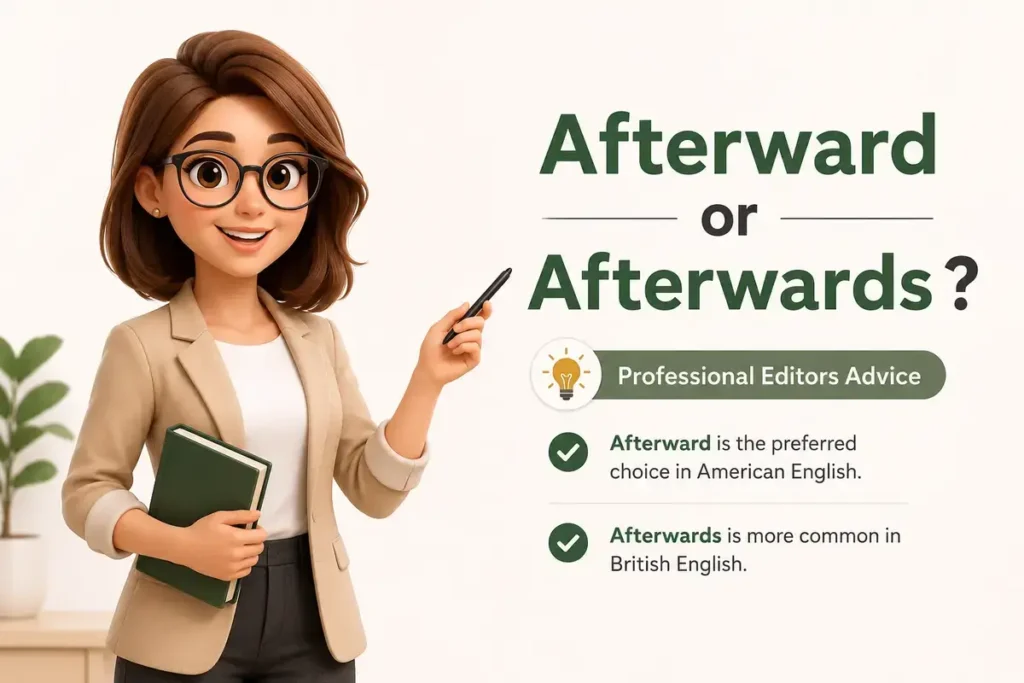
Professional Editors Advice
Experienced editors rarely spend much time deciding between afterward and afterwards. Instead, they focus on consistency and the expectations of the audience. A good editor knows that polished writing is not about choosing a perfect word. It is about making every choice fit naturally within the document.
One of the first things editors consider is the target audience. If the article is written for readers in the United States, afterward is usually the better option. If the publication follows British English, afterwards is the natural choice. Once that decision is made, the spelling remains the same throughout the document.
Professional editors also avoid changing a writer’s regional style without a good reason. If an article consistently follows British English, replacing afterwards with afterward would only create inconsistency. The same principle applies in the opposite direction.
Editors also recommend keeping transition words simple. Many writers reach for formal expressions such as subsequently or thereafter because they sound impressive. In most situations, afterward vs afterwards communicates the same idea more clearly and feels more natural.
Before publishing any piece of writing, professional proofreaders perform one final consistency check. They search the document for both spellings to make sure only one appears. This takes less than a minute and instantly gives the writing a cleaner, more polished appearance.
The best writers build this habit into every project. Instead of asking which spelling is better, they ask which spelling fits their audience. That small shift in thinking leads to stronger, more professional writing.
Frequently Asked Questions
Is Afterward Correct In American English
Yes. Afterward is the preferred spelling in American English and appears in newspapers, business writing, academic publications, and government documents. Although Americans understand afterwards, the version without the final s is much more common in edited American writing.
Is Afterwards Wrong
No. Afterwards is completely correct. It is the standard spelling in British English and is widely used in countries that follow British spelling conventions. The difference is regional, not grammatical.
Do Afterward And Afterwards Mean The Same Thing
Yes. Both words mean later or after that. They function as adverbs and describe when something happens. The meaning never changes because of the spelling.
Which Spelling Should I Use In Business Writing
Choose the spelling that matches your audience or your company’s style guide. American businesses generally prefer afterward, while organizations using British English usually write afterwards. The most important rule is to stay consistent.
Can I Use Both Spellings In The Same Article
It is better not to. Mixing both spellings can make your writing look inconsistent. Pick the form that matches your audience and use it throughout the entire document.
Is One More Formal Than The Other
No. Both spellings have the same level of formality. They work equally well in academic writing, business communication, journalism, and everyday conversation.
Why Does British English Add The Final S
The extra s comes from older spelling traditions that remained common in British English. American English gradually favored shorter spellings for several words, while British English kept many traditional forms.
Do Grammar Checkers Accept Both Spellings
Most modern grammar and spell checking tools recognize both spellings. Some programs may recommend one version based on the language settings you choose, but neither form is considered incorrect.
Can I Replace Afterward With Later
Sometimes, yes. Both words describe something that happens after another event. However, afterward creates a stronger connection between two related actions, while later is more general and can refer to any future time.
How Can I Remember Which One To Use
Think about your audience before you start writing. If you are writing for readers in the United States, choose afterward. If your audience follows British English, choose afterwards. Once you make your choice, keep the same spelling from beginning to end.
Final Verdict
Both afterward and afterwards are correct, and both mean later or after that. The only real difference is regional preference. American English generally favors afterward, while British English usually prefers afterwards.
The best choice depends on the audience you are writing for. Once you decide which variety of English fits your readers, use that spelling consistently throughout your document. This simple habit makes your writing look polished, professional, and carefully edited.
An easy way to remember the difference is this. Think of afterward as the version American writers usually choose, while afterwards is the form readers commonly expect in British English. The meaning never changes, only the spelling preference does.
Once you understand that simple rule, this pair becomes one of the easiest choices you will make as a writer.

Founding Editor
Maya spent six years as a copyeditor at a regional newspaper before starting Grammist, which is where the “answer first” format came from: newsroom style guides don’t have room for a preamble.
She writes and reviews most of the word-pair and spelling entries, and has final say on anything that goes out under the Grammist name.