
If you’ve ever typed affend instead of offend, you’re not alone. It is one of those spelling mistakes that slips into writing because both words sound similar when spoken quickly. Spellcheck might catch it, but not always. If it goes unnoticed, it can make your writing look less polished.
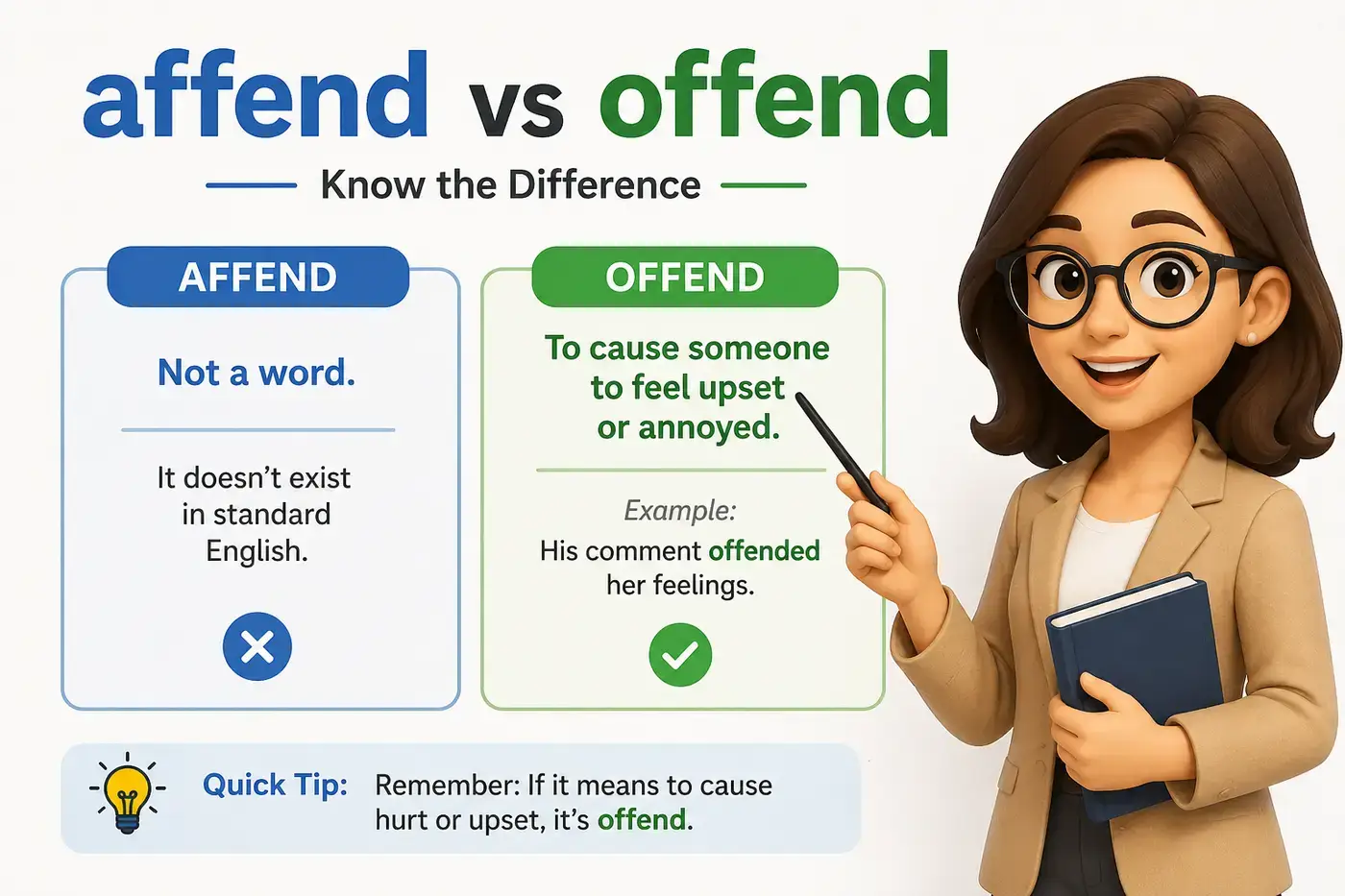
The short answer is simple. Offend is the correct English word. Affend is not a standard English word and appears because of a spelling mistake. If your goal is to describe causing hurt, insult, or annoyance, offend is always the word you need.
This guide explains the difference between affend vs offend in plain English. You’ll learn why people confuse them, how to remember the correct spelling, how to use offend correctly in everyday writing, and the grammar rules that help you avoid this mistake for good.
Direct Answer
Offend is the correct English word. It means to insult, upset, embarrass, or hurt someone’s feelings. Affend is a misspelling and does not appear as a standard word in modern English dictionaries. If you mean to cause offense or emotional hurt, always write offend.
Affend Vs Offend At A Glance
| Feature | Affend | Offend |
|---|---|---|
| Standard English word | No | Yes |
| Correct spelling | No | Yes |
| Found in modern dictionaries | No | Yes |
| Part of speech | None | Verb |
| Meaning | None in modern English | To insult upset hurt or violate rules |
| Appropriate for formal writing | No | Yes |
| Appropriate for everyday writing | No | Yes |
The comparison is clear. Offend belongs in English. Affend does not.
What Does Offend Mean
Offend is a verb. It describes an action that causes someone to feel hurt, insulted, embarrassed, shocked, or upset. It can also mean breaking a law, rule, or accepted standard.
People often think of emotional situations first, but the word has a broader meaning. Someone can offend a friend with rude comments, offend a community by ignoring cultural traditions, or offend the law by committing a crime.
The exact meaning depends on the context.
For example.
- His joke offended several people at the meeting.
- She never wants to offend her customers.
- They apologized after realizing their comments offended the audience.
- Anyone who offends the law may face legal consequences.
Notice that the idea stays the same in every example. Someone or something causes offense.
Is Affend A Real Word
No. Affend is not a recognized English word in modern American or British English. You will not find it in trusted dictionaries because it is simply a spelling mistake.
Most people write affend because English pronunciation can be tricky. The first vowel sound in offend is often spoken quickly in casual conversation. That makes some writers replace the letter o with a.
Typing errors also play a role. Many spelling mistakes happen because fingers move faster than the brain. It is a common slip, especially on phones and tablets.
If you write affend, readers may understand your meaning from the sentence, but they will notice the spelling mistake.

Which Form Is Correct
The correct form is offend. Use offend every time you want to express one of these ideas.
- Hurt someone’s feelings.
- Insult someone.
- Cause annoyance.
- Shock people.
- Break a law or rule.
- Violate accepted standards.
Never replace it with affend because that spelling is incorrect. Here are a few examples.
Correct.
- I did not mean to offend you.
- His words offended the entire team.
- She tried not to offend anyone during the discussion.
- The advertisement offended many viewers.
Incorrect.
- I did not mean to affend you.
- His words affended everyone.
- She hopes not to affend anyone.
Every incorrect sentence becomes correct by changing affend to offend.
Key Differences Between Affend And Offend
Although these spellings look similar, only one belongs in modern English.
| Point | Affend | Offend |
|---|---|---|
| Dictionary status | Not accepted | Accepted |
| English usage | Incorrect | Correct |
| Professional writing | Never use | Always use when appropriate |
| Grammar | Invalid | Verb |
| Meaning | None | Cause offense or violate rules |
Think of it like using the wrong key for a lock. It might look similar, but it simply does not fit.
Grammar Rules
Understanding the grammar behind offend makes it much easier to use correctly.
Offend Is A Verb
The word describes an action.
Examples.
- They offended their neighbors.
- I hope my question does not offend anyone.
- Loud remarks often offend people.
Regular Verb Forms
Like many English verbs, offend follows regular spelling patterns.
| Verb Form | Word |
|---|---|
| Base form | offend |
| Third person singular | offends |
| Present participle | offending |
| Past tense | offended |
| Past participle | offended |
Examples.
- She offends people without realizing it.
- They are offending their customers.
- He offended his teacher yesterday.
- We have offended no one.
Common Sentence Patterns
Offend + person
- The comment offended Sarah.
- His behavior offended everyone.
Be offended by + noun
- She was offended by the remark.
- Many readers were offended by the article.
Offend + group
- The speech offended local residents.
- The campaign offended many voters.
These patterns appear frequently in newspapers, books, business communication, and everyday conversations.
Pronunciation
The standard pronunciation of offend is.
American English IPA
/əˈfɛnd/
British English IPA
/əˈfɛnd/
The stress falls on the second syllable.
Think of it like this.
uh FEND.
Saying the word slowly can help reinforce the correct spelling. Many learners accidentally hear the first sound as the letter a, but the written form always begins with o.
Spelling Rules
English spelling often follows history instead of pronunciation. That is exactly what happens with offend.
The word begins with off because it comes from Latin through Old French. Over hundreds of years, the spelling stayed stable even though pronunciation became softer in everyday speech.
You can avoid mistakes by remembering these simple rules.
- Always begin the word with o.
- Think of the familiar prefix off.
- Never replace the first letter with a.
- Proofread words that sound similar when spoken quickly.
- Trust standard dictionaries instead of phonetic spelling.
A helpful trick is to connect the word with another familiar word.
Offense also starts with o.
If you remember offense, then offend becomes much easier to spell correctly.
Usage Guide
Knowing that offend is the correct spelling is only the first step. The next step is learning how native English speakers actually use it. The word fits many situations, from casual conversations to professional writing and legal discussions.
In most cases, offend means causing emotional hurt or insulting someone. In other situations, it means breaking a rule, law, or accepted standard. The surrounding words make the intended meaning clear.
Using Offend In Everyday Conversation
People often use offend when talking about feelings.
Examples.
- I hope I didn’t offend you.
- His comment offended my sister.
- She apologized because she never wanted to offend anyone.
- Please tell me if something I said offended you.
These examples show that the focus is on another person’s emotional response.
Using Offend In Professional Writing
The word also appears in workplaces, customer service, journalism, and business communication.
Examples.
- The company removed the advertisement because it offended customers.
- Editors reviewed the article to make sure it would not offend readers.
- The speaker chose respectful language to avoid offending the audience.
- Good leaders know how to share honest feedback without offending their teams.
Professional writing calls for respectful language. That does not mean avoiding difficult topics. It means presenting ideas with care and clarity.
Using Offend In Legal And Formal Contexts
In formal English, offend can mean breaking a law or regulation.
Examples.
- Anyone who offends the law may face penalties.
- Businesses that offend environmental regulations can receive heavy fines.
- Citizens who offend public safety rules may face legal action.
This meaning is common in legal documents, government publications, and court decisions.
Examples In Different Contexts
Looking at real examples helps build confidence. Notice how the meaning changes slightly based on the situation.
Family
- I never intended to offend my parents.
- His careless words offended his brother.
School
- The student’s joke offended several classmates.
- Teachers encourage respectful discussions that do not offend others.
Workplace
- The email offended several employees.
- Managers should correct mistakes without offending their staff.
Social Media
- The post offended many followers.
- Content creators should expect different reactions because people have different opinions.
Travel
- Visitors should learn local customs so they do not offend residents.
- Small cultural mistakes can accidentally offend people in another country.
Business
- The brand changed its marketing campaign after it offended customers.
- Companies often review advertisements before publishing them.
Common Mistakes
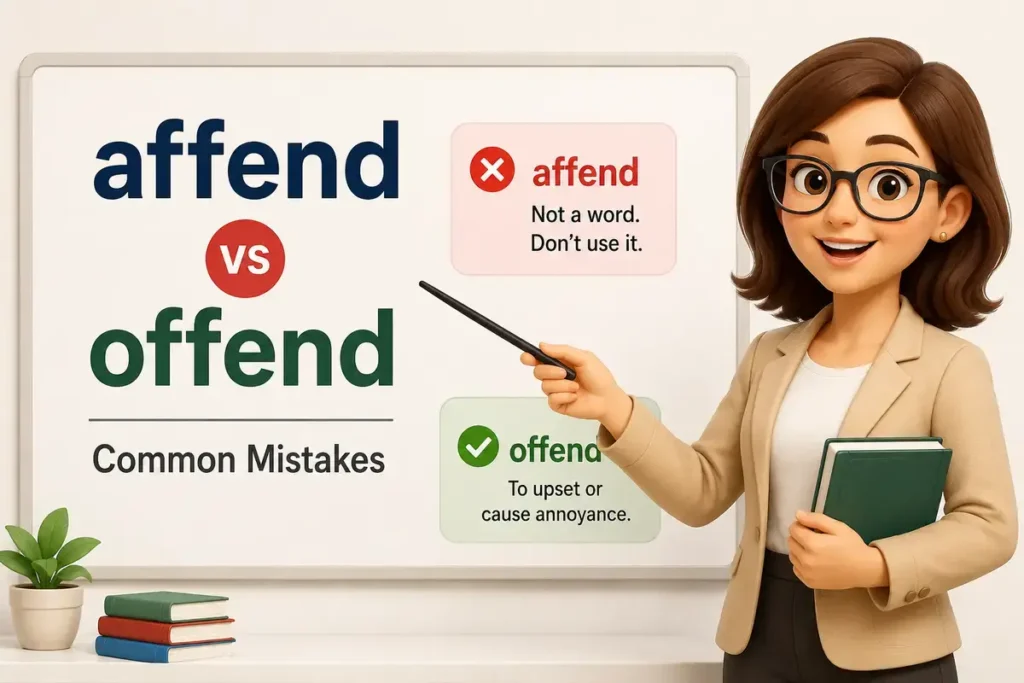
People confuse affend and offend for several reasons. Most mistakes come from pronunciation, typing habits, or simple spelling confusion.
Writing Affend Instead Of Offend
This is the most common mistake.
Incorrect.
- I didn’t mean to affend you.
Correct.
- I didn’t mean to offend you.
Misspelling Related Forms
The error often continues into other verb forms.
Incorrect.
- He affended everyone.
- She is affending people.
Correct.
- He offended everyone.
- She is offending people.
Once you remember the base spelling, the other forms become much easier.
Mixing Offend With Offence Or Offense
Another common mistake involves the noun.
Offend is the verb.
Offense is the preferred American English spelling.
Offence is the preferred British English spelling.
Examples.
- His words offended me.
- That comment caused offense.
- The offence was reported to the authorities.
Choosing the correct noun depends on the variety of English you are using.
Assuming Similar Pronunciation Means Similar Spelling
English has many words that sound alike but follow different spelling patterns.
Examples include.
- Accept and except.
- Affect and effect.
- Advice and advise.
- Lose and loose.
Affend and offend belong in the same group of commonly confused spellings. One form is correct. The other is simply a mistake.
Why People Get Confused
English spelling is not always logical. That is one reason mistakes like affend happen so often.
Several factors contribute to the confusion.
Fast Speech
Native speakers often reduce unstressed vowel sounds. The first sound in offend becomes very soft. Some learners hear it as the letter a instead of o.
Typing Quickly
Fast typing increases spelling errors. The brain recognizes the sound of the word but misses the correct letters.
Learning By Listening
Many English learners spend more time listening than reading. They hear the word correctly but have not seen its written form often enough.
Pattern Matching
Our brains naturally compare new words with familiar spelling patterns. Sometimes that shortcut helps. Sometimes it creates mistakes.
That is exactly what happens with affend.
Memory Tricks
Simple memory tricks can make the correct spelling stick.
Think Of Offense
Both words begin with off.
- Offend.
- Offense.
If you can spell one, you can spell the other.
Remember The Phrase
Offend causes offense. Both important words start with off.
Picture A Red Stop Sign
Imagine a stop sign with the word OFF written across it. If your words hurt someone, the conversation may stop because you caused offense.
Visual memories often last longer than spelling rules.
Read More Than You Hear
The more you read books, newspapers, and trusted websites, the more natural the correct spelling becomes. Good spelling grows through repeated exposure.
Regional Usage
The verb offend stays the same across the major varieties of English.
American English
Americans use offend as the standard verb.
Examples.
- That joke offended many people.
- Please don’t offend your guests.
The noun is usually written as offense.
British English
British English also uses offend.
Examples.
- His remarks offended several colleagues.
- She tried not to offend anyone.
The noun is usually written as offence.
Australian English
Australian English follows the same pattern as British English in most published writing.
- Offend remains the correct verb.
- Offence is the preferred noun.
Canadian English
Canadian English accepts offend as the verb. The noun may appear as offence more often, although offense also appears in some publications.
No matter where you write English, affend is never considered correct.
Etymology
The history of offend explains why its spelling has remained consistent for centuries.
The word comes from the Latin offendere, which meant to strike against, displease, or commit a fault. It later entered Old French before becoming part of Middle English.
As English evolved, pronunciation changed more quickly than spelling. The written form stayed close to its historical roots, which is why modern speakers sometimes expect a different spelling than the one dictionaries recognize.
Many English words share this pattern. Their spelling reflects history, while their pronunciation reflects everyday speech.

Expert Language Insights
Professional editors rarely focus on isolated words. They look at the entire sentence and ask one simple question. Does the wording communicate the intended meaning clearly and naturally?
That principle applies to offend as well.
Many writers worry too much about avoiding the word altogether. In reality, offend is a perfectly normal English verb. The goal is not to remove it from your vocabulary. The goal is to use it accurately and in the right context.
For example, these sentences all sound natural.
- I didn’t mean to offend you.
- The article may offend some readers.
- His actions offended the entire community.
The word becomes awkward only when it is used too often or in situations where another verb expresses the idea more precisely.
Compare these examples.
Less natural.
- His words offended me a little because they offended my friends and offended my family too.
Better.
- His words upset me. They also insulted my friends and embarrassed my family.
Strong writing values precision. Sometimes offend is the best choice. Sometimes another verb communicates your point more clearly.
Related Words
Learning related vocabulary helps you express ideas with greater accuracy.
Synonyms Of Offend
Each synonym carries a slightly different meaning.
| Word | Best Used When |
|---|---|
| Insult | Showing disrespect toward someone. |
| Upset | Causing emotional distress. |
| Hurt | Causing emotional pain. |
| Annoy | Causing irritation. |
| Irritate | Making someone impatient or frustrated. |
| Displease | Creating mild dissatisfaction. |
| Shock | Causing surprise or disbelief. |
| Disturb | Creating emotional discomfort. |
| Embarrass | Making someone feel uncomfortable. |
| Provoke | Triggering a strong reaction. |
Antonyms Of Offend
These words express the opposite idea.
- Please.
- Comfort.
- Respect.
- Honor.
- Delight.
- Reassure.
- Encourage.
- Support.
- Praise.
- Appreciate.
Common Collocations
Native speakers frequently combine offend with certain words.
- Offend someone.
- Offend people.
- Offend readers.
- Offend customers.
- Offend religious beliefs.
- Offend public opinion.
- Deeply offend.
- Easily offend.
- Intentionally offend.
- Accidentally offend.
Learning collocations makes your English sound much more natural.
Idioms Related To Offense
These expressions often appear in everyday English.
- Put someone’s back up.
- Rub someone the wrong way.
- Step on someone’s toes.
- Hit a nerve.
- Cross the line.
- Go too far.
Although these idioms do not always mean exactly the same thing as offend, they often describe similar situations.
Commonly Confused Words
Many writers also confuse these word pairs.
- Affect and effect.
- Accept and except.
- Advice and advise.
- Compliment and complement.
- Principal and principle.
- Lose and loose.
- Then and than.
- Stationary and stationery.
Building familiarity with these pairs improves both spelling and editing skills.
Practical Writing Tips
Good writers do more than spell words correctly. They choose language that fits the situation.
Keep these practical tips in mind.
- Read your sentence aloud before publishing it.
- Replace offend with a more specific verb if it strengthens the meaning.
- Proofread carefully because spellcheck does not catch every mistake.
- Use respectful language when discussing sensitive topics.
- Avoid assuming what might offend another person. Focus on communicating clearly instead.
- Read high quality books, newspapers, and magazines to reinforce correct spelling naturally.
- Build a habit of checking words that often cause confusion.
Small editing habits produce noticeable improvements over time.
Frequently Asked Questions
Is Affend A Real English Word
No. Affend is not a recognized English word. It is simply a misspelling of offend.
Which Is Correct Affend Or Offend
Offend is always the correct spelling in modern English.
What Does Offend Mean
It means to insult, upset, hurt someone’s feelings, or violate a law, rule, or accepted standard.
Why Do People Spell Offend As Affend
Most people make this mistake because the first vowel sound is weak in normal speech. Others simply type too quickly.
Is Offend A Verb Or A Noun
Offend is a verb.
Examples.
- Don’t offend your friends.
- His words offended everyone.
What Is The Noun Form Of Offend
The noun is offense in American English and offence in British English.
Can Offend Have A Positive Meaning
No. The word almost always describes causing emotional hurt, insult, or breaking rules. It carries a negative meaning.
Is It Wrong To Say No Offense
No. No offense is a common expression used before making a potentially sensitive comment. Still, it does not guarantee that the listener will avoid feeling offended.
Can Someone Be Easily Offended
Yes. The adjective offended describes a person’s emotional reaction.
Example.
- She seemed offended by the comment.
Does Offend Always Mean Hurting Feelings
No. In legal and formal English, it can also mean breaking a law or regulation.
How Can I Remember The Correct Spelling
Think of this simple phrase. Offend causes offense. Both words begin with off, making the spelling much easier to remember.
Conclusion
The answer to affend vs offend is straightforward. Offend is the only correct English word. It means to insult, upset, hurt someone’s feelings, or break a law or accepted rule. Affend is not recognized in modern English dictionaries and should never appear in formal or informal writing.
If you remember that offend and offense begin with the same letters, you’ll avoid this spelling mistake every time. Reading regularly, proofreading carefully, and learning common word pairs will also strengthen your spelling skills and make your writing more confident and professional.

Founding Editor
Maya spent six years as a copyeditor at a regional newspaper before starting Grammist, which is where the “answer first” format came from: newsroom style guides don’t have room for a preamble.
She writes and reviews most of the word-pair and spelling entries, and has final say on anything that goes out under the Grammist name.