
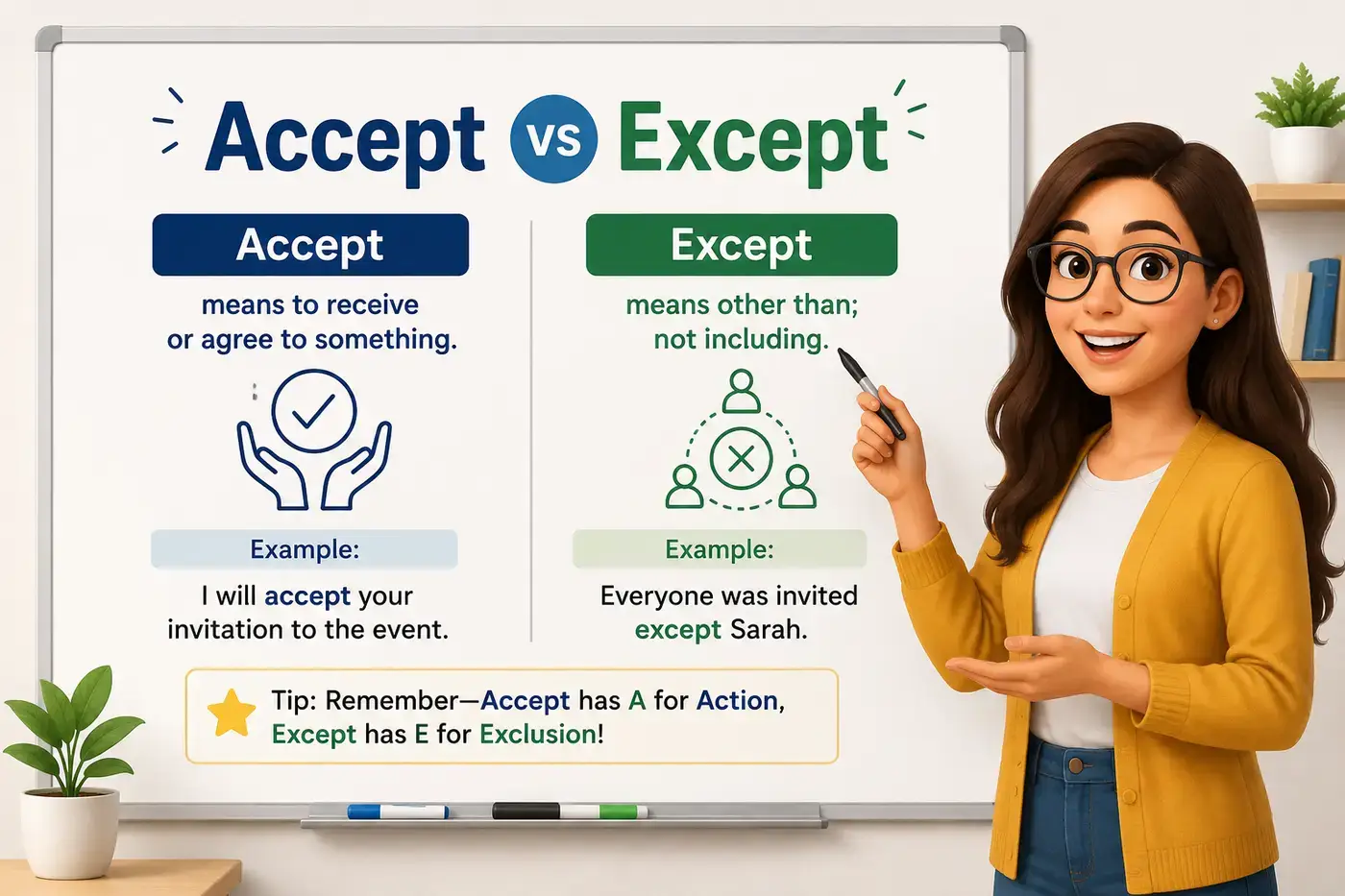
People mix up accept vs except every day. It happens in emails school papers business reports social media posts and even published articles. The two words look almost the same and sound similar. That makes them easy to confuse. Still they have completely different meanings.
Using the wrong one can change the meaning of your sentence. It can also make your writing look careless. A simple mistake might confuse your reader or weaken your credibility.
The good news is that the difference is easy to understand once you know what each word does. You only need to remember one simple idea. Accept means to receive agree to or approve something. Except means to leave something or someone out.
This guide explains the difference in plain English. You’ll learn the meaning of each word the grammar behind them real life examples common mistakes pronunciation spelling tips and simple ways to remember the right choice every time.
Quick Answer
Accept means to agree to receive, take, or approve something, like accepting a gift or accepting an apology. Except means to exclude or leave something out, and it usually works as a preposition meaning “not including.” A simple way to remember it: accept adds something in, except leaves something out.
Accept vs Except Comparison Table
| Feature | Accept | Except |
|---|---|---|
| Part of speech | Verb | Preposition or conjunction (rarely a verb) |
| Core meaning | To receive or agree to something | To exclude or leave out |
| Example sentence | She chose to accept the job offer | Everyone came except Sam |
| Pronunciation | ak SEPT | ik SEPT |
| Common use | Approval, agreement, receiving | Exclusion, exception |
What Does Accept Mean
Accept is a verb, and it means to receive something willingly or to agree with an idea, offer, or situation. When you accept a compliment, you take it in and acknowledge it. You agree to attend when you accept an invitation, . When you accept a challenge, you agree to take it on.
Here are a few natural examples.
- I decided to accept the promotion after thinking it over for a week.
- Please accept my sincere apology for the delay.
- The committee will accept applications until Friday.
- He finally learned to accept help from his friends.
Notice that accept always involves receiving, agreeing, or approving. It’s an action word, and it almost always takes an object, meaning something follows it. You accept a thing, an offer, a fact, or a person’s behavior.
What Does Except Mean
Except works differently. Most of the time, it acts as a preposition, and it means “excluding” or “other than.” It points to something left out of a larger group or statement.
- Everyone finished the marathon except two runners.
- The store is open every day except Sunday.
- I like all vegetables except mushrooms.
Except can also work as a conjunction, connecting two clauses with a similar excluding meaning.
- I would go to the party except I have to work late.
There is also a rare verb form of except, meaning to leave out or exclude formally, often used in legal or formal writing.
- Present company excepted, the entire team missed the deadline.
That usage is uncommon in everyday speech, so for most writing, just remember except as the word that signals exclusion.
Which Form Is Correct Accept or Except
There is no single correct form between the two because they are entirely different words with different jobs. The real question is which one fits your sentence. Ask yourself this: am I talking about receiving or agreeing to something, or am I talking about leaving something out?
If the answer is receiving or agreeing, use accept. If the answer is excluding or leaving out, use except.
A fast test that works almost every time: try swapping in the phrase “not including.” If the sentence still makes sense, except is the word you need.
- Everyone came [not including] Sam. Correct, use except.
- I will [not including] the job offer. Doesn’t make sense, so accept is the right choice.
Key Differences Between Accept and Except
Even though these two words sound alike, they are opposites in a way. Accept brings something into the picture, while except takes something out of it. Here are the main differences broken down clearly.
- Meaning. Accept means to receive or agree. Except means to exclude or leave out.
- Part of speech. Accept is almost always a verb. Except is almost always a preposition or conjunction.
- Function in a sentence. Accept needs an object, something being accepted. Except introduces the thing being left out of a group.
- Sound. Accept starts with a hard “ak” sound. Except starts with a softer “ik” sound, though many people pronounce them very close together, which adds to the confusion.
- Opposite feel. Accept is inclusive. Except is exclusive.
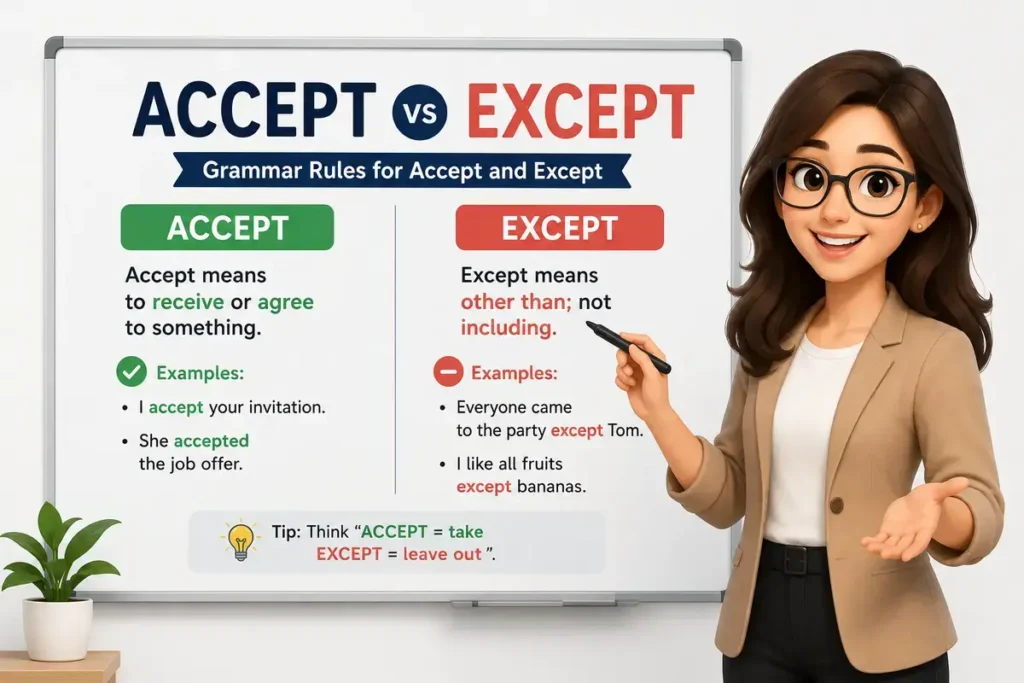
Grammar Rules for Accept and Except
Understanding grammar function makes these words far easier to use correctly, so let’s look at how each one behaves in a sentence.
Accept as a Verb
Accept follows regular verb rules. It changes form based on tense.
- Present: I accept.
- Past: I accepted.
- Future: I will accept.
- Present participle: accepting.
- Past participle: accepted.
Accept almost always needs a direct object. You cannot simply say “I accept” and stop, unless the object is clearly understood from context, such as answering the question “Do you accept the terms?” with “I accept.”
Except as a Preposition
As a preposition, except introduces a noun or pronoun that is being excluded from a statement.
- Everyone except her agreed to the plan.
- All the files except this one were saved correctly.
Except as a Conjunction
When except connects two clauses, it functions similarly to “but” or “only.”
- I would help you move except I already have plans that day.
Except as a Verb
This form is rare and mostly appears in formal, legal, or academic writing.
- The clause excepts government employees from the new policy.
Pronunciation Guide
Because accept and except sound so close, pronunciation confusion is one of the biggest reasons people mix them up in speech and, later, in writing.
- Accept: /əkˈsɛpt/, said as “ak SEPT”
- Except: /ɪkˈsɛpt/, said as “ik SEPT”
The difference sits in that first vowel sound. Accept opens with a slightly stronger “ah” sound, while except opens with a shorter “ih” sound. Say both out loud a few times, slowly, and the difference becomes much easier to hear.
Spelling Rules and Patterns
Both words end the same way, in “cept,” which comes from a Latin root meaning “to take” or “to seize.” That shared ending is exactly why spelling mix ups happen so often.
The part that matters is the beginning.
- Accept starts with AC.
- Except starts with EX.
One easy trick is linking the letter A in accept with the word “add,” since accepting something adds it to your life or your list. Meanwhile, the letters EX in except line up with “exit” or “exclude,” since except always points to something being taken out.
Usage Guide
Let’s look at how both words show up naturally across different situations, so you can see the pattern in action.
Formal Writing
- The board voted to accept the merger proposal.
- All departments must comply, except those with prior written exemption.
Everyday Conversation
- I’ll accept your apology this time.
- Everyone showed up except my brother.
Business and Professional Contexts
- We are pleased to accept your bid for the project.
- All offices will be closed except the downtown branch.
Academic Writing
- Researchers accept a hypothesis only after repeated testing supports it.
- Every variable was controlled except temperature.
Examples in Different Contexts
Seeing these words used across a range of sentence types helps lock in the pattern for good.
Accept examples
- She had to accept that the project timeline would change.
- Will you accept payment by card?
- He accepted the award with a short, humble speech.
- Our team is happy to accept new members this month.
- I accept your explanation, though I wish you had told me sooner.
Except examples
- Nothing on the menu looked appealing except the soup.
- She answered every question correctly except the last one.
- I would join the trip except I already booked another flight.
- All the lights were off except one in the hallway.
- Except for a little rain, the weather was perfect all week.
Common Mistakes People Make
Here are the slip ups that show up most often in writing, along with the fix for each one.
- Mistake: I will except your offer. Fix: I will accept your offer.
- Mistake: Everyone passed the test accept John. Fix: Everyone passed the test except John.
- Mistake: Please except my apology. Fix: Please accept my apology.
- Mistake: The rule applies to all students accept transfer students. Fix: The rule applies to all students except transfer students.
A quick pattern shows up in nearly every mistake: people use accept when they actually mean to exclude something, or they use except when they mean to agree or receive something. Catching that pattern is half the battle.
Why People Get Confused
There are a few solid reasons this mixup happens so often, and understanding them can help you avoid falling into the same trap.
First, the words look almost identical on the page, differing by just two letters near the start. Second, they sound extremely close when spoken quickly, especially in casual conversation. Third, both words share that Latin root tied to taking, so their meanings can feel related even though their actual use is nearly opposite. Finally, autocorrect tools sometimes fail to catch the error, since both words are spelled correctly on their own, just used in the wrong spot.
Memory Tricks to Never Mix Them Up Again
Try one of these simple tricks, and pick whichever clicks best for you.
- The A for Add trick. Accept starts with A, just like add. Accepting something adds it to your life.
- The EX for Exit trick. Except starts with EX, just like exit and exclude. Except always removes something from the group.
- The swap test. If you can replace the word with “not including” and the sentence still makes sense, use except.
- The opposite pairing. Think of accept as the opposite of reject, and except as a cousin of exclude. That contrast alone often clears up the confusion instantly.
Regional Usage
Good news here: accept and except carry the same meaning and function across American, British, Australian, and Canadian English. There is no regional variation in spelling or grammar for these two words. The only small difference you might notice is pronunciation pace and accent, but the core sounds and letters stay consistent everywhere English is spoken.
Etymology and Word Origin
Both words trace back to Latin, and their shared root explains why they look so similar today.
Accept comes from the Latin word accipere, formed from ad, meaning “to,” and capere, meaning “to take.” So at its root, accept literally means “to take to oneself.”
Except comes from the Latin word excipere, formed from ex, meaning “out,” and capere, meaning “to take.” So except literally means “to take out.”
That small difference, “to” versus “out,” is the whole story. Accept pulls something in. Except pulls something out. Once that root meaning clicks, the two words practically explain themselves.
Expert Language Insights
Professional editors will tell you that accept and except rank among the most flagged errors in manuscripts, resumes, and business emails, right alongside affect and effect. The reason isn’t a lack of intelligence on the writer’s part. It’s simply that our brains process similar sounding words through the same mental shortcuts, and under time pressure, the wrong one slips through.
A smart habit used by many professional proofreaders is reading a sentence backward, word by word, when checking for this exact error. Removing normal sentence flow forces your brain to look at each word individually instead of gliding past it based on shape and rhythm. Try it the next time you’re proofreading an important email or report.
Another editorial tip: if a sentence feels ambiguous even after you pick a word, rewrite it with a clearer synonym. Instead of accept, you might use agree to or receive. Instead of except, you might use other than or excluding. Clear writing beats clever writing every time.
Related Words
Building your vocabulary around these two words helps reinforce the difference and gives your writing more range.
- Synonyms for accept: agree, approve, receive, welcome, embrace, take on
- Antonyms for accept: reject, decline, refuse, deny
- Synonyms for except: excluding, other than, apart from, besides, aside from
- Antonyms for except: including, plus, along with
- Common collocations with accept: accept responsibility, accept an offer, accept defeat, accept the terms, accept an invitation
- Common collocations with except: except for, present company excepted, everyone except, all but one
- Idioms and phrases: Accept things as they come describes handling situations calmly as they happen. Present company excepted is a polite way of excluding the people you’re currently speaking to from a general statement.
Practical Writing Tips
Keep these quick reminders nearby whenever you’re drafting something important.
- Read your sentence and ask if you’re including something or leaving something out.
- Try the “not including” swap test on any sentence using except.
- Say the sentence out loud, since hearing the word often reveals the right choice faster than reading it silently.
- Use a synonym in your head first, like agree to or excluding, before typing the final word.
- Keep a sticky note nearby with the A for Add and EX for Exit trick until it becomes second nature.
Frequently Asked Questions
What is the easiest way to remember accept vs except?
Think of accept as adding something in, since both start with A, and except as taking something out, since both start with EX like exit.
Is except ever used as a verb?
Yes, though rarely. In formal or legal writing, except can mean to formally exclude, as in “the clause excepts certain employees from the policy.”
Can accept and except ever mean the same thing?
No. They function in opposite ways. Accept means to receive or agree, and except means to exclude or leave out.
Which word do I use for lists of things left out?
Use except. For example, “I finished all my chores except the laundry.”
How do you pronounce accept and except correctly?
Accept is pronounced ak SEPT, and except is pronounced ik SEPT. The main difference sits in that first vowel sound.
Is it correct to say accept for instead of except for?
No. The correct phrase is except for, meaning excluding. Accept for is a common writing error.
Does British English use accept and except differently than American English?
No. Both words share the same meaning and grammar rules across all major English speaking regions.
What part of speech is except?
Except is most commonly a preposition, and it can also function as a conjunction or, rarely, a verb.
Why do spell checkers miss this mistake?
Both accept and except are spelled correctly as individual words, so a basic spell checker won’t flag them even if you use the wrong one in context. Grammar tools that check meaning are more reliable for catching this error.
Conclusion
The difference in accept vs except is easy to remember once you focus on the meaning instead of the spelling. Use accept when someone receives agrees to approves or admits something. Use except when someone or something is left out of a group. One small spelling change creates a completely different meaning so choosing the right word matters.
A simple question can help every time you write. Are you talking about receiving something or excluding something. If you’re talking about receiving agreeing or approving use accept. If you’re talking about leaving someone or something out use except. With a little practice and careful proofreading you’ll start choosing the correct word automatically and this common mistake will soon become a thing of the past.

Founding Editor
Maya spent six years as a copyeditor at a regional newspaper before starting Grammist, which is where the “answer first” format came from: newsroom style guides don’t have room for a preamble.
She writes and reviews most of the word-pair and spelling entries, and has final say on anything that goes out under the Grammist name.