
If you have searched for encode vs incode, you’re probably trying to decide which form belongs in your sentence. For most English writing the answer is encode. It’s the standard verb used when you mean to convert information into a code or another structured form. Major dictionaries such as Cambridge and Oxford recognize encode with meanings connected to coded messages computing language and biology.
There is one important detail that many simple spelling guides miss. Incode can appear as a legitimate technical term in British postal terminology. Ordnance Survey uses incode for the inward code which forms the final part of a UK postcode.
That means the answer isn’t simply that incode never exists. The correct choice depends on what you mean.
If you’re talking about converting information into a coded form then encode is the word you need, if you’re discussing the technical structure of a UK postcode then incode can be correct, And if you mean the phrase in code then you need two separate words.
This guide explains all three forms so you can choose the right one without second guessing yourself.
Quick Answer
Encode is the standard English verb meaning to convert information into a coded or structured form. Incode is not the normal spelling of that verb. However incode is also used in UK postal terminology for an inward code. In code is a separate two word phrase describing something represented using code.
Encode Vs Incode At A Glance
| Form | Standard use | Part of speech | Main meaning | Example |
|---|---|---|---|---|
| encode | Yes | Verb | Convert information into a coded form | The software will encode the file. |
| incode | Specialized use | Noun | The inward part of a UK postcode | The incode identifies the local delivery area. |
| in code | Yes | Phrase | In a coded or programming form | The error appears in code. |
| encoded | Yes | Verb form | Converted into a coded form | The data was encoded. |
| encoding | Yes | Noun or verb form | The act or process of encoding | Encoding can reduce file size. |
| decode | Yes | Verb | Convert or interpret coded information | The program can decode the file. |
The key point is simple. Encode and incode are not normally competing spellings of the same English verb.
Encode Vs Incode Means
What Does Encode Mean
Encode is a verb. It means to convert information into a code or another form that follows a particular system.
Oxford gives several established meanings. These include changing ordinary language into letters or symbols for secret messages, changing information into a form that a computer can process, and using a linguistic form to express meaning. Oxford also records a biology use in which a gene encodes a protein. (Oxford Learner’s Dictionaries)
Cambridge similarly defines encode in terms of changing something into a system for coded communication or representing complex information in a simpler or shorter form. Its business and technology definition covers putting information into a form that can be stored and read through appropriate technology or knowledge.
In plain English, think of encode as an action.
You start with information in one form.
You use a system to represent that information in another form.
That action is encoding.
For example:
- The program will encode the data.
- The camera encodes the video.
- The software encoded the audio file.
- The system encodes each character.
- The researcher encoded the responses for analysis.
The exact technical process can vary. The basic language function remains the same.
What Does Incode Mean
This is where a more careful explanation matters.
In ordinary English, incode is not the standard alternative spelling of encode. So if you are writing about software converting data you should not replace encode with incode.
However incode does have a recognized specialist use in British postal terminology.
Ordnance Survey describes the incode as the inward code. It is the final three characters of a UK postcode and consists of the postcode sector and postcode unit. For example, in NW6 4DP, the incode is 4DP.
The same terminology appears in Ordnance Survey documentation that defines inward code or incode as part of the postcode system.
So these two statements can both be true:
The software will encode the data.
The postcode incode is 4DP.
The first uses encode as a general English verb.
The second uses incode as a specialized postal noun.
That distinction is easy to miss if you only look at the words without looking at the context.
What Does In Code Mean
There is also a third form that causes confusion.
In code is two words.
It is a normal English phrase and usually means that something is represented using a code or exists within programming code.
For example:
- The message was written in code.
- The error appears in code.
- The developer found the problem in code.
- The instructions were hidden in code.
- The value is stored in code.
Compare that with:
The program will encode the message.
Here encode is a verb describing an action.
In:
The message was written in code.
The phrase in code describes the form in which the message was written.
This is a grammar difference rather than a simple spelling difference.

Encode Vs Incode Grammar Spelling And Context
Encode Is A Verb
The most important grammar rule is straightforward.
Encode functions as a verb when you mean to convert or represent information using a particular code or system.
It can appear in several common forms.
Present Form
Use encode with I you we and they.
- I encode the files before uploading them.
- We encode customer data before processing it.
- They encode the information automatically.
With he she it or another singular third person subject use encodes.
- The application encodes the data.
- The device encodes the signal.
- The system encodes every character.
Oxford lists encode and encodes as standard forms of the verb.
Past Form
The past form is encoded.
- The software encoded the video.
- The system encoded the message.
- The researcher encoded the survey results.
Cambridge identifies encoded as the past simple and past participle of encode.
Present Participle
The present participle is encoding.
- The computer is encoding the file.
- The camera is encoding the video.
- Encoding takes several minutes.
Cambridge lists encoding as the present participle of encode.
Noun Form
Encoding can also function as a noun.
- The encoding of the file took several minutes.
- Character encoding determines how text is represented.
- The team discussed the encoding method.
The noun refers to the process or system involved in encoding.
Encode Has More Than One Context
One reason this word appears so often in technical writing is that its meaning extends across several fields.
Computing
In computing encode often means changing information into a form that a computer system can store process transmit or display.
Oxford specifically lists this computing meaning.
Examples include:
- Encode the text as UTF 8.
- The application encodes the image.
- The server encodes the response.
- The video was encoded before publication.
- The system encodes the characters using a defined character set.
Communication
Encode can describe changing a message into a coded form.
- The operator encoded the message.
- The device encodes the signal before transmission.
- The message was encoded for secure communication.
Keep in mind that encoding and encryption are not automatically the same thing. Encoding can change representation for compatibility storage or transmission. Encryption is specifically concerned with protecting information from unauthorized access.
Linguistics
Encode also appears in linguistics.
Cambridge lists a specialized language meaning involving the use of a word or phrase in a foreign language in the correct way.
Oxford also lists a linguistics sense involving the expression of meaning in a foreign language.
For example:
- The speaker encoded the concept using a different grammatical structure.
- The language encodes tense in the verb.
- Certain meanings are encoded through word order.
Biology
In biology encode has another established meaning.
Oxford notes that a gene can encode a particular protein.
Examples:
- This gene encodes a protein involved in cell function.
- The gene encodes an enzyme.
- Several genes encode proteins with related functions.
This use has nothing to do with typing computer code. It means that genetic information specifies or carries the instructions associated with a biological product.
Encode Vs Incode In Computing
If your context is programming or computer technology then encode is almost certainly the form you want.
Consider these examples.
Correct:
The application will encode the data.
Incorrect for this meaning:
The application will incode the data.
The same applies to related forms.
Correct:
- encoded data
- encoding process
- encoding format
- encoder
- encode the file
- encode the image
- encode the video
Not standard for this meaning:
- incoded data
- incoding process
- incode the file
- incode the image
There is no need to invent a new verb when the established English verb already exists.
Encode Vs In Code
This distinction deserves special attention because it solves a large part of the confusion.
Encode
Encode is one word and functions as a verb.
It describes an action.
The application will encode the file.
In Code
In code is two words.
It normally describes something represented inside a code or written using code.
The problem appears in code.
These sentences look similar but communicate different ideas.
| Sentence | What it means |
|---|---|
| The program will encode the file. | The program converts the file into a particular representation. |
| The problem appears in code. | The problem exists within programming code. |
| The message was written in code. | The message was expressed using a code. |
| The system encoded the message. | The system performed the action of encoding. |
A useful test is to ask yourself what role the phrase plays.
If you need an action, you probably need encode.
If you need to describe something inside or using code, you may need in code.
Why People Confuse Encode Vs Incode
The confusion is understandable.
English has many words beginning with in. Words such as include input insert and inspect are common. A person who hears encode without seeing it written may assume the first part is the familiar word in.
There is another reason too.
The word code is clearly visible inside encode.
That makes people mentally reconstruct the word as something like in + code.
But English spelling does not always work by simply combining familiar words.
The established form is encode.
There is also a pronunciation factor. Cambridge gives the US pronunciation as /ɪnˈkoʊd/. The stress falls on the second syllable.
Because the first syllable is short and unstressed, someone who has mostly heard the word in conversation may not immediately know how it is spelled.
Pronunciation Of Encode
For American English the pronunciation is:
/ɪnˈkoʊd/
Cambridge records this pronunciation for US English and gives /ɪnˈkəʊd/ for UK English.
The word has two syllables.
The stress falls on the second syllable.
The final part sounds like code.
That pronunciation can contribute to the spelling confusion because the first syllable is relatively weak.
A common learner mistake is to hear the first syllable as the separate word in and then write incode.
The spelling does not follow that mistaken division.
The correct written form is encode.
The Spelling Pattern Behind Encode
The word encode can be understood as en plus code.
The prefix en often contributes a meaning related to putting something into a particular state or form.
That pattern appears in words such as:
- enclose
- encase
- enlarge
- enrich
- enable
- enforce
- entrust
This does not mean you can freely replace en with in in English word formation.
Established words have established spellings.
For this word:
en + code = encode
Not:
in + code = incode
Etymological sources trace encode to en plus code. Etymonline dates the verb to 1917 and notes that the computing sense developed later.
The History Of Encode
The history of encode helps explain its structure.
Etymonline dates the verb to 1917 and describes it as being formed from en meaning something like make or put in and code. It also notes that the computing sense dates from the mid twentieth century.
The word code itself has a much older history. It developed from terms associated with written collections and later came to refer to systems of symbols and rules.
Modern computing expanded the usefulness of encode dramatically.
Today the word appears in software engineering digital media data processing character systems linguistics biology communications and many other fields.
That broad use explains why it is familiar to both everyday readers and technical specialists.
Encode Vs Encrypt
This is one of the most useful distinctions for technical writers.
Encode means to convert information into another representation.
Encrypt means to transform information in a way intended to protect it from unauthorized access.
Those functions can overlap in a larger technical process but they are not interchangeable terms.
Compare:
- The program encodes the image.
- The program encrypts the confidential file.
The first sentence focuses on representation.
The second focuses on security.
If you use encode simply because the information is difficult for someone to read you may accidentally describe the wrong process.
Good technical writing uses the most precise verb available.
Encode Vs Decode
The natural counterpart of encode is decode.
Think of the process as two directions.
Encode → coded representation → decode
For example:
- The camera encodes the video.
- The player decodes the video.
- The sender encodes the message.
- The receiver decodes the message.
Oxford explicitly connects encode with decode in its dictionary entry.
This gives you a useful memory trick.
Encode puts information into a coded form.
Decode interprets or converts coded information.
The pair is much more useful than trying to remember incode as an opposite of decode.
Encode Vs Code
Both Code and encode are related but they are not identical.
Code can be a noun.
- The code contains an error.
- The access code is private.
- The programmer reviewed the code.
Code can also be a verb.
- She codes websites.
- They code the application in Python.
- He codes the new feature.
Encode is a more specific verb.
- The system encodes the image.
- The application encodes the data.
- The device encodes the signal.
In simple terms, code can refer to the system itself or the act of writing code. Encode focuses on representing information according to a coding system.

Encode Vs Incode In British English
There is an important regional point here.
British English uses incode in a specialized postal context. Ordnance Survey documentation identifies the incode as the inward code and explains that it forms the last three characters of a UK postcode.
For example:
NW6 4DP
The final three characters are 4DP.
That is the incode.
This is not an alternative British spelling of the verb encode.
So it would be wrong to say that British English uses incode instead of encode when talking about data conversion.
The distinction is based on meaning and technical context.
American English
For American English writing about computing communication biology or linguistics use encode for the verb.
The system encodes the information.
British English
British English also uses encode for the verb.
The specialized postal noun incode is a separate matter.
Canadian English
Canadian English follows the standard English use of encode for the verb.
Australian English
Australian English also uses encode as the standard verb.
The postal sense of incode is specifically associated with the UK postcode system rather than a general spelling difference across English varieties.
Real Life Examples With Encode Vs Incode
The fastest way to understand a word is to see it working naturally.
Here are examples across several contexts.
Everyday Conversation
- The app needs to encode the file before you send it.
- The camera automatically encodes each video.
- The message was encoded before it was transmitted.
- The device can encode the signal quickly.
- We need to encode this information in a simpler format.
Workplace Writing
- Please encode the customer data before uploading the file.
- The software automatically encodes the report.
- Our system encodes each record before storage.
- The video was encoded for online distribution.
- The team is testing a new encoding method.
Technical Writing
- The application encodes the input using UTF 8.
- The server encodes the response before transmission.
- The encoder converts the signal into a suitable digital representation.
- The system stores encoded values rather than the original input.
- The decoder reads the encoded information.
Academic Writing
- The researchers encoded the responses before analyzing the results.
- The study examines how grammatical meaning is encoded.
- The researchers used a consistent method to encode the data.
- The findings show how meaning can be encoded through language.
- The gene encodes a protein involved in cellular function.
Programming Context
- The function encodes the input before returning the result.
- The developer encoded the data as a byte sequence.
- The application is encoding the image.
- The library can encode and decode the data.
- The program failed because the input was not encoded correctly.
Journalism
- The broadcaster encoded the signal before transmission.
- The message had been encoded before it reached the recipient.
- The report explains how digital information is encoded.
Social Media And Informal Writing
- The app encodes the image automatically.
- I had to encode the file before uploading it.
Notice that encode behaves naturally in every example because it is the established verb.
Examples With Incode
The legitimate specialist use of incode looks very different.
For example:
- The postcode incode is 4DP.
- The database stores the outcode and incode separately.
- The incode identifies the local part of the postcode.
- The delivery system uses the incode when sorting mail.
- The full postcode contains both an outcode and an incode.
These examples relate to the UK postcode system. Ordnance Survey confirms that the incode is the final three characters of a postcode and represents the postcode sector and postcode unit.
So if you see incode in a postal document you should not automatically assume that someone made a spelling mistake.
Context decides the answer.
Examples With In Code
Now compare the phrase in code.
- The error appears in code.
- The message was written in code.
- The instructions are hidden in code.
- The developer found the problem in code.
- The value is stored in code.
- The information appears in code rather than plain language.
- The programmer discovered a mistake in code.
Here the space matters because in is a preposition and code is a noun.
Encode Vs Incode Common Mistakes To Avoid
Mistake One
Incorrect for data conversion:
The program will incode the file.
Correct:
The program will encode the file.
Mistake Two
Incorrect:
The message was written incode.
Correct:
The message was written in code.
Mistake Three
Incorrect:
The software incoded the image.
Correct:
The software encoded the image.
Mistake Four
Incorrect:
The application is incoding the video.
Correct:
The application is encoding the video.
Mistake Five
Incorrect assumption:
Incode is simply the British spelling of encode.
Correct understanding:
British English uses encode as the standard verb. Incode has a separate specialized use in UK postal terminology.
Mistake Six
Incorrect assumption:
Encode and encrypt mean exactly the same thing.
Correct understanding:
Encoding changes representation. Encryption focuses on protecting information from unauthorized access.
A Simple Memory Trick For Encode Vs Incode
Use this rule:
Encode is the action.
In code is the phrase.
Incode is a specialized postal term in the UK.
You can also remember the word family:
encode
encoded
encoding
encoder
decode
That family makes it easier to see why incode is not the normal verb you want when discussing data.
Another useful trick is to connect encode with code.
You are putting information into a coded form.
Encode = put into code.
That mental link is simple and reliable.
What Professional Editors Recommend For Encode Vs Incode
A professional editor should never treat encode and incode as interchangeable spellings.
The first question is always context.
If the sentence is about converting information then encode is the appropriate standard verb.
For a sentence contains the phrase in code then keep the words separate.
If the sentence concerns the final portion of a UK postcode then incode may be the correct specialist noun.
This is more precise than simply saying that one word is right and the other is wrong.
Dictionaries support the standard use of encode. Oxford lists its computing linguistic and biological meanings and gives the standard forms encodes, encoded, and encoding. Cambridge likewise recognizes the verb and its related forms.
At the same time official Ordnance Survey documentation confirms that incode has a genuine technical meaning in the British postcode system.
That distinction is exactly the kind of detail a careful editor should preserve.
Why Incode Appears Online
You may still encounter incode in places where it appears to mean encode.
That does not automatically make it an accepted general English spelling.
Online writing contains plenty of:
- Typing mistakes.
- Search query variations.
- Informal abbreviations.
- Programming identifiers.
- Brand names.
- Company names.
- Technical terms.
- User generated content.
Search engines can surface all of these.
A word appearing on a webpage does not by itself prove that the word is a standard dictionary form.
That is why dictionary evidence and the context of the sentence matter more than raw search frequency.
This point is especially useful for English learners. Search results can show you what people type. They do not always tell you what standard edited English recommends.
Does Incode Have A Legitimate Meaning
Yes, but the answer needs context.
Incode has a legitimate specialist meaning in UK postal terminology. It refers to the inward code that forms the final three characters of a UK postcode. Official Ordnance Survey documentation uses the term.
That means it would be too broad to say that incode never exists.
However, if your sentence is about encoding data software video audio text or information then encode is the correct word.
For example:
The software will encode the file.
Not:
The software will incode the file.
Is Encode A Verb Or A Noun
Encode is a verb.
Examples:
- Encode the file.
- The program encodes the data.
- The system encoded the message.
The related noun is encoding.
Examples:
- The encoding process is complete.
- We need a different encoding format.
- The encoding affects compatibility.
A person or device that performs encoding can be called an encoder.
What Is The Past Tense Of Encode
The past tense is encoded.
Examples:
- The system encoded the file.
- The software encoded the image.
- The researcher encoded the responses.
The past participle is also encoded.
- The data has been encoded.
- The file was encoded correctly.
- The information had already been encoded.
Cambridge and Oxford both list these standard verb forms.
What Is The Present Participle Of Encode
The present participle is encoding.
Examples:
- The program is encoding the video.
- The system is encoding the data.
- Encoding can take several minutes.
Incoding is not the standard present participle of encode.
Is Encode Used In Academic Writing
Yes.
The word is common in academic writing across computing linguistics psychology biology communication and related fields.
Examples include:
- The researchers encoded the survey responses.
- The model encodes information in a structured representation.
- The gene encodes a specific protein.
- The study examines how language encodes social meaning.
Oxford specifically recognizes computing linguistics and biology uses.
The word is also useful because it can express a technical process precisely without requiring a long explanation.
Is Encode Vs Incode Formal Or Informal
Encode is neutral and widely accepted.
It works in:
- Academic writing.
- Technical documentation.
- Workplace communication.
- Journalism.
- Educational writing.
- General conversation.
- Programming documentation.
You do not need to replace it with a more complicated expression just to make your writing sound formal.
For example:
The software encodes the image.
is clear and professional.
There is no advantage in replacing it with a long phrase such as:
The software performs the process of transforming the image into a coded representation.
Use the shorter form when the context is already clear.
What Is The Opposite Of Encode
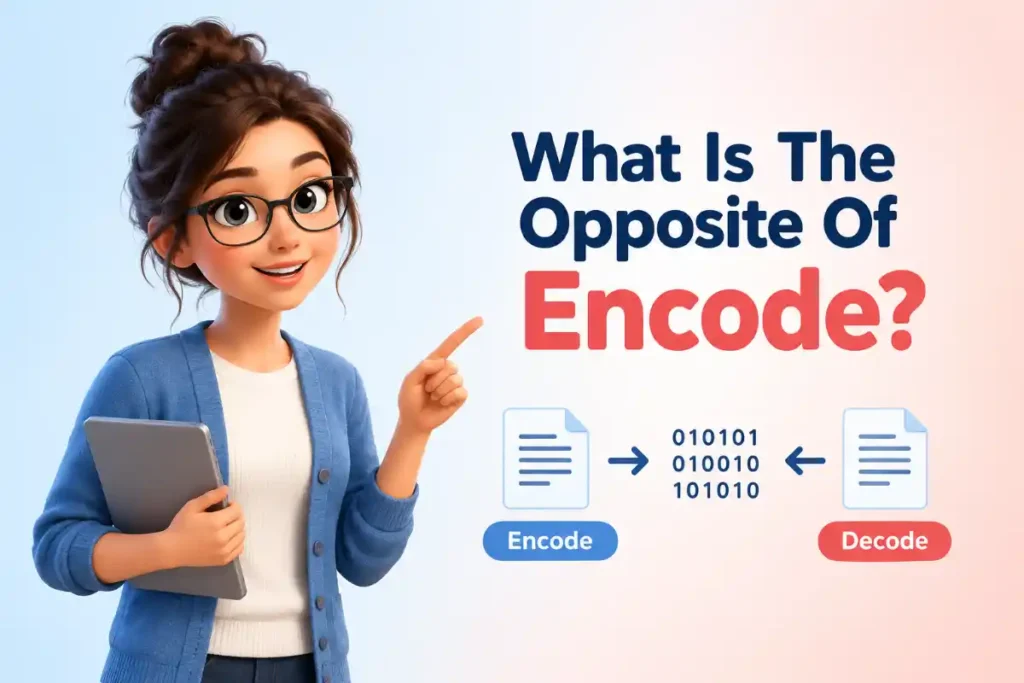
The closest general counterpart is decode.
Encoding moves information into a coded representation.
Decoding interprets or converts that coded representation.
However, the exact technical relationship depends on the system involved.
For cryptographic processes the related pair is normally encrypt and decrypt.
That is another reason to choose verbs carefully in technical writing.
Related Words
Here are useful words from the same semantic field.
| Word | Meaning |
|---|---|
| code | A system of symbols or instructions |
| encode | Convert information into a coded representation |
| encoding | The process or result of encoding |
| encoder | Something or someone that performs encoding |
| encoded | Converted into a coded form |
| decode | Convert or interpret coded information |
| decoding | The process of decoding |
| decoder | Something that decodes |
| encrypt | Transform information for security |
| decrypt | Restore encrypted information |
| encryption | The process of protecting information through cryptographic transformation |
These words overlap in some technical contexts but they are not interchangeable.
Frequently Confused Forms Of Encode Vs Incode
The following distinctions are worth remembering.
Encode And Incode
Encode is the standard verb.
Incode is not the standard verb for data conversion but does have a specialist UK postal meaning.
Encode And In Code
Encode is one verb.
In code is a two word phrase.
Encode And Encrypt
Encode focuses on representation.
Encrypt focuses on security.
Encode And Decode
Encode changes information into a coded form.
Decode interprets or converts coded information.
Code And Encode
Code can be a noun or verb.
Encode is a verb describing the conversion of information into a coded representation.
Encode Vs Incode Frequently Asked Questions
Is encode or incode correct
Encode is correct when you mean to convert information into a coded or structured form. Incode is not the standard spelling of that verb. However, incode is a legitimate specialist term in the UK postcode system where it means inward code.
Is incode a real word
Yes, but its legitimate use is specialized. Ordnance Survey uses incode as another term for inward code in the UK postcode system. It refers to the final three characters of a postcode. It should not be treated as the normal English spelling of the verb encode.
What does encode mean
Encode means to convert information into a particular coded or structured form. It is used in computing communication linguistics and biology. In computing it can describe changing information into a form that a computer can process.
Is in code different from encode
Yes. Encode is a verb that describes an action. In code is a two word phrase that describes something represented using code or located within programming code. For example, a program can encode a file while an error can appear in code.
What is the past tense of encode
The past tense of encode is encoded. For example, you can write The software encoded the file yesterday or The data was encoded before transmission. Cambridge and Oxford both recognize encoded as a standard form of the verb.
What is the difference between encode and encrypt
Encoding changes information into another representation. Encryption transforms information to protect it from unauthorized access. A file can be encoded without being encrypted. Technical writers should use encrypt when security is the main idea and encode when representation or conversion is the focus.
How do you pronounce encode
In American English encode is pronounced /ɪnˈkoʊd/. It has two syllables with the main stress on the second syllable. Cambridge gives /ɪnˈkoʊd/ for US English and /ɪnˈkəʊd/ for UK English. (Cambridge Dictionary)
What is the correct word for converting data
The standard verb is encode. You can say encode the data, encode the file, encode the image, or encode the message. The related process is encoding and the reverse process is generally called decoding.
Encode Vs Incode Final Takeaway
The safest rule is simple.
Use encode when you mean to convert information into a coded or structured form.
Use in code when you mean something is represented inside or using code.
And use incode only when the context specifically calls for the specialized UK postal term meaning inward code.
So if your sentence says:
The software will encode the data.
you have the standard English form.
If your sentence says:
The problem appears in code.
keep in and code separate.
And if you are looking at a UK postcode such as NW6 4DP, the final three characters can correctly be called the incode. (OS Documentation)
The easiest memory rule is this: encode is an action, in code is a phrase, and incode is a specialized postal term.

Founding Editor
Maya spent six years as a copyeditor at a regional newspaper before starting Grammist, which is where the “answer first” format came from: newsroom style guides don’t have room for a preamble.
She writes and reviews most of the word-pair and spelling entries, and has final say on anything that goes out under the Grammist name.