
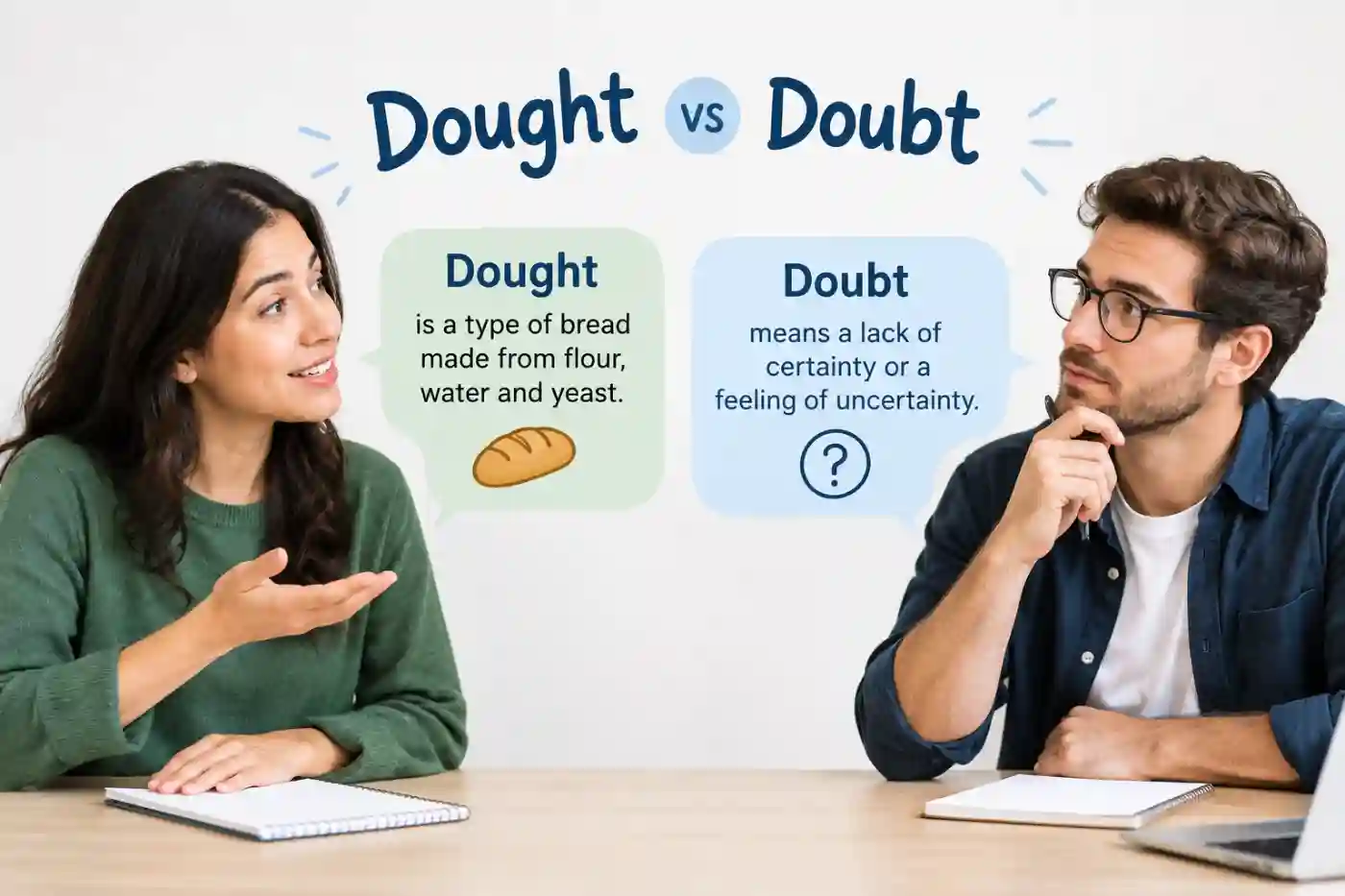
If you’re searching for dought vs doubt, you probably want a simple answer. Which spelling should you use when you mean uncertainty or a lack of belief?
The correct modern word is doubt.
For example, you can write, I doubt his story. You can also write, I have some doubt about the plan. The spelling dought should not be used as an alternative spelling of doubt in ordinary modern English.
There is one important detail that often gets missed. Dought does appear in English dictionaries, but it has a rare historical or dialectal role. Collins records dought as a past form of the Scots and Northern English verb dow, meaning to be able or to thrive. That has nothing to do with the modern noun and verb doubt.
The confusion is understandable. English has words such as thought, bought, fought, brought, and sought. These familiar spellings can make dought look like a logical choice. The silent b in doubt creates another trap because you cannot hear the letter when the word is spoken.
This guide explains the difference clearly. You’ll learn the correct spelling, meaning, pronunciation, grammar, word history, common mistakes, real examples, memory tricks, and the limited historical use of dought.
Quick Answer
Doubt is the correct modern English word for uncertainty, hesitation, or a lack of belief. Dought is not an alternative spelling of doubt. It exists only in rare historical or dialectal usage as a form related to the old verb dow. For modern American English, use doubt.
Dought Vs Doubt At A Glance
| Feature | Dought | Doubt |
|---|---|---|
| Standard modern spelling for uncertainty | No | Yes |
| Meaning uncertainty | No | Yes |
| Modern noun | No | Yes |
| Modern verb | No | Yes |
| Common in American English | No | Yes |
| Common in British English | No | Yes |
| Historical or dialectal use | Yes | Yes |
| Pronunciation | Rare historical forms vary | /daʊt/ |
| Silent b | No | Yes |
| Suitable for modern formal writing | No for this meaning | Yes |
| Suitable for everyday writing | No for this meaning | Yes |
| Common word family | Limited historical forms | doubtful, doubted, doubting, doubter |
The most useful rule is simple.
If you mean uncertainty, write doubt.
Dought Vs Doubt Which One Is Correct
Doubt is the correct word when you mean uncertainty, suspicion, hesitation, or a lack of confidence in something.
Use it in school writing, business emails, articles, reports, conversations, academic work, social media, and professional documents.
Examples include:
- I doubt his explanation.
- She has some doubt about the decision.
- There is no doubt that he worked hard.
- I never doubted your ability.
- They began to doubt the accuracy of the report.
Do not write:
- I dought his explanation.
- She has some dought about the decision.
- There is no dought that he worked hard.
Those sentences use dought as a replacement for doubt, which is not correct in modern standard English.
There is one exception worth knowing. If you are reading a historical text or studying regional English, you may encounter dought as a genuine word with a different history and meaning. Collins lists it as a past form of dow, an old Scots and Northern English verb meaning to be able or to prosper.
So saying that dought has never existed at all would be too broad. The accurate statement is this.
Dought is not the modern spelling of doubt.
That distinction matters for a trustworthy grammar resource because English contains many words that have disappeared from everyday use but remain visible in historical dictionaries and texts.
What Does Doubt Mean
Doubt is a noun and a verb.
As a noun, it refers to a feeling of uncertainty or a lack of confidence about something. Cambridge defines it as a feeling of not being certain about something, especially its truth or quality.
For example:
I have some doubt about his story.
Here, doubt is a noun.
As a verb, doubt means to feel uncertain about something or to find it difficult to believe.
For example:
I doubt his story.
Here, doubt is a verb.
Collins also notes that the verb can mean to distrust someone or question what they say.
The word can therefore cover several closely related ideas.
- Uncertainty.
- Hesitation.
- Lack of confidence.
- Disbelief.
- Suspicion.
- Questioning.
- Distrust.
The exact meaning depends on the sentence.
Doubt As A Noun
When doubt is a noun, it often describes a mental state.
Examples:
- I have doubts about the proposal.
- Her doubts disappeared after the meeting.
- There was little doubt about the result.
- He expressed serious doubt about the claim.
- The evidence left no room for doubt.
The plural form is doubts.
For example:
She still has doubts about moving to another city.
Doubt As A Verb
When doubt is a verb, it describes an action or attitude.
Examples:
- I doubt his explanation.
- We doubt that the plan will work.
- She doubted his intentions.
- They doubted the accuracy of the results.
- He began to doubt himself.
The common verb forms are:
- Doubt.
- Doubts.
- Doubted.
- Doubting.
The spelling keeps the b in every form.
What Does Dought Mean
This is where many online explanations become too simplistic.
Dought can be a real English word in historical and regional usage. It is not simply an imaginary spelling. Collins lists dought as a past form of the old verb dow. That verb has been recorded in Scots and Northern English with meanings related to being able, thriving, prospering, or doing well.
The historical word is closely connected with doughty, an adjective that means brave, determined, hardy, or resolute. Cambridge labels doughty as literary and gives the meaning of being determined and brave.
For example:
She was a doughty campaigner.
Here, doughty means brave and determined.
This history explains why dought can occasionally appear in dictionaries or historical material.
However, none of this changes the answer for modern writing.
If you want to say that you are uncertain about something, dought is not the word you need.
Write:
I doubt the story.
Not:
I dought the story.
Why People Confuse Dought Vs Doubt
The spelling confusion has several causes.
The Words Look Similar
Both forms begin with dou and end with a sound that can make the spelling feel uncertain.
The difference is only one letter.
Dought.
Doubt.
That small visual difference is easy to miss during fast typing.
The B In Doubt Is Silent
The pronunciation of doubt is /daʊt/ in both British and American English according to Cambridge.
The b is not pronounced.
That creates a natural spelling problem. When people spell a word from its sound, they may not remember the silent letter.
The same issue appears in other English words.
- Debt.
- Subtle.
- Thumb.
- Climb.
- Lamb.
English spelling often preserves letters that no longer have a matching sound.
Dought Looks Like Other Words
English has a large group of familiar words ending in ought.
- Thought.
- Bought.
- Fought.
- Brought.
- Sought.
- Taught.
Because dought looks like it belongs to this group, it can feel visually familiar.
But spelling patterns are not always predictable in English.
The fact that thought is spelled with ought does not mean doubt should be spelled dought.
People Spell By Sound
A learner may hear /daʊt/ and try to build the spelling from pronunciation.
That approach works with some English words. It fails with many others.
Doubt is one of the clearest examples because the written b is silent.
Fast Typing Causes Errors
Typing quickly can turn an unusual spelling into a guessed spelling.
Someone who knows the word but does not use it often may type dought automatically. This is especially easy when the surrounding sentence already makes the meaning clear.
Spellcheck Does Not Replace Knowledge
Modern writing tools can catch many spelling mistakes, but writers should not rely on them completely.
A spellchecker can miss unusual words. It can also behave differently depending on the dictionary or language setting.
A strong writer knows the word and checks unfamiliar forms when needed.
Key Difference Between Dought Vs Doubt
The biggest difference is not simply spelling.
It is meaning and modern usage.
Doubt is a normal modern English word.
Dought is a rare historical or dialectal form with a separate history.
That means these are not two competing spellings of the same modern word.
Compare:
I doubt his explanation.
This is standard modern English.
Now consider:
The old text used dought as a past form of dow.
That sentence can be appropriate in a discussion of historical English.
The context changes everything.
Dought Vs Doubt Pronunciation
The standard pronunciation of doubt is /daʊt/. Cambridge gives this pronunciation for both UK and US English.
It is one syllable.
The vowel sound is the same sound you hear in words such as:
- Out.
- About.
- Shout.
- Cloud.
- Proud.
The b is silent.
You should not pronounce the word as if it contained a clear b sound.
A common learner mistake is trying to say every written letter. English does not work that way. Silent letters are part of the spelling system and do not always appear in pronunciation.
Pronunciation Breakdown
Doubt
IPA: /daʊt/.
Syllables: one.
Stress: the whole word carries the natural stress because it has only one syllable.
The final t is pronounced.
The b is silent.
Doubt Grammar
Doubt can function as both a noun and a verb.
Knowing the difference helps you avoid more than a spelling mistake.
Doubt As A Noun
A noun names a thing, idea, state, or concept.
Examples:
I have some doubt about the plan.
His doubts disappeared after the explanation.
There is no doubt about her ability.
Common noun patterns include:
doubt about something
I have some doubt about the result.
doubt that something is true
There is little doubt that the report is accurate.
And doubt as to something
There was some doubt as to the cause.
in doubt
The final result remains in doubt.
without a doubt
She is without a doubt the strongest candidate for the role.
Doubt As A Verb
As a verb, doubt means to question something or to feel that something may not be true.
Examples:
I doubt his explanation.
She doubts his story.
They doubted the report.
We doubt that the plan will succeed.
The verb can take a person or thing as its object.
I doubt him.
It can also introduce a clause.
I doubt that he will come.
The meaning depends on context.
Doubt Verb Forms
The main forms are straightforward.
| Form | Example |
|---|---|
| Base form | I doubt the claim. |
| Third person | She doubts the claim. |
| Past tense | She doubted the claim. |
| Past participle | I have doubted the claim. |
| Present participle | He is doubting the claim. |
Notice that the b remains in every spelling.
Doubted has one important spelling point. The final t of the base word is pronounced as part of the ending in the past form.
doubt → doubted.
Doubt And Doubting
The present participle is doubting.
The spelling does not become douting.
Correct:
He is doubting the decision.
Incorrect:
He is douting the decision.
The silent b remains visible.
This is another useful reason to learn the word family instead of memorizing only one isolated spelling.
Doubt And Doubter
A person who doubts something can be called a doubter.
Examples:
- The doubters were surprised by the result.
- She became a doubter after several promises were broken.
- Every successful idea has its doubters.
The spelling still contains the b.
Doubt And Doubtful
Doubtful is an adjective.
It describes something uncertain or unlikely.
Examples:
The claim seems doubtful.
His explanation is doubtful.
It is doubtful that the project will finish on time.
Do not confuse the noun and adjective.
Doubt is a noun or verb.
Doubtful is an adjective.
Compare:
I have doubt about the claim.
I doubt the claim.
The claim is doubtful.
All three sentences use related ideas, but the grammar changes.
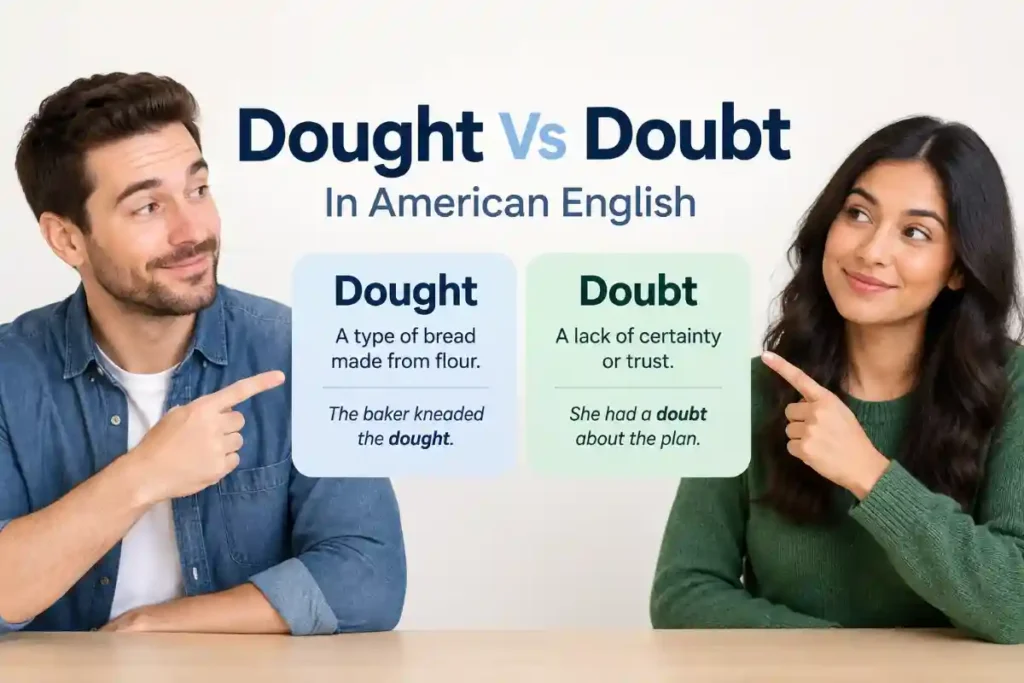
Dought Vs Doubt In American English
In American English, doubt is a common everyday word.
Cambridge gives the American pronunciation as /daʊt/ and defines the noun as a feeling of not knowing what to believe or do, or a condition of uncertainty.
You can use doubt in casual speech.
I doubt it.
For professional writing you can use it.
The findings raise some doubt about the original conclusion.
You can use it in academic writing.
These results cast doubt on the earlier assumption.
You can also use it in formal expressions.
There is no doubt that the evidence requires further review.
The word itself is not informal. Its level of formality depends more on the surrounding sentence.
Dought Vs Doubt In British Canadian And Australian English
The spelling doubt is standard across major varieties of English.
American English uses doubt.
British English uses doubt.
Canadian English uses doubt.
Australian English uses doubt.
The pronunciation is also broadly consistent. Cambridge lists /daʊt/ for both UK and US English.
This is not a case like color and colour, where American and British spelling differ.
There is no standard American spelling dout.
There is no standard British spelling dought for this meaning.
If you are writing for an American audience, use doubt.
The History Of Dought Vs Doubt
The spelling of doubt makes more sense once you know its history.
Etymological sources trace the word through Old French to Latin. Etymonline dates the English verb to around 1200 and connects it to Old French doter and Latin dubitare, meaning to doubt, question, hesitate, or waver in opinion.
The noun developed along a similar path.
The early English forms did not originally contain the modern b.
The letter was later restored under the influence of Latin spelling. Etymonline notes that the b was restored in French and English during the medieval period by scribes influenced by the Latin form. English eventually retained it.
That gives us an important spelling lesson.
The silent b is not random.
It is part of the word’s historical spelling.
Modern English pronunciation moved in its own direction while the written form retained the historical letter.
Dought Vs Doubt Why The Spelling Feels Strange
English spelling is full of historical layers.
Words can preserve letters from earlier stages of the language long after pronunciation changes.
Doubt is a good example.
The modern pronunciation is short and simple.
The spelling looks more complicated.
That gap between sound and spelling is one reason English learners sometimes write dought.
The History Of Dought Vs Doubt
Dought has a separate history.
Collins records dought as a past form of dow, a Scots and Northern English verb meaning to be able, thrive, prosper, or do well.
The related adjective doughty has survived more clearly.
Cambridge defines doughty as literary and gives meanings connected with determination, bravery, and persistence.
Collins traces doughty back through Middle English to Old English forms connected with being worthy or capable.
This is why a dictionary may contain dought even though you should not use it to spell doubt.
Dictionary status and everyday usefulness are not the same thing.
A word can be historically genuine while being inappropriate for ordinary modern writing.
Common Mistakes With Dought Vs Doubt
Mistake One
I dought he is telling the truth.
Correct:
I doubt he is telling the truth.
Mistake Two
There is no dought about it.
Correct:
There is no doubt about it.
The expression without a doubt is also standard.
Mistake Three
I have serious dought about the plan.
Correct:
I have serious doubt about the plan.
A more natural sentence may be:
I have serious doubts about the plan.
Mistake Four
She doughted his explanation.
Correct:
She doubted his explanation.
Mistake Five
He is doutful about the result.
Correct:
He is doubtful about the result.
Notice that the related adjective also retains the b.
Mistake Six
He is douting the evidence.
Correct:
He is doubting the evidence.
Real Life Examples Of Dought Vs Doubt
The fastest way to make a spelling distinction stick is to see the correct word in natural sentences.
Here are more than twenty examples across different contexts.
Daily Conversation
- I doubt he’ll come today.
- I have my doubts about that story.
- Don’t doubt yourself.
- I seriously doubt it.
- There’s no doubt about it.
Workplace Writing
- The latest figures raise some doubt about the forecast.
- I doubt the client will approve the proposal today.
- We had some doubts about the original schedule.
- The new evidence casts doubt on the earlier estimate.
- She never doubted the team’s ability to finish the work.
Academic Writing
- These findings raise doubts about the original theory.
- The evidence leaves little doubt about the outcome.
- Researchers have expressed doubt about the reliability of the data.
- The study casts doubt on the assumption that the effect is universal.
- Several factors make the conclusion doubtful.
Emails
- I doubt we’ll need another meeting.
- Please let me know if you have any doubts about the instructions.
- I have some doubt about the figures in the final section.
- We shouldn’t doubt the value of the feedback.
- I had my doubts at first, but the results were impressive.
Journalism
- The report has raised doubts about the company’s financial position.
- Experts expressed doubt about the long term impact of the decision.
- The new evidence casts doubt on the original claim.
- There is little doubt that the story attracted widespread attention.
Social Media
- I doubt anyone saw that coming.
- No doubt about it. That was a great performance.
- I had my doubts, but you proved me wrong.
- Never doubt what a good team can accomplish.
Literature
Doubt also appears frequently in literary writing because uncertainty is a powerful theme.
A character may doubt another person.
A narrator may express doubt about an event.
A writer may use doubt to create tension.
The word is flexible enough to work in simple dialogue and highly formal prose.
Common Expressions With Doubt
Some expressions are worth learning as complete phrases.
Without A Doubt
This means certainly.
She is without a doubt one of the best teachers here.
No Doubt
This can mean certainly or probably depending on context.
No doubt he’ll call tomorrow.
It can also emphasize strong certainty.
There is no doubt that the evidence is important.
In Doubt
This means uncertain or undecided.
The future of the project is still in doubt.
Beyond A Doubt
This means with complete certainty.
The evidence proves his identity beyond a doubt.
A related expression is beyond reasonable doubt, which is strongly associated with legal contexts.
Benefit Of The Doubt
To give someone the benefit of the doubt means to choose to believe them when you are not completely sure.
I’ll give her the benefit of the doubt.
This is one of the most common expressions built around the word.
Shadow Of A Doubt
A shadow of a doubt means the smallest amount of uncertainty.
There isn’t a shadow of a doubt in my mind.
The phrase is usually used for strong certainty.
Doubt Synonyms
Several words overlap with doubt, but they are not always interchangeable.
Uncertainty
Uncertainty means a lack of certainty.
There is some uncertainty about the final cost.
Suspicion
Suspicion often suggests that you believe something may be wrong or dishonest.
She had a suspicion that something was wrong.
Hesitation
Hesitation focuses on difficulty making a decision.
He answered without hesitation.
Distrust
Distrust means a lack of trust.
She felt distrust toward the company.
Disbelief
Disbelief means difficulty accepting something as true.
He stared at the message in disbelief.
Skepticism
Skepticism means a tendency to question claims or accepted ideas.
The proposal was met with skepticism.
These words belong to the same semantic field, but each has its own shade of meaning.
Opposites Of Doubt
The opposite of doubt can be expressed with words such as:
- Certainty.
- Confidence.
- Belief.
- Conviction.
- Trust.
- Assurance.
For example:
Doubt can make a decision difficult.
Confidence can make a decision easier.

Memory Tricks For Dought Vs Doubt
The best memory trick is simple.
Remember The Silent B
Think:
Doubt has a B you don’t hear.
You hear /daʊt/, but you write doubt.
That gives you a direct link between pronunciation and spelling.
Connect Doubt With Doubtful
Remember the word family.
Doubt → doubtful → doubted → doubting → doubter.
The b stays in the family.
Use A Familiar Phrase
Memorize:
without a doubt.
Once this phrase becomes familiar, the spelling becomes easier to recall.
Think Of The Latin Connection
For advanced learners, the historical link can help.
Doubt comes through Old French from Latin dubitare. The restored b in the spelling reflects that history.
You do not need to remember the Latin to spell the word correctly, but it explains why the spelling contains a letter that modern pronunciation does not reveal.
Editor’s Advice On Dought Vs Doubt
From an editing perspective, the practical rule is extremely simple.
If a modern sentence is talking about uncertainty, use doubt.
For editing a business email, change dought to doubt when the writer clearly means uncertainty.
If you are proofreading an academic paper, the same rule applies.
For writing an article, report, assignment, or website page, use doubt.
If you are working with an old manuscript or studying dialect history, do not automatically delete dought. First check the context. Collins records it as a genuine historical form of dow, so treating every occurrence as a simple spelling mistake would erase a useful piece of English history.
That is the distinction a careful editor makes.
The goal is not simply to label a word correct or incorrect. The goal is to understand the word, its history, its function, and the context in which it appears.
Frequently Asked Questions
Is dought the correct spelling of doubt
No. If you mean uncertainty, hesitation, disbelief, or a lack of confidence, use doubt. The spelling dought is not an alternative modern spelling of doubt. It does exist in limited historical and dialectal usage as a past form of the old verb dow, but that is a separate word with a different history and meaning.
Is dought a real English word
Yes, but only in a limited historical or dialectal sense. Collins records dought as a past form of dow, an old Scots and Northern English verb meaning to be able or to prosper. It should not be used as the modern spelling of doubt.
How do you spell doubt correctly
The correct spelling is doubt. It contains the letters D, O, U, B, and T. The b is silent in pronunciation. A useful memory trick is to connect doubt with doubtful, doubted, doubting, and doubter.
How do you pronounce doubt
Doubt is pronounced /daʊt/. It has one syllable and rhymes with words such as out and about. The b is silent. Cambridge lists /daʊt/ for both British and American English.
Why is the b silent in doubt
The silent b reflects the history of the word. Doubt came into English through Old French from Latin dubitare. The letter was restored to the spelling under Latin influence even though the pronunciation did not retain a b sound.
Is doubt a noun or a verb
Doubt can be both a noun and a verb. As a noun, it means uncertainty or lack of confidence, as in I have some doubt about the claim. As a verb, it means to question or disbelieve something, as in I doubt his explanation.
What is the past tense of doubt
The past tense is doubted.
For example:
I doubted his explanation at first.
The past participle is also doubted.
She has doubted the claim for years.
The spelling keeps the silent b.
What is the difference between doubt and doubtful
Doubt is a noun or verb. Doubtful is an adjective.
For example:
I have some doubt about the result.
I doubt the result.
The result seems doubtful.
All three sentences express related ideas, but the words perform different grammatical roles.
Dought Vs Doubt Related Words You Should Know
Learning the word family makes the spelling easier to remember.
| Word | Part of speech | Meaning |
|---|---|---|
| Doubt | Noun | Uncertainty or lack of confidence |
| Doubt | Verb | To question or disbelieve |
| Doubts | Noun | More than one doubt |
| Doubted | Verb | Past form of doubt |
| Doubting | Verb form | Present participle of doubt |
| Doubter | Noun | A person who doubts |
| Doubtful | Adjective | Uncertain or unlikely |
| Doubtfully | Adverb | In an uncertain way |
| Undoubted | Adjective | Certain or unquestionable |
| Undoubtedly | Adverb | Certainly |
Notice the pattern.
The core spelling remains doubt.
Final Verdict
When you mean uncertainty, hesitation, suspicion, or a lack of belief, use doubt.
Dought is not the modern spelling of that word. It does have a legitimate but rare historical and dialectal use as a past form of dow, so it is more accurate to describe it as a separate historical word rather than simply claiming that it has never existed.
For modern American English, the choice is easy.
Write:
I doubt it.
Not:
I dought it.
Remember the silent b. You hear /daʊt/, but you write doubt.
When the sound hides the letter, let the word family and its history guide your spelling.
Doubt has a silent b. Dought is a different word.

Founding Editor
Maya spent six years as a copyeditor at a regional newspaper before starting Grammist, which is where the “answer first” format came from: newsroom style guides don’t have room for a preamble.
She writes and reviews most of the word-pair and spelling entries, and has final say on anything that goes out under the Grammist name.