
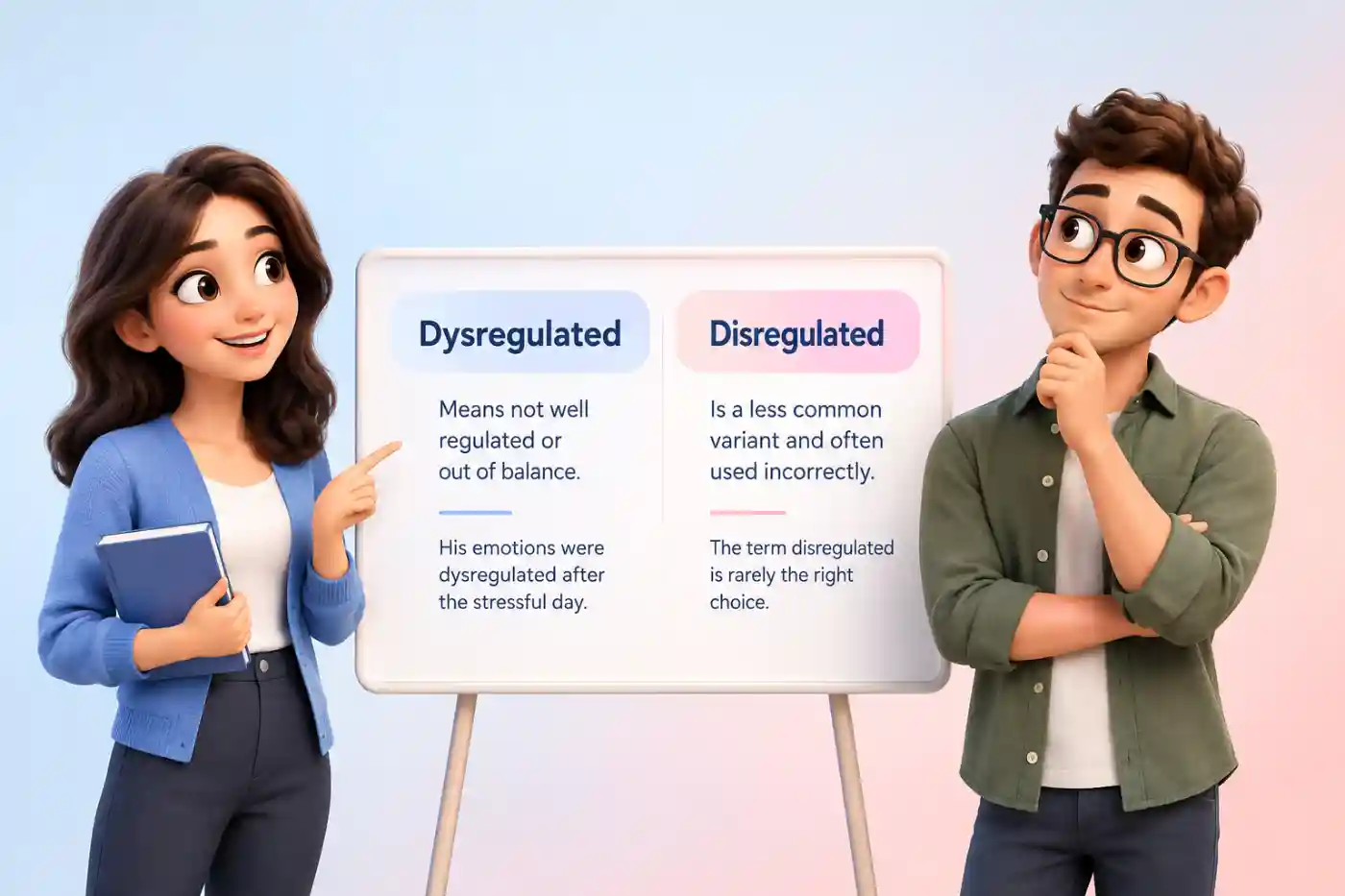
If you’ve searched dysregulated vs disregulated, you’re probably trying to settle a small spelling question that can become surprisingly confusing. The two forms look almost identical. They also sound very similar when spoken. That makes disregulated feel like a reasonable word even though dysregulated is the standard form.
The correct word is dysregulated. It describes something that isn’t being regulated normally or properly. Cambridge Dictionary lists dysregulated as an adjective used in medical and psychological contexts. It gives examples involving body processes and emotional or behavioral control. (Cambridge Dictionary)
The confusion usually comes from the prefixes dys and dis. English has many familiar words beginning with dis such as disconnected, disorganized, and disagree. That pattern can make disregulated look natural at first glance. However, established terminology uses dysregulated for impaired or abnormal regulation.
This guide explains the spelling, meaning, pronunciation, grammar, word formation, usage, regional patterns, common mistakes, and practical examples. You’ll also see how dysregulated differs from related terms such as unregulated, dysregulation, and emotion regulation.
Quick Answer
Dysregulated is the standard and correct form. It means not regulated normally or properly. It’s common in psychology, medicine, biology, and other specialized fields. Disregulated is generally a nonstandard spelling used when someone intends to write dysregulated. In professional and academic writing, use dysregulated.
Comparison Table
| Feature | Dysregulated | Disregulated |
|---|---|---|
| Standard form | Yes | No |
| Part of speech | Adjective | Nonstandard form |
| Basic meaning | Not regulated normally or properly | Usually intended to mean dysregulated |
| Common contexts | Psychology, medicine, biology, neuroscience | Informal or mistaken usage |
| Professional writing | Appropriate | Avoid |
| Academic writing | Appropriate | Avoid |
| Common phrase | Emotional dysregulation | Emotional disregulation |
| Related noun | Dysregulation | No standard noun form |
| Related verb | Dysregulate | Not the standard form |
| Pronunciation | Begins with a sound like dis | Often pronounced like dysregulated |
| US English | Dysregulated | Generally avoid |
| British English | Dysregulated | Generally avoid |
The important point is simple. Dysregulated is the established term used in standard English and specialized writing. Cambridge Dictionary specifically defines it in medical and psychological contexts.
What Does Dysregulated Mean
Dysregulated is an adjective that describes something whose normal regulation is impaired or not working properly.
Cambridge Dictionary defines a dysregulated bodily process as one that isn’t controlled in the way it normally should be. In psychology it also uses the word for difficulty controlling emotions and for behavior associated with that difficulty.
In plain English, you can think of dysregulated as meaning:
- poorly regulated.
- abnormally regulated.
- not functioning within its normal pattern of regulation.
- difficult to control or balance.
The exact meaning depends on the subject.
For example:
Her emotional response became dysregulated after several stressful events.
Here the word refers to emotional control.
Now consider:
The disease can cause dysregulated immune activity.
Here it refers to a biological process.
The word doesn’t belong only to mental health discussions. It can describe biological systems, physiological processes, behavior, emotions, and other systems that normally rely on regulation.
Cambridge provides examples involving glucose metabolism, cell signaling, emotional responses, behavior, and biological activity.
What Does Disregulated Mean
Disregulated is generally not the standard form when you mean impaired or abnormal regulation.
It commonly appears because writers assume that disregulated should be formed by adding dis to regulated. That assumption makes sense on the surface because English has many words beginning with dis. Still, established English usage favors dysregulated for this meaning.
Wiktionary records disregulated as a misspelling of dysregulated.
So if you’re writing an essay, report, article, email, medical document, or educational resource, use dysregulated.
Correct
The study examined dysregulated emotional responses.
Incorrect
The study examined disregulated emotional responses.
The intended meaning is clear in the second sentence, but the spelling isn’t the standard choice.
Which One Is Correct
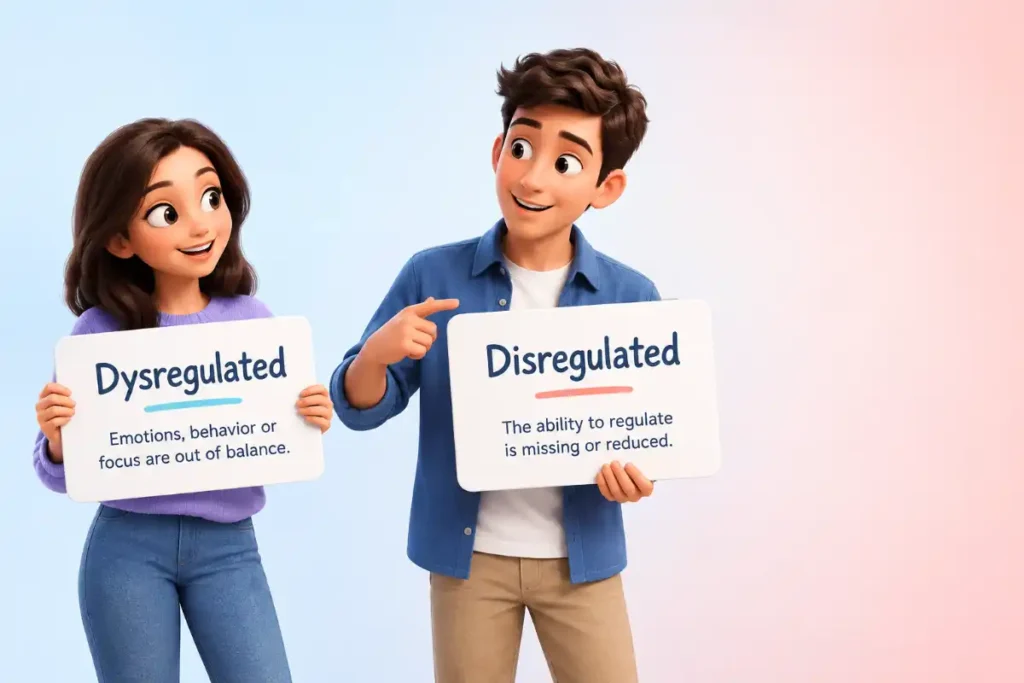
Dysregulated is correct.
Disregulated is generally considered nonstandard when it is intended as the adjective meaning poorly or abnormally regulated.
This distinction matters because dysregulated is an established technical term. Cambridge Dictionary has an entry for it and identifies its use in medical and psychological contexts.
The related noun dysregulation is also established. Cambridge defines dysregulation as a condition in which a bodily process isn’t controlled normally. It also uses the word for difficulty controlling emotions.
The American Psychological Association also defines dysregulation as an excessive or poorly managed mechanism or response. Its entry specifically discusses emotional dysregulation.
That gives us a useful word family:
- regulate.
- regulation.
- dysregulate.
- dysregulated.
- dysregulation.
The spelling remains dys throughout this family.

Understanding Dysregulated
The easiest way to understand dysregulated is to start with the base word regulated.
To regulate something means to control, adjust, manage, or keep it within a desired range.
For example:
The thermostat regulates the room temperature.
A regulated system responds to changes and adjusts itself or is adjusted by another mechanism.
When something becomes dysregulated, that normal regulation isn’t working properly.
The system may react too strongly, too weakly, too often, too slowly, or in another way that falls outside its normal pattern. The exact nature of the problem depends on the context.
That’s why the word can appear in both scientific writing and everyday conversations.
Dysregulated In Psychology
Psychology is one of the areas where people encounter this word most often.
Emotional dysregulation refers broadly to difficulty managing or modulating emotional responses. The APA Dictionary of Psychology defines dysregulation as an excessive or poorly managed mechanism or response.
For example:
He had difficulty calming down after the argument.
A more specialized version could be:
He experienced emotional dysregulation after the argument.
The second sentence uses more technical language. It doesn’t automatically mean that the person has a particular diagnosis. Context matters.
That point is worth remembering because dysregulated is sometimes used too casually online. Calling someone dysregulated isn’t the same as making a clinical diagnosis.
A professional writer should describe the observed behavior or response clearly instead of using the term as a vague label.
Dysregulated In Medicine
The word also has a clear medical use.
Cambridge Dictionary gives examples involving glucose metabolism and cell signaling.
For example:
The condition is associated with dysregulated glucose metabolism.
This means the normal regulatory process involving glucose metabolism isn’t functioning as expected.
Another example is:
Researchers observed dysregulated immune activity.
Again, the word describes a process rather than a person.
This distinction helps prevent overuse. Dysregulated works best when there is some underlying process of regulation that has become abnormal or impaired.
Dysregulated In Biology
Biology uses the word in many contexts.
A biological system constantly responds to changes. Hormones, immune responses, cellular activity, metabolism, and other processes depend on carefully controlled mechanisms.
When one of these processes no longer operates normally, researchers may describe it as dysregulated.
Examples include:
- dysregulated immune activity.
- dysregulated glucose metabolism.
- dysregulated cellular signaling.
- dysregulated inflammatory responses.
- dysregulated hormone activity.
Cambridge’s examples include dysregulated cell signaling and glucose metabolism.
The word is useful because it communicates more than simply saying something is wrong. It points specifically toward a problem involving regulation.
Dysregulated In Everyday English
You’ll also see dysregulated outside technical writing.
For example:
I felt completely dysregulated after a stressful week.
This is understandable and increasingly familiar in everyday discussions about stress and emotions.
Still, audience matters.
If you’re writing for a general audience, a simpler expression may sometimes be clearer:
I felt overwhelmed and had trouble calming down.
If you’re writing for a psychology audience, dysregulated may be the more precise choice.
Good writing isn’t about using the most technical word available. It’s about using the clearest accurate word for the reader.
Dysregulated Grammar
Dysregulated is an adjective.
It usually appears before a noun or after a linking verb.
Before a noun
The child showed dysregulated behavior.
The researchers examined dysregulated immune activity.
The report discussed dysregulated emotional responses.
After a linking verb
Her emotional response became dysregulated.
The system appeared dysregulated.
The process remained dysregulated for several hours.
The related forms are useful too.
| Word | Part of speech | Example |
|---|---|---|
| Regulate | Verb | The body regulates temperature. |
| Regulation | Noun | Temperature regulation is important. |
| Dysregulate | Verb | Stress can dysregulate normal processes. |
| Dysregulated | Adjective | The process became dysregulated. |
| Dysregulation | Noun | The study examined immune dysregulation. |
Cambridge lists dysregulation as a specialized noun and gives both medical and psychological meanings.
Dysregulated Pronunciation
The pronunciation can make the spelling even more confusing because the beginning of dysregulated sounds very similar to the beginning many people expect from disregulated.
For US English Cambridge gives the pronunciation as /dɪsˈreɡ.jəleɪ.t̬ɪd/. The stress falls on the second syllable. (Cambridge Dictionary)
dysregulated (/dɪsˈreɡ.jəleɪ.t̬ɪd/)
The word has four main syllable beats in careful pronunciation:
dys | reg | u | lat | ed
The exact sound can vary slightly in connected speech and across accents. The spelling remains the same.
A common mistake is to let the pronunciation determine the spelling. That’s risky because dys and dis can sound alike in this word.
The safest approach is to remember the word family rather than trying to spell it from sound.
Why The Spelling Feels Unnatural
English spelling often follows historical patterns rather than simple logic.
If you already know words such as:
- disagree.
- disconnect.
- disapprove.
- disorganized.
- dissatisfied.
you may naturally assume:
dis + regulated = disregulated
That pattern feels logical.
The problem is that English doesn’t create every word by attaching any prefix that seems to fit. Established vocabulary depends on history, usage, and conventional word formation.
The standard term that developed is dysregulated.
That’s a good example of why spelling by logic alone can lead you astray.
Dysregulated vs Disregulated And The Prefixes
The main source of confusion is the difference between dys and dis.
The two prefixes have different histories and functions even though they can sound similar.
The Prefix Dys
Dys comes from Greek and is commonly associated with ideas such as abnormality, difficulty, impairment, or faulty function.
You can see the same pattern in words such as:
- dysfunction.
- dyslexia.
- dysphagia.
- dysregulation.
- dystonia.
The exact meaning changes from word to word, so you shouldn’t assume that every dys word has one identical definition.
In dysregulated, the prefix contributes the idea of impaired or abnormal regulation.
The Prefix Dis
Dis has a different history and a much broader range of functions in English. It can contribute meanings involving negation, separation, reversal, or removal.
Consider:
- disagree.
- disconnect.
- disapprove.
- disassemble.
- dissimilar.
Because dis is so productive and familiar, it’s easy to assume it belongs before regulated.
That’s where the spelling error comes from.
Dysregulated vs Unregulated
This is a more useful comparison because unregulated is a standard English word.
The two terms overlap but aren’t always interchangeable.
Unregulated generally means not regulated or not controlled by a particular rule, authority, or system.
For example:
The industry operates in an unregulated market.
Dysregulated points more specifically toward regulation that is abnormal, impaired, or functioning incorrectly.
For example:
The study examined dysregulated immune activity.
A simple way to remember the distinction is:
Unregulated means regulation is absent or not imposed.
Dysregulated means the regulatory process is functioning abnormally.
Context can affect the exact interpretation, so these words shouldn’t be treated as perfect opposites.
Dysregulated vs Dysregulation
These words belong to the same family but serve different grammatical roles.
Dysregulated is an adjective.
The patient showed dysregulated behavior.
Dysregulation is a noun.
The study focused on emotional dysregulation.
Cambridge identifies dysregulation as a specialized noun in both medical and psychological contexts.
The APA also uses dysregulation as the noun for poorly managed mechanisms or responses.
So don’t write:
The patient showed emotional dysregulated.
Instead write:
The patient showed emotional dysregulation.
Or:
The patient appeared emotionally dysregulated.
The first uses the noun. The second uses the adjective.
Why People Confuse Dysregulated vs Disregulated
Several factors work together.
The Words Look Almost Identical
Only one letter changes.
dysregulated
disregulated
When you’re typing quickly, that difference is easy to miss.
The Prefixes Sound Similar
The spoken forms begin with a similar sound. That makes the mistake especially common for people who learn words through conversation.
English spelling doesn’t always give you enough information to reconstruct a word from pronunciation.
Familiar Words Influence Memory
People already know many words beginning with dis.
That creates a strong mental pattern.
When the brain encounters an unfamiliar technical word, it often tries to connect it to something familiar. In this case, disregulated can feel right simply because dis is common.
Online Usage Reinforces Errors
Once a misspelling appears online, other people can repeat it. Social media, forums, casual posts, and copied content can make a nonstandard spelling look more established than it really is.
That doesn’t automatically turn the spelling into the preferred standard form.
Frequency online and standard editorial usage aren’t the same thing.
Spellcheck Isn’t Always Enough
Spellcheck can catch many errors, but specialized terminology and unusual word forms can produce inconsistent results across tools.
That’s why a dictionary remains useful when a word looks unfamiliar.
For this pair, the safest choice is still dysregulated.
Dysregulated In Professional Writing
In professional writing, precision matters.
If you’re writing a psychology paper, medical report, academic assignment, educational article, or workplace document, use dysregulated when that is the intended term.
Examples:
The researchers examined dysregulated emotional responses among participants.
The study explored factors associated with dysregulated behavior.
The treatment may affect processes involved in emotional regulation.
Researchers identified dysregulated signaling within the affected cells.
These examples use the established vocabulary naturally.
However, professional writing also requires restraint. Don’t use dysregulated simply because it sounds scientific.
Compare:
The employee became dysregulated during the meeting.
with:
The employee became visibly upset and struggled to regain composure.
The second sentence may be better for a general workplace report because it describes observable behavior rather than applying a specialized psychological term.
That is an important editorial principle. Accuracy includes choosing the right level of technical language.
Dysregulated In Academic Writing
Academic writing often uses the term in specialized discussions.
Examples include:
- emotional dysregulation.
- behavioral dysregulation.
- dysregulated stress responses.
- dysregulated immune activity.
- dysregulated metabolic processes.
- dysregulated neural activity.
The APA Dictionary of Psychology uses dysregulation as a technical concept involving excessive or poorly managed responses.
Academic writers should still define specialized terminology when their audience may not know it.
For example:
Emotional dysregulation refers to difficulty managing or modulating emotional responses.
That sentence gives the reader a clear starting point before the technical term appears repeatedly.
Real Life Examples For Dysregulated vs Disregulated
Here are natural examples showing how dysregulated works in different contexts.
Daily Conversation
I felt emotionally dysregulated after a very stressful day.
Lack of sleep can leave me feeling more dysregulated than usual.
She needed some quiet time because she felt overwhelmed.
Workplace Writing
The report noted a dysregulated response to repeated stress.
The team discussed ways to reduce stress related to the dysregulated process.
The manager avoided using clinical language and simply described the employee’s observable behavior.
Academic Writing
The researchers examined patterns of emotional dysregulation.
The study investigated dysregulated responses under stressful conditions.
The findings suggest that regulation may change under prolonged stress.
Medical Writing
The condition was associated with dysregulated glucose metabolism.
Researchers observed dysregulated immune activity.
The disease may involve several dysregulated biological pathways.
Cambridge uses medical examples involving glucose metabolism and cell signaling.
Educational Writing
Some students may have difficulty managing strong emotional responses.
Teachers can describe a child as dysregulated when discussing difficulties with emotional or behavioral regulation, but they should avoid turning that description into an unsupported diagnosis.
Social Media
I was completely dysregulated after that chaotic day.
My sleep schedule has been so inconsistent that I feel out of balance.
The first example uses current informal terminology. The second uses simpler everyday language.
Both can work depending on the audience.
Common Mistakes With Dysregulated
The biggest mistake is simply choosing disregulated.
Mistake One
The child became disregulated after the argument.
Correct:
The child became dysregulated after the argument.
Mistake Two
She experienced emotional dysregulated.
Correct:
She experienced emotional dysregulation.
Here the problem isn’t the prefix. It’s the part of speech.
Mistake Three
The system was dysregulation.
Correct:
The system was dysregulated.
Or:
The system showed dysregulation.
Mistake Four
The process was unregulated because it was dysregulated.
This sentence may be technically possible in a very specific context, but the two words shouldn’t be treated as automatic synonyms.
Ask what you actually mean before choosing one.
Mistake Five
Using dysregulated as a diagnosis.
The word describes a state or process. It doesn’t automatically establish a medical or psychological diagnosis.
This is especially important in health related content.
Dysregulated vs Disregulated Memory Tricks
A good memory trick should be simple enough to recall when you’re typing quickly.
Use The Dys Family
Remember:
dysregulation → dysregulated
If you know the noun dysregulation, the adjective becomes much easier.
Think Of Dysfunction
You already know:
dysfunction
and:
dysregulated
Both use dys to point toward abnormal function.
Remember The Word Family
Write this sequence in your notes:
regulate → regulation → dysregulate → dysregulated → dysregulation
That pattern is more useful than memorizing the word alone.
Avoid The Dis Trap
If you catch yourself typing disregulated, stop for a second.
Ask:
Am I describing abnormal or impaired regulation?
If yes, the standard form is dysregulated.
Dysregulated vs Disregulated In American English
For US readers, the standard spelling is dysregulated.
There is no American spelling variation that changes dysregulated to disregulated.
This is different from genuine American and British spelling differences such as color and colour.
For this word, you don’t need to switch forms based on the country.
Canadian English
Canadian English also uses dysregulated in medical, psychological, scientific, and general contexts.
Australian English
Australian English likewise uses dysregulated.
You may see different spelling conventions in related words depending on regional style, but that doesn’t create a standard disregulated version of this term.
Is Disregulated Ever Used
You may encounter disregulated in real writing.
That fact deserves a careful explanation.
A word can appear in published material without being the standard form recommended for general professional writing. Misspellings can spread through repetition, copying, informal communication, and user generated content.
So seeing disregulated online doesn’t mean you should adopt it.
For ordinary English usage, especially in professional and academic contexts, dysregulated is the safer and established choice.
Wiktionary explicitly identifies disregulated as a misspelling of dysregulated.
The major dictionary evidence is also clear about dysregulated. Cambridge has a dedicated entry and identifies the word as specialized vocabulary used in medicine and psychology.
Dysregulated vs Disregulated Word Origin And Formation
The history of dysregulated becomes easier to understand when you look at its components.
The base word regulate ultimately comes through Latin roots associated with directing or controlling. English has used regulate for the idea of controlling or adjusting something according to a standard or system.
The prefix dys comes from Greek and has long been used in medical and scientific vocabulary to indicate abnormality, difficulty, or impaired function.
The combination gives us a term for regulation that is not functioning normally.
This same pattern appears in established technical vocabulary such as dysregulation.
The word has become especially important in medicine, psychology, neuroscience, and biology because these fields frequently discuss systems that depend on regulation.
Dysregulated And Emotion Regulation
The phrase emotion regulation is important when understanding the psychological use of the word.
The APA Dictionary of Psychology defines emotion regulation as the ability to modulate an emotion or group of emotions. It explains that this can involve conscious strategies as well as processes that operate without deliberate awareness.
That gives us a useful contrast.
Emotion regulation refers to the process or ability to manage emotional responses.
Emotional dysregulation refers to problems with that regulation.
Emotionally dysregulated describes a person or response in a context where emotional regulation is impaired or unusually difficult.
These expressions aren’t interchangeable.
For example:
She practiced emotion regulation techniques.
This refers to the process.
The study examined emotional dysregulation.
This refers to the problem or condition being studied.
He appeared emotionally dysregulated during the stressful interaction.
This uses the adjective to describe the observed state or response.
Does Dysregulated Mean Out Of Control
Not always.
That’s an important nuance.
Dysregulated can suggest difficulty controlling or maintaining normal regulation, but it doesn’t necessarily mean complete loss of control.
Cambridge describes a dysregulated bodily process as one that isn’t controlled as it normally should be.
A system can be dysregulated without being completely uncontrolled.
For example, a biological process might still operate while functioning outside its normal range.
Similarly, a person can experience emotional dysregulation while still being capable of making decisions and communicating.
For accurate writing, avoid turning dysregulated into a dramatic synonym for completely out of control.
Dysregulated And Mental Health Language
The word appears frequently in mental health discussions, but writers should use it carefully.
The APA Dictionary recognizes dysregulation as a psychological concept involving poorly managed responses.
Still, describing someone as dysregulated should not be treated as a diagnosis.
A professional editor would consider the context.
For general readers, phrases such as these may be clearer:
- having trouble managing strong emotions.
- struggling to calm down.
- reacting more strongly than expected.
- having difficulty regulating emotional responses.
For specialist readers, dysregulated may communicate the intended concept more efficiently.
The best choice depends on the audience and purpose.
Dysregulated vs Disregulated In Formal And Informal Writing
The word is perfectly appropriate in formal writing when the subject requires it.
Formal
The researchers investigated dysregulated stress responses.
The paper discusses emotional dysregulation in early development.
The findings indicate altered regulation of the immune response.
Informal
I felt completely dysregulated after that conversation.
My sleep has been so bad that I feel dysregulated.
The informal examples are understandable, but they use a specialized term in everyday speech.
That’s increasingly common with psychology vocabulary. Still, plain language can be better when the reader doesn’t need the technical term.
Twenty Natural Examples For Dysregulated vs Disregulated
Here are practical examples you can use as models.
- The researchers studied dysregulated immune responses.
- She felt emotionally dysregulated after several stressful events.
- The paper examines emotional dysregulation in children.
- The condition may involve dysregulated glucose metabolism.
- Scientists observed dysregulated cell signaling.
- Poor sleep can make emotional regulation more difficult.
- The child appeared dysregulated after the unexpected change.
- The therapist discussed strategies for improving emotional regulation.
- The researchers measured signs of dysregulation.
- The study focused on dysregulated stress responses.
- The report described abnormal regulation rather than using the term dysregulated.
- He said he felt dysregulated after a difficult week.
- The biological process became dysregulated under certain conditions.
- The researchers identified several dysregulated pathways.
- The teacher described the student’s behavior without making a clinical judgment.
- The article explains how emotional dysregulation can affect behavior.
- The patient showed signs of a dysregulated physiological response.
- The researchers explored factors associated with dysregulated behavior.
- The system remained dysregulated after the initial disruption.
- In formal writing, use dysregulated rather than disregulated.
These examples show an important pattern. Dysregulated usually modifies a noun or follows a linking verb.
Dysregulated vs Disregulated Related Words
Understanding related vocabulary can make the spelling easier to remember.
Regulate
Regulate is the basic verb.
The body regulates temperature.
Regulation
Regulation is the noun.
Temperature regulation helps maintain stability.
Dysregulate
Dysregulate is the verb related to abnormal regulation.
Certain conditions may dysregulate normal biological processes.
Dysregulated
Dysregulated is the adjective.
The process became dysregulated.
Dysregulation
Dysregulation is the noun.
The researchers examined immune dysregulation.
Unregulated
Unregulated means not regulated or not subject to a particular system of regulation.
The market was largely unregulated.
Self Regulation
Self regulation refers to the ability to manage behavior, attention, emotions, or other responses.
Children gradually develop stronger self regulation skills.
The exact spelling and punctuation of compound terms can depend on the style guide and context. For formal content, check the preferred form used by your field.

Synonyms For Dysregulated
There isn’t one perfect synonym because the word can describe different systems.
Depending on context, useful alternatives include:
- poorly regulated.
- abnormally regulated.
- impaired.
- unstable.
- uncontrolled.
- difficult to regulate.
- out of balance.
- disrupted.
- irregular.
Be careful with these substitutions.
Unstable doesn’t always mean dysregulated.
Uncontrolled can sound much stronger.
Disrupted emphasizes interruption rather than faulty regulation.
Impaired is broader.
For precise writing, dysregulated may be the best choice when the regulation process itself is the focus.
Dysregulated vs Disregulated What Professional Editors Recommend
A professional editor would usually make three decisions.
First, use dysregulated rather than disregulated when referring to abnormal or impaired regulation.
Second, make sure the grammatical form matches the sentence.
Third, consider the reader before using specialized terminology.
If the audience is familiar with psychology or medicine, dysregulated can be precise and efficient.
If the audience is general, a short explanation may help.
For example:
The researchers observed dysregulated emotional responses, meaning the participants had difficulty adjusting their emotional reactions.
That sentence introduces the technical term and immediately explains it.
This approach works well for educational content because it serves both experienced readers and beginners.
What Dictionaries Say About Dysregulated vs Disregulated
Cambridge Dictionary provides strong evidence for the standard form. It lists dysregulated as a specialized adjective and gives medical and psychological definitions.
Cambridge also lists dysregulation as a specialized noun with medical and psychological meanings.
The APA Dictionary of Psychology independently recognizes dysregulation as a psychological term describing excessive or poorly managed mechanisms or responses.
Together, these sources support the standard spelling and its specialized usage.
Frequently Asked Questions
Is dysregulated the correct spelling
Yes. Dysregulated is the standard spelling. Cambridge Dictionary lists it as a specialized adjective used in medical and psychological contexts. It describes something that isn’t regulated normally or properly. Use dysregulated in academic, professional, medical, scientific, and general writing when that is the intended meaning. (Cambridge Dictionary)
Is disregulated a word
Disregulated is not the standard form used for this meaning. It does appear occasionally in real world writing, but it is generally treated as a nonstandard spelling of dysregulated. Wiktionary specifically identifies it as a misspelling. For formal and professional writing, choose dysregulated.
What does dysregulated mean in simple words
Dysregulated means that something isn’t being controlled or balanced in its normal way. The word can describe emotions, behavior, biological processes, metabolism, immune activity, and other systems. Cambridge uses it for both bodily processes and psychological or behavioral responses.
What is emotional dysregulation
Emotional dysregulation refers to difficulty managing or modulating emotional responses. The APA Dictionary of Psychology describes dysregulation as an excessive or poorly managed mechanism or response. The phrase doesn’t automatically describe a diagnosis. Context and the person’s individual situation matter.
What is the difference between dysregulated and unregulated
Unregulated generally means that something isn’t regulated or isn’t subject to a particular regulatory system. Dysregulated points toward regulation that is impaired or functioning abnormally. A market can be unregulated. A biological process can be dysregulated. The two words can overlap in some contexts, but they aren’t interchangeable in every sentence.
How do you pronounce dysregulated
In US English, Cambridge gives the pronunciation /dɪsˈreɡ.jəleɪ.t̬ɪd/. The main stress falls on the second syllable. The beginning sounds similar to the start of many words spelled with dis, which helps explain why people sometimes spell the word as disregulated.
Is dysregulated a medical word
Dysregulated is used as specialized vocabulary in medicine and other scientific fields. Cambridge gives medical examples involving glucose metabolism and cell signaling. The word can describe a biological process that isn’t being controlled normally. It’s also used in psychology for emotional and behavioral regulation.
Can you say someone is dysregulated
Yes, the adjective can describe a person in psychological or behavioral contexts. Cambridge includes psychological usage for people who have difficulty controlling emotions and for related behavior. However, writers should avoid treating dysregulated as a diagnosis. When the audience is general, a plain description of the person’s observable experience may be clearer. (Cambridge Dictionary)
Expert Editor’s Note About Dysregulated vs Disregulated
If I were proofreading a sentence containing disregulated, I’d first check what the writer means.
If the intended meaning is abnormal, impaired, or poorly functioning regulation, I’d change it to dysregulated.
I’d also check the grammar around it. Dysregulated is an adjective. Dysregulation is a noun.
For example:
The patient experienced emotional dysregulation.
and:
The patient appeared emotionally dysregulated.
Both are grammatically sound, but they do different jobs.
I’d also ask if the technical term is necessary. A specialized word can make writing more precise, but it can also make a simple idea harder to understand.
That’s why good editing isn’t just about correcting spelling. It’s about choosing the clearest accurate language for the reader.
Final Verdict
The correct form is dysregulated.
Disregulated is generally a nonstandard spelling and should be avoided in professional, academic, medical, and educational writing.
Remember the word family:
regulate → dysregulate → dysregulated → dysregulation
The biggest mistake is assuming that disregulated must be correct because English has so many words beginning with dis. In this case, established usage uses dys.
When you mean that a process, response, behavior, or system isn’t functioning within its normal pattern of regulation, choose dysregulated.
Dysregulated is the word to remember.

Founding Editor
Maya spent six years as a copyeditor at a regional newspaper before starting Grammist, which is where the “answer first” format came from: newsroom style guides don’t have room for a preamble.
She writes and reviews most of the word-pair and spelling entries, and has final say on anything that goes out under the Grammist name.