

Both headcount and head count are correct English spellings. The closed form, headcount, is common in modern business writing, human resources, workforce planning, and financial reports. The two word form, head count, is also established and remains appropriate in many contexts. The best choice depends on your sentence, your intended meaning, and the style guide you follow.
If you have ever paused while writing an email about staffing levels or wondered if a report should say employee headcount or employee head count, you are not alone. English often combines two word expressions into single words over time, and this process can leave writers with more than one accepted form.
The distinction is especially useful in professional writing because the term appears in hiring plans, payroll reports, company budgets, project proposals, and everyday conversations about the number of people in a group. A small spelling choice can also affect consistency across a document.
In this guide, you will learn the difference between headcount and head count, how to use each form correctly, which spelling works best in business documents, how to form the plural, and which common mistakes to avoid. You will also find natural examples, pronunciation guidance, word history, and practical advice for choosing one form and using it consistently.
Quick Answer
Headcount and head count are both correct. They refer to the number of people in a group, especially employees in an organization. In modern business and HR writing, headcount is a practical default because it is widely used as a single word. Use head count when it fits your established style, and remain consistent throughout your document.
Headcount vs Head Count Comparison Table
The main difference between these spellings is their written form, not their basic meaning. Both can describe the number of people in a group, although the closed form often feels more natural in modern business and HR contexts.
| Feature | Headcount | Head count |
|---|---|---|
| Correct spelling | Yes | Yes |
| Meaning | Number of people in a group | Number of people in a group |
| Part of speech | Noun | Noun phrase |
| Pronunciation | /ˈhed.kaʊnt/ | /ˈhed kaʊnt/ |
| Syllables | Two | Two |
| Primary stress | First syllable | First syllable |
| Business usage | Very common | Also accepted |
| HR reports | Common modern choice | Appropriate in established styles |
| Informal writing | Natural | Natural |
| Formal writing | Appropriate | Appropriate |
| Plural form | Headcounts | Head counts |
| Recommended approach | A useful default | Use when preferred by your style guide |
The table shows that neither spelling is inherently wrong. You do not need to change a correct instance of head count simply because another writer prefers headcount.
For a new business document, however, choosing headcount as your default can make your writing more consistent with contemporary HR terminology.
What Headcount Means
Headcount is a noun that refers to the number of people in a group, organization, department, team, or other defined population.
It is especially common in business when people discuss the number of employees working for a company or the number of positions a department can support.
For example:
- Our current headcount is 120 employees.
- The finance team reviewed the company’s headcount.
- Management plans to increase headcount next quarter.
- The department has a headcount of 18.
- The annual report provides the company’s total headcount.
In each sentence, headcount identifies a number of people rather than a physical object or an abstract idea.
Headcount in human resources
Human resources teams use headcount to describe the number of employees in an organization or a particular part of it.
For example, an HR manager might report that a company has 350 employees at the end of the year. That figure is the company’s headcount at the specified point in time.
The term can also refer to a particular category of employees. A company might track full time employees, part time employees, temporary workers, or employees assigned to a particular location separately.
The exact calculation depends on the organization’s reporting rules. Some companies count individual employees, while others distinguish between employees and approved positions. These measures are related, but they are not always interchangeable.
Headcount in budgeting and planning
In financial planning, headcount often helps determine staffing costs and future hiring needs.
A department may have permission to hire five additional employees, but that does not automatically mean its current headcount has increased by five. The positions might remain vacant until candidates accept offers and begin work.
Consider these examples:
- The budget allows for a headcount increase of 10 employees.
- The team must justify each additional headcount request.
- Finance expects staffing costs to rise as headcount grows.
- The company froze hiring to control its headcount.
In the first example, the intended meaning is clear in ordinary business conversation. In a formal workforce plan, however, an editor might recommend 10 additional positions if the company is discussing approved jobs rather than people currently employed.
That distinction improves accuracy, especially in financial reports.
Headcount in everyday English
Although the word is common in business, its meaning is not limited to employees.
It can refer to the number of people attending a meeting, joining an event, participating in a class, or belonging to a group.
For example:
- We need a headcount before ordering lunch.
- The organizer requested a final headcount for the wedding.
- Please give me a headcount of everyone attending.
- The teacher took a quick headcount before the class trip.
In these examples, the word refers to a count of people rather than an organization’s workforce.
What Head Count Means
Head count is a two word noun phrase with the same basic meaning as headcount. It refers to the number of people in a group or the act of counting them.
The expression has a long history of ordinary English use, and the spaced spelling remains acceptable.
For example:
- The organizer needs a head count before booking the room.
- We took a head count after everyone boarded the bus.
- The manager requested a head count of the available staff.
- Our final head count was lower than expected.
These sentences are grammatically correct. Replacing head count with headcount would preserve their meaning.

Head count as the act of counting people
The two word form can make the act of counting feel especially clear in some sentences.
For instance:
The teacher took a head count before leaving the playground.
Here, the phrase describes a quick check to establish how many students are present.
The closed form works too:
The teacher took a headcount before leaving the playground.
Neither sentence is incorrect. The choice is largely a matter of editorial preference and established usage.
Head count in formal documents
Some organizations have used head count for years in their internal reports, staff policies, or administrative documents. If that spelling appears in an established house style, there is usually no reason to change it.
Consistency matters more than making an unnecessary correction.
For example, a company might use the heading Annual Head Count Report across all its documents. An editor should not automatically change it to Annual Headcount Report unless the organization has decided to standardize its terminology.
The goal is to produce clear, consistent writing rather than to enforce one spelling where both forms are accepted.
Which One Is Correct
Both headcount and head count are correct. Neither spelling should be treated as a universal misspelling of the other.
The closed form is a strong default for modern business writing because it is widely used as a noun in HR, workforce planning, and corporate reporting. The open form remains valid in ordinary English and established organizational styles.
Use these guidelines to choose the right form.
- Choose headcount for a modern business report when no house style dictates otherwise.
- Choose head count if your organization consistently uses the two word form.
- Follow the spelling used by your dictionary or editorial style guide when writing for a specific publication.
- Keep the spelling consistent within a report, article, policy, or presentation.
- Focus on the intended meaning when the distinction between people and positions matters.
Is headcount one word or two words
It can be either one word or two words. Headcount is a closed compound noun, while head count is an open compound noun phrase.
English contains many expressions that appear in more than one written form. Usage can change over time, and different dictionaries or publications may prefer different forms.
For this reason, it is misleading to claim that the two word form is always incorrect or that every writer must use the closed form.
Is head count a spelling mistake
No. Head count is an accepted spelling.
A spellchecker may prefer headcount because of its dictionary settings, but that does not make head count wrong. Similarly, seeing the spaced form in a reputable publication does not mean the editor has made an error.
A proofreader should check the context and the relevant style guide before changing it.
Is headcount more professional
Both forms are professional when used correctly. Still, headcount often fits contemporary business language particularly well.
It appears naturally in expressions such as employee headcount, headcount growth, headcount planning, and headcount reduction. These combinations are familiar in workplace communication.
The two word form can communicate the same information. Professionalism comes from clear wording, accurate figures, and consistent style rather than from closing the space alone.
Why People Confuse Headcount and Head Count
Writers often question these forms because English does not apply a single rule to every compound noun. Some combinations are written as one word, some remain separate, and others use a hyphen.
The spelling of a compound can also vary across dictionaries, industries, and editorial traditions.
English compound words change over time
English often turns common word combinations into single written units. A phrase may begin as two separate words, become familiar as a repeated expression, and eventually appear as a closed compound in many contexts.
However, this process does not happen at the same rate for every expression. Different spellings can remain in use for a long time.
Headcount and head count illustrate this flexibility. Their meanings are closely related, and both forms have become established in written English.
The two forms look equally logical
The expression combines head, referring informally to a person, with count, referring to a number or act of counting.
Because the meaning is easy to understand, writers may naturally write the words separately. Others recognize headcount as a familiar business term and write it as one word.
Neither instinct proves the other form wrong.
Business language favors compact terms
Business documents frequently use compact nouns to label concepts, measurements, and processes.
Expressions such as headcount planning and headcount report fit easily into spreadsheet headings, budget summaries, and HR dashboards. This encourages writers to treat the word as a single unit.
The closed spelling also looks concise in charts and labels where space is limited.
Spellcheckers can create confusion
Digital writing tools do not all use the same dictionary or language settings. One may recognize both forms, while another may flag the less preferred spelling.
Automatic corrections can also replace a writer’s preferred form without considering the organization’s style guide.
A spellchecker is useful for identifying likely errors, but it cannot always determine which accepted spelling best suits a specific document.
Writers assume compound nouns must follow one rule
English does not have a universal rule that requires every compound noun to be closed.
Compare these examples:
- workforce is commonly written as one word.
- work force appears in some contexts and established expressions.
- teamwork is generally written as one word.
- team member is written as two words.
- staffroom and staff room can both appear in English usage, depending on regional and editorial preferences.
These patterns show why a writer should consult actual usage instead of relying on a simple rule that every compound must be one word or two.
Social media spreads conflicting advice
Posts about spelling often present a personal preference as an absolute grammar rule. A writer might see someone claim that head count is wrong because the expression belongs in one word.
Such claims are not reliable unless supported by a credible dictionary or a relevant style guide. For this pair, the practical answer is straightforward: both spellings are accepted.
The best response is to choose a suitable form and apply it consistently.
Key Differences Between Headcount vs Head Count
The most important differences concern spelling, editorial preference, and how writers treat the expression in a sentence. The underlying meaning stays largely the same.
Meaning
Both forms describe the number of people in a group or the process of counting people.
For example:
The headcount increased after the company hired 12 new employees.
The head count increased after the company hired 12 new employees.
Both sentences are correct. The reader receives the same information.
Grammar
Both forms function as nouns. The closed form is a single written word, while the open form consists of two words that work together as a noun phrase.
Both can appear after an article, after a possessive, or as part of a longer noun phrase.
Examples include:
- The headcount is increasing.
- The head count is increasing.
- Our headcount has reached 200.
- Our head count has reached 200.
The grammatical structure remains the same.
Formality
Neither spelling is inherently more formal than the other. Both work in reports, emails, presentations, and ordinary conversation.
However, headcount is especially familiar as a business term. It often appears in concise professional expressions, such as headcount forecast and headcount target.
Regional usage
Both spellings appear in English across different regions. There is no simple rule that assigns headcount exclusively to American English or head count exclusively to British English.
A particular publication may prefer one form, but that is an editorial choice rather than a universal regional distinction.
Consistency
Consistency is one of the few practical differences that writers can control directly.
If a report uses headcount in its title, headings, tables, and body text, continuing with that form creates a cleaner document. Mixing the spellings without a reason can make the writing look insufficiently edited.
Grammar Rules for Headcount vs Head Count
Understanding how these expressions work in a sentence helps you use them confidently.
Both forms are nouns
A noun names a person, place, thing, or concept. In this case, the noun identifies a number of people or a count of them.
Consider the following examples:
- The headcount is 75.
- We need a head count.
- Management approved the new headcount.
- The final head count was 42.
In the first and third examples, headcount functions as a noun that refers to a staffing figure. In the second and fourth, head count serves the same purpose.
How to use articles
Both forms can follow articles such as a, an, and the, as well as possessive words such as our, their, and its.
Examples:
- We need a headcount before the meeting.
- We need a head count before the meeting.
- The company’s headcount has increased.
- The company’s head count has increased.
- Their headcount is lower than ours.
Use a when introducing a count as one count among possible counts. Use the when referring to a specific count that the reader can identify.
The choice between the open and closed spelling does not change these article rules.
How to use headcount with verbs
The noun normally takes a singular verb when it refers to one overall figure.
For example:
- The headcount is stable.
- The headcount has increased.
- Our headcount remains unchanged.
- The head count was higher than expected.
Although a headcount represents multiple people, the noun itself refers to one figure or measurement. That is why singular agreement is natural in these sentences.
Compare this with a sentence about the people themselves:
The employees are attending training.
Here, employees is plural, so the verb is plural too.
How to form the plural
The plural of headcount is headcounts. The plural of head count is head counts.
Examples:
- The company tracks headcounts across its regional offices.
- Each department submitted its headcount.
- The report compares the head counts of three departments.
- Several organizations reported lower headcounts this year.
The plural form is useful when comparing multiple groups, departments, locations, or reporting periods.
In practice, writers often use a singular collective measure when discussing an organization and a plural form when comparing separate groups or counts.
Headcount as a modifier
A noun can modify another noun by describing its type or purpose. Both spellings can appear in longer expressions, although the closed form is especially common in business terminology.
Examples include:
- headcount report
- headcount analysis
- headcount planning
- headcount forecast
- headcount target
- headcount reduction
These expressions describe reports, analyses, plans, forecasts, targets, and reductions related to the number of people in a group.
You can also write head count report or head count planning if your style guide or organization uses the open spelling.
Headcount and employee headcount
The phrase employee headcount refers to the number of employees in a defined group.
For example:
The employee headcount reached 240 in September.
The phrase is grammatically correct, but the context should make clear which employees are included. Does the figure cover permanent employees, all workers, or only staff based in a particular country?
In precise reporting, a short definition can prevent confusion. A company might state that its employee headcount includes all active employees as of the last day of the quarter.
Headcount and headcount numbers
The phrase headcount numbers is common in business conversation, but it can sometimes be unnecessarily repetitive because headcount already refers to a number of people.
Instead of writing:
We reviewed the headcount numbers for each team.
You could write:
We reviewed the headcount for each team.
Still, headcount numbers is understandable and not automatically ungrammatical. Use the shorter expression when it conveys the intended meaning just as clearly.

Pronunciation of Headcount and Head Count
Both spellings have the same usual pronunciation.
Pronunciation guide
Headcount / Head count
/ˈhed.kaʊnt/
Two syllables · HEAD count
Syllable breakdown
- Head: /hed/
- Count: /kaʊnt/
Stress pattern
The main stress falls on the first syllable: HEAD count.
Simple pronunciation hint
Say head as in ahead, without the initial unstressed sound, followed by count as in count the books.
The space in head count does not normally create a different pronunciation. Both forms sound the same in ordinary speech.
A common pronunciation error is to give the second syllable too much stress. The standard pronunciation places the primary stress on head.
Word Origin and History
The expression head count comes from the ordinary English use of head to refer to a person and count to refer to a number or the act of counting.
Using head to represent an individual person is an example of a familiar figure of speech called synecdoche. In this kind of expression, a part stands for the whole. English speakers have long used head in phrases about counting people, animals, and members of a group.
The basic idea is simple: count the heads, and you establish how many people are present.
Over time, the expression became a convenient term for attendance checks and population counts. Its business meaning developed naturally from the same idea. Instead of counting people in a room, organizations began using the term for the number of employees in a department or company.
The closed form headcount reflects a common pattern in English, where a familiar combination of words becomes established as a single compound noun. The open form remains in use too.
There is no need to assume that the two spellings have different origins or separate meanings. They express the same basic concept through different written forms.
British vs American English
The difference between headcount and head count is not a straightforward British versus American spelling issue.
American, British, Canadian, and Australian writers can encounter both forms. Individual dictionaries, publishers, and workplaces may show preferences, but neither spelling belongs exclusively to one national variety of English.
American English
In American workplace communication, headcount is widely recognizable in HR reports, financial planning, and company announcements.
Examples:
- The company plans to increase headcount next year.
- Our current headcount is 450 employees.
- Finance reviewed the headcount forecast.
The open spelling is also understandable and accepted. If an American publication uses head count, there is no automatic need to correct it.
British English
British writers can use either form, depending on the publication or organization.
For example:
The department completed a headcount before the event.
This sentence is natural and clear in British English. The spaced form would communicate the same meaning.
For formal British writing, follow the dictionary and style guide used by the publication or institution.
Canadian English
Canadian English shares many spelling and usage patterns with both American and British English. The term is familiar in Canadian business and administrative settings.
For example:
The annual report includes the headcount for each regional office.
A Canadian writer should follow the employer’s or publisher’s chosen form rather than assume that one spelling is required nationally.
Australian English
Australian English also uses the expression in workplace and everyday contexts.
For example:
The manager requested a head count before the team left the venue.
The closed form is equally understandable. The most useful rule is to keep the chosen spelling consistent within the same document.
Which regional form should you choose
If you are writing for an international audience, headcount is a sensible default for business and HR content. If you are writing for a publication with an established style guide, follow that guide instead.
Do not present the difference as a national spelling rule. The real distinction is editorial preference, not a firm division between regional English varieties.
Real Life Examples of Headcount and Head Count
The following examples show how both forms work in everyday English, professional communication, education, and public reporting. The sentences use realistic situations rather than artificial spelling exercises.
Examples in daily conversation
- We need a headcount before ordering pizza for everyone.
- Can you give me a final head count for the birthday party?
- The headcount was lower than we expected.
- Please take a head count before the children board the bus.
- Our group headcount reached 25 by the end of the afternoon.
Examples in workplace communication
- The company’s headcount increased by 15 employees this quarter.
- Our current head count is 85 people.
- The HR manager prepared a headcount report for the leadership team.
- We need to confirm the final headcount before the annual meeting.
- The department’s headcount remained unchanged throughout the year.
Examples in emails
- Please confirm the headcount for Friday’s training session.
- Could you send me the final head count by Thursday afternoon?
- I’ve updated the headcount figures in the shared report.
- We need an accurate headcount before booking the conference room.
Examples in academic and educational writing
- The researcher recorded the headcount of participants at each session.
- The teacher completed a head count before the school trip.
- The study compared the headcounts of three separate groups.
- The university tracks student headcount across its campuses.
Examples in journalism and public reporting
- The report showed an increase in the company’s headcount during the second quarter.
- Officials provided a preliminary head count following the public event.
- The organization published its annual headcount figures.
- The final head count exceeded the original estimate.
Examples in social media and informal writing
- What’s the headcount for tonight’s dinner?
- Drop your final headcount in the group chat.
- We need a quick head count before heading to the next stop.
These examples demonstrate that both spellings can fit naturally into complete sentences. For business and HR content, the closed form is a useful default. For attendance checks and informal messages, either form works well.
Common Mistakes to Avoid
Although the spelling choice is simple, writers can make mistakes when they confuse the written form with the meaning or use the term too broadly.
Mistake one assuming head count is incorrect
Incorrect claim: Head count is always a spelling mistake.
Correction: Both headcount and head count are accepted forms.
Do not mark the open spelling as wrong simply because your preferred dictionary or software favors the closed form.
Mistake two mixing spellings without a reason
A report that alternates between headcount and head count may look inconsistent.
For example:
The headcount was 120. The next section reviews the head count for each department.
The sentence is understandable, but a consistent version reads more smoothly:
The headcount was 120. The next section reviews the headcount for each department.
Choose one form for the document unless there is a clear editorial reason to retain both.
Mistake three confusing employees with approved positions
A company’s employee count is not always the same as its number of approved positions.
For example, a department might have 40 employees and approval to hire five more. Its current employee headcount is 40, while its authorized staffing capacity could be 45.
Use headcount for the number of people when that is what you mean. Use approved positions, vacancies, or staffing capacity when those terms describe the figure more accurately.
Mistake four using the wrong plural
The standard plural forms are:
- One headcount, several headcounts.
- One head count, several head counts.
Do not write headcount’s when you simply mean more than one headcount. The apostrophe is used for possession or certain contractions, not for ordinary plural nouns.
Mistake five using unnecessary repetition
The phrase headcount total may be useful in some contexts, but total headcount is often more natural.
Similarly, headcount numbers can sometimes be shortened to headcount.
Good editing removes unnecessary words while preserving the intended meaning.
Mistake six treating headcount as a verb
In ordinary modern usage, headcount is primarily a noun. If you mean to establish how many people are present, write count the people, take a headcount, or conduct a head count.
For example:
Less natural: We will headcount the attendees.
Clearer: We will count the attendees.
Also natural: We will take a headcount of the attendees.
The noun can describe the process or result, but a direct verb is often clearer.
Mistake seven assuming the closed spelling is always better
The closed form is a useful default, but that does not mean every instance of head count needs correction.
Professional editing depends on context, consistency, and the requirements of the publication. Avoid changing accepted language simply to impose a personal preference.
Memory Tricks to Remember the Correct Spelling
A simple memory aid can help you choose between the two forms without wasting time.
Remember the business word
Think of headcount as one compact business measure, like a figure in an HR report. When discussing employee totals, the closed form is a convenient default.
Remember what you are counting
A head represents a person, and a count gives the number. Both headcount and head count express this idea.
Remember consistency
Pick one spelling for your document, follow your style guide, and use it throughout.
The most useful trick is to remember that you do not need to discover a hidden grammar rule that makes one form correct and the other wrong. Both are accepted. Your goal is to choose the form that best suits your writing.
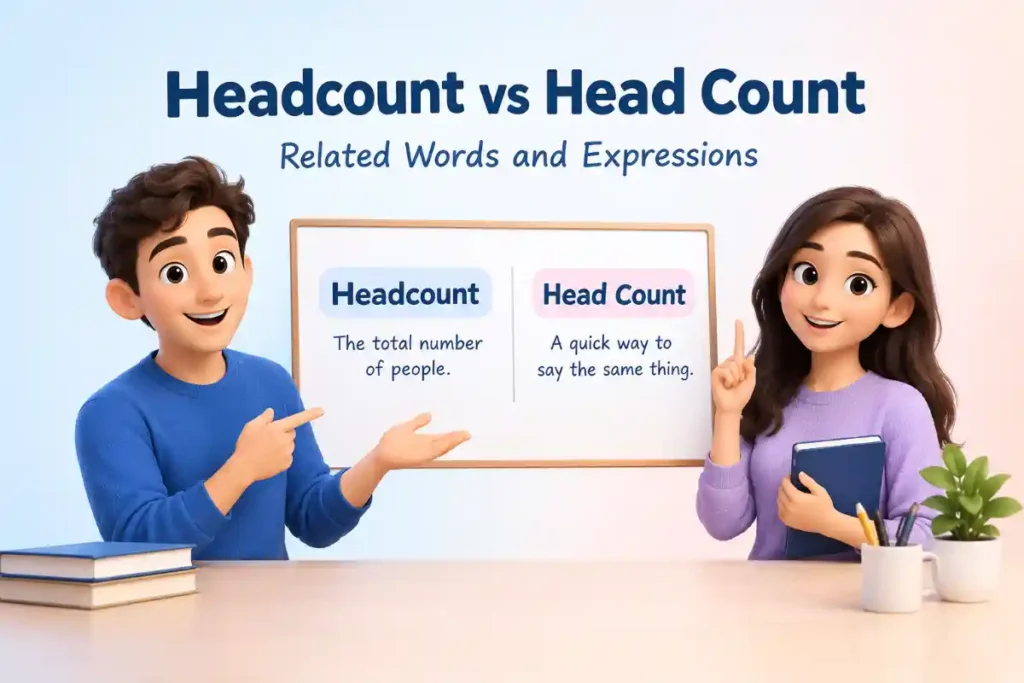
Related Words and Expressions
Understanding related terms can help you choose more precise wording, particularly in professional documents.
| Word or expression | Meaning | Example |
|---|---|---|
| Workforce | People employed by an organization or working in a field | The workforce grew this year. |
| Staffing | The process of supplying workers for a job or organization | Staffing needs have changed. |
| Employee count | The number of employees | The employee count reached 200. |
| Staff numbers | The number of staff members | Staff numbers remained stable. |
| Personnel | People who work for an organization | Personnel costs increased. |
| Attendance | The presence of people at an event or place | Attendance was higher than expected. |
| Enrollment | The number of people registered for a course or program | Enrollment increased this term. |
| Turnout | The number of people who attend or participate | Turnout exceeded expectations. |
| Vacancy | An unfilled job or position | The department has three vacancies. |
| Full time equivalent | A staffing measure based on working hours | The report uses full time equivalent figures. |
These terms are related, but they are not always interchangeable.
For example, workforce refers to the people who work for an organization, while headcount usually refers to their number. Attendance focuses on who is present at a particular event or time. Vacancy refers to an unfilled position, not an employee.
In business reporting, choosing the precise term is often more important than choosing between the two accepted spellings of headcount.
An Expert Editor’s Note
A professional editor would not automatically correct head count to headcount in every document. The first step is to check the intended meaning, the publication’s preferred dictionary, and any house style rules.
Major dictionaries and style guides can differ in their treatment of compound words. A dictionary may list a closed form as its main entry while acknowledging a variant elsewhere. A publisher may also prefer one spelling for consistency across its content.
For practical editing, follow these principles:
- For new business content: Use headcount as a straightforward default.
- For an existing document: Preserve head count if it is correct and used consistently.
- For HR and financial reports: Define the population being counted and distinguish employees from approved positions.
- For formal publications: Follow the relevant dictionary and house style.
- For proofreading: Correct genuine errors, not acceptable spelling variants.
Native speakers use both forms, so the open spelling does not automatically sound less natural. The closed form may feel more familiar in corporate terminology, but the difference is usually minor.
The best edited document is one that communicates its meaning precisely and follows a consistent style.
Frequently Asked Questions
Is headcount one word or two?
Both spellings are correct. Headcount is written as one word, while head count is written as two. Both refer to the number of people in a group or the act of counting them. In modern business writing, headcount is a convenient default, but the spaced form remains acceptable in general English.
Is head count grammatically correct?
Yes. Head count is a valid noun phrase in English. You can write sentences such as We need a head count before the meeting or The final head count was 50. The spelling does not become incorrect simply because another writer uses the closed form. Follow your organization’s preferred style and remain consistent.
What is the plural of headcount?
The plural is headcounts. For the two word form, the plural is head counts. For example, you might compare the headcounts of three departments or review the head counts recorded at several events. Use an apostrophe only when you need to show possession, as in the headcount’s accuracy.
Is headcount the same as employee count?
The terms are closely related, but context matters. Employee count explicitly refers to the number of employees. Headcount can refer to employees, attendees, students, or other groups of people. In business reports, it is important to state which population is included and distinguish the number of actual employees from approved positions.
Should I use headcount or head count in a business email?
For a new business email, headcount is a practical choice, especially when discussing staffing, hiring, or employee totals. However, head count is also correct. If your organization already uses the spaced form in reports and internal communication, following that convention will help keep your writing consistent.
Is headcount a formal word?
Yes. Headcount is appropriate in formal business writing, including HR reports, financial documents, workforce plans, and management presentations. It is also common in everyday conversation. In highly technical or legal documents, you may need a more precise term, such as number of employees or authorized positions, depending on the figure you are describing.
What is the difference between headcount and workforce?
Headcount refers to a number of people, usually expressed as a figure. Workforce refers to the people who work for an organization or within a particular field. For example, a company may have a workforce of 500 employees and report its headcount as 500. The workforce is the group, while headcount is the measure.
Does British English use headcount or head count?
Both forms appear in British English. There is no universal rule requiring British writers to use only the open or closed spelling. A specific publication, employer, or dictionary may prefer one form, so consult the relevant style guide when writing for a British audience.
Final Verdict
Both headcount and head count are correct English spellings. They share the same basic meaning and can be used in business reports, emails, conversations, and other forms of writing.
For modern HR and business content, headcount is a sensible default. Use head count if your preferred style guide or organization calls for it, and avoid switching between the forms without a reason.
Most importantly, distinguish the number of people from the number of available positions. Good writing depends on that accuracy far more than on the space between two words.
Remember this simple rule: both spellings are correct, but consistent and precise usage makes your writing stronger.

Founding Editor
Maya spent six years as a copyeditor at a regional newspaper before starting Grammist, which is where the “answer first” format came from: newsroom style guides don’t have room for a preamble.
She writes and reviews most of the word-pair and spelling entries, and has final say on anything that goes out under the Grammist name.