
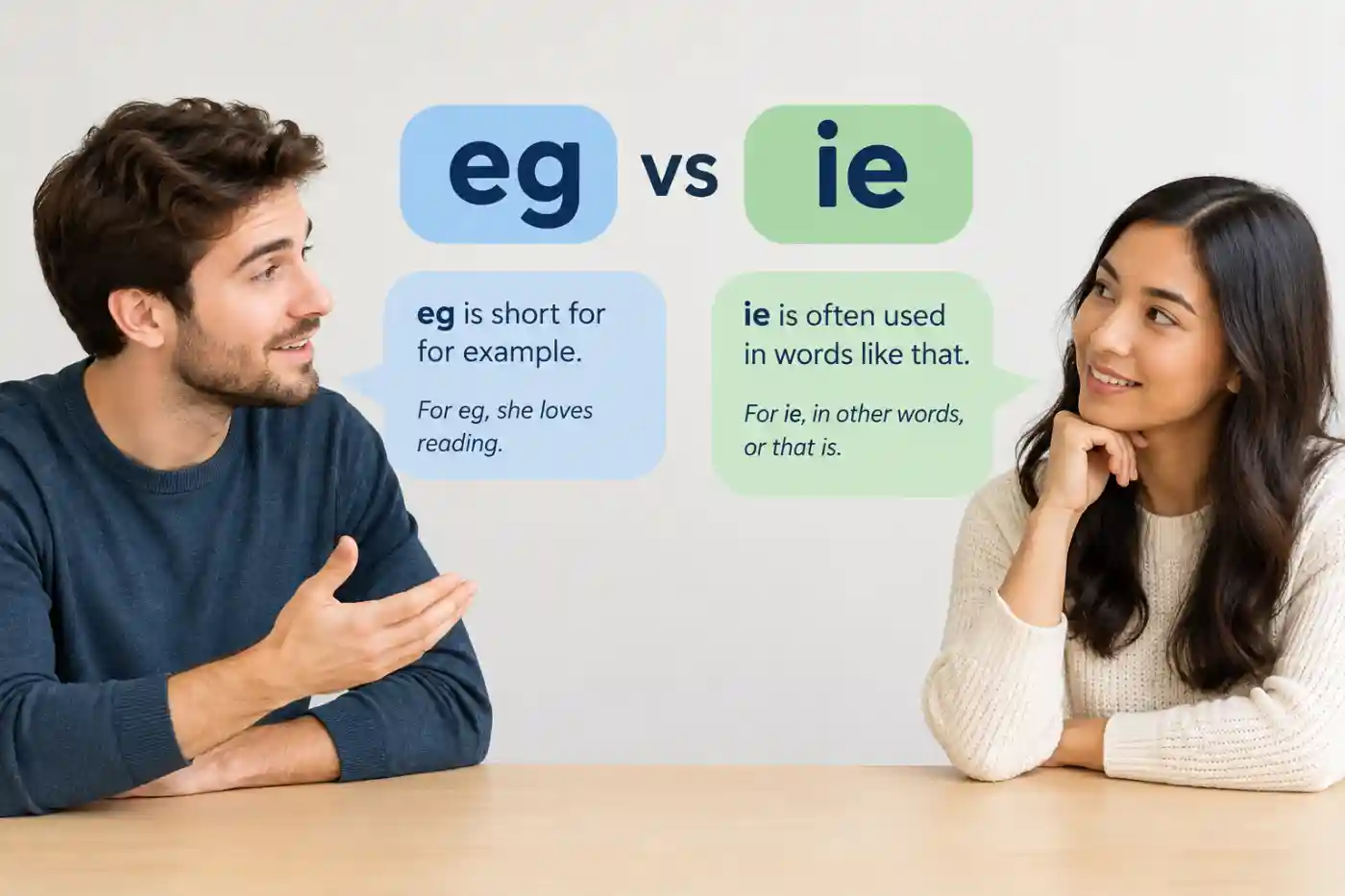
If you have ever stopped while writing because you could not decide between eg vs ie you are not alone. These two tiny abbreviations appear in emails reports essays articles instructions and everyday writing. They also look so similar that even experienced writers can mix them up.
The good news is that the difference is simple once you focus on what each abbreviation does. E.g. means for example. I.e. means that is or in other words. Use e.g. when you want to give one or more examples. Use i.e. when you want to clarify or restate exactly what you mean. Both come from Latin and have become established parts of written English.
The real challenge is not memorizing two Latin expressions. It is recognizing the relationship between the first part of your sentence and the information that follows. If you are giving a sample from a larger group use e.g. If you are explaining the exact meaning of the point you just made use i.e.
This guide explains the difference between e.g. and i.e. with clear examples practical rules punctuation guidance pronunciation tips common mistakes and memory tricks. You will also see how American English handles these abbreviations and when a plain English phrase such as for example or in other words may be a better choice.
Quick Answer
Use e.g. when you mean for example. Use i.e. when you mean that is or in other words. E.g. introduces examples from a larger group. I.e. clarifies or restates the exact meaning of something already mentioned. In American English formal writing commonly uses periods in both abbreviations and a comma after each one.
Eg vs Ie Comparison
| Feature | E.g. | I.e. |
|---|---|---|
| Meaning | For example | That is or in other words |
| Latin source | Exempli gratia | Id est |
| Main purpose | Gives examples | Clarifies or restates |
| Information that follows | Possible examples | A more exact explanation |
| Does it suggest other possibilities | Usually yes | Usually no |
| American English punctuation | E.g., | I.e., |
| Common replacement | For example | That is or in other words |
| Typical use | Lists or illustrates examples | Defines or narrows meaning |
| Part of speech | Abbreviation | Abbreviation |
| Common mistake | Using it for an exact explanation | Using it for a general example |
The central difference is function. E.g. opens the door to examples. I.e. closes the door around a specific meaning.
What Does E.g. Mean
E.g. is an abbreviation of the Latin phrase exempli gratia. It means for example. You use it when you want to name one or more examples that help explain a broader category or idea.
For example:
You can bring a healthy snack e.g., fruit nuts or yogurt.
The items after e.g. are examples. They do not represent every possible healthy snack.
You could also write:
Many cities offer excellent public transportation e.g., New York Chicago and Boston.
The sentence does not claim that these are the only cities with good public transportation. They are simply examples.
That distinction is the heart of e.g.
How E.g. Works
Think of e.g. as a signal that says:
Here are some examples.
You can often replace e.g. with phrases such as:
- for example
- for instance
- such as
- including
Consider this sentence:
Several fruits are rich in vitamin C e.g., oranges kiwis and strawberries.
You could rewrite it as:
Several fruits are rich in vitamin C. For example oranges kiwis and strawberries are good choices.
The meaning stays essentially the same.
What Does I.e. Mean
I.e. comes from the Latin phrase id est. It means that is or in other words. You use it when you want to clarify explain restate or make a statement more precise.
Consider this example:
The office closes at the end of the business day i.e., 5 p.m.
The information after i.e. identifies exactly what the writer means by the end of the business day.
Another example is:
She is an only child i.e., she has no brothers or sisters.
The second part does not give an example of an only child. It explains the meaning of the phrase.
How I.e. Works
Think of i.e. as a signal that says:
Let me explain exactly what I mean.
You can often replace i.e. with:
- that is
- in other words
- specifically
- namely
For example:
The store is closed on the first day of the week i.e., Sunday.
The writer is not offering Sunday as one possible example. The writer is identifying the specific day being discussed.
Eg vs Ie In Simple Terms
The easiest rule is this:
E.g. gives examples. I.e. gives an explanation.
Compare these two sentences.
I enjoy outdoor activities e.g., hiking swimming and kayaking.
Here the writer gives examples of outdoor activities.
Now look at this sentence:
I enjoy one outdoor activity i.e., hiking.
Here hiking identifies the exact activity the writer means.
Another useful test is to replace the abbreviation.
If for example fits naturally use e.g.
If in other words or that is fits naturally use i.e.
This replacement test is one of the simplest ways to choose correctly. Grammar references and language resources consistently make this same functional distinction.
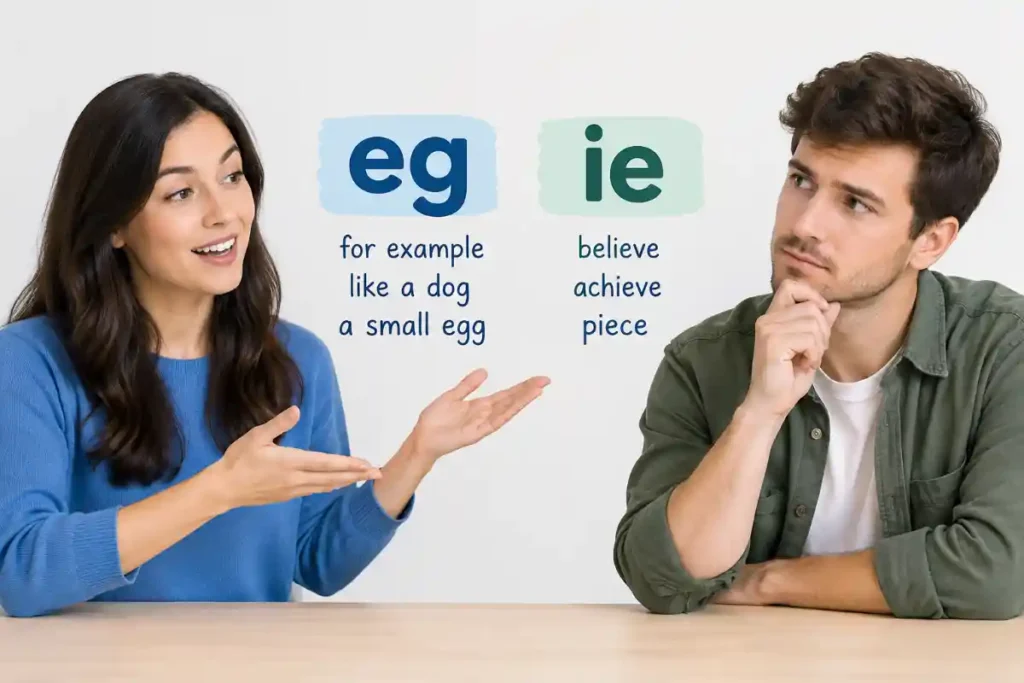
Why People Confuse Eg And Ie
The confusion makes sense. Both abbreviations add information to a sentence. Both come from Latin. Both are common in academic professional and general writing. Their visual forms are also almost identical.
There are several reasons writers swap them.
They Look Almost Identical
E.g. and i.e. are both two letter abbreviations with periods. When you are reading quickly they can blur together.
They Both Add Information
Both abbreviations introduce something that helps the reader understand the previous statement. The difference is the relationship between the original idea and the added information.
E.g. gives a sample.
I.e. gives clarification.
The Latin Origins Are Unfamiliar
Most English speakers do not use Latin in everyday conversation. Knowing that e.g. comes from exempli gratia and i.e. comes from id est can help explain the abbreviations but you do not need to remember the Latin phrases to use them correctly.
People Learn Them Through Writing
Many people encounter these abbreviations in school papers emails reports websites and books rather than through direct grammar lessons. If the distinction is never explained clearly the two forms are easy to mix up.
Autocorrect Does Not Teach Meaning
Spellcheck tools can catch certain typing errors. They do not always explain the difference between two correctly spelled abbreviations used in the wrong context.
That is an important point. A sentence can contain a correctly written i.e. and still use it incorrectly.
Which One Should You Use
Use e.g. when you want to provide examples.
Use i.e. when you want to clarify or restate the exact meaning.
Here are four quick comparisons.
Bring some writing tools e.g., pens pencils or markers.
The items are examples.
Bring one writing tool i.e., a black pen.
The second sentence identifies a specific item.
Another pair:
Some mammals e.g., dogs cats and horses live with humans.
These animals are examples.
The animal is a domestic pet i.e., it is kept by people for companionship.
The second part explains the meaning of domestic pet in this context.
Eg vs Ie In Real Sentences
The difference becomes much easier when you see it in different situations.
Daily Conversation
I like warm drinks e.g., coffee tea and hot chocolate.
I want something caffeine free i.e., no coffee or energy drinks.
Workplace Writing
Please attach the required documents e.g., your résumé and cover letter.
Please submit the final version i.e., the document approved by your manager.
Email Writing
We can meet later this week e.g., Tuesday or Thursday.
The meeting will happen after lunch i.e., after 1 p.m.
Academic Writing
Several factors affect sleep e.g., stress screen use and caffeine.
The sample was limited to adults i.e., participants aged 18 and older.
Instructions
Use a soft brush e.g., a clean paintbrush.
Use the original file i.e., the version saved before editing.
Journalism
Several industries e.g., technology healthcare and manufacturing reported growth.
The policy applies to local residents i.e., people who live within the city limits.
Social Media
You can find great hiking spots nearby e.g., trails around the lake.
I need a quiet weekend i.e., no parties no crowds and no late nights.
The examples show the pattern clearly. E.g. gives you some members of a larger group. I.e. explains exactly what the writer means.
Eg vs Ie Grammar Rules
The two abbreviations do not change the basic grammar of a sentence. They act as signals that introduce additional information. The punctuation around them depends partly on sentence structure and style conventions.
How To Punctuate E.g.
In American English formal writing commonly uses periods in e.g. and a comma after the abbreviation when it introduces additional information.
For example:
Some vegetables e.g., carrots broccoli and spinach contain important nutrients.
When e.g. appears inside parentheses the sentence may look like this:
Many vegetables are easy to prepare (e.g., carrots broccoli and spinach).
The exact punctuation can vary by style guide and sentence structure. The important point is to follow the style system used for your publication or organization.
How To Punctuate I.e.
The same general American English convention applies to i.e.
The deadline is tomorrow i.e., Friday.
Or:
The deadline is tomorrow (i.e., Friday).
Different style guides can make different choices about periods and commas. American usage commonly retains the periods and uses a comma after the abbreviation. British usage can be more flexible about the comma and periods. Consistency matters in professional writing.
Should You Write Eg Or E.g.
In American English e.g. is the familiar formal form. The periods show that the letters represent an abbreviation.
You may also encounter eg without periods. Some publications and style systems allow this form. The important point is to follow the style guide governing your document.
For general American professional writing e.g. is a safe and widely recognized choice.
Should You Write Ie Or I.e.
The same principle applies to i.e.
I.e. is widely recognized in American writing.
Ie also appears in some style systems that omit periods from abbreviations.
For a general audience the familiar i.e. form is usually easier to recognize.
Do You Need Parentheses
No. E.g. and i.e. can appear without parentheses.
For example:
Several options e.g., email phone or chat are available.
They can also appear inside parentheses:
Several options are available (e.g., email phone or chat).
The best choice depends on the sentence and the style of the document.
Parentheses can be useful when the abbreviation introduces an aside. They are not a grammar requirement.
Should You Use Etc After E.g.
Usually no.
The abbreviation e.g. already tells the reader that the list contains examples rather than a complete inventory. Adding etc. can be unnecessary. Grammar resources specifically recommend avoiding the combination when it adds no useful information.
For example:
You can use common fruits e.g., apples oranges bananas and pears.
This already signals that the list contains examples.
Adding:
e.g., apples oranges bananas and pears etc.
makes the sentence feel cluttered.
If you need to emphasize that a list is incomplete you can simply write for example and make the sentence clear.
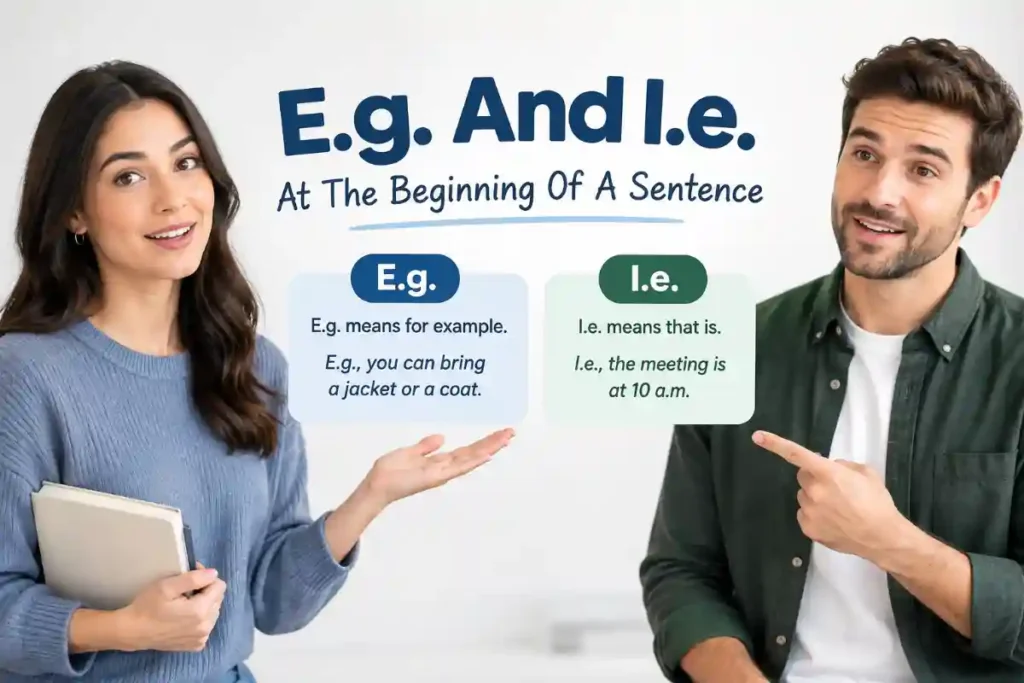
E.g. And I.e. At The Beginning Of A Sentence
You can begin a sentence with either abbreviation but doing so is often less natural in polished prose.
For example:
E.g., you could start with a simple outline.
This is understandable.
Still a smoother version is:
For example you could start with a simple outline.
Likewise:
I.e., the deadline has moved to Friday.
can often become:
In other words the deadline has moved to Friday.
For general readers the full English phrase is often clearer.
E.g. And I.e. In Formal Writing
Both abbreviations are acceptable in many formal contexts. They appear in academic writing technical documents professional communication reports and other forms of written English.
Still do not use them simply to make your writing look formal.
A clear phrase such as for example may be better than e.g. when your readers are not familiar with the abbreviation.
Likewise in other words may be easier to understand than i.e.
Professional writing is not about using the shortest possible form. It is about helping the reader understand your point without stopping to decode it.
When To Spell Them Out
Consider writing the full phrase in reader focused content.
Use:
For example you could save the file as a PDF.
instead of:
E.g., you could save the file as a PDF.
This can be especially helpful in:
- Beginner learning materials.
- Consumer instructions.
- Public facing websites.
- General newsletters.
- Voice focused content.
- Writing for international English learners.
Abbreviations save space but full phrases can improve clarity.
Eg vs Ie Pronunciation
Although e.g. and i.e. are mainly encountered in writing they also have spoken forms.
English speakers do not normally read the Latin phrases aloud in everyday speech. Instead they commonly say the equivalent English expression.
For e.g. speakers often say for example.
For i.e. speakers often say that is or in other words.
When reading a document aloud you may naturally expand the abbreviation rather than pronounce each letter.
The exact spoken form can vary with context and personal preference. The written distinction remains the same.
Common Pronunciation Mistakes
One common mistake is assuming that the abbreviations should be pronounced as Latin words. That is unnecessary for normal English communication.
Another mistake is reading the letters aloud in a way that makes the sentence sound unnatural.
In most everyday situations simply saying for example or in other words is clearer.
Eg vs Ie And Grammar
E.g. and i.e. are abbreviations rather than ordinary nouns verbs adjectives or adverbs. They do not take verb endings or plural forms.
You should not write:
e.g.s
or:
i.e.s
The abbreviations themselves do not become plural when you give multiple examples or explanations.
They introduce information. The grammar of the words that follow still needs to match the sentence.
For example:
Several animals e.g., dogs cats and horses need regular care.
The noun phrase after e.g. remains grammatically connected to the sentence.
Likewise:
The final version i.e., the copy approved by the editor is ready.
Here the phrase after i.e. clarifies the meaning of final version.
Sentence Structure Matters
The abbreviation does not fix a poorly constructed sentence.
Consider:
I enjoy several sports e.g., tennis because it is relaxing.
This is unclear because the relationship between tennis and several sports is not properly structured.
A clearer version would be:
I enjoy several sports e.g., tennis swimming and cycling.
Or:
I enjoy several sports. For example I like tennis swimming and cycling.
The second version may be easier for a general audience.
E.g. With A List
E.g. works naturally before a list of examples.
Bring outdoor clothing e.g., a jacket gloves and a hat.
The list contains possible examples.
I.e. can also introduce a list when the list identifies exactly what the writer means.
Bring the three required documents i.e., your passport application form and receipt.
Here the list defines the three documents being discussed.
The distinction depends on meaning rather than the number of items.
Eg vs Ie In American English
American English commonly uses e.g. and i.e. with periods and a comma after the abbreviation when it introduces additional information. This is a common convention in American professional and academic writing.
For example:
Several states e.g., Texas Florida and Arizona have large rural areas.
And:
The meeting will take place in the afternoon i.e., after noon.
British English can use the same abbreviations but punctuation conventions may differ. Some British style systems omit the comma after the abbreviation. The safest approach is to follow the style guide used by your publication or institution.
Canadian and Australian English also use e.g. and i.e. in similar ways because the underlying distinction comes from the Latin expressions rather than a regional difference in meaning.
The important point is that e.g. does not become i.e. in another variety of English. Their meanings stay the same.
Eg vs Ie In Professional Writing
Professional writers often choose between the abbreviations based on audience.
If the reader is comfortable with common abbreviations then e.g. and i.e. can make prose compact.
If the document is written for a broad audience the full phrases can sometimes be better.
Compare:
Several file types e.g., PDF DOCX and TXT are supported.
With:
Several file types are supported. For example PDF DOCX and TXT files work.
The first version is shorter.
The second version may be easier for a beginner.
Neither approach is automatically superior. The goal is clarity.
Eg vs Ie In Academic Writing
Academic writers use e.g. when introducing examples and i.e. when clarifying a precise point.
For example:
Several variables e.g., age income and education were considered.
And:
The study focused on adults i.e., participants aged 18 and older.
Before submitting academic work always check the required style guide. A university department may have specific preferences for abbreviation punctuation.
Eg vs Ie In Business Writing
Business documents often use both abbreviations.
For example:
Please send the required files e.g., the invoice and receipt.
And:
Please send the final invoice i.e., the version approved by accounting.
Still consider your audience. In a short email for example and that is may sound more natural than abbreviations.
Eg vs Ie In Online Content
Online readers often scan rather than read every sentence carefully. Clear wording can therefore matter more than saving a few characters.
For educational content you might write:
Common examples include apples and oranges.
rather than:
Common examples include fruit e.g., apples and oranges.
The full phrase may be easier for voice search users and English learners.
This is especially useful when your content is designed to answer a direct question. Clear language helps both human readers and systems that extract concise answers from a page.
Common Mistakes With Eg And Ie
Mistake One Using I.e. For Examples
Incorrect:
Many sports i.e., soccer basketball and tennis are popular in the United States.
The writer is giving examples of sports. I.e. does not fit.
Better:
Many sports e.g., soccer basketball and tennis are popular in the United States.
The list represents examples.
Mistake Two Using E.g. For An Exact Meaning
Incorrect:
The store closes at the end of the day e.g., 6 p.m.
If 6 p.m. is the exact time meant by the end of the day in this sentence then i.e. is more appropriate.
Better:
The store closes at the end of the day i.e., 6 p.m.
Mistake Three Thinking E.g. Means Such As Exactly
E.g. and such as often serve similar purposes but they are not grammatically identical.
For example:
I enjoy outdoor sports such as hiking and cycling.
This is a normal part of the sentence.
I enjoy outdoor sports e.g., hiking and cycling.
Here e.g. works as an inserted abbreviation.
Do not treat the two forms as interchangeable in every sentence.
Mistake Four Adding Etc After E.g.
As noted earlier e.g. already signals that the list contains examples. Adding etc. can be redundant.
Mistake Five Forgetting The Periods
In American English formal writing the conventional forms are e.g. and i.e. Many style systems use periods because the forms are abbreviations.
Still some publications use eg and ie. Follow the style guide rather than mixing systems.
Mistake Six Using Them When Plain English Is Better
A sentence can be grammatically correct and still be harder to read than necessary.
For example:
You should review the final document i.e., the document approved by the legal team.
This is fine.
But:
You should review the final document. That is the document approved by the legal team.
may be easier for some readers.
Good editing is not simply about knowing rules. It is about knowing when a simpler option serves the reader better.
Memory Tricks For Eg And Ie
You do not need to memorize the Latin phrases to remember the difference.
Try these simple tricks.
E Means Example
The e in e.g. can remind you of example.
E.g. = example.
I Means In Other Words
The i in i.e. can remind you of in other words.
I.e. = in other words.
Use The Replacement Test
Replace e.g. with for example.
Replace i.e. with in other words.
If the sentence still makes sense you have probably chosen correctly.
Remember The Relationship
Think of e.g. as opening a category.
Fruits e.g., apples oranges and pears.
Think of i.e. as narrowing the meaning.
My favorite citrus fruit i.e., the orange.
The first moves from a broad idea toward examples.
The second moves toward a precise meaning.
Eg vs Ie And Word Origin
Both abbreviations come from Latin.
E.g. comes from exempli gratia. The phrase means roughly for the sake of example and is now commonly understood in English as for example.
I.e. comes from id est. The phrase means that is and is commonly used in English to introduce a clarification or restatement.
The Latin origins explain why the abbreviations do not look like the English phrases they represent.
You do not need Latin knowledge to use them correctly. Modern English speakers generally learn the abbreviations as established English writing conventions.
Related Expressions
Understanding related expressions can make the distinction even easier.
Expressions Related To E.g.
You can often use:
- for example
- for instance
- such as
- including
These expressions introduce examples.
Expressions Related To I.e.
You can often use:
- that is
- in other words
- namely
- specifically
These expressions clarify or narrow a previous statement.
The substitution is not always exact because sentence structure can change. Still it provides a useful editing test.
Expert Editors Note
A professional editor usually starts with the reader rather than the abbreviation.
Ask what the sentence needs.
If the writer wants to illustrate a broad idea with a few examples then e.g. is appropriate.
If the writer wants to make the previous statement more precise then i.e. is appropriate.
Editors also pay attention to consistency. If a document follows an American style that uses periods and commas after these abbreviations the same convention should normally appear throughout the document. Different style systems can make different punctuation choices so the document’s governing style guide should take priority.
Another practical editorial point is readability. E.g. and i.e. are familiar to many educated readers but not everyone understands them instantly. In content aimed at beginners or a broad public audience for example and in other words can be clearer.
That is not a weakness. Good writing is not a contest to see how many abbreviations you can use. The strongest sentence is the one the reader understands immediately.
Frequently Asked Questions
Is E.g. The Same As For Example
Yes. E.g. is an abbreviation of the Latin phrase exempli gratia and is commonly used in English to mean for example. It introduces one or more examples from a broader category. If you can replace e.g. with for example and the sentence keeps the same meaning then e.g. is likely the correct choice.
What Does I.e. Mean
I.e. is an abbreviation of the Latin phrase id est. In English it means that is or in other words. It introduces a clarification or restatement of something already mentioned. Use it when you want to make your exact meaning clearer rather than simply giving an example.
Is E.g. Or I.e. Used For Examples
E.g. is used for examples. It can introduce one example or several examples from a larger group. I.e. has a different function. It introduces a clarification or precise restatement. A simple memory aid is e.g. equals example while i.e. equals in other words.
Should I Use A Comma After E.g. And I.e.
In American English a comma commonly follows e.g. and i.e. when they introduce additional information. For example you may write e.g., apples and oranges or i.e., Friday. Punctuation can vary between style guides and regional conventions so follow the system required for your document.
Can I Use E.g. In Formal Writing
Yes. E.g. is common in academic professional technical and other forms of formal writing. However formal writing does not require abbreviations. For a broad audience the full phrase for example may be easier to understand. Choose the form that gives your readers the clearest sentence.
Can I Use I.e. For A List
Yes but only when the list clarifies exactly what you mean. If the items are merely examples from a larger group use e.g. instead. For instance a sentence that identifies the three required documents can use i.e. because the list defines the documents being discussed. A general list of possible documents should use e.g.
Is Eg Correct Without Periods
Eg without periods appears in some style systems. However e.g. is the familiar form in American English and is widely used in formal writing. The same applies to i.e. and ie. The key is consistency. If your organization university publisher or style guide specifies a particular form follow that convention.
What Is The Easiest Way To Remember Eg And Ie
Remember two short phrases. E.g. means for example. I.e. means in other words. If you are naming some examples from a larger group use e.g. If you are restating or clarifying the exact point use i.e. This simple test works far better than trying to memorize the original Latin expressions.
Final Verdict
E.g. and i.e. are both correct abbreviations but they are not interchangeable.
Use e.g. when you want to introduce examples.
Many outdoor activities e.g., hiking swimming and cycling can improve fitness.
Use i.e. when you want to clarify or restate the exact meaning.
The event starts in the evening i.e., after 6 p.m.
The biggest mistake is choosing based on how the abbreviations look. Choose based on what the following words are doing.
If they give examples use e.g.
If they explain the exact point use i.e.
For American readers remember the familiar forms e.g. and i.e. and follow the punctuation rules required by your style guide. When clarity matters more than brevity feel free to replace them with for example and in other words.
Once you learn that one distinction these two tiny abbreviations stop being a headache and become useful tools for precise writing.

Founding Editor
Maya spent six years as a copyeditor at a regional newspaper before starting Grammist, which is where the “answer first” format came from: newsroom style guides don’t have room for a preamble.
She writes and reviews most of the word-pair and spelling entries, and has final say on anything that goes out under the Grammist name.