
Have you ever typed currier vs courier because you weren’t sure which word belongs in a sentence about delivering a package. You’re not alone. The two spellings look remarkably close and they share several letters. That visual similarity can easily trip up even careful writers.
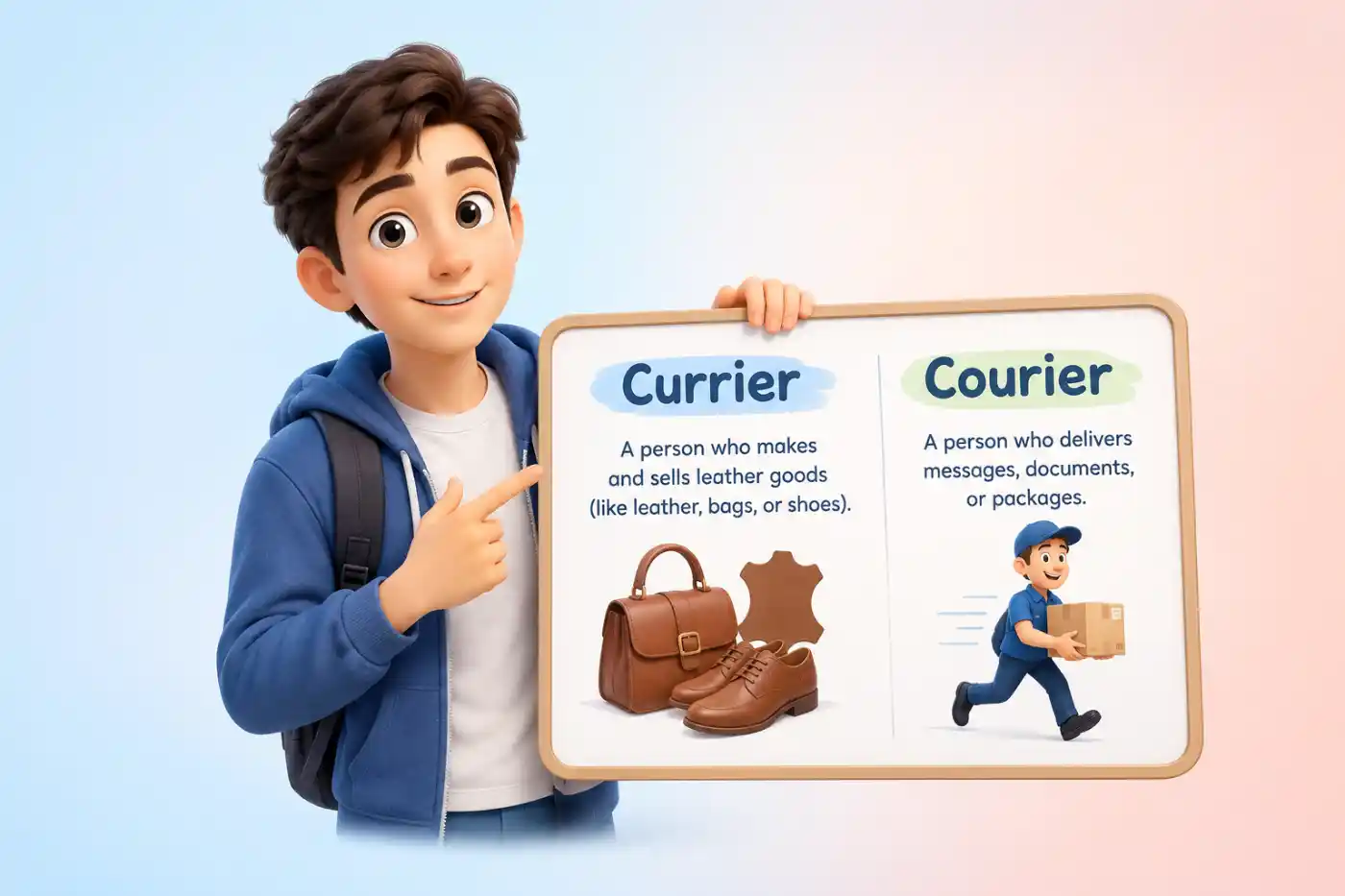
The important point is simple. Courier is the word you want when you mean a person or company that carries and delivers letters packages documents or other items. Currier is also a real English word but it has a completely different meaning. A currier is traditionally a person who prepares and finishes leather after it has been tanned. Dictionaries also record an older connection with preparing horses.
So this isn’t a case where one spelling is correct and the other is simply a typo. Both words exist. The difference lies in meaning history and context.
This guide explains the distinction in detail. You’ll learn how each word works in grammar how to pronounce them where they came from why writers confuse them and how to choose the right form in everyday professional and academic writing. You’ll also see natural examples and a simple memory trick that makes the distinction much easier to remember.
Quick Answer
Courier is correct when you mean someone or a company that delivers letters packages or documents. Currier is a legitimate but uncommon word for someone who prepares and finishes leather. If you’re talking about shipping or delivery use courier. If you’re discussing traditional leather work use currier. (Cambridge Dictionary)
Currier vs Courier At a Glance Comparison
The fastest way to understand these words is to put them side by side.
| Feature | Currier | Courier |
|---|---|---|
| Correct spelling | Currier | Courier |
| Incorrect spelling | Not incorrect | Not incorrect |
| Main meaning | A person who prepares and finishes leather | A person or company that delivers messages packages or documents |
| Part of speech | Noun | Noun and verb |
| Word type | Occupational noun | Occupational noun and action word |
| Pronunciation | Usually like KUR ee er in American English | Usually like KUR ee er or KOOR ee er depending on accent |
| Main field | Leather work | Delivery communication and travel |
| Origin | Old French and Latin roots connected with leather | Old French and Latin roots connected with running |
| Grammar role | Usually a countable noun | Countable noun and transitive verb |
| Formality | Specialized and uncommon | Common and widely used |
| Frequency | Relatively rare in modern everyday English | Very common in delivery and business contexts |
| Typical context | Leather preparation and historical trades | Packages documents messages and delivery services |
| Example | The currier finished the leather by hand. | The courier delivered the package this morning. |
The table reveals the key point. Currier and courier aren’t alternate spellings of the same word. They are separate words with different histories and meanings.
Collins defines a currier as someone who curries leather. Its American English entries also describe a person who prepares and colors leather after tanning.
Cambridge defines a courier as a person or company that takes messages letters or packages from one place to another. It also recognizes courier as a verb meaning to send something using a courier.
That distinction matters when you’re proofreading. If you write that a currier delivered your package you haven’t simply made a spelling mistake. You’ve used a real word in the wrong context.
Currier vs Courier Which Word Should You Use
Use courier when you’re talking about delivery.
For example:
I sent the contract by courier.
The courier arrived at noon.
A courier company will collect the package tomorrow.
Use currier only when you’re referring to the traditional occupation involving leather.
For example:
The currier prepared the leather for the saddler.
The museum exhibit describes the work of a medieval currier.
So is currier ever acceptable. Absolutely. It isn’t an error. It’s simply much less common in modern everyday English.
This distinction is important for editors because spell checkers can sometimes create the wrong impression. A word that looks unusual isn’t automatically wrong. Professional editing requires attention to meaning as well as spelling.
The confusion probably comes from the visual closeness of the two words. Both begin with cur and both contain the letters r i e r near the end. Their pronunciation can also sound similar in some accents. Yet their histories point in different directions.
A useful editorial rule is simple.
Delivery means courier. Leather means currier.
That one sentence solves most cases.

Understanding Currier vs Courier
Understanding Currier
A currier is a person who works with leather after the tanning process. The work involves preparing leather and improving its surface so it can be used for products such as saddles shoes belts bags and other goods.
Collins defines the word as a person who curries leather. American English dictionary entries give the fuller sense of someone who dresses and colors leather after it has been tanned. Some dictionary sources also preserve an older meaning connected with preparing horses.
The word belongs to the vocabulary of traditional trades. You might encounter it in historical writing museum descriptions books about leather craftsmanship genealogy or discussions of old occupations.
For example:
The currier inspected each hide before beginning the finishing process.
Her research revealed that her ancestor worked as a currier.
The word can also appear as part of a surname. A well known American example is Currier and Ives. In that name Currier refers to Nathaniel Currier rather than to the leather occupation.
In modern everyday conversation though most Americans don’t need the occupational word very often. That low frequency is one reason people may assume it is a misspelling of courier.
It isn’t.
Understanding Courier
A courier is someone who carries and delivers something from one place to another. Modern English commonly uses the word for people who deliver packages documents letters and other items.
A courier can be an individual worker or the word can refer to a company that provides delivery services.
For example:
The courier picked up the package at three.
We sent the signed documents by courier.
The company uses a local courier for urgent deliveries.
Cambridge also recognizes courier as a verb. If you courier something you send it using a courier.
For example:
I’ll courier the documents to your office.
The replacement part was couriered to the customer.
Collins gives the same noun and verb distinction and records forms such as couriers, couriering, and couriered.
The word has also developed beyond physical package delivery. Historically a courier could carry urgent messages or diplomatic correspondence. In British usage the word can also refer to a person employed by a travel company to assist travelers.
Today though the delivery sense is the one most readers are likely to recognize.
The Biggest Differences Between Currier vs Courier Explained
The most important differences become easier to remember when you look at several language features separately.
Spelling
The spellings differ in the middle.
Currier contains curri.
Courier contains cour.
That small difference changes the word completely.
A useful visual clue is the ou in courier. If you’re talking about a package delivery service the word you need is courier.
Meaning
Meaning creates the clearest dividing line.
Currier refers mainly to a person involved in leather preparation.
Courier refers mainly to a person or company involved in carrying and delivering something.
They don’t describe the same job.
Grammar
Both words can function as nouns.
A currier is a person.
A courier is a person or company involved in delivery.
Courier also works as a verb. Currier does not normally function as the equivalent delivery verb.
You can write:
The courier delivered the package.
And you can also write:
The company couriered the package.
You wouldn’t normally write:
The company curriered the package.
That would change the word into something that doesn’t fit standard modern usage.
Pronunciation
The two words can sound close. That’s one reason spoken English may contribute to the confusion.
American English commonly gives currier a pronunciation around KUR ee er. Collins gives American pronunciations including forms beginning with the vowel sound represented by kər or kʌr. (Collins Dictionary)
Cambridge gives American pronunciations for courier that include KUR ee er and related regional forms. (Cambridge Dictionary)
So listening alone may not always settle the issue. Context usually does.
Writing Style
Courier belongs comfortably in everyday writing.
You can use it in an email to a customer business report school assignment news story or casual conversation.
Currier has a much narrower range. It tends to appear in historical specialized or occupational contexts.
That difference in frequency is important. A rare word isn’t wrong simply because you don’t see it often.
Everyday Usage
If you’re ordering a package delivery you’re almost certainly looking for courier.
If you’re reading about leather craftsmanship in medieval England you may encounter currier.
Context does the heavy lifting.
Regional Preferences
There isn’t a major American versus British spelling split in these two words like you might see with words such as color and colour.
Courier is standard in both American and British English. Pronunciation can differ between varieties of English. British English commonly uses a pronunciation close to KOO ree uh while American English often uses forms closer to KUR ee er. (Cambridge Dictionary)
Currier is also an established word in both varieties. The main difference isn’t national spelling. It’s frequency and context.
Professional Writing
In business writing the correct choice is almost always courier when you’re discussing delivery.
For example:
Please arrange for a courier to collect the signed agreement.
A professional editor would not replace courier with currier simply because the words look similar.
The same principle applies to invoices shipping notices contracts customer emails and delivery instructions.
Meaning comes before appearance.
Currier vs Courier Why People Confuse These Words
The confusion isn’t mysterious. Several ordinary language factors can push writers toward the wrong spelling.
Similar Letter Patterns
The words share a strong visual pattern.
currier
courier
Both have the opening cur sound in many pronunciations and both finish with a similar ee er sequence in American speech.
When someone types quickly the brain can fill in a familiar spelling rather than carefully selecting the correct word.
Typing Errors
Fast typing creates plenty of mistakes that aren’t really knowledge problems.
Someone who regularly writes about delivery may know perfectly well that courier is correct but still type currier because the fingers follow a familiar pattern.
A good proofreading pass catches these errors.
Pronunciation
American pronunciations can make the words sound particularly close.
If you’ve learned the word mainly by hearing it you may not have a strong mental picture of its spelling.
That is common among language learners and native speakers alike.
Autocorrect
Autocorrect can help but it isn’t a language editor.
It may recognize both words because both are legitimate English vocabulary. If you type currier while intending courier the software may not flag the error because currier is a real dictionary word.
This is an important proofreading lesson. Spell checking can detect many misspellings but it can’t reliably detect every wrong word.
Internet Myths
A common misconception is that one form must simply be an old spelling of the other.
That’s not accurate.
The two words have separate etymological histories. Currier traces back to terms associated with leather while courier developed from words associated with running and carrying messages. (Etymology Online)
Learning Mistakes
Language learners often build vocabulary through sound first.
If you hear someone say courier before seeing it in print you might reasonably construct a spelling based on the sounds you hear. English spelling doesn’t always make that process easy.
The best solution is to connect spelling meaning and context at the same time.
Common Misconceptions
Here are a few misconceptions worth clearing up.
Currier isn’t an incorrect spelling of courier.
Courier isn’t an alternative spelling of currier.
The words don’t have the same meaning.
There isn’t a standard American spelling and a British spelling where one uses currier and the other uses courier for delivery.
Both words are legitimate English words.
That final point is the one many writers miss.
Currier vs Courier Grammar Rules You Should Know
Understanding the grammar of each word helps prevent mistakes because you can see how each one behaves inside a sentence.
Currier as a Noun
Currier is primarily a countable noun.
You can say:
A currier prepared the leather.
The currier examined the hide.
Several curriers worked in the workshop.
Because it refers to a person you can use ordinary noun structures around it.
You can use articles such as a and the.
A currier worked in the village.
The currier had years of experience.
You can also make it plural.
The curriers belonged to a traditional trade.
Courier as a Noun
Courier is also a countable noun.
A courier arrived at the office.
The courier delivered the package.
Several couriers were waiting outside.
The plural is couriers.
Three couriers arrived within an hour.
The word can refer to a person. It can also refer to a business in suitable contexts.
We hired a courier for the delivery.
The courier has offices throughout the region.
Courier as a Verb
This is one of the most useful grammatical differences.
Courier can work as a transitive verb meaning to send something using a courier.
For example:
We couriered the documents to the client.
She couriered the package overnight.
I’ll courier the signed form tomorrow.
The usual structure is a subject followed by the verb and the object.
The company couriered the documents.
Here company is the subject. Couriered is the verb. Documents is the direct object.
Verb Forms
The common forms include:
| Form | Example |
|---|---|
| Base form | courier |
| Third person singular | couriers |
| Present participle | couriering |
| Past tense | couriered |
| Past participle | couriered |
Cambridge and Collins both recognize these verb forms. (Cambridge Dictionary)
Sentence Placement
The noun can appear in several normal positions.
As the subject:
The courier arrived early.
As the object:
I called the courier.
After a preposition:
The package was sent by courier.
After a determiner:
Our courier is waiting downstairs.
The verb can also appear in standard verb positions.
We courier the documents every Friday.
We couriered the documents yesterday.
We are couriering the replacement part today.
Formal Versus Informal Writing
Courier is suitable for both ordinary and professional writing.
You might see it in:
- Customer emails.
- Shipping instructions.
- Business contracts.
- News reports.
- Academic writing.
- Online stores.
- Personal messages.
Currier is more specialized.
You might see it in:
- Historical books.
- Leather industry writing.
- Museum descriptions.
- Genealogy research.
- Discussions of traditional occupations.
- Historical fiction.
The register depends heavily on the subject rather than on a simple formal versus informal distinction.

Sentence Examples For Currier vs Courier That Sound Natural
The easiest way to make the difference stick is to see each word doing real work in a sentence.
Examples With Currier
- The currier prepared the leather for the saddlemaker.
- His family records show that his great grandfather was a currier.
- The museum has an exhibit about the work of the medieval currier.
- A skilled currier could improve the texture and appearance of finished leather.
- The apprentice learned the trade from an experienced currier.
- The book describes the daily life of a nineteenth century currier.
- The old workshop once employed several curriers.
- The historian explained how a currier worked with tanned hides.
- The leather was passed to the currier after the tanning stage.
- The museum guide mentioned the currier as one of several traditional leather trades.
Notice how every example places the word in a leather or historical setting.
Examples With Courier
- The courier delivered my package before noon.
- We sent the signed contract by courier.
- A courier will collect the documents this afternoon.
- The company hired a local courier for urgent deliveries.
- Please give the package to the courier when they arrive.
- The courier called to confirm the delivery address.
- I asked the courier company for a tracking update.
- She couriered the documents to the office yesterday.
- The medical center uses a courier to transport important samples.
- The retailer sent my replacement item through a courier service.
These examples show why courier is the normal choice in modern delivery contexts.
Common Writing Mistakes Of Currier vs Courier and How to Avoid Them
Mistake One
The currier delivered my package.
If you mean a delivery worker this should be:
The courier delivered my package.
Mistake Two
I’ll currier the documents tomorrow.
The correct verb is:
I’ll courier the documents tomorrow.
Mistake Three
The courier prepared the leather.
This sentence could technically make sense if the person happened to perform both jobs but it would not identify a leather specialist.
If you specifically mean the traditional trade use:
The currier prepared the leather.
Mistake Four
Assuming currier is simply a spelling error.
It isn’t.
That assumption can lead an editor to make an unnecessary correction in a historical or specialist text.
Mistake Five
Trusting spell check without checking meaning.
Both words can appear in dictionaries. A spell checker may therefore accept both.
Good proofreading asks a better question:
Does this word express the meaning I intend.
That question catches errors that ordinary spell checking misses.
A Simple Proofreading Strategy
When you’re unsure, stop looking only at the letters.
Ask:
- Am I talking about delivery.
- Am I talking about leather.
- Does the word function as a noun or a verb.
- Does the surrounding sentence support that meaning.
If the subject is packages documents messages or delivery services, choose courier.
If the subject is traditional leather preparation, choose currier.
Pronunciation Made Simple
Pronunciation can make this pair confusing because American speakers may produce sounds that overlap.
Currier
A common American pronunciation is represented approximately as:
KUR ee er
Collins gives American forms around KUR ee er and KUR ee with variation in the first vowel. (Collins Dictionary)
A simple syllable guide is:
cur ree er
The first part receives the strongest emphasis.
Courier
American English commonly gives courier a pronunciation close to:
KUR ee er
Cambridge represents the American pronunciation as /ˈkʊr.i.ɚ/ and also records additional American pronunciation patterns. (Cambridge Dictionary)
British English commonly uses a form closer to:
KOO ree uh
Cambridge gives British pronunciation as /ˈkʊr.i.ə/. (Cambridge Dictionary)
Why Pronunciation Doesn’t Always Help
The important lesson is that pronunciation may not clearly separate these words.
If you hear someone say courier in American English you could potentially hear something quite close to currier.
That’s why spelling and context matter.
When you’re proofreading a sentence about package delivery don’t rely on sound. Look at the meaning.
Currier vs Courier Word History and Origin
The histories of these words provide one of the strongest clues that they aren’t variants of one another.
The Origin of Currier
The word currier dates to the Middle English period. Etymonline traces it to the mid fourteenth century form curayour meaning someone who dressed and colored leather after tanning. It came through Old French forms and ultimately connects to Latin coriarius meaning a tanner or leather worker. French to Latin coriarius and corium meaning hide or leather.
That history explains the meaning beautifully. The word is rooted in the language of leather.
The Origin of Courier
Courier has a very different path.
Etymonline dates the earliest English use to around 1300 with an early sense involving a swift horse. By the middle of the fourteenth century it referred to a messenger carrying letters or dispatches. Its deeper origin leads through Old French to Latin currere meaning to run.
Collins also connects courier with Old French and Latin roots related to running.
That history fits the original idea. A courier was someone who moved quickly from place to place while carrying information.
Two Different Ideas
The etymology gives you a useful conceptual contrast.
Currier connects with leather.
Courier connects with running and carrying messages.
They may look like close relatives on the page but their linguistic histories tell a different story.
Currier vs Courier Usage Across English Speaking Countries
The distinction remains consistent across major varieties of English.
American English
American English uses courier for a delivery person or service.
The courier delivered the package.
It also recognizes courier as a verb.
We couriered the documents.
American English also recognizes currier as a specialized noun for someone who prepares leather.
British English
British English also uses courier for delivery and recognizes an additional travel related meaning for a person who looks after travelers.
This British English uses currier for someone who curries leather.
The biggest difference between American and British English here is therefore not spelling. Pronunciation and some secondary meanings vary more noticeably.
Canadian English
Canadian English generally follows the same standard distinction found in American and British English.
Courier is the ordinary word for a delivery person or delivery service.
Currier remains a specialized term connected with leather work.
Writers in Canada should therefore use the same practical rule as American writers.
Australian English
Australian English also uses courier for delivery services and delivery workers.
The leather occupation can be called a currier.
Again the spelling distinction is based on meaning rather than a national spelling preference.
Currier vs Courier Real World Usage
Understanding how these words appear in different settings makes the distinction easier to apply.
Daily Conversation
In ordinary conversation you’ll most often hear courier in contexts such as:
The courier is outside.
Did the courier deliver the package.
Which courier did you use.
Currier is much less likely unless someone is discussing leather work or history.
School Writing
A student writing about package delivery should use courier.
The company sent the books by courier.
A student writing about traditional trades might use currier.
The currier prepared the leather after it was tanned.
The subject of the essay determines the word.
Business Communication
Courier is extremely common in business communication.
Please send the signed agreement by courier.
Our courier service will collect the documents at 10 a.m.
The courier has confirmed delivery.
Using currier in these sentences would create a clear meaning error.
Academic Writing
Academic writing may use either word depending on the discipline.
A history paper about medieval occupations could reasonably discuss curriers.
A paper about logistics transportation or business operations could use courier.
The specialized nature of currier makes precise context especially important.
Books
Historical novels may use currier when describing a character’s occupation.
Modern fiction may use courier when a character delivers documents packages or messages.
Journalism
News writing commonly uses courier for delivery workers companies and messengers.
Currier can appear in historical reporting or articles about traditional crafts.
Online Writing
Online stores delivery companies and customer service pages almost always use courier.
For example:
Your order has been handed to the courier.
The courier attempted delivery.
Contact the courier for tracking information.
Social Media
Social media posts about package deliveries may use courier casually.
The courier finally arrived.
Currier is unlikely unless the post discusses leather work history or a person with Currier as a surname.
Similar Words As Currier vs Courier and Frequently Confused Terms
These words aren’t direct synonyms but they belong to the same semantic neighborhood as courier or currier.
Messenger
A messenger is someone who carries a message from one person or place to another.
A courier can be a messenger but courier often carries a more specific sense of professional delivery.
The messenger delivered the note.
The courier delivered the legal documents.
Carrier
A carrier can mean a person or company that transports something.
The word has a broader meaning than courier.
A carrier might transport passengers goods mail or packages depending on context.
Delivery Person
Delivery person is a plain modern expression for someone who delivers goods.
It is broader and more conversational than courier in some situations.
Mail Carrier
A mail carrier specifically delivers mail through a postal system.
A courier usually works through a private or specialized delivery service.
The two roles can overlap in everyday discussion but they aren’t identical.
Courier Service
A courier service is a business or system that transports documents packages or other items.
We hired a courier service to deliver the contract.
Tanner
A tanner is a person involved in converting animal hides into leather.
A currier traditionally works with leather after tanning.
That distinction is useful if you’re writing about historical leather production.
Curriery
Curriery refers to the trade work or place associated with a currier. Merriam Webster defines it as the trade of a currier of leather or a place where currying is done.
The word is far less common than courier.

Professional Editor’s Advice About Currier vs Courier
A good editor doesn’t correct words by appearance alone.
That’s especially important with this pair.
If you see currier in a document about leather production don’t automatically replace it with courier. First read the sentence and determine what the writer means.
Likewise if you see currier in a shipping email you should check the context carefully because courier is almost certainly intended.
Here are some practical habits that help.
Read for Meaning
Don’t proofread only letter by letter.
Read the sentence as a whole.
If the sentence talks about packages tracking delivery addresses or shipping then courier should immediately come to mind.
If it discusses hides tanning saddles or leather craftsmanship then currier may be exactly right.
Watch for Context Clues
Certain words naturally point toward courier.
- Package.
- Parcel.
- Delivery.
- Document.
- Shipping.
- Dispatch.
- Messenger.
- Tracking.
- Motorcycle.
- Company.
Words that may point toward currier include:
- Leather.
- Hide.
- Tanning.
- Saddle.
- Horse.
- Craft.
- Workshop.
- Traditional trade.
- Leatherwork.
These aren’t rigid rules. They’re useful signals.
Don’t Trust Spell Check Alone
Both words are legitimate.
That means a basic spelling checker may accept both.
A human editor still has to evaluate meaning.
This is a broader writing lesson worth remembering. Correct spelling and correct word choice are not always the same thing.
A sentence can contain a perfectly spelled word and still be wrong.
Build Meaning Based Memory
Instead of memorizing two spellings without context attach each word to an image.
Picture a courier carrying a package.
Picture a currier working with leather.
The visual contrast makes the difference much easier to remember.
Use the Right Dictionary
If you’re unsure about an uncommon word don’t rely on a random search result.
Check a respected dictionary such as Cambridge Collins Merriam Webster or another established reference source.
For this pair the dictionary evidence is especially useful because it confirms that both words exist but have distinct meanings.
Frequently Asked Questions
Is Currier a Correct Word
Yes. Currier is a legitimate English word. It traditionally refers to a person who prepares and finishes leather after tanning. Dictionaries also record an older connection with preparing horses. The word is much less common than courier in modern everyday English. Its rarity can make it look like a spelling mistake but it isn’t one.
Is Courier the Correct Word for Delivery
Yes. Courier is the standard word for a person or company that carries and delivers packages documents letters and similar items. It is also used as a verb meaning to send something using a courier. For modern shipping business communication and package delivery courier is the word you normally want.
Is Currier a Misspelling of Courier
No. Currier is not a misspelling. It is a separate English word with its own meaning and history. The confusion comes from the similar appearance and pronunciation of the two words. If you’re talking about leather work currier can be correct. If you’re talking about delivery courier is the correct choice.
What Does Currier Mean
Currier refers to a person who works with leather after tanning. Traditional curriers prepared and finished leather so it could be used for different products. American English dictionary sources also preserve a meaning connected with preparing horses. The word is mainly encountered today in historical or specialized discussions.
What Does Courier Mean
Courier usually means a person or company that carries and delivers letters packages documents or other items. The word can also function as a verb. To courier something means to send it using a courier. In British English courier can also refer to someone who looks after travelers on a trip.
How Do You Pronounce Courier
In American English courier is commonly pronounced close to KUR ee er. Cambridge represents one American pronunciation as /ˈkʊr.i.ɚ/ and also records additional American forms. British English commonly uses a pronunciation closer to KOO ree uh. Regional pronunciation can vary.
How Do You Pronounce Currier
Currier is commonly pronounced close to KUR ee er in American English. Collins records American pronunciations around this pattern and gives a British form close to KUR ree uh. Because the pronunciation can resemble courier in some varieties of English context becomes an important clue when identifying the word in speech.
Are Currier and Courier Related
They have different direct histories. Currier comes through French and Latin forms associated with leather. Courier developed through French forms associated with running and carrying messages and ultimately connects with Latin currere meaning to run. Their similar appearance in modern English doesn’t mean they are simply two forms of the same word.
Can Courier Be Used as a Verb
Yes. Courier can function as a transitive verb meaning to send something using a courier. You can write We couriered the documents to the office or I’ll courier the package tomorrow. Cambridge and Collins both recognize this verb use and its related forms.
What Is the Easiest Way to Remember the Difference
Connect each word with its main meaning. Think courier equals delivery and currier equals leather. You can also picture a courier carrying a package and a currier working with a hide. That simple mental contrast is usually enough to prevent the mistake in everyday writing.
Final Verdict
The answer is clear.
Courier is the word you need for a person or company that delivers packages documents letters or messages. It is common in everyday American English and widely used in business writing. It can also function as a verb when you mean sending something through a courier. (Cambridge Dictionary)
Currier is also correct but it has a completely different meaning. It refers mainly to someone who prepares and finishes leather after tanning. It belongs to the vocabulary of traditional leather work and appears much less often in ordinary modern conversation. (Collins Dictionary)
The grammar difference is straightforward too. Both words work as nouns but courier can also work as a verb.
The best memory trick is:
Courier delivers. Currier works with leather.
So if you’re talking about a package sitting at your door choose courier. If you’re writing about a traditional leather worker choose currier.
Once you connect each spelling to its meaning the confusion becomes much easier to avoid.

Founding Editor
Maya spent six years as a copyeditor at a regional newspaper before starting Grammist, which is where the “answer first” format came from: newsroom style guides don’t have room for a preamble.
She writes and reviews most of the word-pair and spelling entries, and has final say on anything that goes out under the Grammist name.