
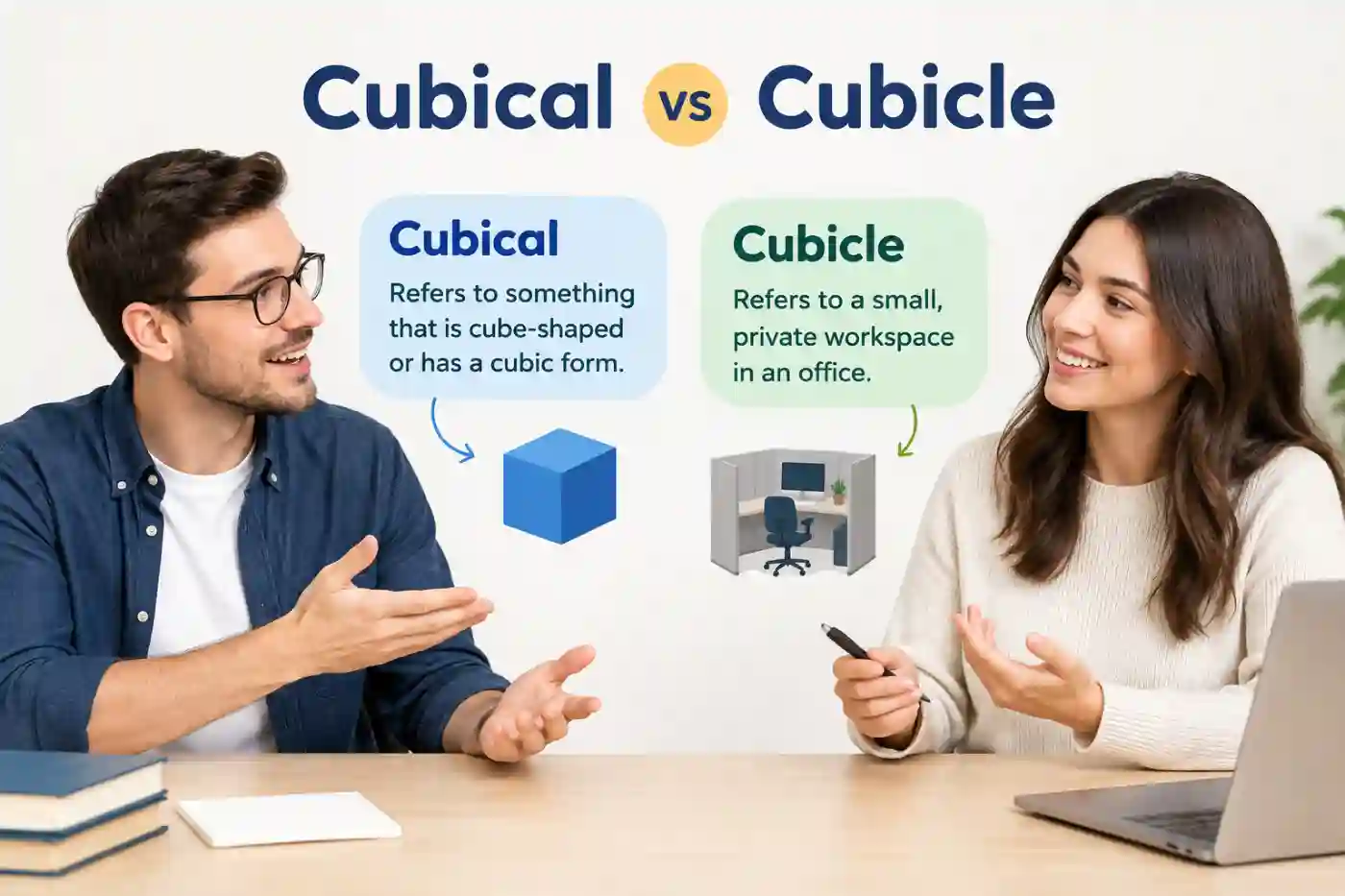
If you’ve ever paused while writing a sentence about an office space and wondered if the right word is cubical vs cubicle then you’re not alone. The two words look almost identical and they share the same basic sound at the beginning. That small spelling difference changes their grammatical role and their meaning.
The correct word for a small enclosed workspace or a divided area is cubicle. You can work in a cubicle. You can sit in a cubicle. And You can decorate your cubicle. The word functions as a noun.
Cubical is a different word. It’s an adjective that describes something shaped like a cube or something related to cubic form or volume. You might describe a box as cubical if its shape is approximately cube shaped.
This distinction becomes much easier once you connect each word to the job it performs in a sentence. One names a space. The other describes a shape or property.
People often mix them up because the spelling differs by only one letter and both words come from the same broader family of words connected with the Latin root for a cube or small room. Typing habits can make the confusion worse.
This guide explains the difference clearly and shows you how skilled writers choose the right word without having to stop and second guess themselves.
Quick Answer
Cubicle is the correct word for a small enclosed space such as an office area, shower area, or changing area. Cubical is an adjective that means cube shaped or related to cubic form or volume. If you mean a small workspace with partitions, use cubicle.
Cubical vs Cubicle At a Glance Comparison
| Feature | Cubicle | Cubical |
|---|---|---|
| Correct spelling | Cubicle | Cubical |
| Incorrect use to avoid | Cubical for an office space | Cubicle for a cube shaped object |
| Main meaning | A small divided or enclosed space | Cube shaped or related to a cube |
| Part of speech | Noun | Adjective |
| Word type | Common concrete noun | Descriptive adjective |
| Pronunciation | /ˈkjuːbɪkəl/ | /ˈkjuːbɪkəl/ |
| Primary role | Names a thing or space | Describes a thing |
| Grammar role | Subject or object | Modifier |
| Formality | Neutral and standard | Neutral and specialized in some contexts |
| Typical context | Offices, showers, changing areas, workspaces | Geometry, design, architecture, science |
| Everyday frequency | Common | Less common |
| Regional use | Common across major English varieties | Used in English but less common in everyday speech |
| Example | She works in a cubicle. | The sculpture has a cubical shape. |
The most important difference sits in the grammar column. Cubicle names something. Cubical describes something.
That one idea solves most of the confusion.
Cubical vs Cubicle Which Word Should You Use?
Use cubicle when you’re talking about a small space separated from a larger room or area.
Examples include:
- an office cubicle.
- a shower cubicle.
- a changing cubicle.
- a study cubicle.
- a hospital cubicle.
Use cubical when you’re describing something that has the form of a cube or relates to cubic dimensions.
Examples include:
- a cubical structure.
- a cubical object.
- a cubical container.
- a cubical design.
- a cubical shape.
So if you want to write:
I work in a cubicle.
that sentence is correct.
If you write:
I work in a cubical.
you’ve changed the word from a noun into an adjective and left the sentence without the noun it needs.
You could write:
I work in a cubical office.
That sentence can be grammatically valid if the office is being described as cube shaped. Still, cubical office isn’t the normal way to refer to a partitioned office workspace. In ordinary American English, office cubicle is the natural expression.
Is Cubical Ever Acceptable?
Yes. Cubical is a real English word. It isn’t simply a misspelling of cubicle.
Merriam Webster defines cubical as an adjective meaning cubic and especially shaped like a cube. It also gives a sense related to volume. The dictionary records its first known use in the 15th century.
That distinction matters because many spelling questions have a false answer hidden inside them. Sometimes the word that looks wrong is actually a legitimate word with a different meaning.
Cubical is one of those cases.
The mistake happens when writers use it for the small room or workspace that should be called a cubicle.
Cubical vs Cubicle Understanding Each Word
Understanding Cubicle
A cubicle is a noun for a small space separated from a larger room or area.
Oxford defines it as a small area separated by curtains or thin or low walls. The dictionary gives examples such as a shower cubicle and an office cubicle. Its American English entry describes it as a small room created by separating part of a larger room.
Cambridge gives a similar explanation. It describes a cubicle as a small space surrounded by walls or curtains and notes the American use for a small room within a larger area.
The word is especially familiar in workplaces.
For example:
- My cubicle is near the window.
- She moved to a larger cubicle.
- His cubicle is next to mine.
- The office has dozens of cubicles.
It can also describe spaces outside an office.
A public swimming facility may have changing cubicles. A bathroom may contain shower cubicles. A medical facility can have patient cubicles.
The common idea is separation. A cubicle creates a smaller personal or functional area inside a larger space.
Understanding Cubical
Cubical is an adjective.
It describes something that resembles a cube or has a cube like form. Merriam Webster lists cubic as a synonym and specifically explains the shape meaning as being shaped like a cube.
Examples include:
- The artist created a cubical sculpture.
- The machine sits inside a cubical enclosure.
- The building has a simple cubical form.
- The container has a nearly cubical shape.
You can also encounter cubical in technical language. Cambridge’s corpus examples include phrases connected with cubical sets and cubical complexes. That shows how the adjective operates naturally in specialized fields such as mathematics and computer science.
In ordinary writing, however, cubic is often the more familiar adjective.
For example, writers commonly say:
- cubic feet.
- cubic inches.
- cubic meters.
- cubic volume.
Oxford defines cubic as an adjective used for volume and for things having the shape of a cube.
That gives you another useful distinction. Cubical is valid, but it isn’t automatically the best adjective every time you want to talk about a cube.
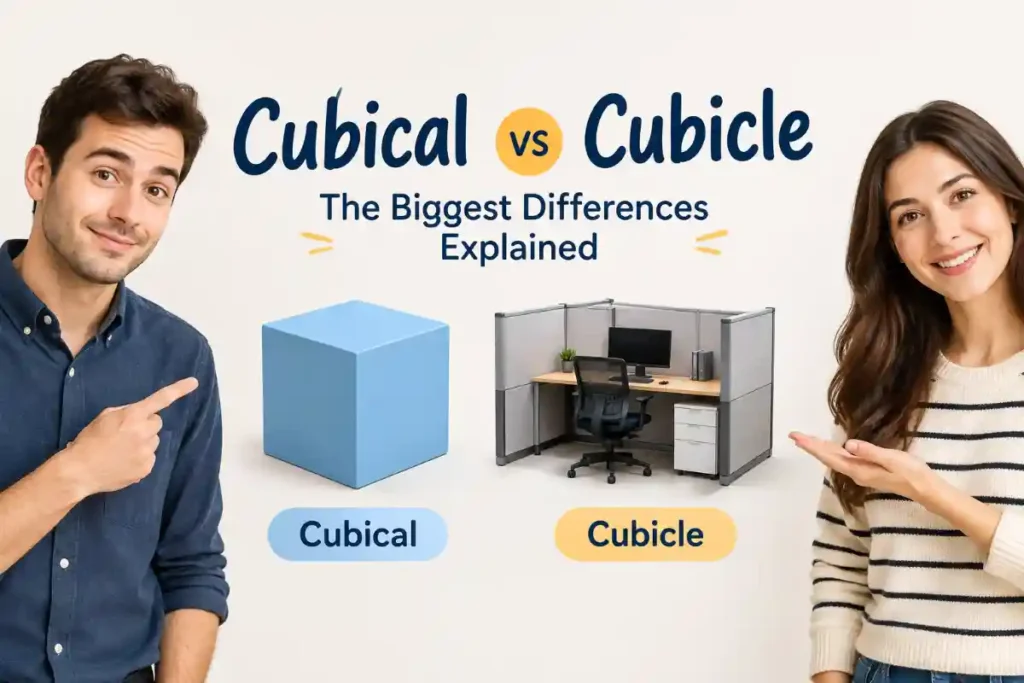
The Biggest Differences Explained Between Cubical vs Cubicle
The easiest way to understand these words is to compare what each one does.
Spelling
The words differ in their endings.
Cubicle ends in cle.
Cubical ends in cal.
That small difference signals a much bigger grammatical difference.
Meaning
Cubicle refers to a space or enclosed section.
Cubical describes shape or a cubic quality.
Think of the relationship this way:
Cubicle = a thing.
Cubical = a description.
That simple mental shortcut can prevent most errors.
Grammar
Cubicle is a countable noun.
You can write:
- one cubicle.
- two cubicles.
- the cubicle.
- my cubicle.
- an office cubicle.
Cubical is an adjective.
You can write:
- a cubical room.
- a cubical structure.
- a cubical object.
- a cubical design.
You normally don’t use cubical by itself to name an office space.
Pronunciation
Interestingly, the two words are pronounced the same in many varieties of English.
They are commonly represented as:
cubicle: /ˈkjuːbɪkəl/
cubical: /ˈkjuːbɪkəl/
The first syllable receives the main stress.
That shared pronunciation explains a major part of the confusion. If you hear the word rather than see it written, context has to tell you which word the speaker means.
Writing Style
Cubicle is common in everyday writing.
Cubical appears more often when the writer needs to describe shape, geometry, architecture, design, or another technical quality.
That means a workplace article will probably contain many instances of cubicle, while a geometry textbook may use cubical more frequently.
Everyday Usage
In daily American English, you are far more likely to hear someone say:
My cubicle is too small.
than:
My cubical is too small.
The first sentence names the workspace.
The second sentence treats cubical as a noun. That isn’t the normal use intended here.
Professional Writing
Professional writing depends heavily on precision. If you are describing office layouts, use cubicle.
If you’re describing an object’s shape, use cubical or the more common cubic when appropriate.
For example:
The company redesigned the cubicles to give employees more space.
But:
The engineers tested a cubical enclosure.
The nouns and adjectives have different jobs. Good editing starts with recognizing that difference.
Cubical vs Cubicle Why People Confuse These Words
The confusion is understandable because several factors overlap.
The Words Sound Almost Identical
For many speakers, cubicle and cubical sound the same.
That means a listener can’t always identify the spelling from pronunciation alone.
English contains many word pairs like this. Context often carries the meaning when two spellings share a pronunciation.
The Words Look Similar
Both words begin with cubic.
They contain the same general sound pattern.
Both connect historically with the idea of a cube or small enclosed space.
The eye therefore treats them as close relatives. They are related, but they don’t perform the same grammatical job.
Typing Errors
A quick search or rushed email can easily produce the wrong ending.
Someone thinking about an office cubicle may type cubical because the brain remembers the sound more strongly than the exact spelling.
This is especially common when you already know that cubical is a real word. Spell check may not flag it because the spelling itself is valid.
That creates a sneaky editing problem.
A spelling checker can tell you that cubical exists. It may not understand that you meant cubicle.
Autocorrect
Autocorrect can make the problem harder to spot.
If a writer types a form that resembles a legitimate English word, software may accept it without raising an alert.
That’s why context matters more than spell check alone.
Internet Myths
Some online explanations claim that cubical is simply wrong.
That’s inaccurate.
Cubical is a legitimate adjective. Merriam Webster lists it as a standard word and gives its meaning as cubic or shaped like a cube.
The real issue isn’t the existence of the word. The issue is using it for the wrong meaning.
Learning Mistakes
English learners often build vocabulary through sound before they fully learn spelling.
A learner might hear someone say cubicle and later remember a spelling that feels logical.
Native speakers can make the same mistake. English spelling often refuses to behave as neatly as pronunciation would suggest.
Cubical vs Cubicle Grammar Rules You Should Know
The strongest grammar rule here is simple.
Cubicle is a noun. Cubical is an adjective.
That difference controls how the words behave.
Cubicle As a Noun
A noun can function as the subject or object of a sentence.
For example:
The cubicle is near the entrance.
Here cubicle is the subject.
I cleaned my cubicle.
Here cubicle is the object of the verb cleaned.
You can also use determiners and possessives with the noun.
Examples include:
- a cubicle.
- the cubicle.
- this cubicle.
- my cubicle.
- her cubicle.
- several cubicles.
The plural form is cubicles.
Cubical As an Adjective
An adjective modifies a noun.
For example:
The cubical structure looks unusual.
Here cubical describes structure.
You can move the description into a complement position too.
The structure is cubical.
In both cases, the adjective describes the shape or form of the subject.
Common Sentence Pattern
One useful pattern is:
article + noun
a cubicle.
Another is:
article + adjective + noun
a cubical structure.
Notice that you need a noun after cubical when it functions as an attributive adjective.
That is a quick grammar test you can use while editing.
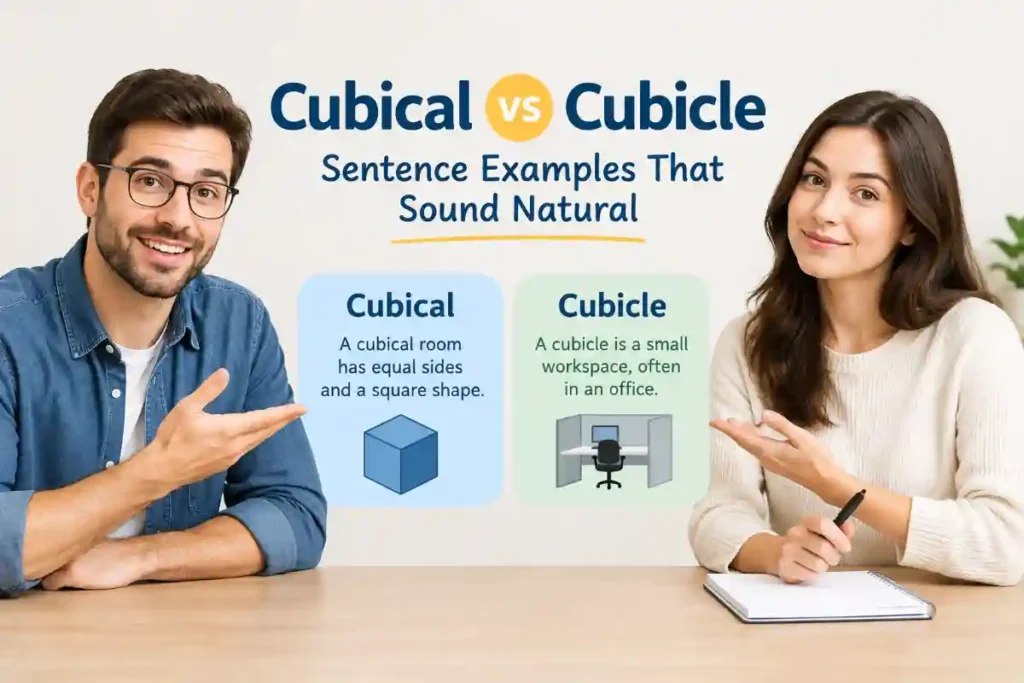
Cubical vs Cubicle Sentence Examples That Sound Natural
The fastest way to make the distinction stick is to see both words working naturally in sentences.
Examples With Cubicle
- My new cubicle is closer to the conference room.
- She keeps a small plant on her cubicle desk.
- The office has enough cubicles for every employee.
- He moved into a quieter cubicle last month.
- I left my notebook in the cubicle.
- The manager walked through the cubicles during the afternoon.
- Each cubicle has a small storage cabinet.
- She decorated her cubicle with family photos.
- The new office design gives every cubicle more natural light.
- I can hear my coworker talking from the next cubicle.
Every sentence uses cubicle as a noun. The word identifies a physical space.
Examples With Cubical
- The designer created a cubical sculpture from wood.
- The laboratory contains a large cubical enclosure.
- The artist used a cubical form as the center of the installation.
- The building has a simple cubical shape.
- Engineers tested the strength of the cubical container.
- The model has a nearly cubical structure.
- The room has a cubical appearance from the outside.
- The machine sits inside a cubical frame.
- The architect experimented with several cubical forms.
- The object looks almost perfectly cubical.
Here cubical modifies a noun or describes the subject after a linking verb.
The Contrast In Action
Compare these pairs.
The employee sat in a cubicle.
The employee worked beside a cubical structure.
The first sentence identifies a place.
The second describes the shape of a structure.
Another pair makes the difference even clearer.
The cubicle has a glass wall.
The glass enclosure is cubical.
The first sentence talks about a workspace.
The second sentence describes the shape of an enclosure.
Cubical vs Cubicle Common Writing Mistakes and How to Avoid Them
Most errors come from treating the two words as spelling variants. They aren’t.
Mistake One
She works in a cubical.
If the intended meaning is an office workspace, this is the wrong word.
Use:
She works in a cubicle.
Mistake Two
The object has a cubicle shape.
This reverses the problem.
A small office space is a cubicle. A shape can be cubical.
Use:
The object has a cubical shape.
You could also write:
The object has a cubic shape.
The second version is often more familiar.
Mistake Three
The company installed ten new cubicals.
If you mean ten office spaces, the plural is cubicles.
The spelling changes from cubicle to cubicles.
Mistake Four
The engineers built a cubicle container.
This sentence could technically describe a container associated with a cubicle, but it doesn’t naturally communicate that the container is cube shaped.
If shape is the intended meaning, write:
The engineers built a cubical container.
Mistake Five
Assuming spell check will catch everything.
It won’t.
Both words are valid English words. A grammar tool may accept either spelling even when your context requires the other.
That is why proofreading requires more than checking red underlines.
Cubical vs Cubicle Editing Tips That Actually Work
A good editor doesn’t simply ask, “Is this word spelled correctly?”
The better question is:
Does this word express the meaning I intend?
Try these checks.
Identify the Thing
If the word names a physical space, cubicle is probably right.
Ask yourself:
Can I put a number before it?
If you can write one cubicle or three cubicles, you’re dealing with the noun.
Identify the Description
If the word describes shape or form, cubical may be right.
Try adding a noun after it.
cubical structure.
cubical object.
cubical design.
If the sentence works naturally, you are using the adjective correctly.
Replace It With Cube Shaped
This is an excellent editing test.
If your sentence still makes sense when you replace cubical with cube shaped, the adjective may be correct.
For example:
The building has a cubical design.
becomes:
The building has a cube shaped design.
The meaning stays close.
Now try that test with:
I work in a cubicle.
Replacing the word with cube shaped destroys the intended meaning.
That tells you that cubicle is the right choice.
Read the Whole Sentence
Never edit a confusing word in isolation.
Look at the words around it.
If you see verbs such as sit, enter, leave, occupy, or work in, the noun cubicle is likely.
If you see words such as shape, form, structure, design, or object, the adjective cubical may fit.
Context does the heavy lifting.
Cubical vs Cubicle Pronunciation Made Simple
Pronunciation is one of the reasons this pair causes trouble.
Cubicle Pronunciation
Cubicle is commonly pronounced:
/ˈkjuːbɪkəl/
You can think of it as:
KYOO bih kuhl
The main stress falls on the first syllable.
The word has three syllables:
cu | bi | cle
Cubical Pronunciation
Cubical is commonly pronounced:
/ˈkjuːbɪkəl/
It can also be thought of as:
KYOO bih kuhl
Again, the main stress falls on the first syllable.
Why Pronunciation Doesn’t Solve the Problem
For many speakers, the two words sound identical or extremely close.
That means you can’t reliably choose the spelling from sound alone.
Instead, listen for meaning.
If the speaker is discussing office furniture, workspaces, showers, or changing areas, cubicle is probably intended.
If the speaker is describing geometry, form, or a cube shaped object, cubical is more likely.
Context is your guide.
Cubical vs Cubicle Word History and Origin
The history of these words helps explain why they look so similar.
The History of Cubicle
Oxford traces cubicle to Late Middle English. It came from Latin cubiculum, meaning a bedroom or sleeping chamber. The Latin word is related to cubare, meaning to lie down.
That history is revealing.
The earliest sense was connected with a small private room. Over time, the word developed into the modern idea of a small enclosed or divided space.
Today, that space may be an office area, shower area, changing area, or another private section.
The modern office meaning fits the broader historical idea surprisingly well. A cubicle is still a small personal space carved out of a larger environment.
The History of Cubical
Merriam Webster records cubical as an adjective with a first known use in the 15th century. It defines the word as cubic and especially as shaped like a cube.
The word belongs to the same family of cube related vocabulary as cube, cubic, and cuboid.
The family connection explains the similar appearance.
It doesn’t make the words interchangeable.
That is an important lesson in English vocabulary. Words can share roots and still develop different meanings and grammatical functions.
Cubical vs Cubicle Usage Across English Speaking Countries
The distinction between the words remains broadly stable across major varieties of English.
American English
American English commonly uses cubicle for an office workspace.
For example:
I spend most of my day in a cubicle.
Oxford’s American English dictionary specifically defines cubicle as a small room created by separating part of a larger room and gives examples such as an office cubicle and shower cubicle.
Cubical is understood as an adjective meaning cube shaped, although cubic is often the more familiar choice in everyday technical descriptions.
British English
British English also uses cubicle for a small divided space.
The word can refer to shower spaces, changing spaces, and other enclosed areas. Oxford gives British examples involving changing cubicles and shower cubicles.
The distinction from cubical remains clear.
Canadian English
Canadian English generally follows the same vocabulary distinction found in American and British English.
A small partitioned workspace is a cubicle.
A cube shaped object can be described as cubical.
Regional differences do not turn these into interchangeable forms.
Australian English
Australian English also uses cubicle for enclosed or partitioned spaces.
The same basic grammatical distinction applies.
This is useful for international writers because the core rule is stable across these varieties. You don’t need a special regional spelling rule to decide between the two.
Cubical vs Cubicle Real World Usage
The best word often becomes obvious once you see the contexts where people actually use it.
Daily Conversation
In casual speech, cubicle is the natural word for a small workspace.
You might say:
My cubicle is freezing today.
Her cubicle is right beside mine.
I left my phone in the cubicle.
You probably wouldn’t use cubical for these meanings.
School Writing
Students may encounter cubical in mathematics, science, design, or architecture.
For example:
The experiment used a cubical container.
They may encounter cubicle when describing rooms or spaces.
For example:
The student changed clothes in a private cubicle.
The subject determines the vocabulary.
Business Communication
Business writing commonly uses cubicle when discussing office design.
For example:
The company plans to replace the old cubicles.
Employees requested larger cubicles.
If the business document discusses physical design, cubical can appear.
The architect proposed a series of cubical structures.
Academic Writing
Academic writing may use cubical in specialized disciplines.
Mathematics and computer science use terms such as cubical complex and cubical set. Cambridge’s corpus includes examples of these technical expressions.
In those settings, cubical isn’t casual decoration. It carries a precise technical meaning.
Books
Authors may use cubicle when describing offices, schools, hospitals, changing rooms, and other spaces.
They may use cubical when describing physical forms.
Literary context can make both words useful without making them interchangeable.
Journalism
Journalists often use cubicle when writing about office culture.
The word can carry social associations too. A cubicle may suggest routine work, corporate life, limited privacy, or a crowded office.
Cubical doesn’t usually carry those workplace associations. It remains descriptive.
Online Writing
Online articles about office life frequently use cubicle.
Technical articles can use cubical in discussions involving geometry, computer science, architecture, or engineering.
The subject matter controls the word.
Social Media
Social media posts often use cubicle in jokes and workplace comments.
For example:
Another Monday in the cubicle.
The word has become part of ordinary workplace vocabulary.
Cubical appears less often outside descriptive or technical contexts.
Cubical vs Cubicle Related Words Worth Knowing
Several words sit close to this pair and can create additional confusion.
Cubic
Cubic is an adjective related to a cube or to volume.
Examples include:
- cubic feet.
- cubic inches.
- cubic meters.
- cubic capacity.
Oxford lists meanings connected with volume and cube shape.
For many everyday technical contexts, cubic sounds more natural than cubical.
Cuboid
Cuboid can function as a noun or adjective.
As a noun, it refers to a solid object with six rectangular sides meeting at right angles. As an adjective, it describes something approximately cube shaped.
A cuboid doesn’t have to be a perfect cube.
That makes it useful in geometry and technical writing.
Cube
Cube is the basic noun for a solid with six equal square faces.
It can also function as a verb in different contexts.
Examples include:
The child played with a wooden cube.
Cut the vegetables into cubes.
The adjective forms cubic and cubical develop from the same general word family.
Cuboid And Cubical
These words are related but not identical.
Cubical emphasizes a cube like form.
Cuboid can describe something shaped like a rectangular box and therefore similar to a cube without necessarily having equal dimensions.
For precise geometry, that distinction matters.
Cubby
Cubby is an informal noun for a small compartment or storage space.
It can appear in schools, homes, offices, and storage areas.
A cubby isn’t the same thing as a cubicle.
A cubby usually functions as a small storage compartment. A cubicle is generally a small area where a person can work, change, shower, or have some degree of privacy.
Professional Editor’s Advice
If I were editing a manuscript and found cubical in a sentence about an office workspace, I wouldn’t treat the problem as a simple spelling error.
I’d first check the intended meaning.
That distinction matters because cubical is a legitimate word. Replacing it automatically could hide the real issue.
A good editor works from meaning to wording.
Ask three questions.
What is the word naming?
If it’s naming a small space, use cubicle.
What is the word describing?
If it’s describing cube shape, cubical may be right.
Would cubic sound more natural?
In technical descriptions involving volume or measurements, cubic is often the stronger choice.
For example:
The tank holds ten cubic meters of water.
You wouldn’t normally choose cubical here.
For shape:
The sculpture has a cubical form.
That works.
For workspace:
She works in a cubicle.
That’s the natural choice.
Skilled writers don’t memorize every word as an isolated spelling. They learn how words behave in sentences. That’s the habit worth building.
A Practical Proofreading Method For Cubical vs Cubicle
When you see cubical or cubicle in your draft, don’t rely on visual recognition alone.
Use this four step check.
- Read the entire sentence.
- Identify the word’s grammatical role.
- Decide if you’re naming a space or describing a shape.
- Read the sentence aloud and check if the meaning matches your intention.
This takes only a few seconds.
It can also catch errors that automated spelling tools miss.
A Useful Substitution Test
When you’re unsure, replace the word temporarily.
If you mean small enclosed space, try small room.
If the sentence still makes sense, cubicle may be the right choice.
For example:
She works in a small room.
Now compare:
She works in a cubicle.
The meanings line up.
If you mean cube shaped, replace the word with cube shaped.
The structure is cube shaped.
Then:
The structure is cubical.
Again, the meanings line up.
This substitution method works because it tests meaning instead of spelling.
A Simple Memory Trick
Think of cubicle as a place.
Think of cubical as a shape.
If you can point to the small space where someone sits, changes clothes, showers, or works, you probably need cubicle.
If you’re describing something that resembles a cube, you may need cubical.
A useful mental picture is an office.
You sit in a cubicle.
You don’t sit in a cubical.
Now picture a geometric object.
The object can be cubical.
That contrast is easy to remember because it connects the word to its real purpose instead of relying on spelling alone.
Frequently Asked Questions
Is Cubical A Correct Word?
Yes. Cubical is a correct English word. It is an adjective meaning cubic or shaped like a cube. It can describe an object, structure, form, or enclosure. The mistake happens when writers use cubical as the noun for an office workspace or another small divided area. In that context, the correct word is cubicle.
Is Cubicle The Correct Word For An Office Space?
Yes. Cubicle is the standard noun for a small office space separated from a larger room by walls, panels, or similar partitions. American English commonly uses the expression office cubicle. You can say that someone works in a cubicle, sits in a cubicle, or has a cubicle near the window.
Are Cubicle And Cubical Pronounced The Same?
They are commonly pronounced the same or almost the same in many varieties of English. Both can be represented as /ˈkjuːbɪkəl/. That shared pronunciation is one reason people confuse the spelling. When you hear the word, context helps determine the intended meaning.
Is Cubical A Misspelling Of Cubicle?
No. Cubical isn’t a misspelling of cubicle. It is a legitimate adjective with its own meaning. Cubicle is a noun for a small divided or enclosed space. Cubical describes something that has the shape or characteristics of a cube. The two words look similar but perform different grammatical jobs.
Can You Say Cubical Office?
You can say cubical office if you specifically mean an office that has a cube shaped form. However, that isn’t the normal expression for a partitioned office workspace. If you mean the small personal workspace inside a larger office, say office cubicle. Context determines the correct choice.
What Is The Difference Between Cubical And Cubic?
Both words can relate to cubes, but they aren’t always interchangeable. Cubical commonly means cube shaped. Cubic has broader technical uses involving cube shape, volume, and measurements. Expressions such as cubic feet, cubic meters, and cubic inches are standard. For measurements, cubic is normally the natural choice.
What Is The Plural Of Cubicle?
The plural of cubicle is cubicles. For example, you can write, The office has twenty cubicles. The spelling changes by adding s after the final e. The plural form of cubical doesn’t work the same way because cubical is normally an adjective rather than a countable noun.
Can Cubical Be Used In Technical Writing?
Yes. Cubical can appear naturally in technical fields such as mathematics, computer science, geometry, architecture, and engineering. Terms such as cubical complex and cubical set occur in specialized writing. In these contexts, the adjective has a precise descriptive role. It isn’t a mistake simply because the word is less common in everyday conversation.
Why Do People Type Cubical Instead Of Cubicle?
The main reason is similarity. The words look almost identical and are commonly pronounced the same or very similarly. People often remember the sound before they remember the spelling. Autocorrect can also fail to catch the mistake because cubical is a valid English word. The software may recognize the spelling while missing the intended meaning.
What Is The Easiest Way To Remember The Difference?
Think cubicle equals space and cubical equals shape. If you’re talking about the small area where someone works or changes clothes, use cubicle. If you’re describing something that looks like a cube, use cubical. You can also remember that cubicle names a thing while cubical describes a thing.
Final Verdict
The difference between these words is much simpler than it first appears.
Cubicle is the correct word for a small enclosed or divided space. It is a noun and commonly refers to office workspaces, shower areas, changing spaces, and similar areas.
Cubical is an adjective. It describes something that is cube shaped or connected with cubic form or volume.
The most important distinction is grammatical.
Cubicle names a space.
Cubical describes a shape.
That gives you a reliable rule for everyday writing.
If you’re talking about the place where you work:
I sit in a cubicle.
For describing an object that resembles a cube:
The object has a cubical shape.
If you’re discussing measurements:
The container holds five cubic meters.
Notice that cubic often works better than cubical in measurement language.

Founding Editor
Maya spent six years as a copyeditor at a regional newspaper before starting Grammist, which is where the “answer first” format came from: newsroom style guides don’t have room for a preamble.
She writes and reviews most of the word-pair and spelling entries, and has final say on anything that goes out under the Grammist name.