

When people search for ember vs gold they’re usually trying to understand the difference between two warm color descriptions. The confusion makes sense because both colors can appear fiery warm and rich. They can also overlap in products such as makeup, clothing, paint, jewelry, interior design, digital palettes, and decorative finishes.
The important point is that ember and gold are not fixed universal color names with one exact shade each. Ember takes its name from the glowing remains of a fire. Gold takes its name from the appearance of the precious metal. As a result, ember usually suggests deep orange, red, brown, or copper warmth, while gold generally suggests yellow, amber, metallic, or golden warmth.
There is another wrinkle. Color names aren’t governed by English spelling rules in the same way ordinary vocabulary is. A paint company, fashion brand, cosmetics company, or designer can use Ember or Gold as a product name for a shade that differs from another company’s version.
So the right comparison depends on what you’re looking at. This guide explains the meanings, visual differences, undertones, common uses, pronunciation, color psychology, examples, and practical ways to tell ember and gold apart. It also explains why some shades can sit between the two.
Quick Answer
Ember usually describes a deep warm color inspired by glowing or fading fire. It often leans red, orange, copper, or brown. Gold usually describes a yellow or yellow orange color associated with the precious metal. Gold is generally brighter and more yellow, while ember tends to look deeper, warmer, and more fire like.
Ember Vs Gold Comparison
| Feature | Ember | Gold |
|---|---|---|
| Basic impression | Deep fiery warmth | Warm yellow metallic warmth |
| Typical color family | Red orange brown | Yellow amber yellow orange |
| Brightness | Usually medium to dark | Usually medium to bright |
| Undertone | Red orange copper | Yellow amber |
| Visual character | Glowing fire or hot coal | Precious metal or warm sunlight |
| Saturation | Can be muted or intense | Can be muted or highly saturated |
| Metallic effect | Not required | Often associated with metallic shine |
| Common uses | Hair color paint makeup clothing | Jewelry makeup fashion design |
| Natural reference | Glowing embers | Gold metal |
| Emotional association | Heat warmth energy | Luxury success richness |
| Common darker version | Burnt orange or copper | Antique gold or bronze gold |
| Common lighter version | Warm orange | Pale gold or champagne gold |
The table gives you the broad distinction. It isn’t a universal color standard because names such as Ember and Gold can describe many different shades.
What Ember Means
The word ember has a very concrete meaning in English before it becomes a color description.
An ember is a small piece of wood or coal that remains hot and glowing after a fire has lost its flames. Cambridge defines an ember as a piece of wood or coal that continues to burn after a fire has no more flames.
Oxford gives a similar definition and notes that an ember can be a piece of wood or coal that is still red and hot after a fire has died. (Oxford Learner’s Dictionaries)
That physical image explains the color name.
When someone calls a shade ember they are usually pointing toward the visual character of glowing fire. The shade may contain:
- Deep orange.
- Burnt orange.
- Red orange.
- Rust.
- Copper.
- Warm brown.
- Dark red.
- Terracotta.
- Charred brown.
There isn’t one official ember color. The word creates a visual association rather than defining one exact RGB or HEX value.
For example a designer might call a dark copper orange Ember. Another company might use Ember for a deep reddish brown. Both can make sense because both resemble different stages of a dying fire.
What Gold Means
Gold has a different origin as a color description.
The word refers to the precious metal and by extension to its characteristic yellowish metallic appearance. As a color name it commonly suggests warm yellow with orange or amber undertones.
Gold can range from pale champagne shades to deep antique gold. Some versions are bright and yellow. Others are muted and brownish. Metallic gold also has a reflective quality that ordinary flat yellow does not have.
That distinction matters.
A flat digital gold color may look yellow or yellow orange. A physical metallic gold finish can appear to shift depending on light and surrounding colors.
Gold can therefore describe both a color family and a material effect.
Ember And Gold Are Color Descriptions
One of the most important points about ember vs gold is that neither word automatically identifies one exact shade.
Color naming is flexible.
A standardized color system can define a precise color using measurements. Everyday color names usually don’t work that way. They communicate an approximate visual idea.
Think of words such as:
- Rose.
- Coral.
- Sand.
- Rust.
- Copper.
- Gold.
- Ember.
- Honey.
- Amber.
These names help people imagine a color. They don’t always tell you its exact numerical values.
This is why two products labeled Ember can look noticeably different.
The same issue appears with Gold. One brand may use a pale yellow gold. Another may use a deep antique gold. A third may use a nearly bronze shade and still call it gold.
What Ember Looks Like
Ember generally looks deeper than ordinary gold.
Imagine a fire after the flames have died down. The wood is dark around the edges but still glows with red orange heat in the center. That visual contrast gives the word ember its character.
Typical ember shades have a warm base and may look:
- Fiery.
- Burnt.
- Smoky.
- Coppery.
- Reddish.
- Orange.
- Earthy.
- Deep.
An ember shade can look almost brown in low light. Under stronger light it may reveal orange or red undertones.
That’s one reason ember works well in autumn palettes and warm interior schemes.
What Gold Looks Like
Gold generally looks lighter and more luminous than ember.
Imagine sunlight hitting a gold ring. The dominant impression is usually yellow with warm orange or brown notes.
Gold can look:
- Yellow.
- Amber.
- Honey colored.
- Warm.
- Metallic.
- Bright.
- Rich.
- Creamy.
- Antique.
The exact appearance depends heavily on the finish.
A metallic gold has highlights and shadows. A matte gold has a softer appearance. A pale gold can approach beige or champagne. An antique gold can move toward brown or bronze.

The Main Visual Difference Between Bmber vs Gold
The simplest way to remember the difference is this.
Ember is inspired by fire. Gold is inspired by metal.
That single distinction gives you a useful mental picture.
If the color makes you think of a glowing coal or fading flame it is likely in the ember family.
If it makes you think of a gold ring or warm metallic surface it is likely in the gold family.
There can still be overlap.
A strong orange gold can resemble ember. A light ember shade can resemble copper or bronze. Color boundaries are not always neat.
Ember Vs Gold In Simple Terms
If you’re choosing between the two for a design project the difference can be described in everyday language.
Ember feels deeper and more fiery.
Gold feels brighter and more luminous.
Ember tends to pull toward red and orange.
Gold tends to pull toward yellow and amber.
Ember often feels earthy.
Gold often feels polished.
Ember can feel rustic or dramatic.
Gold can feel elegant or decorative.
These are broad associations rather than strict rules.
Ember Vs Gold In Color Theory
Color theory helps explain why these shades can look similar while still producing different impressions.
Both ember and gold normally belong to the warm side of the color spectrum. Warm colors include reds, oranges, yellows, and many shades between them.
Ember often sits closer to orange and red.
Gold often sits closer to yellow and yellow orange.
This difference in hue is one of the easiest ways to separate them.
However hue isn’t the only factor.
You also need to consider saturation and lightness.
A dark muted gold can look surprisingly close to a bright brownish ember. A highly saturated ember can look more orange than some gold shades.
That’s why looking only at the name isn’t enough.
Hue And Undertone
Hue describes the basic color family.
Undertone describes the subtle color influence underneath the main appearance.
An ember shade may have:
- Red undertones.
- Orange undertones.
- Copper undertones.
- Brown undertones.
A gold shade may have:
- Yellow undertones.
- Amber undertones.
- Orange undertones.
- Brown undertones.
The orange undertone is where the two families can overlap.
This is especially noticeable in cosmetics and fashion.
A warm gold eyeshadow with strong orange tones may look close to an ember shade. An ember shade with a strong yellow orange base may look golden under bright lighting.
Brightness And Depth
Gold is often perceived as brighter because the classic image of gold involves reflected light.
Ember usually has more visual depth because the reference object is a glowing coal surrounded by darker material.
But don’t treat this as an absolute rule.
Some ember shades are bright orange. Some gold shades are deep brown gold.
The name gives you a starting point. The actual swatch gives you the answer.
Warmth In Ember And Gold
Both colors are warm. They simply express warmth differently.
Ember communicates heat.
Gold communicates radiance.
That’s a useful distinction for design.
If you want something that feels like fire, sunset, autumn leaves, or glowing charcoal, ember can fit naturally.
If you want something that suggests sunlight, jewelry, celebration, luxury, or metallic decoration, gold may fit better.
Is Ember A Shade Of Gold
No. Ember isn’t simply another name for gold.
They can overlap visually but they refer to different color concepts.
Ember comes from the appearance of glowing fire remnants.
Gold comes from the appearance of gold metal.
Some shades may sit between the two. A warm copper gold is a good example. It can contain enough orange and brown to feel ember like while still reading as gold.
That doesn’t make ember and gold synonyms.
Is Gold Warmer Than Ember
Not necessarily.
Both can be strongly warm.
Gold often appears warm because of its yellow and orange components. Ember can appear even warmer because red and orange are strongly associated with heat and fire.
The perceived warmth also changes with surrounding colors.
Place an ember shade next to a cool blue and it may look extremely warm.
Place the same ember shade next to bright orange and it may look comparatively muted.
Color is relational. Your eyes judge a shade partly by what sits beside it.
Ember Vs Gold In Fashion
Fashion uses color names creatively. This makes the distinction especially interesting.
An ember dress might have a deep orange red or burnt copper appearance. It can work well for autumn outfits and earthy color palettes.
Gold clothing usually has a brighter yellow or metallic appearance. It is often used for evening wear, accessories, formal clothing, and statement pieces.
Still, product names vary.
One clothing company might call a dark bronze shade Ember. Another might call a similar shade Antique Gold.
When buying clothing online, look at the product photos and color description instead of relying only on the name.
Lighting can also change the appearance dramatically.
A gold fabric photographed under warm studio lights may appear more orange. Ember fabric photographed under cool lighting may appear more brown.
Ember Vs Gold In Makeup
Cosmetics make the distinction even less rigid.
Makeup brands often use creative shade names. Ember can describe an eyeshadow that is:
- Copper.
- Rust.
- Deep orange.
- Warm brown.
- Red gold.
- Burnt bronze.
Gold can describe:
- Bright yellow gold.
- Champagne gold.
- Antique gold.
- Bronze gold.
- Soft metallic yellow.
- Warm yellow shimmer.
For example one beauty database describes an eyeshadow named Ember as a moderately warm toned dark gold with a metallic finish.
That example proves an important point. A product named Ember can actually sit close to gold on the color spectrum.
So if you’re comparing makeup shades, use the actual swatches rather than assuming the name determines the exact color.

Ember Vs Gold In Interior Design
In interior design, ember tends to create warmth and depth.
It can work with:
- Charcoal.
- Cream.
- Beige.
- Walnut.
- Terracotta.
- Deep green.
- Warm white.
Gold often works as an accent.
It can pair with:
- Black.
- White.
- Navy.
- Emerald.
- Cream.
- Burgundy.
- Deep brown.
A room with ember walls can feel warm and grounded.
A room with gold accents can feel brighter and more decorative.
Gold is often more effective as a detail than as a dominant wall color. Ember can work as either an accent or a larger color field depending on the shade.
Ember Vs Gold In Graphic Design
Digital design requires more precision because a name alone isn’t enough to reproduce a color.
If you are creating a website or brand palette, define the actual color using a system such as HEX, RGB, HSL, or another appropriate specification.
For example, a designer could use an ember inspired color such as a deep burnt orange and a separate gold accent.
The exact values should come from the visual direction of the project rather than from the word alone.
There are online color databases that assign numerical values to names such as Ember Gold. One example lists several different colors under that name.
That variation is another reason professional designers shouldn’t treat ordinary color names as universal standards.
Ember And Gold In Branding
The two colors can communicate different brand personalities.
Ember can suggest:
- Energy.
- Warmth.
- Craft.
- Fire.
- Adventure.
- Strength.
- Autumn.
- Passion.
Gold can suggest:
- Value.
- Celebration.
- Prestige.
- Tradition.
- Achievement.
- Wealth.
- Warmth.
- Quality.
These associations aren’t fixed meanings. Context changes perception.
A restaurant might use ember tones to create a cozy atmosphere. A luxury brand might use gold to suggest premium products.
The same color can communicate something completely different depending on typography, imagery, layout, material, and surrounding colors.
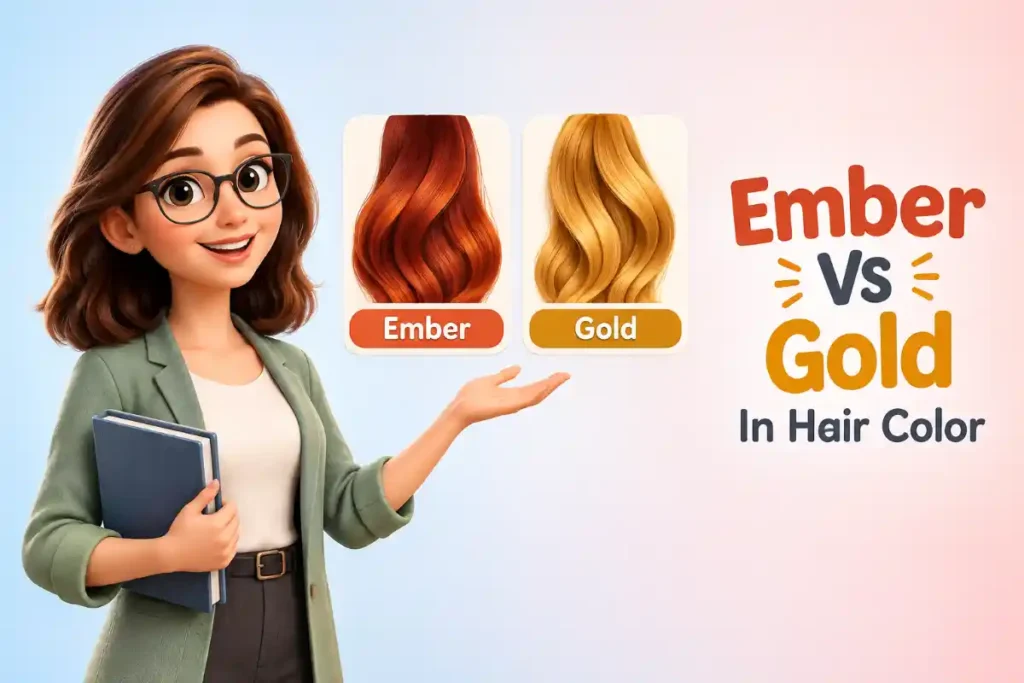
Ember Vs Gold In Hair Color
Hair color terminology adds another layer of ambiguity.
Ember can be used to describe warm red orange or copper tones.
Gold usually suggests yellow warm blonde tones.
An ember inspired hair color may have copper or red warmth.
A golden hair color usually has yellow or honey warmth.
Some shades combine both.
For example a copper gold can look distinctly golden under sunlight while showing strong orange warmth indoors.
Hair color is also affected by natural pigment, lighting, hair texture, and color treatment. The name alone can’t guarantee the final result.
Ember Vs Gold In Writing
The two words behave differently in ordinary English.
Ember is a regular noun.
Example:
The last ember glowed in the fireplace.
Its plural is embers.
Example:
The embers were still warm.
Gold can function as a noun and an adjective.
As a noun:
The ring is made of gold.
As an adjective:
She wore a gold dress.
Gold can also appear in expressions and figurative language.
For example:
- Gold medal.
- Gold standard.
- Heart of gold.
- Worth its weight in gold.
- Golden opportunity.
Ember also appears in figurative expressions.
Examples include:
- Dying embers.
- Glowing embers.
- Embers of hope.
- Embers of a friendship.
- Fan the embers of a conflict.
Collins notes that ember can refer figuratively to the fading remains of an emotion in British English.
Pronunciation Of Ember
In American English ember is pronounced with two syllables.
The stress falls on the first syllable.
The American English pronunciation is represented by dictionaries as /ˈɛmbər/. Cambridge and Oxford both give American pronunciation information for the word. (Cambridge Dictionary)
The first vowel sounds like the vowel in bed.
The final part is unstressed.
The plural form is embers.
Pronunciation Of Gold
Gold has one syllable.
The pronunciation is generally represented as /ɡoʊld/ in American English.
The word begins with the /ɡ/ sound and ends with the /ld/ consonant cluster.
Because gold is a short word, pronunciation mistakes usually involve the vowel or the final consonants rather than syllable stress.
Word Origin Of Ember
The history of ember is surprisingly old.
Oxford traces the word to Old English and identifies it as Germanic in origin. It also notes that the b was added in English for ease of pronunciation.
Collins traces related forms through Middle English and Old English and connects the word with older Germanic forms associated with smoke and fire.
So ember isn’t a modern color marketing term. It has been part of English vocabulary for centuries.
Its color meaning comes naturally from the physical object.
Word Origin Of Gold
Gold has an equally ancient history.
The English word comes from Old English gold and is related to Germanic forms found across several languages.
The basic meaning has remained remarkably stable because the word refers to a material humans have recognized for thousands of years.
Its use as a color description follows the appearance of the metal.
This is why gold can mean the substance itself or a color resembling that substance.
Real Life Examples Of Ember
Here are natural examples showing how ember works in everyday English.
- The fireplace still had one glowing ember left.
- We watched the embers fade after the campfire died.
- The wind carried a few embers across the yard.
- The artist used an ember shade to create a warm autumn palette.
- Her sweater was a deep ember orange.
- The room looked warmer with the ember colored cushions.
- The lipstick has a rich ember tone.
- The sunset faded from bright orange into a darker ember shade.
- The designer chose ember as the main accent color.
- The paint has an earthy ember undertone.
Real Life Examples Of Gold
- She wore a simple gold necklace.
- The invitation uses gold lettering.
- The sunset turned the clouds a soft gold.
- He bought a gold watch for his father.
- The room has gold accents against a dark blue wall.
- The fabric has a subtle gold shimmer.
- The designer chose gold for the logo.
- Her dress was a warm metallic gold.
- The painting uses gold to catch the light.
- The leaves looked almost gold in the afternoon sun.
Ember Vs Gold In Formal Writing
When you’re writing about a specific color in professional content, clarity matters more than creative naming.
If you are describing an actual product, capitalize the shade name only when the manufacturer treats it as a formal product name.
For example:
The manufacturer offers the jacket in Ember.
If you’re simply describing a color, lowercase is normally appropriate.
The jacket has an ember orange finish.
The distinction is similar to other product color names. A formal branded shade can function as a proper product label. A general color description does not need special capitalization.
Common Mistakes With Ember And Gold
The biggest mistake is assuming that ember and gold have one fixed visual definition.
They don’t.
Another common mistake is treating the names as exact technical color specifications.
They aren’t.
Avoid saying:
Ember is always dark red.
Gold is always bright yellow.
Both statements are too absolute.
Instead say:
Ember often has red orange or copper qualities.
Gold often has yellow amber or metallic qualities.
That wording is more accurate.
Another Common Mistake
People sometimes assume that anything orange must be ember.
That’s not true.
Orange is a broad color family. Ember is a descriptive color name based on the appearance of fire remnants.
A bright orange can be called orange, tangerine, pumpkin, flame, or another shade depending on its appearance and context.
Likewise, a brownish yellow doesn’t automatically become gold.
It could be ochre, mustard, bronze, tan, brass, antique gold, or another related shade.
Ember Vs Gold And Bronze
Bronze is especially easy to confuse with both colors.
Bronze normally sits between brown, orange, and metallic yellow.
An ember shade can look bronze because both can contain orange and brown.
Gold can also look bronze when it becomes darker and less yellow.
A useful visual guide is:
Ember: fire and glowing coal.
Bronze: brown orange metal.
Gold: yellow orange precious metal.
These are broad visual anchors rather than strict technical boundaries.
Ember Vs Gold And Copper
Copper is another close relative.
Copper usually has a strong orange red metallic quality.
That makes it especially close to ember.
A deep copper shade can look almost identical to some ember colors.
Gold usually has more yellow.
So if you are comparing copper, ember, and gold, look for the dominant undertone.
Red orange points toward copper or ember.
Yellow orange points more toward gold.
Ember Vs Gold And Amber
Amber creates another interesting overlap.
Amber typically suggests a warm yellow orange or orange brown shade.
Some gold shades look amber.
Some ember shades contain amber undertones.
The difference comes from the visual reference.
Amber suggests resin or warm translucent orange yellow.
Ember suggests glowing fire.
Gold suggests precious metal.
Color names are often best understood through these mental images.
How To Choose Between Ember And Gold
Choose an ember inspired shade when you want:
- A deeper warm color.
- Fire inspired energy.
- Orange or red warmth.
- An earthy appearance.
- A dramatic accent.
- A cozy autumn feeling.
Choose gold when you want:
- A brighter warm accent.
- Yellow or amber warmth.
- A luxurious appearance.
- Metallic shine.
- A celebratory feeling.
- A classic decorative effect.
If you’re choosing paint, fabric, makeup, or digital colors, always compare actual samples under the lighting where the color will be used.
That’s the editor’s practical rule.
Trust the swatch more than the shade name.
How Lighting Changes Ember And Gold
Lighting can completely change how warm colors look.
Under warm incandescent lighting, both ember and gold can appear more orange.
Under cool daylight, gold may look more yellow and ember may reveal stronger red or brown tones.
And under low light, dark ember shades can lose their orange appearance and look brown.
Metallic gold can behave differently because reflection becomes part of the visual effect.
This is why a color that looks perfect on a phone screen can look different on a wall or piece of fabric.
How Surrounding Colors Change Them
Colors don’t exist in isolation.
Put ember beside cream and its warmth becomes more obvious.
Put ember beside bright orange and it may look darker and more muted.
And put gold beside black and it can appear brighter.
Put gold beside pale yellow and it may look deeper and more metallic.
This principle is useful in design and explains why two people can describe the same color differently.
They may be seeing it in different surroundings.
Memory Trick For Ember And Gold
Use this simple association.
Ember equals fire.
Gold equals metal.
Picture a dying campfire for ember.
Picture a gold ring for gold.
The first image gives you red orange and copper warmth.
The second gives you yellow metallic warmth.
This trick works better than trying to memorize technical color values because the names themselves come from those visual references.
Is Ember A Formal Color Name
Ember can be used as a color name, but its exact shade isn’t universal.
Companies can assign the word to their own products.
That means a search for an Ember paint, lipstick, fabric, or digital color can return several different shades.
The word has a recognizable visual association. It doesn’t establish a universal technical specification.
Is Gold A Formal Color Name
Gold is also used as a general color name and as a product shade name.
Unlike a strictly defined color standard, everyday gold can cover a fairly wide range.
It can be:
- Pale gold.
- Bright gold.
- Yellow gold.
- Rose gold.
- Antique gold.
- Old gold.
- Metallic gold.
- Champagne gold.
The surrounding word often gives you more information than Gold alone.
Ember Vs Gold In American English
American English uses both ember and gold normally.
There is no American spelling issue that changes ember into another form.
Cambridge gives the American pronunciation of ember as /ˈem.bɚ/ and identifies the word as a noun that is usually used in the plural when referring to fire remains.
Gold also has the same basic spelling and meaning across major English varieties.
British English can use ember with a slightly different final vowel sound. The spelling remains the same.
Canadian and Australian English also use the same basic forms.
So this isn’t a British versus American spelling dispute.

Ember Vs Gold In Academic Writing
In academic writing, avoid treating color names as precise scientific classifications unless you define the actual color system being used.
For example, saying:
The object was ember colored.
is less precise than:
The object was a deep red orange.
If exact reproduction matters, provide a measurable color specification.
The same principle applies to gold.
If you’re discussing art, fashion, literature, or cultural symbolism, ordinary color names are perfectly useful.
If you’re reporting scientific measurements, use a defined color model.
Ember Vs Gold In Literature
Writers often choose ember because it carries imagery beyond simple color.
An ember can suggest something that remains alive after the main fire has faded.
That makes the word useful in figurative writing.
For example:
The ember of hope remained.
This doesn’t mean literal orange color. It suggests a small remaining source of hope.
Gold can also be symbolic.
It can suggest value, beauty, success, wealth, or something precious.
That’s why writers choose these words for different emotional effects.
Frequently Asked Questions
Is ember the same color as gold
No. Ember and gold can overlap but they usually suggest different color families. Ember tends to lean toward red, orange, copper, or brown. Gold tends to lean toward yellow, amber, and yellow orange. The exact appearance depends on the product, material, lighting, and color system being used.
Is ember a shade of orange
Ember can be considered an orange related color when it has a strong orange base. However, ember isn’t limited to orange. Some ember shades are reddish, coppery, brownish, or dark orange. The name comes from glowing fire remnants rather than from a strict technical color classification.
Is gold yellow or orange
Gold can contain both yellow and orange. Classic gold usually appears yellow with warm orange or amber qualities. Darker gold can move toward brown or bronze. Metallic finishes also change how the color is perceived because reflected light affects the appearance.
Which is darker ember or gold
Ember is often darker than gold, but this isn’t a universal rule. Color names don’t establish fixed brightness levels. A dark antique gold can be deeper than a light ember orange. If brightness matters, compare the actual shades instead of relying on the names.
Can ember look like copper
Yes. Ember and copper can look very similar because both can contain strong orange, red, and brown qualities. Copper usually has a stronger metallic identity, while ember is associated with glowing fire. A specific ember shade can therefore look almost copper under certain lighting.
Can ember be a gold color
A product can be named Ember even if its actual shade is close to gold. Some cosmetics and decorative products use Ember for warm metallic gold shades. One documented example describes an Ember eyeshadow as a warm dark gold with a metallic finish. (Temptalia)
What color is closest to ember
Colors commonly associated with ember include burnt orange, copper, rust, deep orange, red orange, terracotta, and warm brown. The closest match depends on the specific shade. The common feature is a warm fire inspired appearance.
What colors go with ember and gold
Ember works well with cream, beige, charcoal, brown, deep green, and warm white. Gold pairs naturally with black, navy, emerald, cream, burgundy, white, and brown. Using both together can create a rich warm palette when their brightness and saturation are balanced.
Related Color Words
Understanding nearby color terms makes the ember and gold distinction easier.
Amber
Amber usually suggests a transparent or warm yellow orange color. It sits close to both gold and orange.
Copper
Copper is usually a reddish orange metallic color. It often sits close to ember.
Bronze
Bronze generally combines brown, orange, and metallic yellow qualities. It can bridge the visual gap between ember and gold.
Rust
Rust is usually a muted reddish orange or brown orange. It is generally earthier and less luminous than gold.
Burnt Orange
Burnt orange is a deep muted orange with brown or red qualities. It is one of the closest everyday color descriptions to many ember shades.
Antique Gold
Antique gold is usually darker and more muted than bright gold. It can move toward brown or bronze.
Expert Editor’s Note
If you’re editing a sentence that uses ember or gold, don’t treat the words as interchangeable.
They create different mental pictures.
Use ember when the intended image involves glowing fire, deep orange warmth, copper, red orange, or the fading heat of a fire.
Use gold when the intended image involves yellow metallic warmth, precious metal, brightness, value, or a golden glow.
If the sentence describes a specific commercial shade, preserve the official product name. A brand’s Ember may not match another brand’s Ember.
If precision matters, add a plain color description.
For example:
The wall was painted a deep ember orange.
That tells the reader much more than Ember alone.
For digital design, give the actual HEX or RGB value when exact reproduction matters. For physical products, use a swatch or manufacturer reference.
Professional editing is often less about finding a supposedly perfect word and more about giving readers enough information to understand exactly what you mean.
Final Takeaway
Ember and gold are both warm colors, but they create different visual associations. Ember points toward glowing fire and usually carries red, orange, copper, or brown warmth. Gold points toward precious metal and usually carries yellow, amber, or yellow orange warmth.
The biggest mistake is treating either name as one exact standardized shade. Color names vary across brands and industries. Lighting, finish, saturation, and surrounding colors can also change what you see.
If you’re choosing a color for a product, design, outfit, room, or makeup look, compare the actual shade rather than relying on the name alone.
Remember it this way: ember glows like fire. Gold shines like metal.

Founding Editor
Maya spent six years as a copyeditor at a regional newspaper before starting Grammist, which is where the “answer first” format came from: newsroom style guides don’t have room for a preamble.
She writes and reviews most of the word-pair and spelling entries, and has final say on anything that goes out under the Grammist name.