

Eccentric vs eclectic is a common word choice problem because the two adjectives look and sound surprisingly similar. They also appear in discussions about people, art, fashion, music, design, ideas, and personal taste. That overlap can make the difference feel smaller than it really is.
The key distinction is simple. Eccentric describes something unusual or outside what most people consider normal. Eclectic describes something that combines ideas, styles, or elements from several different sources. Oxford defines eccentric as strange or unusual and eclectic as drawing from a wide variety rather than following one style or set of ideas. (Oxford Learner’s Dictionaries)
So an eccentric person might dress in a very unusual way. An eclectic person might enjoy classical music, hip hop, jazz, country, and electronic music.
The words can sometimes describe the same person or object. Still, they focus on different qualities. Eccentric points to unusualness. Eclectic points to variety and selection.
This guide explains the difference in plain English. You’ll learn the meanings, pronunciation, grammar, word origins, common mistakes, regional usage, natural examples, memory tricks, and practical rules that make the choice easy.
Quick Answer
Eccentric means strange, unusual, or noticeably different from what people normally expect. Eclectic means combining or choosing things from many different styles, sources, or ideas. An eccentric person stands out because of unusual behavior. An eclectic person or thing stands out because of variety.
Eccentric Vs Eclectic Comparison
| Feature | Eccentric | Eclectic |
|---|---|---|
| Basic meaning | Strange or unusual | Drawn from many different sources |
| Main idea | Unusualness | Variety |
| Part of speech | Adjective and noun | Mainly adjective |
| Pronunciation | /ɪkˈsentrɪk/ | /ɪˈklektɪk/ |
| Common use | Person, behavior, clothes, habits | Taste, style, collection, approach |
| Tone | Often neutral or mildly humorous | Usually neutral or positive |
| Example | He has an eccentric personality. | She has eclectic taste in music. |
| Related noun | Eccentricity | Eclecticism |
| Common phrase | Eccentric behavior | Eclectic taste |
Cambridge gives eccentric the sense of strange or unusual and notes that the word can sometimes carry a humorous quality. It defines eclectic as combining useful or appealing elements from different areas or systems rather than following one system.
What Eccentric Means
Eccentric is an adjective that describes a person or thing that seems strange, unusual, unconventional, or different from what people normally expect.
For example:
Her eccentric uncle wears bright purple suits every day.
The important idea is not variety. The important idea is that his behavior or appearance stands outside the usual pattern.
You can use eccentric for:
- A person.
- A personality.
- Behavior.
- Clothing.
- Habits.
- Ideas.
- Design.
- Artistic choices.
- Lifestyle choices.
Oxford gives examples such as eccentric behavior, eccentric clothes, and an eccentric aunt.
The word can be positive, neutral, or mildly negative depending on context. Calling someone eccentric can suggest that the person is interesting and individualistic. In another context, it can suggest that the person’s behavior is odd.
For example:
The eccentric artist painted every wall in his house bright orange.
This sentence focuses on the artist’s unusual choice.
Eccentric As A Noun
Eccentric can also function as a noun.
In this form, it means a person who behaves in an unusual way.
Everyone knew him as a harmless eccentric.
Oxford lists this noun use as a person considered strange or unusual.
The plural is eccentrics.
The town attracted artists and other eccentrics.
The related noun eccentricity refers to the quality or state of being eccentric. It can also refer to an unusual habit or action.
What Eclectic Means
Eclectic is an adjective used for something that combines or selects elements from different sources, styles, systems, or traditions.
For example:
She has an eclectic taste in music.
This means she enjoys music from many different styles.
She might listen to jazz in the morning, country music in the afternoon, classical music at night, and rock on the weekend. The point is not that her taste is strange. The point is that it covers many different styles.
Cambridge explains that eclectic methods, beliefs, and ideas combine useful or appealing elements from different areas instead of following one system.
Eclectic commonly describes:
- Taste.
- Style.
- Music.
- Art.
- Fashion.
- Interior design.
- Collections.
- Ideas.
- Approaches.
- Methods.
- Beliefs.
- Backgrounds.
- Influences.
For example:
The restaurant has an eclectic menu.
The menu contains dishes from several culinary traditions.
His writing style is eclectic.
His writing draws from different influences or styles.
She took an eclectic approach to teaching.
She selected useful techniques from several teaching methods rather than following one method exclusively.
The Biggest Difference
The easiest way to separate the two words is to ask what quality you’re describing.
Eccentric means unusual.
Eclectic means varied.
Think of two rooms.
One room contains a giant purple sofa shaped like a crescent moon. It may be eccentric because the design is unusual.
Another room contains a vintage wooden table, a modern lamp, a traditional rug, abstract paintings, and furniture from several design periods. It may be eclectic because it combines different styles.
The first word focuses on standing apart from the norm.
The second focuses on bringing different things together.
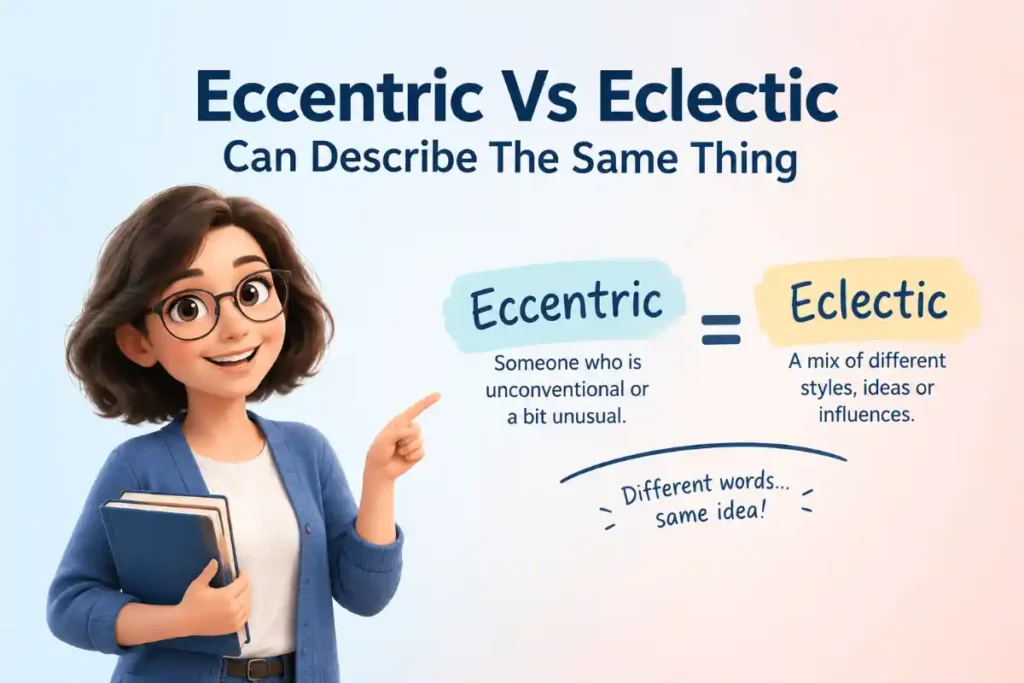
Eccentric Vs Eclectic Can Describe The Same Thing
This is where the distinction gets interesting.
A person’s style can be both eccentric and eclectic.
Imagine someone who wears cowboy boots, a Victorian jacket, a neon shirt, and a vintage hat. The outfit could be called eclectic because it combines several styles. It could also be called eccentric if the overall appearance is unusually bold or strange.
The words are not always opposites.
Instead, they describe different dimensions of the same subject.
An eclectic art collection can also look eccentric if the combinations are highly unusual.
An eccentric artist can have eclectic influences.
So don’t think of the words as two boxes where only one can ever be correct. Focus on the exact idea you want to communicate.
Why Eccentric Vs Eclectic Get Confused
There are several reasons these words cause trouble.
First, they have similar shapes. Both begin with ec and contain the letter sequence cent or lect that can make them visually confusing during quick reading.
Second, both are relatively formal adjectives. You may encounter them in writing about art, culture, personality, design, literature, and ideas. That shared territory can make the distinction less obvious.
Third, both words can describe something that feels different from the ordinary. An eclectic style may look unusual because it combines unexpected elements. An eccentric style may also look unusual because it breaks conventional expectations.
The meanings still differ.
Eclectic asks what sources or styles have been brought together.
Eccentric asks how unusual the result or behavior is.
Eccentric Vs Eclectic Pronunciation
The pronunciations are different.
Eccentric is pronounced:
/ɪkˈsentrɪk/
It has three syllables.
The main stress falls on the second syllable.
Eclectic is pronounced:
/ɪˈklektɪk/
It also has three syllables.
The main stress falls on the second syllable.
Cambridge and Oxford give these pronunciations for American English.
The opening sounds are similar enough to cause confusion. The middle sounds are different, though. Eccentric contains the sound associated with centr. Eclectic contains the sound associated with lect.
A useful listening clue is the middle consonant group.
Eccentric sounds like it connects to center.
Eclectic sounds like it connects to select.
That connection also helps with meaning.
Eccentric Vs Eclectic A Simple Memory Trick
Use this memory trick:
Eccentric = unusual.
Eclectic = many choices.
For eccentric, think of something that moves away from the center. The historical meaning of the word is closely connected with being outside the center.
For eclectic, think of selecting from different sources.
You can remember it this way:
Eccentric breaks from the norm. Eclectic borrows from many forms.
That distinction works in most everyday situations.
Eccentric Vs Eclectic In Grammar
Both words are most commonly used as adjectives.
Eccentric As An Adjective
Place eccentric before a noun.
He has an eccentric personality.
She wore an eccentric outfit.
The artist had an eccentric style.
You can also use it after a linking verb.
His behavior was eccentric.
Her ideas seemed eccentric.
Eccentric As A Noun
Use an eccentric for one person.
He is an eccentric.
Use eccentrics for more than one.
The neighborhood became popular with artists and eccentrics.
The related noun is eccentricity.
His eccentricity became part of his public image.
Oxford lists eccentricity as both an uncountable noun for the quality of being unusual and a countable noun for an unusual act or habit.
Eclectic As An Adjective
Eclectic normally comes before a noun or after a linking verb.
She has eclectic taste.
They created an eclectic collection.
His influences are eclectic.
The restaurant’s menu is eclectic.
The related noun is eclecticism.
The band’s eclecticism is one reason its music is difficult to classify.
Cambridge defines eclecticism as the practice or fact of combining things from many different areas or systems.
The adverb is eclectically.
The director draws eclectically from several film traditions.
Cambridge lists eclectically as meaning in an eclectic way.
Eccentric Vs Eclectic In Context
Context usually makes the correct word clear.
People
Use eccentric when describing unusual behavior or personality.
My neighbor is eccentric but friendly.
Use eclectic when describing a person’s broad range of interests or influences.
My neighbor has eclectic interests in music and art.
The first sentence says the person is unusual.
The second says the person’s interests come from many different areas.
Fashion
Her eccentric outfit attracted everyone’s attention.
The clothing is unusual.
Her eclectic outfit combined vintage and modern pieces.
The clothing combines different styles.
Music
The musician has an eccentric stage presence.
The behavior or appearance is unusual.
The musician has eclectic musical influences.
The music draws from different traditions.
Interior Design
The designer created an eccentric living room with a ceiling covered in mirrors.
The room is unusual.
The designer created an eclectic living room with antique and modern furniture.
The room combines different styles.
Writing
The author’s eccentric characters often behave in unexpected ways.
The characters are unusual.
The author’s eclectic influences include mythology, comedy, history, and science fiction.
The writing draws from many sources.
Twenty Natural Examples For Eccentric Vs Eclectic
Here are practical examples showing the difference in real sentences.
- He has an eccentric sense of humor.
- She has an eclectic taste in music.
- The professor was known for his eccentric habits.
- The gallery displayed an eclectic collection of paintings.
- His eccentric clothing made him easy to recognize.
- Her wardrobe is eclectic and includes pieces from many decades.
- The inventor had an eccentric personality.
- The designer uses an eclectic mix of colors and textures.
- His eccentric behavior surprised his coworkers.
- Her eclectic background helped her understand different audiences.
- The novelist created an eccentric main character.
- The novelist drew on an eclectic range of literary traditions.
- The musician’s stage performance was eccentric.
- The musician’s influences were eclectic.
- Their new house has an eccentric exterior.
- Their new house has an eclectic interior.
- The professor’s eccentric teaching habits became famous among students.
- The professor uses an eclectic teaching method.
- The artist’s personal style is eccentric.
- The artist’s work reflects an eclectic mixture of cultural influences.
Notice the pattern. Eccentric usually highlights the unusual quality. Eclectic highlights the mixture or range.
Common Mistakes With Eccentric
One common mistake is using eccentric when you simply mean varied.
Incorrect in meaning:
She has an eccentric taste in music because she likes jazz, country, and classical music.
That sentence could be understood as saying her musical taste is strange.
Better:
She has an eclectic taste in music because she enjoys jazz, country, and classical music.
Another mistake is assuming eccentric always means negative.
It doesn’t.
The eccentric artist became one of the most respected figures in the local art scene.
Here eccentric simply describes an unconventional person.
Common Mistakes With Eclectic
A frequent mistake is using eclectic to mean strange.
For example:
His behavior was eclectic.
This sounds unnatural if your intended meaning is that he behaves strangely.
Use eccentric instead.
His behavior was eccentric.
Another common error is assuming that eclectic means random.
An eclectic collection can be carefully chosen. The word suggests selection from different sources. It doesn’t automatically mean that the elements have no connection.
For example:
She has an eclectic book collection.
This means the collection contains books from many genres or areas. It doesn’t mean she bought random books without thought.
Is Eclectic Always Positive
Not necessarily.
The word is often neutral or positive, especially when describing taste, knowledge, artistic influences, or a creative approach. Cambridge and Oxford both use it for combinations drawn from different styles and sources.
For example:
The restaurant offers an eclectic menu.
That will usually sound positive or at least neutral.
However, context can make the word less flattering.
The report takes an eclectic approach to the evidence.
Depending on the context, a reader might simply mean that the report draws from several methods. A critic could also imply that the approach lacks a single organizing framework.
The word itself doesn’t automatically express approval or disapproval.
Is Eccentric Always Negative
No.
Eccentric can suggest individuality, creativity, charm, or originality.
Her eccentric personality made her unforgettable.
It can also suggest behavior that others consider odd.
His eccentric habits made working with him difficult.
Context controls the tone.
Cambridge specifically notes that eccentric can describe something strange or unusual in a humorous way.
Eccentric Vs Eclectic Usage British And American English
There is no major American versus British spelling difference between these words.
American English uses:
eccentric
eclectic
British English uses the same spellings.
The main differences you may notice are pronunciation details and surrounding vocabulary.
Oxford’s American entries give eccentric as /ɪkˈsɛntrɪk/ and eclectic as /ɪˈklɛktɪk/. (Oxford Learner’s Dictionaries)
Canadian and Australian English also use the same standard spellings.
So you don’t need to memorize separate regional spellings for this pair.
Eccentric Vs Eclectic Word Origins
The origins explain the difference surprisingly well.
Eccentric comes from Greek roots connected with being outside the center. Oxford traces the word through Latin to Greek ekkentros, meaning out of the center.
Etymonline notes that the early English noun referred to an orbit or circle that did not have Earth precisely at its center. The later sense of an odd or whimsical person developed much later.
That history gives you a useful mental image.
Something eccentric is figuratively away from the center or normal pattern.
Eclectic has a different origin. Oxford traces it to Greek eklektikos, from eklegein, meaning to pick out or choose.
That fits the modern meaning perfectly.
An eclectic person or style chooses from many sources.
So the word origins give you two strong memory anchors:
Eccentric = away from the center.
Eclectic = choose from different sources.
Eccentric Vs Eclectic In Everyday American English
In American English, both words are familiar, but they appear in different conversational settings.
Eccentric often appears when people talk about personalities.
He’s a little eccentric.
This is a natural everyday sentence.
Eclectic often appears when people talk about taste or style.
She has an eclectic taste in music.
You might also hear:
That’s a pretty eclectic collection.
The words can sound more sophisticated than simple alternatives such as strange or varied, but both remain normal English vocabulary.
If you’re writing for a broad audience, choose the simpler word when it communicates your meaning just as clearly.
For example:
He has an unusual personality.
may be clearer than:
He has an eccentric personality.
However, eccentric carries a more specific sense of unusual individuality.
Likewise:
She likes many kinds of music.
is simpler than:
She has eclectic musical tastes.
But eclectic emphasizes the range and mixture of those influences.
Formal And Informal Usage Of Eccentric Vs Eclectic
Eccentric works comfortably in both formal and informal English.
You can use it in conversation:
My uncle is pretty eccentric.
You can also use it in professional or academic writing:
The novelist’s eccentric characters challenge traditional ideas about social behavior.
Eclectic is somewhat more formal in tone. Oxford labels it formal and gives examples involving literary taste, mixtures, and approaches.
It is especially common in writing about:
- Art.
- Music.
- Design.
- Literature.
- Education.
- Philosophy.
- Research methods.
- Culture.
That doesn’t make it unsuitable for conversation.
I have pretty eclectic taste in movies.
That sounds completely natural.
When To Use Eccentric
Choose eccentric when the main idea is that something is unusual.
Use it for:
- Unusual people.
- Strange habits.
- Unconventional behavior.
- Unusual clothing.
- Unexpected personal choices.
- Distinctive artistic behavior.
- Unconventional ideas.
A quick test is:
Could I replace the word with unusual or unconventional without changing the main meaning?
If yes, eccentric may be the right choice.
Examples:
He has an eccentric personality.
She has an eccentric way of decorating her office.
The scientist was known for his eccentric habits.
When To Use Eclectic
Choose eclectic when the main idea is variety created by selecting from different sources.
Use it for:
- Music taste.
- Fashion.
- Art collections.
- Interior design.
- Literary influences.
- Teaching methods.
- Research approaches.
- Cultural interests.
- Knowledge.
- Collections.
A useful test is:
Does the subject combine elements from different styles or sources?
If yes, eclectic is likely the right word.
Examples:
She has eclectic taste in books.
The hotel has an eclectic design.
His research uses an eclectic approach.
Eccentric Vs Eclectic In Academic Writing
Academic writers need to be especially careful because these words communicate different ideas.
Consider:
The researcher used an eccentric approach.
This suggests the approach was unusual or unconventional.
Now compare:
The researcher used an eclectic approach.
This means the researcher drew from several methods, theories, or traditions.
The second sentence doesn’t necessarily say the approach was strange.
This distinction matters in academic writing because eclectic can describe a deliberate methodological choice.
For example:
The study uses an eclectic framework that combines insights from psychology, sociology, and linguistics.
Here the word tells the reader that the framework draws from multiple disciplines.
Calling the same framework eccentric would shift the meaning toward unusualness.
Eccentric Vs Eclectic In Professional Writing
In workplace writing, context matters.
You might write:
The company’s founder had an eccentric management style.
This says the management style was unusual.
You could write:
The company uses an eclectic range of marketing strategies.
This says the company draws from different strategies.
Avoid using eclectic simply because something contains several items.
For example:
The meeting included an eclectic collection of topics.
This can work if the topics come from very different areas. However, wide ranging or varied may be clearer in some professional contexts.
Good editing isn’t about choosing the more sophisticated word. It’s about choosing the word that says exactly what you mean.
Similar Words To Eccentric
Depending on context, useful alternatives include:
- Unusual.
- Unconventional.
- Odd.
- Quirky.
- Peculiar.
- Individualistic.
- Unorthodox.
- Strange.
- Out of the ordinary.
These aren’t perfect substitutes in every sentence.
Quirky often sounds lighter and friendlier.
Unconventional focuses on breaking from common practice.
Strange is broader and can sound more negative.
Eccentric often suggests a distinctive personal quality.
Similar Words To Eclectic
Related words include:
- Varied.
- Diverse.
- Mixed.
- Wide ranging.
- Multifaceted.
- Assorted.
- Diverse in style.
- Broad.
- Multidisciplinary.
Again, the meanings aren’t identical.
Diverse emphasizes difference or variety.
Eclectic emphasizes selecting or combining elements from different sources.
For example:
She has diverse interests.
This tells us that her interests cover many areas.
She has eclectic interests.
This can suggest that her interests are drawn from many different styles, subjects, or traditions.
Opposites And Contrasts
The natural contrast for eccentric is often:
- Conventional.
- Typical.
- Ordinary.
- Mainstream.
- Traditional.
- Normal.
The natural contrast for eclectic can be:
- Consistent.
- Uniform.
- Specialized.
- Single style.
- Narrow.
- Monolithic.
The exact opposite depends on context.
For example:
His style is eccentric rather than conventional.
But:
Her design is eclectic rather than uniform.
These comparisons reveal the central distinction.
Common Expressions
Some natural expressions with eccentric include:
- Eccentric behavior.
- Eccentric personality.
- Eccentric character.
- Eccentric artist.
- Eccentric style.
- Eccentric habits.
- Eccentric ideas.
- Eccentric clothes.
Common expressions with eclectic include:
- Eclectic taste.
- Eclectic style.
- Eclectic mix.
- Eclectic collection.
- Eclectic approach.
- Eclectic influences.
- Eclectic background.
- Eclectic range.
- Eclectic combination.
Cambridge specifically identifies eclectic taste as a common expression for enjoying things from many different styles of art, music, food, fashion, and related areas.
A Practical Editor’s Rule For Eccentric Vs Eclectic
When proofreading, I use a simple meaning test.
Ask:
Is the sentence about being unusual?
Choose eccentric.
Ask:
Is the sentence about choosing or combining elements from different sources?
Choose eclectic.
For example:
His taste in music is eccentric.
This suggests his taste is strange or unusual.
His taste in music is eclectic.
This suggests he enjoys music from many different styles.
Both sentences are grammatically correct. They simply communicate different ideas.
That is an important point for English learners. A word can be grammatically correct and still be the wrong word for the intended meaning.
Common Search Questions
Is eccentric the same as eclectic?
No. Eccentric means unusual or unconventional. Eclectic means combining or selecting elements from different sources or styles. An eccentric person may behave in an unusual way. An eclectic person may have broad interests or a style that combines several influences. The words sometimes overlap in context, but their central meanings are different.
Is eclectic a positive word?
Eclectic is often neutral or positive. It commonly describes broad taste, creative style, diverse influences, or a flexible approach. For example, saying someone has eclectic taste in music usually suggests that the person enjoys many styles. Context can change the tone, but the word itself doesn’t automatically carry a negative meaning.
Can a person be eccentric and eclectic?
Yes. The two words can describe different qualities of the same person. Someone can have unusual behavior and also enjoy a wide range of styles, ideas, or activities. For example, an artist might have an eccentric personality and an eclectic range of artistic influences. One word describes unusualness while the other describes variety.
Is eclectic the same as diverse?
Not exactly. Diverse means containing many different types or elements. Eclectic often suggests that someone has selected or combined elements from different sources, styles, or systems. An eclectic collection is diverse, but the word eclectic adds the idea of choosing from different influences.
What is the noun form of eccentric?
The noun forms are eccentric and eccentricity. An eccentric is a person who is considered unusual or strange. Eccentricity refers to the quality of being unusual or to an unusual habit or action. The plural of eccentricity is eccentricities.
What is the noun form of eclectic?
The main noun form is eclecticism. It refers to the practice or quality of combining things from different areas or systems. For example, you could write, The artist’s work shows strong eclecticism. The adverb form is eclectically.
How do you pronounce eccentric and eclectic?
In American English, eccentric is pronounced /ɪkˈsentrɪk/. Eclectic is pronounced /ɪˈklektɪk/. Both have three syllables and stress the second syllable. The middle sounds differ, so listening carefully to the center of each word can help you keep them separate. (Cambridge Dictionary)
Which word should I use for music taste?
Use eclectic when you mean that someone enjoys many different types of music. For example, She has eclectic taste in music. Use eccentric only when you mean the person’s musical taste itself is unusual or strange. In most situations involving a broad range of genres, eclectic is the natural choice.
d page.
Final Verdict
Eccentric and eclectic are not interchangeable.
Use eccentric when you mean strange, unusual, or unconventional.
Use eclectic when you mean drawn from or combining many different styles, sources, or ideas.
The fastest memory trick is simple:
Eccentric is about being unusual.
Eclectic is about choosing from variety.
So an eccentric person may dress in a surprising way. An eclectic person may enjoy everything from classical music to heavy metal. An artist can be eccentric in personality and eclectic in artistic influences.
When you’re unsure, look at the heart of the sentence. If the focus is on something standing outside the norm, choose eccentric. If the focus is on a mixture of different influences, choose eclectic.
Once you connect eccentric with unusualness and eclectic with selection and variety, the difference becomes much easier to remember.

Founding Editor
Maya spent six years as a copyeditor at a regional newspaper before starting Grammist, which is where the “answer first” format came from: newsroom style guides don’t have room for a preamble.
She writes and reviews most of the word-pair and spelling entries, and has final say on anything that goes out under the Grammist name.