
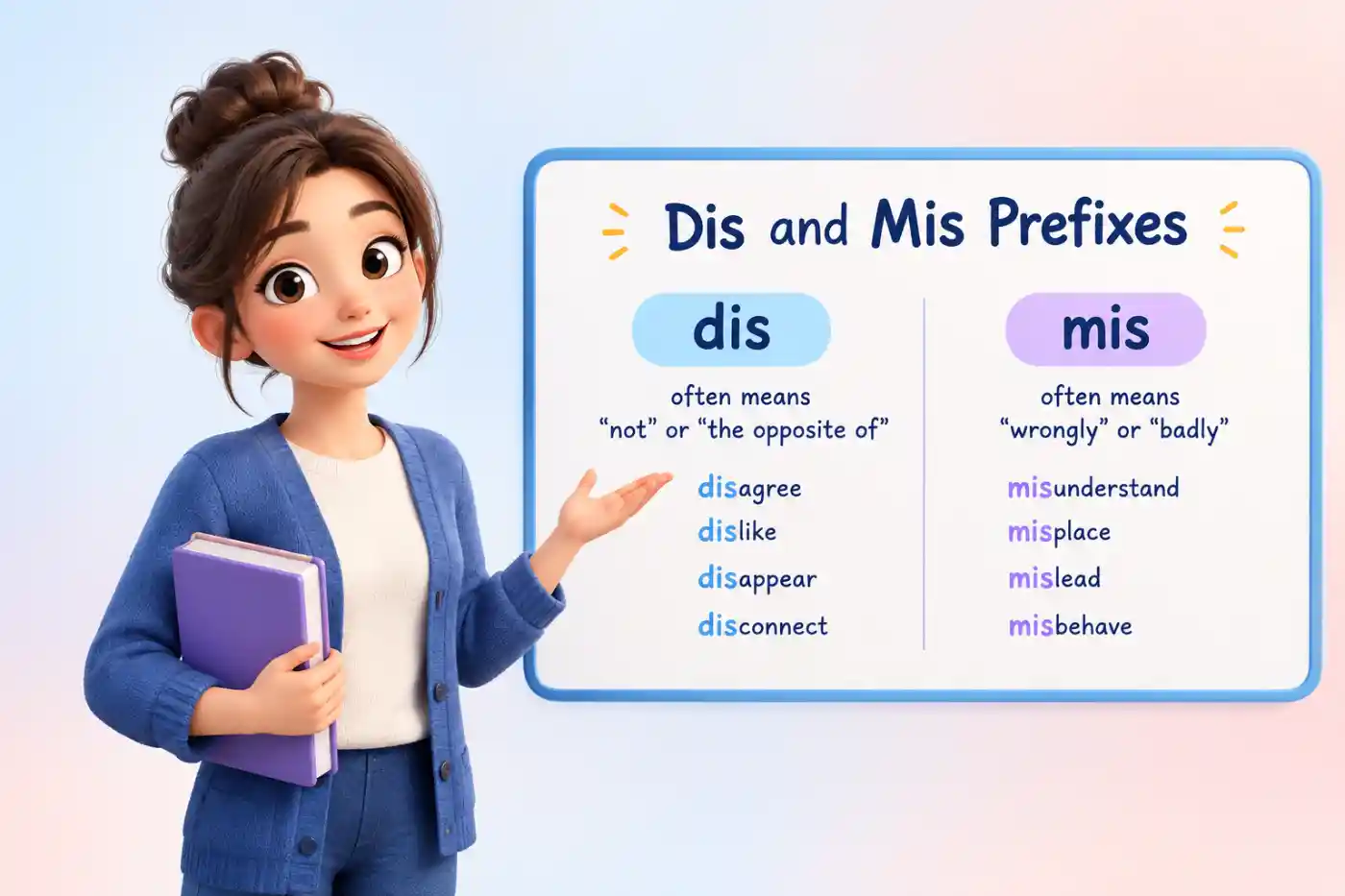
English prefixes can change a familiar word into something with a very different meaning. Two prefixes that often cause confusion are dis and mis. They look similar and both can create words with negative meanings. That similarity makes it easy to wonder which one belongs in a particular word.
The good news is that dis and mis prefixes usually have different jobs. The prefix dis commonly expresses not, the opposite of, reversal, separation, or removal. The prefix mis usually means wrongly, badly, incorrectly, or in an unsuitable way.
For example, disagree means to have a different opinion. Misunderstand means to understand something incorrectly. You can see the difference clearly once you look at the meaning of the whole word rather than simply treating both prefixes as a general sign of something negative.
This guide explains how dis and mis work, where they come from, how they sound, how they differ in real sentences, and how native English speakers use them. You’ll also find practical examples, common mistakes, memory tricks, related words, and answers to the questions learners often ask.
Quick Answer
The prefix dis usually means not, opposite, apart, away, or reverse. The prefix mis usually means wrongly, badly, or incorrectly. For example, disagree means not agree, while misunderstand means understand incorrectly. They can overlap in a few words, but they aren’t generally interchangeable.
Dis and Mis Prefixes At A Glance
| Feature | Dis | Mis |
|---|---|---|
| Main idea | Not, opposite, apart, away, or reverse | Wrongly, badly, or incorrectly |
| Pronunciation | /dɪs/ | /mɪs/ |
| Common role | Negation, reversal, separation, removal | Incorrect or faulty action |
| Common examples | disagree, dislike, disconnect, dishonest | misunderstand, misread, mislead, misbehave |
| Common word classes | Adjectives, nouns, verbs, and adverbs | Especially verbs and nouns formed from verbs |
| Origin | Mainly Latin | Germanic and Old English |
| Basic question | Is the idea reversed, absent, separated, or opposed | Was something done wrongly or badly |
| Example | disagree | misinterpret |
Oxford lists dis as a prefix used with adjectives, adverbs, nouns, and verbs to express not or the opposite. Oxford lists mis as a prefix used in verbs and nouns to express something bad or wrong.
What Is A Prefix
A prefix is a letter or group of letters placed at the beginning of a word to change its meaning. For example, adding un to happy creates unhappy. Adding re to write creates rewrite.
The important point is that a prefix does more than add letters. It adds meaning.
Consider these examples.
- agree becomes disagree.
- trust becomes distrust.
- understand becomes misunderstand.
- read becomes misread.
- behave becomes misbehave.
- connect becomes disconnect.
The base word gives you the central idea. The prefix modifies that idea.
English has many prefixes that express negative or opposite meanings. Cambridge lists dis and mis among the common negative prefixes along with un, non, in, and related forms. (Cambridge Dictionary)
What Does Dis Mean
The prefix dis has several connected meanings. The most useful meanings for English learners are not, opposite of, apart, away, reverse, and sometimes remove.
Oxford gives the core meaning as not or the opposite of. Cambridge also describes dis as a prefix that can form opposites. (Oxford Learner’s Dictionaries)
Look at these examples.
Agree → disagree
If you agree with someone, you share the same opinion. If you disagree, you hold a different opinion.
Like → dislike
If you like something, you enjoy it or have a favorable feeling toward it. If you dislike it, you do not like it.
Honest → dishonest
An honest person behaves truthfully. A dishonest person does not.
Connect → disconnect
To connect means to join things together. To disconnect means to separate them.
Appear → disappear
To appear means to become visible or present. To disappear means to stop being visible or present.
The exact meaning depends on the base word. That is important because dis does not produce one simple meaning in every English word.
What Does Mis Mean
The prefix mis usually means wrongly, badly, or incorrectly.
Cambridge defines mis as a prefix added to a verb or a word formed from a verb to show that the action has been done wrongly or badly. Oxford gives the same general idea and includes examples such as misbehaviour and misinterpret. (Cambridge Dictionary)
Consider these examples.
Understand → misunderstand
You understand something correctly. You misunderstand it when you interpret it incorrectly.
Read → misread
You misread something when you read it incorrectly or interpret the written information incorrectly.
Hear → mishear
You mishear someone when you hear their words incorrectly.
Lead → mislead
To mislead someone is to cause that person to have a wrong idea or impression.
Behave → misbehave
To misbehave means to behave badly or in a way that breaks expected rules.
The central idea is an error or bad action. The prefix often tells you that the action did not happen correctly.
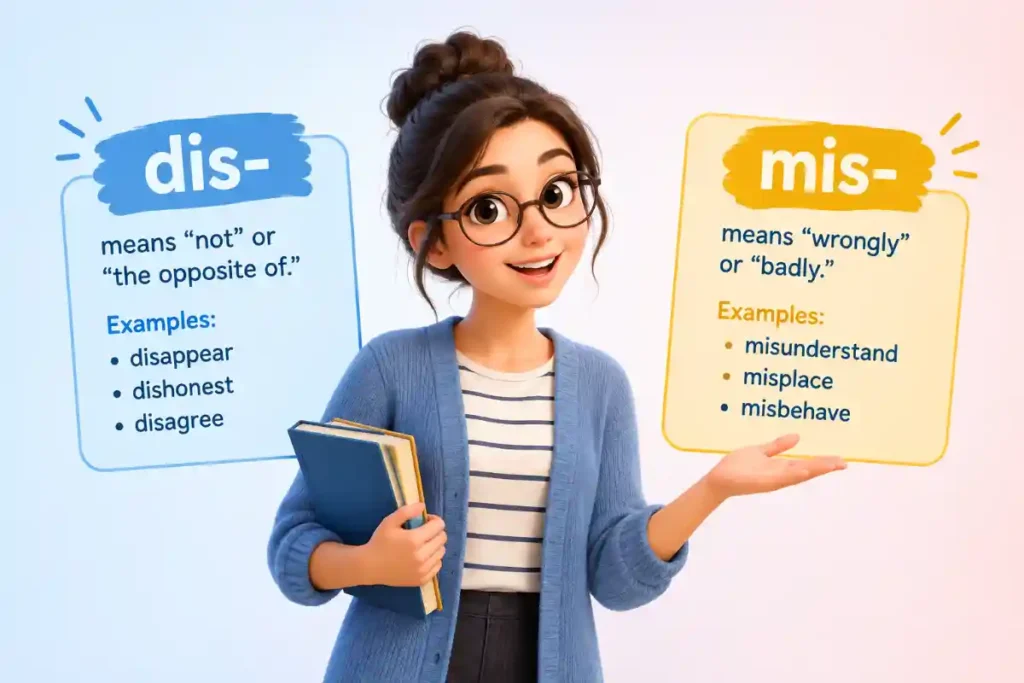
Dis and Mis Prefixes Have Different Jobs
The easiest way to understand the difference is to focus on the action or state described by the complete word.
Dis often changes the meaning toward an opposite state.
Mis often shows that an action happened incorrectly.
Compare these pairs.
Agree and disagree
Disagree means to hold a different opinion. It does not mean that you agreed incorrectly.
Understand and misunderstand
Misunderstand means that you understood something incorrectly.
Trust and distrust
Distrust means a lack of trust or a negative attitude toward trust. Mistrust can also mean a lack of trust and has considerable overlap with distrust.
Inform and misinform
Misinform means to give someone information that is not correct. Cambridge defines misinform as telling someone information that is not correct. (Cambridge Dictionary)
This gives you a useful mental rule.
Dis often changes the relationship or state. Mis often changes the accuracy or quality of an action.
This rule works well for many common words, although English contains exceptions and historical formations.
Dis Prefix Examples
The prefix dis appears in many everyday English words.
Disagree
Agree means to share an opinion.
Disagree means to have a different opinion.
Example.
I disagree with the conclusion.
Dislike
Like means to enjoy or approve of something.
Dislike means to have an unfavorable feeling toward it.
Example.
I dislike overly complicated instructions.
Dishonest
Honest describes truthful behavior.
Dishonest describes behavior that lacks honesty.
Example.
The company dismissed the employee for dishonest conduct.
Disconnect
Connect means to join or link.
Disconnect means to separate or break a connection.
Example.
Please disconnect the charger before cleaning the device.
Disapprove
Approve means to accept or support something.
Disapprove means to regard something as unacceptable or wrong.
Example.
Her parents disapprove of the decision.
Disappear
Appear means to become visible or present.
Disappear means to cease being visible or present.
Example.
The clouds disappeared by noon.
Disqualify
Qualify means to meet the requirements for something.
Disqualify means to make someone or something ineligible.
Example.
A false statement can disqualify an applicant.
Discontinue
Continue means to keep going.
Discontinue means to stop something.
Example.
The manufacturer decided to discontinue the older model.
Mis Prefix Examples
The prefix mis also creates many common English words.
Misunderstand
To understand something incorrectly is to misunderstand it.
Example.
I think you misunderstood my question.
Misread
To read something incorrectly is to misread it.
Example.
I misread the date on the appointment notice.
Mishear
To hear something incorrectly is to mishear it.
Example.
I must have misheard your name.
Mislead
To cause someone to develop a wrong idea or impression is to mislead that person.
Example.
The advertisement could mislead customers.
Misbehave
To behave badly or improperly is to misbehave.
Example.
The children started to misbehave during the long trip.
Misinterpret
To interpret something incorrectly is to misinterpret it.
Example.
Readers may misinterpret the writer’s point.
Miscalculate
To calculate something incorrectly is to miscalculate it.
Example.
We miscalculated the total cost.
Mismanage
To manage something badly is to mismanage it.
Example.
The team struggled because the project was mismanaged.
Misplace
To put something somewhere and then be unable to find it is to misplace it.
Example.
I always seem to misplace my keys.
Misprint
A misprint is a printing error.
Example.
The first edition contained a misprint.
Why Dis and Mis Are Easy To Confuse
The confusion makes sense because both prefixes often produce words with negative meanings. English learners may see disagree, dislike, misunderstand, and misbehave and assume that the prefixes work in exactly the same way.
They do not.
There is also a visual similarity. Both prefixes are short. Both begin with the letter m or d followed by the short vowel sound found in many common English words. When you are writing quickly, that similarity can make one prefix feel interchangeable with the other.
Another problem is that English learners often try to create new words logically. That method can work with some productive prefixes, but English vocabulary contains many established words whose forms developed over centuries. A word that seems logically possible may not be a standard English word.
For example, English has misunderstand, but it does not normally use disunderstand.
English has disagree, but misagree is not the standard everyday form.
That means you should learn common prefixed words as vocabulary units instead of assuming that every base word can take either prefix.
The Grammar Of Dis Words
The prefix dis can appear in several parts of speech.
Dis With Verbs
Examples include:
- disagree
- disconnect
- disapprove
- discontinue
- disobey
- distrust
Example.
They disagreed about the final decision.
Dis With Adjectives
Examples include:
- dishonest
- disloyal
- dissatisfied
- disrespectful
- dissimilar
Example.
The two products are dissimilar in several important ways.
Dis With Nouns
Examples include:
- disagreement
- disbelief
- distrust
- disadvantage
- discomfort
Example.
The disagreement lasted for several hours.
Dis With Adverbs
Some words with dis function as adverbs or have adverbial forms.
Example.
The results were surprisingly different.
The key point is that the prefix itself does not determine the complete grammar of the word. The resulting word determines its grammatical role.
The Grammar Of Mis Words
The prefix mis is especially common with verbs and nouns derived from verbs.
Examples include:
- misunderstand
- misread
- mishear
- mislead
- misjudge
- misinterpret
- misinform
- misbehave
- miscalculate
- misunderstanding
- misinformation
- misinterpretation
Consider the verb misunderstand.
Present tense.
I misunderstand the instructions.
Past tense.
I misunderstood the instructions.
Past participle.
I have misunderstood the instructions.
The prefix stays attached while the verb changes form.
This is an important grammar point. You do not change the prefix to show tense. The base word takes the normal grammatical change.
Dis and Mis Prefixes In Real Sentences
The best way to understand these prefixes is to see them working in natural sentences.
- I disagree with your conclusion.
- She dislikes crowded restaurants.
- The employee was dishonest about the figures.
- Please disconnect the device before opening it.
- We had a disagreement about the schedule.
- The old sign has disappeared.
- He misunderstood what I said.
- I misread the instructions.
- She misheard the announcement.
- The report could mislead readers.
- He miscalculated the final amount.
- The manager mismanaged the project.
- I misplaced my wallet this morning.
- The student misinterpreted the question.
- They distrust the company because of its past actions.
- She misjudged the situation.
- The child began to misbehave during class.
- I was misinformed about the meeting time.
- The article contains a misprint.
- The disagreement was resolved after a long conversation.
These examples show why meaning matters more than the appearance of the prefix.
How Dis And Mis Work In Different Contexts
Once you understand the basic distinction, the next step is to see how these prefixes behave in more advanced vocabulary.
Dis In Everyday Conversation
Words with dis are extremely common in ordinary speech.
You might say:
I disagree.
He dislike it.
He don’t distrust him.
I disconnected the phone.
I disapprove of that behavior.
These words are not formal vocabulary. Native speakers use many of them every day.
Mis In Everyday Conversation
The same is true for mis.
You might say:
I misunderstood you.
I misheard that.
She misplaced my phone.
I misread the message.
I misjudged the situation.
These expressions are especially useful because mistakes happen constantly in normal conversation.
Dis In Workplace Writing
Words with dis are common in professional communication.
Examples include:
- disagreement
- dissatisfaction
- disadvantage
- disclosure
- discontinuation
- disapproval
- distrust
Example.
The client expressed dissatisfaction with the service.
Example.
There was a disagreement about the delivery schedule.
Example.
The policy creates a disadvantage for smaller businesses.
Mis In Workplace Writing
Words with mis are also common in professional settings.
Examples include:
- misunderstanding
- miscommunication
- misinformation
- misinterpretation
- miscalculation
- mismanagement
- misalignment
Example.
The delay resulted from a misunderstanding about the deadline.
Example.
The figures were affected by a miscalculation.
Example.
The email caused some miscommunication between the two teams.
These words are useful because they describe mistakes without always blaming a specific person.
Dis And Mis In Academic Writing
Academic writing uses both prefixes frequently.
Words such as disagreement, disadvantage, dissimilar, and disproportionate can describe differences, limitations, or opposing positions.
Words such as misinterpretation, misclassification, misrepresentation, and misunderstanding can describe errors in analysis or interpretation.
For example:
The two studies disagree on the estimated effect.
The results may be misinterpreted without additional context.
The researchers identified a possible misclassification in the data.
The theory has several disadvantages.
The authors acknowledged a misunderstanding of the earlier research.
Academic writers should choose these words carefully because the prefix can affect the strength of the claim.
Calling a statement misleading suggests that it gives an inaccurate impression. Calling it dishonest makes a stronger claim about the nature of the conduct.
That difference matters in careful writing.

Dis And Mis In Formal Writing
Both prefixes work naturally in formal English.
However, some words carry stronger emotional or evaluative force than others.
Compare:
disagreement
This simply indicates that people have different views.
dishonesty
This indicates a lack of honesty and can make a serious accusation.
misunderstanding
This usually describes an incorrect understanding without necessarily suggesting bad intentions.
misrepresentation
This describes presenting something inaccurately or inaccurately portraying it.
A professional editor pays attention to these differences because precise vocabulary helps readers understand the writer’s intended meaning.
Dis And Mis In American English
In American English, common words with dis and mis are written as single words.
Examples include:
- disagree
- dislike
- dishonest
- disconnect
- misunderstanding
- misread
- mislead
- misbehave
The prefix normally attaches directly to the base word. You should not insert a space between the prefix and the word.
Incorrect.
dis agree
Correct.
disagree
Incorrect.
mis understand
Correct.
misunderstand
English prefix spelling can have exceptions, especially with less common formations and specialized terms. Cambridge notes that there are no absolute rules covering every prefix spelling choice and recommends checking a good learner dictionary for individual words.
Dis And Mis In British English
The same basic distinction applies in British English.
British English uses common forms such as:
- disagree
- dishonest
- disconnect
- misunderstanding
- misbehave
- misinterpret
- mislead
Some individual words may have regional spelling differences for reasons unrelated to the prefix itself.
For example, British English commonly uses misbehaviour, while American English commonly uses misbehavior.
The prefix remains mis in both forms. The difference comes from the spelling of the ending.
Canadian and Australian English generally follow the same broad prefix patterns. Individual vocabulary choices and spelling conventions can vary, but the core meanings of dis and mis remain stable.
Dis And Mis Pronunciation
The two prefixes have different vowel sounds.
Dis is pronounced /dɪs/.
Mis is pronounced /mɪs/.
The vowel sound is the same short vowel sound in both prefixes. The main difference is the first consonant.
The d in dis is a voiced consonant.
The m in mis is a nasal consonant.
The two prefixes are therefore easy to distinguish when you listen closely.
Oxford gives /dɪs/ for dis and /mɪs/ for mis. (Oxford Learner’s Dictionaries)
Common Pronunciation Mistakes
Some learners pronounce dis as if it began with an t sound. Others may reduce the vowel too much.
The best approach is to say the prefix clearly at first and then practice it inside familiar words.
Practice these pairs.
disagree
misunderstand
dislike
misread
disconnect
mislead
Listening practice helps because the difference becomes much easier to hear when you compare the first sound.
Dis And Mis Prefixes And Spelling
A prefix normally attaches directly to a word.
Examples.
dis + agree = disagree.
mis + understand = misunderstand.
mis + lead = mislead.
dis + connect = disconnect.
You should not automatically add a hyphen simply because you are adding a prefix. Standard English normally writes common prefixed words as one word.
Some less common formations have different conventions. A dictionary should settle the spelling of an individual word.
This is one reason professional editors check the actual word rather than relying only on a general prefix rule.
Why You Cannot Always Choose A Prefix Logically
This is one of the most important lessons for English learners.
You cannot always create a standard English word by attaching dis or mis to a base word.
For example:
agree → disagree
Correct.
understand → misunderstand
Correct.
But:
understand → disunderstand
Not standard English.
And:
agree → misagree
Not the normal standard form.
English vocabulary developed through many historical stages. Words entered the language from different sources and followed different paths. Modern speakers inherited those established forms.
So instead of asking:
Can I put dis or mis in front of this word?
Ask:
Which established English word expresses the meaning I need?
That small change in thinking can prevent many vocabulary errors.
Important Pairs With Similar Meanings
Some words with dis and mis have meanings that overlap.
The clearest example is distrust and mistrust.
Both can refer to a lack of trust. Dictionary.com notes that the two words are often treated as synonyms, although their histories and some usage patterns differ.
Distrust
Distrust can function as both a noun and a verb.
Example.
She distrusted the salesman.
Example.
There was growing distrust of the organization.
Mistrust
Mistrust can also function as both a noun and a verb.
Example.
He mistrusted the offer.
Example.
Years of conflict created deep mistrust.
In many ordinary situations, the two words can overlap. This is a good reminder that prefix meanings are useful guides rather than mathematical formulas.
Misinformation And Disinformation
These two words deserve special attention because they are often confused.
Misinformation refers to false or incorrect information. Cambridge defines it as false information that can be given by mistake or deliberately.
Disinformation usually refers to false information spread deliberately to deceive people.
So the distinction is often about intent.
Example.
Someone shares a false claim because they believe it is true.
That can be misinformation.
Someone knowingly creates and spreads a false claim to deceive people.
That can be disinformation.
The distinction is useful, but context still matters. Do not assume someone’s intent simply because a statement is false.
This pair is a strong example of how the meanings of dis and mis can influence modern vocabulary.
Mislead And Dislead
This is another useful example.
Mislead is the standard English word.
It means to cause someone to have a wrong idea or impression.
Example.
The headline may mislead readers.
Dislead is not the normal standard word for this meaning.
This illustrates an important rule.
Do not create a word simply because its structure appears logical. English accepts some formations and rejects others.
Misunderstand And Disunderstand
Misunderstand is the correct standard word.
It means to understand something incorrectly.
Example.
I think you misunderstood what I meant.
Disunderstand is not standard everyday English.
The reason is historical as well as grammatical. English does not build its vocabulary from perfectly interchangeable prefix formulas.
When you learn a word such as misunderstand, learn the whole word and its meaning.
Disapprove And Misapprove
Disapprove is the normal standard word.
It means to regard something as wrong, unacceptable, or unsuitable.
Example.
The board disapproved of the proposal.
Misapprove is not the normal word for this meaning.
If you mean that someone approved something incorrectly, a phrase such as approved it incorrectly may be clearer.
This is another example of why meaning should guide your choice.
Common Mistakes With Dis And Mis Prefixes
Mistake One
Writing misagree instead of disagree.
Incorrect.
I misagree with your point.
Correct.
I disagree with your point.
Mistake Two
Writing disunderstand instead of misunderstand.
Incorrect.
I disunderstood the instructions.
Correct.
I misunderstood the instructions.
Mistake Three
Using mis to mean every kind of negative meaning.
The prefix mis does not simply mean bad in every situation.
Misread means read incorrectly.
Misbehave means behave badly.
The exact meaning comes from the whole word.
Mistake Four
Using dis for every opposite.
English does not allow you to attach dis to any word and automatically create a correct opposite.
For example, English uses unhappy, not dishappy.
It uses incorrect, not discorrect.
It uses impossible, not dispossible.
English has several negative prefixes, and each has its own vocabulary patterns.
Mistake Five
Assuming a negative word must have a negative prefix.
Some words simply have negative meanings without either prefix.
For example:
bad
wrong
false
poor
incorrect
The prefix system is only one part of English word formation.
The History Of Dis And Mis Prefixes
The history of these prefixes explains why they behave differently.
The prefix dis comes mainly from Latin. Etymological sources trace it to a Latin form carrying ideas such as apart, away, and in a different direction. It later developed negative and reversing meanings in English. (Etymology Online)
The prefix mis has a Germanic history. Etymological sources connect it with Old English mis and Proto Germanic forms carrying the idea of being wrong, divergent, or astray. It was productive in Old English and has continued to form words in English. (Etymology Online)
That difference is important.
Dis and mis may look like modern competitors, but they did not begin as two interchangeable English tools. They came into English through different historical paths.
The Origin Of Dis
The Latin prefix dis carried meanings connected with separation, apartness, and movement away. Over time, it developed negative and reversing senses.
You can still see traces of those older ideas in modern English.
Disconnect suggests separation.
Discard suggests throwing something away.
Disjoin suggests separating something that was joined.
Disagree expresses a difference of opinion.
The meanings are not identical, but they share a broad idea of separation, opposition, reversal, or lack.
Etymological sources also note that dis passed through Old French forms in some words before entering or becoming established in English. (Etymology Online)
The Origin Of Mis
The history of mis is different.
The prefix comes from a Germanic source and has been part of English word formation since Old English. Its core ideas include wrong, bad, divergent, or astray. (Etymology Online)
That historical meaning fits many familiar modern words.
Mislead means lead someone astray.
Misunderstand means understand wrongly.
Misread means read incorrectly.
Misbehave means behave badly.
Misjudge means judge incorrectly.
The modern meanings are easier to remember when you connect them to the central idea of going wrong.
A Practical Meaning Test
When you encounter an unfamiliar word beginning with dis or mis, try this simple test.
Ask What Happened
If the word describes an opposite, absence, reversal, separation, or removal, dis may be involved.
If the word describes an action performed incorrectly or badly, mis may be involved.
For example:
disconnect
Something becomes separated.
misconnect
This is not a normal everyday English word.
disagree
The opinion is opposite or different.
misunderstand
The understanding is incorrect.
This test will not solve every word in English, but it works well as a first clue.
A Better Vocabulary Strategy
Do not memorize prefixes in isolation.
Learn the prefix together with common word families.
For dis, learn groups such as:
- agree
- disagree
- agreement
- disagreement
- connect
- disconnect
- connection
- disconnection
- approve
- disapprove
- approval
- disapproval
For mis, learn groups such as:
- understand
- misunderstand
- misunderstanding
- interpret
- misinterpret
- misinterpretation
- inform
- misinform
- misinformation
- behave
- misbehave
- misbehavior
This approach makes vocabulary easier to retrieve because you learn meaning, grammar, spelling, and word formation together.
Memory Tricks For Dis And Mis
A good memory trick should be simple enough to use when you are writing quickly.
Remember Dis As Different Or Opposite
Think of dis as pointing toward a difference, separation, or opposite.
disagree means a different opinion.
disconnect means separate.
dislike means the opposite of like.
This will help you remember many common examples.
Remember Mis As Mistake
The easiest memory trick for mis is the word mistake.
When something goes wrong, think mis.
misread means read wrong.
mishear means hear wrong.
miscalculate means calculate wrong.
misunderstand means understand wrong.
This is not a complete linguistic rule, but it is a very useful learner shortcut.
Learn Whole Words
If a word feels uncertain, memorize the complete word instead of trying to build it from a rule.
For example, learn:
misunderstand
not simply:
mis + understand
The second approach is useful for understanding the structure. The first approach helps you produce the word correctly.
Related Prefixes
Dis and mis are not the only prefixes that can create negative or contrasting meanings.
Un
Un often expresses the opposite or absence of a quality.
Examples:
unhappy
unfair
unknown
Unlike mis, it does not usually mean that an action was performed incorrectly.
Non
Non often means not or absence.
Examples:
nonfiction
nonpayment
nonverbal
In
The prefix in and its related forms can express not.
Examples:
inaccurate
incomplete
incorrect
The form can change depending on the following sound.
De
De can express reversal, removal, or reduction in some words.
Examples:
deactivate
devalue
decentralize
The important lesson is that English has several prefix systems. You cannot always replace one negative prefix with another.
Related Words With Dis
Here are useful words to learn alongside dis.
- disagree
- disadvantage
- disbelief
- discomfort
- disconnect
- discourage
- dislike
- dishonest
- disobey
- disapprove
- discontinue
- discover
- distrust
- disrespect
Some of these words have meanings that are not completely predictable from the modern meaning of the prefix and base word. That is normal in English vocabulary.
Related Words With Mis
Useful words with mis include:
- misbehave
- miscalculate
- miscommunicate
- misinterpret
- misjudge
- mislead
- mismanage
- misplace
- misprint
- misread
- misrepresent
- misspell
- misunderstand
- mistrust
- misuse
Notice that misuse can mean to use something incorrectly or improperly.
Example.
The medication was misused.
It can also function as a noun in some contexts.
Example.
The report described the misuse of public funds.
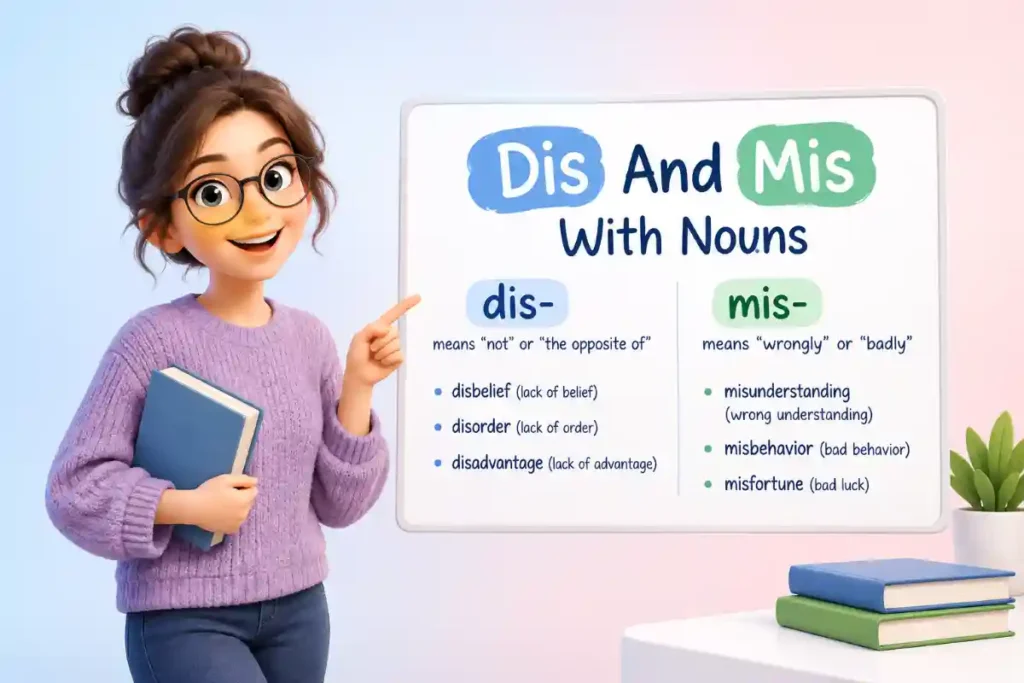
Dis And Mis With Nouns
Many prefixed verbs create related nouns.
Consider:
disagree → disagreement
misunderstand → misunderstanding
misinterpret → misinterpretation
misinform → misinformation
disapprove → disapproval
This is useful for academic and professional writing because you can shift between actions and concepts.
Compare:
The two researchers disagreed.
There was a disagreement between the researchers.
The reader misunderstood the argument.
The misunderstanding affected the discussion.
The writer misinterpreted the evidence.
The misinterpretation changed the conclusion.
Learning these word families gives you more control over sentence structure.
Dis And Mis In Editing
A professional editor looks beyond spelling.
Suppose a writer says:
The reader disinterpreted the sentence.
The problem is not just a missing dictionary check. The writer has chosen the wrong word formation.
The correct form is:
The reader misinterpreted the sentence.
Now consider:
I misapprove of the decision.
The intended meaning may be that the writer does not approve.
The natural word is:
I disapprove of the decision.
An editor therefore asks what the writer actually means before correcting the letters.
That is the heart of good editing. Correct spelling matters, but correct meaning matters more.
Expert Editor’s Note About Dis And Mis Prefixes
The safest approach is to treat dis and mis as related but distinct word forming elements.
Use dis when the established word expresses an opposite, lack, separation, reversal, or related negative relationship.
Use mis when the established word describes something done wrongly, badly, or incorrectly.
Do not invent a word simply because the prefix seems logical. Check a reliable dictionary when you are unsure.
Oxford specifically lists dis and mis as prefixes with different core meanings. Cambridge also separates them in its grammar and dictionary resources. (Oxford Learner’s Dictionaries)
Professional editing also requires attention to register. Disagreement is neutral. Dishonesty can make a serious accusation. Misunderstanding often describes an error without assigning bad intent. Choosing the right word can therefore change the tone of an entire sentence.
Common Questions About Dis And Mis Prefixes
What is the difference between dis and mis
Dis commonly expresses not, the opposite, separation, reversal, or removal. Mis commonly expresses something done wrongly, badly, or incorrectly. For example, disagree means to have a different opinion, while misunderstand means to understand something incorrectly. The prefixes can both create negative words, but they usually describe different kinds of meaning.
Does mis always mean wrong
No. Mis commonly carries the idea of something being wrong, bad, or incorrect, but the exact meaning depends on the complete word. Misread means read incorrectly, while misbehave means behave badly. Some words also have established meanings that are not fully predictable from the prefix alone.
Does dis always mean not
No. Dis often expresses negation, but it can also express ideas such as separation, reversal, or movement away. Disagree expresses an opposing opinion, while disconnect expresses separation. The best way to understand the prefix is to consider the meaning of the complete word.
Can I use dis and mis interchangeably
Usually not. English has established words rather than a fully interchangeable prefix system. We say disagree, not normally misagree. We say misunderstand, not disunderstand. A few pairs overlap in meaning, such as distrust and mistrust, but those cases should be learned as individual vocabulary items.
What does mis mean in misunderstand
In misunderstand, the prefix mis carries the idea of something happening incorrectly. To misunderstand something means to understand it incorrectly or to form the wrong interpretation. The word is therefore built around the idea of an incorrect understanding.
What does dis mean in disagree
In disagree, the prefix dis creates the idea of opposition or difference. To disagree means to have an opinion that differs from another person’s opinion or from a stated position. It does not mean that you performed the action of agreeing incorrectly.
Are dis and mis negative prefixes
Both can create words with negative or unfavorable meanings, but they do different work. Dis often creates opposition, absence, separation, or reversal. Mis often indicates an incorrect or bad action. Calling both simply negative prefixes is useful for a basic introduction, but it does not explain their full meanings.
How can I remember dis and mis
Think of dis as connected with difference, opposition, or separation. Think of mis as connected with mistakes. Disagree shows a different opinion. Disconnect shows separation. Misread shows an incorrect reading. Misunderstand shows an incorrect understanding. These simple associations can help you choose the right word.
Final Takeaway
The biggest difference between dis and mis is the kind of meaning they usually create.
Dis often points toward an opposite, lack, separation, reversal, or removal.
Mis often points toward something done wrongly, badly, or incorrectly.
Compare these four words and the distinction becomes clear.
Disagree means to have a different opinion.
Disconnect means to separate.
Misunderstand means to understand incorrectly.
Misread means to read incorrectly.
The most common mistake is trying to treat dis and mis as interchangeable negative prefixes. They are not. English vocabulary has its own established patterns, and some words simply take one prefix rather than another.
If you are unsure, look at the complete word and ask what it means. Then check a reliable dictionary instead of guessing from the prefix alone.
Once you start seeing dis as difference or separation and mis as a mistake or wrong action, these prefixes become much easier to remember.

Founding Editor
Maya spent six years as a copyeditor at a regional newspaper before starting Grammist, which is where the “answer first” format came from: newsroom style guides don’t have room for a preamble.
She writes and reviews most of the word-pair and spelling entries, and has final say on anything that goes out under the Grammist name.