
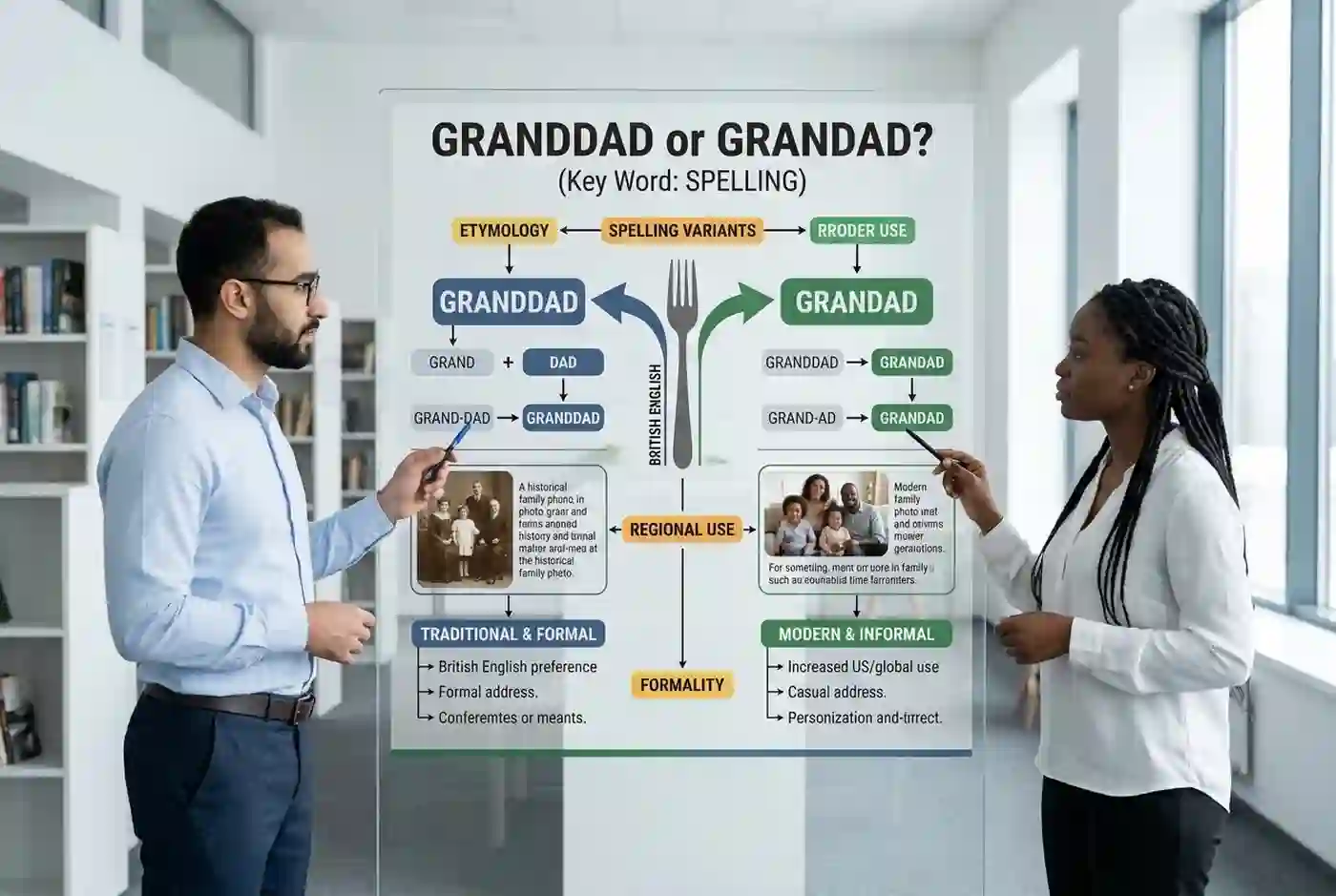
Choosing between granddad or grandad can be confusing because both spellings look right and sound the same. You might see one version in a family message and the other in a British book or an American article. So which spelling should you use?
The good news is that both granddad and grandad are correct. They are informal words for grandfather, meaning the father of your mother or father. The main difference comes down to regional preference and personal choice rather than meaning or grammar.
In American English, granddad is a familiar spelling. In British English, grandad is also widely used, although both forms are understood in Britain. The Oxford Advanced Learner’s Dictionary lists grandad and notes that granddad is especially common in North American English. Collins Dictionary also recognizes both forms.
This guide explains the spelling difference, pronunciation, word history, grammar, capitalization, and regional usage. You’ll also find natural examples for everyday conversations, family messages, workplace writing, and published content. By the end, you’ll know which spelling suits your audience and how to use it naturally.
Quick Answer
Both granddad and grandad are correct spellings of the informal word for grandfather. Granddad is especially familiar in North American English, while grandad is strongly associated with British English. They have the same meaning and pronunciation. Choose the spelling that fits your audience or your family’s preference, then use it consistently.
Granddad vs Grandad At A Glance
| Feature | Granddad | Grandad |
|---|---|---|
| Correct spelling | Yes | Yes |
| Meaning | Grandfather | Grandfather |
| Part of speech | Noun | Noun |
| Pronunciation | /ˈɡrændæd/ | /ˈɡrændæd/ |
| Style | Informal and familiar | Informal and familiar |
| Regional association | Especially North American English | Especially British English |
| Common use | Family conversations and writing | Family conversations and writing |
| Plural | Granddads | Grandads |
| Possessive | Granddad’s | Grandad’s |
| Formal alternative | Grandfather | Grandfather |
| Example | My granddad loves fishing. | My grandad loves fishing. |
The table highlights the main point. Neither spelling is a mistake. The extra d in granddad reflects a spelling variation, not a difference in meaning.
Which Spelling Is Correct
Both spellings are correct. You can use granddad or grandad to refer to your grandfather.
For example:
- My granddad taught me how to ride a bike.
- My grandad taught me how to ride a bike.
Both sentences are grammatically correct and communicate the same idea.
The choice usually depends on regional convention, family preference, or the style of the publication you’re writing for. A British writer may naturally choose grandad, while an American writer may prefer granddad or the equally familiar grandpa.
There is no universal rule that makes one spelling correct and the other incorrect. The important thing is to choose the form that fits your situation.
What Does Granddad Mean
Granddad is an informal noun meaning grandfather. It refers to the father of one of your parents.
For example, if your mother’s father tells you a story about his childhood, you might say:
My granddad told me a story about his childhood.
The word sounds warm and familiar. People often use it when speaking to relatives, talking about childhood memories, or writing personal messages.
Granddad can refer to a grandfather on either side of the family. You might have a maternal granddad, who is your mother’s father, and a paternal granddad, who is your father’s father.
The word doesn’t identify a person’s age, personality, or relationship with their grandchildren beyond the family connection. A granddad may be young or old, playful or serious, nearby or living far away.
Dictionary references classify granddad as an informal word for grandfather. Dictionary.com also traces it to the combination of grand and dad.
What Does Grandad Mean
Grandad has the same meaning as granddad. It is an informal noun for a person’s grandfather.
For example:
My grandad takes me to the park every Sunday.
The sentence means exactly the same thing as it would with granddad.
Grandad is particularly familiar in British English. It’s common in family conversations, children’s stories, personal writing, and everyday references to a grandfather. However, people outside Britain can use it too.
The spelling is also easy to recognize because it combines grand and ad, a familiar informal form related to dad. The missing second d doesn’t change how the word sounds.
According to Oxford Learner’s Dictionaries, grandad is an informal term for grandfather, with granddad especially noted in North American English.
The Main Difference Between Granddad And Grandad
The main difference is regional preference, not definition.
Granddad is particularly familiar in North American English. Grandad is closely associated with British English. Both forms are valid, and neither has a different family meaning.
Consider these examples:
American style
My granddad lives in Ohio and visits us every summer.
British style
My grandad lives in Leeds and visits us every summer.
The spellings fit their respective regional settings, but either sentence would be understood in both countries.
Personal preference also plays a role. Some families have always written Grandad, while others use Granddad. A family may even prefer Grandpa, Gramps, or another nickname.
If you’re writing a story or article for a particular audience, follow the spelling that best matches its language variety. For a personal card or message, the family’s preferred form is usually the best choice.
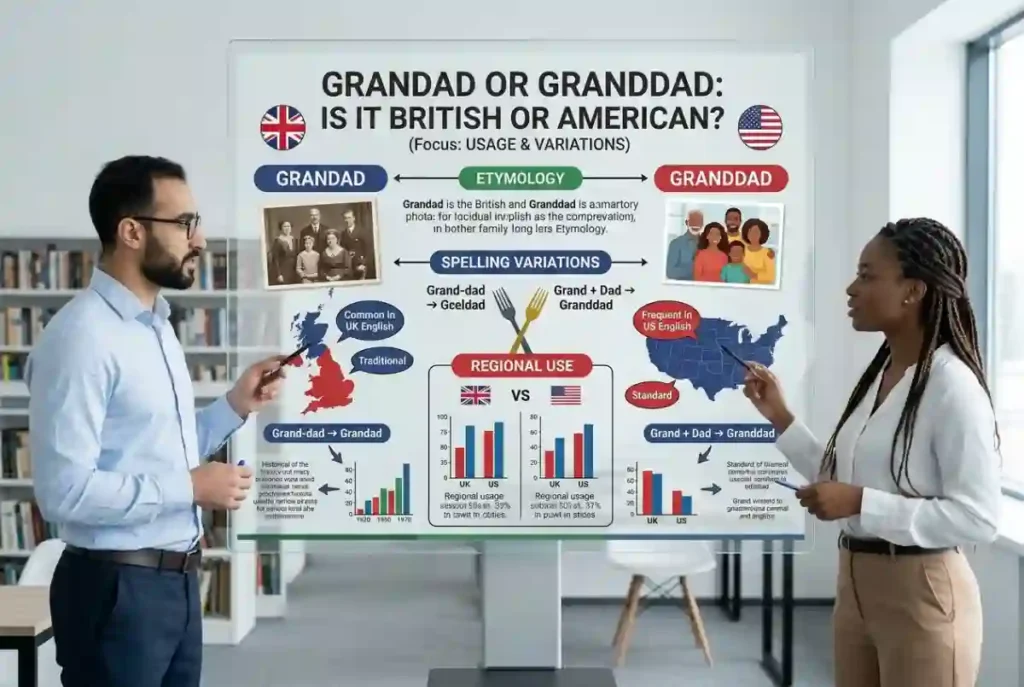
Is Grandad British And Granddad American
That is a useful general guide, but it is not an absolute rule.
Grandad is strongly associated with British English, while granddad is especially common in North American English. Authoritative dictionaries recognize both spellings, and British English does not exclude granddad. Likewise, grandad remains understandable to American readers.
In the United States, grandpa is also a familiar everyday choice. Some American families use granddad, while others prefer grandpa, papa, or a name unique to the family.
British families may choose grandad, granddad, grandpa, or another personal term. These choices often reflect family tradition rather than a fixed national rule.
Canadian English also recognizes both spellings, alongside grandpa and grandfather. Australian English uses familiar family terms such as grandad and grandpa, with individual preferences varying by family and context.
The safest approach is to treat the regional associations as helpful patterns rather than strict boundaries.
Granddad And Grandad Pronunciation
The words granddad and grandad are pronounced the same way in standard English. The additional d in granddad does not create another spoken sound.
Their usual pronunciation is represented in IPA as:
/ˈɡrændæd/
Both words have two syllables:
- Grand is the first syllable.
- Dad is the second syllable.
The main stress falls on the first syllable. In everyday speech, the words sound like the familiar combination of grand and dad.
Say both versions aloud:
- My granddad is funny.
- My grandad is funny.
You should hear no difference in the spoken word. The spelling distinction appears only on the page.
Common Pronunciation Mistakes
The most useful thing to remember is that you don’t need to change your pronunciation to match the spelling.
Some learners may try to give granddad an extra beat because it has an additional letter. That isn’t necessary. Both forms have two syllables.
The pronunciation may vary slightly from speaker to speaker because English accents differ. Those natural accent differences do not make one spelling more correct than the other.
Granddad And Grandad Grammar
Both words function as nouns. They follow the same basic grammar rules, so choosing one spelling does not change the sentence structure.
Using Granddad Or Grandad In A Sentence
You can use either word as the subject or object of a sentence.
As the subject
My granddad lives near the beach.
My grandad lives near the beach.
As the object
We visited granddad yesterday.
We visited grandad yesterday.
After a preposition
I learned that recipe from my granddad.
I learned that recipe from my grandad.
Each pair is grammatically correct. The spelling choice does not affect the role of the noun.
The Plural Forms
The standard plural forms are granddads and grandads.
Add s to whichever spelling you choose.
- Both granddads attended the family dinner.
- The children made cards for their grandads.
- My two granddads enjoy gardening.
- Her grandads live in different cities.
The plural does not require an apostrophe. Writing granddad’s to mean more than one granddad is incorrect.
An apostrophe has a different job. It usually marks possession or a contraction, not a regular plural.
The Possessive Forms
Use an apostrophe and s to show that something belongs to a granddad or grandad.
Singular possessive
- My granddad’s car is blue.
- My grandad’s birthday is in July.
- Granddad’s favorite chair is beside the window.
Plural possessive
- The granddads’ stories made everyone laugh.
- Both grandads’ photographs were displayed at the reunion.
In the plural possessive forms, the apostrophe follows the final s. This signals that something belongs to more than one granddad or grandad.
Capitalization Rules
Capitalize Granddad or Grandad when you use it as a name in place of a person’s name.
Examples
- I asked Granddad to help me.
- We are visiting Grandad this weekend.
- Granddad told us a story.
Keep the word lowercase when you use it as a common noun.
Examples
- My granddad is visiting this weekend.
- Her grandad lives in London.
- I called my granddad last night.
A helpful test is to replace the word with the person’s name. If the word functions like a name in the sentence, capitalization is usually appropriate.
Family members sometimes use their preferred spelling and capitalization as a personal convention. Follow that preference in a card, family history, or personal message.
Common Grammar Errors
Watch out for these frequent mistakes:
- Incorrect: My granddad are coming today.
Correct: My granddad is coming today. - Incorrect: I visited my grandads house.
Correct: I visited my granddad’s house. - Incorrect: Both granddad’s attended the party.
Correct: Both granddads attended the party.
The first example has an agreement problem. The other two confuse a possessive apostrophe with the spelling of an ordinary plural or possessive noun.
Granddad vs Grandad Word Origin And History
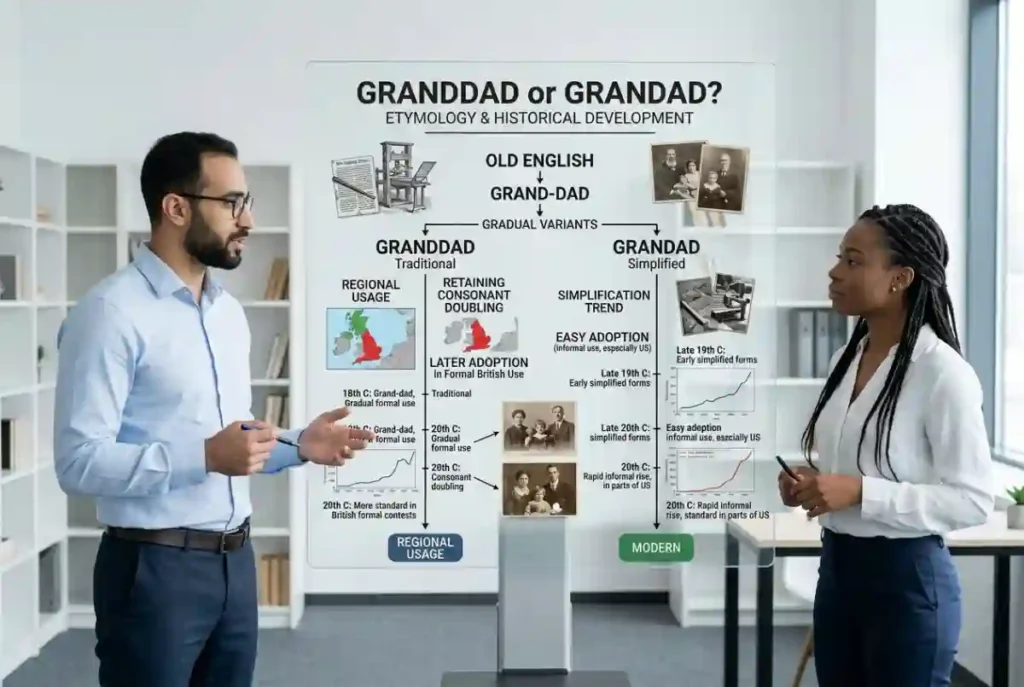
Both forms developed from the combination of grand and dad. The word grand appears in family terms to indicate a generation above or below a person, as in grandmother, grandfather, grandson, and granddaughter.
The informal word dad means father. Combining grand with dad creates a familiar label for a grandfather.
The Online Etymology Dictionary records grandad, also spelled granddad, from 1793. It also records the earlier form grand dada from the 1690s. These dates show that the family term has a long history in English.
The spellings developed as informal vocabulary rather than as a strict pair of regional spelling rules. Over time, both became established forms.
This history also explains why the words have the same meaning. They grew from the same basic parts, and the extra d in one modern spelling does not indicate a separate family relationship.
Why People Confuse Granddad And Grandad
The confusion is understandable because the words look almost identical and sound exactly alike.
The Extra Letter
The most obvious difference is the second d in granddad. In grandad, the word ends with a single d before the final part of the compound is complete.
Since the difference is so small, a writer may not notice it while typing. Both versions look plausible, and both are accepted.
Pronunciation Does Not Help
Unlike word pairs that sound different, granddad and grandad offer no spoken clue to the correct spelling for a particular audience. A learner can know the word perfectly well and still hesitate when writing it.
The solution is to learn the two accepted spellings along with their regional associations.
Regional Habits
Readers often become familiar with the version they see most often in their own region.
Someone who regularly reads British books may instinctively type grandad. An American writer may be more used to granddad or grandpa.
Neither habit proves that the other form is wrong. Familiarity explains the preference.
Typing And Autocorrect
Autocorrect may accept one form, suggest another, or leave the spelling unchanged. That behavior does not establish a spelling rule.
A spellchecker can help identify an accidental typo, but it may not know the preference of your audience. Check the style guide or dictionary for your intended English variety when consistency matters.
Online Spelling Myths
You may come across claims that grandad is always British and granddad is always American. Those claims are too absolute. Dictionaries recognize both forms and show that the main distinction is regional tendency rather than a rule that excludes either spelling from a country.
The practical lesson is simple. Don’t correct an accepted spelling just because it differs from your own preference.
Granddad Or Grandad In Everyday Writing
Both spellings work in personal writing, family conversations, and informal storytelling. The best choice depends on the reader and the tone you want to create.
Here are examples showing how the words fit different situations.
Daily Conversation
- My granddad makes the best pancakes.
- I am going to see my grandad this afternoon.
- Granddad always knows how to make me laugh.
- My grandad taught me to ride a bicycle.
- We spent the whole summer visiting our granddad.
Family Messages And Greeting Cards
- Happy birthday to the best granddad in the world.
- Thank you for all the wonderful memories, Grandad.
- I hope my granddad knows how much I love him.
- Sending love to Granddad on Father’s Day.
- We made a photo album filled with pictures of our grandad.
Workplace And Professional Writing
The words are informal, so grandfather may suit a formal document better. However, granddad and grandad fit naturally when the writing discusses personal experiences.
- In the interview, the founder explained how his granddad inspired his interest in engineering.
- The employee shared a lesson about patience that he learned from his grandad.
- My granddad encouraged me to pursue a career in education.
- Her grandad helped her start the family business.
Academic Writing And School Assignments
A school essay about family history or personal experience can use either spelling.
- My granddad grew up in a small farming town.
- The essay describes the lessons I learned from my grandad.
- My granddad taught me the importance of keeping family traditions alive.
- I interviewed my grandad for a school project about local history.
In a formal research paper, use grandfather when it fits the style and purpose better. If the word appears in a direct quotation, preserve the spelling used in the original.
Stories And Journalism
Both spellings can appear in personal stories, interviews, memoirs, and news articles.
- Her granddad saved old letters that told the story of his childhood.
- The article describes how his grandad influenced his love of music.
- My granddad told me stories about the neighborhood before it changed.
- The documentary follows a young musician who learned from her grandad.
- In his memoir, the writer remembers the summer he spent with Granddad.
These are original examples rather than quotations from published works. They show how the words can fit different types of writing without changing their meaning.
Granddad Or Grandad In Formal Writing
Neither spelling is inherently incorrect in formal writing, but both are informal family terms. The appropriate choice depends on the kind of document you’re preparing.
For a personal essay, a family memoir, or a speech, granddad or grandad may sound natural and sincere. In a legal document, academic paper, or official family record, grandfather is often the clearer choice.
Consider these examples.
Informal
My granddad taught me how to repair an old car.
More formal
My grandfather taught me how to repair an old car.
The meaning remains the same, but the second sentence uses a more formal family term.
If you’re quoting a relative or reproducing someone’s exact words, retain their original wording. Editing a quotation to make it sound more formal could change the speaker’s voice.
Granddad Vs Grandpa Vs Grandfather
English has several words for a grandfather. They share a basic meaning, but their tone and regional use can differ.
| Word | Meaning | Typical tone |
|---|---|---|
| Granddad | Grandfather | Informal and familiar |
| Grandad | Grandfather | Informal and familiar |
| Grandpa | Grandfather | Informal and affectionate |
| Grandfather | Father’s or mother’s father | Neutral or formal |
| Gramps | Grandfather | Casual and affectionate |
| Granddaddy | Grandfather | Affectionate and often associated with American usage |
| Papa | A family term for a father or grandfather | Personal and affectionate |
These words are not always interchangeable in every family. A child may call one relative Grandpa and another Granddad. Another family may use Papa or a nickname based on the person’s name.
The family’s established preference usually matters more than a dictionary’s regional label.
Granddad Vs Grandpa
Both words refer to a grandfather, but they have different spellings and sounds.
Granddad combines grand and dad. Grandpa combines grand and pa, a familiar form associated with papa.
Granddad may sound more natural to someone who grew up using that family term. Grandpa may feel more familiar to someone whose relatives have always used it.
Neither word is more correct. Choose the one that matches your intended meaning and the person’s preferred such as name.
Granddad Vs Grandfather
The main difference is formality.
Grandfather is a standard term suitable for formal and informal contexts. Granddad is more conversational and personal.
For example:
- My grandfather worked as a teacher.
- My granddad worked as a teacher.
Both are correct. The first sounds more neutral, while the second creates a more familiar tone.
Memory Tricks For Granddad vs Grandad
Remembering both spellings is easy once you connect each form with its regional association.
Remember The Extra D
Think of granddad as grand plus dad. The word dad begins with a d, and that spelling helps you remember the double d in the complete word.
The other accepted form, grandad, uses one d at the point where the two parts meet.
This trick helps you recall both versions without treating either as an error.
Connect Grandad With British English
If you often write for a British audience, remember that grandad is a familiar British form.
For a North American audience, granddad is a useful spelling to remember, although grandpa is also common.
These associations are guides rather than strict rules.
Choose One Form For Each Project
When writing a long article, memoir, or family history, choose one spelling and keep it consistent.
For example, if you begin with my grandad taught me to cook, keep using grandad throughout the same narrative unless a quotation or another person’s chosen name requires a different form.
Consistency makes editing easier and prevents accidental changes in spelling.
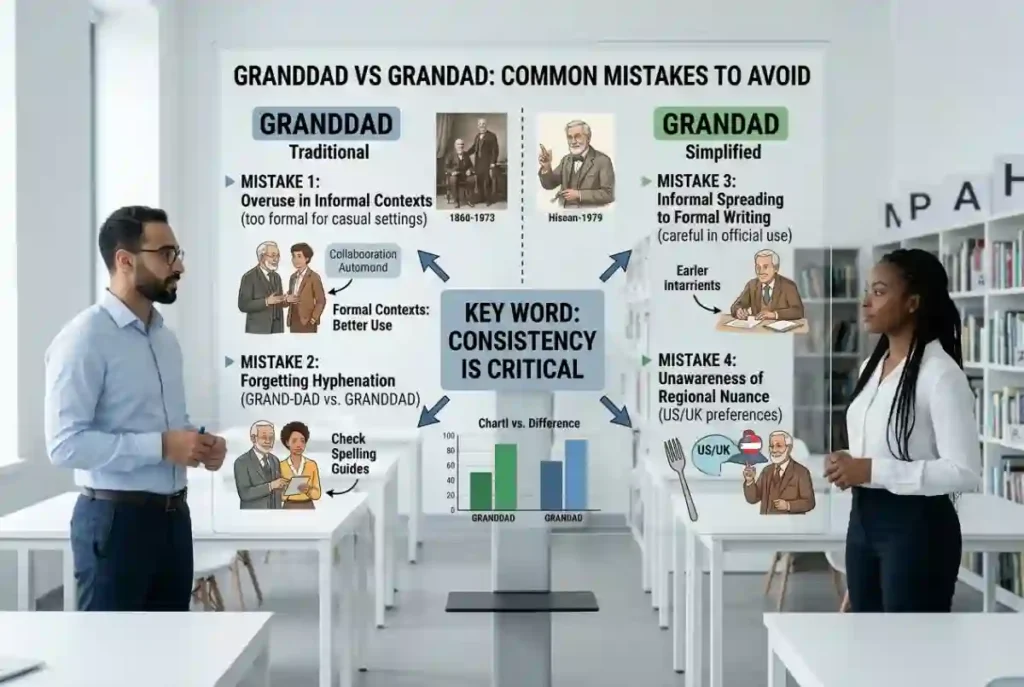
Granddad vs Grandad Common Mistakes To Avoid
Treating One Spelling As Wrong
The most common mistake is assuming that grandad is a misspelling of granddad or the other way around.
Both spellings are accepted. Correcting one to the other without considering context may introduce an unnecessary change.
Changing The Pronunciation
The extra d does not add a syllable. Both forms have the same standard pronunciation.
Don’t try to pronounce granddad differently just because it contains one extra letter.
Using An Apostrophe For The Plural
The plural of granddad is granddads. The plural of grandad is grandads.
Apostrophes are not needed to form these plurals.
Write:
Both granddads attended the wedding.
Do not write:
Both granddad’s attended the wedding.
The second version incorrectly uses a possessive form.
Ignoring Capitalization
Capitalize the word when you use it as a name.
Granddad is coming over today.
Use lowercase when you identify the relationship.
My granddad is coming over today.
The same rule applies to grandad.
Assuming A Dictionary Preference Is An Exclusive Rule
A dictionary may label one spelling as British or note that another is especially common in North America. That information describes usage. It doesn’t automatically make the less common regional form incorrect.
For careful editing, check the dictionary relevant to your audience and follow the chosen style consistently.
Expert Editor’s Note About Granddad vs Grandad
From an editor’s perspective, granddad and grandad are spelling variants of the same informal noun. The choice is about audience, convention, and personal preference rather than a difference in meaning.
Oxford Learner’s Dictionaries lists grandad and recognizes granddad as an alternative, especially in North American English. Collins Dictionary also recognizes both forms. These dictionary entries support treating the two spellings as valid rather than labeling one an error.
For American English content, granddad is a sensible choice if you want to use the spelling that fits common North American usage. For British English content, grandad is a natural option. If a publisher provides a house style, follow it.
Family terms also carry personal meaning. A name that looks unusual to an editor may reflect a family’s long standing preference. Avoid changing it simply to match your own habit.
The strongest editorial decision is the one that maintains accuracy and consistency while respecting the intended voice.
Frequently Asked Questions
Is granddad or grandad correct
Both granddad and grandad are correct. They are informal words for grandfather and have the same pronunciation and meaning. Granddad is especially familiar in North American English, while grandad is strongly associated with British English. Choose the form that matches your audience or your family’s preference.
Is grandad a misspelling of granddad
No. Grandad is an accepted spelling rather than a mistake. Dictionaries recognize it as an informal term for grandfather. Although granddad contains an extra d, the additional letter does not change the meaning or pronunciation. Both spellings work in everyday English.
Which spelling is more common in American English
Granddad is especially familiar in North American English. However, many American families use grandpa, and grandad is also understood. If you’re writing for an American audience, granddad or grandpa will usually feel natural. Follow the spelling used by the person or family you’re describing when that preference is known.
Which spelling is more common in British English
Grandad is strongly associated with British English and is a natural choice for British readers. However, granddad is also used in Britain. Both are correct, so you don’t need to change an established spelling just because the audience is British.
Do granddad and grandad sound different
No. Both words have the same standard pronunciation, usually represented as /ˈɡrændæd/. Each word has two syllables, with stress on the first. The additional d in granddad is a spelling difference rather than an extra spoken sound.
What is the plural of granddad and grandad
The plural forms are granddads and grandads. Add s to the spelling you have chosen. No apostrophe is needed for a regular plural. Use an apostrophe only when the sentence requires a possessive, as in my granddad’s garden or both grandads’ stories.
Should I capitalize granddad or grandad
Capitalize the word when it functions as a name, as in Grandad is visiting today. Use lowercase when it describes a family relationship, as in My grandad is visiting today. Personal family conventions may differ, so follow the preferred form when writing a card or family record.
Is granddad suitable for formal writing
Both forms are informal, so grandfather often suits formal or academic writing better. Still, granddad or grandad can be appropriate in personal essays, interviews, memoirs, and direct quotations. The main goal is to use language that fits the document and preserves the speaker’s intended meaning.
Final Verdict
Both granddad and grandad are correct. They mean the same thing, sound the same, and follow the same grammar rules.
The main distinction is regional preference. Granddad is especially familiar in North American English, while grandad is strongly associated with British English.
For American content, choose granddad unless a family or publication has a different preference. For British content, grandad is a natural choice. In either case, remain consistent throughout the same piece of writing.
Most importantly, don’t mistake an accepted variant for a spelling error. The best spelling is the one that fits your audience and respects the name your family uses.

Founding Editor
Maya spent six years as a copyeditor at a regional newspaper before starting Grammist, which is where the “answer first” format came from: newsroom style guides don’t have room for a preamble.
She writes and reviews most of the word-pair and spelling entries, and has final say on anything that goes out under the Grammist name.