
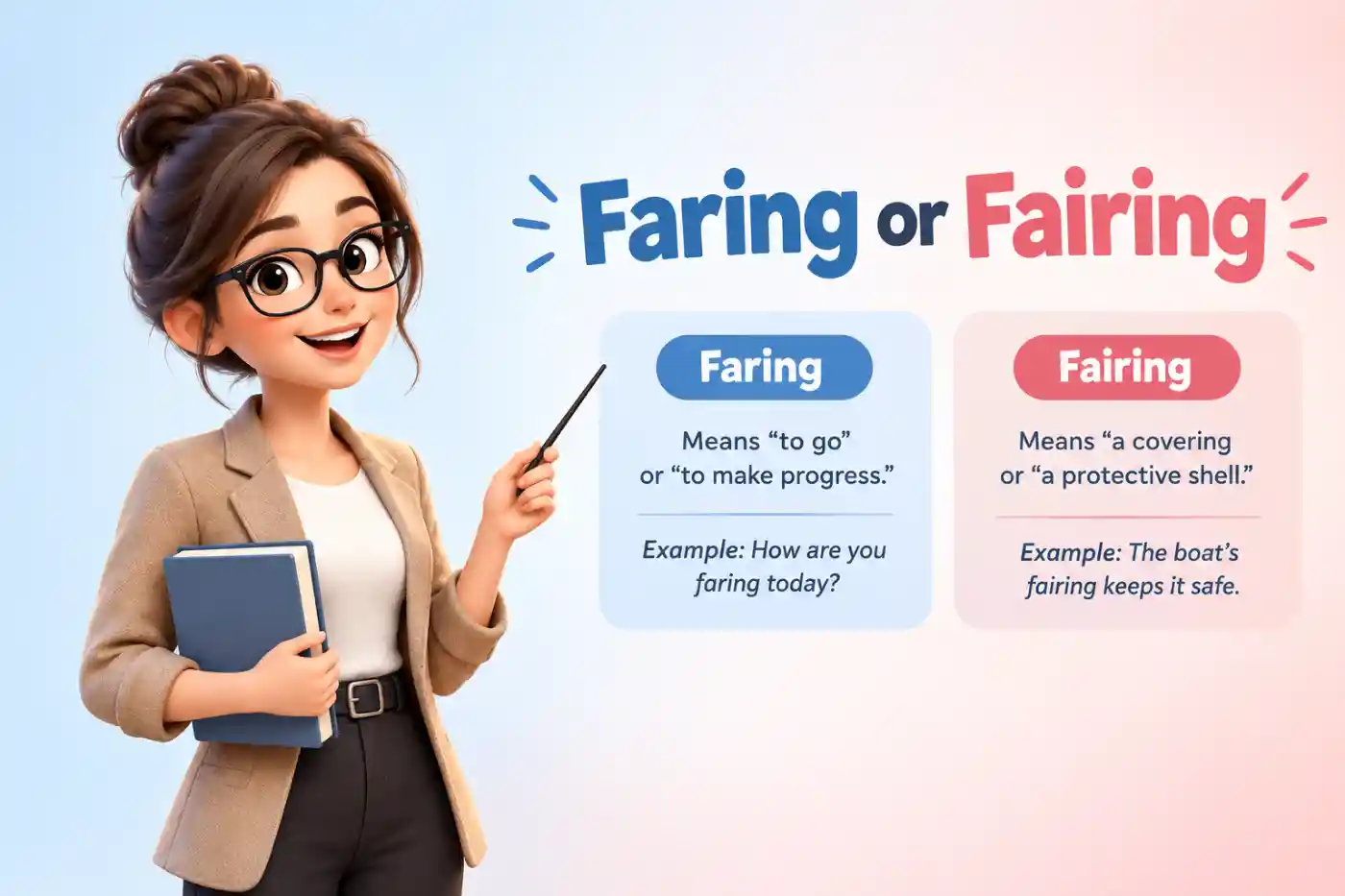
The words faring and fairing sound almost identical, but they have different meanings and grammatical uses. If you are writing about how someone is doing in life or how a business is performing, faring is the word you need. If you are describing a protective cover on a motorcycle or an aerodynamic panel on an aircraft, fairing is correct.
The confusion makes sense because both words share the same pronunciation in most varieties of English. They also look nearly identical, with just one extra letter separating them. Spellcheck may not catch the mistake because both spellings are legitimate English words.
Choosing the correct form becomes much easier once you connect each word to its purpose. This guide explains the meaning of faring and fairing, the grammar behind each spelling, their origins, and the situations where you will see them in everyday writing. You will also find practical examples from conversations, business writing, transportation, and technical contexts, along with memory tricks and answers to common spelling questions.
Quick Answer About Faring or Fairing
Faring is the correct spelling when you mean doing well or badly or making progress. It is the present participle of the verb fare. Fairing usually refers to a smooth cover or structure that reduces air resistance on an aircraft or vehicle. Both spellings are correct English words, but they serve different purposes.
Faring vs Fairing Comparison Table
| Feature | Faring | Fairing |
|---|---|---|
| Root word | Fare | Fair |
| Main meaning | Doing or progressing | A streamlined cover or structure |
| Usual part of speech | Verb form | Noun |
| Other grammatical use | Gerund | Verb form in technical contexts |
| Typical context | Work school health business and sports | Aircraft motorcycles rockets boats and bicycles |
| Pronunciation | Usually sounds like fairing | Usually sounds like faring |
| Example | How are you faring at work? | The motorcycle needs a new fairing. |
| Correct replacement | Doing or progressing | A cover or streamlined structure |
| Common mistake | Using fairing to mean doing | Using faring to mean a vehicle part |
The most useful distinction is simple. Faring describes how someone or something is doing. Fairing usually names a physical structure. Once you identify the meaning of your sentence the spelling becomes much easier to choose.
What Does Faring Mean
Faring is the present participle of fare. When fare works as a verb it can mean to do or progress in a particular way. It can also describe how a person manages a situation or experiences a result. The word often appears with an adverb such as well badly better or poorly. Cambridge Dictionary
For example you might ask how a friend is faring after moving to a new city. A manager might discuss how a company is faring during a difficult year. A teacher could describe how students are faring in a challenging course.
In each case the word refers to progress or performance rather than a physical object.
Faring as a Verb Form
Faring belongs to the same verb family as fare fares and fared.
| Verb form | Example |
|---|---|
| Base form | I hope you fare well. |
| Third person singular | The team fares better at home. |
| Past tense | She fared well in the interview. |
| Present participle | He is faring well in his new role. |
| Past participle | The company has fared better this year. |
The present participle often appears after a form of be to create a continuous verb phrase. In the sentence The business is faring well the phrase is faring describes how the business is doing at the present time.
Faring can also act as a gerund when the verb form functions as a noun. For example Faring well in a new role takes time uses faring well in a new role as the subject of the sentence.
Common Expressions With Faring
Faring often appears in expressions about progress and personal circumstances.
The word Faring well means doing well or making good progress.
- The new restaurant is faring well despite strong competition.
- My sister is faring well at university.
- The project is faring well after a slow start.
Faring badly means experiencing difficulty or poor results.
- Small shops are faring badly during the roadworks.
- Several teams are faring badly this season.
- He was faring badly before he found a better support system.
The word Faring better compares someone’s current situation with another time or person.
- The business is faring better than expected.
- How are you faring compared with last month?
- The students are faring better with the new teaching method.
Faring poorly is a slightly more formal way to describe weak performance or difficult circumstances.
- The local economy is faring poorly.
- Some applicants are faring poorly in the new selection process.
Is Faring the Same as Doing
In many sentences faring can be replaced with doing without changing the main idea.
- How are you faring? becomes How are you doing?
- The company is faring well becomes The company is doing well.
- The team is faring badly becomes The team is doing badly.
This substitution is one of the easiest ways to check your spelling. If doing fits naturally in the sentence use faring rather than fairing.
The two words are not perfect synonyms in every context. Fare can also relate to travel or food in other uses. Still the doing test works well for the common expression about progress.
What Does Fairing Mean
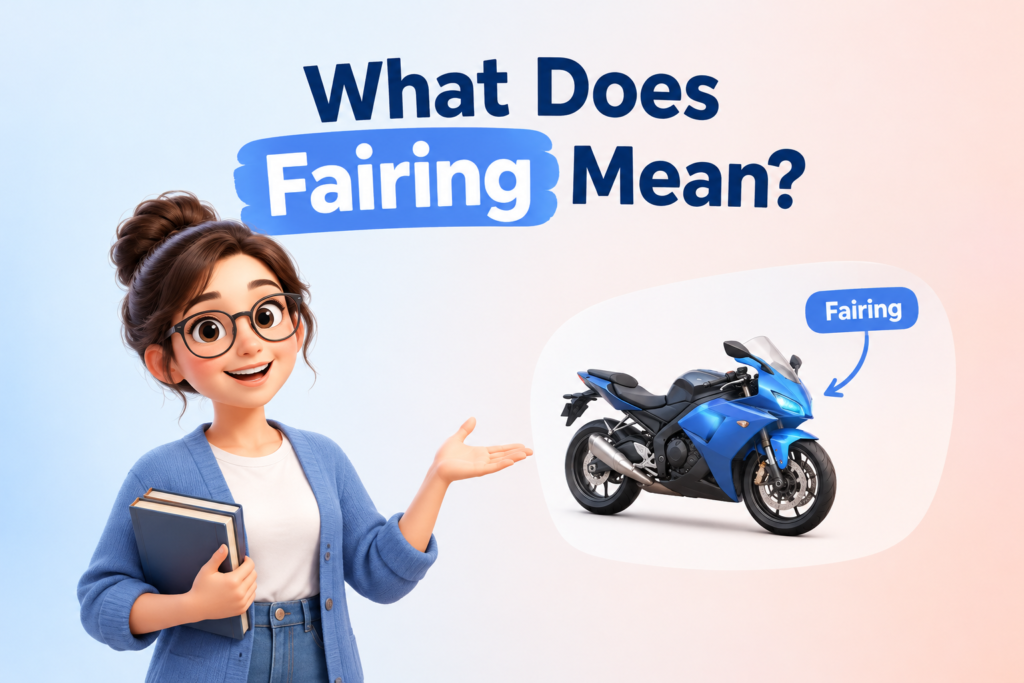
Fairing most often refers to a structure or cover designed to create a smoother outer shape. In engineering and transport it can reduce drag or protect parts from wind and weather. Fairings appear on motorcycles aircraft bicycles boats rockets and spacecraft. Dictionary.com
The exact purpose depends on the object. A motorcycle fairing can help deflect wind and rain away from the rider. An aircraft fairing can smooth the transition between parts of the plane. A rocket payload fairing protects equipment during the early stages of flight.
Unlike faring in the sense of making progress fairing usually names a thing you can see or touch.
Fairing on a Motorcycle
Motorcycle fairings are body panels fitted around parts of a bike. Depending on the design they can improve airflow protect some components and offer a degree of protection from wind and road debris.
Examples include:
- The mechanic replaced the cracked fairing.
- A loose fairing caused a rattling noise at high speed.
- She chose a motorcycle with a full fairing for longer trips.
- The front fairing was damaged during the fall.
- The replacement fairing matched the original paint.
In all five examples the word identifies a physical component. Writing faring would change the spelling to a verb form and would not name the motorcycle part correctly.
Fairing on an Aircraft
Aircraft designers use fairings to smooth areas where parts meet or where equipment would otherwise create extra drag. Their shape and location depend on the aircraft and the job the component needs to perform.
Examples include:
- The inspection revealed a crack in the wing fairing.
- Engineers redesigned the fairing to improve airflow.
- The aircraft returned to service after the damaged fairing was repaired.
- Technicians checked the fairing before the next test flight.
- The new design uses a lighter composite fairing.
Technical writing often places fairing next to terms such as aerodynamic drag fuselage wing and composite material. These nearby words provide useful clues about its meaning.
Fairing on a Rocket or Spacecraft
A rocket fairing is a protective outer cover that surrounds a payload during launch. The payload might include a satellite or scientific equipment. The fairing shields the payload from airflow and other launch conditions until the vehicle reaches the point where the cover can be released.
Examples include:
- The rocket fairing enclosed the satellite before launch.
- Engineers tested the payload fairing before the mission.
- The fairing separated after the vehicle passed through the early part of its flight.
- The team checked the protective fairing for damage.
- A larger fairing allowed the rocket to carry a bigger payload.
These examples also show why the word matters beyond motorcycles. In aerospace writing fairing is a specific technical term rather than a general word for doing well.
Fairing as a Verb Form
There is a less familiar grammatical use of fairing. The verb fair can mean to smooth or shape a surface so that it blends into the surrounding surface. In this technical sense fairing is the present participle of fair.
For example:
- The technician is fairing the surface before applying the finish.
- The crew spent the afternoon fairing the hull.
- The engineer checked the fairing work before painting began.
This use is common in certain engineering boatbuilding and construction contexts. It does not mean that someone is progressing well. The intended action is smoothing or shaping a surface.
Fairing in Older British Usage
Fairing has also appeared as a noun in older British usage for a gift or treat associated with a fair. Some dictionaries record additional regional or historical meanings. These uses are much less common in modern everyday English than the technical meaning.
For most modern writing the surrounding context makes the intended meaning clear. A sentence about an aircraft points to the technical noun. A sentence about an old custom or a traditional fair may use one of the historical meanings.
Grammar Rules for Faring and Fairing
Understanding the grammar behind these forms helps you avoid mistakes in longer sentences.
How to Form Faring From Fare
The verb fare forms its present participle by adding ing and dropping the final silent e.
The pattern is:
- fare becomes faring
- care becomes caring
- share becomes sharing
- stare becomes staring
The spelling follows a familiar English rule. When a verb ends in a silent e the final e is usually dropped before adding ing.
That is why faring has no second letter i after the a. The word comes from fare rather than fair.
How Faring Works in Continuous Tenses
The present continuous uses a form of be followed by the present participle.
- I am faring well.
- She is faring better at her new school.
- They are faring badly in the competition.
The past continuous follows the same pattern with was or were.
- The company was faring well before costs increased.
- The players were faring better during the second half.
These sentences describe a situation in progress during a particular period.
How Faring Works With Have
The present perfect uses have or has followed by the past participle. In the case of fare the past participle is fared.
- I have fared well in similar situations.
- She has fared better since changing jobs.
- The team has fared poorly against stronger opponents.
Do not write has faring or have faring when you mean the present perfect. Use has fared or have fared.
The distinction is between the present participle faring and the past participle fared.
How to Use Fairing as a Noun
When fairing names a physical component it can be singular or plural.
- The fairing is damaged.
- The fairing was replaced.
- The fairings are stored in the workshop.
- Both fairings need inspection.
Use a or the when the grammar requires an article.
- A fairing protects the equipment.
- The fairing was removed for repairs.
The plural form is fairings. It does not change to fairings with any special spelling adjustment beyond adding s.
How to Use Fairing as a Verb
In specialist contexts fairing can be the present participle of fair when that verb means smoothing a surface.
- The builder is fairing the hull.
- They are fairing the edges before painting.
In this construction fairing describes an action. The object of the action may be a hull surface or another part that needs to blend smoothly with the surrounding shape.
The technical meaning is quite different from faring well. A reader needs the context to identify the correct sense.

Why People Confuse Faring or Fairing
The confusion between faring and fairing comes from their similar appearance and pronunciation. Both words contain the same basic sound pattern and end with the letters ing. In ordinary conversation you may not notice any difference at all.
Their meanings are different because they come from different root words. Remembering those roots is more reliable than trying to hear a spelling difference that usually does not exist.
They Sound Almost Identical
In most common varieties of English faring and fairing are homophones. Homophones are words that sound the same but have different meanings or spellings.
Other familiar examples include right and write or brake and break. The sound alone cannot tell you which word a writer intends.
That is why the sentence context matters so much. If someone says a company is faring well the discussion is about performance. If a mechanic mentions a damaged fairing the discussion is about a vehicle component.
The Extra Letter Looks Easy to Miss
The visual difference is small. Faring contains one letter fewer than fairing. When you type quickly it is easy to add or omit the letter without noticing.
This is especially common when a writer has heard the word but has not seen it in print. Someone who knows the phrase faring well from conversation might assume the spelling contains fair because the sounds match.
Reading the complete sentence before choosing the word can prevent this error.
Spellcheck May Not Catch the Mistake
Most spelling tools recognize both forms as valid English words. A spellchecker may therefore accept The team is fairing well even though the writer intends to say that the team is doing well.
This is a context error rather than a simple spelling error. The software sees a real word but may not understand that the word does not fit the intended meaning.
Grammar and proofreading tools can sometimes flag such problems, but they are not guaranteed to identify every incorrect word choice. A quick meaning check is still useful.
The Word Fair Can Be Misleading
The word fair is familiar and has several meanings. It can describe something just or reasonable. It can also mean attractive or moderately good in certain contexts.
That familiarity may tempt writers to use fairing when they mean doing reasonably well. However fairing is not the normal spelling for the idea of making progress.
The verb fare carries the meaning in expressions such as fare well and fare badly. Its present participle is faring.
Internet Advice Can Oversimplify the Difference
Some spelling discussions present one form as correct and the other as incorrect. That advice misses the important point. Both forms exist and both are correct in suitable contexts.
The error occurs when writers treat them as interchangeable. The right approach is to connect each spelling with its meaning rather than memorize one as correct in every situation.
Pronunciation of Faring and Fairing
Faring and fairing are normally pronounced alike. In many American accents the pronunciation is close to FAIR ing. Both have two syllables with the main stress on the first syllable.
A broad phonetic representation is /ˈfɛrɪŋ/ in many American pronunciations. Exact vowel symbols vary by accent and dictionary transcription. The important practical point is that both spellings share the same pronunciation in common English speech.
How to Say Each Word
Break the word into two parts.
- Faring sounds like FAIR plus ing.
- Fairing sounds like FAIR plus ing.
Do not try to add an extra syllable to fairing because it contains an extra letter. The extra letter changes the spelling not the usual syllable count.
Can Pronunciation Help You Choose
Usually not. Since the words sound alike pronunciation cannot reliably identify the intended spelling.
Use meaning instead. If you are describing how someone is doing choose faring. If you mean a vehicle cover choose fairing.
The Origin of Faring and Fairing
The words developed from different roots. Their modern meanings make more sense once those roots are clear.
The History of Faring
Faring comes from the verb fare. The verb has a long history in English and traces back to Old English faran which meant to travel or go. Over time fare developed several related meanings including getting along managing a situation and experiencing a particular result.
The older sense of going or traveling still appears in expressions such as fare forth in older writing. In modern everyday English the most familiar verbal use is often about how someone or something is doing.
That history explains why faring is linked to progress rather than physical equipment.
The History of Fairing
The technical noun fairing developed from fair used as a verb in shipbuilding and related trades. In this technical sense fair refers to making a surface smooth or bringing curves into a regular shape. The noun later described a structure that creates a smoother outline. Etymonline records the technical sense from the nineteenth century.
The connection to smoothness helps explain why the word is used in aerodynamics. A fairing can make a structure’s outer shape more streamlined and help reduce drag.
The two words therefore differ for a historical reason as well as a modern grammatical one. Faring comes from fare. Technical fairing comes from fair.
Faring or Fairing in British and American English
The difference between faring and fairing is not a standard British versus American spelling difference. Both spellings are used in British and American English, but their meanings remain distinct.
American English
American writers use faring when discussing progress or performance.
- How is your new business faring?
- The team is faring better this season.
They use fairing for the relevant technical structure.
- The motorcycle fairing needs repair.
- Engineers inspected the rocket fairing.
British English
British English follows the same main distinction.
- The students are faring well in their exams.
- The aircraft needs a replacement fairing.
Older British writing may also use fairing for a traditional gift or treat associated with a fair. This is a historical or regional meaning rather than a spelling variation of faring.
Canadian and Australian English
Canadian and Australian English also use faring for progress and fairing for the technical noun. Local pronunciation and vocabulary preferences can vary, but the main spelling distinction remains the same.
For international writing choose the spelling that matches your intended meaning. There is no need to change faring to fairing to suit a particular English speaking region.
Real Life Examples of Faring Or Fairing
Examples are often the quickest way to recognize the correct form. The following sentences show how both words work in different settings.
Daily Conversation
- How are you faring after your first week at work?
- I hope you are faring well in your new home.
- How is your brother faring after the move?
- The family is faring better now that everyone has settled in.
Workplace and Business
- The company is faring well despite rising costs.
- Our sales team is faring better than it did last quarter.
- The manager asked how the new project was faring.
- Small businesses are faring poorly in the current market.
Emails and Professional Updates
- I wanted to check how you are faring with the new assignment.
- Please let me know how the project is faring after the latest changes.
- The department is faring well under the revised schedule.
- We will review how the team is faring at the next meeting.
Academic Writing and Education
- The researchers examined how students were faring in the first year of university.
- The revised teaching method helped more students fare well in their assessments.
- The report explains how schools are faring under the new policy.
- Several participants were faring better after receiving additional guidance.
Journalism and Public Discussion
- Local retailers are faring better than analysts expected.
- The article explores how rural communities are faring during the economic slowdown.
- The team has fared well against several highly ranked opponents.
- Officials discussed how public services are faring under budget pressure.
Vehicles and Engineering
- The motorcycle fairing was scratched during the fall.
- The mechanic ordered a replacement fairing.
- Engineers redesigned the aircraft fairing to improve airflow.
- The rocket fairing protected the satellite during launch.
- The bicycle fairing reduced wind resistance during testing.
- Technicians removed the damaged fairing before inspection.
- The boat builder spent the morning fairing the hull.
- The aircraft has a lightweight fairing around the equipment.
These examples highlight the central difference. Faring describes a result or situation. Fairing usually identifies a component or describes a technical smoothing process.
Common Mistakes With Faring and Fairing
Mistake One. Writing Fairing Well
Incorrect for the intended meaning.
- The new employee is fairing well.
Correct.
- The new employee is faring well.
The sentence describes how the employee is doing. The root verb is fare.
Mistake Two. Writing Motorcycle Faring
Incorrect for the vehicle component.
- The motorcycle needs a new faring.
Correct.
- The motorcycle needs a new fairing.
Here the word names a physical body panel.
Mistake Three. Assuming Faring Is Always a Noun
Faring is usually a verb form or gerund. In the sentence The workers are faring well it forms part of a verb phrase. In Faring well requires patience it functions as a gerund.
Do not treat it as the standard name for a vehicle part.
Mistake Four. Assuming Fairing Can Never Be a Verb
Fairing is usually a noun in common technical discussions, but it can also be a verb form. In boatbuilding or surface preparation fairing a hull means smoothing its surface into a suitable shape.
The context and sentence structure determine the grammatical role.
Mistake Five. Trusting Spellcheck Alone
A spelling tool may accept both forms because neither is inherently misspelled. If you type The company is fairing well a basic spellchecker might not flag it.
Read the sentence for meaning. Spellcheck can catch many typing errors but it cannot replace a careful review of word choice.
Memory Tricks for Faring and Fairing
A simple memory trick can help you select the right spelling in seconds.
Remember Fare and Faring
Connect faring with fare.
Think of the question How do you fare? It asks how you are doing or managing.
The pattern is:
- Fare means to do or manage.
- Fared describes how someone did.
- Faring describes how someone is doing.
For example She is faring well means She is doing well.
Remember Fair and Fairing
Connect fairing with fair in the technical sense of smoothing a surface. A fairing helps create a smooth outer shape on a vehicle or aircraft.
Think of this chain:
- Fair means smooth in a technical context.
- Fairing is a structure that helps create a smooth outline.
- Aerodynamic fairings can help reduce drag.
Use the Replacement Test
Ask yourself what the sentence means.
If you can replace the word with doing or progressing use faring.
If the sentence names a physical cover or component use fairing.
For example The company is doing well confirms that The company is faring well is correct. By contrast The aircraft needs a new cover points toward fairing when the intended component is an aerodynamic structure.

Related Words and Expressions to Fair and Fairing
Understanding related terms helps you use both words with confidence.
Words Related to Faring
Depending on the context you can replace faring with expressions such as:
- Doing well
- Making progress
- Managing
- Coping
- Performing
- Getting along
- Experiencing success
- Facing difficulties
These alternatives are not exact substitutes in every sentence. Choose the one that preserves the intended meaning and tone.
For example The company is faring well could become The company is performing well. In a personal conversation How are you faring? might become How are you getting along?
Words Related to Fairing
In technical writing related terms include:
- Aerodynamic cover
- Body panel
- Streamlined structure
- Protective shell
- Cowling
- Fuselage
- Drag reduction
- Surface smoothing
These terms have different technical meanings. A cowling is not identical to every fairing and a body panel may serve purposes beyond reducing drag. Use the exact term when the specific component matters.
Commonly Confused Words
Faring and fairing belong to a larger group of English words that sound alike or look similar.
- Fare and fair. Fare can refer to travel costs or doing in a particular way. Fair can mean just or reasonable.
- Brake and break. A brake slows a vehicle. Break means to damage or separate something.
- Right and write. Right can mean correct. Write means to form words.
- Principal and principle. A principal can be a person in charge. A principle is a rule or belief.
- Stationary and stationery. Stationary means not moving. Stationery refers to writing materials.
The best way to learn these pairs is to study each word in a full sentence rather than memorizing the spelling alone.
Expert Editor’s Note
A professional editor would not automatically replace one form with the other. The first step is to identify the intended meaning and the role the word plays in the sentence.
If the writer describes performance or progress the editor will normally choose faring. If the writer names an aircraft or motorcycle component the editor will choose fairing. In a technical description of surface preparation the editor may retain fairing as a verb form.
Dictionary entries support this distinction. Cambridge identifies faring as the present participle of fare. Dictionary.com defines the common technical noun fairing as a structure used to reduce drag or deflect wind and rain. Cambridge Dictionary Dictionary.com
For formal writing use the word that matches the meaning. Do not change the spelling to suit a regional preference because this pair does not follow the usual pattern of alternative British and American spellings.
An editor should also consider the audience. In everyday conversation How are you doing? may sound more natural than How are you faring? Both are correct, but faring can sound more formal or reflective. In an engineering report fairing is often the precise term a reader expects.
Frequently Asked Questions
Is faring or fairing correct?
Both are correct English words. Use faring when describing how someone or something is doing or progressing. Use fairing for a structure that creates a smooth outline or reduces drag, such as a motorcycle or aircraft component. The intended meaning determines the spelling.
Is it faring well or fairing well?
The correct expression is faring well. It comes from the verb fare and means doing well or making good progress. For example you might write The business is faring well this year. Fairing well is incorrect for this meaning because fairing does not serve as the ordinary verb form of fare.
How are you faring or how are you fairing?
Write How are you faring? when asking someone how they are doing. It is a correct expression that can sound slightly more formal than How are you doing? The spelling fairing would normally suggest a physical structure or a technical smoothing process rather than someone’s personal circumstances.
What is a fairing on a motorcycle?
A motorcycle fairing is a body panel or covering fitted around parts of the motorcycle. Depending on its design it can help manage airflow and shield the rider or components from wind and weather. Motorcycle fairings come in different shapes and sizes. The exact design depends on the model and its intended use.
Is fairing ever a verb?
Yes. In specialist contexts fairing can be the present participle of the verb fair which can mean smoothing a surface so it blends into the surrounding shape. A boat builder might describe fairing a hull before painting it. This technical use is different from the expression faring well which describes progress or performance.
Are faring and fairing pronounced the same?
In most common English accents the two words are pronounced alike. Both usually have two syllables with stress on the first. Since pronunciation does not reliably distinguish them you should use the sentence meaning to choose the spelling. Think of fare for progress and fairing for the technical structure.
What is the plural of fairing?
The usual plural is fairings. For example The workshop ordered two replacement fairings. The plural form follows the normal rule of adding s to the singular noun. When fairing is used as a verb form it does not take a plural ending in the same way. Verb agreement depends on the sentence subject.
Can I use fairing instead of faring in formal writing?
No. Formal writing still requires the spelling that matches the meaning. Use faring for progress or performance and fairing for the relevant structure or technical smoothing action. Both words are legitimate, but replacing one with the other creates a word choice error rather than a regional spelling variation.
Conclusion
The difference between faring and fairing comes down to meaning. Faring is the present participle of fare and describes how someone or something is doing. Fairing usually names a streamlined cover or structure used on vehicles aircraft and spacecraft. It can also describe a technical process of smoothing a surface.
Remember the simple test. If you mean doing well or making progress choose faring. If you mean a physical component choose fairing. The right word makes your meaning clear before the reader reaches the end of the sentence.

Founding Editor
Maya spent six years as a copyeditor at a regional newspaper before starting Grammist, which is where the “answer first” format came from: newsroom style guides don’t have room for a preamble.
She writes and reviews most of the word-pair and spelling entries, and has final say on anything that goes out under the Grammist name.