
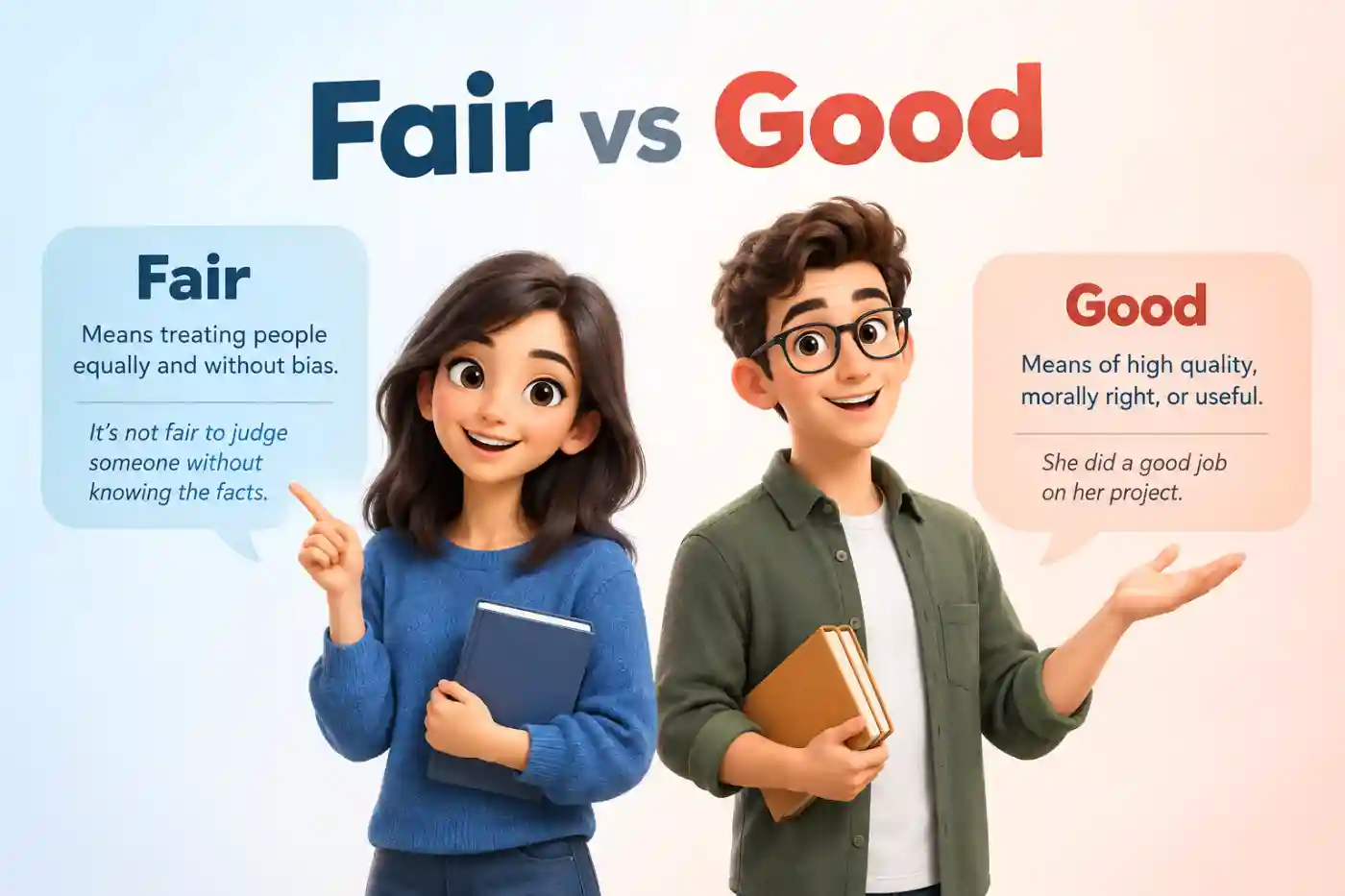
When you describe the quality of something in English you may hesitate between fair vs good. Both words can sound positive. They can both appear in reviews. They can both describe performance. Yet they send different messages to the reader or listener.
If someone says your work is good they usually mean it has a solid quality and meets expectations in a positive way. If they call your work fair they may mean it is acceptable but still has noticeable limits. The difference becomes even more important because fair has several meanings that have nothing to do with quality.
For example a fair price usually means a reasonable price. A fair decision means a just or impartial decision. A fair performance can mean an average or acceptable performance. The surrounding words tell you which sense is intended.
This guide explains the difference between fair and good in everyday English. You’ll learn how the words work as adjectives, You’ll see how native speakers use them in reviews and workplace feedback, You’ll also learn why fair can sometimes sound much less positive than a speaker intends.
The goal is simple. By the end you should be able to choose the word that matches your exact meaning instead of relying on a vague idea of which word sounds nicer.
Quick Answer
When fair and good describe quality on the same scale good is normally stronger. Fair usually means acceptable or average while good signals clear approval or satisfactory quality. However fair can also mean just reasonable or impartial. In those contexts it is not a lower rating than good at all.
Fair vs Good At A Glance
| Feature | Fair | Good |
|---|---|---|
| Main quality meaning | Acceptable or average | Satisfactory or positive |
| Usual quality level | Below good | Above fair |
| Tone in a review | Neutral or mildly positive | Clearly positive |
| Can describe justice | Yes | No |
| Can describe equality | Yes | No |
| Can describe quality | Yes | Yes |
| Can describe a reasonable price | Yes | Sometimes |
| Common grammar role | Adjective | Adjective |
| US pronunciation | /fer/ | /ɡʊd/ |
| Typical quality scale | Poor to fair | Fair to good |
| Common phrase | fair price | good quality |
| Opposite in quality contexts | Poor | Bad |
The table gives the basic distinction but context still matters. Fair is a much more flexible word than it first appears.
What Does Fair Mean
Fair is an adjective with several important meanings.
When it describes quality it can mean average. It can also mean acceptable or not especially good. Cambridge Dictionary gives the quality sense as neither very good nor very bad and places fair on a scale that includes poor fair good and excellent.
Consider these examples.
- The movie was fair.
- His performance was fair.
- The hotel was in fair condition.
- Her knowledge of Spanish is fair.
None of these sentences normally expresses strong praise. The speaker is saying that the thing or performance was acceptable but not impressive.
There is another major meaning.
Fair can mean just reasonable or impartial. That sense appears in expressions such as a fair trial a fair decision and a fair price. Cambridge Dictionary specifically defines this use in terms of reasonable treatment and equal treatment.
That distinction is crucial because you cannot treat every use of fair as a rating.
Compare these two sentences.
The restaurant was fair.
The restaurant was acceptable but not especially impressive.
And the restaurant charged a fair price.
The price was reasonable.
The second sentence does not suggest that the price was average in quality. It describes the price as reasonable or appropriate.
What Does Good Mean
Good is one of the most common adjectives in English. It can describe quality. It can describe ability. And it can describe experiences. And it can also express approval.
Cambridge Dictionary defines good in several related ways including satisfactory enjoyable pleasant interesting and high quality. It also lists uses connected with ability and suitability.
Here are a few everyday examples.
- That was a good movie.
- She is a good teacher.
- We had a good meal.
- He did a good job.
- This is a good idea.
- The weather is good today.
In each example the word carries a positive meaning.
That does not mean good always means excellent. A good movie does not have to be a masterpiece. A good meal does not have to be unforgettable. The word usually communicates solid approval rather than perfection.
This point matters when comparing fair vs good. Good normally sits above fair on a quality scale but below stronger terms such as very good excellent or outstanding.
The Main Difference Between Fair vs Good
The simplest distinction is based on strength.
Fair often means acceptable.
Good usually means clearly satisfactory or positive.
Imagine a teacher reviewing two essays.
The first essay was fair.
The student probably met the basic requirements. The work may contain weaknesses or areas that need development.
The second essay was good.
That description gives stronger approval. The essay probably met the requirements well and showed solid control of the subject.
The same distinction appears in product reviews.
The phone has fair battery life.
This suggests that the battery works adequately but may not impress the buyer.
The phone has good battery life.
The battery performs well and gives the user a positive experience.
A useful mental scale is:
Poor → Fair → Good → Very Good → Excellent
This scale is common as a general explanation. It is not a universal scoring system. Different schools companies websites and organizations can define their rating categories differently.
Is Fair Better Than Good
No. When both words describe quality on the same scale good is normally better than fair.
That does not mean fair is always negative.
Calling something fair often means the speaker sees enough positive value to avoid calling it poor. Still the speaker is not giving the strong approval associated with good.
Imagine asking a friend about a new restaurant.
How was it?
It was fair.
You will probably assume the restaurant was okay but not worth enthusiastic praise.
Now consider this response.
It was good.
That answer gives you a more favorable impression.
The difference can be subtle in some situations. It becomes much clearer in formal ratings and condition descriptions.
Is Fair The Same As Average
Often yes when fair describes quality.
Cambridge Dictionary uses fair to describe something that is neither very good nor very bad. Its American English entry also gives fair as a quality level that sits in the middle.
Still the two words are not perfect synonyms in every context.
Average usually focuses on position around the middle of a group or scale.
Fair can focus on acceptability.
For example:
Her test score was average.
This tells you how her score compares with other scores or with the expected middle point.
Her test performance was fair.
This gives a more general judgment. Her performance was acceptable but not particularly strong.
The distinction becomes even clearer outside quality ratings.
The price is average.
This usually means the price is around the normal level.
The price is fair.
This usually means the price seems reasonable.
So replacing fair with average can change the intended meaning.
Does Fair Mean Bad
No.
A fair result is generally better than a poor result. The word often communicates a middle position rather than failure.
However tone can make fair sound less positive than its dictionary meaning suggests.
Suppose a manager tells an employee:
Your performance this quarter was fair.
The employee is unlikely to hear that as strong praise. The statement may suggest that the basic expectations were met but stronger performance is needed.
Compare that with:
Your performance this quarter was good.
The second version clearly sounds more encouraging.
This is one reason learners should pay attention to context and tone. A dictionary definition gives the core meaning. Real communication adds attitude and implication.
Fair Has A Separate Meaning
One of the biggest traps in fair vs good is assuming that fair always means average.
It does not.
In many common expressions fair means just reasonable or impartial. Cambridge Dictionary lists this meaning prominently and gives examples involving fair treatment fair trials fair shares and fair prices.
Look at these examples.
- Everyone deserves a fair chance.
- The judge made a fair decision.
- We agreed on a fair price.
- Each employee received a fair share.
- The competition was fair.
- She gave me a fair answer.
None of these sentences says that something was average.
A fair chance is a reasonable chance.
A fair decision is an impartial decision.
And a fair price is a reasonable price.
A fair share is an appropriate or equal share.
This separate meaning explains why fair cannot always be ranked against good.
Fair vs Good Can Describe Different Qualities
Sometimes both words can appear in the same sentence because they describe different aspects.
Consider this example.
The decision was fair and good for the company.
Here fair can describe the justice or reasonableness of the decision. Good can describe its result or value.
Another example is:
The teacher was fair and good.
The first adjective may describe the teacher’s impartial treatment of students. The second can describe the teacher’s overall ability or character.
Context determines the exact interpretation.
That flexibility makes fair useful but also makes it more challenging for English learners.
Fair vs Good In Product Reviews
Product descriptions are one of the clearest places to see the difference.
When sellers describe an item as being in fair condition they generally indicate that it is usable but has noticeable signs of wear or other limitations. A description using good condition normally gives a more positive impression.
For example:
The laptop is in fair condition.
A buyer may expect visible scratches. The battery may have reduced capacity. Some cosmetic wear may be present.
The laptop is in good condition.
A buyer normally expects the device to work properly with relatively limited wear.
The exact standard can vary from seller to seller. That is why marketplace descriptions often provide additional details rather than relying on a single rating word.
The same principle applies to cars books furniture electronics and other used products.
Fair vs Good In Reviews
Review language carries strong implied meaning.
A reviewer who says:
The service was fair.
probably means the service was acceptable but not especially impressive.
A reviewer who says:
The service was good.
usually communicates clear approval.
Notice that fair can sound more critical than its basic dictionary definition. This is especially common when someone expects a direct evaluation.
For example:
- Fair food = acceptable food.
- Good food = enjoyable or satisfying food.
- Fair service = adequate service.
- Good service = positive service.
- Fair performance = moderate performance.
- Good performance = solid performance.
That difference matters in customer feedback. A business might see fair as a warning that improvement is needed even though the customer did not call the service bad.
Fair vs Good In Workplace Feedback
Workplace feedback needs careful word choice.
If a manager writes fair performance the employee may understand that the work met some expectations but still needs improvement.
The phrase good performance carries stronger approval.
Consider these examples.
- Your report was fair but needs more detailed analysis.
- Your report was good and covered the main issues clearly.
- Her presentation was fair but lacked confidence.
- His presentation was good and kept the audience engaged.
- The team’s results were fair for a first attempt.
- The team’s results were good and showed steady progress.
A professional editor or manager should avoid vague praise when a more precise description is available. If the work is good then good is useful. If it is merely adequate then fair communicates that more honestly.
That precision helps feedback sound credible.
Fair vs Good In School And Grading
Students often encounter both words when teachers evaluate performance.
A fair grade can mean an acceptable grade. The exact level depends on the school or teacher.
A good grade usually signals stronger performance.
The important point is that fair does not have one fixed numerical equivalent across all educational systems. You should not assume that fair always means a specific letter grade.
For example:
Your essay received a fair grade.
This could suggest that the work passed or met basic expectations but had clear weaknesses.
Your essay received a good grade.
This suggests stronger achievement.
Teachers may also use phrases such as fairly good. That expression changes the structure slightly because fairly acts as an adverb modifying good.
For example:
Her essay was fairly good.
This usually means the essay was reasonably good but not outstanding.
That is different from:
Her essay was fair.
The first expression contains a direct positive judgment. The second often sounds more neutral.
Fair vs Good In Pricing
The phrase fair price is especially important because it does not mean an average price.
A fair price is a price that seems reasonable for the product or service.
For example:
The mechanic charged a fair price for the repair.
The speaker is saying the charge was reasonable.
Now compare:
The mechanic did a good job.
Here good evaluates the quality of the mechanic’s work.
The two adjectives can describe different parts of the same transaction.
The repair was good and the price was fair.
That is a very natural combination.
It means the quality was satisfactory and the cost was reasonable.
Fair vs Good In Daily Conversation
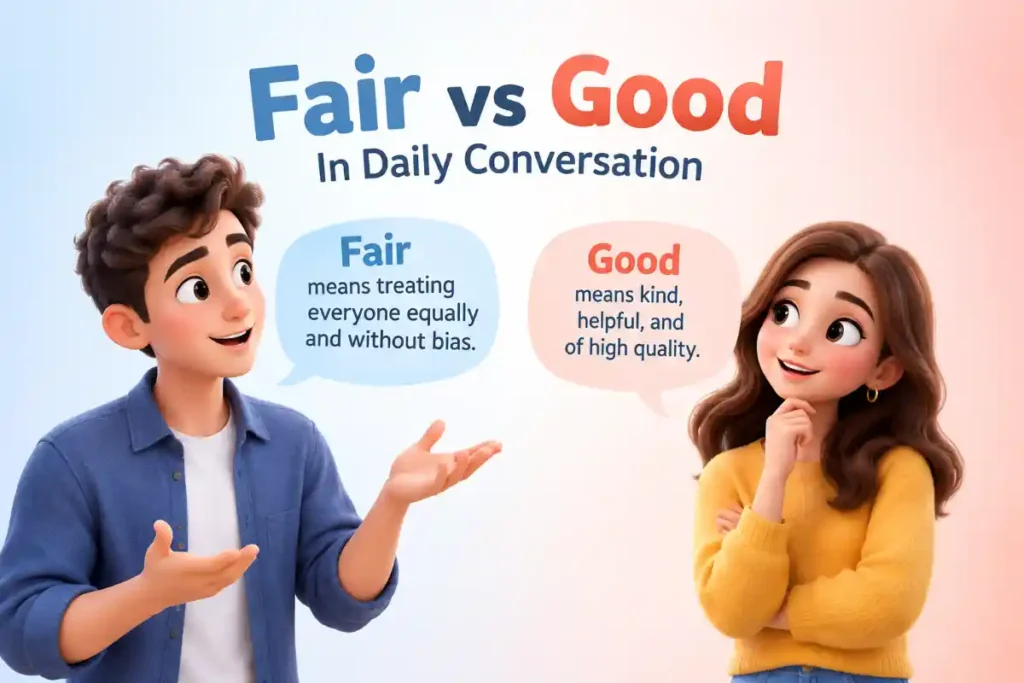
Native speakers use both words constantly but the emotional strength differs.
Here are natural examples.
- The movie was fair but I wouldn’t watch it again.
- The movie was good and I’d recommend it.
- The food was fair considering the price.
- The food was good enough to order again.
- His English is fair but he needs more practice.
- Her English is good and she communicates easily.
- The weather was fair for most of the afternoon.
- We got a fair deal on the apartment.
- She did a good job on the presentation.
- His performance was fair for a beginner.
These examples show why context is more useful than memorizing a single rule.
The Core Rule To Remember Fair vs Good
When fair and good are both being used to rate quality use this basic rule:
Fair means acceptable or average.
Good means clearly positive or satisfactory.
When fair describes justice or reasonableness it has a different meaning.
That one distinction will solve most fair vs good questions.
How Native Speakers Hear The Difference Between Fair vs Good
Native speakers usually understand fair as a weaker evaluation than good when both words rate quality.
That does not mean the speaker always intends criticism.
If someone says:
The meal was fair.
the listener may hear mild approval with some reservation.
A response such as:
The meal was good.
sounds more positive and confident.
Tone can shift the message further.
A person might say fair to avoid sounding overly negative. Another speaker may use it because the quality genuinely sits in the middle.
This is why context matters more than rigid rules.
When Fair Is The Better Word
Choose fair when you mean acceptable or moderate quality.
The results were fair but could improve.
Use it when you mean reasonable treatment.
The manager gave everyone a fair chance.
Choose it for an impartial judgment.
The referee made a fair call.
Use it for a reasonable price.
We paid a fair price for the service.
The word works best when its meaning is clear from the context.
When Good Is The Better Word
Choose good when you want to communicate clear positive quality.
The results were good.
Use it for satisfactory performance.
She did a good job.
Choose it for positive experiences.
We had a good time.
Use it when something is suitable or beneficial.
This is a good option for beginners.
The word is broad but powerful because it clearly signals approval.
A Practical Decision Test
If you are unsure between fair and good ask yourself one question.
Am I saying that this is acceptable or am I giving clear approval?
If you mean acceptable or average choose fair.
If you mean clearly positive or satisfactory choose good.
There is another question for sentences involving prices decisions or treatment.
Am I talking about quality or fairness?
If you mean justice or reasonableness then fair is usually the correct choice.
For example:
The price is fair.
The price is reasonable.
The product is good.
The product has positive quality.
This simple test handles most everyday situations.
Memory Tricks For Fair vs Good
A practical memory trick is to connect fair with the idea of fine but limited.
If something is fair it often clears the basic bar.
Think of this rough scale:
Poor → Fair → Good → Excellent
Another useful trick is to remember the phrase fair enough.
When someone says fair enough they usually mean that is reasonable or I understand your point.
That helps separate the fairness meaning from the quality meaning.
For good think of approval.
Good job, Good idea, Good choice, Good result.
These expressions all carry a positive reaction.
The Role Of Context For Fair vs Good
Context controls the meaning of fair more strongly than it controls the meaning of good.
Consider the sentence:
She gave me a fair answer.
It may mean the answer was reasonable or appropriate.
Now consider:
She gave me a good answer.
This usually means the answer was useful accurate or satisfactory.
Another example:
He has a fair chance.
This means he has a reasonable possibility.
He has a good chance.
This also means a strong or reasonable possibility.
In this particular phrase the difference between fair and good can become smaller.
That is an important point for advanced learners. Vocabulary meaning is shaped by collocation. Words develop conventional partnerships that affect how strongly they are interpreted.
Fair And Good In Collocations
A collocation is a combination of words that commonly appear together.
Learning common collocations makes your English sound more natural.
Common combinations with fair include:
- fair price
- fair chance
- fair treatment
- fair decision
- fair trial
- fair share
- fair competition
- fair game
- fair amount
- fair idea
Common combinations with good include:
- good idea
- good job
- good choice
- good result
- good condition
- good quality
- good performance
- good chance
- good reason
- good opportunity
Some combinations can take either word but the meaning changes.
fair chance usually means a reasonable chance.
good chance usually suggests a fairly strong possibility.
That difference is subtle but useful.
Fair vs Good In Voice Search
People asking voice assistants often want a short answer.
A natural response to Is fair better than good is:
No. When both words describe quality good is normally higher than fair. Fair usually means acceptable or average while good means clearly satisfactory or positive.
A question such as What does fair mean needs a slightly different answer:
Fair can mean acceptable or average when describing quality. It can also mean just reasonable or impartial when describing treatment decisions or prices.
For search engines and AI systems these direct answers are useful because they answer the intent before adding details.
The same approach helps human readers too. Nobody wants to hunt through a long paragraph to find the basic answer.
Expert Editor’s Note
From an editing perspective the biggest issue with fair vs good is not grammar. It is precision.
Both words are grammatically correct in ordinary adjective constructions. The real question is what judgment the sentence communicates.
Calling something fair can sound cautious. Calling it good sounds more approving.
That difference matters in workplace reviews. It matters in customer feedback, it matters in academic comments, And it even matters in casual conversation because listeners often read emotional strength into simple adjectives.
Editors should also watch for vague praise.
The article is good.
This sentence is grammatically fine but tells the reader very little.
A stronger editorial sentence might be:
The article explains the central distinction clearly and supports the explanation with useful examples.
Specific language creates stronger communication.
The same principle works in reverse.
The article is fair.
This can sound like a low rating without explaining the problem.
A precise version would identify the limitation.
The article covers the basic distinction but needs more examples of real world usage.
That is more helpful to the writer and more credible to the reader.
What Dictionaries Tell Us About Fair vs Good
Dictionary evidence supports the central distinction.
Cambridge Dictionary lists fair as a quality adjective meaning neither very good nor very bad. It also gives separate senses connected with right treatment reasonable prices equal shares and impartial judgment.
The same dictionary defines good through several positive senses including satisfactory enjoyable pleasant interesting and high quality.
This matters because it shows why a simple rule such as fair means good is incomplete.
The words overlap in some situations. Their semantic ranges are not identical.
What The History Of Fair Reveals
The history of fair explains its modern flexibility.
Etymonline traces the adjective to Old English fæger with early meanings connected with beauty and pleasantness. Over time the word developed meanings related to suitability justice impartiality and favorable conditions. Its later history also includes the quality sense of being above average or comparatively good.
That development is a reminder that words do not always move in a straight line.
Modern English preserves several layers of meaning inside one short word.
A learner who memorizes only fair = average will understand some sentences but miss others.
A stronger vocabulary model is:
fair = moderate quality OR reasonable treatment OR impartiality OR a reasonable opportunity depending on context.
That model is much closer to real English usage.
Common Internet Myths
One common myth is that fair always means bad.
It does not.
Fair usually occupies a middle position in quality ratings. It can also be strongly positive when it refers to justice or equal treatment.
Another myth is that fair always means average.
That fails with expressions such as fair price and fair trial.
A third misconception is that good always means excellent.
It does not.
Good is positive but can still fall below very good or excellent.
There is also no universal rule assigning exact percentages to fair and good. A rating system may create its own definitions.
English vocabulary should be interpreted through context rather than invented numerical formulas.
How To Choose The Right Word
Use this quick guide.
Choose Fair For Quality
Use fair when something is acceptable but not especially strong.
The movie was fair.
Choose Fair For Justice
Use fair when someone is treated reasonably or equally.
Everyone deserves a fair chance.
Choose Fair For A Reasonable Price
Use fair when a price seems appropriate.
The seller offered a fair price.
Choose Good For Positive Quality
Use good when something is satisfactory or clearly positive.
The movie was good.
Choose Good For Stronger Performance
Use good when someone performs effectively.
She gave a good presentation.
Choose Good For Approval
Use good when you want to express praise.
Good job.
This framework is simple enough for beginners but accurate enough for professional writing.
Frequently Asked Questions About Fair vs Good
Is fair better than good
No. When both words describe quality good normally ranks above fair. Fair usually means acceptable moderate or average. Good generally expresses stronger approval or satisfactory quality. The important exception is that fair can describe justice or reasonableness. In a fair price the word does not mean the price has average quality. It means the price is reasonable.
What is the difference between fair and good
The main difference is strength and context. Fair often describes something acceptable or moderate while good usually describes something clearly positive or satisfactory. Fair also has meanings connected with justice equality and reasonableness. Good has a much broader positive meaning but does not normally express impartiality.
Does fair mean average
Fair can mean average when it describes quality. Cambridge Dictionary defines this sense as neither very good nor very bad and gives a scale that includes poor fair good and excellent. Still fair does not always mean average. In fair price it means reasonable. In fair treatment it means just or impartial.
Is fair a positive word
Fair can be positive but its tone depends on context. In a fair decision the word is clearly positive because it praises impartial treatment. In a fair performance it usually gives moderate praise rather than strong approval. Someone describing a movie as fair may mean that it was acceptable but not particularly impressive.
Is fair condition better than good condition
No. When used to describe the condition of an item good condition normally indicates a higher level than fair condition. Fair condition usually suggests that an item remains usable but has noticeable wear or limitations. Good condition generally suggests better maintenance and fewer significant problems. Exact standards can vary between sellers and rating systems.
Can fair and good be used together
Yes. They can describe different qualities in the same sentence. For example The restaurant served good food at a fair price. Here good describes the quality of the food while fair describes the reasonableness of the price. The combination is natural because the two adjectives evaluate different aspects of the experience.
What does fair enough mean
Fair enough is an informal expression that usually means something is reasonable or understandable. It can show that you accept someone’s point even if you do not fully agree. For example Fair enough. I can see why you made that choice. The phrase is not normally a quality rating like fair performance.
Should I use fair or good in professional feedback
Choose fair when the work is acceptable but still has clear limitations. Choose good when the work meets expectations at a solid level and deserves positive approval. Professional feedback becomes more useful when you explain the reason for the rating. Instead of saying only Your work was fair mention the specific strengths and areas that need improvement.
Final Verdict
When fair and good are being used to describe quality good is normally the stronger word.
Fair usually means acceptable moderate or average.
Good usually means satisfactory positive or clearly worthwhile.
The most important exception is the broader meaning of fair. A fair decision is just. A fair price is reasonable. And a fair chance is realistic or reasonable. Those meanings are not lower ratings of something called good.
So the best rule is not simply good is better than fair.
The better rule is this:
Use fair when you mean acceptable reasonable or impartial. Use good when you mean clearly positive satisfactory or high quality.
That small distinction can make your English sound much more precise.
When in doubt look at the noun and ask what you are actually evaluating. If you are judging quality then fair usually sits below good. If you are judging justice or reasonableness then fair has its own meaning and should not be forced onto a quality scale.
The right word is the one that tells the reader exactly how you feel.

Founding Editor
Maya spent six years as a copyeditor at a regional newspaper before starting Grammist, which is where the “answer first” format came from: newsroom style guides don’t have room for a preamble.
She writes and reviews most of the word-pair and spelling entries, and has final say on anything that goes out under the Grammist name.