
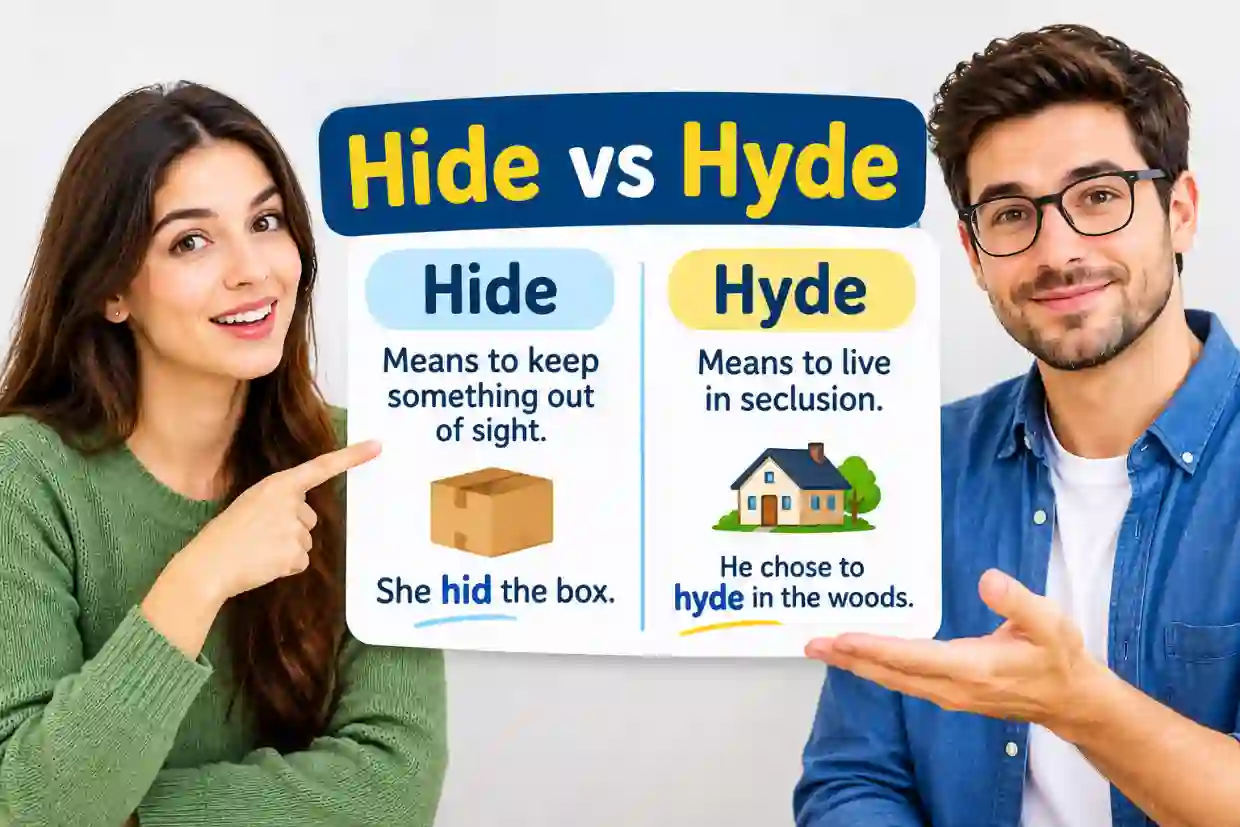
The words hide vs hyde look almost identical, and they sound the same in most English accents. However, they serve different purposes. One is a common English word that means to keep something out of sight. The other is mainly a proper name used in surnames, fictional characters, and place names.
If you have ever wondered if you should write hide or Hyde in a sentence, the answer depends on what you want to say. Choosing the wrong spelling can change the meaning of a sentence or make an otherwise correct piece of writing look like it contains a spelling mistake.
The confusion is easy to understand. Both spellings share the same pronunciation, and the letter y in Hyde makes it look like an alternative spelling of hide. However, Hyde is not the standard spelling of the verb meaning to conceal something. In ordinary writing, use hide when you mean to put something out of sight, keep a secret, or prevent someone from seeing something.
This guide explains the difference between hide and Hyde, their meanings, pronunciation, grammar, word origins, and common mistakes. You will also find practical examples from everyday conversation, professional writing, literature, and online communication, along with simple memory tricks to help you choose the right spelling every time.
Quick Answer
Hide is the correct spelling of the common English verb meaning to conceal something or stay out of sight. Hyde is a proper noun, usually a surname or part of a name, such as Mr. Hyde in Strange Case of Dr Jekyll and Mr Hyde. Use hide for ordinary actions and Hyde for names.
Hide vs Hyde Comparison Table
The main difference between these words is their function in a sentence. Hide is an everyday English verb, while Hyde is generally a proper noun.
| Feature | Hide | Hyde |
|---|---|---|
| Correct use | Common English word | Proper name |
| Main meaning | To conceal or keep out of sight | A name, often a surname |
| Part of speech | Verb and noun | Proper noun |
| Pronunciation | /haɪd/ | /haɪd/ |
| Syllables | One | One |
| Example | Please hide the key. | Mr. Hyde entered the room. |
| Capitalization | Usually lowercase | Usually uppercase |
| Verb forms | Hides, hid, hidden, hiding | No ordinary verb forms |
| Plural | Hides, in relevant noun uses | Hydes, when referring to multiple people with that name |
| Common context | Actions, secrets, objects, feelings | People, characters, places, and named entities |
| Typical mistake | Confusing hide with hid | Using Hyde as a general verb |
The simplest rule: If you mean to conceal something, write hide. If you are referring to someone or something named Hyde, use Hyde.
What Does Hide Mean
Hide is a common English word with several related meanings. Most often, it means to prevent something from being seen, discovered, or known.
It can describe a physical action, such as putting a gift behind a cupboard, or an emotional action, such as concealing your disappointment. It can also refer to an animal’s skin, especially when used as a noun.
Hide as a verb
As a verb, hide means to put something somewhere it cannot easily be seen or to keep information from being discovered.
For example:
- I need to hide the birthday present before she arrives.
- The child tried to hide behind the sofa.
- He could not hide his disappointment.
- She decided to hide the documents in a drawer.
- The company attempted to hide the truth from its customers.
In each sentence, hide describes concealment. The object being concealed can be a physical item, a person, an emotion, or information.
The verb also appears in common expressions such as hide away, hide from, and hide behind. These expressions add context to the action.
Hide as a noun
Hide can also be a noun referring to the skin of an animal, particularly a large animal such as a cow or horse.
Examples include:
- The leather was made from cowhide.
- The hunter examined the animal’s hide.
- The museum displayed a traditional animal hide.
This noun is less common in everyday conversation than the verb, but it appears in discussions of leather, farming, wildlife, and historical crafts.
Do not confuse this meaning with hiding, which usually refers to the act of concealing something or the state of being concealed.
Hide in everyday expressions
The word appears in several familiar phrases.
| Expression | Meaning | Example |
|---|---|---|
| Hide away | Put something somewhere private or secluded | She hid away the old letters. |
| Hide from | Avoid being seen by someone | The puppy hid from the visitors. |
| Hide behind | Use something as cover, literally or figuratively | He hid behind an excuse. |
| Have something to hide | Have a secret or something one does not want discovered | I have nothing to hide. |
| Hide in plain sight | Remain unnoticed despite being visible | The answer was hiding in plain sight. |
| Hide your feelings | Keep emotions from being seen | She tried to hide her feelings. |
These phrases demonstrate how widely hide is used in modern English. None requires the spelling Hyde unless a proper name is involved.
What Does Hyde Mean

Hyde is usually a proper noun. It commonly appears as a surname, in fictional names, and in geographical or historical references.
Unlike hide, it does not function as the standard English verb for concealing something.
Hyde as a surname
Hyde is an established family name found in English speaking communities. It may refer to a particular person, family, or historical figure.
Examples:
- Dr. Hyde will lead the research project.
- Ms. Hyde sent the meeting invitation.
- The Hyde family moved to another town.
- I spoke with Robert Hyde after the lecture.
In these examples, Hyde identifies a person or family. Its spelling is part of the name and should be preserved.
Hyde in literature
One of the best known uses of the word appears in Robert Louis Stevenson’s novella Strange Case of Dr Jekyll and Mr Hyde, published in 1886.
Mr. Hyde is a fictional character associated with the darker side of Dr. Jekyll’s divided identity. The character’s name has become closely associated with the contrast between respectable behavior and hidden or destructive impulses.
For example:
- Mr. Hyde is a central character in Stevenson’s novella.
- The student wrote an essay about Dr. Jekyll and Mr. Hyde.
- The phrase Jekyll and Hyde is sometimes used to describe someone who seems to have two very different sides to their personality.
In this literary context, Hyde must retain its proper spelling and capitalization. Writing Mr. Hide would incorrectly change the character’s name.
Hyde in place names and other proper nouns
Hyde also appears in place names, organizations, titles, and other named entities. For instance, Hyde Park is the name of a famous park in London.
Examples:
- We walked through Hyde Park during our visit to London.
- The article discussed the history of Hyde Park.
- The library organized a reading about Jekyll and Hyde.
The correct spelling depends on the specific name. A writer should check the official spelling of a person, place, institution, or title rather than changing it to match the common word hide.
Hide vs Hyde Which One Is Correct
Both hide and Hyde are correct English spellings, but they are not interchangeable.
Use hide when writing about concealment, secrecy, or keeping something out of sight. Use Hyde when referring to a person, family, fictional character, place, or other entity with that name.
Consider these examples:
- Correct: Please hide the envelope.
- Incorrect for this meaning: Please hyde the envelope.
- Correct: Mr. Hyde opened the door.
- Incorrect if the character’s name is intended: Mr. Hide opened the door.
The second example in each pair illustrates a different problem. Hyde is not the standard spelling of the verb, while Hide changes the spelling of a proper name.
Is Hyde ever an alternative spelling of hide
No. In standard modern English, Hyde is not an accepted alternative spelling of the ordinary verb hide.
You might encounter Hyde in a username, brand name, artistic title, or deliberate wordplay. A writer can also invent a name that resembles an ordinary word. Such creative uses do not make Hyde a standard verb spelling.
For formal writing, schoolwork, professional emails, and published articles, use hide for the action of concealing something.
Is hide always a verb
No. Although hide is most familiar as a verb, it can also be a noun referring to an animal’s skin.
Compare these sentences:
- Verb: The children hide behind the tree.
- Noun: The craftsman treated the animal hide.
The surrounding words make the grammatical function clear. Hyde, by contrast, is ordinarily a proper noun.
Why People Confuse Hide vs Hyde
Several factors make these words easy to mix up. The main reasons are their identical pronunciation, their similar appearance, and the influence of familiar names.
They sound the same
In standard English pronunciation, hide and Hyde are homophones. This means they sound alike but have different spellings and uses.
Both are pronounced /haɪd/, with one syllable and a final /d/ sound.
When someone says, “I need to hide the keys,” the sound alone does not reveal the spelling. A listener must use the sentence’s meaning to determine the intended word.
This is particularly important when writing dialogue from memory, taking notes during a conversation, or using speech to text software.
The spelling looks almost identical
Only one letter distinguishes the two forms. Both begin with h, contain the long i sound, and end with d.
The letter y in Hyde may make it appear like an older or more unusual spelling of hide. However, the spelling difference reflects the distinction between a common word and a proper name, not a general rule that y can replace i.
Proper names are easy to remember
People frequently encounter the name Hyde in books, films, television, and place names. Someone familiar with Mr. Hyde may remember the spelling and mistakenly use it in ordinary writing.
The reverse can also happen. A person who knows the common verb hide might write Mr. Hide when referring to the literary character.
The solution is to identify the intended meaning before choosing the spelling.
Autocorrect and typing habits can cause errors
Spellcheckers may accept both forms because both exist in English. A spelling tool can recognize a word as valid without understanding the writer’s intended meaning.
For example, a sentence such as “I will hyde the gift” may escape detection if the software treats Hyde as a valid name. Capitalization and the surrounding sentence may help, but automated tools do not always catch the error.
Proofreading should therefore focus on meaning as well as spelling.
Internet myths can spread confusion
Some online posts suggest that Hyde is an archaic spelling of the verb hide. Others assume that changing i to y creates an acceptable stylistic variation.
These claims should not be treated as reliable spelling guidance. Although English spelling has changed throughout its history, modern standard English uses hide for the verb and Hyde for the proper name.
A familiar surname, fictional character, or unusual username does not establish a new standard spelling for a common word.
Key Differences Between Hide vs Hyde
The distinction becomes clearer when you compare meaning, grammar, capitalization, and context.
Meaning and function
Hide describes an action or, less commonly, an animal’s skin. Hyde identifies a named person, place, family, or character.
- The magician will hide the coin. The word describes an action.
- Dr. Hyde will explain the experiment. The word identifies a person.
Grammar and sentence structure
Hide behaves like an ordinary verb. It changes form to show tense and grammatical structure.
- Present: I hide my spare key.
- Third person present: She hides her spare key.
- Past: She hid her spare key.
- Past participle: She has hidden her spare key.
- Present participle: She is hiding her spare key.
Hyde does not follow this pattern because it is a name rather than an ordinary verb. You would not normally write Hyde, Hyded, or Hyden to describe the act of concealing something.
Capitalization
The common verb hide is lowercase unless it begins a sentence or appears in a title with capitalization rules that require an initial capital.
A proper name such as Hyde starts with a capital letter.
Compare:
- I want to hide the evidence.
- Mr. Hyde appears in the story.
Capitalization can help readers distinguish the two, but it does not replace the need to use the correct spelling.
Hide vs Hyde Pronunciation Guide
Both words have the same standard pronunciation, so you cannot reliably distinguish them by sound alone.
Hide
IPA: /haɪd/
One syllable. Rhymes with side, ride, and wide.
Hyde
IPA: /haɪd/
One syllable. The same pronunciation as hide.
How to pronounce both words
The pronunciation has three main sound elements.
- /h/: Start with a light breath of air.
- /aɪ/: Say the vowel sound found in my or time.
- /d/: Finish with the voiced consonant heard in day.
Put the sounds together to say hide or Hyde. Both have the same stress pattern because each word has only one syllable.
A common mistake is to assume that the y in Hyde creates a different sound. It does not. The letter y represents the same vowel sound in this name.
The practical lesson is simple: listen for the meaning of the sentence instead of relying on pronunciation to choose the spelling.
Hide vs Hyde Word Origin
The two spellings have different histories and developed different roles in English.
The history of hide
The verb hide comes from Old English hȳdan, meaning to conceal or keep out of sight. The word has Germanic roots and has been part of English for many centuries.
Its forms developed over time, but the core meaning remained closely connected to concealment. Modern uses include hiding physical objects, concealing emotions, keeping information secret, and avoiding detection.
The noun hide, meaning an animal’s skin, has a separate historical development associated with older Germanic vocabulary. Although the noun and verb share the same modern spelling, their meanings are distinct.
The history of Hyde
Hyde is an established surname and also appears in place names. Like many English surnames, it can have historical connections to geographical features, settlements, or earlier forms of personal and family names.
The exact origin of an individual surname depends on the family and historical records. It would be inaccurate to claim that every person named Hyde shares one particular family history.
The literary association with Mr. Hyde became especially famous after Robert Louis Stevenson’s 1886 novella about Dr. Jekyll and Mr. Hyde. The name has since become widely recognized in literature and popular culture.
Did Hyde come from an older spelling of the verb hide
The shared sound does not prove that Hyde is an older version of the modern verb. The standard verb has its own established spelling, while Hyde functions mainly as a name.
Historical spellings can vary in older documents, but modern writers should follow present day conventions rather than assume that a surname provides an alternative spelling for an everyday word.
British vs American English
There is no meaningful British and American spelling difference between hide and Hyde. Both varieties use hide for the common verb and Hyde for the proper name.
| Variety of English | Standard verb | Proper name |
|---|---|---|
| American English | hide | Hyde |
| British English | hide | Hyde |
| Canadian English | hide | Hyde |
| Australian English | hide | Hyde |
Some English words have different regional spellings, such as color and colour. This is not one of those cases.
For example, an American writer would say, “Hide the documents in the cabinet.” A British writer would use the same spelling. The surname in Hyde Park also retains its established spelling in both varieties.
Regional pronunciation can vary slightly across English accents, but this does not create a standard spelling distinction between the two words.
Real Life Examples of Hide vs Hyde
The following examples show how to use both words naturally in different settings.
Everyday conversation
- “Can you hide the birthday present until Saturday?”
- “The cat likes to hide under the bed.”
- “I tried to hide my surprise, but everyone noticed.”
- “Where did you hide the spare key?”
- “Stop trying to hide from your responsibilities.”
Each sentence uses hide because it describes concealment or avoidance.
Workplace and professional communication
- “Please hide the confidential file from the shared display.”
- “The report should not hide the risks associated with the project.”
- “Employees must never hide errors in financial records.”
- “We need to hide personal information before sharing this screenshot.”
- “Dr. Hyde will present the findings at the staff meeting.”
The first four examples use the common verb. The last uses a person’s name, so Hyde needs a capital letter.
Emails and messages
- “I will hide the gift in the storage cupboard.”
- “Please do not hide important updates from the team.”
- “Could you confirm that the surname is spelled Hyde?”
- “I have nothing to hide, so you can review the documents.”
These examples illustrate why context matters in written communication. A name may require careful checking, especially when several people are involved in an email conversation.
Academic writing
- “The experiment examined how animals hide from predators.”
- “The student compared Dr. Jekyll and Mr. Hyde in a literature essay.”
- “Researchers should not hide limitations in their published findings.”
- “The paper discusses Stevenson’s portrayal of Hyde as a fictional character.”
In academic writing, correct spelling supports clarity and credibility. Proper names should match the source being discussed.
Literature and journalism
- “The journalist argued that the official statement appeared to hide key facts.”
- “The article explored the enduring popularity of Dr. Jekyll and Mr. Hyde.”
- “The story follows a child who tries to hide from a mysterious stranger.”
- “The historical report mentioned a member of the Hyde family.”
The intended meaning determines the spelling in every case.
Social media and informal writing
- “I need a clever place to hide my snacks.”
- “Just finished reading Dr. Jekyll and Mr. Hyde.”
- “Nothing to hide, nothing to worry about.”
- “Is Hyde Park worth visiting during a weekend in London?”
Online writing can be casual, but the basic spelling distinction remains the same. A username or creative title may use unusual spelling, yet standard prose should still use hide for concealment.
Common Mistakes With Hide vs Hyde
Many errors happen because writers focus on how a word sounds rather than what it means.
Mistake one using Hyde as a verb
Incorrect: “I will hyde the package before the guests arrive.”
Correct: “I will hide the package before the guests arrive.”
The sentence describes an action, so it needs the ordinary verb hide.
Mistake two misspelling a proper name
Incorrect: “Mr. Hide is the main character in the novella.”
Correct: “Mr. Hyde is the main character in the novella.”
When discussing Stevenson’s character, preserve the established spelling of the name.
Mistake three confusing hide with hid
Incorrect: “Yesterday, I hide the letter in a drawer.”
Correct: “Yesterday, I hid the letter in a drawer.”
Hide is the base form, while hid is its simple past tense. This is a separate spelling issue, but it often appears in the same type of writing.
Mistake four using hidden incorrectly
Incorrect: “She has hid the documents.”
Correct: “She has hidden the documents.”
In standard English, the present perfect uses has or have with the past participle hidden.
Mistake five assuming every unfamiliar spelling is acceptable
A word may look plausible and still be incorrect in context. Hyde is a real English name, but that does not make it an acceptable replacement for hide in ordinary sentences.
Mistake six changing a name to match a spellchecker
A spellchecker may suggest changes to unfamiliar names. Do not automatically replace Hyde with hide in a person’s name, a literary title, or a geographical name.
Always verify the intended reference before making the correction.
Grammar Rules for Hide vs Hyde
Understanding the grammar of hide helps prevent mistakes beyond the basic spelling difference.
The verb forms of hide
Hide is an irregular verb. Its past tense and past participle do not follow the regular pattern of adding ed.
| Verb form | Correct spelling | Example |
|---|---|---|
| Base form | Hide | Hide the letter. |
| Third person present | Hides | He hides the letter. |
| Simple past | Hid | He hid the letter. |
| Past participle | Hidden | He has hidden the letter. |
| Present participle | Hiding | He is hiding the letter. |
Notice that none of these forms uses Hyde. The spelling remains connected to the verb’s established forms.
Using hide in different tenses
Present tense: Use hide for habits, general facts, or actions in the present.
Example: Some animals hide when they sense danger.
Past tense: Use hid for a completed action in the past.
Example: She hid the keys before leaving the house.
Present perfect: Use hidden after has or have.
Example: They have hidden the evidence.
Present continuous: Use hiding after a form of be.
Example: The children are hiding behind the curtains.
These distinctions matter because a sentence can contain the correct basic word but still have a grammatical error.
Nouns and plurals
The noun hide, meaning an animal’s skin, can have the plural form hides when referring to separate skins.
Example: The trader purchased several animal hides.
The surname Hyde can become Hydes when referring to multiple people with that surname.
Example: The Hydes hosted a family gathering.
For a possessive, write Hyde’s when something belongs to one person named Hyde, for example, “Hyde’s office is on the second floor.”
For a family, you can write “the Hydes’ house” to indicate possession by the family. The apostrophe follows the plural form.
Memory Tricks to Remember Hide vs Hyde
These simple methods can help you remember the correct spelling.
Hide means keep out of sight.
Think of hiding a gift, a key, or a secret. If you are describing the action of concealment, choose hide.
Hyde is a name.
Connect the spelling to Mr. Hyde from the famous literary story or to Hyde Park in London. Names retain their established spelling.
Check the meaning before the spelling.
Ask yourself, “Am I describing an action or naming a person or place?” That quick question usually settles the choice.
One final memory trick is to learn this sentence:
“Hide the secret, but remember Mr. Hyde.”
It pairs the ordinary verb with a familiar proper name, making the difference easy to recall.
Hide vs Hyde Related Words and Commonly Confused Terms

Learning related words can help you recognize the difference between spelling, meaning, and grammatical function.
| Word | Meaning | Example |
|---|---|---|
| Conceal | To keep something from being seen or known | He concealed the letter. |
| Cover | To place something over another thing | Cover the box with a cloth. |
| Disguise | To change appearance to avoid recognition | She disguised her identity. |
| Secrete | To hide something in a secret place | He secreted the papers away. |
| Hid | Past tense of hide | She hid the keys. |
| Hidden | Past participle or adjective | The hidden door was difficult to find. |
| Hiding | The act of concealment | The children were hiding. |
| Jekyll | A name associated with Dr. Jekyll | Dr. Jekyll is a literary character. |
These words are related in meaning or context, but they are not all interchangeable.
For example, conceal is a close synonym of hide, while hid and hidden are grammatical forms of the same verb. Hyde belongs to the category of proper names.
What is the opposite of hide
Depending on the context, common opposites of hide include reveal, expose, show, and disclose.
- Hide the truth. Reveal the truth.
- Hide the object. Show the object.
- Hide the evidence. Expose the evidence.
- Hide the information. Disclose the information.
The best opposite depends on the intended meaning. Reveal often works for secrets, while show is more natural for physical objects.
An Expert Editor’s Note on Hide vs Hyde
A professional editor would not treat hide and Hyde as competing spelling variants. They serve different purposes, and the surrounding sentence usually makes the intended choice clear.
Standard dictionaries distinguish the common verb hide from the proper name Hyde. When checking an unfamiliar name, editors also consult the original source, an official website, or a reliable biographical reference.
Here are the practical rules an editor would follow.
- Use hide for the act of concealing an object, person, feeling, or piece of information.
- Use Hyde for a verified surname, place name, fictional character, or other established proper noun.
- Check irregular verb forms separately. The past tense is hid, and the past participle is hidden.
- Do not rely on a spellchecker alone. A correctly spelled word can still be wrong for the sentence.
- Preserve the spelling of names in book titles, citations, academic essays, and professional documents.
For formal writing, the most natural choice is also the simplest one. Write the common verb in its standard form, and capitalize a proper name when referring to the specific person or place.
Frequently Asked Questions on Hide vs Hyde
Is hide or Hyde the correct spelling?
Both spellings are correct, but they have different uses. Hide is the standard spelling of the verb meaning to conceal something. Hyde is generally a proper noun, such as a surname or the name of a fictional character. Use the word that matches your intended meaning rather than choosing based on appearance alone.
Is Hyde an alternative spelling of hide?
No. Hyde is not a standard alternative spelling of the ordinary verb hide. Although the words sound the same, modern English distinguishes the common verb from the proper name. You may see Hyde in creative titles, usernames, or brand names, but these special uses do not change the standard spelling rule.
Do hide and Hyde sound the same?
Yes. Both words are normally pronounced /haɪd/ in English. They contain one syllable and rhyme with side, ride, and wide. Since pronunciation does not distinguish them, readers and listeners rely on context to identify the intended word. The spelling depends on the meaning or the name being discussed.
What is the past tense of hide?
The simple past tense of hide is hid. For example, “I hid the letter yesterday.” The past participle is hidden, as in “I have hidden the letter.” These are irregular verb forms, so you should not write hided in standard English. None of these forms is spelled Hyde.
Should I write Mr. Hide or Mr. Hyde?
Write Mr. Hyde when referring to the character in Robert Louis Stevenson’s Strange Case of Dr Jekyll and Mr Hyde. The spelling is part of the character’s established name. Writing Mr. Hide changes the name and is incorrect in this literary context, even though the two forms have the same pronunciation.
Is Hyde Park spelled with an i or a y?
The established name is Hyde Park, with a y. The name refers to a famous park in London, England, among other places that share the name. When writing about a specific place, check its official spelling and preserve it. The common verb hide is not a substitute for the proper name.
Can hide be used as a noun?
Yes. Besides its common use as a verb, hide can be a noun referring to the skin of an animal, especially a large animal. For example, “The craftsman worked with cowhide.” This noun is different from Hyde, which is generally used as a proper name. Context determines the meaning of hide.
How can I remember the difference between hide and Hyde?
Remember that hide is an action, while Hyde is a name. You hide a gift, conceal a secret, or hide from danger. Mr. Hyde is a character, and Hyde Park is a place. The sentence “Hide the gift, then read about Mr. Hyde” reinforces both spellings in one simple example.
Final Verdict on Hide vs Hyde
The difference between hide and Hyde is straightforward once you focus on meaning rather than sound.
- Hide is the correct spelling for the common verb meaning to conceal or keep something out of sight. It can also refer to an animal’s skin.
- Hyde is generally a proper noun used for surnames, fictional characters, places, and other named entities.
- Both words share the same standard pronunciation, so context determines the correct spelling.
- Remember the related verb forms: hide, hides, hid, hidden, and hiding.
The most common mistake is using Hyde as a verb simply because it sounds right. Avoid that error by checking the purpose of the word before you write it.
Hide a secret, but never hide the difference between hide and Hyde.

Founding Editor
Maya spent six years as a copyeditor at a regional newspaper before starting Grammist, which is where the “answer first” format came from: newsroom style guides don’t have room for a preamble.
She writes and reviews most of the word-pair and spelling entries, and has final say on anything that goes out under the Grammist name.