
The correct spelling is flies or flys only when you are asking which form to use, because flies is the standard English spelling and flys is generally incorrect in ordinary writing. The word flies can refer to more than one flying insect or serve as the third person singular form of the verb fly. Understanding the spelling rule will help you avoid mistakes in emails, schoolwork, professional writing, and everyday conversations.
English spelling can feel tricky because many nouns form their plurals by adding s or es. However, nouns ending in a consonant followed by y usually change the y to ies. That is why we write one fly and two flies rather than one fly and two flys.
The same pattern appears in words such as baby and babies, city and cities, and story and stories. Learning this rule makes it easier to spell unfamiliar words correctly.
This guide explains the difference between flies and flys, shows how the spelling rule works, and explores the word’s meanings as both a noun and a verb. You’ll also find practical examples, common mistakes, memory tricks, and answers to frequently asked questions.
Quick Answer
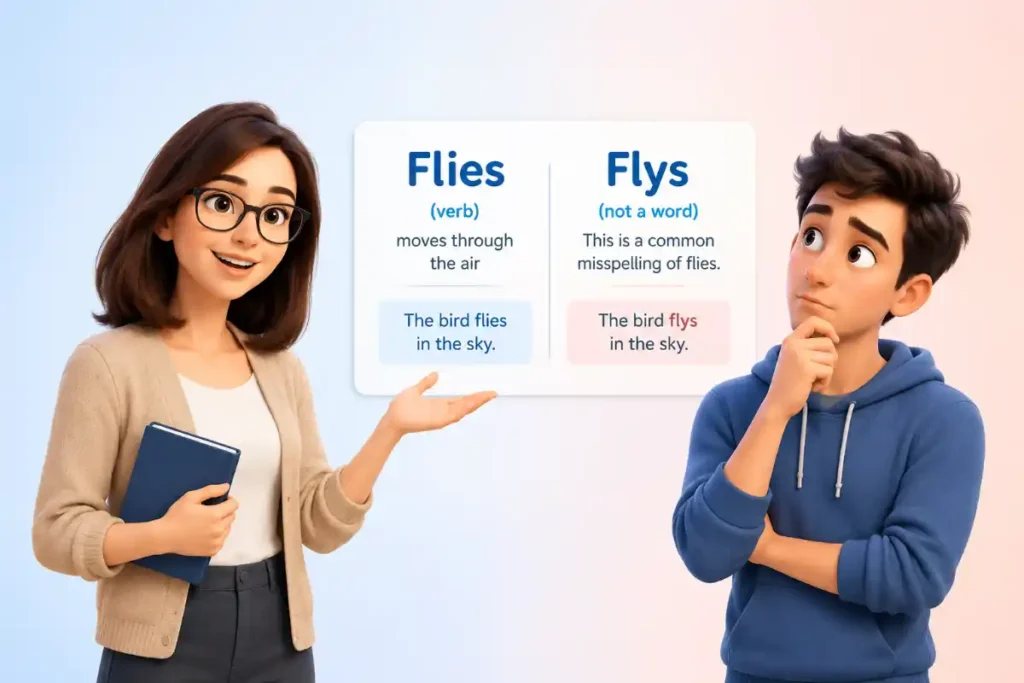
Flies is the correct spelling for the plural of fly and for the verb used with he, she, or it in the present tense. Flys is generally a misspelling in standard English. For example, write The fly buzzes around the room and Two flies landed on the window.
Flies or Flys At a Glance
| Feature | Flies | Flys |
|---|---|---|
| Correct spelling | Yes | Generally no |
| Plural of fly | Correct | Incorrect |
| Present tense verb | Correct | Incorrect in standard English |
| Part of speech | Noun or verb | Not the standard form |
| Example as a noun | Several flies entered the room. | Several flys entered the room. |
| Example as a verb | The bird flies south. | The bird flys south. |
| Formal writing | Use it | Avoid it |
| Everyday English | Standard | Usually a spelling mistake |
The key distinction is simple. Flies follows the normal English spelling rule for words ending in a consonant plus y. The letter y changes to ies when forming the plural or the third person singular form of this verb.
Flies or Flys Which One Is Correct
Flies is the correct spelling in standard English. You should use it in school assignments and professional documents as well as casual messages.
The word has two main grammatical uses.
First it is the plural form of the noun fly.
- One fly is sitting on the wall.
- Three flies are sitting on the wall.
Second it is the present tense form of the verb fly when the subject is he, she, it, or another singular noun.
- I fly to Chicago every summer.
- She flies to Chicago every summer.
The verb changes because English adds s or es to the base form for a third person singular subject in the simple present tense. Since fly ends in a consonant followed by y the spelling changes to flies.
By contrast flys does not follow the standard spelling rule in these examples. It is not the correct plural of the insect and it is not the standard third person singular form of the verb.
What Does Flies Mean
Flies has more than one meaning because it can be a noun or a verb. The sentence tells you which meaning applies.
Flies As a Noun
As a noun flies means more than one fly. A fly is a small winged insect. Common examples include houseflies and fruit flies.
Examples include:
- The flies gathered near the fruit.
- Flies can enter a room through an open window.
- A few flies were buzzing around the picnic table.
- The farmer used screens to keep flies away from the animals.
In each sentence flies refers to multiple insects. The singular form is fly.
Flies As a Verb
As a verb flies is the simple present tense form used with a third person singular subject.
Examples include:
- The bird flies over the lake.
- My brother flies to Boston for work.
- A kite flies high above the field.
- Time flies when you are having fun.
The meaning depends on the subject and context. A bird flies through the air. A pilot flies an aircraft. Time flies is an idiom that means time seems to pass quickly.
Flies In Clothing
In clothing and tailoring fly can also refer to the opening in a pair of trousers that is covered by a flap or fastened with buttons or a zipper. The plural flies is possible when discussing more than one such opening.
This use is less common in everyday spelling questions but it is still valid English.
Flies In Fishing
In fly fishing a fly is an artificial lure designed to resemble an insect or another small food source for fish. The plural is flies.
For example:
- The angler packed several flies for the trip.
- These flies imitate small insects found in streams.
This is another valid noun use. It follows the same spelling rule as the insect.
Why Flies Is Correct and Flys Is Wrong
The reason comes from a common English spelling rule.
When a noun or verb ends in a consonant followed by y the y usually changes to i before the appropriate ending.
For plurals the pattern is:
Consonant + y → ies
Examples include:
| Singular | Plural |
|---|---|
| Fly | Flies |
| Baby | Babies |
| City | Cities |
| Puppy | Puppies |
| Story | Stories |
| Country | Countries |
| Party | Parties |
| Lady | Ladies |
| Family | Families |
| Cherry | Cherries |
The same general pattern appears with verbs in the third person singular.
| Base verb | Third person singular |
|---|---|
| Fly | Flies |
| Cry | Cries |
| Try | Tries |
| Carry | Carries |
| Study | Studies |
| Apply | Applies |
| Worry | Worries |
| Hurry | Hurries |
The rule is not difficult once you identify the letter before y. In fly the letter before y is l which is a consonant. That is why the standard form becomes flies.
When Does Y Change to IES
The spelling change normally happens when a word ends in a consonant followed by y.
For example:
- The baby cries at night.
- The teacher studies the results.
- The company applies the new policy.
- The bird flies above the trees.
The same rule applies to plural nouns.
- One city becomes two cities.
- One puppy becomes three puppies.
- One story becomes several stories.
However the rule changes when a vowel comes before the y.
When Do You Keep the Y
When a word ends in a vowel followed by y you usually keep the y and add s.
Examples include:
| Singular | Plural |
|---|---|
| Boy | Boys |
| Toy | Toys |
| Day | Days |
| Key | Keys |
| Monkey | Monkeys |
| Journey | Journeys |
| Essay | Essays |
| Valley | Valleys |
The letter before y determines the pattern.
Fly ends in ly where l is a consonant. The plural becomes flies.
Boy ends in oy where o is a vowel. The plural becomes boys.
This contrast explains why English uses flies but boys. It is a spelling rule rather than an arbitrary exception.
Flies vs Flys In Grammar
The difference between the two spellings is easiest to understand when you look at how each form works in a sentence.
Singular and Plural Nouns
A singular noun refers to one thing. A plural noun refers to more than one.
- A fly is on the ceiling.
- Two flies are on the ceiling.
The article a tells you that the first sentence refers to one insect. The number two tells you that the second sentence refers to multiple insects.
Using flys in the second sentence would be a spelling error.
Subject Verb Agreement
English verbs change form depending on the subject in the simple present tense.
- I fly.
- You fly.
- We fly.
- They fly.
- He flies.
- She flies.
- The plane flies.
The verb fly stays unchanged with I, you, we, and they. It changes to flies with he, she, it, or a singular noun.
This rule is part of subject verb agreement. The verb form must match the subject.
Past Tense
The past tense of fly is flew.
Examples:
- The bird flew across the garden.
- She flew to New York last week.
- The plane flew through heavy clouds.
Do not write flied for ordinary flight through the air. The standard past tense is flew.
However flied does appear in baseball terminology. It describes hitting a ball that is caught in the air. For example a player flied out to center field. This is a specialized sports use and does not replace flew in ordinary contexts.
Present Participle
The present participle of fly is flying.
Examples:
- The birds are flying south.
- She is flying to Denver tomorrow.
- A flying insect landed on the screen.
The final y stays in place when adding ing.
Past Participle
The past participle of fly is flown.
Examples:
- I have flown to Seattle several times.
- The plane had flown for six hours.
- She has flown with that airline before.
The main verb forms are:
| Verb form | Example |
|---|---|
| Base form | Fly |
| Third person singular | Flies |
| Simple past | Flew |
| Past participle | Flown |
| Present participle | Flying |
Learning these forms will help you avoid confusing flies with other verb forms.
Flies or Flys in Everyday Sentences
The easiest way to learn the correct spelling is to see it in natural situations. These examples show how flies works as a noun and as a verb.
Daily Conversation
- There are flies near the kitchen window.
- My dog chases flies around the garden.
- The bird flies away whenever I get close.
- Time flies when we spend the day together.
- A fly landed on my sandwich.
- The little plane flies over our neighborhood every morning.
Workplace and Business Writing
- Our manager flies to the main office twice a month.
- The company flies its staff to training events.
- The sales team flies out on Monday morning.
- Our delivery schedule changes when the pilot flies through bad weather.
- The executive flies between several offices during the week.
Emails and Professional Messages
- She flies to the conference tomorrow.
- The director flies home after the final meeting.
- Our team flies to Dallas for the annual event.
- He flies back on Friday and will join the call on Monday.
Academic Writing
- The bird flies south during the colder months.
- Several species of flies feed on decaying organic matter.
- The research examines how a fruit fly responds to changes in its environment.
- A dragonfly flies with two pairs of wings.
- The study tracks how far the insect flies in a single day.
Journalism and News Writing
- The rescue team flies supplies to the affected region.
- A flock of birds flies across the valley at sunrise.
- The airline flies to several international destinations.
- The aircraft flies at a lower altitude during the test.
Social Media and Informal Writing
- Time flies when you’re having fun.
- This little bird flies faster than I expected.
- These flies keep showing up near my plants.
- She flies out tomorrow for her long awaited vacation.
The examples show that flies is not limited to insects. It also appears in travel writing and everyday expressions about movement and time.
Why People Confuse Flies or Flys
Several habits can lead writers to choose flys by mistake.
The Habit of Adding S
Many English plurals form by adding s to the singular noun.
- Cat becomes cats.
- Book becomes books.
- Car becomes cars.
Because this pattern is familiar some people apply it to fly and produce flys. The problem is that English uses a different rule for words ending in a consonant plus y.
The correct plural is flies.
Confusion With Words Ending in Vowels
Words such as boy, toy, and day form their plurals by adding s.
- Boy becomes boys.
- Toy becomes toys.
- Day becomes days.
Writers sometimes apply that pattern to fly without noticing that the letter before y is a consonant rather than a vowel.
Spelling by Sound
The words flies and flys are generally pronounced the same. The spelling difference does not create a clear sound difference in ordinary speech.
As a result someone may know the word well when speaking but still write it incorrectly. English spelling often preserves patterns that cannot be heard in pronunciation alone.
Typing Too Quickly
Typing mistakes are another common cause. Someone may type flys because the fingers follow a familiar pattern or because the writer is rushing.
Spellcheck may catch the error but not every tool flags every mistake. A quick review can prevent an incorrect form from appearing in published writing.
Social Media and Informal Writing
Online posts often contain spelling mistakes. When people see an incorrect form repeatedly they may start to think it is acceptable.
That does not change the standard spelling. For ordinary English writing the correct form remains flies.
Autocorrect and Predictive Text
Autocorrect can help but it is not a substitute for knowing the rule. Depending on the app and the surrounding sentence a device may overlook a typo or suggest an unintended word.
If the spelling matters for schoolwork or professional writing check the sentence instead of trusting predictive text alone.
Confusion About Regional English
Some English words have different spellings in American and British English. Examples include color and colour or organize and organise.
Flies is not one of those differences. American British Canadian and Australian English all use flies as the standard plural of fly and the standard third person singular verb form.
Common Mistakes With Flies
The following errors are easy to make but simple to correct.
Mistake One
Incorrect: The flys are buzzing around the lamp.
Correct: The flies are buzzing around the lamp.
The noun ends in a consonant followed by y so the plural uses ies.
Mistake Two
Incorrect: My sister flys to work every week.
Correct: My sister flies to work every week.
The subject my sister is singular. The simple present tense verb therefore takes the third person singular form flies.
Mistake Three
Incorrect: The birds flies south every winter.
Correct: The birds fly south every winter.
The subject birds is plural. The verb stays in its base form fly.
Mistake Four
Incorrect: She flyed to London yesterday.
Correct: She flew to London yesterday.
Flew is the simple past tense of fly.
Mistake Five
Incorrect: The plane has flew for six hours.
Correct: The plane has flown for six hours.
The present perfect tense uses has followed by the past participle flown.
Mistake Six
Incorrect: The birds are flies over the lake.
Correct: The birds are flying over the lake.
The verb phrase are flying describes an action in progress.
Mistake Seven
Incorrect: One flies landed on the table.
Correct: One fly landed on the table.
The word one requires a singular noun in this sentence.
Mistake Eight
Incorrect: Two fly landed on the wall.
Correct: Two flies landed on the wall.
The number two requires a plural noun.
A Simple Memory Trick for Flies
Remember this rule.
Consonant plus Y becomes IES.
The word fly ends in a consonant followed by y. Change the y to i and add es.
Fly → Flies.
You can use the same trick for other words.
- Baby becomes babies.
- City becomes cities.
- Puppy becomes puppies.
- Story becomes stories.
- Party becomes parties.
Now compare them with words that end in a vowel followed by y.
- Boy becomes boys.
- Toy becomes toys.
- Key becomes keys.
- Day becomes days.
The difference is the letter before y. If it is a consonant the plural usually ends in ies. If it is a vowel the plural usually ends in ys.
A second memory trick is to think of the word tries. You would never normally write trys in standard English. Since fly follows the same pattern you can remember flies by linking it to tries.
Is Flys Ever Correct
In standard everyday English flys is not the correct spelling of the plural noun or the third person singular verb.
However a word that looks like Flys could appear as a proper name or as part of a brand name. A company or product can choose an unusual spelling for its identity. That does not make the spelling standard English for the ordinary noun or verb.
In technical contexts a specialized term may also have its own spelling conventions. Writers should follow the relevant organization or publication style when using such terms.
For normal sentences about insects flight or travel use flies.
British vs American English
The spelling of flies is the same in British and American English.
| Variety of English | Correct plural | Correct verb form |
|---|---|---|
| American English | Flies | She flies |
| British English | Flies | She flies |
| Canadian English | Flies | She flies |
| Australian English | Flies | She flies |
There is no regional spelling rule that makes flys acceptable in ordinary English.
Pronunciation can vary slightly from one accent to another but the written form stays the same.
Word Origin and Spelling History
The noun fly comes from Old English flēoge. The verb fly comes from an Old English verb form related to flight. Both words developed through the history of English and are now written with the same modern spelling.
The plural flies follows a long standing English pattern for words ending in a consonant followed by y. This spelling pattern also appears in many other nouns and verbs.
The form is not a recent invention or a regional preference. It reflects an established spelling convention in modern English.
Flies in Idioms and Expressions
The word flies appears in several familiar expressions.
Time Flies
Time flies means time seems to pass quickly.
Example: Time flies when you’re enjoying yourself.
The expression uses flies as a verb. The subject is time which is treated as singular.
When Pigs Fly
When pigs fly is an informal expression used to describe something that is extremely unlikely or impossible.
Example: He said he would clean the garage without being asked. I told him that would happen when pigs fly.
Although this expression uses fly rather than flies it helps demonstrate the different forms of the verb.
Fly Off the Handle
To fly off the handle means to become suddenly angry.
Example: My supervisor tends to fly off the handle when a deadline is missed.
The expression uses the base form fly because it follows to.
Fly Under the Radar
To fly under the radar means to avoid attracting attention.
Example: The small business managed to fly under the radar until its product became popular.
These expressions show how the verb fly extends beyond literal movement through the air.
Practice Test
Choose the correct form for each sentence.
- The bird ___ over the trees.
- Three ___ landed on the fruit.
- My uncle ___ to Miami every summer.
- The children watched the butterflies as they ___ through the garden.
- This airline ___ to several European cities.
- A single ___ entered the kitchen.
- The plane has ___ across the Atlantic.
- She ___ out for work every Monday.
- The birds ___ south when the weather gets colder.
- Time ___ when you are having fun.
Answers and Explanations
- Flies. The singular subject the bird takes the third person singular verb form.
- Flies. The number three requires the plural noun.
- Flies. The subject my uncle is singular.
- Fly. The plural subject they takes the base form.
- Flies. The singular subject this airline requires the third person singular form.
- Fly. The phrase a single refers to one insect.
- Flown. The present perfect construction uses has flown.
- Flies. The singular subject she takes flies.
- Fly. The plural subject the birds takes the base form.
- Flies. The subject time is singular.
The most useful lesson from this exercise is that spelling depends on grammar as well as meaning. Before choosing a form check the subject and the tense.
Frequently Asked Questions
Is flies or flys correct?
Flies is correct in standard English. Use it as the plural of the insect fly or as the present tense verb with a singular third person subject. For example write The flies are outside and The bird flies south. The spelling flys is generally incorrect in these uses.
Why does fly become flies instead of flys?
English usually changes the y to i and adds es when a word ends in a consonant followed by y. Since the letter before y in fly is l the correct form is flies. The same rule applies to baby and babies and city and cities.
Is flies a plural noun or a verb?
It can be both. As a plural noun flies refers to multiple insects or other things called flies. As a verb it is the third person singular form of fly in the simple present tense. For example The flies are buzzing uses a noun while The bird flies uses a verb.
What is the plural of fly?
The plural of fly is flies. For example you would write One fly landed on the table but Two flies landed on the table. The spelling follows the standard rule for nouns ending in a consonant plus y. Writing flys is incorrect for the ordinary plural form.
What is the past tense of fly?
The simple past tense of fly is flew. For example She flew to California last week. The past participle is flown as in She has flown to California several times. The form flied is used in a specialized baseball context but not for ordinary flight.
Do British and American English spell flies differently?
No. British American Canadian and Australian English all use flies as the standard spelling. There is no regional rule that changes the ordinary plural to flys. Pronunciation may vary slightly across accents but the spelling stays the same.
How do you use flies in a sentence?
You can use flies as a noun or a verb. For example Several flies gathered around the fruit uses it as a plural noun. In My father flies to work twice a month it is a verb. The subject and sentence structure help you identify its grammatical role.
Is flys ever acceptable in informal writing?
Flys may appear in a brand name or as a deliberate creative spelling. However it is not the standard plural of fly or the standard third person singular verb form. For ordinary messages and published content use flies. Informal writing does not automatically make a spelling error correct.
Expert Editor’s Note
When proofreading flies or flys focus on the grammatical role of the word rather than how it sounds. Both forms may look plausible to a learner because English uses several plural patterns. Yet standard spelling rules clearly support flies in ordinary use.
A professional editor should also check the surrounding verb forms. A sentence such as The birds flies south contains a subject verb agreement error even though flies is spelled correctly. The plural subject birds requires fly.
Likewise The bird fly south is incorrect in the simple present tense because the singular subject bird requires flies.
These distinctions matter in polished writing. Correct spelling is only one part of grammatical accuracy. The subject and verb must agree and the tense must match the intended meaning.
For publication the safest approach is to use flies for the plural noun and third person singular present tense verb. Use flew for the simple past and flown for the past participle. This small set of forms covers most ordinary writing situations.
Final Verdict
Flies is the correct spelling. Flys is generally a misspelling when you mean multiple insects or describe someone or something flying in the simple present tense.
Remember the main spelling rule. When a word ends in a consonant followed by y the y usually changes to i before es is added. That is why fly becomes flies just as baby becomes babies and city becomes cities.
Also remember that the correct form depends on grammar. A bird flies but birds fly. Yesterday a bird flew and over its lifetime it may have flown thousands of miles.
Once you understand these patterns you can choose the correct word with confidence. A small spelling rule can prevent a surprisingly common mistake.

Founding Editor
Maya spent six years as a copyeditor at a regional newspaper before starting Grammist, which is where the “answer first” format came from: newsroom style guides don’t have room for a preamble.
She writes and reviews most of the word-pair and spelling entries, and has final say on anything that goes out under the Grammist name.