
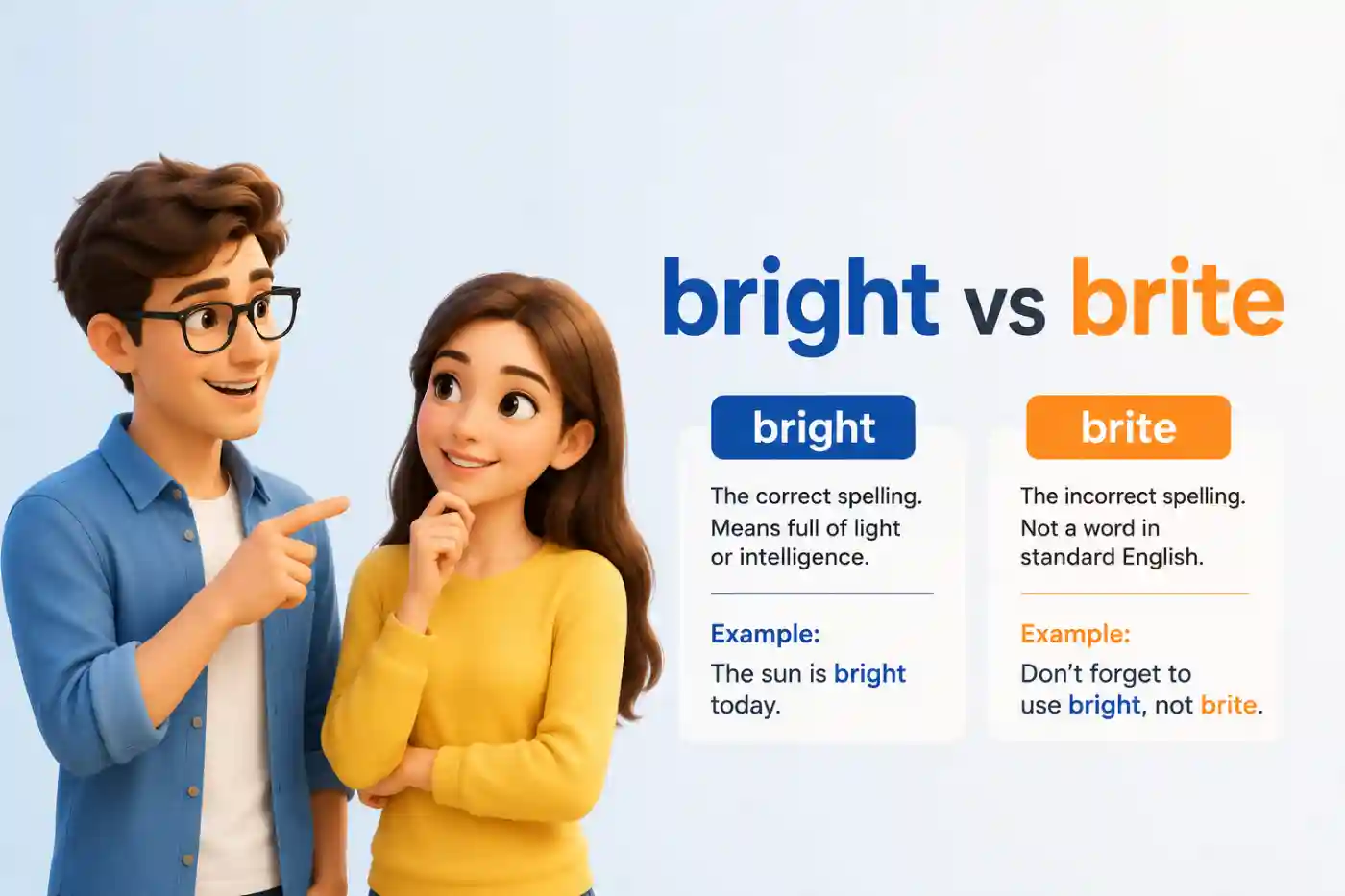
Bright vs Brite is a common spelling question because both forms appear online. The standard English word is bright. It can describe strong light, vivid colors, intelligence, or something that looks cheerful and clear. Brite is mainly a nonstandard or specialized form used in brand names, product names, and informal contexts.
Bright vs Brite Quick Answer
Bright is the correct standard English spelling. Use it in school writing, professional communication, academic work, and everyday English. Brite isn’t normally accepted as the standard spelling, although you may see it in company names, trademarks, product names, or stylized branding.
Bright vs Brite At a Glance
| Feature | Bright | Brite |
|---|---|---|
| Standard English spelling | Yes | No |
| Common dictionary word | Yes | Generally no as a standard alternative |
| Meaning | Full of light or vivid and intelligent | Usually a stylized form of bright |
| Part of speech | Adjective and noun in some uses | Usually a proper name or stylized word |
| Pronunciation | /braɪt/ | Usually /braɪt/ |
| Formal writing | Recommended | Avoid unless it’s a proper name |
| Everyday English | Very common | Uncommon |
| Academic writing | Correct | Usually incorrect |
| Business writing | Correct | Use only for an official name |
| Brand names | Possible | Common as a stylized spelling |
| Example | The room is bright. | Brite may appear in a product name. |
Which Word Should You Use
Use bright in normal English writing.
The room is bright.
She wore a bright yellow jacket.
He has a bright future.
That student is bright and curious.
Use Brite only when the spelling is part of an official name or intentional branding.
For example, a company may choose Brite instead of Bright because the shorter spelling looks distinctive. In that situation, don’t change the name to Bright during editing.
This gives you a simple rule.
Bright is the standard English word. Brite is usually a stylized form.
Understanding Bright Vs Brite
The adjective bright has several related meanings. Its core idea often involves light, clarity, vividness, or positive qualities.
Bright Meaning
When bright describes light, it means giving off or reflecting a strong amount of light.
The kitchen is bright in the morning.
It can also describe a strong or vivid color.
She chose a bright blue dress.
The word can describe intelligence too.
She’s a bright student.
It can also describe something hopeful or promising.
He has a bright future ahead of him.
These meanings are different on the surface but connected by the broader idea of something standing out clearly.
Bright as an Adjective
Most everyday uses of bright are adjectival.
It can modify nouns directly.
a bright room.
a bright color.
a bright child.
a bright idea.
The meaning changes according to the noun that follows it.
Bright as a Noun
Bright can also appear as a noun in specific contexts. For example, British English can use brights for brightly colored clothing or fabrics. This isn’t the main use most American readers need to know.
For standard American English, the adjective is by far the most important function.
Understanding Brite
Brite isn’t the normal spelling of the English adjective.
You may encounter it in names and branding because companies often modify ordinary words to create a distinctive identity.
For example, a business might use Brite in its name because the shortened spelling is memorable or visually appealing.
The same pattern appears in many brand names. Companies sometimes remove letters, change spelling, or use unusual capitalization to make a name stand out.
That doesn’t mean the altered form becomes the standard spelling in general English.
If a company is officially named Brite, preserve that spelling.
If you’re writing a normal sentence about something full of light, use bright.
The Biggest Differences Between Bright and Brite
The main difference is standard usage.
Bright belongs to ordinary English vocabulary.
Brite generally functions as a stylized spelling.
The pronunciation is usually the same. Both forms represent the sound /braɪt/ when Brite is intended as a variation of bright.
The important distinction appears in writing.
Consider these sentences:
The hallway is bright.
This is standard English.
The hallway is brite.
This looks like a spelling error unless Brite refers to a specific name or product.
That distinction matters in professional writing. Readers expect standard spelling unless a proper name requires something different.

Why People Confuse Bright and Brite
The confusion usually comes from visual exposure.
People see Brite in company names advertisements product packaging websites and usernames. After seeing the spelling repeatedly, they may assume it’s an accepted alternative to bright.
Another reason is pronunciation. Since both forms can represent the same sound, someone who hears the word first has no way to know which spelling the writer intends.
Branding makes the problem even more confusing.
A company might deliberately choose Brite because it looks shorter and more modern. Once readers encounter that spelling, they may start using it in ordinary writing.
Autocorrect and informal online communication can also reinforce unusual spellings.
Still, the standard rule remains simple.
For normal English prose use bright.
For an official name use the exact spelling chosen by the organization or brand.
Bright vs Brite in Everyday Writing
If you’re writing a sentence about light, color, intelligence, or optimism, bright is the natural choice.
The sun is bright today.
The walls are bright white.
She has a bright personality.
That’s a bright idea.
The future looks bright.
Writing brite in these sentences would normally look like a spelling mistake.
The exception comes when Brite is part of a proper name.
In that case, capitalization and context signal that you’re dealing with a name rather than ordinary vocabulary.
This is an important editing principle. A nonstandard spelling can still be correct when it’s the official spelling of a name.
Bright vs Brite in Professional Writing
Professional writing should favor bright unless you’re referring to a specific brand or organization.
In business emails, reports, proposals, websites, and workplace documents, standard spelling makes your writing easier to trust.
For example:
The office has bright lighting.
is appropriate.
The office has brite lighting.
looks like an error.
However, if you’re discussing a company called Brite, keep the official name unchanged.
Brite launched a new product.
Changing the name to Bright would introduce an error of its own.
The best editors understand this difference. They don’t automatically correct unusual spellings. They first determine if the word is ordinary vocabulary or a proper name.e would introduce an error of a different kind.
Why People Confuse bright vs brite
The confusion makes sense once you look at how English spelling works.
They sound the same
Bright and Brite are pronounced the same when they represent the same basic word.
When people hear a word rather than see it they can’t always tell which spelling belongs on the page.
That is a classic spelling problem. English contains many cases where sound alone isn’t enough to determine spelling.
Brite looks logical
Brite looks as though it should be a simpler version of bright.
The letters gh can feel unnecessary to learners because they don’t represent a separate sound in this word. Someone may naturally think that removing gh should leave a more phonetic spelling.
But English spelling doesn’t work like a simple sound code. Historical spelling patterns often remain even after pronunciation changes.
Branding reinforces the confusion
People see Brite in names and advertisements. Repeated exposure makes the spelling familiar.
Familiarity can be misleading.
A branded spelling may look completely normal because you’ve seen it hundreds of times. That doesn’t mean it has become the standard spelling of the ordinary word.
Autocorrect can make things worse
Spellcheck tools don’t always understand naming conventions perfectly. A branded word may be accepted because it is a proper name or because the software recognizes it from a dictionary.
On the other hand a writer may type brite and assume it is acceptable simply because the word isn’t automatically flagged.
Good editing still requires human judgment.
English learners may rely on sound
A learner who knows the pronunciation /braɪt/ may search for a spelling based on sound.
That approach can produce brite.
The better strategy is to connect the word with a familiar spelling pattern. Bright belongs with words such as light and night in terms of spelling pattern. That makes the unusual gh easier to remember.
Internet exposure creates false confidence
Search engines return branded names alongside ordinary vocabulary. A reader may see Brite many times and conclude that both forms are standard.
Search results show what exists online. They don’t automatically tell you what belongs in formal English.
That distinction is useful far beyond this pair.
Grammar Rules for bright vs brite
Bright is primarily an adjective.
It usually modifies a noun.
Examples include:
- a bright room
- bright sunlight
- a bright student
- a bright color
- a bright future
It can also appear after a linking verb.
Examples include:
- The room is bright.
- Her smile looks bright.
- The colors seem bright.
- The future appears bright.
Bright also has comparative and superlative forms.
- bright
- brighter
- brightest
Examples:
- This room is bright.
- The upstairs room is brighter.
- The room near the window is the brightest.
Bright also appears in related forms such as brightly and brightness.
Examples include:
- The stars were shining brightly.
- The brightness hurt my eyes.
- She smiled brightly.
These forms show why spelling matters. Once you know the standard base word you can build related words correctly.
Brite doesn’t normally form part of this ordinary grammatical family.
You wouldn’t normally write:
- britely
- briteness
- briteness improved
If you see a form like Brite in a name you should treat it as a name rather than automatically trying to build grammatical forms from it.
That is one of the clearest practical tests. Standard vocabulary participates naturally in the grammar of the language. A stylized brand spelling usually doesn’t.
Sentence Examples for bright vs brite
The easiest way to understand the distinction is to see it in natural sentences.
Ten examples using bright
- The living room looks bright after the curtains are opened.
- She wore a bright blue jacket to the meeting.
- He is one of the brightest students in the class.
- We had a bright sunny afternoon at the park.
- That was a bright idea and it saved us several hours.
- The bright screen made it difficult to sleep.
- Her future looks bright after completing the program.
- The flowers have bright yellow petals.
- A bright smile can make a conversation feel warmer.
- The hallway became brighter when we replaced the old bulbs.
Each example uses bright as an ordinary English word. Its meaning changes slightly with context but its grammatical role remains clear.
Ten examples using Brite
Brite needs a different treatment because it normally appears as part of a name.
- The package was labeled Brite.
- Brite appeared as the product name on the box.
- The company uses Brite as part of its business name.
- The advertisement featured the Brite product prominently.
- She searched for the Brite brand online.
- The store carries several products from Brite.
- The logo spells the company name Brite.
- The article referred to the Brite product by its official name.
- The Brite name appeared on the product label.
- The manufacturer chose Brite as its brand spelling.
These examples deliberately treat Brite as a name. That is the safest way to understand its role in modern writing.
If you’re simply describing something as full of light then use bright.

Common Writing Mistakes With bright vs brite
The most common mistake is using brite as a normal adjective.
Incorrect:
- The room is brite.
Standard:
- The room is bright.
Incorrect:
- She has a brite future.
Standard:
- She has a bright future.
Incorrect:
- He is a brite student.
Standard:
- He is a bright student.
Incorrect:
- The flowers are brite yellow.
Standard:
- The flowers are bright yellow.
Another mistake is assuming that a familiar brand spelling can be transferred into ordinary writing.
For example a writer may see Brite on packaging and later write brite in an article. The connection is understandable but the transfer is incorrect.
The editor’s question should be simple: Am I naming something or describing something?
If you’re naming a product and its official name is Brite then keep Brite.
If you’re describing the product as bright then use bright.
That one question solves most problems.
Proofreading tip
When proofreading an article search for brite.
Then inspect every occurrence.
If it is part of a proper name keep it.
If it is being used as the ordinary adjective then change it to bright.
This is faster and more reliable than trying to judge the spelling while reading every sentence.
Pronunciation of bright vs brite
Bright is pronounced /braɪt/.
It has one syllable.
A simple way to approximate the sound is to think of the vowel sound in eye followed by the consonant sounds in bright.
The pronunciation can be represented as:
/braɪt/
The Cambridge Dictionary gives /braɪt/ for both United States and United Kingdom pronunciation.
The word does not have multiple syllables. The entire word is spoken as one unit.
Sound breakdown
The beginning /b/ is the sound found in words such as book.
The middle vowel /aɪ/ is the sound found in eye.
The ending /t/ is the sound found in top.
Together they form /braɪt/.
Common pronunciation mistake
Some learners may try to pronounce the written gh as a separate sound. That isn’t correct here.
The gh in bright doesn’t produce a separate consonant sound.
This is another reason the spelling can feel strange. The written form contains letters that don’t map neatly onto a separate spoken sound.
What about Brite
When Brite represents the same concept as bright it is generally pronounced /braɪt/ too.
The spelling changes. The pronunciation usually doesn’t.
That makes this a spelling distinction rather than a pronunciation distinction.
Word History of bright vs brite
Bright has a very old history.
Modern bright developed from Old English forms including beorht and related spellings. The word traces through Germanic language history and ultimately connects with an ancient Indo European root associated with shining and brightness.
The older forms changed in spelling over centuries. English spelling was not always fixed in the way modern readers expect.
The historical record includes Middle English forms and several Old English spellings. Eventually the modern form bright became established.
The meaning also developed.
The original sense centered on shining or being radiant. Later English extended the word into figurative meanings.
For example the idea of light can naturally lead to clarity. Clarity can then suggest intelligence. Light can also suggest hope and positive prospects.
That explains meanings such as:
- a bright student
- a bright idea
- a bright future
These aren’t random meanings. They grew from a long semantic history.
Etymological sources trace bright to Proto Germanic roots connected with shining and brightness.
The history of brite
Brite has a different story.
Etymological records describe it as a spelling variant of bright. It became associated with phonetic spelling movements and later with advertising. Etymonline records advertiser usage from at least 1905 through the name Star brite Metal Polish.
That history is worth knowing because it explains why Brite can look familiar.
It isn’t simply a random misspelling invented on the internet. It has appeared in real English usage for a long time. Still, historical or commercial usage doesn’t make it the standard modern spelling of the adjective.
There is also an older dictionary record for brite as a regional verb meaning to become overripe. That historical sense is marked as provincial English and is not the ordinary meaning most modern readers have in mind.
For modern American writing the practical rule remains clear. Use bright for the ordinary adjective.
Usage Across English Speaking Countries
Bright is standard across major varieties of English.
American English
American English uses bright as the normal spelling.
You will see it in school writing business communication journalism books websites and everyday conversation.
Examples include bright light bright colors bright student and bright future.
British English
British English also uses bright.
There isn’t a standard British spelling change from bright to brite.
The pronunciation is also listed as /braɪt/ by Cambridge.
Canadian English
Canadian English follows the same standard spelling in ordinary writing.
Bright is the expected form in education publishing business communication and general prose.
Australian English
Australian English also uses bright as the standard spelling.
The differences among these varieties do not turn bright into brite.
This is useful because some spelling pairs genuinely do vary across English speaking regions. This one generally doesn’t.
Brite may appear in commercial names in any country because businesses are free to choose distinctive names.
Real World Usage of bright vs brite
Context matters more than the spelling alone.
Daily conversation
Bright is common in ordinary speech.
You might say:
- The sun is really bright today.
- That room is too bright.
- She’s a bright kid.
- Those colors are bright.
Brite is unlikely to appear as a normal spoken adjective. You may hear it as part of a brand or product name.
School writing
Use bright.
Students should write:
- The bright colors make the painting stand out.
They shouldn’t replace bright with brite simply because the pronunciation is the same.
Academic and educational writing depends on standard spelling.
Business communication
Use bright when describing something.
For example:
- The new office has bright lighting.
If the company or product is officially called Brite then preserve the proper name.
Academic writing
Bright is the appropriate standard form.
Academic writing values consistency and recognized language conventions. A stylized spelling can look like an error when it isn’t part of a proper name.
Books
Authors use bright in ordinary prose.
A fictional company or product can use Brite as part of its identity if the author intentionally creates that name.
Journalism
Journalists normally use standard spelling in their own prose.
They may preserve Brite when reporting an official company name product name or title.
Online writing
The same principle applies to websites and blogs.
Use bright for ordinary English.
Use Brite for names that actually use that spelling.
Social media
Social media is more flexible. Brands may use creative spellings for handles and names.
That doesn’t change the underlying spelling rule.
A social media username can contain almost any stylistic spelling. That doesn’t make every spelling standard English.
Similar Words Related to bright vs brite
Bright has a large semantic family. Choosing a related word can sometimes make your writing more precise.
Brilliant
Brilliant can describe intense light.
It can also describe exceptional intelligence or quality.
A brilliant diamond reflects strong light. A brilliant student can demonstrate exceptional ability.
Radiant
Radiant often suggests light that seems to pour outward.
You might describe a radiant smile or radiant sunlight.
Luminous
Luminous emphasizes something that gives off or appears to give off light.
It often sounds more technical or literary than bright.
Vivid
Vivid usually focuses on strong color or a clear mental impression rather than physical light.
A vivid red dress is intensely colored.
Shining
Shining directly describes something reflecting or producing light.
It can also describe success or excellence in figurative contexts.
Intelligent
When bright refers to someone’s mental ability intelligent may be a more precise alternative.
A bright student and an intelligent student can communicate similar ideas, although their tone may differ.
Clever
Clever often suggests quick thinking or skill.
It can sometimes sound more informal than intelligent.
Cheerful
When bright describes someone’s mood or manner cheerful may be the more exact word.
This illustrates an important writing principle. Synonyms aren’t always interchangeable. The best word depends on the specific shade of meaning you want.

Professional Editor Advice for bright vs brite
An experienced editor doesn’t simply ask if a word looks familiar. The editor asks what job the word is doing.
That distinction matters here.
If bright describes a noun then it is ordinary vocabulary.
If Brite identifies a company or product then it is a proper name.
The same letters can therefore occupy very different editorial roles.
Check the source of the spelling
If you see Brite in published material ask where it came from.
Is it a logo?
If is it a company name?
A product name?
Is it a fictional name?
Is it an official title?
If yes then preserve the spelling when accuracy requires it?
If none of those applies then bright is probably the intended standard form?
Don’t trust visual familiarity
Writers often assume a spelling is correct because they’ve seen it repeatedly.
That’s a dangerous editing habit.
Advertising exposes readers to stylized spellings all the time. Marketing language is designed to stand out. Standard English is designed for consistent communication.
Those goals can overlap but they aren’t identical.
Use search carefully
Searching a word online can confirm that it exists. It doesn’t automatically confirm that it is the correct standard spelling for your sentence.
For language questions use authoritative dictionaries and established editorial references rather than relying only on search frequency.
Read the sentence aloud
Pronunciation won’t distinguish these forms because they usually sound the same. Still, reading aloud can help you identify the intended meaning.
Ask yourself what the sentence is saying.
If it describes brightness then use bright.
If it identifies a name then check the official spelling.
Build spelling associations
Bright belongs to the familiar spelling pattern found in words such as light and night.
That association makes the spelling easier to remember.
Instead of memorizing five individual letters, remember the family.
Bright rhymes with light.
That makes the spelling much easier to retrieve.
Frequently Asked Questions About bright vs brite
Is bright the correct spelling?
Yes. Bright is the standard English spelling for the adjective meaning full of light vivid intelligent cheerful or promising. It is used in both American and British English. If you’re writing a normal sentence you should choose bright. Brite should generally be reserved for a proper name product name company name or deliberate stylized spelling.
Is brite a real word?
Brite has appeared in English as a spelling variant and has a documented history in advertising and some historical regional usage. In modern standard English however it isn’t the normal spelling of the adjective bright. Most contemporary uses you encounter are likely to be names brands products or stylized spellings.
Are bright and brite pronounced the same?
Yes. When Brite is being used as a stylized spelling of bright it is generally pronounced /braɪt/. Bright has one syllable. Cambridge lists /braɪt/ for both United States and United Kingdom pronunciation. The main distinction is spelling and usage rather than sound.
Can I use brite in formal writing?
Don’t use brite as the ordinary spelling in formal writing. Use bright instead. The main exception is a proper name that officially uses Brite. If you’re writing about a company or product called Brite you should preserve its official spelling. Outside that naming context bright is the professional choice.
Why does Brite appear in brand names?
Brands often use unusual spellings to make names distinctive and memorable. Brite is visually shorter and can stand out in a logo or product label. Historical evidence also shows that Brite has been used in advertising for more than a century. A branded spelling can therefore be intentional without becoming the standard spelling of the underlying English word.
Is bright used in American English?
Yes. Bright is a standard and very common word in American English. It can describe light color intelligence mood sound and future prospects. American dictionaries recognize these meanings. The spelling does not normally change to brite in American English.
Is bright used in British English?
Yes. Bright is also the standard spelling in British English. There is no normal British spelling rule that changes bright to brite. Cambridge gives the same basic pronunciation for British and American English. Regional differences do not make brite the standard alternative.
Can bright describe a person?
Yes. Bright can describe someone who is intelligent or quick to understand things. For example you can say that a child is bright or that a student is one of the brightest people in the class. This figurative meaning developed from the broader idea of clarity and brightness and has been established in English for centuries.
What does bright mean in a sentence?
Bright can mean different things depending on context. In The lamp is bright it refers to strong light. She wore a bright dress it refers to vivid color. He is bright it refers to intelligence. In They have a bright future it refers to promise and hope. Context determines the precise sense.
How can I remember the correct spelling?
Use a simple association. Bright rhymes with light. Both contain the familiar ight spelling pattern. If you’re describing light color intelligence happiness or promise choose bright. If you see Brite check first to see if it is a brand or proper name. That quick test will prevent most mistakes.
Final Verdict
The standard spelling is bright.
Use bright in ordinary English whenever you’re describing something that gives off or reflects light. You can also use it for vivid colors intelligent people cheerful expressions promising situations and many related ideas.
Brite has a legitimate history as a spelling variant and has been used in advertising and other stylized contexts. It can also appear in company names product names and brands. That doesn’t make it the standard spelling of the everyday adjective.
The most useful rule is this:
Bright is the ordinary English word. Brite is usually a name or stylized spelling.
If you’re writing an essay choose bright.
Writing a business email choose bright.
Describing a room choose bright.
Describing a color choose bright.
If you’re describing an intelligent person choose bright.
Describing a hopeful future choose bright.
If you’re referring to a product officially named Brite keep Brite because proper names should be reproduced accurately.
The easiest memory trick is bright rhymes with light. Both belong to the familiar ight spelling pattern.
Once you separate standard vocabulary from branding you won’t have much trouble with this pair again.

Founding Editor
Maya spent six years as a copyeditor at a regional newspaper before starting Grammist, which is where the “answer first” format came from: newsroom style guides don’t have room for a preamble.
She writes and reviews most of the word-pair and spelling entries, and has final say on anything that goes out under the Grammist name.