
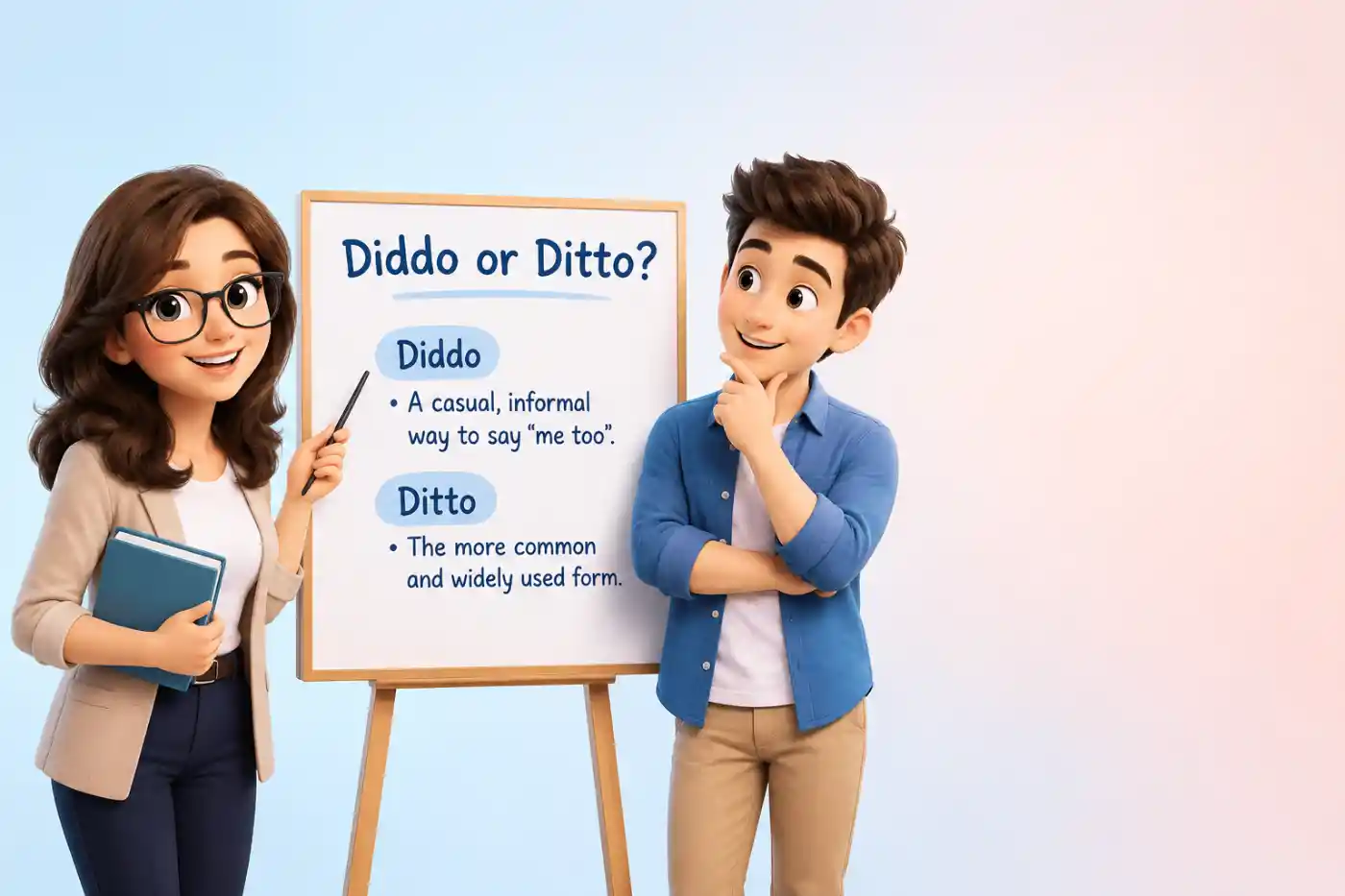
If you have ever typed diddo or ditto and stopped to wonder which spelling is correct, you’re dealing with a very common English spelling confusion. The answer is simple: ditto is the correct spelling when you mean the same thing, same here, likewise, or the same as something already mentioned. Diddo is generally a misspelling of ditto.
The confusion makes sense. Ditto is a short word that people often learn through conversation rather than formal writing. When someone says it quickly, the middle consonant can be easy to hear incorrectly. That can lead people to write diddo because it seems to match the sound.
There’s more to this little word than its spelling, though. Ditto can work as a response in conversation, an adverb meaning likewise, a noun referring to something repeated, and a verb meaning to copy or repeat. It also has an interesting history that reaches back to Italian and Latin.
This guide explains the difference between diddo and ditto, shows you how to use the correct form, covers pronunciation and grammar, explores the word’s history, and gives you practical examples for everyday and professional writing. By the end, you’ll know exactly when to use ditto and why diddo is usually the wrong choice.
Quick Answer
Ditto is the correct spelling. Diddo is a common misspelling when you mean the same, same here, likewise, or the same as something already mentioned. Use ditto in conversations, messages, lists, and appropriate informal writing. In formal writing, a more specific phrase such as I agree or the same applies may be clearer.
Diddo or Ditto Comparison
| Feature | Ditto | Diddo |
|---|---|---|
| Standard spelling | Yes | No |
| Standard English word | Yes | No in this sense |
| Main meaning | The same or likewise | Usually a misspelling of ditto |
| Common use | Agreement and repetition | Informal spelling error |
| Pronunciation | Roughly dit oh | Not a standard pronunciation |
| Part of speech | Adverb noun and verb | Not normally recognized as the intended word |
| Formal writing | Sometimes appropriate | Avoid |
| Texting | Common | Sometimes appears as a typo |
| Meaning of same here | Yes | No |
| Meaning of repeat | Yes | No |
The distinction is straightforward. If you want to say that you agree with something someone just said or that the same information applies again, use ditto.
Which One Is Correct
Ditto is the correct spelling.
If someone says:
I love this restaurant.
You can reply:
Ditto.
That means you love the restaurant too.
You can also use ditto to avoid repeating information. For example:
The first package arrived on Monday. Ditto the second package.
Here, ditto means that the second package followed the same pattern.
The spelling diddo does not serve as the standard form of this word. Major dictionaries recognize ditto and describe its uses around agreement, repetition, and sameness. Cambridge lists ditto as an adverb and noun, while Collins also records verb uses. (Cambridge Dictionary)
So if you’re checking an email, school assignment, article, message, or social media post, choose ditto when you mean the same.
What Does Ditto Mean
Ditto has a few closely related meanings, but they all revolve around the same basic idea.
At its simplest, ditto means the same as something already said or written.
In conversation, it can mean:
- Same here.
- Me too.
- I agree.
- I feel the same.
- Likewise.
- The same applies.
- Repeat what was just mentioned.
In a list, ditto can indicate that the information above should be repeated.
It is mean in some contexts, ditto can also mean a duplicate or copy. As a verb, it can mean to copy or repeat something.
Cambridge defines the conversational use as agreement with something just said or avoiding repetition. It also identifies a noun use connected with the ditto mark used in lists. (Cambridge Dictionary)
The central idea never changes much. Ditto tells the reader or listener that something already stated applies again.

How Ditto Works In Conversation
The conversational use is probably the one most people encounter today.
Imagine this exchange:
I’m exhausted after that flight.
Ditto.
The second speaker is saying that they are also exhausted.
Here’s another example:
I think we should leave early.
Ditto.
This means the second person agrees with the suggestion.
The word can also respond to a positive statement.
I really enjoyed the concert.
Ditto.
The speaker means they enjoyed it too.
This short response is useful because it avoids repeating a full sentence. Instead of saying I really enjoyed the concert too, one person can simply say ditto.
That makes the word especially handy in casual conversation, text messages, comments, and informal online communication.
How Ditto Works In Writing
Ditto has a longer history as a written shortcut.
Suppose a list contains several entries with the same city:
New York
Ditto
Ditto
The second and third entries indicate that the same city applies again.
Historically, writers also used a ditto mark to show that information above should be repeated. Dictionaries still recognize this meaning. Cambridge describes the mark as a symbol used in a list to avoid writing the same information again. (Cambridge Dictionary)
Modern writers have many other tools available, so the written use of ditto marks is less prominent than it once was. Still, you may encounter them in tables, records, lists, historical documents, and some specialized contexts.
Is Ditto A Real Word
Yes. Ditto is a well established English word.
It appears in major English dictionaries and has several recognized grammatical functions. Cambridge lists it as an adverb and noun. Collins also records noun, adverb, and verb uses. (Cambridge Dictionary)
This matters because people sometimes assume that ditto is simply slang. It can certainly sound casual when someone uses it as a quick response, but its history and dictionary record are much broader.
The word has been part of English for centuries.
Is Diddo A Real Word
If you mean the word used to express same or likewise, diddo is not the standard spelling.
You may encounter diddo online. Someone might type it in a text, comment, username, brand name, character name, or other special context. That does not make it the standard spelling of the English word ditto.
For normal English writing, use ditto.
This distinction is important because a word can appear online without being a standard dictionary form. Internet usage often spreads typos quickly. A familiar mistake can start to look legitimate simply because you see it repeatedly.
Frequency alone does not establish a spelling as standard English.
Why People Confuse Diddo And Ditto
The confusion usually comes from sound rather than meaning.
The Words Look Similar
Diddo and ditto differ by only one letter. Both are short. Both contain two syllables when spoken naturally. That visual similarity makes the incorrect version look surprisingly believable.
When a word already feels familiar, your brain can fill in a spelling pattern before you consciously check it.
The Spoken Word Can Be Misheard
Ditto is commonly pronounced with the stress on the first syllable. In American English, Cambridge gives the pronunciation as /ˈdɪt̬.oʊ/. (Cambridge Dictionary)
In natural conversation, sounds can become less distinct. Someone who has heard the word many times but rarely seen it written may remember an approximation of the sound instead of the spelling.
That can lead to diddo.
People Spell By Sound
English creates problems for learners because spelling and pronunciation do not always match perfectly.
When people hear an unfamiliar word, they often write the sounds they think they hear. That strategy works for some words but fails for others.
Ditto is one of those words where hearing the sound alone may not give you enough information to choose the correct letters.
Informal Messages Encourage Errors
Texting and social media move quickly. People often type without proofreading short messages.
A typo such as diddo may pass unnoticed because the reader understands the intended meaning immediately.
Once people see the same mistake repeatedly, it can start to look normal.
Autocorrect Does Not Solve Every Spelling Problem
Autocorrect catches many common errors, but it does not catch everything.
A short word that resembles a possible name, username, or informal expression may not trigger a correction. That means diddo can sometimes remain in a message even when the writer intended ditto.
Diddo Or Ditto In American English
American English uses ditto.
The spelling does not change to diddo in American English. The same standard spelling applies in British English and other major varieties of English.
The pronunciation has some regional variation. Cambridge lists the British form as /ˈdɪt.əʊ/ and the American form as /ˈdɪt̬.oʊ/. (Cambridge Dictionary)
The spelling remains ditto.
This is an important point for English learners. Regional pronunciation can vary without creating a different standard spelling.
Ditto Pronunciation
The American pronunciation is commonly represented in IPA as:
/ˈdɪt̬.oʊ/
It has two syllables.
The stress falls on the first syllable.
The British pronunciation is commonly represented as:
/ˈdɪt.əʊ/
The main difference involves the final vowel sound and some details of the middle consonant. Cambridge lists both regional forms. (Cambridge Dictionary)
Common Pronunciation Mistake
The most relevant mistake is allowing the middle sound to influence the spelling.
Even if casual speech makes the consonant sound less clear, the written form remains ditto.
Think of pronunciation and spelling as related but separate systems. You should not change the spelling simply because a sound becomes softer in natural speech.
The Grammar Of Ditto
Ditto is an unusual word because it can perform several grammatical roles.
Ditto As An Adverb
As an adverb, ditto can mean likewise or as said before.
Examples:
I enjoyed the first movie and ditto the sequel.
The team supported the proposal. Ditto the board.
The weather was poor on Tuesday and ditto on Wednesday.
This use connects directly to the idea of repeating information.
Ditto As A Sentence Substitute
Ditto can stand alone as a response.
I’m ready to go.
Ditto.
Here, the word replaces a longer response such as I’m ready to go too.
This is especially common in conversation.
Ditto As A Noun
Ditto can refer to something that is the same as something previously mentioned.
For example:
I ordered the same meal as yesterday. I’ll have a ditto.
This noun use is less common than the conversational response.
Ditto As A Verb
Ditto can also function as a verb meaning to copy or repeat.
Collins records forms such as dittoed and dittoing. (Collins Dictionary)
For example:
The assistant dittoed the information from the previous form.
This verb use exists, but it is much less common in everyday American conversation than the adverbial or sentence substitute use.
Ditto And Punctuation
Punctuation depends on how you use the word.
When ditto stands alone as a complete response, it can take a period.
Example:
I feel the same way.
Ditto.
When it appears within a longer sentence, punctuation follows the normal structure of that sentence.
Examples:
I liked the first proposal and ditto the second.
The first group approved the plan. Ditto the second group.
There is no special punctuation rule that turns ditto into a special grammatical category.
Treat it according to its role in the sentence.
Diddo Or Ditto In Formal Writing
Ditto is a real English word, but that does not mean it is always the clearest choice.
In a formal report, academic paper, legal document, technical explanation, or professional recommendation, precision usually matters more than brevity.
Instead of:
Ditto for the second group.
You might write:
The same applies to the second group.
Instead of:
Ditto.
You might write:
I agree with that conclusion.
Instead of:
Ditto the previous result.
You might write:
The previous result was also observed in this experiment.
This does not make ditto incorrect. It simply means that the best word depends on the writing situation.
Professional editing is often about choosing the clearest expression rather than simply choosing a grammatically possible one.
Ditto In Casual Writing
Ditto works naturally in casual writing.
You can use it in:
- Text messages.
- Friendly emails.
- Online comments.
- Casual conversations.
- Personal notes.
- Informal social media posts.
- Light dialogue.
For example:
That was the best burger I’ve had all year.
Ditto.
Or:
I’m ready for the weekend.
Ditto.
The word feels short and conversational because it replaces a longer agreement.

Diddo Or Ditto In Academic Writing
In academic writing, context matters.
You can use a recognized word without it being the best choice for a particular sentence. Academic writing usually benefits from precise statements that tell the reader exactly what is being repeated or agreed with.
Instead of relying heavily on ditto, an academic writer might use:
- Similarly.
- The same result was observed.
- The previous finding also applies.
- The second group showed the same pattern.
- The researchers reached the same conclusion.
These alternatives make the relationship between ideas explicit.
Ditto is not wrong simply because a piece of writing is academic. It is usually less precise than the alternatives.
Ditto In Workplace Writing
Workplace use depends on the setting.
A quick team message might say:
I agree with Sarah’s suggestion.
Ditto.
That sounds natural in a casual workplace conversation.
A formal report might instead say:
The same recommendation applies to the second department.
That version gives the reader more information and sounds more precise.
The practical rule is simple. Use ditto freely in casual communication when everyone understands the reference. In formal documents, name the repeated idea instead of making the reader look backward.
Twenty Natural Examples With Ditto
Here are examples that show the word in different situations.
Daily Conversation
- I’m exhausted after that workout. Ditto.
- I love this coffee shop. Ditto.
- I think we should leave now. Ditto.
- I’m hungry. Ditto.
- That movie was surprisingly good. Ditto.
Text Messages
- I miss summer already. Ditto.
- I can’t wait for Friday. Ditto.
- That was such a long meeting. Ditto.
- I need a vacation. Ditto.
- I’m ordering pizza tonight. Ditto.
Workplace Communication
- The first team approved the proposal. Ditto the second team.
- The same deadline applies to the marketing group. Ditto the design group.
- I agree with your recommendation. Ditto.
- The first report showed strong results. Ditto the follow up report.
Informal Writing
- She loved the book and ditto the sequel.
- The restaurant received positive reviews. Ditto its new location.
- He supports the idea and ditto his colleagues.
More Formal Contexts
- The first experiment produced the expected result. The second experiment did the same.
- The original policy applies to contractors. The same applies to temporary staff.
- The first study reported similar findings. The later study reached a similar conclusion.
Notice that the final examples avoid ditto because a more explicit expression gives the reader more information.
That is an important editorial lesson. Knowing a word means more than knowing its definition. Good writing also requires knowing when a word helps and when another expression communicates the idea more clearly.
Common Mistakes With Ditto
Writing Diddo
This is the main spelling mistake.
Incorrect:
Diddo.
Correct:
Ditto.
Treating Diddo As A Second Standard Spelling
Diddo is not an accepted alternative spelling of ditto in standard English.
The fact that people use it online does not create a standard spelling.
Assuming Ditto Always Means I Agree
Ditto often means I agree or same here, but that is only one use.
It can also mean that information already mentioned applies again.
For example:
The first invoice was sent on Monday. Ditto the second invoice.
Here, ditto is about repetition rather than personal agreement.
Using Ditto Without A Clear Reference
Ditto depends on context.
If the reader cannot tell what you are repeating, the word becomes vague.
For example:
The plan changed significantly. Ditto.
What does ditto refer to?
The sentence does not provide enough information.
Clear writing gives the reader a visible connection between ditto and the information being repeated.
Overusing Ditto
A paragraph filled with ditto can become difficult to follow.
Use it as a shortcut, not as a replacement for every repeated idea.
Good writing balances efficiency with clarity.
Why Diddo Can Look Correct
There is a psychological reason misspellings can feel familiar.
When you see the same incorrect form often enough, your brain starts recognizing it as a familiar visual pattern.
That familiarity can create a false sense of correctness.
Diddo looks plausible because it follows the general shape of ditto. It also feels close to the spoken form for some speakers.
But standard spelling depends on established written usage, not just what looks or sounds familiar.
The safest approach is to memorize the correct form:
Ditto.
A Simple Memory Trick For Ditto
The easiest trick is to connect the spelling with the idea of repetition.
Ditto has two t letters.
Think:
Same thing. Two t letters. Ditto.
You can also connect it with the phrase ditto mark. The same word appears again, and the spelling stays the same.
Another useful trick is to remember the contrast:
Ditto means the same. Diddo is the mistake.
Once you associate the word with its meaning, the spelling becomes easier to recall.
Ditto And Same
Ditto and same overlap, but they do not always sound equally natural.
Consider:
I love that song.
Same.
This is extremely casual.
Ditto sounds slightly more distinctive:
I love that song.
Ditto.
Both can communicate agreement, but they create a different tone.
Same is extremely common in modern casual conversation. Ditto has a slightly more playful or old fashioned flavor in some contexts.
Ditto And Me Too
Me too is usually clearer when you are talking about yourself.
I’m tired.
Me too.
Ditto.
Both responses work, but me too directly identifies the speaker’s shared feeling.
Ditto simply signals that the previous statement also applies.
For that reason, me too can sound warmer and more personal, while ditto can sound shorter or more playful.
Ditto And Likewise
Likewise is another close alternative.
For example:
It was nice meeting you.
Likewise.
This means the same positive sentiment applies to the second person.
Ditto can work in some similar contexts, but likewise often sounds more natural in polite exchanges.
Likewise can also connect actions or situations:
The first group responded positively. The second group responded likewise.
Ditto is possible in some contexts, but the sentence feels more concise and conversational.
Ditto And Also
Also usually adds information.
Ditto usually repeats or agrees with information already given.
Compare:
I also liked the movie.
Ditto.
The first sentence adds the speaker’s opinion. The second simply signals that the same opinion applies.
That difference matters in careful writing.
Ditto And Repeat
Repeat means to say or do something again.
Ditto can indicate repetition, but it often carries the idea of repeating something already stated without actually saying it again.
If a teacher says:
Please repeat the sentence.
The student should say the sentence again.
If someone says:
I agree with your point.
Ditto.
The second person does not repeat the entire point.
So the words overlap but perform different jobs.
Ditto Marks
A ditto mark is a symbol used to show that something above should be repeated.
This practice has traditionally appeared in lists, tables, accounts, and records.
For example, imagine a table with several rows where the same location appears repeatedly. Instead of writing the location again in every row, a ditto mark can indicate that the previous entry applies.
Cambridge and Collins both recognize this use. (Cambridge Dictionary)
The mark is particularly associated with historical and tabular writing.
Modern digital documents often make copying and pasting so easy that writers have less need for traditional ditto marks.
Still, the concept remains useful because it explains part of the word’s history and meaning.
The Origin Of Ditto
Ditto has an interesting linguistic history.
English borrowed it from Italian. Collins traces it to the Tuscan Italian form of detto, meaning said, which ultimately connects to Latin dicere, meaning to say. (Collins Dictionary)
Etymonline dates the English use to the seventeenth century and explains that the word originally helped avoid repeating month names in dates. Its meaning later expanded to refer more broadly to the same thing or something already mentioned. (Etymology Online)
That history explains why ditto has such a strong connection with repetition.
The word essentially carries the idea of something already said.
Over time, its practical use expanded beyond written records. Today, someone can simply say ditto to communicate agreement.
How The Meaning Developed
The history of ditto follows a useful path.
First, the word was associated with something already said or named.
Then it became useful for avoiding repetition in records and lists.
Later, its meaning expanded to include the general idea of the same thing.
Eventually, conversational English adopted it as a short response meaning that the same statement applies to another person.
That is why the modern conversational meaning does not feel disconnected from the historical one.
The basic concept has remained remarkably stable:
Something already stated applies again.
British English And American English
The spelling ditto is standard in both British and American English.
The pronunciation differs slightly.
British English commonly uses /ˈdɪt.əʊ/.
American English commonly uses /ˈdɪt̬.oʊ/. (Cambridge Dictionary)
The meaning is also broadly shared.
British and American speakers can use ditto to indicate agreement, repetition, or sameness.
Canadian and Australian English also use the established spelling ditto. There is no standard regional spelling called diddo.
Is Ditto Formal Or Informal
Ditto can appear across different levels of writing, but its conversational use is generally informal.
Cambridge marks the American adverbial use as informal. (Cambridge Dictionary)
That does not mean you should never use it in professional communication.
Instead, consider the purpose of the document.
A casual email:
I agree with your recommendation. Ditto for the rest of the team.
A formal report:
The rest of the team reached the same conclusion.
Both communicate a similar idea, but the second version is more explicit.
Professional writing often rewards clarity over clever shortcuts.
When To Use Ditto
Use ditto when:
- You want to say the same thing applies.
- You want to show agreement.
- The reference is obvious.
- The tone is conversational.
- Repeating the full statement would feel unnecessary.
- You are working with a list or record where repetition is clear.
Examples:
I’m ready.
Ditto.
The first group approved the proposal. Ditto the second group.
She enjoyed the first book and ditto the sequel.
When To Avoid Ditto
Avoid it when:
- The reader may not know what you are referring to.
- You are writing a formal academic argument.
- A legal document requires precise language.
- A technical report needs exact information.
- Repetition would actually make the meaning clearer.
- The word would create an overly casual tone.
In these situations, choose a precise alternative.
You might write:
- The same applies.
- Likewise.
- I agree.
- The second group reached the same conclusion.
- The previous result was repeated.
- The same information applies below.

Editor’s Advice On Diddo Or Ditto
As an editor, the first correction is simple: change diddo to ditto when the intended meaning is same, likewise, or the same as previously stated.
After correcting the spelling, look at the sentence itself.
Ask one practical question:
Will the reader immediately know what ditto refers to?
If the answer is yes, the word may work perfectly.
If the answer is no, replace it with a clearer phrase.
That approach is better than treating every word as simply correct or incorrect. Strong editing considers spelling, grammar, meaning, tone, audience, and context at the same time.
Dictionaries support the standard spelling ditto and recognize several grammatical uses. Cambridge identifies adverbial and noun uses, while Collins records noun, adverb, and verb functions. (Cambridge Dictionary)
Common Questions About Diddo Or Ditto
Is Diddo Or Ditto Correct
Ditto is correct when you mean the same, same here, likewise, or the same as previously stated. Diddo is generally a misspelling of ditto. If you are writing an email, article, assignment, report, or message and intend the standard English word, choose ditto.
What Does Ditto Mean In A Text
In a text message, ditto usually means same here, me too, or I agree. For example, if someone writes I’m ready for the weekend and you respond with ditto, you are saying that you feel the same way. The word can also mean that the information previously mentioned applies again.
Is Diddo A Word
Diddo is not the standard spelling of the English word used to mean same or likewise. You may encounter diddo as a name, username, title, or other proper name. Those special uses do not change the standard spelling of the English word. For ordinary writing, use ditto.
Why Do People Spell Ditto As Diddo
People often write diddo because the two forms look similar and the spoken word can be misheard. Fast speech can make the middle consonant less obvious. People also make quick typing mistakes and may see the incorrect form often enough for it to feel familiar. Standard English spelling still uses ditto.
Is Ditto Formal English
Ditto is a standard English word, but its conversational use is generally informal. It can appear in professional communication when the tone allows it. In academic, legal, technical, or highly formal writing, a more explicit phrase such as the same applies, likewise, or the same result was observed may provide greater clarity.
Can Ditto Mean I Agree
Yes. In conversation, ditto can mean I agree or I feel the same. If someone says I think this was the right decision and you answer ditto, you are expressing agreement. The word can also indicate repetition without expressing personal agreement, so context determines the exact meaning.
How Do You Pronounce Ditto
In American English, ditto is commonly pronounced /ˈdɪt̬.oʊ/. It has two syllables with stress on the first syllable. British English commonly uses /ˈdɪt.əʊ/. The spelling remains ditto in both varieties of English.
What Is A Ditto Mark
A ditto mark is a symbol used to show that the information above should be repeated. It has traditionally appeared in lists, tables, accounts, and records. The practice helped writers avoid copying the same word or phrase repeatedly. The word ditto itself has the broader meaning of something already said or stated.
Quick Reference Guide
If you mean same here, use ditto.
For I agree, you can use ditto.
If you mean the same as above, use ditto.
For likewise, ditto may work depending on the sentence.
If you mean repeat this information, ditto can work in the right context.
If you have written diddo, check the sentence. For intended the standard English word for sameness or agreement, change it to ditto.
Final Verdict
When choosing between diddo or ditto, use ditto.
Ditto is the established English word meaning the same, same here, likewise, or the same as something already mentioned. It can also refer to repeated information and has noun, adverb, and verb uses.
Diddo is generally a spelling mistake when used with that meaning.
The confusion usually comes from pronunciation, visual similarity, fast typing, and informal online communication. Once you connect the spelling with the meaning, the mistake becomes easy to avoid.
Remember the simplest rule:
Ditto has two t letters. Ditto means the same.
When you want to agree or avoid repeating something that has already been said, ditto is the word to choose.

Founding Editor
Maya spent six years as a copyeditor at a regional newspaper before starting Grammist, which is where the “answer first” format came from: newsroom style guides don’t have room for a preamble.
She writes and reviews most of the word-pair and spelling entries, and has final say on anything that goes out under the Grammist name.