
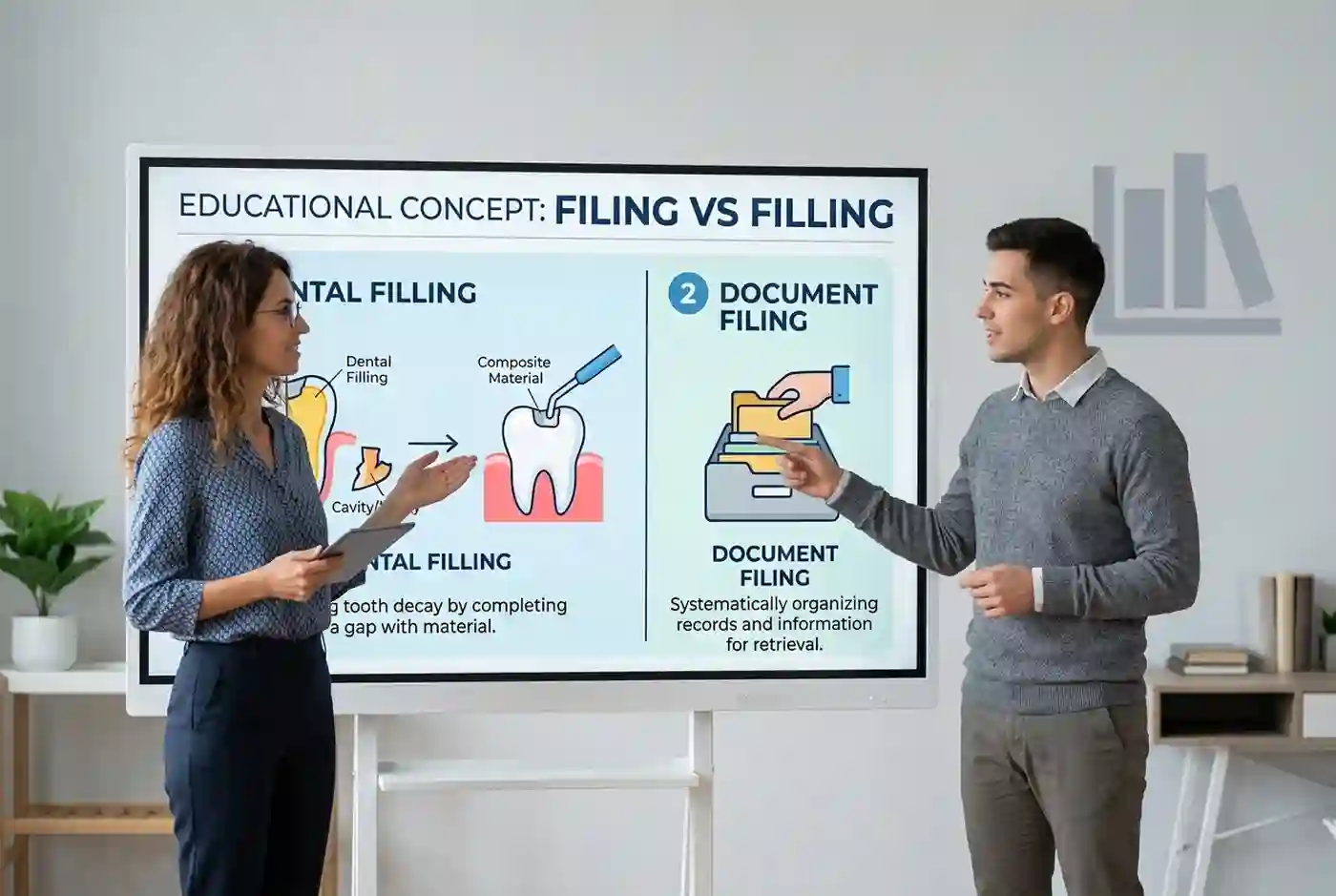
When you are unsure about filing vs filling you are dealing with two correctly spelled English words that have different meanings. The confusion usually comes from their similar appearance and the fact that both end in ing. However the base verbs are completely different. Filing comes from file while filling comes from fill.
The difference becomes clear once you connect each word to its root meaning. Filing usually involves organizing documents or records. It can also describe the act of officially submitting something or using a file tool to smooth or shape a surface. Filling relates to making something full or putting something into an empty space. It can also refer to completing a form or supplying something that is missing.
This distinction matters in everyday writing as well as professional communication. A sentence such as I am filing the documents describes organizing or submitting documents. I am filling the documents would usually suggest putting something into them and may sound incorrect if you mean organizing paperwork.
This guide explains the meaning of each word, the grammar behind the spelling, pronunciation, regional usage, common mistakes, word origins, and dozens of natural examples. By the end, you should be able to choose the correct form quickly and confidently.
Quick Answer
Filing means organizing documents, officially submitting something, or using a file to smooth a surface. Filling means making something full, putting something into an empty space, or completing something such as a form. Filing comes from file. Filling comes from fill. They have different meanings and different pronunciations.
Filing vs Filling At a Glance
| Feature | Filing | Filling |
|---|---|---|
| Base word | File | Fill |
| Main meaning | Organizing or submitting information | Making something full |
| Common part of speech | Noun or verb form | Noun adjective or verb form |
| Verb | File | Fill |
| Present participle | Filing | Filling |
| Pronunciation | /ˈfaɪ.lɪŋ/ | /ˈfɪl.ɪŋ/ |
| First vowel sound | Long i sound | Short i sound |
| Common context | Records offices law documents | Forms food containers spaces |
| Example | She is filing the reports. | She is filling the boxes. |
| Spelling pattern | File becomes filing | Fill becomes filling |
| Main spelling clue | Final silent e disappears | Final l remains doubled |
Cambridge defines filing as the activity of putting documents or electronic information into files. It also recognizes filing as an official record in legal contexts and as the material produced when a file is used to remove small pieces from a surface.
Cambridge defines fill as making something full or using empty space. The word also covers putting substances into spaces and providing something that is needed.
What Filing Means
Filing is the present participle and gerund form of file when file means to organize information or submit a document. In ordinary office language filing means putting papers records or electronic information into an organized system.
For example:
She is filing the invoices.
This means she is organizing the invoices into the appropriate files.
The word also appears in legal business and government contexts.
The company is filing its annual report.
Here filing means officially submitting the report to an authority or organization.
A third meaning comes from the other verb file. A file is also a tool used to smooth shape or remove material from a surface. In that sense:
He is filing the edge of the metal.
The action involves using a file to alter the surface.
Cambridge gives filing several established meanings including putting information into files an official record and small pieces of material produced by filing.
Filing as a Noun
It can function as a noun when it refers to the activity itself.
Filing takes up most of my morning.
The office has improved its filing system.
Electronic filing has reduced the amount of paper we use.
In legal writing filing can refer to an official submission.
The court received the filing yesterday.
This use is especially common in expressions such as court filing legal filing tax filing and bankruptcy filing.
Filing as a Verb Form
Filing can also function as the present participle of file.
She is filing the documents.
They are filing the complaint today.
He is filing the paperwork in alphabetical order.
In these sentences the word describes an action that is happening now or around the present time.

What Filling Means
Filling comes from the verb fill. Its central meaning is connected to making something full or putting something into an empty space.
She is filling the glass with water.
They are filling the boxes with books.
The workers are filling the tank.
Filling can also describe completing something that has empty spaces.
I am filling in the application.
In this context the person is writing information into the spaces provided on the form.
The word has many other common uses. Cambridge notes that fill can mean making something full using empty space putting a substance into an empty space providing something that is needed or employing someone for a position.
Filling as a Noun
Filling can be a noun when it refers to material placed inside something.
The cake has a chocolate filling.
What kind of filling does the sandwich have?
The pillow has a soft filling.
The word also refers to the material placed into a tooth during dental treatment.
I need a new filling.
Cambridge lists food fillings dental fillings and material used to fill something among the established meanings of filling.
Filling as an Adjective
Filling can also describe food that makes you feel full.
The soup was surprisingly filling.
I need a light meal because that dish is very filling.
This use is different from the verb form but comes from the same basic idea of filling the stomach.
Filing vs Filling Which One Is Correct
Both filing and filling are correct. Neither spelling is a general alternative to the other.
Choose filing when the base verb is file.
Choose filling when the base verb is fill.
A useful test is to remove ing.
filing → file
filling → fill
If the sentence needs the verb file then use filing. If the sentence needs fill then use filling.
Compare these sentences:
She is filing the records.
He is organizing the records.
She is filling the boxes.
Is she putting things into the boxes?
The two actions are completely different even though their written forms look similar.
Filing vs Filling Meaning Difference
The strongest distinction is meaning.
Filing is associated with files records submissions and smoothing material.
Filling is associated with fullness spaces containers forms positions and substances.
Think about the objects that normally follow each word.
Filing often appears with:
- documents
- records
- reports
- forms
- complaints
- applications
- taxes
- paperwork
- cases
- cabinets
- records systems
Filling often appears with:
- boxes
- bottles
- cups
- tanks
- bags
- forms
- gaps
- holes
- spaces
- positions
- vacancies
- sandwiches
- cakes
- teeth
These patterns provide a strong context clue.
If someone says filing the paperwork the action is organizing or submitting paperwork.
If someone says filling out the paperwork the action is entering information into paperwork.
That distinction is particularly important because filing and filling can appear near each other in office contexts while referring to completely different tasks.
Filing vs Filling Pronunciation
The pronunciation difference is one of the best ways to separate the words when speaking.
Filing is pronounced approximately:
/ˈfaɪ.lɪŋ/
It has two syllables:
FI ling
The first syllable contains the long i sound found in words such as file and five.
Filling is pronounced:
/ˈfɪl.ɪŋ/
It also has two syllables:
FIL ling
The first vowel has the short i sound found in words such as fill and sit.
Cambridge gives filing as /ˈfaɪ.lɪŋ/ and filling as /ˈfɪl.ɪŋ/ in both its UK and US pronunciation information.
The difference can be summarized like this:
filing sounds like file ing
filling sounds like fill ing
The spelling reflects that difference.
The Spelling Rule Behind Filing
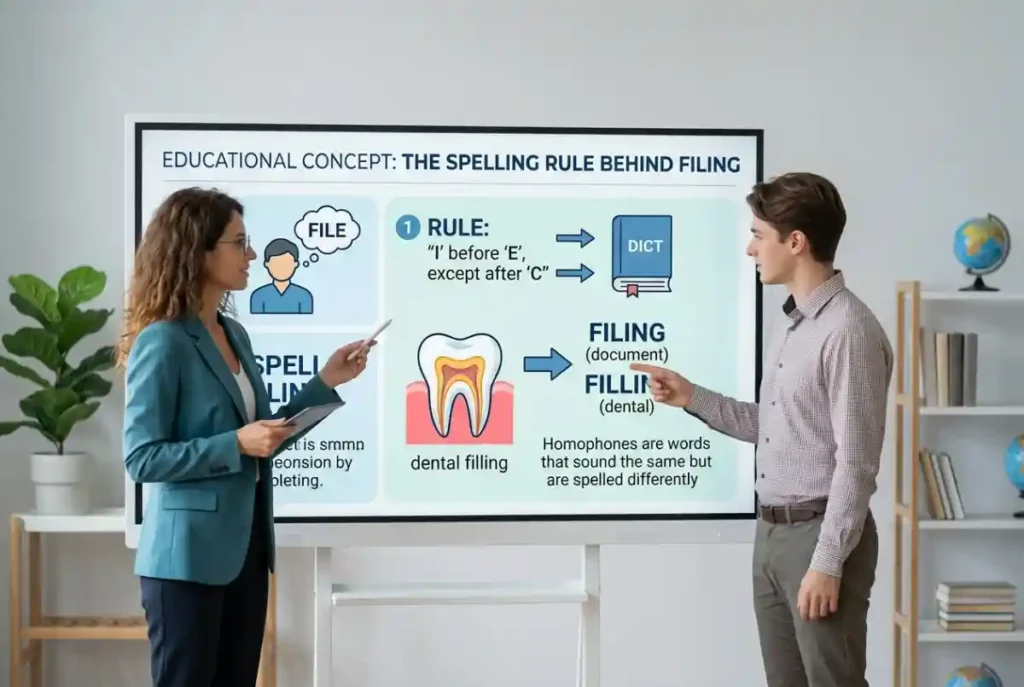
Filing becomes much easier once you understand what happens to the final e in file.
The base word is:
file
When ing is added the final silent e is removed.
file + ing = filing
This is why fileing is incorrect.
The same pattern appears in other English words.
make → making
write → writing
drive → driving
use → using
The final silent e normally disappears before the suffix ing.
Therefore:
file → filing
not:
fileing
The Spelling Rule Behind Filling
The spelling of filling follows a different pattern.
The base word is:
fill
The word already ends in ll.
When ing is added the final ll remains.
fill + ing = filling
Therefore:
filling is correct.
The form filing is not a shortened version of filling. It comes from a completely different base word.
Compare:
file → filing
fill → filling
This small spelling difference changes both pronunciation and meaning.
Cambridge grammar guidance explains that English often doubles final consonants before vowel starting suffixes in specific spelling patterns. The exact rule depends on the structure and stress of the base word.
In this particular pair the easiest approach is not to memorize a complicated rule. Remember the base verbs.
Why Filing vs Filling Are Confused
The confusion has several causes.
First the words share most of their letters. Both begin with fil and both end with ing. Only the vowel pattern and the final consonant structure separate them.
Second both words are common in office and workplace English. Someone may encounter filing documents and filling out forms in the same setting.
Third typing quickly can make the distinction easy to miss. A writer who is thinking about paperwork may accidentally choose the wrong form.
Another problem comes from pronunciation. People who learn English mainly through reading may not notice the difference between the long vowel in filing and the short vowel in filling.
The reverse can happen too. A learner may know the spoken forms but hesitate when writing them.
Filing vs Filling in Office English
Office language provides some of the clearest examples.
Filing documents means organizing documents.
Filling out documents means entering information into documents.
Consider this workplace exchange:
Please fill out this application before filing it.
The first action is completing the application. The second action is submitting or storing it according to the required system.
That sentence demonstrates why the words should not be treated as interchangeable.
Other common workplace expressions include:
filing paperwork organizing records by filing them submitting reports through the proper channels, filing a formal complaint submitting a tax return completing a form entering information into a form filling an available position occupying a vacant role fulfilling a customer order.
The meaning comes from the base verb rather than from the ing ending.
Filing vs Filling With Forms
Forms create a particularly common trap.
In American English people commonly say:
I am filling out the form.
In British English fill in a form is especially common. Cambridge describes fill in a form as mainly British and notes that fill out a form is usual in American English.
This does not mean filing a form and filling out a form mean the same thing.
Filling out a form means writing or typing the requested information.
Filing a form can mean officially submitting it or placing it into an organized record system.
For example:
I am filling out the tax form.
You are completing the form.
I am filing the tax form.
You are submitting or recording the completed form through the required process.
That distinction is useful in business legal academic and government writing.
Filing vs Filling in Legal English
Legal English makes the distinction even more important.
Someone can file a complaint.
A lawyer may file a lawsuit.
In court, an attorney can file a motion.
Taxpayers often file a tax return.
Finally, an individual may file an appeal to challenge a decision.
In these expressions file means to officially submit or record something.
By contrast a person can fill out a legal form before filing it.
The sequence might look like this:
First I filled out the application.
Then I filed the application.
The first action involves completing information. The second involves officially submitting or recording the document.
Cambridge specifically identifies filing as an official record in legal usage and gives filing documents to an authority as a distinct sense of file.
Filing vs Filling in Academic Writing
Academic writing also uses both words but for different purposes.
The researchers are filing the study records.
This refers to record management.
The researchers are filling the tables with data.
This means adding information to empty spaces.
A student might write:
Students must fill out the registration form before filing their paperwork with the department.
That sentence uses both concepts correctly.
Academic prose also uses fill in abstract expressions.
The study fills a gap in the literature.
Here fill does not involve a physical container. It means providing something that was missing. Cambridge includes this broader sense of fill as providing something needed or absent.
Filing vs Filling in Digital Contexts
Filing is not limited to paper.
You can file electronic documents.
I spent the afternoon filing digital records.
You can also file information in a database or organizational system.
Filling has a digital use too.
I am filling in the online application.
She is filling out the registration form.
The medium does not change the basic distinction.
Paper or digital information can be filed.
A paper or digital form can be filled out.
Twenty Natural Examples
The following examples show how native speakers normally use these words.
1. I spent the morning filing invoices.
2. She is filing the reports by department.
3. The lawyer is filing a complaint today.
4. We need to finish filing these records.
5. The company uses digital filing for most documents.
6. He is filling the bottle with water.
7. They are filling the boxes with donated clothes.
8. I am filling out the application now.
9. She filled in the form before the meeting.
10. The manager is filling a vacant position.
11. Please fill the tank before you leave.
12. The children were filling their bags with snacks.
13. The office assistant handles filing and data entry.
14. Please fill out the attached form and return it.
15. The court received the filing yesterday.
16. We are filling the empty spaces with new information.
17. She spent the afternoon filing old correspondence.
18. The bakery is filling the pastries with cream.
19. The dentist replaced my old filling.
20. The soup was warm and surprisingly filling.
These examples show why context matters. The correct word depends on the action being described.
Filing vs Filling in Grammar
Understanding the grammar behind these words makes the spelling easier to remember. Both filing and filling come from verbs, and both can act as present participles, gerunds, or nouns.
The grammar may look similar, but the meaning still comes from the base verb.
Filing and Filling as Present Participles
A present participle often appears with a form of be to describe an action in progress.
Examples:
- She is filing the documents.
- She is filling the box.
- They are filing a report.
- They are filling the bottles.
In the first and third examples, the subjects are organizing or submitting records. In the second and fourth examples, the subjects are putting something into a space.
Filing and Filling as Gerunds
A gerund is a verb form ending in ing that functions as a noun.
For example:
Filing documents takes time.
Here, filing documents acts as the subject of the sentence.
Filling the tank takes several minutes.
In this sentence, filling the tank is also the subject.
Both words can appear after verbs and prepositions.
- She enjoys filing records.
- He finished filling the boxes.
- They discussed filing the complaint.
- We talked about filling the empty positions.
The word ending does not determine the meaning on its own. The base verb does.
Filing and Filling in Different Tenses
The two verbs follow ordinary English tense patterns.
| Tense | File | Fill |
|---|---|---|
| Simple present | I file the records. | I fill the container. |
| Present continuous | I am filing the records. | I am filling the container. |
| Simple past | I filed the records. | I filled the container. |
| Past continuous | I was filing the records. | I was filling the container. |
| Present perfect | I have filed the records. | I have filled the container. |
| Past perfect | I had filed the records. | I had filled the container. |
| Future | I will file the records. | I will fill the container. |
Notice that the past tense forms are filed and filled. The first has one l before ed, while the second keeps the double l.
Filing vs Filling in Sentence Structure
Both verbs can take direct objects.
The assistant is filing the invoices.
The direct object is the invoices.
The assistant is filling the folders.
The direct object is the folders.
The sentences are grammatically similar but describe different actions. The first usually means organizing the invoices. The second means putting something into the folders.
The second sentence may sound less natural if the writer intends to say that the folders are being filled with documents. In that case, the sentence can be clearer:
The assistant is filling the folders with invoices.
Clear sentence structure helps readers understand the action without guessing.
Filing vs Filling in Workplace English
These words appear often in offices because employees regularly handle documents, forms, records, and equipment.
The correct word depends on the task.
Filing Documents
Use filing when you organize records or submit paperwork.
Examples:
- The assistant is filing the employee records.
- Our team finished filing the invoices.
- The accountant is filing the tax documents.
- The manager filed the complaint yesterday.
- The legal department is filing a motion with the court.
Each sentence refers to organizing or formally submitting records.
Filling Out Documents
Use filling out when someone enters information into a form.
Examples:
- The new employee is filling out the hiring paperwork.
- Please finish filling out the expense report.
- I spent ten minutes filling out the online application.
- The customer is filling out a feedback form.
- We are filling out the required fields before submitting the request.
The distinction matters because workplace instructions need to be precise. Asking someone to file a form may mean submitting it, while asking them to fill it out means completing the information.
A Common Office Example
Imagine a supervisor sends this message:
Please finish filing the employee information form before noon.
The instruction may mean that the form needs to be submitted or added to an official record system.
If the supervisor wants the employee to enter personal information, the better wording is:
Please finish filling out the employee information form before noon.
A single letter changes the task.
Filing vs Filling in Legal and Financial Writing
Legal and financial contexts make the distinction especially important.
Filing Legal Documents
In law, filing often means formally submitting a document to a court or another authorized body.
Common expressions include:
- Filing a lawsuit.
- Filing a motion.
- Filing an appeal.
- Filing a complaint.
- Filing a legal brief.
- Filing court documents.
For example:
The attorney is filing an appeal with the court.
The attorney is formally submitting the appeal.
Filling Out Legal Forms
By contrast, filling out a legal form means entering the required information.
For example:
The client is filling out the authorization form.
The client is completing the document before it is submitted.
Filing vs Filling in Academic Writing
Students and researchers also encounter both words.
Use filing when describing the organization or submission of records, research documents, applications, or formal requests.
Use filling when describing the act of completing forms or placing material into a space.
Examples:
- The researcher is filing the ethics approval documents.
- Students must fill out the course evaluation form.
- The department filed the required report.
- The laboratory assistant is filling the sample containers.
- Researchers are filing applications for funding.
- The student finished filling out the scholarship application.
Academic writing often requires precise descriptions of procedures. If the writer uses filing when they mean filling out, readers may misunderstand the steps involved.
Filing vs Filling in Emails
Professional emails should state the requested action clearly.
Here are examples of natural email sentences.
Using filing:
- I have finished filing the invoices for this month.
- The team is filing the required documents today.
- Please confirm once you have filed the application.
- We are filing the updated report with the department.
- The legal team has filed the paperwork.
Using filling:
- I am filling out the form now.
- Please finish filling out the attached document.
- We are filling the storage boxes this afternoon.
- The customer is filling out the online survey.
- I have finished filling in the missing details.
One useful editing tip is to include the object and the purpose when the action could be unclear.
Instead of writing:
I am filing it now.
you might write:
I am filing the completed application with the department now.
That version makes the task easier to understand.
Filling In vs Filling Out
Both fill in and fill out are widely used when completing forms, but regional preferences and context can affect which phrase sounds most natural.
In American English, fill out a form is especially common.
Please fill out this application before the interview.
Fill in is often used when entering missing information or completing individual blanks.
Please fill in your date of birth.
British English commonly uses fill in a form, although fill out is also understood.
These patterns overlap. The safest choice is to follow the wording used by the organization or style guide you are writing for.
The word filling works with either phrase.
- Filling out a form.
- Filling in a form.
- Filling in the missing details.
Do not replace either expression with filing out when you mean completing a form.
Filing vs Filling in Daily Conversation
Everyday speech offers plenty of examples.
- I’m filing the receipts after lunch.
- She’s filling the pitcher with water.
- We spent the morning filing old paperwork.
- He is filling the freezer with groceries.
- The clerk filed my application yesterday.
- I need to fill out this form before the appointment.
- The dentist is filling a cavity.
- She is filing her nails before the party.
- Dad is filling the car with gas.
- The office manager is filing the new contracts.
Each sentence uses the word that matches the intended action.
Filing vs Filling in Technology
Digital systems have not removed the difference between these words.
People still file digital records by placing them in folders, categories, or document management systems. They also file electronic forms or reports with agencies and organizations.
Filling, on the other hand, often involves entering data into digital fields.
Examples:
- The employee is filing the digital invoices by month.
- Please fill in the required fields.
- I filed the online complaint this morning.
- She is filling out the web form.
- The software is filling the field with saved information.
The last example describes an automated process. The software inserts information into a field, so filling is the natural choice.
Filing vs Filling in Health and Dentistry
In health care, both words appear in specific contexts.
Filling a Tooth
A dental filling is material used to restore a tooth damaged by decay or injury.
The dentist is filling the patient’s tooth.
The dentist is placing material into the treated area.
The noun filling also refers to the material itself.
My tooth filling needs to be checked.
Filing Nails
In nail care, filing means shaping or smoothing nails with a nail file.
She is filing her nails into a rounded shape.
The action involves removing or smoothing small amounts of material rather than making a container full.
Filing Medical Records
Medical offices use filing when organizing or formally submitting records.
The administrator is filing the patient’s records.
The word describes record management, not a medical treatment.
These examples show that the correct spelling depends on the action rather than the general subject area.
Filing vs Filling in Cooking
Cooking provides a useful example of filling as both a verb and a noun.
As a verb:
She is filling the pastries with cream.
The cream is being placed inside the pastries.
As a noun:
The cream filling tastes delicious.
The noun refers to the substance inside the pastry.
By contrast, filing is not the correct word for adding ingredients to food. A person may be filing documents about a recipe, but they are filling a pastry with jam.
The two words have separate roles even when they appear in the same kitchen.
Filing vs Filling Pronunciation
The words have different first vowel sounds.
| Word | IPA | Syllables | Sound guide |
|---|---|---|---|
| Filing | /ˈfaɪ.lɪŋ/ | Two | FYE ling |
| Filling | /ˈfɪl.ɪŋ/ | Two | FILL ing |
In filing, the first vowel is the long i sound heard in fine, time, and file.
In filling, the first vowel is the short i sound heard in sit, win, and fill.
The final ing is pronounced similarly in both words.
A Pronunciation Memory Trick
Say these pairs slowly:
- File and fill.
- Filing and filling.
- While and will.
- Mile and mill.
The vowel contrast becomes easier to hear when you practice words with similar consonants.
For many American speakers, the distinction is clear even in fast speech. However, unfamiliar accents or poor audio can make the words harder to distinguish, so context remains useful.
Filing vs Filling in British and American English
There is no spelling difference between British and American English for these words.
Both varieties use:
- Filing documents.
- Filing a complaint.
- Filling a container.
- Filling out a form.
- Filling a cavity.
The main regional difference concerns some expressions, especially fill in a form and fill out a form. American English often favors fill out a form, while British English commonly uses fill in a form. Both expressions are understood across many English speaking regions.
Canadian and Australian English also use filing and filling with the same basic meanings. Local organizations may have their own preferences for completing forms, but the spelling distinction remains the same.
Word Origins and Etymology
The two words developed from different base verbs.
The Origin of File
The verb file, when it refers to arranging documents, is linked to the idea of placing papers in an orderly sequence. Its history is connected to the use of a line or thread for arranging documents and related records.
The noun file also refers to a tool used to smooth or shape materials. That meaning has a separate historical path from the verb used for organizing paperwork, though both forms are now common in modern English.
Today, the word covers several actions, including organizing records, submitting official documents, and smoothing an edge with a tool.
The Origin of Fill
The verb fill comes from Old English fyllan, meaning to make full or fill up. Its core meaning has remained stable over time.
Modern uses include filling a container, filling a gap, filling a position, filling out a form, and filling a tooth.
The shared ing ending does not mean the two words share the same origin or meaning. It simply forms common verb forms and nouns from different base words.
Common Mistakes With Filing and Filling
The most common mistakes involve using the right spelling for the wrong action.
Mistake One: Filing Out a Form
Incorrect: I am filing out the application.
Correct: I am filling out the application.
Use filling out when entering information into the form. Use filing when submitting the completed application.
Mistake Two: Filling Documents
Unclear: I am filling the documents.
This sentence might be understood in a special context, but it is not the usual way to say that you are organizing paperwork.
Clearer: I am filing the documents.
If you mean entering information into them, write:
I am filling out the documents.
Mistake Three: Using Filling for Official Submission
Incorrect for the intended meaning: She is filling a complaint with the court.
Correct: She is filing a complaint with the court.
The complaint is being formally submitted.
Mistake Four: Adding an Extra Letter
Incorrect: He is fillling the bottle.
Correct: He is filling the bottle.
The base word already has two ls. Do not add a third.
Mistake Five: Keeping the Final E
Incorrect: The assistant is fileing the papers.
Correct: The assistant is filing the papers.
Drop the silent e before adding ing.

Memory Tricks for Filing vs Filling
Simple memory tricks can help you choose the right word without checking a dictionary.
Remember the Base Word
Filing comes from file.
Think of a file cabinet, a file folder, or filing official paperwork.
Filling comes from fill.
Think of filling a glass, filling a box, or filling a blank on a form.
Use the Fullness Test
Ask yourself if something is being made full.
If yes, filling is probably the right word.
- Filling a bottle.
- Filling a hole.
- Filling a vacancy.
- Filling out a form.
If the action involves organizing records or formally submitting documents, filing is usually the right choice.
Use the Form Sequence
For paperwork, remember this practical sequence:
Fill out the form. Check the details. File or submit it.
This sequence helps distinguish completing information from formally sending it to the right place.
Related Words and Expressions
Several words are closely related to filing and filling.
File and Filed
File is the base verb.
Filed is its simple past form and past participle.
Examples:
- I file the receipts every month.
- She filed the report yesterday.
- The complaint has been filed.
Fill and Filled
Fill is the base verb.
Filled is its simple past form and past participle.
Examples:
- I fill the bottle every morning.
- He filled the tank yesterday.
- The box has been filled.
Filing Cabinet
A filing cabinet is a piece of furniture used to store and organize documents.
The clerk placed the records in the filing cabinet.
Filing System
A filing system is a method for organizing and retrieving documents.
The office introduced a new filing system.
Filling Station
In some English varieties, a filling station is a place where vehicles get fuel. In American English, gas station is more common.
Filling Material
Filling material is a substance used to fill a gap, cavity, or space.
The worker used filling material to repair the crack.
Fill In and Fill Out
Both phrases can mean completing a form.
Fill in is also common when entering missing details.
Fill out is particularly common in American English when completing an entire form.
File Away
File away means to store something in an organized place, often for future reference.
Please file away the signed agreement.
This expression reinforces the idea of filing as organization rather than making something full.
Expert Editor’s Note
As an editor, I recommend checking the base verb before deciding how to spell its ing form. The question is not simply which word looks right. It is which action the sentence describes.
If the subject is organizing paperwork, submitting a legal document, or smoothing an edge with a file, filing is the correct choice.
If the subject is making a space full, adding material, completing a form, or putting food inside another food, filling is usually correct.
Professional editors also look at the surrounding words. Filing a complaint and filling out a complaint form are both natural expressions, but they describe separate steps.
Spell checkers may not catch an error because both words exist. The writer must check meaning, not just spelling.
For formal writing, prefer specific verbs and clear objects. Instead of saying I am filing it, say I am filing the report with the department if that is what you mean. If you are entering information, write I am filling out the report.
The extra detail removes uncertainty and makes the writing more professional.
Frequently Asked Questions
Is filing or filling correct
Both spellings are correct, but they have different meanings. Filing usually refers to organizing documents, formally submitting paperwork, or smoothing a surface with a file. Filling means making something full, adding material to a space, or completing a form. Choose the word that matches the action you want to describe.
What is the difference between filing and filling out
Filing a document often means submitting it to an organization or placing it in an official record system. Filling out a document means entering the required information. For example, you fill out a tax return before filing it with the relevant tax authority. The two actions can happen in sequence.
Is it filing out a form or filling out a form
The correct phrase for completing a form is filling out a form. The verb fill means to put information into the required spaces. Filing a form usually means formally submitting it or adding it to a record system. Although both phrases can be correct in different contexts, filing out is not the standard expression for completing a form.
Why does filing have one L and filling have two
The spelling follows the base verb. File ends in a silent e, which is dropped before adding ing, giving filing. Fill already ends in two ls, so the spelling keeps them when adding ing, giving filling. Remembering the base words is the easiest way to avoid the error.
How do you pronounce filing and filling
In American English, filing is pronounced /ˈfaɪ.lɪŋ/, while filling is pronounced /ˈfɪl.ɪŋ/. Both have two syllables, but their first vowel sounds differ. Filing starts with the long i sound in file, while filling starts with the short i sound in fill.
Is filing a form the same as filling in a form
No. Filling in a form means entering information into its spaces. Filing a form usually means submitting it to an authority or storing it in an official record system. British English commonly uses fill in a form, while American English often favors fill out a form. Both completing and submitting may be required.
What is the past tense of filing and filling
The past tense of file is filed, and the past tense of fill is filled. For example, She filed the report yesterday means she organized or submitted it. She filled the container yesterday means she made it full. The forms follow normal English verb patterns.
Can filing and filling be used as nouns
Yes. Filing can refer to the act of organizing or submitting documents, as in The filing took an hour. Filling can refer to material inside something, as in The pie filling was delicious, or to the act of making something full. The surrounding words reveal which meaning is intended.
Final Verdict on Filing vs Filling
The difference between filing vs filling comes down to the base verbs file and fill.
Filing means organizing records, submitting official paperwork, or smoothing a surface with a file.
Filling means making something full, putting material into a space, or completing a form.
The most common mistake is writing filing out a form when you mean filling out a form. Remember that you usually fill out the information first, then file or submit the completed document.
A single letter can change the meaning of a sentence. Learn the base verbs, listen for the vowel difference, and choose the word that describes the action accurately.

Founding Editor
Maya spent six years as a copyeditor at a regional newspaper before starting Grammist, which is where the “answer first” format came from: newsroom style guides don’t have room for a preamble.
She writes and reviews most of the word-pair and spelling entries, and has final say on anything that goes out under the Grammist name.