
If you have ever paused over extent vs extant you are not alone. These two words look almost identical and both begin with the same four letters. They also sound similar enough to cause confusion when you hear them in conversation. Yet their meanings are completely different. Using one in place of the other can change the meaning of a sentence or make your writing look careless.
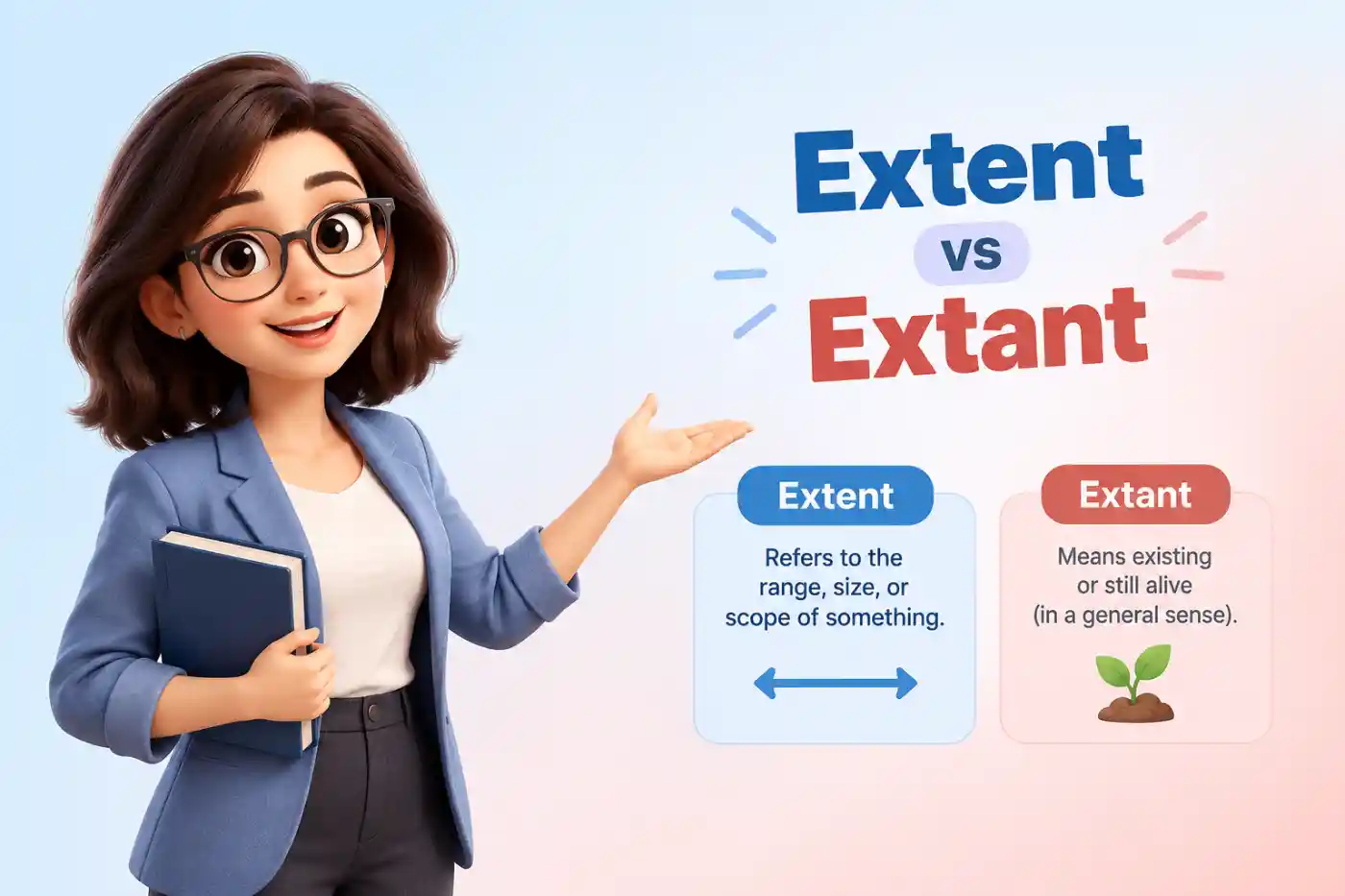
The good news is that the difference becomes simple once you connect each word with its core idea. Extent is a noun that refers to size range amount degree or limits. You might discuss the extent of damage the extent of a problem or the extent of someone’s knowledge. Extant is an adjective that means still existing or surviving. It is especially common in formal writing when people discuss old documents texts species records or other things that have survived from the past. Cambridge defines extent in terms of area length size amount and degree while extant refers to something old that still exists.
This guide explains the difference in plain English. You will learn the correct spelling meaning pronunciation grammar word origin common mistakes real life examples and practical memory tricks. By the end you should be able to recognize the right word almost instantly.
Quick Answer
Extent is a noun meaning size amount range or degree. Extant is an adjective meaning still existing or surviving. Use extent in phrases such as the extent of the damage. Use extant for something that still survives such as an extant manuscript. They are different words with different meanings.
Extent vs Extant At A Glance
| Feature | Extent | Extant |
|---|---|---|
| Correct spelling | Extent | Extant |
| Part of speech | Noun | Adjective |
| Main meaning | Size amount range or degree | Still existing or surviving |
| Pronunciation | /ɪkˈstent/ | /ekˈstænt/ or /ˈek.stənt/ |
| Main use | Describes degree size area or scope | Describes something that continues to exist |
| Common context | Damage knowledge influence area problems | Manuscripts records species texts artifacts |
| Formality | Common in everyday and formal English | Formal |
| Regional spelling | Same in major English varieties | Same in major English varieties |
| Example | We underestimated the extent of the damage. | The museum owns an extant manuscript. |
| Common confusion | Mistaken for extant | Mistaken for extent |
The spelling is close but the grammatical role gives you an important clue. Extent names a thing or measurement. Extant describes a thing.
What Does Extent Mean
Extent is a noun that refers to the size length area amount range or degree of something.
Cambridge gives two central meanings. The first concerns physical size or area. The second concerns degree or severity. For example you can discuss the physical extent of a forest or the extent of an injury.
Consider these examples.
The full extent of the forest was difficult to see.
The doctor explained the extent of the injury.
We did not understand the extent of the problem.
The report examines the extent of poverty in the region.
In each sentence extent answers a question similar to how much how large how far or how serious.
That is the central meaning to remember.
Extent As Size Or Area
When extent refers to physical dimensions it can mean the amount of space something covers.
The survey measured the extent of the wetland.
From the hill we could see the full extent of the valley.
The researchers mapped the extent of the ice sheet.
Here the word is closely related to ideas such as area range length size and spread.
Extent As Degree Or Severity
Extent can also describe how strong serious or significant something is.
We underestimated the extent of the damage.
She was surprised by the extent of his knowledge.
The investigation revealed the extent of the financial loss.
This meaning is extremely common in modern English.
You can often replace extent with degree or amount without changing the basic idea.
The extent of the problem was unexpected.
The degree of the problem was unexpected.
The amount of damage was unexpected.
The exact replacement depends on the context but the underlying idea is similar.
What Does Extant Mean
Extant is an adjective meaning still existing or still surviving.
It is especially useful when discussing something from the past that has survived into the present. Cambridge labels the word as formal and gives examples involving old records and surviving works.
For example.
The library contains several extant manuscripts.
Only a few extant copies of the book are known.
The researcher examined the earliest extant records.
Several extant species belong to this ancient group.
The word often carries an important idea of survival. Something existed in the past and still exists now.
Extant Usually Sounds Formal
You can use extant in ordinary English but it has a distinctly formal and academic tone.
Instead of saying:
The oldest surviving manuscript is kept here.
A scholar might write:
The oldest extant manuscript is kept here.
Both sentences communicate the same basic idea. The second sounds more academic and specialized.
That is why extant appears often in history archaeology literature law biology paleontology religious studies and academic research.
Extent vs Extant In One Simple Rule
A useful rule is this.
Extent tells you how much. Extant tells you what still exists.
Ask yourself what information your sentence needs.
If you mean size amount range degree or scope use extent.
If you mean still existing or surviving use extant.
Compare these sentences.
We studied the extent of the damage.
We studied the extant records.
The first sentence asks how much damage occurred.
The second sentence describes records that still exist.
Once you focus on meaning instead of spelling the difference becomes much easier.
Which One Is Correct
Both extent and extant are correct English words. Neither is a misspelling of the other.
The correct choice depends entirely on meaning.
Use extent when you mean size amount range degree or scope.
Use extant when you mean still existing or surviving.
For example:
The extent of the damage was shocking.
The extant records were incomplete.
It would be incorrect to switch these words.
The extant of the damage was shocking.
The extent records were incomplete.
The first sentence needs a noun referring to degree or amount. The second needs an adjective describing surviving records.
Why People Confuse With Extent vs Extant
The confusion is understandable because the words share several visual features.
Both begin with ext.
They both contain ent near the end.
Both have two syllables in many common pronunciations.
They both can appear in formal writing.
Both are connected historically to Latin words beginning with ex.
That visual similarity can cause readers to recognize the general shape of a word without fully processing its meaning.
Visual Similarity
The words differ by only one vowel.
extent
extant
That small spelling difference is easy to overlook during fast reading.
Pronunciation Similarity
The words also share similar sounds at the beginning.
Extent is commonly pronounced /ɪkˈstent/.
Extant may be pronounced /ekˈstænt/ or /ˈek.stənt/ depending on pronunciation pattern and dictionary variety. Cambridge lists these forms for extant.
The final vowel sound helps distinguish them but casual speech can make the contrast less obvious.
Fast Typing
Keyboard mistakes can also produce the wrong word. Someone who knows both words may type one while intending the other because the spellings are so close.
This is particularly common when writing quickly or editing a document without carefully checking context.
Familiarity
Extent is much more common in general English. Extant is more specialized and formal.
That creates an interesting problem. A writer may know the word extant from academic reading but rarely use it personally. When the word comes to mind they may accidentally write extent because it is more familiar.
The reverse can also happen when a writer has seen extant frequently in scholarly texts and unconsciously selects it for a sentence that actually needs extent.
Key Differences Between Extent vs Extant
The most important differences involve meaning grammar and function.
Meaning
Extent means size amount range or degree.
Extant means still existing or surviving.
Part Of Speech
Extent is a noun.
Extant is an adjective.
This difference is extremely useful.
You can say:
The extent was surprising.
But you cannot normally use extant in the same grammatical position.
You can say:
The extant manuscript was valuable.
Here extant modifies manuscript.
Question Answered
Extent often answers:
How much.
How large.
And how far.
How serious.
Extant answers:
Does it still exist.
Is it still surviving.
Typical Context
Extent commonly appears in discussions of:
Damage.
Knowledge.
Influence.
Size.
Area.
Problems.
Risk.
Change.
Impact.
Loss.
Extant commonly appears in discussions of:
Manuscripts.
Records.
Documents.
Texts.
Species.
Artifacts.
Traditions.
Buildings.
Evidence.
Literature.
Historical sources.
Register
Extent is completely normal in everyday English.
Extant is more formal and often associated with academic or specialist writing.
That does not make extant better. It simply makes it more specialized.
Grammar Of Extent
Because extent is a noun you can use it in several standard noun structures.
The Extent Of Something
This is one of the most common patterns.
The extent of the damage was unclear.
Scientists measured the extent of the contamination.
We are still investigating the extent of the problem.
The noun after of identifies the thing being measured or evaluated.
To Some Extent
This phrase means partly or to a certain degree.
To some extent I agree with your argument.
The decision was successful to some extent.
Cambridge lists to some extent as a common expression meaning partly.
To A Certain Extent
This expression means to a limited or specified degree.
The criticism is valid to a certain extent.
The policy helped to a certain extent.
To What Extent
This phrase asks about degree.
To what extent did the policy affect employment.
To what extent can these results be trusted.
This expression is especially common in academic questions and formal discussion.
To The Extent That
This structure means to the degree that something happens or is true.
The project succeeded to the extent that the main goals were achieved.
The phrase can introduce a result or limitation.
To The Same Extent
This means to the same degree or amount.
The two groups did not benefit to the same extent.
Cambridge lists several common extent expressions including to the same extent to some extent to what extent and to the extent that.
Grammar Of Extant
Extant is an adjective.
That means it normally modifies a noun or appears after a linking verb.
Extant Before A Noun
The most common structure is:
extant + noun
Examples include:
extant manuscript.
extant records.
For extant evidence.
extant literature.
Use it for extant species.
For extant copies.
extant traditions.
Extant After A Linking Verb
You can also use extant after verbs such as be.
Several records are still extant.
Only two examples remain extant.
This construction is grammatical but often sounds more formal than simply saying still exist.
Extant Does Not Mean Old
This is an important distinction.
Extant means still existing. It does not literally mean ancient or old.
However the word is often used with historical objects because scholars frequently need to distinguish surviving material from material that has disappeared.
For example:
The extant documents date from the eighteenth century.
The word extant tells us that the documents still exist. The date tells us that they are old.
Extent vs Extant Examples
The easiest way to master these words is to see them in natural sentences.
Daily Conversation
I had no idea about the extent of the damage.
We did not realize the extent of the traffic problem.
The full extent of the delay became clear later.
She was surprised by the extent of his knowledge.
Workplace English
The manager asked for a report on the extent of the losses.
The team needs to understand the extent of the issue.
The audit revealed the extent of the financial problem.
The company has reviewed the extent of the changes required.
Academic Writing
Researchers examined the extent to which social factors influenced the results.
The study measures the extent of environmental change.
Several extant studies support this conclusion.
The paper compares the extant literature on the subject.
History And Literature
Only a few extant manuscripts contain the complete text.
Historians examined the extent of the kingdom’s influence.
The archive contains several extant letters from the period.
The scholar compared the surviving text with other extant sources.
Science
Scientists are still assessing the extent of the contamination.
The study examined the geographic extent of the species.
Several extant species are threatened by habitat loss.
Researchers documented the extent of the population decline.
Journalism
Officials are still determining the extent of the damage.
The investigation revealed the extent of the fraud.
Experts warned that the full extent of the crisis may not be known for months.
The museum has displayed several extant artifacts from the period.
Social Media And Informal Writing
I did not realize the extent of the mess.
You have no idea about the extent of this problem.
The damage is bigger than we first thought.
In informal writing, people usually prefer simple words such as size amount range or degree rather than extant.
Extent vs Extant In Academic Writing
Academic writing provides one of the clearest contrasts.
Consider these examples.
The researchers examined the extent of political change.
The researchers examined the extant political literature.
The first sentence concerns degree or scale.
The second sentence concerns literature that currently survives or exists.
You could even use both words in the same sentence.
The researchers assessed the extent to which the extant evidence supports the theory.
That sentence is grammatically correct and shows the difference clearly.
The first word describes degree.
The second describes existing evidence.
Extent vs Extant In Formal Writing
Both words can appear in formal writing but they perform different jobs.
Extent is common in reports essays research papers business documents and professional correspondence.
Extant is more specialized.
You are more likely to see it in sentences about historical evidence literary texts scientific species legal records or surviving documents.
For most general readers still existing or surviving may be clearer than extant.
An experienced editor does not choose a sophisticated word simply because it sounds academic. The best word is the one that communicates the intended meaning clearly.
Pronunciation Of Extent
Cambridge gives the pronunciation of extent as:
/ɪkˈstent/
The stress falls on the second syllable.
You can think of it as:
ik STENT
The final sound is similar to the vowel sound in words such as tent and sent.
Common Pronunciation Mistake
Some learners may pronounce extent with a stronger first syllable because they are influenced by the spelling.
The important feature is the stress on the second syllable.
Pronunciation Of Extant
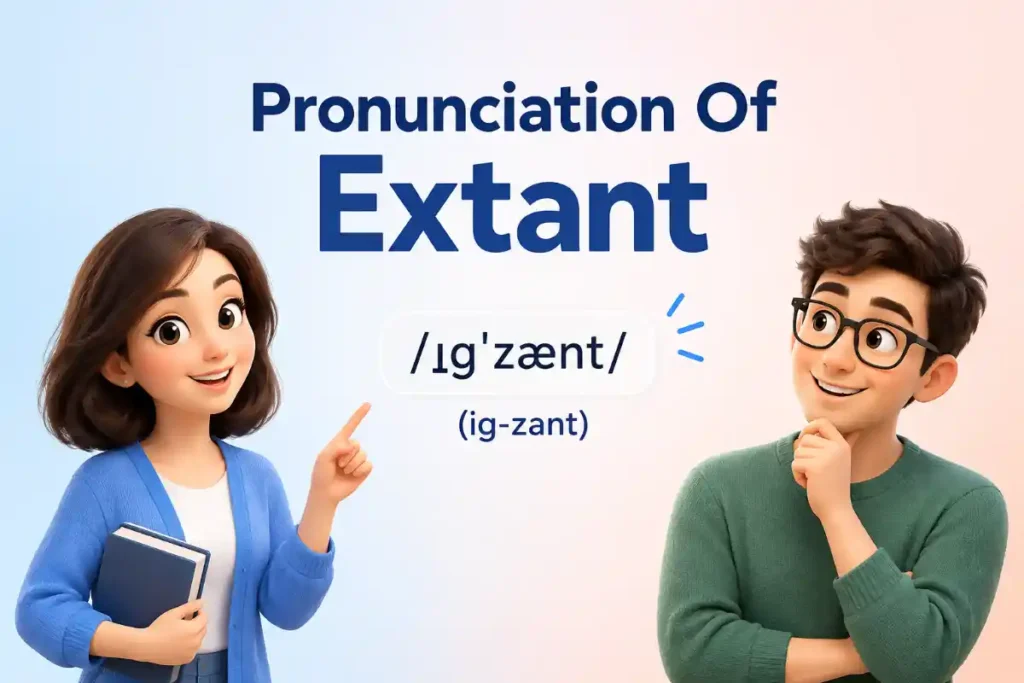
Cambridge lists more than one pronunciation pattern for extant. The forms include:
/ekˈstænt/
/ˈek.stənt/
The exact pronunciation can vary by speaker and variety of English.
The first form places stronger stress on the second syllable.
The second form places stress on the first syllable.
For learners the safest approach is to recognize both patterns in listening and follow a trusted dictionary or pronunciation model for formal speech.
Spelling Rules For Extent And Extant
There is no British spelling rule that changes extent into extant.
There is also no American spelling rule that changes one into the other.
They are separate words.
The vowel is meaningful.
extent contains e in the final stressed syllable.
extant contains a.
That single vowel difference signals a completely different word.
A useful visual reminder is:
Extent = degree or size.
Extant = existing.
Extent vs Extant Usage In British And American English
Neither word has a major British and American spelling difference.
British English uses extent and extant.
American English also uses extent and extant.
Canadian English follows the same basic distinction.
Australian English follows the same basic distinction.
The difference is therefore not a regional spelling issue. If you see extant in an American academic paper it does not mean the writer is using an American spelling variant of extent. It is simply the other word.
Word Origin Of Extent
The history of extent helps explain its connection to words such as extend and extension.
Etymonline traces extent to Middle English forms dating from around 1300. The word came through Anglo French and Old French from Latin extendere, meaning to spread out or stretch out. The modern sense involving degree or the amount to which something extends developed later.
This history connects extent with a whole family of English words.
Extend.
Extension.
Extended.
Extensive.
Extent.
All of these words are associated with the idea of stretching out or reaching across space or time.
That connection is useful for vocabulary building.
Extent And Extend
Consider the relationship.
The road extends for several miles.
The road has a considerable extent.
The first word is a verb.
The second is a noun.
Word Origin Of Extant
Extant has a completely different historical path.
Etymonline traces extant to Latin extare, meaning to stand out be visible or exist. The English adjective appeared in the sixteenth century and developed the sense of something that still exists.
This gives you a useful conceptual connection.
Extant = existing.
The historical meaning of standing out or being visible developed into the modern idea of something remaining in existence.
This is why extant is especially useful when discussing surviving evidence.
Extent vs Extant Do Not Share The Same Meaning
The words look related but their meanings should not be treated as interchangeable.
Extent is about degree or size.
Extant is about existence.
That distinction is more important than their similar spelling.
You can remember the difference through the questions they answer.
Extent asks how much.
Extant asks what still exists.
Common Mistakes With Extent
One common mistake is using extant as a noun.
Incorrect:
The extant of the damage was enormous.
Correct:
The extent of the damage was enormous.
Another mistake is using extent before a noun when you actually mean surviving.
Incorrect:
The extent manuscript was discovered in the archive.
Correct:
The extant manuscript was discovered in the archive.
The intended meaning is that the manuscript still exists.
Common Mistakes With Extant
A common mistake is assuming extant means ancient.
It does not.
A modern object could technically be described as extant because it exists. In actual usage the word is strongly associated with surviving historical material.
Another mistake is using extant when existing would be clearer.
For example:
The extant problem needs attention.
This sentence is possible in a specialized context but sounds unusual to many readers.
A clearer sentence would be:
The existing problem needs attention.
Professional writing should favor clarity over unnecessary formality.
Is Extant A Common Word
Extant is a real and established English word but it is much less common in everyday conversation than extent.
You are more likely to encounter extant in academic and specialist contexts.
Common examples include:
extant manuscripts.
Use it for extant records.
extant literature.
extant species.
For extant evidence.
extant copies.
Because the word is relatively formal some readers may find still existing or surviving easier to understand.
That does not make extant incorrect. It simply means that register matters.
Is Extent More Common Than Extant
Yes.
Extent belongs to general English vocabulary and appears frequently in everyday speech professional writing journalism academic writing and ordinary conversation.
Extant belongs to a narrower formal vocabulary.
This difference matters when choosing a word for your audience.
If you are writing for a general audience you may prefer:
The oldest surviving document.
If you are writing a scholarly article you may choose:
The oldest extant document.
Both are grammatical.
The second is more specialized.
Memory Tricks For Extent And Extant
A good memory trick should connect spelling with meaning.
Extent Equals Extent Of Something
Think of the common phrase:
the extent of
Damage.
Problem.
Change.
Influence.
If you can naturally say the extent of something you probably need extent.
Extant Equals Existing
Think:
Extant = existing.
Both ideas begin with ex and concern something being present or remaining.
Another useful connection is:
Extant = it exists.
The letters are not an exact spelling match but the association is easy to remember.
Ask One Question
When you are unsure ask:
Am I talking about how much or about what still exists.
If the answer is how much use extent.
If the answer is what still exists use extant.
A Simple Test
Try these sentences mentally.
We need to determine the ___ of the damage.
The museum owns an ___ manuscript.
The first answer is extent.
The second answer is extant.
Now try:
Researchers studied the ___ to which the policy affected employment.
The answer is extent.
The library preserved several ___ copies of the document.
The answer is extant.
The pattern becomes obvious once you focus on meaning.
Extent vs Extant And Similar Words
Understanding nearby words can make the distinction even stronger.
Extent And Degree
Degree can often replace extent when talking about severity or amount.
The extent of the damage was surprising.
The degree of the damage was surprising.
Extent often sounds more natural when discussing the scale or reach of something.
Extent And Scope
Scope refers to the range or boundaries of something.
The scope of the project is large.
The extent of the project is large.
These sentences are not always interchangeable because scope often focuses on what is included while extent focuses on size degree or range.
Extant And Existing
Existing is the simpler everyday alternative to extant.
The existing records are incomplete.
The extant records are incomplete.
The second sentence is more formal and can suggest surviving historical material.
Extant And Surviving
Surviving is often the clearest synonym.
The surviving manuscript is valuable.
The extant manuscript is valuable.
The first is more accessible.
The second is more specialized.
Extant And Extinct
These words are especially useful to compare.
Extant means still existing.
Extinct means no longer existing.
For example:
The species is extant.
The species is extinct.
This is one of the strongest vocabulary connections for remembering extant.
Related Expressions With Extent
Extent appears in several established phrases.
To Some Extent
This means partly or to a certain degree.
I agree to some extent.
To A Certain Extent
This means to a limited or specified degree.
The plan worked to a certain extent.
To What Extent
This asks how much or how far.
To what extent did the decision affect the company.
To A Greater Extent
This means more strongly or more significantly.
The policy affected rural communities to a greater extent.
To A Lesser Extent
This means less strongly or less significantly.
The northern region was affected to a lesser extent.
To The Extent That
This means to the degree that.
The plan succeeded to the extent that the main objectives were achieved.
These expressions are a major reason extent appears so often in formal English. Cambridge lists several of these patterns as established phrases and collocations.
Does Extant Have A Plural Form
No.
Extant is an adjective so it does not have a plural form.
You can say:
One extant manuscript.
Several extant manuscripts.
The adjective stays the same.
Extent is a noun and can sometimes appear as extents when discussing multiple measurable ranges or specialized technical contexts.
In ordinary writing however the singular noun extent is far more common.
Can Extent Be A Verb
No.
Extent is a noun.
The related verb is extend.
For example:
The road extends across the valley.
The extent of the road is difficult to measure.
Do not use extent as the verb.
Extant is also not a verb. It is an adjective.
Can Extant Be Used In Everyday English
Yes but it may sound unusually formal.
For most casual situations still existing or surviving is more natural.
You might say:
Are any original copies still existing.
A historian might write:
Are any original copies extant.
The second version is concise but more specialized.
This is an important lesson in vocabulary. A word can be correct without being the best choice for every audience.
Common Internet Misconceptions
One misconception is that extant is simply a misspelling of extent.
It is not.
Both are legitimate English words with different meanings.
Another misconception is that extant is an alternative spelling of extent in British English.
It is not.
Another is that extant always means ancient.
It does not. Its central meaning is still existing. The association with old material comes from common usage.
A final misconception is that extent always refers to physical size.
It does not.
Extent can describe degree or severity as well as physical area or length.
For example:
The extent of her influence was enormous.
There is no physical measurement involved in that sentence.
Expert Editors Note About Extent vs Extant
A professional editor would first identify the intended meaning rather than compare the spelling visually.
If the sentence concerns degree amount scope size range or severity the correct word is extent.
If the sentence describes something that still exists or survives the correct word is extant.
Dictionary evidence supports this distinction clearly. Cambridge defines extent through ideas such as area length size amount and degree. Cambridge defines extant as formal language for something that is still existing.
An editor would also consider audience.
In general writing existing and surviving may be clearer than extant.
In academic historical or specialist writing extant can be precise and useful.
The strongest writing does not use the more complicated word simply to sound intelligent. It chooses the word that communicates the intended meaning with the least friction.
Extent vs Extant In Professional Editing
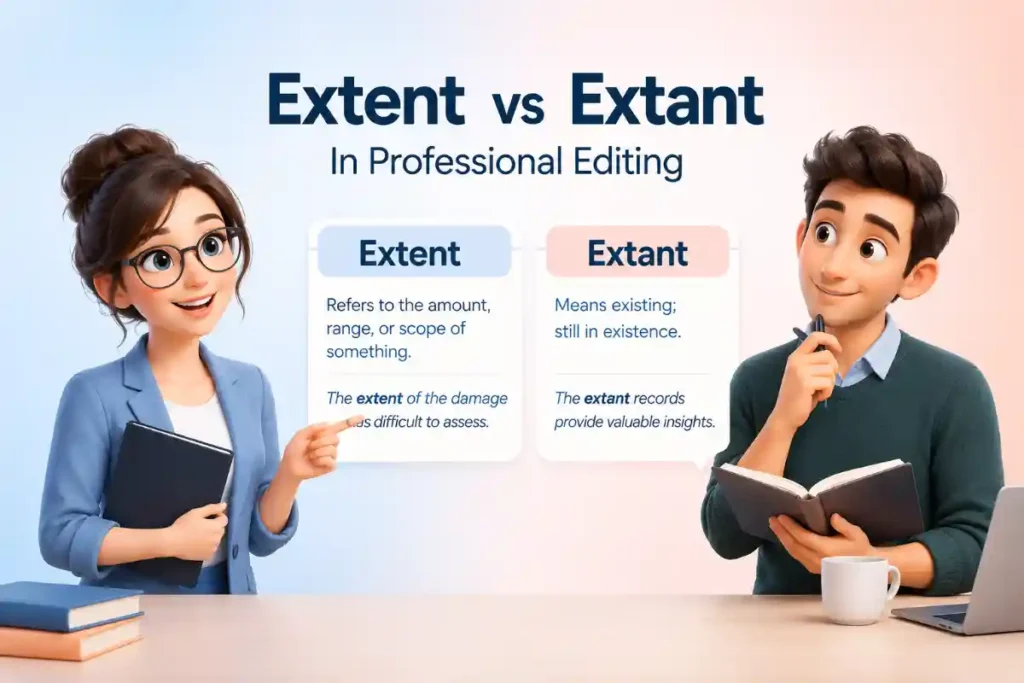
Suppose you are editing this sentence:
The researchers examined the extant of the environmental damage.
The problem is not merely spelling.
The word is grammatically wrong because the sentence needs a noun meaning degree or amount.
The corrected version is:
The researchers examined the extent of the environmental damage.
Now consider:
The researchers examined the extent manuscripts.
Here the sentence needs an adjective describing surviving manuscripts.
The corrected version is:
The researchers examined the extant manuscripts.
This shows why spelling checks alone are not enough. Context and grammar determine the correct word.
Extent vs Extant How To Choose The Right Word In Seconds
Use this three step method.
First identify the grammatical role.
If you need a noun meaning size amount or degree choose extent.
If you need an adjective meaning still existing choose extant.
Second ask the meaning question.
Does the sentence answer how much or how large.
Use extent.
Does the sentence describe something that still exists.
Use extant.
Third read the entire sentence aloud.
If the extent of sounds natural you probably have your answer.
If the extant manuscript or the extant records makes sense you probably need extant.
This method works better than memorizing spelling alone because it connects grammar meaning and context.
Frequently Asked Questions
Is extent or extant correct
Both words are correct but they have different meanings. Extent is a noun meaning size amount range or degree. Extant is an adjective meaning still existing or surviving. Use extent in phrases such as the extent of the damage. Use extant to describe surviving material such as an extant manuscript or extant records.
What is the difference between extent and extant
Extent refers to size amount range or degree. Extant refers to something that still exists. For example the extent of the damage describes how much damage occurred. An extant document is a document that still survives. The words are spelled similarly but belong to different grammatical categories and perform different functions.
Is extant a synonym for existing
Yes. Extant can mean existing or still surviving. It is more formal than existing and often appears in academic historical scientific and literary writing. It is especially common when writers discuss documents manuscripts species records artifacts or other material that has survived from an earlier period.
Does extant mean ancient
Not exactly. Extant means still existing. The word is often used with ancient or historical things because scholars frequently need to identify which old documents texts species or artifacts have survived. The idea of being old comes from the context rather than from the basic definition of extant.
What does extent mean in a sentence
Extent usually means the size amount range or degree of something. In the sentence We underestimated the extent of the damage the word means how large or serious the damage was. Common phrases include the extent of the problem to some extent and to what extent.
How do you pronounce extent
Extent is commonly pronounced /ɪkˈstent/. The main stress falls on the second syllable. You can think of it as ik STENT. The word is pronounced the same in the basic British and American forms listed by Cambridge.
How do you pronounce extant
Extant has more than one accepted pronunciation pattern. Cambridge lists /ekˈstænt/ as well as /ˈek.stənt/. The stress can therefore fall on the second syllable or first syllable depending on pronunciation. Learners should recognize both forms when listening to formal speech.
Can extent and extant be used in the same sentence
Yes. For example: The researchers assessed the extent to which the extant evidence supports the theory. Here extent means degree while extant describes evidence that still exists. Using both words together can actually make their different meanings easier to understand.
Final Thoughts
The difference between extent vs extant is much simpler than the spelling makes it appear.
Extent is a noun. It means size amount range or degree. You use it when discussing how much how large how far or how serious something is.
Extant is an adjective. It means still existing or surviving. It is especially common in formal writing about historical documents manuscripts records literature species artifacts and other surviving material.
The most useful memory trick is short:
Extent means how much.
Extant means still existing.
Do not choose between these words by looking only at their spelling. Look at the meaning your sentence needs. Once you connect extent with degree and extant with existence the distinction becomes easy to recognize.
The best word choice is not the word that looks right. It is the word that says exactly what you mean.

Founding Editor
Maya spent six years as a copyeditor at a regional newspaper before starting Grammist, which is where the “answer first” format came from: newsroom style guides don’t have room for a preamble.
She writes and reviews most of the word-pair and spelling entries, and has final say on anything that goes out under the Grammist name.