

Online Scamalytics Review have become a serious problem for internet users. Fake accounts, suspicious website visits, automated bots, payment fraud, and identity theft can affect individuals and businesses. As online activity increases, identifying suspicious connections has become an important part of internet security.
One tool associated with this area is Scamalytics. It helps businesses evaluate the potential fraud risk connected to an IP address. Its technology can identify suspicious network activity, detect certain proxy and VPN connections, and provide information that helps online platforms make better security decisions.
But what exactly does this service do? Can ordinary internet users benefit from it? Does a high fraud score mean someone is a scammer? And can website owners use it to protect their platforms?
This guide explores how the service works, what its IP fraud scores mean, its main features, potential benefits, limitations, and privacy considerations. It also explains how US users can interpret an IP address report without jumping to conclusions.
Quick Answer
Scamalytics is an online fraud detection service that analyzes IP addresses and network information to estimate potential fraud risk. It provides IP risk scores, proxy detection, network intelligence, and tools for businesses that want to identify suspicious traffic. However, an IP risk score is not proof that a person is involved in fraud.

How AI Is Changing IP Tracking in 2026

Cybersecurity Analyst Monitoring Fraud Alerts

AI-Powered Directory Creator: How AI Transforms Directory Building in 2026 | DirectoryEasy
What Is Scamalytics?
Scamalytics is a fraud prevention company that provides tools for identifying potentially risky internet connections and suspicious online users.
Its main service focuses on IP address intelligence. An IP address is a numerical identifier assigned to a device or network when it connects to the internet. Websites and online platforms can use this information to understand where a connection appears to originate and identify network characteristics that might indicate suspicious activity.
For example, a website might receive hundreds of account registrations from a single network. Some registrations could be legitimate, but others might come from automated bots or people attempting to create fake accounts.
An IP fraud detection system can help the website investigate those connections.
According to the company’s official website, its products operate at two main levels:
- IP fraud detection: Evaluates individual IP addresses and identifies potentially risky internet connections.
- User fraud detection: Uses multiple data points, shared information, and machine learning to help businesses identify suspicious users.
The company serves businesses that want to reduce online fraud, particularly platforms that deal with user accounts, online interactions, and financial transactions. scamalytics.com+1
It is important to understand that this is primarily a business security service rather than a general antivirus program. It does not replace antivirus software, a firewall, or a complete identity protection solution.
How Does Scamalytics Work?
The service analyzes information associated with an IP address and compares it with available fraud intelligence.
When someone visits a website, the website can collect technical information about the connection. That information can help its security system identify unusual patterns.
Here is a simplified explanation of the process.
1. IP Address Analysis
The system starts by examining the IP address associated with an internet connection.
It looks at available information about the network, including its provider, network organization, location information, and reputation.
For example, an IP address associated with a residential internet provider may have a different risk profile from one associated with a hosting company or a known proxy service.
However, network type alone does not establish someone’s intentions.
2. Fraud Intelligence Comparison
The system compares network information with fraud intelligence collected from its wider network.
According to the company, its proprietary risk score uses feedback from operators who report confirmed fraudulent activity.
It can also examine surrounding IP addresses and network relationships, including subnets, autonomous system numbers, and hosting blocks.
This approach helps identify potentially suspicious connections even when an individual IP address has limited history. Scamalytics+1
3. Proxy and VPN Detection
The system checks for certain anonymizing technologies and network characteristics.
These can include:
- Virtual private networks.
- Tor exit nodes.
- Public proxies.
- Web proxies.
- Datacenter connections.
- Certain residential proxy connections.
These technologies are not automatically dangerous. Many ordinary internet users use VPNs for privacy, remote work, or security.
The purpose of detection is to give businesses additional information about a connection.
4. Risk Score Generation
After examining the available information, the service produces an IP fraud score.
The score ranges from 0 to 100. Lower scores indicate lower estimated risk, while higher scores indicate greater potential fraud risk.
A business can use this information to decide how to handle a particular connection.
For example, it might allow a low risk visitor to continue normally while asking a higher risk visitor to complete an additional verification step.
5. Business Security Decisions
The final decision belongs to the website or business using the information.
A company might combine the IP score with account age, login history, payment information, device behavior, and other security signals.
This is important because an IP address alone cannot reliably identify the person behind a connection.
Understanding the Scamalytics IP Fraud Score
The fraud score is one of the most important features of the platform.
It gives businesses a numerical indication of the potential fraud risk associated with an IP address.
The official API documentation describes four main risk categories.
IP fraud score guide
0 to 19
Low risk
Generally indicates a lower level of suspected fraud activity.
20 to 59
Medium risk
May justify additional checks or verification.
60 to 89
High risk
Suggests a stronger risk signal that deserves investigation.
90 to 100
Very high risk
May justify blocking or manual review when supported by other evidence.
Score categories published in the official API documentation. docs.scamalytics.com+1
What Does a Score of 0 Mean?
A score of zero generally indicates that the system has no known fraud risk associated with the IP address based on its available information.
It does not guarantee that the person using the connection is trustworthy.
A person can still commit fraud using an IP address with a low score. The score only describes the available network intelligence.
What Does a Score of 50 Mean?
A score of 50 falls into the medium risk category.
It indicates that the connection deserves additional attention, but it does not establish fraudulent activity.
A website might request a CAPTCHA, email verification, or another security check before allowing certain activities.
What Does a Score of 90 Mean?
A score of 90 falls into the very high risk category.
It indicates a strong fraud risk signal based on the available data. A business might investigate the connection, request additional authentication, or restrict a suspicious transaction.
However, a high score should not automatically be treated as evidence that an individual is a criminal or scammer.
Is the Score a Percentage?
The company describes its score using an approximate relationship to suspected fraudulent activity observed from an IP address.
For example, its documentation explains that a score of 70 represents approximately seven out of ten users seen from that IP address being associated with fraudulent behavior.
This is not the same as a guaranteed probability that a particular visitor is committing fraud. The result depends on the available observations and should be interpreted as a risk indicator. docs.scamalytics.com+1
Main Features of Scamalytics
The service provides several tools that can help businesses understand suspicious internet traffic.
Here are its most important features.
1. IP Address Lookup
GetIPLoc – Premium IP Intelligence
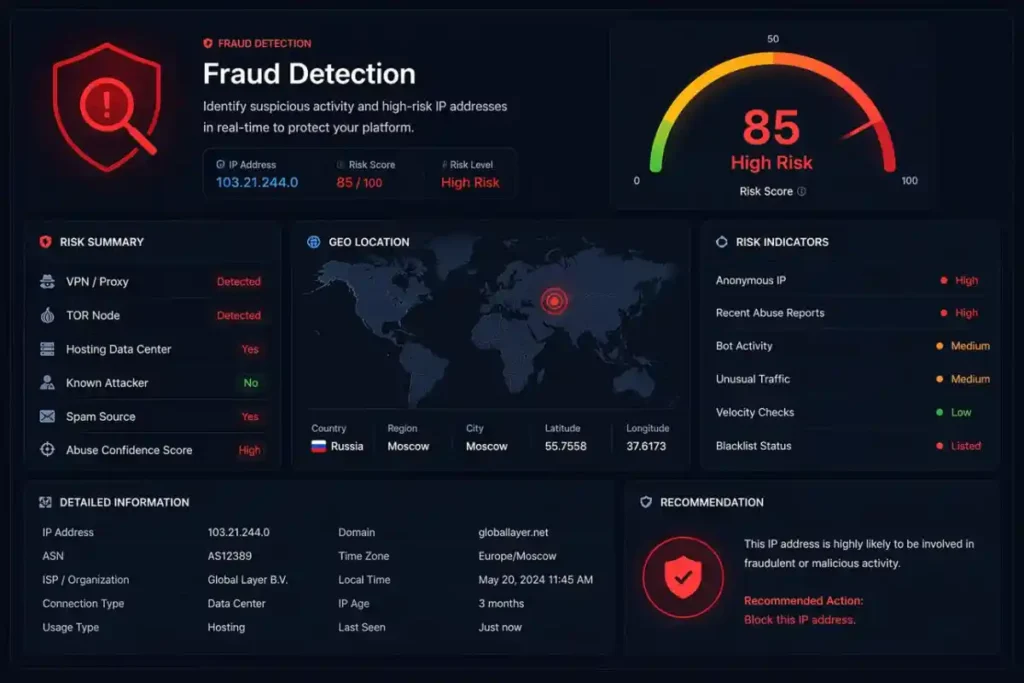
The IP lookup tool allows users to investigate an IP address and view its available fraud risk information.
A report can include:
- IP fraud score.
- Risk classification.
- Internet service provider information.
- Network organization details.
- Approximate geographic information.
- Proxy and anonymization indicators.
- Additional network intelligence.
This feature is useful for investigating suspicious traffic, reviewing unusual login activity, and understanding the reputation of a network.
Users can visit the official IP address checker to explore the lookup service.
2. VPN Detection
VPNs allow people to connect to the internet through another server.
They are commonly used for privacy, remote work, and protecting internet traffic on public WiFi networks.
However, some fraudsters also use VPNs to hide their original network connections.
The platform can identify certain VPN exit nodes and provide that information to businesses.
For example, an online retailer might notice several suspicious orders coming from connections associated with anonymizing services.
Instead of automatically rejecting every VPN user, the retailer can combine this information with payment verification and account behavior.
3. Proxy Detection
A proxy server acts as an intermediary between a user’s device and the website they visit.
Some proxies have legitimate purposes, while others can be used to hide the origin of automated traffic.
Proxy detection helps businesses recognize these connections and decide how to handle them.
The available detection capabilities depend on the data source and subscription level. The current API documentation distinguishes basic public proxy detection from more extensive commercial proxy intelligence. docs.scamalytics.com
4. Tor Network Detection
Tor is a privacy focused network that routes internet traffic through multiple relays.
It can help users protect their identity and browsing activity.
However, the same privacy features can also make it harder for websites to identify suspicious activity.
The service can identify known Tor exit nodes, giving businesses another signal when evaluating incoming connections.
Using Tor does not automatically make someone a scammer.
5. Geolocation Information
IP geolocation estimates the geographic area associated with an internet connection.
Depending on the available information, a report may include:
- Country.
- State or region.
- City.
- Postal code.
- Approximate coordinates.
- Time zone.
For US businesses, this information can help identify unusual login patterns.
For instance, an account might normally connect from California but suddenly receive a login attempt from a network associated with another country.
That difference may justify additional verification.
However, IP geolocation is not precise enough to identify someone’s exact home address. VPNs, mobile networks, and internet routing can also affect location results.
6. External Denylist Information
The service combines information from multiple external sources.
Its API documentation lists sources such as MaxMind GeoLite2, IPinfo, FireHOL, IPsum, Spamhaus DROP, and x4bnet.
These sources provide different types of information, including network ownership, geolocation, proxy indicators, and redlist signals. docs.scamalytics.com
Combining different sources can provide a more useful picture than relying on one database.
7. IP Address Lookup
Our XDR Solution | CommandLink

The API is particularly useful for companies that want to automate IP risk checks.
Developers can integrate it into websites, applications, and internal security systems.
For example, an online business could request an IP risk assessment when a customer:
- Creates an account.
- Signs in from a new network.
- Places an order.
- Requests a password reset.
- Attempts an unusual transaction.
The API returns structured information that software can process automatically.
The current version 3 documentation describes US and European API endpoints and support for IPv4 and IPv6 lookups. It also advises developers to keep their API credentials on the server rather than exposing them in public browser code. docs.scamalytics.com
Who Can Benefit From Using It?
Although ordinary internet users can explore IP lookup information, the main audience consists of businesses and developers.
Different industries can use network risk information in different ways.
Online Retailers
Online stores deal with payment fraud, fake orders, account abuse, and automated checkout attempts.
An IP risk assessment can provide another signal when reviewing unusual purchases.
For example, a retailer might combine network information with billing details and payment verification before approving an expensive order.
Financial Technology Companies
Financial technology platforms need to protect accounts and transactions.
They can use IP intelligence to investigate suspicious login attempts, unusual account activity, and connections associated with known risky infrastructure.
An IP score should remain one part of a broader fraud prevention process.
Dating Websites
Dating platforms can face fake profiles, romance scams, automated registrations, and suspicious messaging activity.
Network intelligence can help identify connections that deserve further investigation.
The company specifically describes user fraud detection as one of its services for dating platforms and social networks. scamalytics.com+1
Social Media Platforms
Social networks often deal with fake accounts, spam, automated engagement, and coordinated abusive activity.
IP information can help their security teams recognize suspicious patterns.
However, a single IP address should not be enough to label a user as dishonest.
Website Owners
Small website owners can also benefit from understanding unusual traffic.
For example, an administrator might investigate repeated login attempts, suspicious registrations, or automated requests.
The API can be useful for websites that need a technical way to evaluate incoming connections.
Cybersecurity Teams
Security professionals can use IP intelligence as one part of their investigation process.
It may help them understand the network behind a suspicious connection and identify potential relationships with known risky infrastructure.
Is Scamalytics Legit or a Scam?
This is an important question for anyone researching the platform.
Based on its official website, published product documentation, API information, and privacy policy, Scamalytics is an established fraud detection service rather than an anonymous website making unsupported security claims.
The company identifies itself as a provider of fraud prevention products for businesses. It also publishes technical documentation explaining its IP lookup service, risk scoring system, and data sources.
Its website provides information about its products, API access, and business services. scamalytics.com+2
However, being a legitimate company does not mean every result it produces is perfect.
There are two separate questions to consider:
- Is the company a genuine fraud detection provider?
- Can every fraud score accurately identify a suspicious person?
The available information supports the first point. The second requires more caution because IP based fraud detection has limitations.
My assessment: It appears to be a legitimate business security service with practical uses for IP risk assessment. Users should still evaluate its results alongside other evidence.
Is Scamalytics Safe to Use?
For general IP address research, the service can be useful. However, users should understand what information they are submitting and how they plan to use the results.
Here are a few things worth considering.
Checking an IP Address
Looking up an IP address can help you understand its network reputation and available security information.
For example, a website administrator might investigate an address associated with repeated suspicious login attempts.
However, avoid entering sensitive personal information into unrelated forms or unofficial websites claiming to provide the same service.
Use the official website and review its privacy policy.
Using the API
Businesses integrating the API should protect their account credentials.
The official documentation specifically advises developers not to expose API keys in client side JavaScript, mobile applications, or public code repositories.
API requests should go through a secure backend. docs.scamalytics.com
Understanding Privacy
IP addresses can be considered personal data under certain privacy laws, depending on the circumstances.
The company publishes a privacy policy describing its processing of information for fraud prevention and related services.
US businesses using IP intelligence should also consider applicable privacy requirements, including relevant state privacy laws.
Do not assume that using a fraud detection tool automatically makes your website compliant with privacy regulations.
Advantages and Disadvantages
Like other security services, the platform has strengths and limitations.
| Advantages | Disadvantages |
|---|---|
| Provides IP fraud scores | Scores are not proof of fraud |
| Offers proxy and VPN detection | Detection coverage can vary |
| Provides network intelligence | IP location may be inaccurate |
| Supports API integration | Requires technical knowledge |
| Combines multiple data sources | Some information requires paid access |
| Useful for business security | Not a complete cybersecurity solution |
| Supports automated risk checks | Can produce false positives |
Advantages Explained
Useful IP intelligence: Businesses can investigate potentially suspicious network connections without building every detection feature themselves.
Multiple information sources: Combining proprietary fraud intelligence with external databases can provide additional context.
API integration: Developers can connect risk assessments to existing registration, login, and payment workflows.
Flexible security decisions: Businesses can use risk scores to decide when additional verification is appropriate.
Support for different industries: Online retailers, dating services, social platforms, and financial technology businesses can use IP intelligence for different security purposes.
Disadvantages Explained
False positives: Legitimate users can receive elevated risk scores because they share an IP address or use network services associated with suspicious activity.
Incomplete visibility: No fraud detection provider has access to every internet connection or every instance of online fraud.
Technical requirements: API integration requires development knowledge and appropriate security practices.
Paid features: Some advanced data sources and services require a paid subscription.
Limited individual protection: An IP fraud score does not protect someone’s bank account, remove malware, or identify every online scam.
Why Can a Legitimate User Receive a High Fraud Score?
This is one of the most important limitations to understand.
Imagine that you are an ordinary internet user living in the United States. You connect through a VPN while traveling or working remotely.
Your connection might use an IP address that has previously been associated with suspicious activity.
A fraud detection system could assign that address an elevated score.
Does this mean you are a scammer?
No.
There are several reasons a legitimate connection might receive a higher risk score.
1. Shared IP Addresses
Many people use the same public IP address.
This happens in apartment buildings, offices, universities, public WiFi networks, and mobile carrier networks.
If one user engages in suspicious activity, other users sharing that network may be affected by its reputation.
2. VPN Usage
VPN providers operate large networks of shared servers.
Some of these IP addresses may have been used for automated activity or fraudulent registrations.
A person using a VPN for ordinary privacy reasons could therefore encounter a higher risk classification.
3. Public WiFi Connections
Coffee shops, hotels, airports, and libraries often provide internet access to many visitors.
These networks can produce unusual traffic patterns because multiple devices connect through shared infrastructure.
4. Mobile Internet Connections
Mobile carriers sometimes assign public IP addresses dynamically or use carrier grade network address translation.
This means an IP address may be shared among different customers over time.
Its reputation may not reflect the behavior of the person currently using it.
5. Changing Internet Connections
Internet providers can change the IP addresses assigned to customers.
An address previously used by another subscriber might later be assigned to someone completely different.
This can create situations in which a new user inherits an existing IP reputation.
For these reasons, a high score should lead to further investigation rather than an automatic accusation.
Scamalytics Pricing and Plans
The company offers different options for businesses that need IP fraud intelligence.
Its pricing structure includes an Essential plan and additional premium data services.
The available features depend on the selected subscription.
According to its published pricing information, the core offering includes:
- IP fraud scoring.
- Open source geolocation.
- Public proxy information.
- Datacenter detection.
- Autonomous system number information.
- External deny list information.
- Bulk IP lookup capabilities.
- Open source VPN and Tor detection.
The company also offers additional premium data options. scamalytics.com+1
Premium Data Options
| Premium feature | Published price |
|---|---|
| Premium Proxy | $80 per month |
| Premium Geolocation | $60 per month |
| Premium ISP and Organization | $20 per month |
| Residential Proxy Data | $100 per month |
Prices shown are those listed in the published pricing information reviewed for this article. Confirm current pricing, billing terms, and availability on the official website before purchasing.
The company also advertises a 15 day trial for premium data add ons in its pricing information.
Is the Free Version Enough?
The free offering may be sufficient for someone who only needs occasional IP research or wants to understand the basic features.
However, businesses processing large numbers of requests may need API access, higher usage limits, or premium information.
Before purchasing a subscription, consider how many IP addresses you expect to check and which data fields your security system actually needs.
You can review the latest options on the official Scamalytics pricing page.
How to Use Scamalytics for an IP Address Check
If you want to investigate an IP address, the basic process is straightforward.
How AI Is Changing IP Tracking in 2026

Follow these steps.
Step 1. Visit the official website.
Open scamalytics.com/ip in your browser.
Step 2. Find the IP lookup tool.
Locate the IP address checker on the website.
Step 3. Enter an IP address.
Use the IP address you want to investigate. You can check your public IP address or an address associated with suspicious website activity.
Step 4. Review the results.
Look at the fraud score, risk classification, network details, and available proxy information.
Step 5. Understand the context.
Do not judge an individual based on one number. Consider the connection type, shared network conditions, and other available evidence.
Step 6. Take appropriate action.
If you manage a website, you can use the information to decide if additional verification or a closer security review is necessary.
For ordinary users, the report is best treated as an informational resource rather than a personal background check.
Scamalytics vs Other IP Fraud Detection Tools
Several companies provide IP intelligence, proxy detection, and fraud prevention services.
The right choice depends on the information you need and the type of business you operate.
Here are three alternatives worth exploring.
访客IP定位服务API接口介绍及对接-ipapi – 超全API平台 – 幂简集成

MaxMind
MaxMind provides IP geolocation and fraud prevention products. Its GeoIP databases help businesses understand the approximate location and network information associated with an IP address.
Website: maxmind.com
IPinfo provides IP address intelligence, geolocation, network information, and related data services. It can be useful for developers and businesses that need network information through an API.

Website: ipinfo.io
IP2Location Python Library — IP2Location Python
IP2Location offers IP geolocation and proxy detection databases. It is another option for companies that want to investigate network characteristics and identify anonymizing connections.
Website: ip2location.com
Which Tool Should You Choose?
Each service has a different focus.
- Choose Scamalytics if you want a fraud focused IP score combined with network intelligence.
- Consider MaxMind if geolocation and related fraud prevention data are important to your business.
- Explore IPinfo if you need detailed IP information and developer friendly API services.
- Consider IP2Location if proxy detection and geolocation databases match your requirements.
Do not select a service based on its advertised features alone. Compare data coverage, pricing, API documentation, update frequency, and integration requirements.
Important Limitations You Should Know
Before relying on any IP fraud detection platform, keep these limitations in mind.
An IP address does not identify a person. It identifies a network connection. Different people can use the same address, and one person can use several different addresses.
A clean score does not guarantee safety. Fraudsters can use new IP addresses, compromised devices, residential proxies, or legitimate internet connections.
A high score does not prove criminal activity. Shared networks and VPN connections can affect the results.
Location information is approximate. IP geolocation should not be treated as an exact physical location.
Data coverage is incomplete. The company itself states that its fraud detection network does not have visibility into the entire internet. Its assessments are based on the web connections it can observe. Fraud Check+1
The best approach is to combine IP intelligence with account history, device signals, transaction patterns, and appropriate verification procedures.
Frequently Asked Questions
1. What is Scamalytics used for?
It is used to assess the potential fraud risk associated with IP addresses and internet connections. Businesses can use its information to detect suspicious traffic, investigate unusual registrations, identify certain VPN and proxy connections, and improve online fraud prevention.
2. Is Scamalytics legitimate?
Yes. The company has an established website, published product information, technical API documentation, and a privacy policy. It provides fraud detection services for businesses. However, its risk scores should not be treated as guaranteed judgments about individuals.
3. Is Scamalytics free?
The company provides a free usage option for its IP fraud checking services, with additional paid plans and premium data options. Usage limits and available features depend on the selected offering.
4. What does a Scamalytics score of 100 mean?
A score of 100 represents the highest risk category in its IP fraud scoring system. It indicates a very high potential fraud risk associated with that connection based on available intelligence. It does not prove that the current user is committing fraud.
5. Can Scamalytics detect VPNs?
Yes. Its IP fraud risk API includes VPN detection and other network intelligence. Detection coverage depends on the available data sources and subscription level.
6. Can Scamalytics detect Tor connections?
Yes. The service can identify known Tor exit nodes through its network intelligence and integrated data sources. This helps businesses understand the characteristics of incoming connections.
7. Can a typical person receive a high IP fraud score?
Yes. Shared IP addresses, VPN servers, public WiFi networks, mobile carrier connections, and previously used IP addresses can influence network reputation. A high score does not automatically indicate suspicious behavior by the current user.
8. Does Scamalytics reveal someone’s exact location?
No. IP geolocation provides an estimate based on network information. It cannot reliably identify someone’s exact home address or physical location.
9. Is Scamalytics an antivirus program?
No. It focuses on fraud detection and IP network intelligence. It does not replace antivirus software, malware protection, endpoint security, or a firewall.
10. Can website owners integrate Scamalytics?
Yes. The company provides an API that developers can integrate into websites and applications. Businesses can use the returned information to support automated fraud checks and security decisions.
11. Is a low IP fraud score completely safe?
No. A low score indicates a lower estimated risk based on available information. A connection with a low score can still be involved in fraud, so businesses should consider other security signals.
12. Does Scamalytics store personal information?
The company’s privacy policy describes its collection and processing of information for fraud prevention and related business purposes. Anyone concerned about personal data should review the current policy and applicable privacy terms before using its services.
Final Verdict
Scamalytics is a useful option for businesses that want to understand the potential fraud risk associated with internet connections. Its IP lookup service, fraud scoring system, proxy detection, external data sources, and API integration can help security teams investigate suspicious online activity.
Its biggest advantage is that it combines several types of network intelligence into a single assessment. This can save businesses time when reviewing unusual traffic and deciding when additional verification is needed.
However, it is not a complete solution to online fraud. IP addresses can be shared, changed, or hidden behind privacy services. A high risk score does not prove that an individual is dishonest, and a low score does not guarantee that a connection is safe.
For US website owners, online retailers, and developers, the service is worth considering as one component of a broader fraud prevention strategy.
For everyday internet users, its IP lookup tool can provide useful information, but it should not replace sensible online safety habits.
Overall verdict: A legitimate and potentially useful IP fraud intelligence service, particularly for businesses that need additional information about suspicious network connections. Use its scores as security signals, not final judgments.

Rowan Blake reviews websites, online services, and digital tools to help readers make informed decisions. With a focus on honest insights, practical comparisons, and clear explanations, Rowan makes it easier to discover useful platforms and choose the right tools with confidence.