
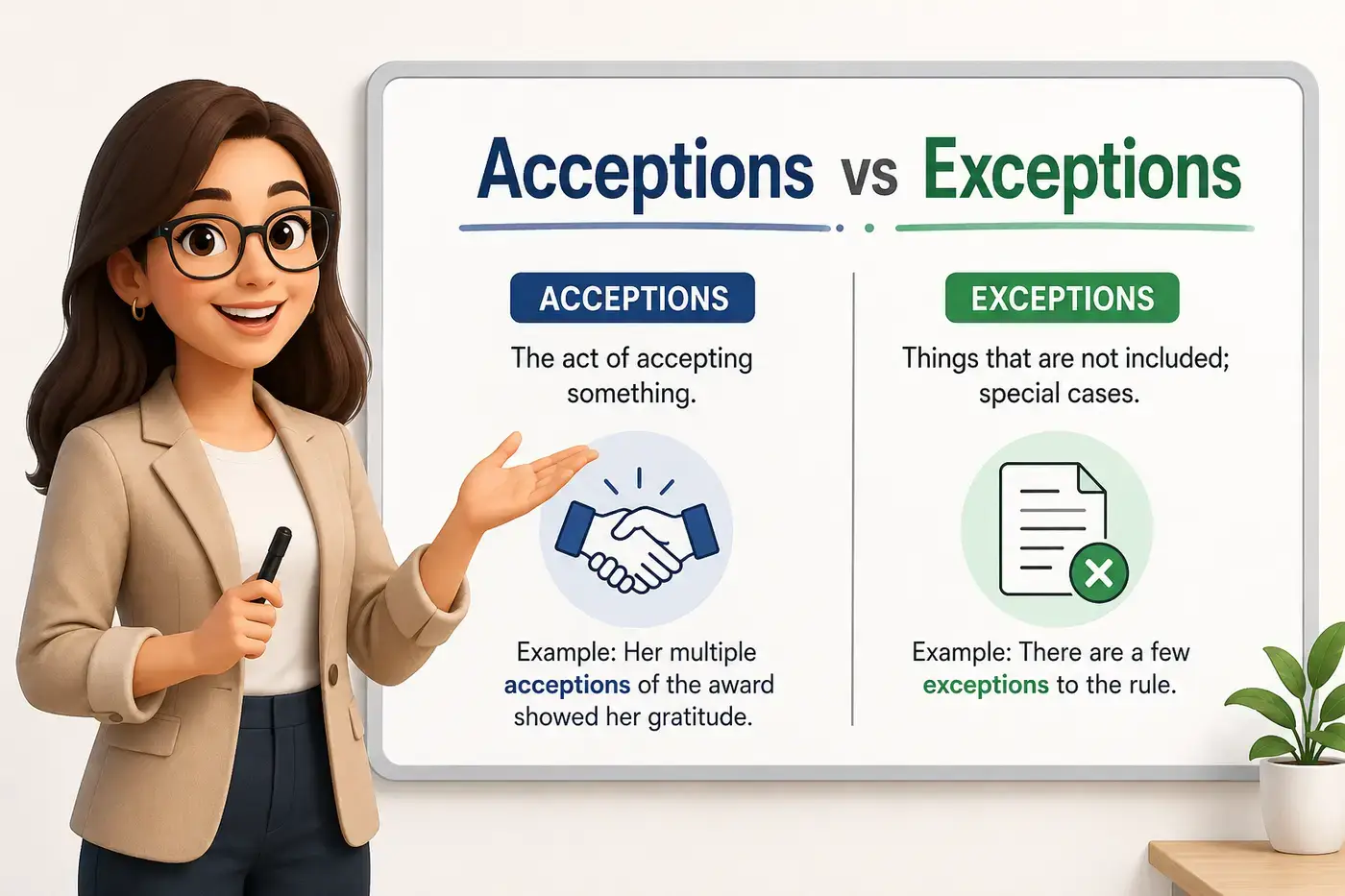
The words acceptions vs exceptions look almost identical, so it’s easy to assume one is simply a misspelling of the other. In fact, both are legitimate English words with completely different meanings. One belongs mainly to the world of dictionaries and linguistics, while the other appears in everyday conversations, school assignments, business writing, legal documents, and countless other situations.
If you searched for acceptions vs exceptions, you’re probably trying to find out if acceptions is a real word, how it differs from exceptions, and when each one should be used. The answer is straightforward. Acceptions refers to the different meanings or senses of a word. Exceptions refers to people, things, or situations that are excluded from a rule or do not follow the usual pattern.
Although exceptions is a common part of everyday English, acceptions is a specialized term that most people encounter only in dictionaries, linguistic research, or academic writing. That difference explains why many native English speakers recognize one word immediately but hesitate when they see the other.
This guide explains both words in clear, everyday English. You’ll learn what they mean, how to pronounce them, where they are used, why people confuse them, and how to remember the difference with confidence.
Quick Answer
Acceptions is the plural of acception, which means the different meanings or senses of a word in linguistics and dictionary writing. Exceptions is the plural of exception, which refers to people, things, or situations that do not follow a rule or are excluded. Both words are correct, but they belong to completely different contexts.
Acceptions Vs Exceptions Comparison
| Feature | Acceptions | Exceptions |
|---|---|---|
| Part of speech | Plural noun | Plural noun |
| Singular form | Acception | Exception |
| Meaning | Different meanings or senses of a word | Things or people excluded from a rule |
| Common field | Linguistics and dictionaries | Everyday English business education and law |
| Frequency | Rare | Very common |
| Example | The dictionary lists several acceptions of the term. | There are several exceptions to the rule. |
What Does Acceptions Mean
Acceptions is the plural form of acception. It refers to the different meanings, senses, or interpretations that a single word or expression can have.
Unlike many everyday vocabulary words, acceptions is used mainly by linguists, dictionary editors, translators, language researchers, and scholars. Most English speakers rarely encounter it outside books or articles about language.
Simple Definition
Acceptions means the different meanings or recognized senses of a word.
For example, the word bank has more than one acception. One meaning refers to a financial institution, while another refers to the land beside a river. Each meaning represents a separate acception.
Common Uses Of Acceptions
You’ll most often see acceptions in discussions about language and word meanings.
Examples include:
- The dictionary lists several acceptions of the word.
- Linguists examined the historical acceptions of the term.
- Some older acceptions are no longer used in modern English.
- Each acception reflects a different meaning that developed over time.
Where Is Acceptions Used
Although uncommon in daily conversation, acceptions appears naturally in fields such as:
- Linguistics.
- Lexicography.
- Dictionary editing.
- Semantic analysis.
- Translation studies.
- Historical language research.
- Academic publications.
If you’re reading about vocabulary, word history, or dictionary definitions, you’ll occasionally come across this term.
Expert Editorial Insight
Many readers assume acceptions is a typo because they have never seen it before. It is actually a legitimate English word with a long history. Professional editors recognize it as correct, but they also know it belongs to specialized writing. For general audiences, words like meanings, definitions, or senses are often better choices because they communicate the same idea more clearly.
What Does Exceptions Mean
Exceptions is the plural form of exception. It refers to people, things, or situations that do not follow a general rule or are excluded from it.
Unlike acceptions, this word is part of everyday English. People use it in conversations, classrooms, workplaces, legal documents, news reports, and almost every type of writing.
Simple Definition
Exceptions means things or people that are left out of a rule or differ from what is normally expected.
Common Uses Of Exceptions
You use exceptions whenever a general rule has one or more cases that do not fit.
Examples include:
- There are a few exceptions to the rule.
- Every student passed the exam with two exceptions.
- The policy includes several important exceptions.
- Most stores close on holidays, but there are a few exceptions.
Where Is Exceptions Used
Because rules exist almost everywhere, exceptions appears across many fields, including:
- Education.
- Business.
- Law.
- Government.
- Healthcare.
- Science.
- Everyday communication.
It is one of the most commonly used nouns in English because very few rules apply without exceptions.
Expert Editorial Insight
Editors often encourage writers to explain the exception instead of simply mentioning that one exists. For example, saying there are a few exceptions is less helpful than identifying those exceptions. Specific details make writing more useful and more credible.
Which Word Is Correct
Both acceptions and exceptions are correct English words. The right choice depends on what you’re discussing.
Use acceptions when talking about the meanings or senses of words.
Examples:
- The glossary explains the different acceptions of the term.
- The dictionary records several acceptions of this expression.
- Scholars compared the acceptions found in older manuscripts.
Use exceptions when talking about rules, exclusions, or situations that do not follow the norm.
Examples:
- The policy has several exceptions.
- Every applicant qualified except for a few exceptions.
- The law includes important exceptions.
The confusion happens because the words differ by only one letter, yet their meanings have nothing in common. Exceptions appears so often that many readers assume acceptions must be a spelling mistake. It isn’t. It simply belongs to a much narrower area of English.
Key Differences Between Acceptions And Exceptions
Although these words look alike, they describe two completely different ideas. One belongs to language and meaning, while the other belongs to rules and exclusions.
| Acceptions | Exceptions |
|---|---|
| Refers to different meanings of a word | Refers to things or people excluded from a rule |
| Used mainly in linguistics and dictionaries | Used in everyday English |
| Focuses on vocabulary and meaning | Focuses on rules and special cases |
| Rare in general writing | Common in all forms of writing |
A simple comparison makes the difference easier to remember.
- Think of a dictionary when you see acceptions because dictionaries explain the different meanings of words.
- Think of a rulebook when you see exceptions because rules often have situations that do not apply.
- Acceptions belongs to the study of language and vocabulary.
- Exceptions belongs to the idea of exclusions and special cases.
Once you connect each word with its natural context, choosing the correct one becomes much easier.
Grammar Rules
Both acceptions and exceptions are plural nouns. They may look similar, but they cannot replace each other because they describe different concepts.
Acceptions Is A Plural Noun
The singular form is acception. It refers to one meaning or recognized sense of a word. The plural acceptions refers to two or more meanings.
Examples:
- This dictionary includes an older acception of the word.
- The article discusses several acceptions that appeared in medieval English.
- Different dictionaries sometimes include different acceptions.
Exceptions Is A Plural Noun
The singular form is exception. It refers to one case that does not follow a rule. The plural exceptions refers to multiple cases.
Examples:
- There is one exception to the policy.
- The contract includes several exceptions.
- Most rules have a few exceptions.
Using Articles And Quantifiers
Because both words are countable nouns, they work naturally with articles and quantity words.
Examples with acception:
- An acception.
- One acception.
- Several acceptions.
- Many acceptions.
Examples with exception:
- An exception.
- One exception.
- Several exceptions.
- Many exceptions.
Quick Grammar Test
Before choosing one of these words, ask yourself this question.
- Are you discussing the meaning of a word or phrase? If so, use acceptions.
- Are you discussing a person, thing, or situation that does not follow a rule? If so, use exceptions.
This simple habit helps you choose the correct word in almost every situation.
Pronunciation
The two words sound very similar because they share nearly the same spelling. The main difference is the opening vowel sound.
| Word | IPA | Simple Pronunciation |
|---|---|---|
| Acceptions | /əkˈsɛpʃənz/ | ak SEP shunz |
| Exceptions | /ɪkˈsɛpʃənz/ | ik SEP shunz |
Many native speakers pronounce these opening sounds very closely during natural conversation. That is one reason the words are sometimes confused. Fortunately, the surrounding sentence almost always makes the intended meaning clear.
Spelling Rules
The spelling difference between these words is only one letter, but that small change creates two completely different meanings.
Remember The First Letters
A simple memory trick can help.
- Acceptions relates to the meanings of words. Think of academic language, analysis, or articles. These are all places where you’re most likely to see the word.
- Exceptions relates to something being left out. Think of exclude, excluded, or exemption. Each of these words shares the same idea of something that does not follow the usual rule.
Proofreading Tip
Because exceptions is much more common, writers sometimes use it by mistake when discussing dictionary meanings.
Incorrect example:
- The dictionary lists several exceptions of the word.
Correct example:
- The dictionary lists several acceptions of the word.
When proofreading, focus on the meaning instead of the spelling. If you’re talking about the meanings of a word, acceptions is the correct choice. If you’re talking about exclusions from a rule, use exceptions instead.
Usage Guide
The easiest way to choose between acceptions and exceptions is to think about the subject of your sentence.
If you’re discussing the meanings of a word, use acceptions. If you’re talking about rules, exclusions, or situations that do not follow a general pattern, use exceptions.
Although the two words look alike, they almost never appear in the same type of writing. Acceptions belongs to language studies and dictionary work, while exceptions belongs to everyday English.
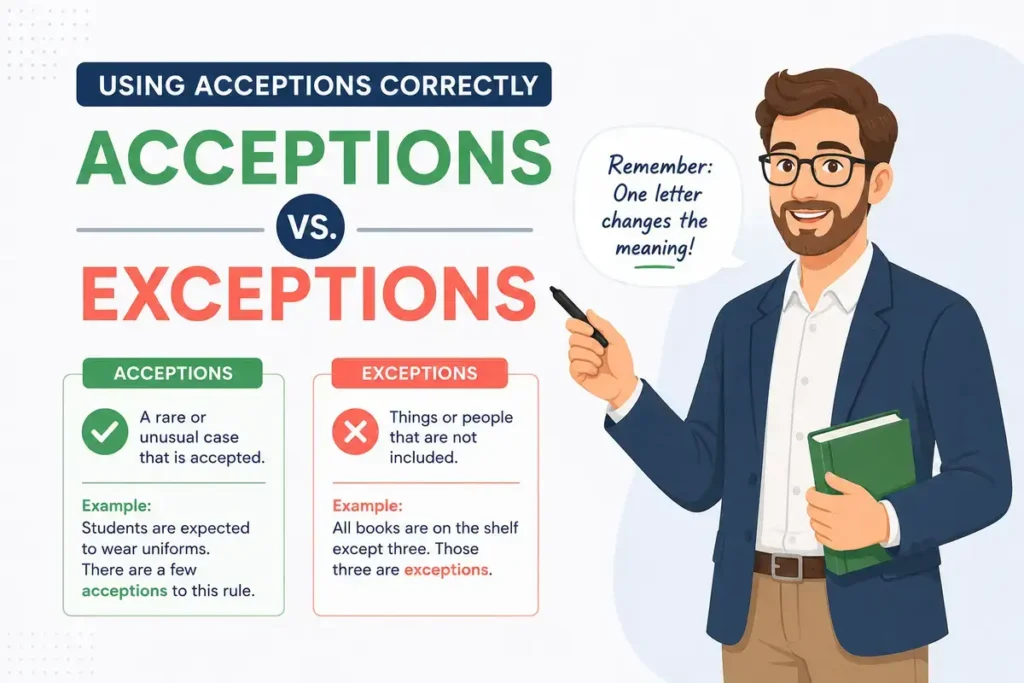
Using Acceptions Correctly
Use acceptions when discussing vocabulary, semantics, or dictionary definitions.
Examples:
- The dictionary explains several acceptions of the word.
- Researchers compared the acceptions found in different editions.
- Some acceptions disappeared as the language evolved.
- Modern readers rarely recognize the oldest acceptions of the term.
Using Exceptions Correctly
Use exceptions when talking about rules, policies, patterns, or anything that includes special cases.
Examples:
- Every rule has a few exceptions.
- The contract contains several exceptions.
- There are very few exceptions to this policy.
- Most students completed the assignment with only two exceptions.
A Simple Way To Decide
Ask yourself one question before writing.
Are you talking about a word or a rule?
If you’re talking about a word and its meanings, choose acceptions.
If you’re talking about a rule and the things that do not follow it, choose exceptions.
That quick check solves almost every situation.
Examples In Different Contexts
Seeing these words in real sentences makes the difference much easier to remember.
Dictionary And Linguistics
These examples show how acceptions appears in language related discussions.
- The dictionary includes several acceptions of the word light.
- Linguists identified older acceptions that disappeared centuries ago.
- Every acception reflects a different historical period.
- Some acceptions remain common while others are considered obsolete.
Academic Writing
Researchers often use acceptions when analyzing vocabulary or historical texts.
- The paper compares the acceptions recorded in medieval dictionaries.
- Scholars debated the original acceptions of the expression.
- Different languages preserve different acceptions of the same root word.
- Understanding older acceptions helps explain historical documents.
Everyday Conversation
Most people use exceptions, not acceptions, during daily conversations.
- There are a few exceptions to that rule.
- Everyone arrived on time with two exceptions.
- The store accepts returns with certain exceptions.
- I usually agree with him, but there are exceptions.
School
- Every student completed the project except for a few exceptions approved by the teacher.
- The classroom rules include several exceptions for medical needs.
- The handbook clearly explains the exceptions.
- Teachers rarely discuss acceptions unless the lesson focuses on language or dictionaries.
Workplace
- The company policy has several exceptions.
- Most employees work remotely with a few exceptions.
- Managers must explain any exceptions before approving the request.
- Editors reviewed the acceptions of technical terms before publishing the manual.
Law And Government
Legal writing often refers to exceptions because laws usually include special cases.
- The regulation contains several important exceptions.
- The judge reviewed each exception carefully.
- Tax laws include numerous exceptions.
- Government agencies sometimes publish guidance explaining those exceptions.
Translation And Lexicography
These fields frequently use acceptions because professionals analyze word meanings.
- The translator compared every acception before choosing the best equivalent.
- The lexicographer documented new acceptions found in modern usage.
- Dictionaries regularly update acceptions as language changes.
- Some regional acceptions eventually become part of standard English.
Common Mistakes
Most mistakes happen because the two words differ by only one letter. Their meanings, however, are completely unrelated.
Mistake One
❌ The dictionary lists several exceptions of the word.
✅ The dictionary lists several acceptions of the word.
Why it is incorrect.
Dictionaries list meanings, not exclusions.
Mistake Two
❌ There are several acceptions to this rule.
✅ There are several exceptions to this rule.
Why it is incorrect.
Rules have exceptions, not meanings.
Mistake Three
❌ Linguists studied the historical exceptions of the term.
✅ Linguists studied the historical acceptions of the term.
Why it is incorrect.
The discussion is about meanings that developed over time.
Mistake Four
❌ The policy contains many acceptions.
✅ The policy contains many exceptions.
Why it is incorrect.
Policies include exclusions or special cases.
Mistake Five
❌ Every word has several exceptions.
✅ Some words have several acceptions.
Why it is incorrect.
Words can have multiple meanings, but they do not normally have exceptions.
Why People Get Confused
At first glance, the confusion seems understandable. The words look almost identical and sound very similar. The real reason goes a little deeper.
They Differ By Only One Letter
Many readers notice the beginning and end of a word but pay less attention to the middle. Because of that, acceptions and exceptions can appear almost identical during fast reading.
One Word Is Much More Common
Most English speakers see exceptions regularly.
By contrast, acceptions appears mainly in dictionaries, academic books, and linguistic research. Many people have never encountered it before.
Spell Check Does Not Always Help
Modern writing tools usually recognize both words because both are valid English. That means a sentence like this may pass spell check.
- The dictionary lists several exceptions of the word.
The spelling is correct. The meaning is not.
People Guess Instead Of Reading The Context
Readers often recognize the overall shape of a word instead of examining every letter.
Professional editors avoid this mistake by checking the meaning of the entire sentence instead of relying on appearance alone.
Memory Tricks
Simple memory techniques can make these words much easier to remember.
Picture A Dictionary
Whenever you see acceptions, imagine opening a dictionary. Dictionaries explain meanings. That is exactly what acceptions refers to.
Picture A Rulebook
Whenever you see exceptions, imagine a rule with a few special cases written underneath it. Those special cases are the exceptions.
Connect The First Letters
A quick letter association can also help.
- Acceptions begins with Ac. Think about academic language or analysis, where discussions about word meanings are common.
- Exceptions begins with Ex. Think about exclude because exceptions are things left out of a general rule.
Use The Subject Test
Instead of memorizing definitions, focus on the topic. If the sentence discusses language, vocabulary, or definitions, acceptions is probably the right choice. If the sentence discusses rules, policies, or exclusions, exceptions is almost certainly correct.
Regional Usage
There is no significant difference in how these words are used across major English speaking countries. The meanings remain the same in American, British, Canadian, and Australian English. The main difference is frequency.
American English
American English uses exceptions every day. Acceptions appears mostly in dictionaries, university research, and professional language studies.
British English
British English follows the same pattern. You’ll regularly see exceptions, while acceptions is limited to linguistic and scholarly writing.
Canadian English
Canadian English also treats acceptions as a specialized term. Exceptions remains the standard word in everyday communication.
Australian English
Australian English follows the same usage.
Most speakers rarely encounter acceptions outside academic contexts, while exceptions appears in everyday speech and writing.
Across all major English varieties, the definitions and spelling remain consistent.
Etymology
Understanding where these words came from makes their meanings easier to remember.
Origin Of Acception
Acception comes from the Latin word acceptio, which originally referred to receiving or understanding something in a particular sense.
As English developed, the meaning became more specialized. Today, acception refers to the recognized meaning or sense of a word, especially in dictionaries and linguistic studies.
Origin Of Exception
Exception comes from the Latin word exceptio, meaning something taken out or excluded. That idea has remained remarkably consistent throughout history. Modern English still uses exception to describe something that does not fit a general rule.
Although the two words share similar historical roots, centuries of language development gave them very different meanings.
Expert Language Insights
Professional editors pay close attention to context because context almost always reveals the correct word. When proofreading, they rarely focus on spelling alone. Instead, they ask what the sentence is actually discussing.
If the subject is vocabulary, definitions, semantics, or dictionaries, acceptions is usually the correct choice. If the subject is policies, rules, contracts, patterns, or special cases, exceptions is almost always the correct choice.
Editors also recognize that acceptions is a technical word. Even when it is perfectly correct, they sometimes replace it with meanings or definitions if the article is written for a general audience. Doing so improves readability without changing the message.
Related Words Synonyms Antonyms Collocations Idioms And Confusing Terms
Understanding related vocabulary helps you recognize both words more naturally.
Related Words For Acceptions
Depending on the context, these words express similar ideas.
- Meanings.
- Senses.
- Definitions.
- Interpretations.
- Usages.
- Semantic meanings.
These words are often easier for general readers to understand.
Related Words For Exceptions
Common alternatives include:
- Exclusions.
- Special cases.
- Exemptions.
- Omissions.
- Deviations.
- Irregularities.
Choose the alternative that best fits your sentence.
Antonyms Of Exception
Depending on the context, possible opposites include:
- Rule.
- Standard.
- Norm.
- General case.
- Regular occurrence.
Because acception refers to meanings rather than opposites, it does not have a direct everyday antonym.
Common Collocations With Acceptions
Although relatively uncommon, these combinations appear in academic writing.
- Different acceptions.
- Multiple acceptions.
- Historical acceptions.
- Dictionary acceptions.
- Various acceptions.
- Original acceptions.
Common Collocations With Exceptions
These combinations are extremely common.
- With a few exceptions.
- No exceptions.
- Several exceptions.
- Rare exceptions.
- Important exceptions.
- An exception to the rule.
- Notable exceptions.
Related Confusing Word Pairs
If you’re interested in language, you may also find these commonly confused words useful.
- Accept and except.
- Affect and effect.
- Advice and advise.
- Principal and principle.
- Complement and compliment.
- Then and than.
- Farther and further.
- Stationary and stationery.
- Lay and lie.
- Who’s and whose.
Practical Writing Tips
Professional writers avoid confusion by focusing on meaning before spelling.
These habits can help you do the same.
- Think about the subject of the sentence before choosing the word.
- Use acceptions only when discussing the meanings of words.
- Use exceptions when discussing rules or exclusions.
- Don’t assume acceptions is a typo. It is a legitimate English word used in specialized contexts.
- Read the entire sentence during proofreading instead of checking individual words.
- Avoid replacing meanings with acceptions unless your audience is familiar with linguistic terminology.
- When writing for general readers, choose the clearest word that communicates your idea accurately.
- If a spell checker approves both words, verify the meaning yourself before publishing.
Frequently Asked Questions
Is Acceptions A Real Word
Yes. Acceptions is a real English word. It is the plural form of acception, which means the different meanings or senses of a word. Although it is correct, it is used mainly in linguistics, lexicography, dictionary editing, and academic writing. Most people rarely encounter it in everyday English.
Which Is More Common Acceptions Or Exceptions
Exceptions is far more common.
You’ll see exceptions in conversations, business writing, school assignments, legal documents, news articles, and everyday communication. Acceptions appears mostly in dictionaries, language research, and scholarly publications.
What Is The Difference Between Acceptions And Exceptions
The difference is simple. Acceptions refers to the meanings or senses of a word. Exceptions refers to people, things, or situations that do not follow a rule or are excluded from it. Although the words look similar, they describe completely different concepts.
Can I Use Acceptions Instead Of Meanings
Yes, but only in the right context.
Acceptions is technically correct when discussing the meanings of words. However, it sounds formal and specialized. For most readers, meanings or definitions are clearer and more natural.
Is Acceptions Used In Everyday English
Not very often.
Most native English speakers never use acceptions in daily conversation. It is primarily found in dictionaries, linguistic research, translation studies, and academic writing.
Can Exceptions Refer To People
Yes.
An exception can be a person, object, event, or situation that does not follow a general rule.
Examples include:
- Every employee attended the meeting except for two exceptions approved by management.
- Most students completed the assignment with a few exceptions.
Why Do People Confuse Acceptions And Exceptions
The confusion happens because the words differ by only one letter and sound very similar when spoken. Another reason is that exceptions is extremely common, while acceptions is relatively rare. As a result, many readers assume acceptions is simply a spelling mistake even though it is a legitimate English word.
Does Spell Check Catch This Mistake
Not always.
Since both words are spelled correctly, many spell check tools accept them without recognizing that the wrong one was chosen. Reading the sentence carefully and thinking about its meaning is still the most reliable way to catch the mistake.
How Can I Remember The Difference
The easiest way is to connect each word with the situation where it naturally belongs.
- Think of a dictionary when you see acceptions because dictionaries explain the meanings of words.
- Think of a rulebook when you see exceptions because rules often have special cases or exclusions.
That simple association makes the distinction much easier to remember.
Conclusion
Although acceptions vs exceptions differ by just one letter, they belong to completely different parts of the English language. Acceptions is a specialized term that refers to the meanings or senses of a word, making it useful in linguistics, dictionary writing, and semantic analysis. Exceptions, on the other hand, refers to people, things, or situations that do not follow a rule. It is one of the most common nouns in everyday English and appears in everything from casual conversations to legal documents.
The easiest way to choose the correct word is to focus on the subject of your sentence. If you’re discussing vocabulary, definitions, or word meanings, acceptions is the right choice. If you’re talking about rules, policies, or special cases, use exceptions instead. Once you connect each word with its natural context, the difference becomes easy to remember, and you’ll be able to use both terms accurately and confidently.

Founding Editor
Maya spent six years as a copyeditor at a regional newspaper before starting Grammist, which is where the “answer first” format came from: newsroom style guides don’t have room for a preamble.
She writes and reviews most of the word-pair and spelling entries, and has final say on anything that goes out under the Grammist name.